Back to Blog

Literacy

Reading, writing, vocabulary, and oracy across all subjects. Evidence-based approaches for teachers at every key stage. Updated for 2026.

Literacy is not the responsibility of English teachers alone. When a Year 8 learner cannot extract the key argument from a science textbook paragraph, that is a literacy problem, and it is a science teacher's problem. Beck, McKeown, and Kucan (2013) demonstrated that vocabulary knowledge is one of the most reliable predictors of reading comprehension, and reading comprehension is a prerequisite for learning in every subject. The vocabulary gap between the most and least advantaged learners at age 7 already stands at approximately 4,000 words, and it widens through school without deliberate intervention.

This hub covers the full range of literacy demands in schools: early reading and phonics, reading comprehension strategies, vocabulary instruction, academic writing, oracy and spoken language, and whole-school approaches. Each article is grounded in the research and provides practical techniques for classroom implementation across key stages and subjects.

Start with Reading Comprehension Strategies for the foundations, then follow the pathway below.

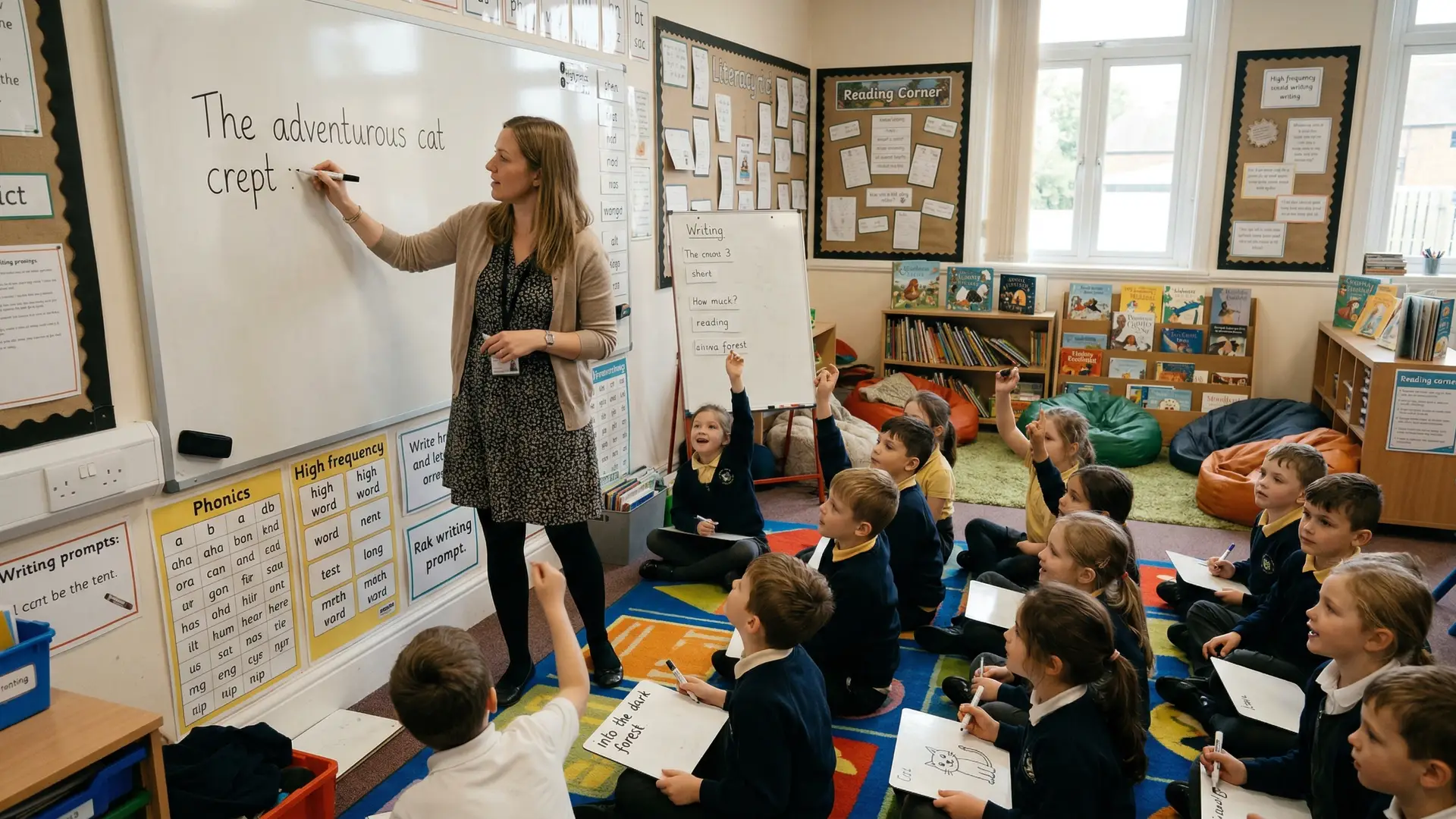
Teacher leading a shared writing session in a literacy-rich UK primary classroom

Four Approaches to Literacy Instruction: Key Distinctions

Approach What It Involves Best Used For Evidence Strength
Systematic Phonics Explicit, sequenced teaching of grapheme-phoneme correspondences and blending skills. Early reading (Reception to Year 2). Intervention for older struggling readers. Very strong. The strongest evidence for any early reading approach. Recommended by EEF and Rose Review (2006).
Reading Comprehension Strategies Explicit teaching of strategies: predicting, clarifying, summarising, questioning, and visualising. Once decoding is secure. Key Stages 2, 3, and 4 across all subjects. Strong. EEF rates reading comprehension strategies at +6 months with high security.
Explicit Vocabulary Teaching Direct instruction of Tier 2 and Tier 3 words: definition, context, morphology, and multiple encounters. Across all subjects and key stages. Particularly important for disadvantaged learners. Strong. Beck et al. (2013) and EEF Improving Literacy in Secondary Schools guidance both recommend this.
Writing Instruction Explicit modelling of writing processes: planning, drafting, revising. Genre knowledge and sentence-level work. All key stages. Extended writing tasks in any subject that requires analytical or argumentative prose. Strong when combining strategy instruction with content knowledge. Shared and modelled writing particularly effective.

Your Learning Pathway

Step 1: Start here
Reading Comprehension Strategies

The complete guide to explicit comprehension instruction. Predicting, clarifying, summarising, questioning, and visualising.

Step 2: Go deeper
Vocabulary Instruction → Reciprocal Reading →

Two of the highest-impact approaches: building word knowledge systematically and using peer dialogue to deepen text comprehension.

Step 3: Apply it
Writing Frames → Oracy in the Classroom →

Structured supports for written and spoken language development that work across subjects and key stages.

+6
months progress
Reading comprehension strategies
EEF, 2021
4,000
word gap at age 7
Between most and least advantaged learners
Biemiller, 2006
High
evidence rating
Phonics for early reading
Rose Review, 2006
3
word tiers
Framework for vocabulary selection
Beck et al., 2013

Browse by Topic

Reading Comprehension
Vocabulary and Word Study
  • Vocabulary Instruction
  • Tier 2 Vocabulary Teaching
  • Morphology and Word Roots
  • Academic Language Development
  • Building Word Consciousness
Writing Instruction

Common Questions About Literacy Teaching

What is the Simple View of Reading? +

The Simple View of Reading (Gough and Tunmer, 1986) states that reading comprehension equals word recognition multiplied by language comprehension. Both components must be strong for a learner to read well. A child with strong phonics but poor vocabulary will decode words accurately but not understand what they have read. A child with rich language knowledge but weak phonics will struggle to decode in the first place. This model explains why interventions must target the right component: phonics teaching addresses word recognition, while vocabulary instruction and reading aloud to children addresses language comprehension. The Rose Review (2006) adopted this model as the basis for the English phonics curriculum.

What are Tier 1, Tier 2, and Tier 3 vocabulary words? +

Beck, McKeown, and Kucan (2013) proposed three tiers. Tier 1 words are basic, high-frequency words that most children learn through speech: "house", "run", "happy". These rarely need explicit teaching. Tier 2 words are high-value academic words that appear frequently across texts and subjects but are less common in speech: "analyse", "consequence", "significant", "demonstrate". These are the most important words to teach explicitly because they unlock comprehension across all subjects. Tier 3 words are subject-specific technical terms: "photosynthesis", "quadratic", "sonnet". These are taught in context within subjects. Most vocabulary instruction time should focus on Tier 2 words.

What is reciprocal reading and how do I use it? +

Reciprocal reading (Palincsar and Brown, 1984) is a structured approach to text comprehension in which learners take turns leading discussion of a text using four roles: predictor (what will happen next and why?), clarifier (which words or phrases are unclear?), questioner (what questions does the text raise?), and summariser (what are the key points so far?). The teacher models each role explicitly before handing it over to learners. Research shows strong effects, particularly for struggling readers and learners with lower vocabulary. It works because the four strategies mirror what skilled readers do automatically, and the structured dialogue gives all learners a role in the comprehension process, not just the most confident.

Is literacy only for English teachers? +

No. Literacy is a cross-curricular responsibility. Every subject uses text, and every subject requires learners to read, write, and talk in disciplinary ways. A history learner who cannot read a primary source for inference, a science learner who cannot write a structured method, and a geography learner who cannot distinguish argument from evidence are all showing literacy gaps that subject teachers are best placed to address. Whole-school literacy does not mean every teacher becomes an English teacher: it means every teacher explicitly teaches the reading, writing, and vocabulary demands of their own subject. The EEF's "Improving Literacy in Secondary Schools" guidance sets out how to do this without adding to teacher workload.

What is the most effective way to teach writing? +

The evidence points to a combination of approaches. The process writing approach (planning, drafting, revising, editing) teaches writing as a craft with distinct stages rather than a single act. Strategy instruction teaches specific planning and drafting strategies explicitly: SEEC (Statement, Evidence, Explanation, Comment), for example, gives secondary learners a concrete structure for analytical paragraphs. Modelled and shared writing, where the teacher writes aloud while narrating decisions, makes the implicit explicit. Sentence combining tasks, where learners merge simple sentences into more complex ones, improve syntactic fluency. WAGOLL (What a Good One Looks Like) helps learners understand quality criteria before they write, not after. The EEF's "Improving Literacy in Key Stages 2 and 3" guidance synthesises these into practical recommendations.

What is oracy and why should schools prioritise it? +

Oracy refers to the ability to articulate ideas, develop understanding, and engage with others through spoken language. It is not the same as talking: it is purposeful, structured communication. Mercer's (2000) research on exploratory talk showed that when learners are taught to reason together explicitly, using accountable talk moves such as "I agree because...", "I want to challenge that...", and "building on what you said...", both their thinking and their academic outcomes improve. Hattie (2009) rates oral feedback at 0.75 effect size. Schools that invest in oracy development, through structured debate, Socratic discussion, and deliberate talk routines, report improvements not just in communication but in reading comprehension, writing quality, and learner confidence.

How should I support learners with dyslexia in my classroom? +

Dyslexia is characterised by difficulties with accurate and fluent word recognition, poor spelling and decoding, which typically reflect a deficit in phonological awareness. It is not a vision problem or a sign of low intelligence. In any subject classroom, three adjustments have strong evidence: first, do not rely on written text alone to convey information, pair text with audio, diagrams, or verbal explanation. Second, reduce the writing demand for demonstrating knowledge where the writing itself is not the learning objective: allow typed or verbal responses. Third, pre-teach key vocabulary before a reading task: knowing what words mean before encountering them in text reduces the decoding burden significantly. Specialist literacy interventions (structured phonics programmes such as Reading Recovery or Sounds-Write) should run alongside, not instead of, good subject teaching.

Want to go deeper?

The Structural Learning platform has CPD courses, interactive lesson planning tools, and a growing library of resources built on the research above. Open a free account to browse.

Literacy Across the Curriculum
Reading, vocabulary, and writing instruction for subject teachers at Key Stages 2, 3, and 4.
Coming 2026
Early Reading and Phonics
The Simple View of Reading, systematic phonics, and intervention for struggling readers. Evidence-based practice for EYFS and KS1.
Coming 2026
AI Lesson Planning
Generate evidence-based lessons using AI tools grounded in cognitive science. Try it now.
Free to try
Open a free account

No credit card required.

About this hub. Articles are written by practising educators and reviewed against peer-reviewed research. Citations follow author-date format. New content added regularly. Get in touch if you cannot find what you need.

Where should I start?

I am new to this topic which article should I read first?

Start with the most-comprehensive guide in the list below. Look for titles that say A Teachers Guide those are flagship deep-dives. They link out to all the related concepts.

What is the evidence base?

Every article cites peer-reviewed research and translates findings into classroom practice. Where research is contested, we say so. Where the evidence is strong, we explain why and what to do.

How can I use this in tomorrows lesson?

Each guide ends with practical next-lesson actions. You can also use our AI lesson planning tools which generate full lesson plans grounded in these methods.
Explore more categories