The Neurodivergent IB Learner: Surviving the DP Core (EE, TOK, CAS)The Neurodivergent IB Learner: Surviving the DP Core (EE, TOK, CAS): practical strategies and classroom examples for teachers

Updated on  

March 24, 2026

The Neurodivergent IB Learner: Surviving the DP Core (EE, TOK, CAS)

|

March 24, 2026

SENCOs, DP coordinators, and learning support teams guide to scaffolding the IB Diploma Core (Extended Essay, Theory of Knowledge, CAS) for neurodivergent pupils with ADHD, autism, and PDA without reducing intellectual demand.

The IB Diploma Programme was built for a particular kind of learner: self-directed, comfortable with ambiguity, motivated by abstract reasoning, and capable of managing a 40-hour research project alongside six subjects. For many pupils, this is a reasonable description. For a significant and growing proportion of learners in IB schools, it describes precisely the skill profile they find most difficult.

Neurodivergent pupils are in IB classrooms everywhere. Pupils with ADHD, autism, dyspraxia, dyscalculia, Pathological Demand Avoidance (PDA), and a range of co-occurring profiles are sitting the Diploma, and their numbers are rising as IB schools widen access and learning support teams improve identification. The DP Core, the three compulsory components that sit alongside the six subject groups, poses particular challenges. The Extended Essay (EE), Theory of Knowledge (TOK), and Creativity, Activity, Service (CAS) each demand capabilities that neurodivergent learners find hardest: executive function, abstract reasoning, and social initiative.

This guide is for learning support staff, SENCOs in IB schools, DP coordinators, and class teachers who supervise neurodivergent pupils through the Core. The strategies here do not lower the intellectual bar. The IB Diploma is rigorous, and it should be. What they do is remove the hidden barriers that prevent some pupils from showing what they actually know and can do.

Key Takeaways

  1. The DP Core targets the hardest skills: Executive function (EE), abstract metacognitive reasoning (TOK), and social initiative (CAS) are the skill areas where many neurodivergent learners need the most support. Without deliberate scaffolding, the Core becomes the point where the Diploma is lost.
  2. Executive function deficits make the EE structurally inaccessible: Diamond (2013) and Barkley (1997) demonstrate that task initiation, sustained attention, and working memory are measurably weaker in pupils with ADHD. The 40-hour, open-ended EE design amplifies every one of these difficulties.
  3. TOK can be made concrete: The Perspective and Compare operations from the Thinking Framework turn abstract epistemological questions into structured, tangible comparisons. Concrete thinkers can access the full depth of TOK through scaffolded examples.
  4. CAS flexibility is a legitimate adaptation: Solo CAS options, non-verbal reflection formats, and AI-assisted reflection writing are genuine accommodations the IB allows. PDA pupils need demand to be framed as choice, not obligation.
  5. Access arrangements exist but are systematically underused: Extra time for the TOK essay and EE, word processor access, and more frequent EE supervisor check-ins are all permitted. Schools consistently fail to apply for them early enough or to deploy them strategically.

The Problem No One Discusses

IB schools are proud of their inclusivity. The IB learner profile describes pupils who are open-minded, risk-taking, and reflective. Schools market themselves as welcoming diverse learners. But the structural design of the DP Core sits in tension with this aspiration in ways that are rarely examined honestly.

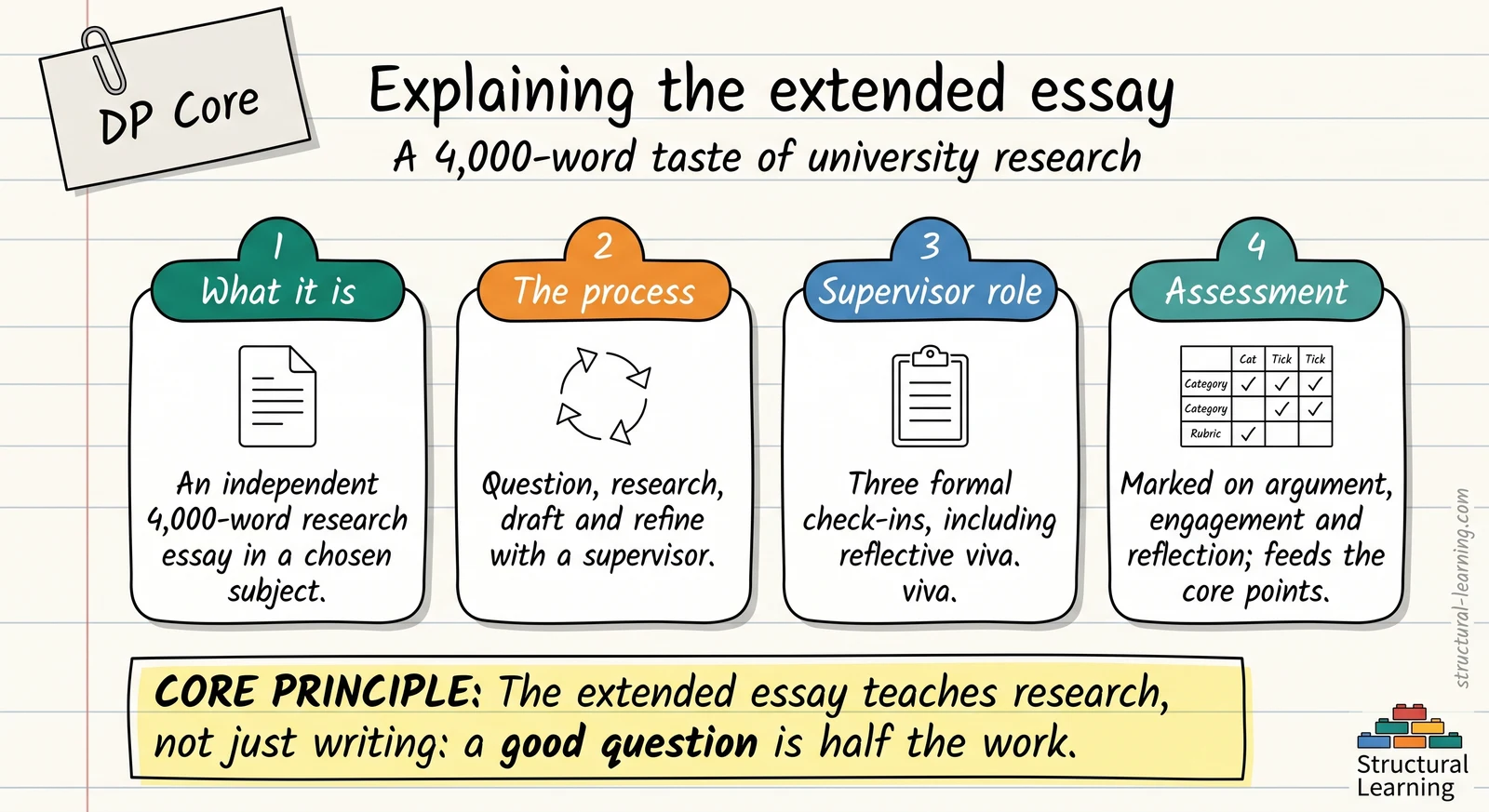
The Extended Essay asks a 16-year-old to identify a research question, plan and execute an independent 40-hour investigation, and produce a 4,000-word academic paper without continuous teacher direction. Theory of Knowledge asks pupils to reason about the nature of knowledge itself, to consider how personal perspectives, language, and cultural frameworks shape what we can claim to know. CAS asks them to initiate and sustain their own creative, physical, and service projects, document the process reflectively, and demonstrate personal growth.

Each of these demands is pedagogically sound. For high-ability, neurotypical pupils with strong self-regulation, they represent stretching but achievable challenges. For pupils whose executive function, abstract reasoning, or social cognition works differently, they represent a design that was never built with them in mind. The problem is not that the Diploma is too hard. It is that the Core creates hidden barriers that have nothing to do with intellectual capability and everything to do with neurological profile.

Gathercole and Alloway (2008) showed that working memory difficulties, common in ADHD and developmental language disorder, significantly impair the ability to hold a complex plan in mind while executing it. This is exactly what the EE requires. Milton (2012) introduced the double empathy problem to explain why autistic individuals experience difficulty in social interactions not from deficit but from a mismatch in communication styles. CAS group projects embed this mismatch into a compulsory assessment component. These are not marginal concerns. They are structural issues that learning support teams in IB schools need to name and address.

Executive Function and the Extended Essay

The EE is, in cognitive terms, one of the most demanding tasks a secondary pupil will encounter. It requires sustained independent planning over 18 months, repeated decision-making about research direction, the ability to tolerate uncertainty and ambiguity, and the capacity to produce a coherent long-form written argument. Diamond (2013) identifies three core executive function components: inhibitory control, working memory, and cognitive flexibility. All three are stressed by the EE, and all three are weaker in many neurodivergent learners.

For pupils with ADHD, the primary barriers are task initiation, time estimation, and sustained attention. Barkley (1997) demonstrated that ADHD involves a fundamental difficulty with self-regulation across time: the inability to connect present actions to future consequences in the way neurotypical planning requires. The EE's 18-month timeline, with infrequent formal check-ins, is precisely the kind of structure that ADHD makes hardest. Research does not happen in neat sessions. It sprawls. Deadlines feel abstract until they arrive. The pupil who could write a brilliant essay if placed in a structured environment produces nothing because the structure was assumed rather than provided.

For autistic pupils, a different cluster of difficulties emerges. Topic selection is often the first crisis. An autistic pupil may have a deep, specific interest in one area and find the expectation to select a "manageable" question paralyzing: the question they want to investigate is either too narrow (too specific for the available literature), too broad (impossible to contain in 4,000 words), or in a subject area the school does not offer as an EE option. Once a topic is chosen, the open-ended nature of the research process itself creates anxiety. How much is enough? When do I stop reading and start writing? The absence of a clear stopping rule is deeply uncomfortable for learners who prefer defined parameters.

Practical strategies for supervisors supporting neurodivergent pupils through the EE:

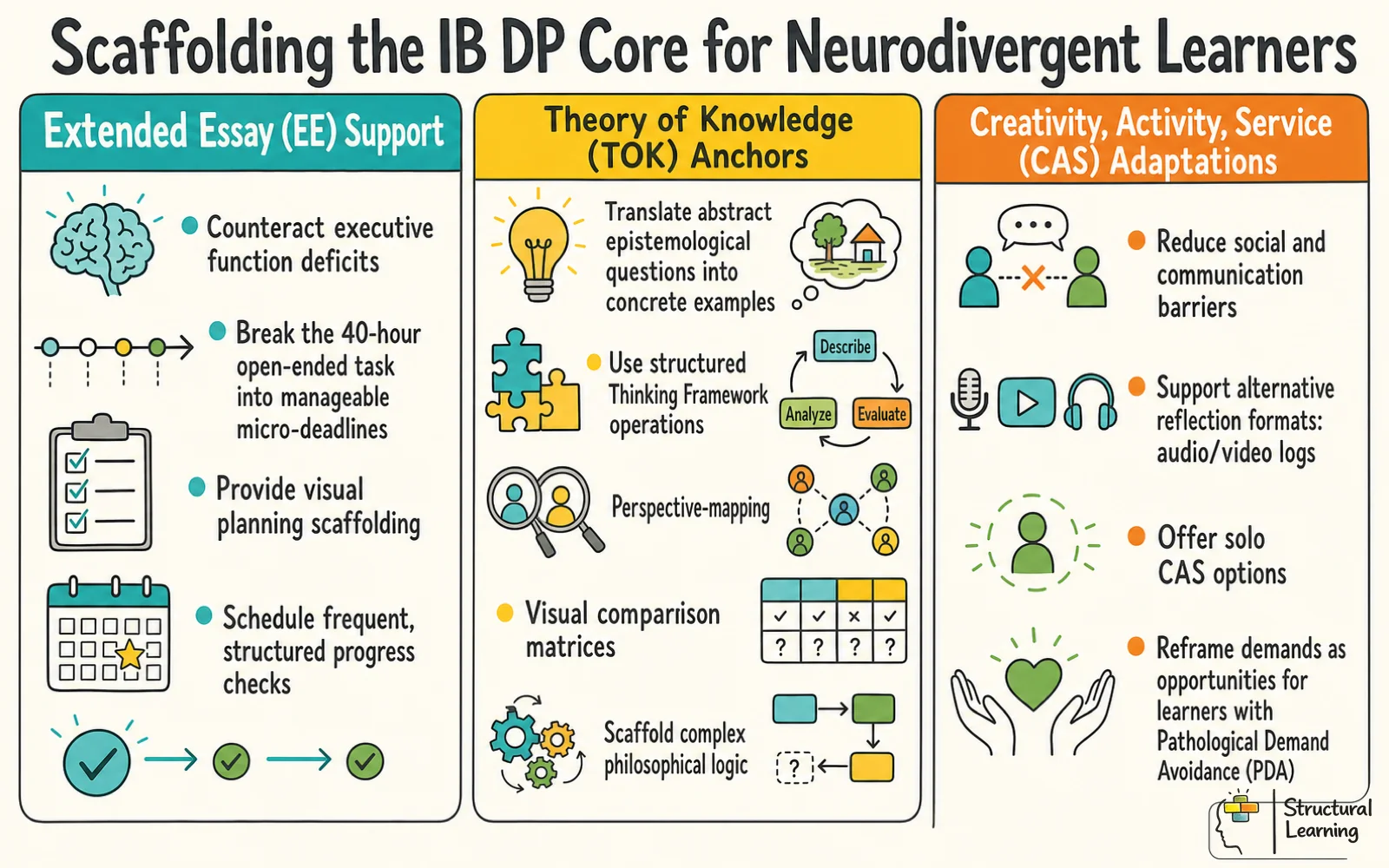
Break the 40 hours into 20 micro-deadlines. Each session should have a defined deliverable. Not "research for 2 hours" but "read three sources and write one paragraph summarising their key claim." This gives task initiation a clear entry point and transforms the vague obligation into a series of completable tasks. The metacognitive planning deficit that underlies avoidance is directly addressed when the forethought phase is done in collaboration with the supervisor.

Provide a visual EE timeline. A physical or digital Gantt chart showing the research, drafting, revision, and submission phases with colour-coded weeks gives the pupil an external working memory prosthetic. Time is abstract; a visual timeline makes it concrete. Using the Thinking Framework's Sequence operation, the supervisor and pupil map the EE process from research question to submission, identifying each step and its dependencies. This externalises the planning that the pupil's working memory cannot hold.

Use fortnightly short check-ins, not monthly formal sessions. IB regulations allow supervisors to hold regular meetings. More frequent, shorter meetings reduce the gap between support sessions and lower the risk of a pupil becoming stuck and silently disengaging. A 15-minute check-in every two weeks is more protective than a 45-minute session once a month.

Separate topic selection from research question formation. Allow the pupil to explore three or four possible areas before narrowing. For autistic pupils with special interests, frame the constraint as "what aspect of X could we investigate using the evidence available?" rather than "pick a topic." The constraint is the same; the framing acknowledges the pupil's interest rather than dismissing it.

TOK and Abstract Reasoning

Theory of Knowledge is, by design, abstract. The course asks pupils to examine the nature of knowledge across different areas of knowledge (the natural sciences, history, the arts, mathematics, ethics, and more) and through different ways of knowing (language, reason, emotion, imagination, faith, memory, intuition, and sense perception). For pupils who are comfortable with abstraction, this is intellectually stimulating. For concrete thinkers, including many autistic pupils and some pupils with ADHD who struggle with sustained abstract reasoning, TOK can feel like being asked to think about thinking in a language they do not yet speak.

The central TOK questions are genuinely difficult: How do we know what we know? What is the relationship between evidence and certainty? Can personal experience count as knowledge? These are questions that have occupied philosophers for millennia. Asking a 16-year-old with limited exposure to philosophical discourse to answer them in an essay is ambitious. Asking an autistic 16-year-old who processes information concretely and sequentially to answer them without scaffolding is often asking for failure.

The Thinking Framework's Perspective operation is particularly powerful here. Instead of "How does language shape knowledge?", the teacher reframes: "A doctor and a patient use the word 'pain' in the same conversation. What does each of them know that the other does not? How does language help and hinder their understanding?" The abstract question becomes a concrete comparison between two knowable perspectives. The intellectual demand is unchanged; the entry point is now accessible.

The Compare operation works similarly. TOK essays require students to examine different knowledge frameworks. Rather than asking "How do the natural sciences and the arts approach truth?", the teacher builds a structured comparison table: what counts as evidence in each area, what a "good" claim looks like, what happens when claims conflict. This is the same intellectual work as the abstract question, approached through a structured cognitive operation that many neurodivergent learners can use reliably. Metacognitive awareness of one's own thinking process is itself a TOK-relevant skill, and teaching it explicitly gives neurodivergent pupils both an academic strategy and a genuine object of TOK inquiry.

For the TOK Exhibition, which replaced the TOK presentation in the 2022 curriculum, pupils select three objects to represent a TOK prompt. This is a more concrete task than a traditional essay or presentation and suits some neurodivergent learners better. Supervisors should be alert to this and ensure pupils are not automatically steered towards the essay format without considering whether the Exhibition format might be a better match for their thinking style.

Practical approaches for TOK teachers:

Anchor every abstract claim in a concrete example before generalising. When introducing Ways of Knowing, use real scenarios: a doctor diagnosing from symptoms (reason + sense perception), a historian interpreting a diary entry (language + memory), a musician describing what they felt while composing (emotion + imagination). The abstraction follows the concrete; it does not precede it.

Use structured templates for essay planning. A TOK essay plan with named sections (knowledge claim, counterclaim, example from Area of Knowledge 1, example from Area of Knowledge 2, conclusion about implications) gives pupils who cannot generate essay structure independently a framework to work within. This is scaffolding, not simplification.

Teach TOK vocabulary as vocabulary, not as assumed knowledge. Terms like "justified true belief", "epistemic community", and "knowledge framework" are domain-specific jargon. Neurodivergent pupils, particularly those with language processing differences, may understand the underlying concept without being able to decode the terminology. Explicit vocabulary instruction is as relevant in TOK as it is in MFL.

CAS and Social Demands

CAS is the component that learning support teams discuss least, perhaps because it appears less academically demanding than the EE or TOK. This perception is misleading. CAS requires pupils to identify and plan their own projects, collaborate with others over sustained periods, reflect on their personal development, and produce a portfolio of evidence. For pupils with social anxiety, PDA, or autism, these demands are often the hardest in the entire Diploma.

Group CAS projects are a particular challenge. The IB expects pupils to demonstrate learning outcome 5 (collaborative skills) and learning outcome 7 (considering the ethical implications of actions). Both require sustained engagement with others in the context of shared goals. For autistic pupils, group projects create a high cognitive load around social inference: what does the group expect of me? Who makes the decisions? What should I do when the group is doing something I think is wrong? The barriers to learning here are invisible to supervisors who focus on whether the project is happening rather than on the pupil's experience of participating.

For pupils with PDA, the framing of CAS as a requirement triggers demand avoidance. PDA is characterised by an anxiety-driven need to avoid perceived demands (Newson et al., 2003, cited in the PDA Society literature). Telling a PDA pupil they must complete 150 hours of CAS activities, categorised as Creativity, Activity, and Service, is a demand structure almost perfectly designed to provoke avoidance. The IB's own language around CAS is full of obligations: "students must", "learners are required to", "the student should demonstrate." For PDA pupils, this language alone can be a barrier before a single activity has been attempted. Our guide to PDA in schools covers this in depth, but DP coordinators need to understand how to adapt the CAS framing specifically.

Practical adaptations for CAS:

Offer genuine solo CAS options. Individual creativity projects (a pupil who paints, writes, codes, or designs independently), personal physical challenges (training for a solo run, learning a new sport alone), and one-to-one service (tutoring a younger sibling, volunteering at a library) all meet CAS requirements without requiring sustained group collaboration. These are not workarounds; they are legitimate IB options that schools underuse.

Allow non-verbal reflection formats. CAS reflection does not have to be written. The IB accepts a range of evidence formats, including audio recordings, video journals, photographs with captions, and visual portfolios. For pupils with dyslexia, expressive language difficulties, or writing anxiety, these alternatives remove a barrier that has nothing to do with the quality of their CAS experience.

Use AI as a demand-free scaffold for reflection writing. A pupil who can describe their CAS experience verbally but cannot translate that into written reflection can use an AI tool to help structure their spoken account into written form. This is comparable to using a scribe or word processor, both of which are standard accommodations. Our guide to AI for SEND administration covers the principles behind this kind of AI-assisted accessibility.

Frame CAS choice as genuine choice. For PDA pupils, present CAS options as a menu rather than a mandate. "We need to plan your CAS for Year 12. Here are eight different types of project. Which of these interests you?" changes the dynamic from compliance to autonomy. The requirement is unchanged; the relationship to it shifts. Self-regulation of learning research consistently shows that perceived autonomy increases engagement and reduces avoidance.

Access Arrangements and the DP Core

The IB provides a formal access arrangements process for candidates with learning differences or disabilities. Applications are submitted through the school's IB coordinator and require supporting documentation (educational psychologist reports, medical evidence, or equivalent). The IB considers applications for extra time (typically 25% additional time for written examinations and assessments), use of a word processor, rest breaks, separate invigilation, and a reader or scribe.

For the DP Core specifically, access arrangements apply to the TOK essay (a formal written submission) and, where relevant, to the final EE submission. Schools often fail to apply these arrangements early enough, or to apply them at all for Core components because the focus is on examination subjects. The TOK essay and EE are high-stakes written tasks; a neurodivergent pupil who receives extra time in their subject examinations should almost always have that arrangement considered for the Core written components too.

What schools miss more often is the informal accommodation space. The IB does not specify a single format for CAS reflection, which gives schools significant flexibility. EE supervision can be more intensive than schools typically offer without violating IB regulations. TOK teachers can provide more structured planning templates without affecting assessment. Universal Design for Learning principles suggest that reducing unnecessary barriers for neurodivergent learners benefits all learners, and the IB's own pedagogical framework is consistent with this approach.

The conversation between the learning support team and the DP coordinator is the critical intervention point. In many IB schools, these teams operate in parallel with limited crossover. Learning support staff understand the pupil's cognitive profile; DP coordinators understand the IB regulations. The schools where neurodivergent pupils do best in the DP Core are those where these two teams collaborate from the start of Year 12, not when a crisis emerges in Year 13.

The Thinking Framework as Universal Design

The Thinking Framework provides eight cognitive operations that work across subjects and year groups: Compare, Classify, Sequence, Cause and Effect, Part-Whole, Analogy, Perspective, and Systems Thinking. In the context of the DP Core, these operations function as a universal scaffold that gives neurodivergent learners a structured, predictable pathway into intellectual tasks that would otherwise feel unnavigable.

Consider the EE research process through the Sequence operation. The pupil and supervisor map the research process step by step: identify the knowledge gap, select three starting sources, read and annotate, identify themes, write one paragraph summarising each theme, identify the argument that connects them, draft the introduction. This is not a simplified version of the EE process; it is the EE process made explicit. The Sequence operation externalises the planning that the pupil's working memory cannot hold, without removing any intellectual demand.

In TOK, the Perspective operation structures what is otherwise an ungrounded discussion of "points of view." Asking a pupil to identify two specific perspectives on a knowledge claim, name what each perspective allows you to see and what it prevents you from seeing, and then evaluate which perspective is better evidenced is the same intellectual work as a TOK essay argument. It is approached through a structured operation rather than an unstructured discussion, and it is therefore accessible to pupils who cannot generate that structure independently.

In CAS, the Part-Whole operation helps pupils plan a CAS project by mapping its components: what is the overall goal, what are the individual activities that contribute to it, how do the activities connect, and what evidence will the portfolio contain. This is genuine project planning, done through a cognitive scaffold that neurodivergent learners can use consistently across different contexts. Our full guide to the Thinking Framework across the school explores these operations in depth.

The IB Diploma is one of the most intellectually demanding secondary programmes in the world. That is not a problem. The Thinking Framework's contribution is not to make it less demanding but to make the intellectual pathway more visible. When a neurodivergent pupil uses Compare to structure a TOK argument, they access the same depth of thinking as their neurotypical peers, through a structured, predictable route rather than an assumed one. This is Universal Design for Learning applied to the most challenging curriculum most of these pupils will encounter. It works because it respects both the rigour of the IB and the reality of the learner.

What IB Coordinators Should Do

The changes that make the biggest difference for neurodivergent pupils in the DP Core are mostly structural and cost nothing except planning. They require coordinators and learning support teams to work together, to apply existing IB flexibility rather than assuming the rules are fixed, and to begin that work at the start of Year 12 rather than in response to failure in Year 13.

A practical checklist for DP coordinators:

Audit your DP Core for hidden barriers at the start of each cohort. For each neurodivergent pupil entering Year 12, ask: what does the EE require that this pupil finds hardest? What does TOK require? What does CAS require? Which of those requirements can be scaffolded without reducing the assessment demand? Map barriers before they become crises.

Train EE supervisors in neurodivergent-aware mentoring. Most EE supervisors are subject specialists, not learning support staff. They may not know that a pupil's failure to respond to an email or to bring their draft to a session is not disrespect or laziness but executive function difficulty. A one-hour briefing on ADHD, autism, and executive function for all EE supervisors each year changes the quality of support across the cohort.

Establish a CAS flexibility register. Document which pupils have agreed solo CAS options, which are using non-verbal reflection formats, and which require additional check-ins. This prevents CAS coordinators from inadvertently applying group-project pressure to pupils for whom that has been explicitly identified as a barrier.

Create a TOK scaffolding bank. Structured essay planning templates, worked examples of TOK arguments using the Thinking Framework's Perspective and Compare operations, and annotated exemplar essays give pupils who cannot generate essay structure independently a resource bank to draw on. This is not giving them the answers; it is giving them the planning architecture.

Submit access arrangements early. IB access arrangement applications for Year 13 examinations should be initiated in Year 12 Term 1, not Year 13 Term 2. For Core written components, ensure that existing exam arrangements are explicitly applied to the TOK essay and the EE final submission, not only to subject papers.

Connect learning support to Core supervision from day one. The learning support SENCO and the DP coordinator should meet at the start of each year to review the neurodivergent cohort entering Year 12. Shared knowledge of each pupil's profile, planned accommodations, and risk factors means that neither team is operating without the other's information.

What to Try This Term

Start with three pupils. Identify the three neurodivergent pupils in your current DP cohort who are most at risk in the Core: the one who has not started their EE, the one who disengages in TOK, the one whose CAS portfolio is empty. Sit with each of them individually and ask one question: what is the hardest part of this for you?

Listen to the answer without reframing it into what you expected to hear. A pupil who says "I don't know where to start with my EE" is telling you the forethought phase is not happening. A pupil who says "TOK doesn't feel real to me" is telling you they need concrete anchors before abstraction. A pupil who says "I hate doing CAS with my group" is telling you the social demands are the barrier, not the activities themselves.

Then apply one strategy from this guide to each pupil. For the EE pupil: break the next two months into fortnightly micro-deadlines with defined deliverables. For the TOK pupil: use the Perspective operation to reframe their next essay question in concrete terms. For the CAS pupil: offer a solo option or a non-verbal reflection format. One strategy, applied consistently, is more useful than a comprehensive plan applied inconsistently.

The IB Diploma is worth doing. It is worth doing well. Neurodivergent learners who complete the DP Core with appropriate support often describe it as among the most meaningful academic experiences of their lives, precisely because it was hard and they were not left to fail alone. The support is the point. The rigour is not diminished by it; it is made accessible to the people who deserve the chance to meet it.

Further Reading

Further Reading: Key Research on Neurodiversity and Rigorous Curricula

The following papers provide the academic foundation for the strategies in this guide. They cover executive function, working memory, the double empathy problem, and inclusive approaches to demanding academic programmes.

  1. Executive Functions View study ↗
    227 citations

    Diamond, A. (2013). Annual Review of Psychology, 64, 135-168.

    Diamond's foundational review maps the three core executive functions (inhibitory control, working memory, cognitive flexibility) and their developmental trajectories. Essential reading for any educator supporting pupils with ADHD or developmental differences through tasks requiring sustained self-directed planning.

  2. ADHD and the Nature of Self-Control View study ↗
    4,800+ citations

    Barkley, R. A. (1997). Guilford Press.

    Barkley's model of ADHD as a disorder of self-regulation across time, rather than a simple attention deficit, reframes how teachers understand task initiation and time management difficulties. Directly applicable to understanding why the EE's open timeline creates structural barriers for ADHD pupils.

  3. The Ontological Status of Autism: The Double Empathy Problem View study ↗
    1,200+ citations

    Milton, D. E. M. (2012). Disability & Society, 27(6), 883-887.

    Milton's reframing of autism as a mismatch between communication styles rather than a social deficit has significant implications for CAS. Group CAS projects embed the double empathy mismatch into a compulsory assessment component. Understanding this reframes how coordinators design CAS social requirements.

  4. Working Memory and Learning: A Practical Guide for Teachers View study ↗
    560+ citations

    Gathercole, S., & Alloway, T. P. (2008). SAGE Publications.

    This practical guide translates working memory research into classroom strategies. The authors demonstrate how working memory difficulties affect complex multi-step tasks, which has direct implications for EE supervision and TOK essay planning support.

  5. EEF SEND in Mainstream Schools Guidance Report View study ↗
    EEF, 2020

    Education Endowment Foundation. (2020). Education Endowment Foundation.

    The EEF's evidence synthesis on SEND provision identifies high-quality teaching, targeted support, and specialist interventions as the three tiers of effective SEND provision. The guidance on metacognitive strategies and explicit instruction maps directly onto DP Core scaffolding approaches.

Loading audit...

The IB Diploma Programme was built for a particular kind of learner: self-directed, comfortable with ambiguity, motivated by abstract reasoning, and capable of managing a 40-hour research project alongside six subjects. For many pupils, this is a reasonable description. For a significant and growing proportion of learners in IB schools, it describes precisely the skill profile they find most difficult.

Neurodivergent pupils are in IB classrooms everywhere. Pupils with ADHD, autism, dyspraxia, dyscalculia, Pathological Demand Avoidance (PDA), and a range of co-occurring profiles are sitting the Diploma, and their numbers are rising as IB schools widen access and learning support teams improve identification. The DP Core, the three compulsory components that sit alongside the six subject groups, poses particular challenges. The Extended Essay (EE), Theory of Knowledge (TOK), and Creativity, Activity, Service (CAS) each demand capabilities that neurodivergent learners find hardest: executive function, abstract reasoning, and social initiative.

This guide is for learning support staff, SENCOs in IB schools, DP coordinators, and class teachers who supervise neurodivergent pupils through the Core. The strategies here do not lower the intellectual bar. The IB Diploma is rigorous, and it should be. What they do is remove the hidden barriers that prevent some pupils from showing what they actually know and can do.

Key Takeaways

  1. The DP Core targets the hardest skills: Executive function (EE), abstract metacognitive reasoning (TOK), and social initiative (CAS) are the skill areas where many neurodivergent learners need the most support. Without deliberate scaffolding, the Core becomes the point where the Diploma is lost.
  2. Executive function deficits make the EE structurally inaccessible: Diamond (2013) and Barkley (1997) demonstrate that task initiation, sustained attention, and working memory are measurably weaker in pupils with ADHD. The 40-hour, open-ended EE design amplifies every one of these difficulties.
  3. TOK can be made concrete: The Perspective and Compare operations from the Thinking Framework turn abstract epistemological questions into structured, tangible comparisons. Concrete thinkers can access the full depth of TOK through scaffolded examples.
  4. CAS flexibility is a legitimate adaptation: Solo CAS options, non-verbal reflection formats, and AI-assisted reflection writing are genuine accommodations the IB allows. PDA pupils need demand to be framed as choice, not obligation.
  5. Access arrangements exist but are systematically underused: Extra time for the TOK essay and EE, word processor access, and more frequent EE supervisor check-ins are all permitted. Schools consistently fail to apply for them early enough or to deploy them strategically.

The Problem No One Discusses

IB schools are proud of their inclusivity. The IB learner profile describes pupils who are open-minded, risk-taking, and reflective. Schools market themselves as welcoming diverse learners. But the structural design of the DP Core sits in tension with this aspiration in ways that are rarely examined honestly.

The Extended Essay asks a 16-year-old to identify a research question, plan and execute an independent 40-hour investigation, and produce a 4,000-word academic paper without continuous teacher direction. Theory of Knowledge asks pupils to reason about the nature of knowledge itself, to consider how personal perspectives, language, and cultural frameworks shape what we can claim to know. CAS asks them to initiate and sustain their own creative, physical, and service projects, document the process reflectively, and demonstrate personal growth.

Each of these demands is pedagogically sound. For high-ability, neurotypical pupils with strong self-regulation, they represent stretching but achievable challenges. For pupils whose executive function, abstract reasoning, or social cognition works differently, they represent a design that was never built with them in mind. The problem is not that the Diploma is too hard. It is that the Core creates hidden barriers that have nothing to do with intellectual capability and everything to do with neurological profile.

Gathercole and Alloway (2008) showed that working memory difficulties, common in ADHD and developmental language disorder, significantly impair the ability to hold a complex plan in mind while executing it. This is exactly what the EE requires. Milton (2012) introduced the double empathy problem to explain why autistic individuals experience difficulty in social interactions not from deficit but from a mismatch in communication styles. CAS group projects embed this mismatch into a compulsory assessment component. These are not marginal concerns. They are structural issues that learning support teams in IB schools need to name and address.

Executive Function and the Extended Essay

The EE is, in cognitive terms, one of the most demanding tasks a secondary pupil will encounter. It requires sustained independent planning over 18 months, repeated decision-making about research direction, the ability to tolerate uncertainty and ambiguity, and the capacity to produce a coherent long-form written argument. Diamond (2013) identifies three core executive function components: inhibitory control, working memory, and cognitive flexibility. All three are stressed by the EE, and all three are weaker in many neurodivergent learners.

For pupils with ADHD, the primary barriers are task initiation, time estimation, and sustained attention. Barkley (1997) demonstrated that ADHD involves a fundamental difficulty with self-regulation across time: the inability to connect present actions to future consequences in the way neurotypical planning requires. The EE's 18-month timeline, with infrequent formal check-ins, is precisely the kind of structure that ADHD makes hardest. Research does not happen in neat sessions. It sprawls. Deadlines feel abstract until they arrive. The pupil who could write a brilliant essay if placed in a structured environment produces nothing because the structure was assumed rather than provided.

For autistic pupils, a different cluster of difficulties emerges. Topic selection is often the first crisis. An autistic pupil may have a deep, specific interest in one area and find the expectation to select a "manageable" question paralyzing: the question they want to investigate is either too narrow (too specific for the available literature), too broad (impossible to contain in 4,000 words), or in a subject area the school does not offer as an EE option. Once a topic is chosen, the open-ended nature of the research process itself creates anxiety. How much is enough? When do I stop reading and start writing? The absence of a clear stopping rule is deeply uncomfortable for learners who prefer defined parameters.

Practical strategies for supervisors supporting neurodivergent pupils through the EE:

Break the 40 hours into 20 micro-deadlines. Each session should have a defined deliverable. Not "research for 2 hours" but "read three sources and write one paragraph summarising their key claim." This gives task initiation a clear entry point and transforms the vague obligation into a series of completable tasks. The metacognitive planning deficit that underlies avoidance is directly addressed when the forethought phase is done in collaboration with the supervisor.

Provide a visual EE timeline. A physical or digital Gantt chart showing the research, drafting, revision, and submission phases with colour-coded weeks gives the pupil an external working memory prosthetic. Time is abstract; a visual timeline makes it concrete. Using the Thinking Framework's Sequence operation, the supervisor and pupil map the EE process from research question to submission, identifying each step and its dependencies. This externalises the planning that the pupil's working memory cannot hold.

Use fortnightly short check-ins, not monthly formal sessions. IB regulations allow supervisors to hold regular meetings. More frequent, shorter meetings reduce the gap between support sessions and lower the risk of a pupil becoming stuck and silently disengaging. A 15-minute check-in every two weeks is more protective than a 45-minute session once a month.

Separate topic selection from research question formation. Allow the pupil to explore three or four possible areas before narrowing. For autistic pupils with special interests, frame the constraint as "what aspect of X could we investigate using the evidence available?" rather than "pick a topic." The constraint is the same; the framing acknowledges the pupil's interest rather than dismissing it.

TOK and Abstract Reasoning

Theory of Knowledge is, by design, abstract. The course asks pupils to examine the nature of knowledge across different areas of knowledge (the natural sciences, history, the arts, mathematics, ethics, and more) and through different ways of knowing (language, reason, emotion, imagination, faith, memory, intuition, and sense perception). For pupils who are comfortable with abstraction, this is intellectually stimulating. For concrete thinkers, including many autistic pupils and some pupils with ADHD who struggle with sustained abstract reasoning, TOK can feel like being asked to think about thinking in a language they do not yet speak.

The central TOK questions are genuinely difficult: How do we know what we know? What is the relationship between evidence and certainty? Can personal experience count as knowledge? These are questions that have occupied philosophers for millennia. Asking a 16-year-old with limited exposure to philosophical discourse to answer them in an essay is ambitious. Asking an autistic 16-year-old who processes information concretely and sequentially to answer them without scaffolding is often asking for failure.

The Thinking Framework's Perspective operation is particularly powerful here. Instead of "How does language shape knowledge?", the teacher reframes: "A doctor and a patient use the word 'pain' in the same conversation. What does each of them know that the other does not? How does language help and hinder their understanding?" The abstract question becomes a concrete comparison between two knowable perspectives. The intellectual demand is unchanged; the entry point is now accessible.

The Compare operation works similarly. TOK essays require students to examine different knowledge frameworks. Rather than asking "How do the natural sciences and the arts approach truth?", the teacher builds a structured comparison table: what counts as evidence in each area, what a "good" claim looks like, what happens when claims conflict. This is the same intellectual work as the abstract question, approached through a structured cognitive operation that many neurodivergent learners can use reliably. Metacognitive awareness of one's own thinking process is itself a TOK-relevant skill, and teaching it explicitly gives neurodivergent pupils both an academic strategy and a genuine object of TOK inquiry.

For the TOK Exhibition, which replaced the TOK presentation in the 2022 curriculum, pupils select three objects to represent a TOK prompt. This is a more concrete task than a traditional essay or presentation and suits some neurodivergent learners better. Supervisors should be alert to this and ensure pupils are not automatically steered towards the essay format without considering whether the Exhibition format might be a better match for their thinking style.

Practical approaches for TOK teachers:

Anchor every abstract claim in a concrete example before generalising. When introducing Ways of Knowing, use real scenarios: a doctor diagnosing from symptoms (reason + sense perception), a historian interpreting a diary entry (language + memory), a musician describing what they felt while composing (emotion + imagination). The abstraction follows the concrete; it does not precede it.

Use structured templates for essay planning. A TOK essay plan with named sections (knowledge claim, counterclaim, example from Area of Knowledge 1, example from Area of Knowledge 2, conclusion about implications) gives pupils who cannot generate essay structure independently a framework to work within. This is scaffolding, not simplification.

Teach TOK vocabulary as vocabulary, not as assumed knowledge. Terms like "justified true belief", "epistemic community", and "knowledge framework" are domain-specific jargon. Neurodivergent pupils, particularly those with language processing differences, may understand the underlying concept without being able to decode the terminology. Explicit vocabulary instruction is as relevant in TOK as it is in MFL.

CAS and Social Demands

CAS is the component that learning support teams discuss least, perhaps because it appears less academically demanding than the EE or TOK. This perception is misleading. CAS requires pupils to identify and plan their own projects, collaborate with others over sustained periods, reflect on their personal development, and produce a portfolio of evidence. For pupils with social anxiety, PDA, or autism, these demands are often the hardest in the entire Diploma.

Group CAS projects are a particular challenge. The IB expects pupils to demonstrate learning outcome 5 (collaborative skills) and learning outcome 7 (considering the ethical implications of actions). Both require sustained engagement with others in the context of shared goals. For autistic pupils, group projects create a high cognitive load around social inference: what does the group expect of me? Who makes the decisions? What should I do when the group is doing something I think is wrong? The barriers to learning here are invisible to supervisors who focus on whether the project is happening rather than on the pupil's experience of participating.

For pupils with PDA, the framing of CAS as a requirement triggers demand avoidance. PDA is characterised by an anxiety-driven need to avoid perceived demands (Newson et al., 2003, cited in the PDA Society literature). Telling a PDA pupil they must complete 150 hours of CAS activities, categorised as Creativity, Activity, and Service, is a demand structure almost perfectly designed to provoke avoidance. The IB's own language around CAS is full of obligations: "students must", "learners are required to", "the student should demonstrate." For PDA pupils, this language alone can be a barrier before a single activity has been attempted. Our guide to PDA in schools covers this in depth, but DP coordinators need to understand how to adapt the CAS framing specifically.

Practical adaptations for CAS:

Offer genuine solo CAS options. Individual creativity projects (a pupil who paints, writes, codes, or designs independently), personal physical challenges (training for a solo run, learning a new sport alone), and one-to-one service (tutoring a younger sibling, volunteering at a library) all meet CAS requirements without requiring sustained group collaboration. These are not workarounds; they are legitimate IB options that schools underuse.

Allow non-verbal reflection formats. CAS reflection does not have to be written. The IB accepts a range of evidence formats, including audio recordings, video journals, photographs with captions, and visual portfolios. For pupils with dyslexia, expressive language difficulties, or writing anxiety, these alternatives remove a barrier that has nothing to do with the quality of their CAS experience.

Use AI as a demand-free scaffold for reflection writing. A pupil who can describe their CAS experience verbally but cannot translate that into written reflection can use an AI tool to help structure their spoken account into written form. This is comparable to using a scribe or word processor, both of which are standard accommodations. Our guide to AI for SEND administration covers the principles behind this kind of AI-assisted accessibility.

Frame CAS choice as genuine choice. For PDA pupils, present CAS options as a menu rather than a mandate. "We need to plan your CAS for Year 12. Here are eight different types of project. Which of these interests you?" changes the dynamic from compliance to autonomy. The requirement is unchanged; the relationship to it shifts. Self-regulation of learning research consistently shows that perceived autonomy increases engagement and reduces avoidance.

Access Arrangements and the DP Core

The IB provides a formal access arrangements process for candidates with learning differences or disabilities. Applications are submitted through the school's IB coordinator and require supporting documentation (educational psychologist reports, medical evidence, or equivalent). The IB considers applications for extra time (typically 25% additional time for written examinations and assessments), use of a word processor, rest breaks, separate invigilation, and a reader or scribe.

For the DP Core specifically, access arrangements apply to the TOK essay (a formal written submission) and, where relevant, to the final EE submission. Schools often fail to apply these arrangements early enough, or to apply them at all for Core components because the focus is on examination subjects. The TOK essay and EE are high-stakes written tasks; a neurodivergent pupil who receives extra time in their subject examinations should almost always have that arrangement considered for the Core written components too.

What schools miss more often is the informal accommodation space. The IB does not specify a single format for CAS reflection, which gives schools significant flexibility. EE supervision can be more intensive than schools typically offer without violating IB regulations. TOK teachers can provide more structured planning templates without affecting assessment. Universal Design for Learning principles suggest that reducing unnecessary barriers for neurodivergent learners benefits all learners, and the IB's own pedagogical framework is consistent with this approach.

The conversation between the learning support team and the DP coordinator is the critical intervention point. In many IB schools, these teams operate in parallel with limited crossover. Learning support staff understand the pupil's cognitive profile; DP coordinators understand the IB regulations. The schools where neurodivergent pupils do best in the DP Core are those where these two teams collaborate from the start of Year 12, not when a crisis emerges in Year 13.

The Thinking Framework as Universal Design

The Thinking Framework provides eight cognitive operations that work across subjects and year groups: Compare, Classify, Sequence, Cause and Effect, Part-Whole, Analogy, Perspective, and Systems Thinking. In the context of the DP Core, these operations function as a universal scaffold that gives neurodivergent learners a structured, predictable pathway into intellectual tasks that would otherwise feel unnavigable.

Consider the EE research process through the Sequence operation. The pupil and supervisor map the research process step by step: identify the knowledge gap, select three starting sources, read and annotate, identify themes, write one paragraph summarising each theme, identify the argument that connects them, draft the introduction. This is not a simplified version of the EE process; it is the EE process made explicit. The Sequence operation externalises the planning that the pupil's working memory cannot hold, without removing any intellectual demand.

In TOK, the Perspective operation structures what is otherwise an ungrounded discussion of "points of view." Asking a pupil to identify two specific perspectives on a knowledge claim, name what each perspective allows you to see and what it prevents you from seeing, and then evaluate which perspective is better evidenced is the same intellectual work as a TOK essay argument. It is approached through a structured operation rather than an unstructured discussion, and it is therefore accessible to pupils who cannot generate that structure independently.

In CAS, the Part-Whole operation helps pupils plan a CAS project by mapping its components: what is the overall goal, what are the individual activities that contribute to it, how do the activities connect, and what evidence will the portfolio contain. This is genuine project planning, done through a cognitive scaffold that neurodivergent learners can use consistently across different contexts. Our full guide to the Thinking Framework across the school explores these operations in depth.

The IB Diploma is one of the most intellectually demanding secondary programmes in the world. That is not a problem. The Thinking Framework's contribution is not to make it less demanding but to make the intellectual pathway more visible. When a neurodivergent pupil uses Compare to structure a TOK argument, they access the same depth of thinking as their neurotypical peers, through a structured, predictable route rather than an assumed one. This is Universal Design for Learning applied to the most challenging curriculum most of these pupils will encounter. It works because it respects both the rigour of the IB and the reality of the learner.

What IB Coordinators Should Do

The changes that make the biggest difference for neurodivergent pupils in the DP Core are mostly structural and cost nothing except planning. They require coordinators and learning support teams to work together, to apply existing IB flexibility rather than assuming the rules are fixed, and to begin that work at the start of Year 12 rather than in response to failure in Year 13.

A practical checklist for DP coordinators:

Audit your DP Core for hidden barriers at the start of each cohort. For each neurodivergent pupil entering Year 12, ask: what does the EE require that this pupil finds hardest? What does TOK require? What does CAS require? Which of those requirements can be scaffolded without reducing the assessment demand? Map barriers before they become crises.

Train EE supervisors in neurodivergent-aware mentoring. Most EE supervisors are subject specialists, not learning support staff. They may not know that a pupil's failure to respond to an email or to bring their draft to a session is not disrespect or laziness but executive function difficulty. A one-hour briefing on ADHD, autism, and executive function for all EE supervisors each year changes the quality of support across the cohort.

Establish a CAS flexibility register. Document which pupils have agreed solo CAS options, which are using non-verbal reflection formats, and which require additional check-ins. This prevents CAS coordinators from inadvertently applying group-project pressure to pupils for whom that has been explicitly identified as a barrier.

Create a TOK scaffolding bank. Structured essay planning templates, worked examples of TOK arguments using the Thinking Framework's Perspective and Compare operations, and annotated exemplar essays give pupils who cannot generate essay structure independently a resource bank to draw on. This is not giving them the answers; it is giving them the planning architecture.

Submit access arrangements early. IB access arrangement applications for Year 13 examinations should be initiated in Year 12 Term 1, not Year 13 Term 2. For Core written components, ensure that existing exam arrangements are explicitly applied to the TOK essay and the EE final submission, not only to subject papers.

Connect learning support to Core supervision from day one. The learning support SENCO and the DP coordinator should meet at the start of each year to review the neurodivergent cohort entering Year 12. Shared knowledge of each pupil's profile, planned accommodations, and risk factors means that neither team is operating without the other's information.

What to Try This Term

Start with three pupils. Identify the three neurodivergent pupils in your current DP cohort who are most at risk in the Core: the one who has not started their EE, the one who disengages in TOK, the one whose CAS portfolio is empty. Sit with each of them individually and ask one question: what is the hardest part of this for you?

Listen to the answer without reframing it into what you expected to hear. A pupil who says "I don't know where to start with my EE" is telling you the forethought phase is not happening. A pupil who says "TOK doesn't feel real to me" is telling you they need concrete anchors before abstraction. A pupil who says "I hate doing CAS with my group" is telling you the social demands are the barrier, not the activities themselves.

Then apply one strategy from this guide to each pupil. For the EE pupil: break the next two months into fortnightly micro-deadlines with defined deliverables. For the TOK pupil: use the Perspective operation to reframe their next essay question in concrete terms. For the CAS pupil: offer a solo option or a non-verbal reflection format. One strategy, applied consistently, is more useful than a comprehensive plan applied inconsistently.

The IB Diploma is worth doing. It is worth doing well. Neurodivergent learners who complete the DP Core with appropriate support often describe it as among the most meaningful academic experiences of their lives, precisely because it was hard and they were not left to fail alone. The support is the point. The rigour is not diminished by it; it is made accessible to the people who deserve the chance to meet it.

Further Reading

Further Reading: Key Research on Neurodiversity and Rigorous Curricula

The following papers provide the academic foundation for the strategies in this guide. They cover executive function, working memory, the double empathy problem, and inclusive approaches to demanding academic programmes.

  1. Executive Functions View study ↗
    227 citations

    Diamond, A. (2013). Annual Review of Psychology, 64, 135-168.

    Diamond's foundational review maps the three core executive functions (inhibitory control, working memory, cognitive flexibility) and their developmental trajectories. Essential reading for any educator supporting pupils with ADHD or developmental differences through tasks requiring sustained self-directed planning.

  2. ADHD and the Nature of Self-Control View study ↗
    4,800+ citations

    Barkley, R. A. (1997). Guilford Press.

    Barkley's model of ADHD as a disorder of self-regulation across time, rather than a simple attention deficit, reframes how teachers understand task initiation and time management difficulties. Directly applicable to understanding why the EE's open timeline creates structural barriers for ADHD pupils.

  3. The Ontological Status of Autism: The Double Empathy Problem View study ↗
    1,200+ citations

    Milton, D. E. M. (2012). Disability & Society, 27(6), 883-887.

    Milton's reframing of autism as a mismatch between communication styles rather than a social deficit has significant implications for CAS. Group CAS projects embed the double empathy mismatch into a compulsory assessment component. Understanding this reframes how coordinators design CAS social requirements.

  4. Working Memory and Learning: A Practical Guide for Teachers View study ↗
    560+ citations

    Gathercole, S., & Alloway, T. P. (2008). SAGE Publications.

    This practical guide translates working memory research into classroom strategies. The authors demonstrate how working memory difficulties affect complex multi-step tasks, which has direct implications for EE supervision and TOK essay planning support.

  5. EEF SEND in Mainstream Schools Guidance Report View study ↗
    EEF, 2020

    Education Endowment Foundation. (2020). Education Endowment Foundation.

    The EEF's evidence synthesis on SEND provision identifies high-quality teaching, targeted support, and specialist interventions as the three tiers of effective SEND provision. The guidance on metacognitive strategies and explicit instruction maps directly onto DP Core scaffolding approaches.

No Posts found.
Back to Blog

{"@context":"https://schema.org","@graph":[{"@type":"Article","headline":"The Neurodivergent IB Learner: Surviving the DP Core (EE, TOK, CAS)","description":"A practical guide for SENCOs, DP coordinators, and learning support teams on how to scaffold the IB Diploma Programme Core for pupils with ADHD, autism, PDA, and other neurodivergent profiles without reducing intellectual demand.","datePublished":"2026-03-24T10:00:00.000Z","dateModified":"2026-03-24T10:00:00.000Z","author":{"@type":"Person","name":"Paul Main","jobTitle":"Founder & Educational Consultant"},"publisher":{"@type":"Organization","name":"Structural Learning","logo":{"@type":"ImageObject","url":"https://cdn.prod.website-files.com/5b69a01ba2e409e5d5e055c6/5b7ed3e19e6f9b0001c3b8e4_SL-logo.png"}},"mainEntityOfPage":"https://www.structural-learning.com/post/neurodivergent-ib-learner-dp-core-guide","about":[{"@type":"Thing","name":"IB Diploma Programme","sameAs":"https://www.wikidata.org/wiki/Q898943"},{"@type":"Thing","name":"Neurodiversity","sameAs":"https://www.wikidata.org/wiki/Q1127039"},{"@type":"Thing","name":"Executive Functions","sameAs":"https://www.wikidata.org/wiki/Q1500517"}]},{"@type":"BreadcrumbList","itemListElement":[{"@type":"ListItem","position":1,"name":"Home","item":"https://www.structural-learning.com"},{"@type":"ListItem","position":2,"name":"Blog","item":"https://www.structural-learning.com/post"},{"@type":"ListItem","position":3,"name":"The Neurodivergent IB Learner","item":"https://www.structural-learning.com/post/neurodivergent-ib-learner-dp-core-guide"}]}]}