Updated on
August 20, 2026
IB Extended Essay: A Supervisor's Guide for Teachers
A practical IB Extended Essay guide for supervisors, covering 2027 changes, reflection, feedback, academic integrity and a workable school timeline.


Updated on
August 20, 2026
A practical IB Extended Essay guide for supervisors, covering 2027 changes, reflection, feedback, academic integrity and a workable school timeline.
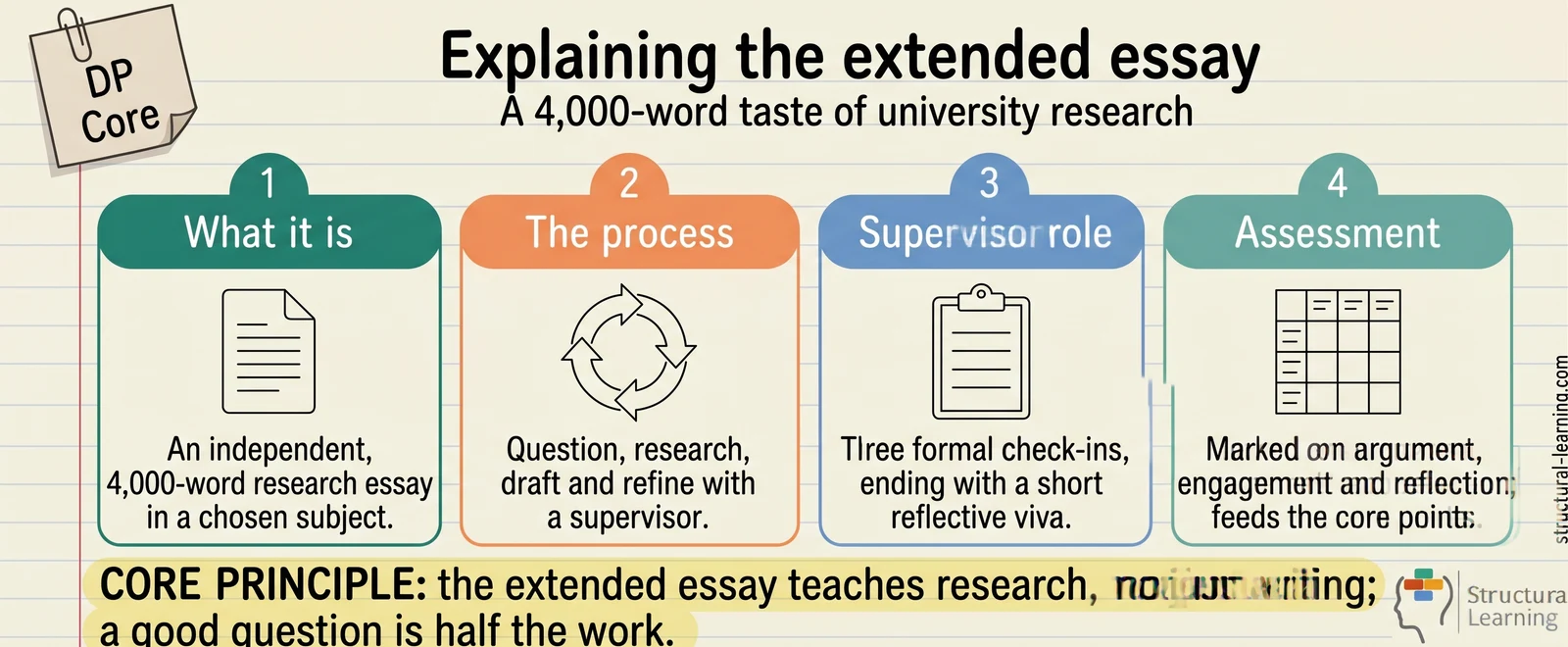
The IB Extended Essay is an independent research paper of no more than 4,000 words. It is compulsory for Diploma candidates and optional for course learners. Teachers help each learner shape a feasible question, choose suitable methods, use sources honestly and reflect on choices, while leaving the argument and writing firmly in the learner's hands (International Baccalaureate, 2026).
Check the examination session before using this guide. Learners completing a 2026 session must follow the guide and forms that apply to that session. First assessment 2027 uses the new guide, with subject-focused and interdisciplinary pathways, a Researcher's Reflection and Progress Form (RPF), and a reflective statement of no more than 500 words.
For example, a supervisor should help a history learner turn “propaganda in war” into a question with a defined country, medium and period. The supervisor can test whether sources exist and whether the method fits, but the learner must choose the argument and write the paper.
The Extended Essay asks a learner to explore a focussed question through their own research. Allow about 40 hours of learner work and a recommended three to five hours of supervision. This includes three required reflection sessions. The IB marks the essay, while teachers guide the work without becoming co-authors.
Key takeaways
| Decision | At a glance |
|---|---|
| Output. | A research paper of their own, of no more than 4,000 words. |
| Pathways for first assessment 2027. | Subject-focused or interdisciplinary across two DP subjects. |
| Learner time. | About 40 hours. |
| Supervision time. | A recommended three to five hours. |
| Formal reflections. | Initial, interim and final. The final session ends in the viva voce. |
| Form for first assessment 2027. | RPF, with attendance records and a reflective statement of no more than 500 words. |
| Assessment. | The IB marks the essay. For 2027, it also reviews reflection through criterion E. |
| Supervisor boundary. | Question, challenge and guide. Never rewrite, line-edit or supply the learner's work. |
The Extended Essay sits within the core of the Diploma Programme, alongside Theory of Knowledge. For wider curriculum context, use the International Baccalaureate overview. The official current overview confirms the purpose and broad shape of the task.
The learner's examination session decides the rules. A school should not apply 2027 terminology, forms or assessment arrangements retrospectively to a 2026 candidate. EE leads need one cohort register that records the session, right guide, pathway, subject allocation, supervisor and required form for each learner.
Begin each supervisor briefing with the guide version, not a summary inherited from last year's handbook. Place the exact guide and school procedures in one controlled location, label them by examination session, and archive superseded copies away from the active folder. This simple document-control step prevents familiar wording from being mistaken for current policy.
The current IB Extended Essay overview is a good first check (International Baccalaureate, 2026). It does not replace the guide for that session. For the new route, teachers should consult the Extended Essay guide for first assessment 2027 before they advise a learner (International Baccalaureate, 2027).
Schools set their own internal milestones so that forms and last checks are complete in time. The external deadline is set by the IB, not chosen locally. EE leads should confirm the current submission deadline information and then work backwards.
For first assessment 2027, learners choose a subject-focused or interdisciplinary pathway. The older RPPF wording gives way to the RPF, which records attendance and contains a reflective statement of no more than 500 words. Reflection is assessed through criterion E, so this is more than a change of initials.
The RPF supports three set talks across the inquiry. The last reflective statement should show how the learner's thought, choices and research grew. It is not a small essay summary or a diary of tasks.
Teachers can ask clear questions that help the learner spot choices. But the learner must select and state the reflection.
The pathway decision also needs attention. A subject-focused essay develops a question through the concepts, methods and evidence of one DP subject. A two-subject essay purposefully integrates two DP subjects because that combination improves the answer. The new route does not require each learner to work across two subjects, nor does it reward a paper divided into two disconnected subject sections.
Make the change clear in training. Give teachers a one-page comparison of the cohorts they actually supervise, then ask them to locate each rule in the right official guide. Link this briefing to the school's broader IB assessment procedures so that checks for authorship, access and hand-in are handled consistently.
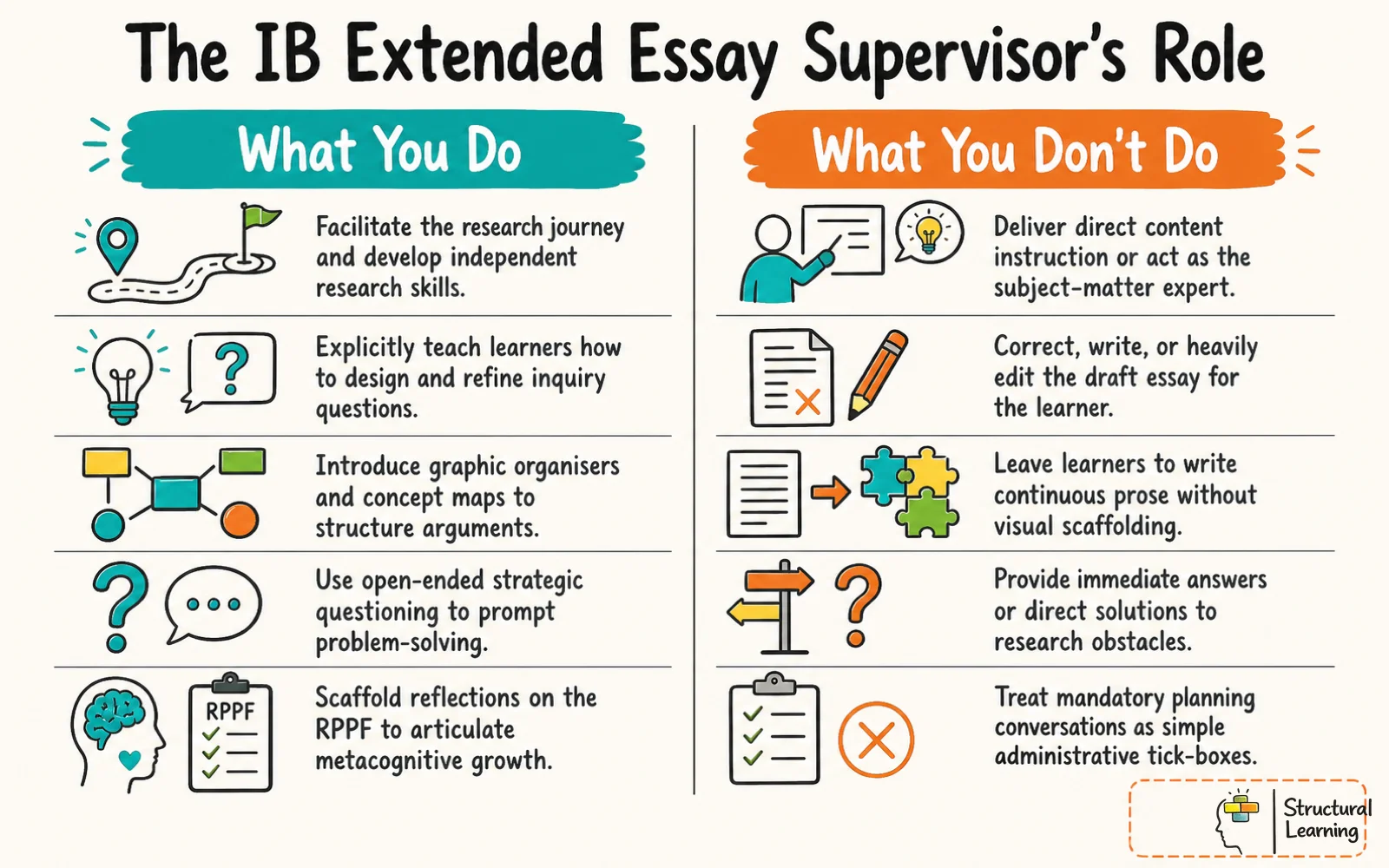
A supervisor makes the research work safe, clear and sound without doing the hard thought. The role includes checks on scope, method, source access, ethics and progress. It also includes the three formal reflections and checks on the learner's own work. It rules out rewrites, line edits and made-up analysis.
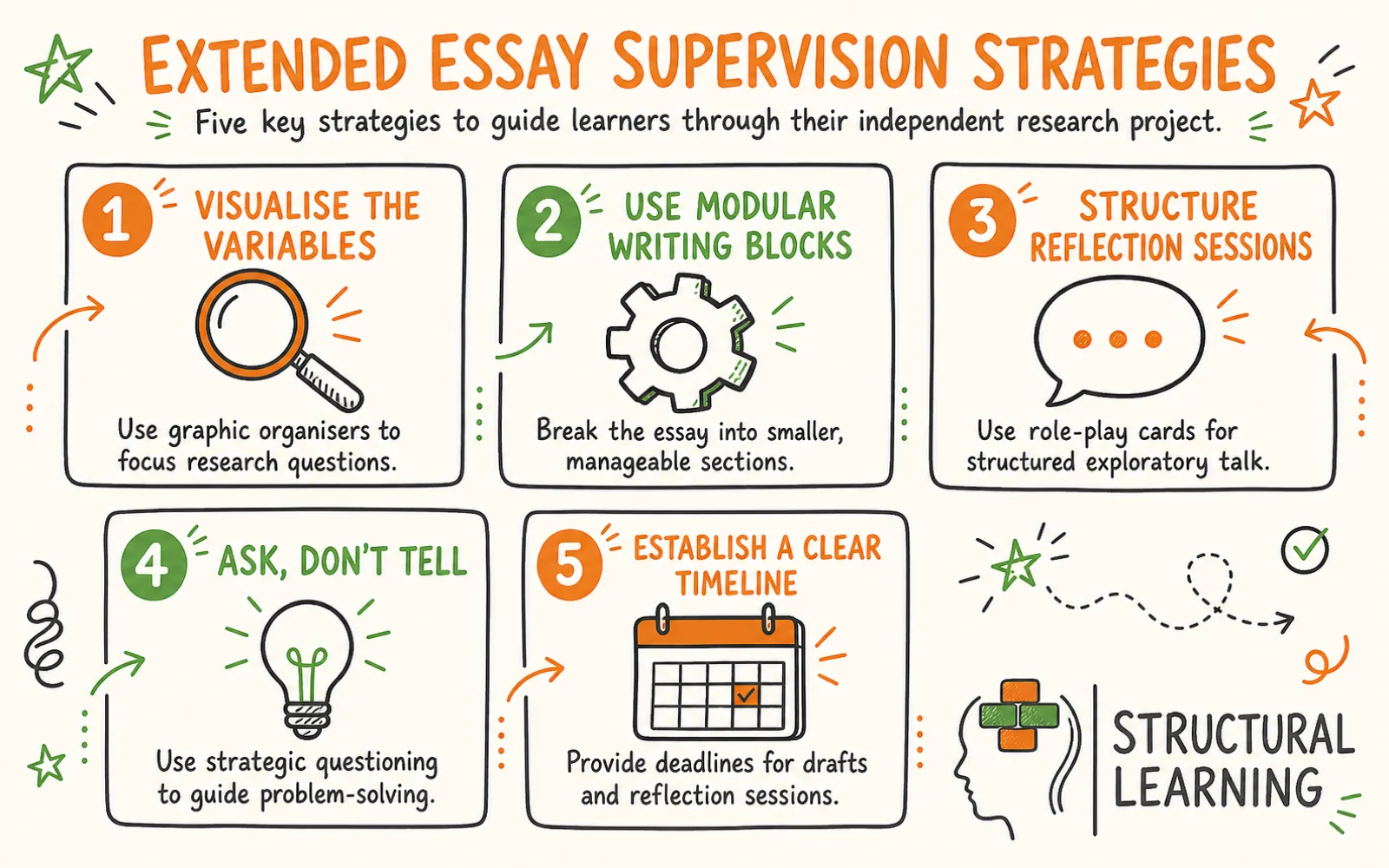
Useful supervision makes choices clear. Ask, “What evidence would change your conclusion?”, “Can this method answer that exact question?” and “Which limitation matters most?” These prompts keep role with the learner. A supervisor may explain what a defensible argument needs, but should not dictate the claim or provide the paragraph that makes it.
The best check is whether the learner can explain the next step in their own words. At the end of a meeting, ask them to state the task, source and due date. Log the agreed task. This builds skill and gives a fair record without turning a short check-in into a fourth formal reflection.
Unequal feedback is a school-level risk. If one supervisor offers broad questions while another returns a heavily edited document, learners have received materially different help. Agree a common feedback protocol, sample comments across departments and resolve borderline cases through the EE lead. Use the exact current guide when deciding what teachers may do with a draft.
Teachers do not have to know every fact in a learner's topic. But they need enough skill in the subject and method to spot a poor design. If a key skill is missing, the EE lead can seek sound help without giving away the work. This project supervision guide can help schools tell coaching from co-production.
A workable timeline moves from orientation to approval, research, drafting, reflection and submission through clear outputs. Schools should set internal deadlines rather than copy universal calendar dates. Build backwards from the IB hand-in date, protect time for problems, and distinguish routine progress checks from the three formal reflection sessions.
Explain the task, guide, pathways, rules for honest work and help on offer. Learners list a few areas rather than defend their first idea. The output is a short list of draft questions, a first source scan and a frank account of rooms, tools, language, data and access.
Before approval, require a focused question, a provisional method, accessible sources, an ethics and safety check, and a plan for the first phase of work. The initial formal reflection belongs here. A learner should leave knowing what they will investigate, why the approach fits and which uncertainty they need to resolve first.
Learners gather, judge and sort their sources. Science may need a pilot. A literature learner may need a small text sample.
A history learner may test if an archive can cover the planned time and place. The goal is not just “more notes”. It is a sound set of sources and a new plan.
The interim session should examine what changed, which obstacles matter and whether the question remains answerable. Require an argument map that connects claims, evidence, counterarguments and limitations. This exposes gaps before continuous prose makes them harder to see.
Set modular drafting milestones, then apply the feedback rules from the current guide. A single complete draft checkpoint is often easier to govern than repeated informal editing, but schools must use the rule that applies to their cohort. The learner revises, checks citations and prepares the final submission independently.
After the work is complete, hold the final reflection session and viva voce. The talk checks ownership and gives the learner space to evaluate choices, challenges and learning. The learner then completes the required reflection in the right form, while the school finishes checks for authorship and hand-in.
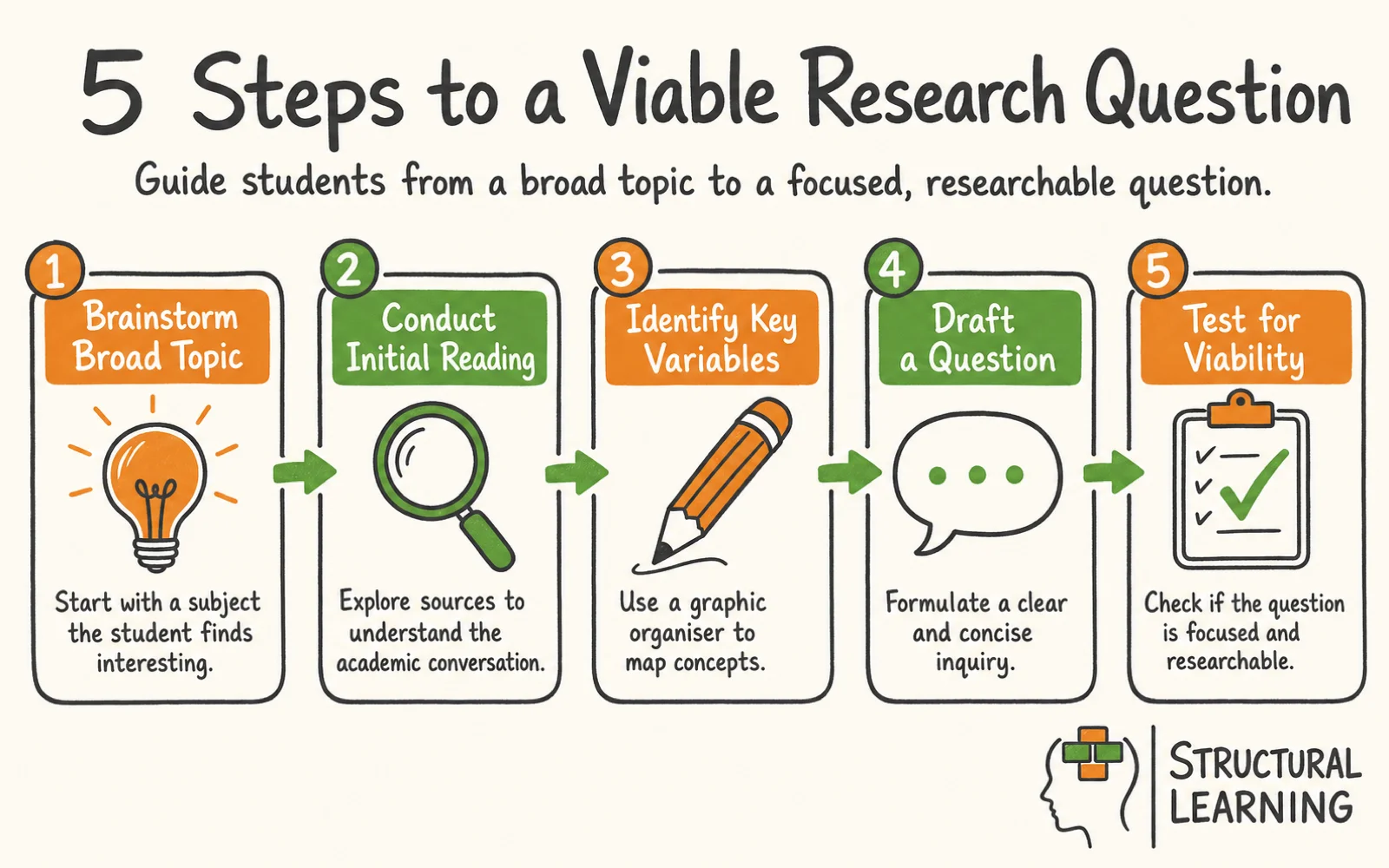
Approve a question only when it is focused, answerable, supported by accessible evidence and matched to a valid method. Topic enthusiasm is necessary but insufficient. A promising proposal can still fail because sources are unavailable, data collection is unsafe, the scale is too broad or the method cannot produce relevant evidence.
“Propaganda in the Second World War” is a topic, not a research question. A more workable history question could ask: “To what extent did British Ministry of Information films seek to influence civilian morale between 1940 and 1942?” The wording identifies an actor, medium, place, period and analytical judgement while leaving room for contestable evidence.
Before approval, the learner should find a sound set of films, primary sources on target viewers or their response, and trusted later work. They must also explain how they will read the films and weigh claims about their effect. If key items are out of reach, change the question before the work goes too far.
Teach this as an inquiry cycle: ask, search, test, read and refine. A question can change when new sources or fit demand it. The learner should log why. Take great care with people, private data, risk, unsafe items or claims that the source base cannot bear.

The initial, interim and final reflection sessions are required and sit within the recommended three to five hours of supervision for first assessment 2027. Ordinary check-ins can support progress, but they do not replace the formal sessions. Each formal talk should produce clearer learner thinking, an accurate attendance record and authentic reflection.
The initial talk tests purpose and fit. Ask the learner to explain why the question matters, how the method fits, which sources are on hand and what could make the plan fail. A helpful outcome is a justified direction plus a specific next action, not supervisor approval based on enthusiasm alone.
The interim talk looks for signs of growth and change. The learner should name what changed, which sources work best, what failed and how the case is taking shape. A good result is a well judged change to the question, method, source plan or form. The work must stay their own.
The final session takes place after completion and concludes the process through the viva voce. It allows the learner to discuss choices, limitations, integrity and intellectual development. It is not a last editing appointment. For 2027, the learner's RPF reflective statement is no more than 500 words and is assessed through criterion E.
Do not reproduce IB prompts in a local worksheet. Instead, train teachers to use open questions, allow thinking time and avoid scripting polished answers. Learners should draw on their own research record, meeting notes and choices. Reflection becomes meaningful when it explains why a choice mattered, not when it lists dates and tasks.
Feedback should improve the learner's judgement, not improve the essay on the learner's behalf. Teachers may question focus, argument, method, evidence, structure and referencing, within the rules of the right guide. They must not line-edit, rewrite passages, create analysis or offer repeated private coaching that produces unequal support.
Use comments such as “Which evidence supports this claim?” or “How does this section answer the research question?” Avoid tracked rewrites, replacement sentences and detailed corrections across the text. Department moderation can compare a small sample of supervisor feedback so that staff share a defensible boundary. When in doubt about draft rules, check the exact current guide rather than relying on memory.
Learners need a sound note system that marks quotes, new wording, short accounts and their own thought. Ask them to log full source facts when they use a source, not at the end. Teachers can check the trail from a claim to a note and source. Then ask how the source shaped the end view.
The IB does not ban generative AI. If assessed work uses AI-made material, that use must be clear, credited in the text and listed in the source list. The work must still show the learner's own grasp. This principle was stated when the IB set out its response to generative AI (International Baccalaureate, 2023), and schools should also use the current IB guidance on AI in learning, teaching and assessment (International Baccalaureate, 2026).
Set an auditable school routine: disclose the tool, purpose and material used; retain relevant process evidence where school policy requires it; verify factual claims against dependable sources; and reference generated material appropriately. AI output is not evidence merely because it sounds confident. Undisclosed or poorly understood use can obscure authorship, introduce fabricated sources and weaken the viva voce.
Inclusive supervision removes avoidable barriers while preserving the same academic demand and learner ownership. Use accessible meeting prompts, chunked milestones, organisation aids and explicit explanations of research language. Any formal access arrangement must follow the current inclusive-access rules for the learner's session rather than an informal local adjustment.
A long independent project places heavy demands on planning, attention and working memory. Break the process into clear outputs, such as a source shortlist, method check, argument map and section plan. Keep one shared record of the next action. This reduces executive load without simplifying the research question or supplying the intellectual answer.
For EAL learners, distinguish language support from authorship. Teachers can clarify task vocabulary, model how academic sources signal claims and provide planning frames used across the cohort. They should not recast the learner's prose into more sophisticated English. Ask the learner to explain difficult reasoning orally, then let them decide how to express it in writing.
Good scaffolding fades. Early meetings may use a consistent agenda and visual prompts; later meetings should require the learner to set the agenda, name the obstacle and propose the next step. Check whether an aid increases independence. If it produces a teacher-dependent essay, redesign or withdraw it.
Consistency matters here too. Help should be logged, open to all through an agreed route and reviewed by the right school lead. It should not depend on which supervisor has more free time. The coordinator should track missed meetings, stalled work and blocked sources soon enough for help to work.
For first assessment 2027, a subject-focused essay uses the ideas, methods and sources of one DP subject. A two-subject essay joins two DP subjects because both help answer the question. The route is not more bold by default. It must not become two essays joined at the end.
A biology learner could test how one set change affects seed growth in a named plant. Approval rests on a safe range, sound measures, repeat tests and a clear way to read the data. A pilot should show if the kit can give sound data before the learner starts the full study.
Subject fit matters. A literature essay needs close text work, not a life story or plot summary. A maths essay must do maths, not tell the tale of a theorem.
A history essay needs a question bound by key people, place and time. The supervisor tests fit without inventing the learner's work.
A learner could ask how the design and price of a city bus plan changed access for one group. Geography could map space and travel. Economics could test cost and choice. The two fields join when work from both changes the answer, not when each field fills one half of the essay.
Ask three questions before approving this two-subject route: Would one subject alone leave a material gap? Can the learner use the methods of both subjects accurately? Is there a coherent plan for integrating the evidence? If the answer to any is no, refine the design or choose a subject-focused pathway.
Whichever pathway is chosen, teachers should align milestones with the learner's Approaches to Learning skills. Research, self-management, communication and critical thinking can be taught explicitly, but the learner must apply them to this particular inquiry.
Most supervision problems concern time, scope, setbacks, due dates and authorship. Use the right guide and one fair school plan. The short answers below help teachers act. But they do not override the IB rules for that session or the EE lead's role in a fair school approach.
For first assessment 2027, the recommended total is three to five hours, including the three required reflection sessions. Plan it across the process rather than spending most of it on a late draft. Keep an accurate record of formal sessions and significant guidance.
Yes, when fit or new sources make the change wise. The learner should state why, test the new question against sources, method and ethics, and log the choice. A change should help the work, not hide a lack of progress.
No. It must be no more than 4,000 words. A shorter essay can still be rigorous if it answers the question with sufficient analysis and evidence. Teachers should not encourage padding, and learners must check the current guide for what is included in the word count.
A failed experiment does not automatically end the essay. The learner should examine whether the design, data or limitation still supports a valid analysis, and whether a safe, ethical adjustment is feasible. Teachers can question the method but must not manufacture results or conceal failure.
Record the missed milestone, name the smallest viable next output and apply the school's escalation process. Internal deadlines should include contingency time. They cannot move the IB's external submission deadline, so EE leads need an early risk register rather than last-minute rescue work.
Any AI-generated material used in assessed work must be transparent, credited in the body and referenced in the bibliography. The learner should be able to explain and defend the submitted work. Apply current IB guidance and the school's documented process consistently across the cohort.
Supervision cannot remove all risk from a learner's own research, and it should not try. Schools must keep learners safe, protect fair access and note real limits on kit, sources, language, time and staff skill. A sound system flags these limits early and uses the same rules across the cohort.
Do not approve data collection before ethics, safety, permission and privacy questions are settled. Human-participant work needs particular care around consent, sensitive topics, personal data and power relationships. A question that cannot be investigated safely or ethically must change, however interesting it appears.
Gaps in school means can shape topic choice. One learner may have archive access, lab kit or a family link that another lacks. Do not strip out all choice.
Check that each approved plan has a fair path to good sources and apt school help. Log rare cases and EE lead choices.
Monitor supervisor workload as a quality issue. Large caseloads encourage rushed meetings and inconsistent feedback. Shared research teaching can cover source evaluation, note-making, academic integrity and planning, while individual meetings focus on the learner's choices. Check the implications for IB scoring and grades without turning supervision into criterion coaching.
Use moderation to protect boundaries. Sample meeting records and feedback across subjects, look for unusually intensive intervention, and retrain where necessary. The aim is not identical conversations. It is comparable access to guidance, clear ownership and choices anchored in the same current guide.
These official sources support the guide-version, timing, reflection, form and academic-integrity claims in this article. Teachers should use the version that applies to the learner's examination session and consult current programme documentation when a local procedure or remembered rule differs.
Coordinator action: name which guide applies to each current cohort, record it against each learner, and brief all teachers against that exact guide before the next formal reflection session.