PYP Transition Guide: UK Primary Schools Moving to Inquiry
|
April 22, 2026
Learn how UK primary schools transition from National Curriculum to the IB Primary Years Programme. Week-by-week changes, phonics strategy, and real classroom examples.
Phonics Remains Protected: The Primary Years Programme does not replace synthetic phonics teaching. Phonics is systematic, daily, and non-negotiable; inquiry provides meaningful application contexts.
Transdisciplinary Planning Requires Cognitive Shift: Moving from topic coverage to conceptual depth demands collaborative planning, professional development, and 12-18 months of heavy workload before culture embeds.
Ofsted Recognizes Rigorous PYP Implementation: Inspection frameworks assess curriculum breadth, phonics fidelity, assessment rigour, and learner voice, all central to PYP. International curricula increasingly receive strong inspection outcomes when evidence is clearly presented.
Assessment Changes from Levels to Criterion-Referenced Rubrics: Progress is described through agency criteria (Inquirer, Communicator, Thinker, etc.) and continuous formative feedback, not end-of-unit summative grades.
National Curriculum vs. PYP: Side-by-Side Planning Shift
Opening: Monday Morning in a Transitioning Primary School
A Year 2 teacher steps into the staff planning room on a Monday morning, two weeks into her primary's first term as an authorised PYP school. On the whiteboard: a single sentence. "Human migration is a response to challenges and opportunities." Next to it, the word central idea.
In her twelve years teaching the National Curriculum, units had clear names. "Egyptians." "Victorians." "Our Bodies." The learning objectives were ticked off methodically: learners could "identify a suffix," "use conjunctions," "order numbers to 100." This was different.
She sat down in the planning meeting alongside her year-group partner. "But where," she asked quietly, "is the phonics?"
This question sits at the heart of every school's PYP transition. The fear is real, and it deserves respect. UK primary teachers have been trained to deliver systematic synthetic phonics daily, to monitor Phonics Check pass rates, and to progress learners through carefully sequenced phases. International inquiry frameworks can feel like a move away from those non-negotiable requirements, not alongside them.
By the end of this guide, you will understand how phonics, maths mastery, and the wider National Curriculum don't vanish in PYP. Instead, they find new purpose within a transdisciplinary framework that asks learners to think more deeply about why they are learning, not just what.
What Changes on Day One: Five Shifts in Classroom Practice
The first shock is structural. In a National Curriculum primary, a unit's shape is predictable. Objectives come first: what will learners know or do? Then activities are designed to meet those objectives. Phonics happens daily at 10am. Maths has its own timetable slot. Reading, writing, and foundation subjects cluster around these anchors.
In a PYP classroom, the sequence inverts. Planning starts not with discrete objectives but with a central idea , a conceptual statement about the world that learners will explore. "People respond to challenges in creative ways." "How we organise systems reflects our values." These are not topics; they are intellectual hooks that span weeks of thinking.
From this central idea emerges a second shift: from coverage to depth. In the National Curriculum, a term might see learners "learn about" five historical periods, three types of ecosystems, and place-value strategies to 100. In PYP, a unit dives deep into a single concept. Perhaps it is "Responsibility" , explored through the eyes of a community helper, a character in a story, a scientific discovery, and a learner's own actions. By the fourth week, learners have encountered responsibility through multiple lenses and can articulate what it means.
The third change is integration. In National Curriculum schools, subjects are taught separately, with occasional "topic" links. A Victorian topic might touch on history, geography, and English, but maths happens in isolation and science follows its own spiral. In PYP, subjects genuinely interweave. A unit on "How the World Works" might explore cause and effect through a physics investigation (why do things fall?), a character study (what makes someone act unkindly?), and a mathematical pattern (how does probability work?).
Fourth is agency. Traditional units are teacher-planned. Learners receive the unit framework and complete the activities. PYP asks learners to shape the inquiry. After the provocation (the hook), the question shifts from "What do we need to find out?" (the teacher's question) to "What do you want to find out?" Learner questions become lines of inquiry.
Finally, assessment transforms. Instead of a summative end-of-unit test measuring whether learners met pre-defined objectives, PYP uses criterion-referenced rubrics that describe learning along agency dimensions: Can this learner act as an Inquirer? A Communicator? A Thinker? Feedback is formative and continuous, woven throughout the unit.
None of these shifts remove phonics, reading, writing, or maths from the day. They reshape how and why those skills are applied.
The Real Timetable: PYP Alongside Statutory Hours
The parent at the school gates asks the same question the Year 2 teacher asked: "If we're doing all this inquiry, when are the children learning phonics?"
The honest answer is: it's complicated, and the complexity is real.
UK primary schools must deliver systematic synthetic phonics, daily, with fidelity. This is non-negotiable. The Phonics Check at the end of Year 1 is not optional. Maths mastery is inspected by Ofsted. Reading and writing are foundation skills. These do not disappear in PYP; they remain anchors.
Here is what a realistic timetable looks like in a Year 1 or Year 2 PYP classroom:
Monday to Wednesday mornings (8:50-9:20): 30 minutes of structured phonics. This is separate from inquiry, systematic, and teacher-directed. Letters and Sounds phases are taught in sequence: initial sounds, then CVC words, then digraphs. Multi-sensory strategies (sound buttons, oral blending, sound mats) are used consistently. Phonics progress is tracked separately from inquiry progress. This is the statutory foundation.
Wednesday to Friday mornings (9:20-10:30): Guided reading, shared writing, and writing application, using phase-appropriate texts and writing contexts that happen to be connected to the unit's inquiry. A Year 1 unit on "Who Helps Us?" (central idea: People in communities have different roles) includes guided reading of decodable texts about helpers that use Phase 3 or 4 sounds. Shared writing might involve co-authoring a sentence: "A vet helps pets." The phonics taught on Monday is applied, not repeated, in a meaningful context.
Daily (10:30-11:15): Maths, fluency-first (ten minutes of subitising, counting, number bonds), followed by conceptual reasoning that often connects to the inquiry theme. If the unit explores "Pattern," learners might investigate repeating and growing patterns in both discrete maths (beads on a string) and nature (stripes on a zebra). The mastery goal (understanding pattern deeply) is served; the conceptual lens (How does pattern appear in our world?) anchors the inquiry.
Afternoons: Creative, collaborative, and investigative work within the inquiry. Learners might be reading informational texts about their research question, recording observations from an experiment, discussing findings with a partner, or designing an artefact that demonstrates understanding. Phonics and maths are integrated where relevant, but the focus is on the inquiry process: questioning, investigating, thinking, communicating.
The timetable is not trick photography. It is genuinely possible, and real schools are doing it. The key is that phonics is protected time , not squeezed into morning gaps or treated as revision. Phonics fidelity is monitored separately from inquiry engagement. Maths fluency has its non-negotiable slot. But reading and writing within inquiry are meaningful, not contrived.
Parents see their child learning phonics and engaging in real thinking simultaneously. They are not choosing between one or the other.
Planning a Unit of Inquiry: From Central Idea to Classroom
The planning arc for a PYP unit is roughly four to six weeks, and it follows a distinct shape.
It begins not with outcomes but with a central idea: a conceptual lens that learners will explore. This is different from a topic. "Homes around the world" is a topic. "The design of homes reflects the culture and geography that shaped them" is a central idea. It makes a claim about relationships in the world, not just naming a subject area.
From this central idea, teachers identify key concepts , the disciplinary lenses that will shape inquiry. A unit on "How the World Works" might focus on cause and effect, systems, and evidence. A unit on "Rights and Responsibilities" might explore power, perspective, and agency. Each concept surfaces in multiple subjects. Maths involves cause and effect (what happens when we double a number?). Science investigates evidence. Humanities explores power. The concepts thread through.
Next comes the provocation , an authentic trigger that launches inquiry. This might be a film clip, an artefact, a guest speaker, a problem, or a story. The provocation should spark genuine curiosity, not answer questions. A unit on human migration might show a photograph of a refugee family at a border. Learners are invited to ask: What questions do you have? What do you want to find out?
Those learner questions become lines of inquiry , typically three to five questions that shape the unit's direction. "Why do people move?" "Where do migrants go?" "What challenges do migrants face?" "How can we help?" These are the pathways learners will explore, not the endpoints the teacher has predetermined.
Throughout the unit, learners engage in different inquiry processes: asking questions, researching (reading texts, interviewing, observing), discussing, testing ideas, documenting thinking, and reflecting. Phonics and maths are embedded naturally. In a research activity, learners read texts using phase-appropriate phonetically-plausible words. In a data representation task, learners might count migrants by destination and represent that using a bar graph. The skills serve the inquiry.
Formative assessment happens throughout, using criterion-referenced rubrics. Instead of a final test, learners receive feedback on their thinking, questioning, communication, and agency during the inquiry. Teachers use observations, learner conversations, portfolios, and student-created artefacts as evidence.
Finally, learners engage in an agency project , an action or demonstration of learning that shows they have understood the central idea. In a unit on community helpers, learners might interview a helper and present what they learned. In a migration unit, they might create a poster or write a letter to a decision-maker. The project is not a test; it is an authentic application of understanding.
A concrete Year 1 example makes this real. The unit title is "Who Helps Us?" (central idea: People in communities have different roles and responsibilities).
Key concepts: Responsibility, Community, Role. Lines of inquiry: "Who helps in our community?" "What do helpers do?" "Why is their work important?" Provocation: photographs of community helpers (fire fighter, nurse, teacher, shop worker) with a question: "Who do you know who helps?"
Over three weeks, learners interview a family member or invited guest (a police officer, a librarian). They read decodable texts about jobs. They sort helpers by role and draw what they do. In guided writing, they compose a simple sentence: "A teacher helps children learn." In maths, they count different types of helpers and create a bar graph. Near the end, learners present their learning: "This is [Helper]. They help by [action]. I think their job is important because [reason]."
Assessment is criterion-referenced: Is the learner an Inquirer (asking questions about helpers)? A Communicator (expressing what they learned)? A Doer (taking action, e.g., thanking a helper)?
This is not play. It is structured, purposeful, and rigorous.
Assessment in PYP: Moving Away from Levels
For UK teachers trained under the old National Curriculum Levels system, PYP assessment can feel abstract. Levels were numbers (a child was "Level 2b" or "Level 3") and relatively simple to track. Schools since 2014 have invented their own descriptors (e.g., "Greater Depth," "Secure," "Developing"), which are more informative but still comparative.
PYP assessment operates on a different logic: criterion-referenced, not norm-referenced. A rubric describes what proficiency looks like on specific criteria, not how a learner compares to peers.
For example, a phonics and writing rubric for a Year 1 unit might describe four levels of the criterion "Uses phonically-plausible strategies in independent writing":
Exceeding: Writes simple sentences using all Phase-taught phonemes correctly and applies them independently in writing about familiar topics.
Secure: Writes simple words and simple sentences using most Phase-taught phonemes; some phonemes are applied correctly in independent writing.
Developing: Writes words and attempts sentences, using some Phase-taught phonemes; blending and oral strategies are more secure than independent application.
Not Yet: Attempts to segment sounds orally but cannot yet represent phonemes in independent writing.
The rubric is specific (which phonemes? applied how?) and developmental (each level shows growth). The same learner might be "Secure" in phonetic writing but "Developing" as an Inquirer (asking deeper questions).
This is more nuanced than a level. It tells parents precisely what their child can do and where to support next. It also means assessment is continuous, not summative. Rather than testing learners at the end of the unit, teachers observe and collect evidence throughout. Feedback is immediate and formative: "I notice you're using Phase 4 sounds in your writing. Next, we'll explore digraphs together."
The shift requires training. Teachers accustomed to assigning a level or grade need to learn to gather evidence, interpret criteria, and describe progress in terms of agency and conceptual thinking. By month three of implementation, most teachers have begun; by month six, confidence grows. This is a known sticking point in PYP transitions, and it requires explicit professional development.
Parents often appreciate criterion-referenced rubrics once they understand them. Instead of "Your child is Secure," which invites the question "Secure compared to what?", rubrics show "Your child demonstrates responsibility by completing tasks and considering others' perspectives. Next, we're exploring how to take action responsibly in our community." It is richer and more actionable.
Teacher CPD and the First Term: What Really Happens
The professional development timeline for PYP adoption is brutal in its honesty.
Weeks 1-2: Teachers attend IBO Foundation Training. Typically, this is two or three days delivered on school-based INSET days or during half-term. The training covers PYP philosophy, the inquiry cycle, the learner profile, assessment principles, and unit planning. For teachers from traditional topic backgrounds, the cognitive load is enormous. Concepts like "transdisciplinary" and "central idea" feel jargony. Questions arise: "But where is phonics? Where are the learning outcomes?" By day two, many teachers are overwhelmed. This is normal.
Weeks 3-4: Schools move into school-based collaborative planning. Year groups or grade teams come together to plan their first unit. A Year 1 teacher sits alongside a Year 2 teacher who has never designed an inquiry unit before. Everyone is drafting central ideas, sorting key concepts, and trying to map the National Curriculum into the transdisciplinary framework. First central ideas are often either too broad ("Learning") or too narrow ("Our classroom"). Collaborative refinement takes time. Senior leaders (head, deputy, curriculum lead) must actively participate in these sessions, modelling PYP thinking and redirecting ideas that are drifting toward traditional topics.
Month 2: The first units launch. Teachers are teaching inquiry cycles, managing student questioning, and integrating phonics and maths while learning to do all these things. This is where energy dips. Teachers ask: "Am I doing this right? Are learners actually understanding deeper concepts, or are they just doing busywork?" Consultant support or senior leadership observation during this phase is valuable. Teachers need to see a unit in action, reflect on what worked, and adjust.
Month 3: Collaborative reflection and cycle two planning begins. Teachers troubleshoot what emerged in month two: "How do we scaffold phonics fidelity within this inquiry without it feeling disconnected?" "How do we assess learner thinking when rubrics are this different from what I know?" Data emerges. Are learners developing as inquirers? Are they thinking conceptually, or just gathering facts? This reflection is essential. Teachers who skip it often become frustrated, believing PYP is impossible or that they are failing at it.
Months 4-6: Inquiry culture begins to embed. Teachers see learner engagement shift. Children ask better questions. Phonics and maths progress data remain strong. Assessment confidence grows. Senior leaders maintain the "why" of PYP visibly, countering the inevitable moments when teachers revert to habit: "Can we just do a traditional topic for this unit?" The answer is: not if you want PYP to take root. Consistency matters.
A critical success factor throughout this timeline is leadership mindset. If the head or curriculum lead still views inquiry as "nice to have" and National Curriculum coverage as the real goal, teachers will feel caught between two systems and will eventually choose the familiar one. If senior leaders model PYP thinking, release planning time generously, and shield teachers from excessive accountability anxiety during the implementation dip, cultural shift happens faster.
The realistic timeline for PYP to feel normal (not effortful) is 18-24 months. The timeline for cultural embedding (where inquiry is business-as-usual and teachers ask "Why would we plan any other way?") is 3-5 years. Schools that rush this, or that treat PYP as a curriculum graft rather than a cultural shift, tend to revert to traditional practice once external consultant support ends.
Phonics, Reading, and the Inquiry Paradox
Ask a phonics specialist: "Can systematic synthetic phonics fidelity coexist with inquiry-based reading?"
The specialist will say: "Yes, absolutely."
Ask a practitioner in a newly transitioning school: "Is it actually possible?"
They will often say: "I'm not sure yet."
This is the tension that surfaces most often in PYP transitions. Phonics is systematic, sequential, and teacher-directed. Inquiry is generative, student-shaped, and emergent. They seem philosophically opposed.
They are not.
The research on phonics, now three decades deep, shows that phonics fidelity , the systematic, sequential teaching of letter-sound correspondences, is essential and separate from context. A learner can acquire Phase 4 phonemes (CVCC words like "nest") through teacher-directed phonics instruction and encounter those phonemes in authentic reading texts connected to an inquiry. The fidelity is maintained; the context is enriched.
Real schools doing this typically protect phonics as a distinct 20-30 minute daily block. Monday to Wednesday mornings, systematic SSP phases are taught: initial sounds, CVC words, digraphs, trigraphs, etc. Multi-sensory teaching (sound buttons, sound mats, oral blending games) is used. Fidelity is monitored through phonics checks (informal running records or formal Phonics Check data). This is non-negotiable.
Guided reading and shared writing incorporate texts and writing that use phase-appropriate phonemes but are meaningfully connected to inquiry. In a Year 2 unit on human migration, guided reading texts might feature Phase 5 digraphs (ea, oi, ai) and explore migration themes: journeys, homes, families, safety. The phonics is taught in the 20-minute block; the reading is applied in the inquiry context.
A concrete Year 2 example: the central idea is "Human migration is a response to challenges and opportunities." The provocation is a simple story about a family moving because of a job opportunity. Lines of inquiry: "Why do people move?" "Where do they move to?" "What do they need?"
Phonics protected time (Mon-Wed, 8:50-9:20): Phase 5 digraphs (ai, ea, oi, ou). Routine: flashcard recognition, oral blending, segmenting, writing words on whiteboards. Teacher-directed, systematic, brisk.
Guided reading (Wed-Fri, 9:20-10:00): Decodable texts at Phase 5 level that involve movement, homes, or journeys. Perhaps a book titled "A Boat on the Sea" (ai, oa digraphs, simple narrative about travel). Learners read, decode using Phase 5 strategies, and discuss: "Where is the boat going? Why?" The text serves the inquiry and provides a meaningful context for phonics application.
Shared writing: Teacher and learners co-author a simple text about the provocation story, using Phase 5 words. "The family had to go. They wanted a new home. The boat took them across the sea." Phonemes are spelled correctly; the message is about the unit's concept.
Assessment captures both. Phonics progress is tracked via the SSP phases and fidelity checks. Reading engagement and inquiry thinking are assessed via rubrics ("Is this learner asking questions about migration?").
This is not a compromise. It is integration. Ofsted would observe this and see systematic phonics, meaningful reading, and coherent learning simultaneously.
The 12-18 Month PYP Implementation Timeline
Maths Mastery and Concept-Based Inquiry
A head of maths in a transitioning school often asks: "Will PYP dilute our mastery approach?"
The answer is no, if the school designs units thoughtfully.
PYP distinguishes between calculation fluency (quick recall and procedural skill) and conceptual understanding (deep, connected reasoning). Mastery approaches in UK primary schools emphasize both. A learner who "mastered" place value to 100 can not only count and order numbers but understands that 100 is ten tens, and that this structure explains addition and subtraction.
Concept-based inquiry complements this. Instead of place value being taught in isolation, a unit might explore "Pattern and Systems" through multiple lenses: maths (place value patterns, counting patterns), science (patterns in nature), art (geometric patterns), music (rhythmic patterns). The central idea is "Patterns help us understand systems in our world." Learners might investigate repeating patterns in beads, draw patterns they find in nature, and use counting patterns to predict sequences. By the end of four weeks, they have explored "Pattern" deeply, conceptually, mathematically, aesthetically, and scientifically.
Daily maths fluency time is separate from inquiry-connected reasoning. A 10-15 minute fluency block (subitising, counting, number bonds, times tables) remains protected and teacher-directed. The rigour of mastery is not compromised. But in the reasoning block (20-30 minutes), maths thinking might be applied within an inquiry context.
For example, a Year 3 unit on "How the World Works" explores the concept of "Systems." In maths, learners investigate ordering and relationships: sets of numbers in order, how algorithms (step-by-step instructions) create systems, how place value is a system of ten. The depth of mastery thinking is evident; the context is conceptual.
Ofsted will observe this and see both fluency and depth, not breadth at the expense of mastery.
One realistic tension is timetabling. If inquiry is generously scheduled, fluency time can be squeezed. Schools that successfully integrate maths into inquiry protect fluency time first and then build inquiry around the remaining hours. It is possible but requires discipline.
Parental Communication: Explaining PYP at the Gates
A parent asks: "Is this real learning or just playing with themes?"
This question deserves a respectful answer, and it deserves a long-term communication strategy.
Most parents understand traditional topic work. "We're learning about the Victorians this half-term." They can imagine what that looks like: a timeline on the wall, a visit to a museum, books about Queen Victoria, maybe a Victorian dress-up day. It is concrete, tangible.
PYP is less visible. "We're exploring the concept of 'Responsibility' through a unit on community helpers." The central idea is abstract. The inquiry process is less obviously "educational" to a parent walking past a classroom where learners are asking questions, interviewing an adult, and discussing what they found out.
Schools need a communication strategy that demystifies PYP and shows that rigour is intact.
Monthly unit newsletters are the baseline. For each unit, send home a summary:
"This month, Year 2 is exploring a unit titled 'Human Rights and Responsibilities.' We're investigating: What are human rights? How are children's rights protected? How can we act responsibly to protect others' rights? In phonics, we're learning Phase 4 digraphs (sh, ch, th) through texts about community roles and responsibilities. In maths, we're exploring 'fairness' through sharing and grouping activities. Learners are reading, writing about, and discussing real scenarios: What makes something fair? How do different communities decide what is fair? By the end of the unit, each learner will have created something (a poster, a story, a campaign idea) that shows their understanding."
The newsletter shows work: phonics progress, maths reasoning, reading and writing application. It shows the concepts, not just activities.
Parent information sessions on PYP are essential early in the transition. A 30-minute meeting where a school explains: "What is inquiry?" "Why concepts?" "How is assessment different?" "How can you support your child's learning at home?"
An agenda might look like:
What's Changing (10 min): From "learning about topics" to "learning to think deeply about concepts"
The Inquiry Cycle (10 min): Show a real example: How a unit on pets moves from provocation ("Why do we keep pets?") through research ("What do pets need?") to action ("Create a pet care guide")
Assessment (5 min): Rubrics describe what your child can do (Inquirer, Communicator, Thinker), not a number grade
Supporting at Home (5 min): Ask your child their inquiry questions; read books together about the unit's concepts; encourage them to think deeply, not just gather facts
By the first half-term review meeting, most parents have seen evidence: photos of learners engaged in meaningful work, writing samples that show phonics progress and conceptual thinking, feedback that describes their child's growth as an inquirer, not a grade.
Within six months, parental anxiety typically reduces. Within a year, many parents describe PYP positively: "My child is asking better questions. She's reading more for pleasure because she's interested in the topics we're exploring."
The Ofsted Question: PYP and Inspection
Headteachers moving to PYP often ask: "Will this harm our Ofsted grade?"
This fear is legitimate but, with evidence, manageable.
Ofsted's 2023 School Inspection Handbook prioritises curriculum breadth, depth, sequencing, assessment, and learner voice. A rigorous PYP implementation meets all these criteria.
Curriculum breadth: PYP, through transdisciplinary units, ensures learners encounter knowledge and skills from all National Curriculum areas. Schools map their central ideas and lines of inquiry explicitly to National Curriculum strands, showing that, over a year, coverage is comprehensive. Ofsted inspectors will look for this mapping.
Curriculum depth: This is PYP's strength. Instead of teaching surface-level knowledge across many topics, learners develop conceptual understanding over weeks. Ofsted increasingly values depth over breadth.
Phonics fidelity: Ofsted inspects phonics teaching, listening to learners read decodable texts and examining phonics tracking data. PYP schools protect phonics time and fidelity separately. Inspector findings typically show: "Phonics is taught systematically and learners' phonics knowledge is secure."
Assessment: Ofsted looks for evidence that teachers assess learning, act on findings, and adapt teaching. PYP's continuous, criterion-referenced assessment exceeds this expectation. Schools have portfolios, rubrics, and learner evidence that show where each learner is and what they need next.
Learner voice: Ofsted values schools where learners have agency and are motivated to learn. PYP's emphasis on student questioning and inquiry naturally generates this.
The potential Ofsted anxiety is: "Is transdisciplinary coverage actually covering all National Curriculum strands?" This is a fair question. Schools must be deliberate. When designing a year overview of central ideas and units, curriculum leads must ensure that, across all units, learners encounter all NC subject areas and year-group objectives. Some knowledge (phonics, maths fluency) is taught discretely; some (history, geography, science) is integrated into inquiry. But integration must be intentional, not accidental.
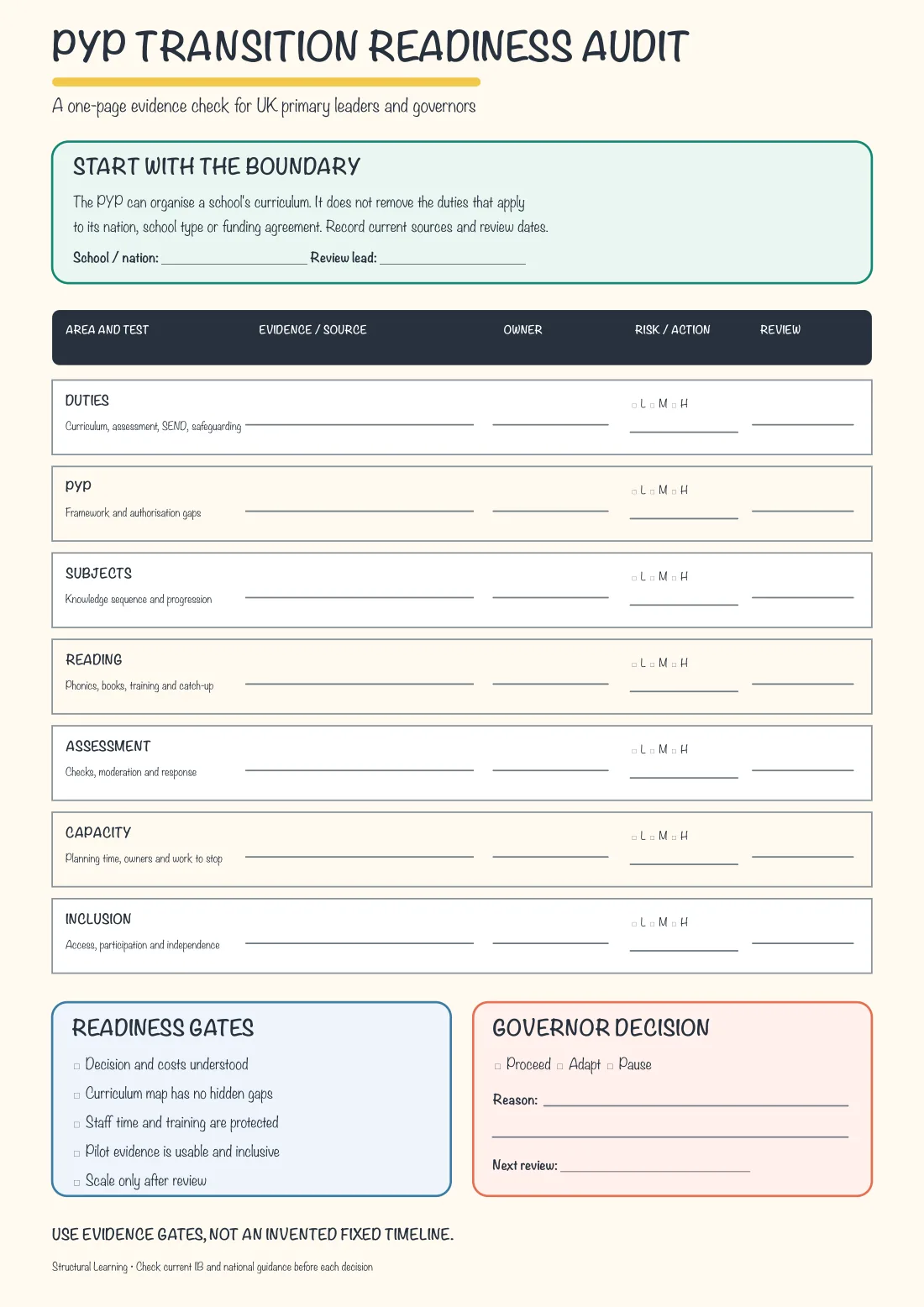
A school's Ofsted evidence pack for a PYP transition should include:
Year overview with NC mapping: Shows which units address which NC strands
Assessment rubrics: Show how learners are assessed on agency criteria and subject-specific skills simultaneously
Learner portfolios: Demonstrating thinking, inquiry processes, and skill development across units
Learner voice evidence: Student interviews, learner surveys, evidence of student questioning and agency
Schools with 18-24 months of PYP implementation, clear evidence, and strong phonics data have received positive Ofsted outcomes. The fear is often worse than the reality.
Common Transition Tensions and How Schools Resolve Them
Tension
What Teachers Fear
How Real Schools Solve It
Phonics quality
"If phonics is just one part of inquiry, won't it get diluted?"
Phonics is 20-30 minutes daily, protected, systematic, and tracked separately. Inquiry provides meaningful application contexts, not replacement. Schools see phonics fidelity improve because reading becomes purposeful and engaging.
Maths mastery dilution
"Inquiry will make maths broad but shallow."
Daily fluency time is separate and teacher-directed. Depth comes from exploring concepts like "Pattern," "Relationship," and "Change" through maths and multiple other disciplines simultaneously. Mastery plus meaning.
Planning complexity
"Won't transdisciplinary units make planning impossibly difficult?"
Yes, in year one. By year two, schools develop unit templates and collaborative routines. Senior leaders guide first-round planning heavily. By year three, collaborative culture normalizes it. Reality: 3-5 months of demanding workload, then it eases.
Parent skepticism
"Parents will see 'theme work' as soft learning."
Monthly newsletters, parent meetings, and student-led conferences show real thinking and application. Parents see phonics progress and conceptual engagement simultaneously. Within a year, most parents understand and support the model.
Teacher belief
"I've taught traditionally for twenty years. I don't know how to do inquiry."
Cognitive apprenticeship works: pair teachers with experienced inquiry practitioners; co-plan first units; model inquiry cycles together; reflect on learning. Within six months, teachers see learner engagement shift noticeably. Belief follows practice.
Assessment confidence
"I don't know how to assess conceptual thinking."
Training on rubric design, moderation sessions, and learner portfolios build confidence incrementally. Teachers start with simple rubrics ("Is the learner asking questions?") and build toward sophisticated criterion-referenced descriptions.
Ofsted readiness
"Will international curriculum harm inspection grades?"
Schools with 18-24 months of PYP implementation show strong Ofsted outcomes when evidence is clearly presented (NC mapping, phonics data, rubrics, learner voice). The fear is often more powerful than the reality.
Leadership stability
"What if the head who championed PYP leaves?"
Embed PYP into school improvement plans and strategic documents. Ensure multiple teachers are trained and confident. Build inquiry culture, not dependency on a single leader. Succession planning matters.
First-Term Checklist for Heads Moving to PYP
For September:
Secure IBO Foundation Training for all teachers (2-3 days delivered on INSET days or half-term)
Assign inquiry mentors (experienced external consultants or existing inquiry practitioners) to each year group
Release collaborative planning time (at least four half-days before units launch)
Draft a year overview of central ideas and key concepts; ensure National Curriculum coverage is mapped
Create a unit planning template (central idea, concepts, lines of inquiry, phonics/maths/literacy integration points, assessment rubrics)
For October-November:
Launch first units with consultant or senior leadership support; observe inquiry cycles and note learner engagement
Host a parent information session demystifying PYP and addressing anxieties
Conduct mid-unit reflection with teachers: What's working? Where's friction? What needs adjusting?
Use findings to refine term two units; revisit central ideas if they are too broad or too narrow
For Beyond:
Establish a monthly inquiry community of practice (grade-team reflection on assessment, learner voice, integration)
Track Phonics Check and maths assessment data; verify that rigour is maintained
Revisit the school's "why" for PYP annually; assess whether inquiry culture is deepening
Realistic Timeline: From Authorization to Embedded Practice
Months 1-6 (Authorization phase): The school applies to IBO. IBO reviews the application. A site visit occurs. Authorization is granted or deferred. Meanwhile, staff reading and informal training begin. Leadership attends IBO workshops or other PYP school visits. The team is building knowledge and commitment.
Months 7-12 (Implementation year one): Foundation Training is delivered. First units are taught with heavy support and collaborative planning. Teacher confidence is variable. Some teachers are excited; others are anxious. Assessment rubrics are drafted and revised. Phonics data is collected to verify fidelity is maintained. Parent concerns emerge; communication strategies are put in place.
Months 13-18 (Implementation year two): Teachers refine units based on learner and teacher data. Inquiry cycles become more fluid; teachers are less dependent on detailed scripts. Assessment rubrics are contextualized for the school. Phonics and inquiry integration becomes noticeably smoother. Some teachers have become advocates; others remain skeptical but functional. Ofsted readiness is increasing.
Months 19-24 (Implementation year three): Inquiry culture is embedded into normal practice. Assessment confidence is high. Schools begin collecting Ofsted readiness evidence systematically. Parental understanding and trust have grown. New teachers joining the school learn inquiry from experienced peers rather than external consultants.
Year 4+: PYP is the business-as-usual curriculum. The focus shifts from implementation to deepening: How are we strengthening concepts? How is agency evolving? What community partnerships can deepen inquiry?
The realistic expectation is that cultural shift, where teachers naturally think in concepts and inquiry, takes 3-5 years. However, operational improvements (smoother planning, more confident teaching, stronger learner engagement) are visible within 12-18 months.
Schools that rush implementation, or that lack senior leadership commitment, often extend timelines or revert to traditional practice when external support ends.
The Bigger Picture
PYP is not a curriculum rebrand. It is a shift from "What will we teach?" to "What will learners understand?" The shift is cognitively demanding for teachers, emotionally risky for heads (Ofsted uncertainty, parental expectations), and generative for learners (deeper thinking, greater agency, sustained curiosity).
The real challenge is the 12-18 month implementation dip. Planning workload is heavy. Teacher confidence fluctuates. Learners are learning new ways of thinking while teachers are learning new ways of teaching. But by month 24, schools typically report: learner engagement is noticeably higher, conceptual thinking is visible in learner work, phonics and maths rigour is maintained, parental confidence has recovered, and Ofsted-ready evidence is clear.
The transition is not for every school. It requires cultural readiness, leadership commitment, and realistic timelines. But for schools willing to invest in the cognitive work of moving from coverage to depth, from teacher direction to learner agency, and from compartmentalized subjects to transdisciplinary concept-based learning, the transformation is profound. Learners develop as inquirers, thinkers, communicators, and knowers, not incidentally, but intentionally.
Phonics + Inquiry: The Protected Balance Model
Further Reading: Key Research Papers
These peer-reviewed studies provide the evidence base for the strategies discussed above.
Day's research examines how educational policy changes affect teachers' working conditions and practice quality. For UK primary teachers transitioning to PYP inquiry-based learning, this highlights the importance of understanding how policy shifts impact daily teaching realities and the need for adequate support during curriculum transitions.
Bridging silos on a budget: how interprofessional education shapes collaborative attitudes across low-and middle-income countries - a systematic reviewView study ↗
Joshi et al. (2025)
This systematic review explores how collaborative education approaches work in resource-limited settings. Primary teachers implementing PYP inquiry methods can learn from these interprofessional strategies to foster teamwork and communication skills amongst students, even when working with limited budgets and resources.
The impact of fostering relationships through music within a special school classroom for students with autism spectrum disorder: an action research studyView study ↗ 17 citations
Mcferran et al. (2016)
McFerran's action research demonstrates how music can build meaningful relationships with students who have autism spectrum disorder. Primary teachers adopting inquiry-based approaches can use these relationship-building strategies through creative subjects to engage all learners more effectively in their investigations.
Language learner cognition: Exploring adult migrants’ L2 activity beyond the classroomView study ↗
Navarro (2016)
Navarro's study investigates how adult language learners engage with learning outside formal classroom settings. This research offers valuable insights for primary teachers about extending inquiry learning beyond the classroom, encouraging students to become independent investigators in their daily lives.
Relationships between engineering faculty beliefs and classroom practicesView study ↗
Ross et al. (2017)
This research explores the gap between what engineering educators believe about teaching and their actual classroom practices. Primary teachers transitioning to PYP can benefit from reflecting on alignment between their beliefs about inquiry learning and their implemented teaching methods.
Further Reading: Official Sources and Research
IBO (2020). Programme Standards and Practices. Available at https://ibo.org/programmes/primary-years-programme/ , Official authorization requirements, governance structures, and school commitments for PYP adoption.
Murdoch, K., & Wilson, J. (2008). How to Succeed with Inquiry in the Classroom. Ulysses Press. , Practical inquiry cycles, assessment within inquiry, and primary classroom examples.
Erickson, H. L., Lanning, L. A., & French, R. (2017). Concept-Based Curriculum and Instruction for the Thinking Classroom: Tools for Teachers (2nd ed.). ASCD. , Foundational framework on concept ladders, depth weighting, and primary applications.
Ofsted (2015). "Curriculum and Assessment in Reception and Key Stage 1." Available at https://www.gov.uk/government/publications , Inspection expectations for curriculum breadth, phonics fidelity, and assessment rigour in primary settings.
DfE (2007). Letters and Sounds: A Phonics Resource for Teachers. Available at https://www.gov.uk/government/publications , Statutory synthetic phonics framework; compatible with inquiry-based reading contexts.
Castles, A., Rastle, K., & Nation, K. (2018). "Ending the Reading Wars: Reading Acquisition and Dyslexia." Psychological Bulletin, 144(12), 1174-1209. , Evidence that phonics fidelity and meaningful reading contexts are complementary, not competing.
{
"@context": "https://schema.org",
"type": "FAQPage",
"mainEntity": [
{
"type": "Question",
"name": "Will we still teach phonics if we move to PYP?",
"acceptedAnswer": {
"type": "Answer",
"text": "Yes. Phonics is protected, systematic, and non-negotiable. The Primary Years Programme does not replace synthetic phonics. Instead, PYP provides meaningful contexts for applying phonics in guided reading and writing. Phonics fidelity is monitored separately from inquiry engagement, ensuring both rigour and purpose."
}
},
{
"type": "Question",
"name": "How does PYP fit with the National Curriculum?",
"acceptedAnswer": {
"type": "Answer",
"text": "PYP and the National Curriculum are complementary. Schools map central ideas and lines of inquiry to National Curriculum strands, ensuring that learners encounter all required knowledge and skills. Some subjects (phonics, maths fluency) are taught discretely; others (history, geography, science) are integrated into transdisciplinary units. Intentional mapping prevents gaps."
}
},
{
"type": "Question",
"name": "What happens to maths mastery in PYP?",
"acceptedAnswer": {
"type": "Answer",
"text": "Maths mastery remains central. Daily fluency time (subitising, number bonds, times tables) is protected and teacher-directed. Conceptual reasoning then explores mathematics through concepts like 'Pattern,' 'Systems,' or 'Change,' which connect to inquiry units. Mastery deepens through both procedural fluency and conceptual depth."
}
},
{
"type": "Question",
"name": "Will Ofsted accept PYP as an alternative curriculum?",
"acceptedAnswer": {
"type": "Answer",
"text": "Yes. Ofsted inspects curriculum breadth, depth, assessment rigour, and learner voice, all central to PYP. Schools with 18-24 months of PYP implementation, clear evidence (National Curriculum mapping, phonics data, assessment rubrics), and strong learner voice typically receive positive inspection outcomes. International curricula are increasingly recognised as rigorous by Ofsted."
}
},
{
"type": "Question",
"name": "How long does the transition take?",
"acceptedAnswer": {
"type": "Answer",
"text": "Initial implementation is 12-18 months (expect heavy planning workload and variable teacher confidence). Embedded practice (where inquiry is normal) is 24-36 months. Full cultural shift takes 3-5 years. However, improvements in learner engagement and conceptual thinking are visible within 12-18 months."
}
},
{
"type": "Question",
"name": "What if parents don't understand inquiry-based learning?",
"acceptedAnswer": {
"type": "Answer",
"text": "Parent communication is essential. Monthly unit newsletters explaining concepts, phonics progress, and learner agency, combined with parent information sessions and student-led conferences, demystify PYP. Most parents understand and support the approach within six months when they see phonics rigour and conceptual thinking in action."
}
},
{
"type": "Question",
"name": "Do we need external consultants for the transition?",
"acceptedAnswer": {
"type": "Answer",
"text": "External support is highly recommended for the first 12 months (IBO Foundation Training, unit planning support, assessment moderation). After month 12, schools often lead their own professional development as collaborative inquiry culture embeds. Having experienced inquiry teachers on staff accelerates the transition."
}
}
]
}
Free Resource Pack
PYP Transition Guide: Moving to Inquiry
Essential resources for UK primary schools adopting an inquiry-based approach.
Fill in your details below and we'll send the resource pack straight to your inbox.
✅
Your resource pack is ready
We've also sent a copy to your email. Check your inbox.
About the Author
Paul Main
Founder, Structural Learning · Fellow of the RSA · Fellow of the Chartered College of Teaching
Paul translates cognitive science research into classroom-ready tools used by 400+ schools. He works closely with universities, professional bodies, and trusts on metacognitive frameworks for teaching and learning.
{"@context":"https://schema.org","@graph":[{"@type":"Organization","@id":"https://www.structural-learning.com/#org","name":"Structural Learning","url":"https://www.structural-learning.com/","logo":{"@type":"ImageObject","url":"https://cdn.prod.website-files.com/5b69a01ba2e409501de055d1/5b69a01ba2e40996a5e055f4_structural-learning-logo.png"}},{"@type":"Person","@id":"https://www.structural-learning.com/team/paul-main/#person","name":"Paul Main","url":"https://www.structural-learning.com/team/paul-main","jobTitle":"Founder","affiliation":{"@id":"https://www.structural-learning.com/#org"}},{"@type":"BreadcrumbList","@id":"https://www.structural-learning.com/post/pyp-transition-guide-uk-primary-schools#breadcrumb","itemListElement":[{"@type":"ListItem","position":1,"name":"Home","item":"https://www.structural-learning.com/"},{"@type":"ListItem","position":2,"name":"Blog","item":"https://www.structural-learning.com/blog"},{"@type":"ListItem","position":3,"name":"PYP Transition Guide: UK Primary Schools Moving to Inquiry","item":"https://www.structural-learning.com/post/pyp-transition-guide-uk-primary-schools"}]},{"@type":"BlogPosting","@id":"https://www.structural-learning.com/post/pyp-transition-guide-uk-primary-schools#article","headline":"PYP Transition Guide: UK Primary Schools Moving to Inquiry","description":"Learn how UK primary schools transition from National Curriculum to the IB Primary Years Programme. Week-by-week changes, phonics strategy, and real classroom examples.","author":{"@id":"https://www.structural-learning.com/team/paul-main/#person"},"publisher":{"@id":"https://www.structural-learning.com/#org"},"datePublished":"2026-04-22","dateModified":"2026-04-22","inLanguage":"en-GB"}]}