Teaching History: Evidence-Based Strategies for the Classroom
|
March 7, 2026
Evidence-based strategies for teaching history in secondary schools. Covers historical thinking, source analysis, misconceptions, retrieval practice, and Ofsted requirements.
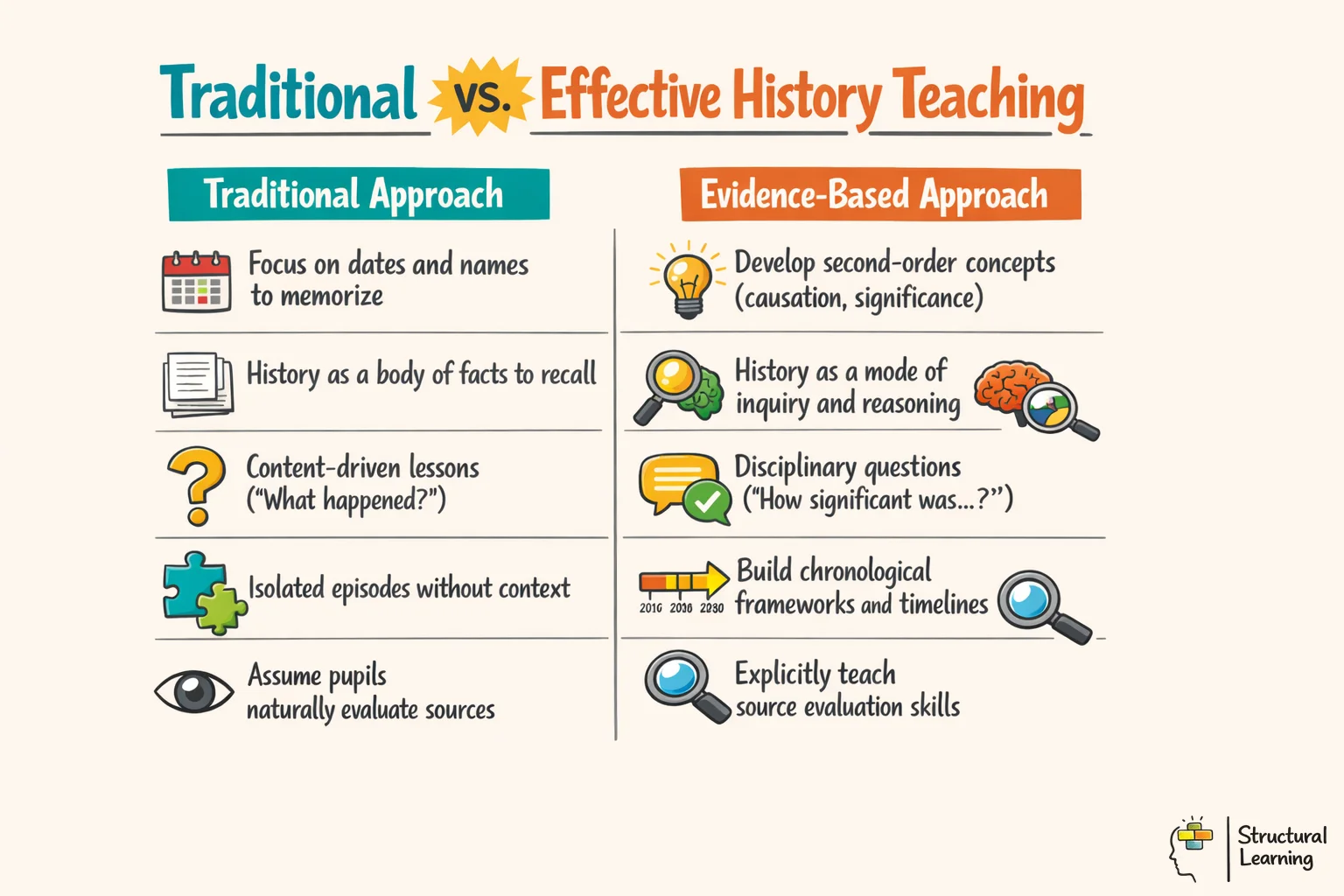
History teachers face a peculiar challenge: the subject is inherently engaging, yet pupils often reduce it to a list of dates and names to memorise for an exam. The problem is not the content but the way we frame the discipline. When history is taught as a body of facts rather than a mode of inquiry, pupils learn to recall rather than to reason. This guide sets out what the research says about effective history teaching and translates it into classroom practice.
Key Takeaways
History is thinking, not memorising dates: Effective history teaching develops second-order concepts (causation, change, significance, evidence) alongside substantive knowledge of events and periods.
Chronological frameworks matter: Pupils who lack a mental timeline struggle to place events in context. Building and revisiting chronological schemas prevents isolated fact learning.
Source work requires explicit teaching: Pupils do not naturally evaluate sources for reliability or bias. They need structured approaches, modelled examples, and scaffolded questioning.
Retrieval strengthens historical knowledge: Regular low-stakes quizzes on previously taught periods prevent the forgetting curve from erasing hard-won knowledge.
Historical Thinking: Beyond Memorisation
The historian Sam Wineburg (2001) described historical thinking as an "unnatural act." Most people approach the past through a lens of present-day assumptions, judging historical actors by contemporary standards and treating evidence as confirmation of what they already believe. Teaching pupils to think historically means explicitly disrupting these habits. It requires deliberate instruction, not just exposure to interesting content.
Historical thinking is organised around two types of knowledge. Substantive knowledge refers to the content of history: events, people, places, and periods. Second-order concepts refer to the disciplinary tools historians use: causation, change and continuity, significance, evidence, and interpretation. Pupils need both. A pupil who knows the causes of the First World War but cannot explain what "cause" means as a historical concept will struggle with any unfamiliar question (Lee and Ashby, 2000).
In practice, this means designing lessons around disciplinary questions, not just content coverage. Instead of "What happened at the Battle of the Somme?", ask "How significant was the Somme in changing attitudes to the war?" The second question requires pupils to deploy their knowledge rather than simply reproduce it. It also signals to pupils that history is a subject in which they reason, not one in which they receive.
A useful classroom routine is to display a second-order concept at the start of each lesson and return to it explicitly at the end. In a Year 8 lesson on the abolition of the slave trade, the concept might be "significance." Ask pupils to rate the significance of three different factors on a scale of one to five, then justify their rating in two sentences. This embeds the disciplinary vocabulary and gives pupils a framework for thinking before they write extended answers.
Building Chronological Understanding
Chronological understanding is the scaffolding on which all other historical knowledge hangs. Without a mental timeline, pupils experience history as a series of disconnected episodes rather than a developing story. Research on schema development shows that new information is retained more effectively when it can be connected to an existing knowledge structure. In history, that structure is chronological sequence (Fordham, 2016).
The most effective approach is to build an explicit timeline at the start of each unit and return to it throughout. This does not mean a decorative display on the wall that pupils ignore. It means an active tool that pupils annotate, question, and revise. At the start of a unit on the Cold War, pupils might place six events on a blank timeline with only start and end years marked. They correct errors as they learn more, which itself becomes a retrieval exercise.
Timelines also help pupils grasp the concept of change and continuity, which is consistently one of the most challenging second-order concepts. When pupils can see visually that some things changed rapidly (European borders after 1918) while others remained stable (the power of the Catholic Church across three centuries), they develop a more nuanced historical understanding. Dual coding, combining the verbal explanation with the visual representation, strengthens retention (Clark and Paivio, 1991). For a deeper account of how visual representations work alongside text, see the guide on dual coding.
A practical activity: give pupils a set of 12 event cards from a period they have just studied. Ask them to sort the cards into chronological order without notes, then check against their exercise books. The sorting task activates prior knowledge, the checking creates a feedback loop, and the discussion of disagreements deepens understanding of sequence and consequence. Keep the activity brief (eight to ten minutes) and use it regularly so the skill becomes automatic.
Teaching Source Analysis and Evidence
Source analysis is the skill most associated with history in the public imagination, yet it is also the one most poorly taught. The typical lesson pattern, read the source, answer three comprehension questions, write a paragraph about reliability, produces mechanical responses rather than genuine historical reasoning. Pupils learn to spot that a source is "biased" without understanding why bias is not automatically a problem for the historian (Wineburg, 2001).
Explicit instruction is needed. Pupils require a structured approach to sourcing, contextualisation, and corroboration before they can work independently. Sourcing means asking who produced this source, for what purpose, and in what context. Contextualisation means asking what else was happening at the time that might explain what is and is not in this source. Corroboration means asking whether other sources support or contradict this account and what the discrepancies might reveal.
Model the process before releasing pupils to work alone. Project a source on the board and think aloud as you work through each stage. Name what you are doing: "I am now sourcing this document, which means I am thinking about the author's position and purpose." This explicit labelling is crucial. Research on scaffolding shows that naming the cognitive process helps pupils transfer the skill to new contexts. Without the label, pupils see only a completed analysis, not the thinking behind it.
Give pupils a structured template for their first several attempts at source analysis: three rows, one for each stage, with a sentence stem in each. "The author of this source is... and their purpose was..." Once pupils can complete the template without prompting, begin removing the sentence stems while keeping the row structure. Finally, ask pupils to produce their own structure. This gradual release is essential for building independence with a genuinely complex skill. For strategies on framing questions that push pupils into deeper analysis, the guide on questioning strategies offers practical approaches.
Historical Thinking Concepts: A Classroom Reference
Concept
Definition
Common Pupil Mistake
Teaching Strategy
Causation
Why events happened; the relationship between factors and outcomes
Listing causes without explaining the connections between them
Use causation diagrams that require pupils to draw arrows and label the relationship, not just list factors
Change and Continuity
What changed over a period, what stayed the same, and at what rate
Treating all change as equally significant; ignoring continuity entirely
Dual-axis grids where pupils plot rate and extent of change separately for different aspects of life
Significance
How important an event or person was; to whom and by what criteria
Conflating importance with fame; assuming significance is self-evident
Teach explicit criteria (scale, durability, contemporary impact) and ask pupils to justify their significance rating against each one
Evidence
The sources historians use and the process of drawing inferences from them
Dismissing biased sources as useless; treating all sources as equally reliable
Model sourcing, contextualisation, and corroboration explicitly before asking pupils to attempt independently
Interpretation
How historians construct different accounts from the same evidence
Assuming one interpretation is simply correct and others are wrong
Present two contrasting historical interpretations and ask pupils to identify the questions each historian was asking and the evidence each prioritised
Common Historical Misconceptions
History classrooms are fertile ground for misconceptions because the subject deals with human experience, which pupils instinctively interpret through their own experience. Three misconceptions recur across age groups and are worth addressing directly rather than hoping they will resolve themselves through exposure to correct content.
The first is presentism: judging historical actors by the moral standards of the present. Pupils routinely describe medieval peasants as "stupid" for believing in witchcraft or condemn Victorian factory owners without asking what alternatives were available to them. Presentism prevents genuine historical empathy and distorts causal analysis. The remedy is explicit discussion of what people at the time knew, believed, and valued. Ask pupils: "What would you have believed if you had been born in this time and place, with access only to what was known then?"
The second misconception is the "great man" theory of history, the belief that events are driven primarily by the decisions of a small number of exceptional individuals. This makes causal analysis shallow. A lesson on the causes of the Second World War that centres solely on Hitler's decisions misses the structural economic, social, and political factors that made his rise possible. Counteract this by always asking pupils to identify at least one non-human cause alongside any individual one. The cognitive load of holding multiple causal factors simultaneously is high, so use graphic organisers to reduce the processing demand.
The third misconception is the idea that history is fixed and agreed upon. Many pupils believe that historians simply discover what happened rather than constructing interpretations from fragmentary evidence. Exposing pupils to two genuinely contrasting academic interpretations of the same event, presented side by side, is the most direct cure. Choose a topic they have already studied in detail so that their knowledge base is strong enough to evaluate the competing claims rather than simply accepting the more recent or confident-sounding one.
Addressing misconceptions requires more than correction. Research on conceptual change (Vosniadou, 2013) shows that simply telling pupils they are wrong does not dislodge entrenched beliefs. You need to create cognitive conflict: a moment when the pupil's existing belief produces a prediction that the evidence clearly contradicts. Plan for this deliberately. Ask pupils to make a prediction before revealing the historical reality, then discuss why their assumption led them astray.
Retrieval Practice for History
History has a memory problem. Pupils study the First World War in Year 9, then return to it in Year 12 to find that most of what they learned has faded. This is not a sign of poor teaching; it is a predictable consequence of the forgetting curve. The solution is systematic retrieval practice: regularly bringing previously learned material back to mind rather than assuming it is retained because it was once taught.
Low-stakes quizzing is the most accessible retrieval tool for history teachers. At the start of each lesson, ask five questions about content from the previous week, previous month, and previous term. This spacing across time intervals is crucial. Retrieving information after a short delay strengthens memory more than retrieving it immediately. Roediger and Butler (2011) found that students who took a practice test after a delay retained significantly more material one week later than those who simply restudied. The principle applies directly to historical knowledge.
The content of retrieval quizzes matters. Avoid questions that test only surface facts ("In what year did the Berlin Wall fall?") and include questions that require pupils to use their knowledge ("Give two reasons why the Berlin Wall was built and explain why one was more important than the other"). The second type of question retrieves both substantive knowledge and second-order reasoning, making the retrieval attempt richer and the memory trace stronger. This aligns with what the research on spaced practice shows about the value of distributing review across a course.
Brain dumps are a useful complementary technique. Give pupils a blank page and ask them to write everything they can remember about a period studied several weeks earlier. After two minutes, ask pupils to compare their output with a partner, then reveal a knowledge organiser for the period. The gaps between what they recalled and what the knowledge organiser contains become the focus for the next ten minutes of re-teaching. This approach connects retrieval practice to responsive teaching without requiring elaborate preparation. For a broader account of how memory works in classroom contexts, see the guide on working memory.
Narrative and Causation in History
Narrative is often seen as the enemy of analytical history teaching: a return to storytelling that bypasses rigorous thinking. This is a false opposition. Strong narrative and strong analysis are complementary. Pupils who cannot construct a coherent narrative of events cannot write analytical essays about them, because they lack the causal structure on which analysis depends. The question is not whether to use narrative but how to use it analytically (Counsell, 2000).
Teach pupils explicitly that historical narratives are constructions, not transcriptions. A narrative involves selection (what to include and exclude), sequencing (what order to present events in), and interpretation (what to say about the relationship between events). These are the same decisions that historians make, just at a larger scale. When a Year 10 class writes an account of the causes of the First World War, they are making all three of these decisions whether they realise it or not. Making those decisions visible is the first step towards teaching pupils to make them well.
Causation is the conceptual core of historical narrative. Research consistently shows that pupils struggle with multi-causal explanation, particularly with weighing causes against each other. Chapman (2021) argues that pupils need explicit frameworks for thinking about causation before they can produce sophisticated written analysis. One effective framework distinguishes between long-term causes (the underlying conditions that made an event possible), short-term causes (the triggers that set events in motion), and contingent causes (the accidents and individual decisions that could have gone differently). Applying this framework to a well-known event first, then to a less familiar one, builds transferable analytical skill.
A practical activity for teaching causal reasoning: give pupils eight cause cards for a historical event and ask them to sort them into the three categories above. Then ask them to rank the top two causes from each category and explain their choices in a paragraph. The sorting task reduces cognitive load by externalising the initial categorisation, leaving working memory free for the evaluative reasoning. The paragraph task then requires pupils to articulate their reasoning in writing, which consolidates the thinking. Graphic organisers can support this categorisation work effectively; see the guide on graphic organisers for templates.
History and Ofsted Deep Dives
Ofsted's subject-specific deep dives ask history departments to articulate their curriculum intent clearly. Inspectors want to understand what the curriculum is designed to achieve, how it is sequenced, and whether pupils are developing historical knowledge and skills in a cumulative and coherent way. Departments that cannot answer these questions clearly tend to struggle in deep dives, regardless of how good individual lessons are.
Curriculum intent for history should specify both the substantive content pupils will study and the second-order concepts they will develop across the key stage. A vague statement such as "we want pupils to understand the past" is insufficient. A stronger statement might read: "By the end of Key Stage 3, pupils will have studied British, European, and world history across a chronological range from the medieval period to the present day. They will have developed the ability to construct multi-causal explanations, evaluate historical interpretations, and analyse sources using the concepts of sourcing, contextualisation, and corroboration." This gives inspectors something concrete to verify against classroom practice.
Sequencing is the most scrutinised element of the deep dive. Inspectors will ask why topics are taught in a particular order and how later content builds on earlier content. A department that teaches the First World War in Year 9 and the Congress of Vienna in Year 8 needs to be able to explain how the earlier unit creates the knowledge base for the later one. Without a coherent answer, the sequence looks arbitrary. Consider mapping the second-order concepts as well as the substantive content to show how complexity builds over time.
Pupils themselves are interviewed in Ofsted deep dives. Train pupils to use the disciplinary vocabulary of the subject. Ask them regularly: "What second-order concept are we working on today?" and "How does this lesson connect to what we studied last term?" This metacognitive habit, articulating what they are learning and why it is sequenced as it is, prepares pupils for the kind of questions an inspector might ask. It also deepens their own understanding. For practical strategies on developing this kind of reflective awareness, see the guide on metacognition.
Subject leaders should ensure that their assessment model aligns with the curriculum intent. If the curriculum claims to develop second-order historical thinking, the assessments should require pupils to demonstrate that thinking, not merely recall content. An essay question asking pupils to "explain why the Roman Empire fell" assesses both substantive knowledge and causal reasoning. A multiple-choice quiz on Roman emperors assesses only recall. Both have their place, but the balance should reflect what the department says it values. The principles of direct instruction are useful here: explicit modelling of the target performance before asking pupils to produce it independently ensures assessment is genuinely diagnostic rather than merely discriminatory.
Applying Cognitive Science to History Lessons
The history classroom is an excellent setting for applying interleaving, the practice of mixing different topics or types of problem within a single study session rather than blocking all practice on one topic before moving to the next. In history, this might mean a revision lesson that moves between the causes of one war, the significance of a key individual from a different period, and source analysis from a third topic. Blocked practice feels more comfortable, but interleaved practice produces better long-term retention (Kornell and Bjork, 2008).
Schema-building is equally important. Pupils who have rich schemas for a historical period, connected networks of knowledge about its political, social, and economic dimensions, can place new information quickly and accurately. When a Year 9 pupil already has a strong schema for interwar Germany, the introduction of a new source about the 1923 hyperinflation crisis lands in a pre-existing context rather than floating in isolation. Building these schemas requires revisiting periods from multiple angles across a unit rather than covering each topic once. The guide on schema theory explains the underlying cognitive mechanism in detail.
Knowledge organisers have become standard in many history departments, but their value depends entirely on how they are used. A knowledge organiser that pupils copy out once and file away provides minimal benefit. A knowledge organiser used as the source material for weekly retrieval quizzes, brain dumps, and self-testing routines becomes a genuinely powerful tool. Consider building a rotating retrieval schedule into the department's scheme of work so that key content is tested at spaced intervals across the year. This removes the burden of remembering from individual teachers and makes retrieval practice a structural feature of the curriculum rather than an individual habit.
Further Reading: Key Papers on History Education
The following works represent the strongest research base for evidence-informed history teaching. Each is cited by practitioners and researchers working at the intersection of history education and cognitive science.
Progression in Historical Understanding Among Students Ages 7-14View study ↗ Foundational study
Lee, P. and Ashby, R. (2000)
Lee and Ashby's analysis of how pupils aged 7 to 14 develop historical understanding remains the most influential framework for thinking about progression in history education. Their research identified distinct stages in pupils' ability to work with evidence and construct historical explanations, and it underpins the second-order concept model used in most English history curricula today. Particularly useful for departments designing Key Stage 3 assessments that genuinely track development over time.
Historical Thinking and Other Unnatural ActsView study ↗ Essential reading
Wineburg, S. (2001)
Wineburg's book-length argument that historical thinking requires deliberate cultivation rather than natural development is essential reading for any history teacher. His studies of expert historians and novice students reading the same documents reveal just how differently trained readers approach evidence. The chapter on presentism offers the most useful classroom-applicable analysis of why pupils struggle to think in genuinely historical terms, with specific suggestions for what to do about it.
Knowing History in SchoolsView study ↗ Current practice
Chapman, A. (2021)
Chapman's UCL Press volume, available open-access, addresses the relationship between substantive and disciplinary knowledge in history education with unusual clarity and precision. His analysis of how pupils develop causal reasoning provides a direct theoretical foundation for the classroom strategies described in this guide. The chapters on curriculum design are particularly relevant for heads of department preparing for Ofsted deep dives, as Chapman's framework maps directly onto the questions inspectors ask about sequence and intent.
Historical Knowledge and Historical Skills: A Distracting DichotomyView study ↗ Influential chapter
Counsell, C. (2000)
Counsell's chapter directly challenges the assumption that history teachers must choose between teaching knowledge and teaching skills. Her argument that substantive knowledge and second-order concepts are mutually dependent, not competing priorities, has shaped a generation of curriculum thinking in English history departments. The practical implication for classroom teachers is clear: activities that develop disciplinary thinking must be built on a secure knowledge base, and a secure knowledge base only becomes useful when pupils have the tools to deploy it analytically.
Knowledge and Language: Being Historical with Substantive ConceptsView study ↗ Advanced practice
Fordham, M. (2016)
Fordham's chapter addresses a problem that many history teachers recognise but find difficult to articulate: pupils who know a great deal of historical content but cannot use the specific vocabulary of the discipline with precision. His analysis of how substantive concepts (words like "revolution," "empire," or "democracy") carry historical meaning that must be taught explicitly offers a practical corrective to approaches that assume vocabulary is acquired through reading alone. Essential for departments working on extended writing and for teachers preparing pupils for the demands of GCSE and A-level examination language.
History teachers face a peculiar challenge: the subject is inherently engaging, yet pupils often reduce it to a list of dates and names to memorise for an exam. The problem is not the content but the way we frame the discipline. When history is taught as a body of facts rather than a mode of inquiry, pupils learn to recall rather than to reason. This guide sets out what the research says about effective history teaching and translates it into classroom practice.
Key Takeaways
History is thinking, not memorising dates: Effective history teaching develops second-order concepts (causation, change, significance, evidence) alongside substantive knowledge of events and periods.
Chronological frameworks matter: Pupils who lack a mental timeline struggle to place events in context. Building and revisiting chronological schemas prevents isolated fact learning.
Source work requires explicit teaching: Pupils do not naturally evaluate sources for reliability or bias. They need structured approaches, modelled examples, and scaffolded questioning.
Retrieval strengthens historical knowledge: Regular low-stakes quizzes on previously taught periods prevent the forgetting curve from erasing hard-won knowledge.
Historical Thinking: Beyond Memorisation
The historian Sam Wineburg (2001) described historical thinking as an "unnatural act." Most people approach the past through a lens of present-day assumptions, judging historical actors by contemporary standards and treating evidence as confirmation of what they already believe. Teaching pupils to think historically means explicitly disrupting these habits. It requires deliberate instruction, not just exposure to interesting content.
Historical thinking is organised around two types of knowledge. Substantive knowledge refers to the content of history: events, people, places, and periods. Second-order concepts refer to the disciplinary tools historians use: causation, change and continuity, significance, evidence, and interpretation. Pupils need both. A pupil who knows the causes of the First World War but cannot explain what "cause" means as a historical concept will struggle with any unfamiliar question (Lee and Ashby, 2000).
In practice, this means designing lessons around disciplinary questions, not just content coverage. Instead of "What happened at the Battle of the Somme?", ask "How significant was the Somme in changing attitudes to the war?" The second question requires pupils to deploy their knowledge rather than simply reproduce it. It also signals to pupils that history is a subject in which they reason, not one in which they receive.
A useful classroom routine is to display a second-order concept at the start of each lesson and return to it explicitly at the end. In a Year 8 lesson on the abolition of the slave trade, the concept might be "significance." Ask pupils to rate the significance of three different factors on a scale of one to five, then justify their rating in two sentences. This embeds the disciplinary vocabulary and gives pupils a framework for thinking before they write extended answers.
Building Chronological Understanding
Chronological understanding is the scaffolding on which all other historical knowledge hangs. Without a mental timeline, pupils experience history as a series of disconnected episodes rather than a developing story. Research on schema development shows that new information is retained more effectively when it can be connected to an existing knowledge structure. In history, that structure is chronological sequence (Fordham, 2016).
The most effective approach is to build an explicit timeline at the start of each unit and return to it throughout. This does not mean a decorative display on the wall that pupils ignore. It means an active tool that pupils annotate, question, and revise. At the start of a unit on the Cold War, pupils might place six events on a blank timeline with only start and end years marked. They correct errors as they learn more, which itself becomes a retrieval exercise.
Timelines also help pupils grasp the concept of change and continuity, which is consistently one of the most challenging second-order concepts. When pupils can see visually that some things changed rapidly (European borders after 1918) while others remained stable (the power of the Catholic Church across three centuries), they develop a more nuanced historical understanding. Dual coding, combining the verbal explanation with the visual representation, strengthens retention (Clark and Paivio, 1991). For a deeper account of how visual representations work alongside text, see the guide on dual coding.
A practical activity: give pupils a set of 12 event cards from a period they have just studied. Ask them to sort the cards into chronological order without notes, then check against their exercise books. The sorting task activates prior knowledge, the checking creates a feedback loop, and the discussion of disagreements deepens understanding of sequence and consequence. Keep the activity brief (eight to ten minutes) and use it regularly so the skill becomes automatic.
Teaching Source Analysis and Evidence
Source analysis is the skill most associated with history in the public imagination, yet it is also the one most poorly taught. The typical lesson pattern, read the source, answer three comprehension questions, write a paragraph about reliability, produces mechanical responses rather than genuine historical reasoning. Pupils learn to spot that a source is "biased" without understanding why bias is not automatically a problem for the historian (Wineburg, 2001).
Explicit instruction is needed. Pupils require a structured approach to sourcing, contextualisation, and corroboration before they can work independently. Sourcing means asking who produced this source, for what purpose, and in what context. Contextualisation means asking what else was happening at the time that might explain what is and is not in this source. Corroboration means asking whether other sources support or contradict this account and what the discrepancies might reveal.
Model the process before releasing pupils to work alone. Project a source on the board and think aloud as you work through each stage. Name what you are doing: "I am now sourcing this document, which means I am thinking about the author's position and purpose." This explicit labelling is crucial. Research on scaffolding shows that naming the cognitive process helps pupils transfer the skill to new contexts. Without the label, pupils see only a completed analysis, not the thinking behind it.
Give pupils a structured template for their first several attempts at source analysis: three rows, one for each stage, with a sentence stem in each. "The author of this source is... and their purpose was..." Once pupils can complete the template without prompting, begin removing the sentence stems while keeping the row structure. Finally, ask pupils to produce their own structure. This gradual release is essential for building independence with a genuinely complex skill. For strategies on framing questions that push pupils into deeper analysis, the guide on questioning strategies offers practical approaches.
Historical Thinking Concepts: A Classroom Reference
Concept
Definition
Common Pupil Mistake
Teaching Strategy
Causation
Why events happened; the relationship between factors and outcomes
Listing causes without explaining the connections between them
Use causation diagrams that require pupils to draw arrows and label the relationship, not just list factors
Change and Continuity
What changed over a period, what stayed the same, and at what rate
Treating all change as equally significant; ignoring continuity entirely
Dual-axis grids where pupils plot rate and extent of change separately for different aspects of life
Significance
How important an event or person was; to whom and by what criteria
Conflating importance with fame; assuming significance is self-evident
Teach explicit criteria (scale, durability, contemporary impact) and ask pupils to justify their significance rating against each one
Evidence
The sources historians use and the process of drawing inferences from them
Dismissing biased sources as useless; treating all sources as equally reliable
Model sourcing, contextualisation, and corroboration explicitly before asking pupils to attempt independently
Interpretation
How historians construct different accounts from the same evidence
Assuming one interpretation is simply correct and others are wrong
Present two contrasting historical interpretations and ask pupils to identify the questions each historian was asking and the evidence each prioritised
Common Historical Misconceptions
History classrooms are fertile ground for misconceptions because the subject deals with human experience, which pupils instinctively interpret through their own experience. Three misconceptions recur across age groups and are worth addressing directly rather than hoping they will resolve themselves through exposure to correct content.
The first is presentism: judging historical actors by the moral standards of the present. Pupils routinely describe medieval peasants as "stupid" for believing in witchcraft or condemn Victorian factory owners without asking what alternatives were available to them. Presentism prevents genuine historical empathy and distorts causal analysis. The remedy is explicit discussion of what people at the time knew, believed, and valued. Ask pupils: "What would you have believed if you had been born in this time and place, with access only to what was known then?"
The second misconception is the "great man" theory of history, the belief that events are driven primarily by the decisions of a small number of exceptional individuals. This makes causal analysis shallow. A lesson on the causes of the Second World War that centres solely on Hitler's decisions misses the structural economic, social, and political factors that made his rise possible. Counteract this by always asking pupils to identify at least one non-human cause alongside any individual one. The cognitive load of holding multiple causal factors simultaneously is high, so use graphic organisers to reduce the processing demand.
The third misconception is the idea that history is fixed and agreed upon. Many pupils believe that historians simply discover what happened rather than constructing interpretations from fragmentary evidence. Exposing pupils to two genuinely contrasting academic interpretations of the same event, presented side by side, is the most direct cure. Choose a topic they have already studied in detail so that their knowledge base is strong enough to evaluate the competing claims rather than simply accepting the more recent or confident-sounding one.
Addressing misconceptions requires more than correction. Research on conceptual change (Vosniadou, 2013) shows that simply telling pupils they are wrong does not dislodge entrenched beliefs. You need to create cognitive conflict: a moment when the pupil's existing belief produces a prediction that the evidence clearly contradicts. Plan for this deliberately. Ask pupils to make a prediction before revealing the historical reality, then discuss why their assumption led them astray.
Retrieval Practice for History
History has a memory problem. Pupils study the First World War in Year 9, then return to it in Year 12 to find that most of what they learned has faded. This is not a sign of poor teaching; it is a predictable consequence of the forgetting curve. The solution is systematic retrieval practice: regularly bringing previously learned material back to mind rather than assuming it is retained because it was once taught.
Low-stakes quizzing is the most accessible retrieval tool for history teachers. At the start of each lesson, ask five questions about content from the previous week, previous month, and previous term. This spacing across time intervals is crucial. Retrieving information after a short delay strengthens memory more than retrieving it immediately. Roediger and Butler (2011) found that students who took a practice test after a delay retained significantly more material one week later than those who simply restudied. The principle applies directly to historical knowledge.
The content of retrieval quizzes matters. Avoid questions that test only surface facts ("In what year did the Berlin Wall fall?") and include questions that require pupils to use their knowledge ("Give two reasons why the Berlin Wall was built and explain why one was more important than the other"). The second type of question retrieves both substantive knowledge and second-order reasoning, making the retrieval attempt richer and the memory trace stronger. This aligns with what the research on spaced practice shows about the value of distributing review across a course.
Brain dumps are a useful complementary technique. Give pupils a blank page and ask them to write everything they can remember about a period studied several weeks earlier. After two minutes, ask pupils to compare their output with a partner, then reveal a knowledge organiser for the period. The gaps between what they recalled and what the knowledge organiser contains become the focus for the next ten minutes of re-teaching. This approach connects retrieval practice to responsive teaching without requiring elaborate preparation. For a broader account of how memory works in classroom contexts, see the guide on working memory.
Narrative and Causation in History
Narrative is often seen as the enemy of analytical history teaching: a return to storytelling that bypasses rigorous thinking. This is a false opposition. Strong narrative and strong analysis are complementary. Pupils who cannot construct a coherent narrative of events cannot write analytical essays about them, because they lack the causal structure on which analysis depends. The question is not whether to use narrative but how to use it analytically (Counsell, 2000).
Teach pupils explicitly that historical narratives are constructions, not transcriptions. A narrative involves selection (what to include and exclude), sequencing (what order to present events in), and interpretation (what to say about the relationship between events). These are the same decisions that historians make, just at a larger scale. When a Year 10 class writes an account of the causes of the First World War, they are making all three of these decisions whether they realise it or not. Making those decisions visible is the first step towards teaching pupils to make them well.
Causation is the conceptual core of historical narrative. Research consistently shows that pupils struggle with multi-causal explanation, particularly with weighing causes against each other. Chapman (2021) argues that pupils need explicit frameworks for thinking about causation before they can produce sophisticated written analysis. One effective framework distinguishes between long-term causes (the underlying conditions that made an event possible), short-term causes (the triggers that set events in motion), and contingent causes (the accidents and individual decisions that could have gone differently). Applying this framework to a well-known event first, then to a less familiar one, builds transferable analytical skill.
A practical activity for teaching causal reasoning: give pupils eight cause cards for a historical event and ask them to sort them into the three categories above. Then ask them to rank the top two causes from each category and explain their choices in a paragraph. The sorting task reduces cognitive load by externalising the initial categorisation, leaving working memory free for the evaluative reasoning. The paragraph task then requires pupils to articulate their reasoning in writing, which consolidates the thinking. Graphic organisers can support this categorisation work effectively; see the guide on graphic organisers for templates.
History and Ofsted Deep Dives
Ofsted's subject-specific deep dives ask history departments to articulate their curriculum intent clearly. Inspectors want to understand what the curriculum is designed to achieve, how it is sequenced, and whether pupils are developing historical knowledge and skills in a cumulative and coherent way. Departments that cannot answer these questions clearly tend to struggle in deep dives, regardless of how good individual lessons are.
Curriculum intent for history should specify both the substantive content pupils will study and the second-order concepts they will develop across the key stage. A vague statement such as "we want pupils to understand the past" is insufficient. A stronger statement might read: "By the end of Key Stage 3, pupils will have studied British, European, and world history across a chronological range from the medieval period to the present day. They will have developed the ability to construct multi-causal explanations, evaluate historical interpretations, and analyse sources using the concepts of sourcing, contextualisation, and corroboration." This gives inspectors something concrete to verify against classroom practice.
Sequencing is the most scrutinised element of the deep dive. Inspectors will ask why topics are taught in a particular order and how later content builds on earlier content. A department that teaches the First World War in Year 9 and the Congress of Vienna in Year 8 needs to be able to explain how the earlier unit creates the knowledge base for the later one. Without a coherent answer, the sequence looks arbitrary. Consider mapping the second-order concepts as well as the substantive content to show how complexity builds over time.
Pupils themselves are interviewed in Ofsted deep dives. Train pupils to use the disciplinary vocabulary of the subject. Ask them regularly: "What second-order concept are we working on today?" and "How does this lesson connect to what we studied last term?" This metacognitive habit, articulating what they are learning and why it is sequenced as it is, prepares pupils for the kind of questions an inspector might ask. It also deepens their own understanding. For practical strategies on developing this kind of reflective awareness, see the guide on metacognition.
Subject leaders should ensure that their assessment model aligns with the curriculum intent. If the curriculum claims to develop second-order historical thinking, the assessments should require pupils to demonstrate that thinking, not merely recall content. An essay question asking pupils to "explain why the Roman Empire fell" assesses both substantive knowledge and causal reasoning. A multiple-choice quiz on Roman emperors assesses only recall. Both have their place, but the balance should reflect what the department says it values. The principles of direct instruction are useful here: explicit modelling of the target performance before asking pupils to produce it independently ensures assessment is genuinely diagnostic rather than merely discriminatory.
Applying Cognitive Science to History Lessons
The history classroom is an excellent setting for applying interleaving, the practice of mixing different topics or types of problem within a single study session rather than blocking all practice on one topic before moving to the next. In history, this might mean a revision lesson that moves between the causes of one war, the significance of a key individual from a different period, and source analysis from a third topic. Blocked practice feels more comfortable, but interleaved practice produces better long-term retention (Kornell and Bjork, 2008).
Schema-building is equally important. Pupils who have rich schemas for a historical period, connected networks of knowledge about its political, social, and economic dimensions, can place new information quickly and accurately. When a Year 9 pupil already has a strong schema for interwar Germany, the introduction of a new source about the 1923 hyperinflation crisis lands in a pre-existing context rather than floating in isolation. Building these schemas requires revisiting periods from multiple angles across a unit rather than covering each topic once. The guide on schema theory explains the underlying cognitive mechanism in detail.
Knowledge organisers have become standard in many history departments, but their value depends entirely on how they are used. A knowledge organiser that pupils copy out once and file away provides minimal benefit. A knowledge organiser used as the source material for weekly retrieval quizzes, brain dumps, and self-testing routines becomes a genuinely powerful tool. Consider building a rotating retrieval schedule into the department's scheme of work so that key content is tested at spaced intervals across the year. This removes the burden of remembering from individual teachers and makes retrieval practice a structural feature of the curriculum rather than an individual habit.
Further Reading: Key Papers on History Education
The following works represent the strongest research base for evidence-informed history teaching. Each is cited by practitioners and researchers working at the intersection of history education and cognitive science.
Progression in Historical Understanding Among Students Ages 7-14View study ↗ Foundational study
Lee, P. and Ashby, R. (2000)
Lee and Ashby's analysis of how pupils aged 7 to 14 develop historical understanding remains the most influential framework for thinking about progression in history education. Their research identified distinct stages in pupils' ability to work with evidence and construct historical explanations, and it underpins the second-order concept model used in most English history curricula today. Particularly useful for departments designing Key Stage 3 assessments that genuinely track development over time.
Historical Thinking and Other Unnatural ActsView study ↗ Essential reading
Wineburg, S. (2001)
Wineburg's book-length argument that historical thinking requires deliberate cultivation rather than natural development is essential reading for any history teacher. His studies of expert historians and novice students reading the same documents reveal just how differently trained readers approach evidence. The chapter on presentism offers the most useful classroom-applicable analysis of why pupils struggle to think in genuinely historical terms, with specific suggestions for what to do about it.
Knowing History in SchoolsView study ↗ Current practice
Chapman, A. (2021)
Chapman's UCL Press volume, available open-access, addresses the relationship between substantive and disciplinary knowledge in history education with unusual clarity and precision. His analysis of how pupils develop causal reasoning provides a direct theoretical foundation for the classroom strategies described in this guide. The chapters on curriculum design are particularly relevant for heads of department preparing for Ofsted deep dives, as Chapman's framework maps directly onto the questions inspectors ask about sequence and intent.
Historical Knowledge and Historical Skills: A Distracting DichotomyView study ↗ Influential chapter
Counsell, C. (2000)
Counsell's chapter directly challenges the assumption that history teachers must choose between teaching knowledge and teaching skills. Her argument that substantive knowledge and second-order concepts are mutually dependent, not competing priorities, has shaped a generation of curriculum thinking in English history departments. The practical implication for classroom teachers is clear: activities that develop disciplinary thinking must be built on a secure knowledge base, and a secure knowledge base only becomes useful when pupils have the tools to deploy it analytically.
Knowledge and Language: Being Historical with Substantive ConceptsView study ↗ Advanced practice
Fordham, M. (2016)
Fordham's chapter addresses a problem that many history teachers recognise but find difficult to articulate: pupils who know a great deal of historical content but cannot use the specific vocabulary of the discipline with precision. His analysis of how substantive concepts (words like "revolution," "empire," or "democracy") carry historical meaning that must be taught explicitly offers a practical corrective to approaches that assume vocabulary is acquired through reading alone. Essential for departments working on extended writing and for teachers preparing pupils for the demands of GCSE and A-level examination language.