Updated on
September 21, 2026
IB Diploma vs Certificate: Differences and When to Switch
Understand the IB Diploma and Diploma Programme Course Results, what changes when a learner leaves the full Diploma, and what schools and families must check.


Updated on
September 21, 2026
Understand the IB Diploma and Diploma Programme Course Results, what changes when a learner leaves the full Diploma, and what schools and families must check.
An “IB certificate” is not a smaller version of the IB Diploma. The full Diploma is a complete programme award. Diploma Programme Course Results is the current formal term often meant by “IB certificate” (International Baccalaureate, 2026).
It reports a learner’s results in individual DP subjects. It does not award the Diploma or give an overall DP score.
This difference matters when a school reviews a learner’s route. It changes the expected results document. It also changes the questions that an intended university must answer. Confirm both before agreeing to any subject or registration change.
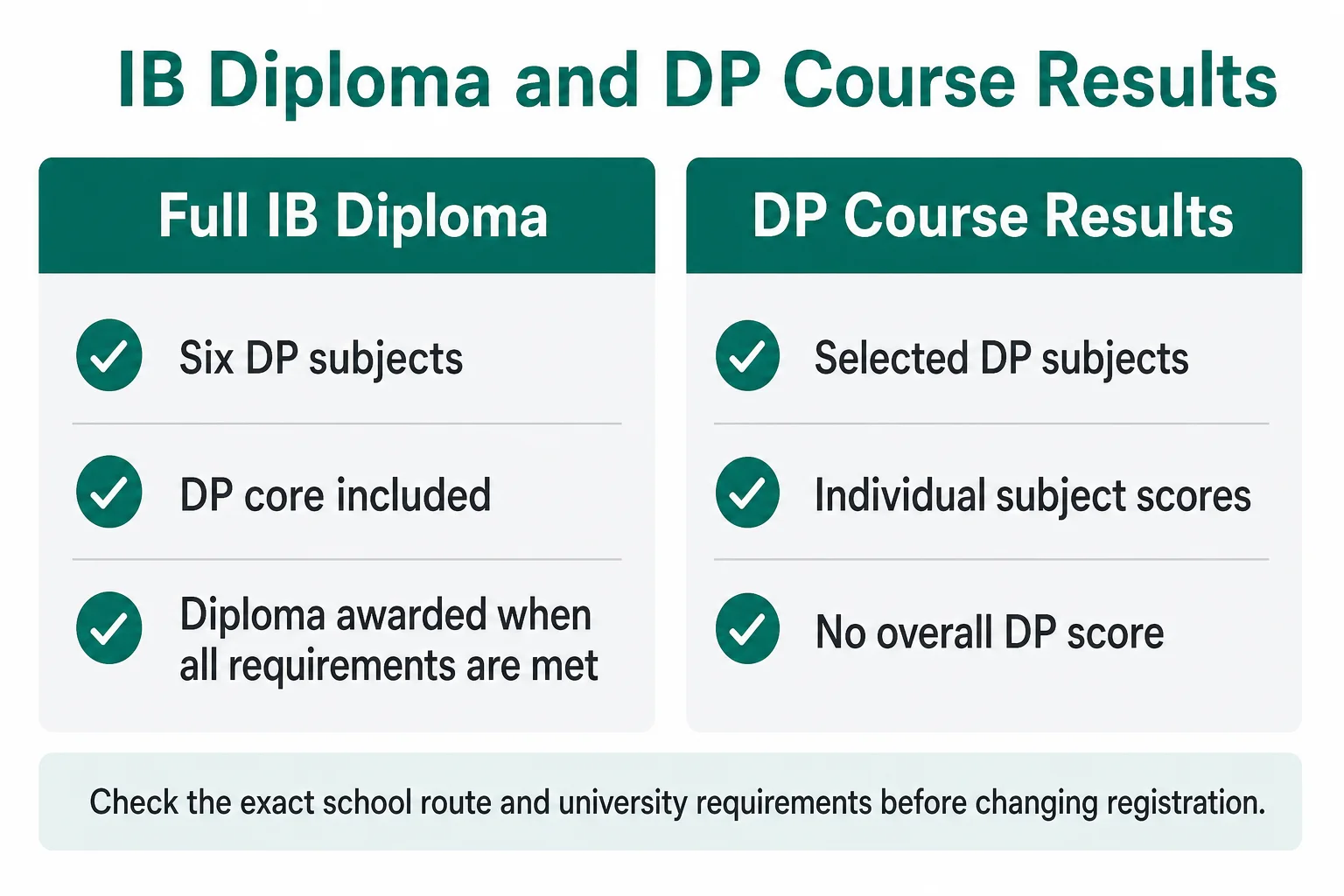
The full IB Diploma has six Diploma Programme subjects and the DP core. Learners who meet all requirements receive the Diploma and a DP results certificate. What many families call an “IB certificate” is now formally called Diploma Programme Course Results.
This document records individual subject results. It does not award the Diploma or show an overall DP score.
The terms matter because “certificate” can suggest a smaller Diploma. It is not a separate Diploma award. The IB states that a learner who completes the full DP receives two documents.
These are the Diploma and a DP results certificate. Selected-course learners receive DP Course Results. So do learners who do not fulfil the Diploma requirements.
These current IB results documents should guide the discussion (International Baccalaureate, 2026).
For wider context, see our International Baccalaureate overview. The rest of this guide explains the academic and administrative changes. It also sets out what schools and families should check before changing registration.
The main difference is the programme award. A Diploma candidate follows the full subject pattern and core. They must then meet the current award requirements. A course learner receives results for the DP subjects taken. These results show demanding study, but they do not combine into the IB Diploma.
On a phone, swipe across the table to compare both routes.
| Feature | Full IB Diploma | DP Course Results |
|---|---|---|
| Study pattern | Six DP subjects, normally including Higher Level and Standard Level study, plus the DP core. | One or more selected DP subjects at the level agreed with the school. |
| Core | Theory of Knowledge, the Extended Essay and Creativity, Activity, Service are Diploma requirements. | The DP core is not what creates an overall course award. A school may still offer related learning, but the coordinator must explain the local arrangement. |
| Results document | Successful full DP completers receive the Diploma and a DP results certificate. | The document lists individual course scores and does not show an overall DP score. |
| University use | Considered against the institution’s published Diploma, subject and grade conditions. | Considered according to whether the institution accepts individual DP subjects and what other qualification completes the learner’s entry profile. |
DP subjects use both external and internal assessment. The mix depends on the subject. Results use the IB scale.
The full Diploma also has rules for the combined subject and core outcome. Our guides to IB grades and Diploma points and IB assessment explain how this works. They avoid turning a school decision into a single-number rule.
The core is more than “extra work”. Each part has its own educational purpose. Schools can review our Theory of Knowledge guide, Extended Essay guide and Creativity, Activity, Service guide.
These guides can help staff locate the difficulty. It may involve unclear expectations, crowded deadlines or the complete programme pattern.
Some learners start with selected DP courses. Their school may provide this qualification mix, and their planned next step may accept it. This is a planned curriculum route, not a failed Diploma attempt. The school should define the full leaving qualification, subjects, levels and how universities will see each result.
A planned course route can combine individual DP subjects with another qualification. This may be a national school-leaving qualification or another recognised programme. Valid combinations depend on several local factors.
These include school authorisation, timetables, regulations and the admissions context. Families should not assume that every IB World School offers the same mix. Schools may also report or recognise the mix in different ways.
Use the school’s current subject offer with our Diploma Programme curriculum guide. Together, they can help identify possible subjects and levels. The coordinator must confirm what the school has timetabled and opened to the learner.
The coordinator, learner and family should record the precise subject names and levels. They should also record assessment sessions and the qualification beside the DP courses. Next, check how the intended university treats an individual DP subject. It may be an entry qualification, supporting evidence or neither.
This planning prevents a common source of confusion. “Taking IB” can mean completing the full Diploma. It can also mean taking several DP courses.
Sometimes, it only means attending a school that offers an IB programme. Applications need the precise route. The learner should name the expected qualification and avoid informal labels.
Leaving the full Diploma after registration is a formal change. It affects both the curriculum and school administration, so it is not the same as dropping one lesson. The coordinator must check registration, assessment entries, the remaining programme and the complete school-leaving qualification. Timing and available choices depend on the school, exam session and local rules.
A learner may find one Higher Level subject hard to access. They may fall behind across several parts of the programme. Their circumstances may also change after they start.
None of these points sets an automatic threshold for leaving the Diploma. Instead, they show that the school needs a structured review. That review should use current evidence, not promises about likely outcomes.
First, separate the possible causes. Review subject knowledge, completed assessments, attendance, language access, organisation and the timetable. Each cause needs a different response.
For example, a missed Extended Essay deadline differs from a mathematics gap. The second problem may affect entry to a target degree. A route change may be suitable.
However, it should not replace a fixable teaching, access or scheduling response.
List the subjects, levels, internal assessments and exams that would continue. Then note what replaces each removed subject or core requirement. The school should explain how completed work may count towards a reported result.
It should also state which deadlines remain. Finally, it should show how the revised route appears on reports, transcripts and applications.
Do not promise a fixed weekly reduction in work. The effect depends on what changes and what replaces it. Work already under way also matters.
Instead, make a calendar for the proposed route. Compare its remaining assessments with the learner’s current calendar.
Universities do not use one global rule for DP Course Results. Requirements vary by institution, country, degree and subject mix. Admissions teams may check the full Diploma and individual results.
They may also check Higher Level subjects, language evidence and other qualifications. The published requirement for the exact course is the key decision point.
The IB advises learners to research recognition for their intended destinations. They should not assume that recognition is the same everywhere (International Baccalaureate, 2026). A university may accept the full Diploma but not individual course results as an equal entry profile. Another may consider named DP subjects with a recognised national qualification.
Requirements can vary within one university. Engineering may name Higher Level Mathematics and Physics. Another degree may set different subject rules.
Regulated or highly selective courses can add more conditions. Check the current course page. Then ask admissions to confirm in writing how they would assess the learner’s exact qualification mix.
In the UK, tariff information can describe qualifications. However, it does not replace a university’s entry rules. Our IB points and UCAS Tariff guide explains this difference.
Other countries may use national recognition statements or equivalence rules. Legalisation rules may also affect the use of results.
Applicants should confirm which results document the university needs. They should also check how to send it and whether it needs legalisation. The IB provides routes for transcripts and legalisation.
However, document rules and deadlines vary (International Baccalaureate, 2026). The coordinator should check these details before application deadlines. Waiting until results arrive may be too late.
A sound process starts with the learner’s intended destination. It also needs a clear account of the current difficulty. The school should compare support within the Diploma with each available route.
It should check the effect on qualifications and record who verified each fact. The aim is a sound decision for one learner. It is not a general rule about resilience or ability.
This process guards against two opposite errors. A school may keep a learner on the Diploma because change feels like failure. It may also change registration before checking the learner’s next step. A good decision depends on verified fit, not the status of either route.
The IB Career-related Programme is a separate programme. It is not a step down from the Diploma Programme. It combines at least two DP courses with career-related study and the CP core.
The CP is only possible when a school offers the authorised programme. The school must also provide a suitable career-related pathway (International Baccalaureate, 2026).
The current CP core has four named parts for first teaching from August 2025. They are personal and professional skills, community engagement, language and cultural studies, and the reflective project (International Baccalaureate, 2026). Schools should use current IB documents. Older descriptions may not match the curriculum now being taught.
A school cannot call a reduced DP timetable the CP. A move between programmes may affect admissions, timetables and registration. It also depends on available career-related study.
If a school offers both programmes, the coordinator should explain whether transfer is possible. They should also check whether the CP fits the learner’s destination. If the school does not offer the CP, it cannot be a fallback.
Families need facts about the exact qualification. General reassurance about the IB is not enough. These questions form a clear checklist for a meeting with the coordinator. The school should answer them for the proposed route and record when another organisation must confirm an answer.
The IB explains how it recognises achievement and sends results. Yet the coordinator remains vital. The school controls its curriculum offer and registration process.
Families should leave with a written route, named actions and sources. A verbal recommendation is not enough.

This guide explains the key difference and offers a school decision process. It cannot decide if a route suits one learner. IB rules, school provision and university requirements can change.
The key claims and linked IB pages were reviewed on 21 August 2026. Readers must still check the current rules before acting.
This guide does not claim that course and Diploma learners have equal admissions outcomes. It also does not claim that a route change improves admission, attainment or wellbeing. Results depend on the learner’s circumstances and full qualification profile.
They also depend on the intended destination. Each admissions decision is specific to the applicant and course.
The clearest next step is one action: confirm the exact school route and university requirements before changing registration.
These official sources support the article’s key terms and results-document claims. They also support its assessment, university recognition and Career-related Programme content. We checked them for this candidate on 21 August 2026. The school must still confirm its provision. Families must also confirm admissions rules for the learner and intended destination.