Updated on
September 24, 2026
Reasonable Steps Before Incompatibility: A SENCO Guide
A practical SENCO guide to evidencing reasonable steps before an EHCP placement is treated as incompatible with efficient education of others.


Updated on
September 24, 2026
A practical SENCO guide to evidencing reasonable steps before an EHCP placement is treated as incompatible with efficient education of others.
Reasonable steps before incompatibility describes the adjustments a mainstream school or local authority must try before it says an EHCP placement would harm the education of others. Department for Education and Department of Health (2015) set a high bar: a school cannot refuse mainstream education just because support is hard to arrange. It must show that other learners' education would be harmed and that no reasonable step could remove that risk.
For example, a Year 8 learner who leaves their seat during independent writing should first trigger changes to the room, task, staffing and specialist advice, not an immediate refusal.
This article sets out five checks SENCOs should evidence before they speak to the local authority about placement suitability. These checks are environmental adjustment, curriculum access, staffing, external advice and APDR records. It is not legal advice. It gives leaders a safer audit trail for lawful and inclusive decision-making.
Legal source map in SENCO language. Consensus cache: not yet populated.
Current law
Section 33 protects a child's right to mainstream education. This changes only if the parent disagrees, or if the school cannot protect the efficient education of other learners after taking reasonable steps (Children and Families Act, 2014).
Recent case signal
AA v Hounslow makes section 33 clearer. It does not give a free-standing right to any preferred mainstream experience (Upper Tribunal, 2025).
SENCO rule
Record what changed, who reviewed it, what happened next and why the remaining impact could not be removed.
The phrase comes directly from the Children and Families Act 2014, section 33(2) (Children and Families Act, 2014). It sets the only ground on which a mainstream placement can lawfully be refused for a child with an EHCP whose parents have not requested an alternative. The SEND Code of Practice clarifies the test (Department for Education and Department of Health, 2015, para. 1.26): the placement must produce "incompatibility with the efficient education of others", and that incompatibility cannot be removed by reasonable steps the school could take.
Two things follow. First, the bar is incompatibility, not inconvenience. A learner who is challenging to teach, requires substantial adaptation, or stretches TA capacity does not meet the threshold. The Tribunal will ask whether other learners' education is being meaningfully harmed, not whether staff are working harder.
Second, reasonable steps come before incompatibility. You cannot jump to "this won't work" until you can show that the school has tried the adjustments a reasonable school would try.
This matters because most refusal cases fail because of the reasonable steps test, rather than the disruption itself. SEND Tribunals often find that schools claiming a child will disrupt learning have not tried all their options. In many cases, schools have not even attempted the basic adjustments listed in the SEND Code of Practice.
SENCOs need to separate two questions that are often merged in consultation responses. Section 39 deals with a parental request for a particular school. Section 33 deals with the wider duty to secure mainstream education when an EHC plan is being made or maintained.
The practical risk is that a school writes one broad refusal letter and mixes suitability, resource pressure and behaviour worries. That weakens the evidence. The local authority and Tribunal need to see which legal test is being addressed and what evidence supports it.
| Question | Main legal route | What evidence helps |
|---|---|---|
| Is the named school suitable for the learner's age, ability, aptitude and SEN? | Section 39 preference decision | Needs, Section F provision, staffing model, specialist advice and school capacity to deliver the specified provision. |
| Would attendance harm the efficient education of others? | Section 33 mainstream exception | Specific impact on known groups, duration, frequency, evidence of lost learning and reasonable steps already tried. |
| Are there reasonable steps that would remove the incompatibility? | Section 33 plus SEND Code paragraph 9.90 | Environmental changes, curriculum access, staffing, external advice, review data and reasons each remaining step is not reasonable. |
Question
Is the named school suitable for the learner's age, ability, aptitude and SEN?
Main route: Use the Section 39 preference decision. Evidence: Include the learner's needs, Section F provision, staffing model, specialist advice and capacity to deliver the specified provision.
Question
Would attendance harm the efficient education of others?
Main route: Section 33 mainstream exception. Evidence: show the specific impact on known groups, how long it lasts, how often it happens, evidence of lost learning and the reasonable steps already tried.
Question
Are there reasonable steps that would remove the incompatibility?
Main route: Use Section 33 with SEND Code paragraph 9.90. Evidence: Show environmental changes, curriculum access, staffing, external advice and review data. Also explain why each remaining step is not reasonable.
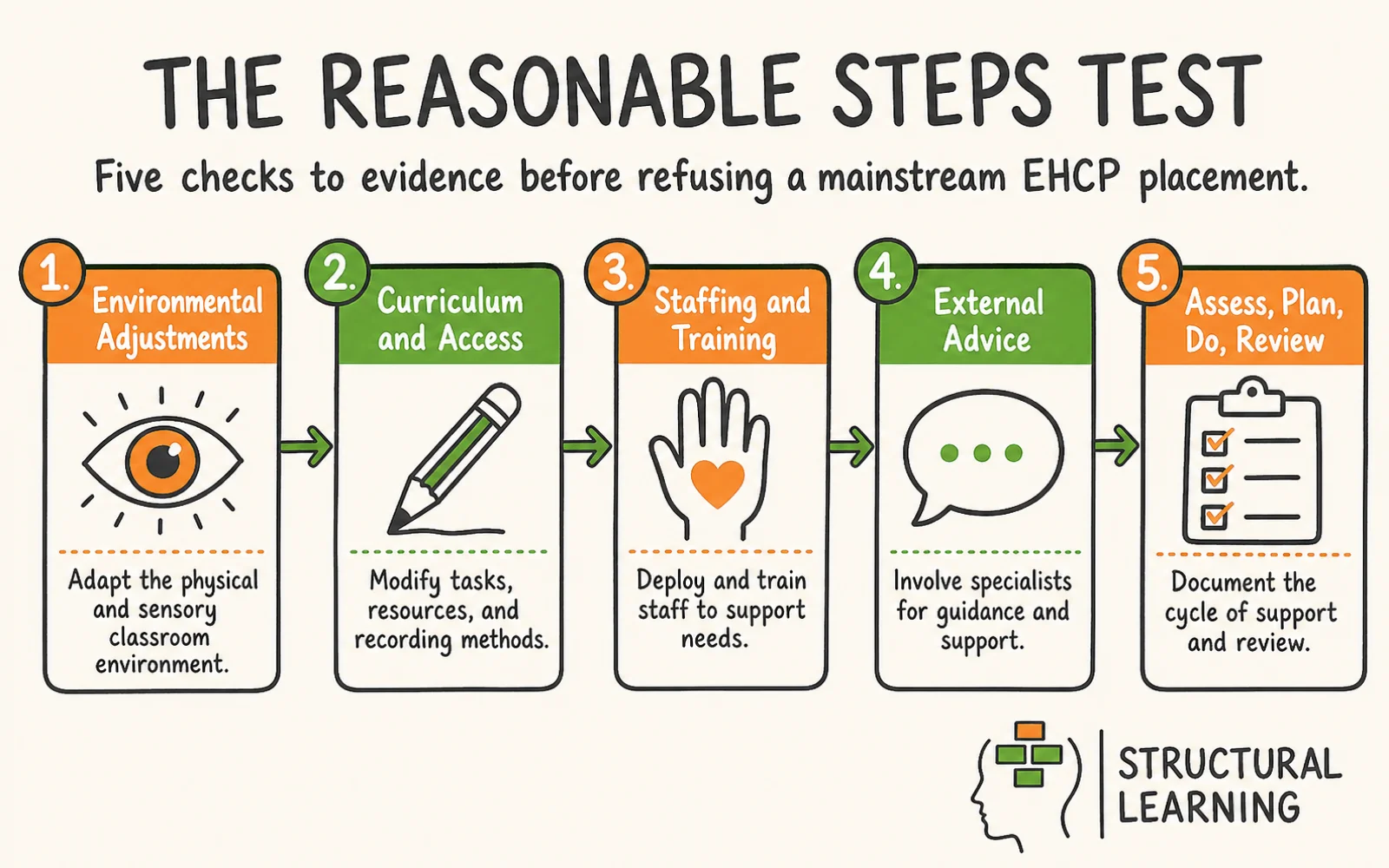
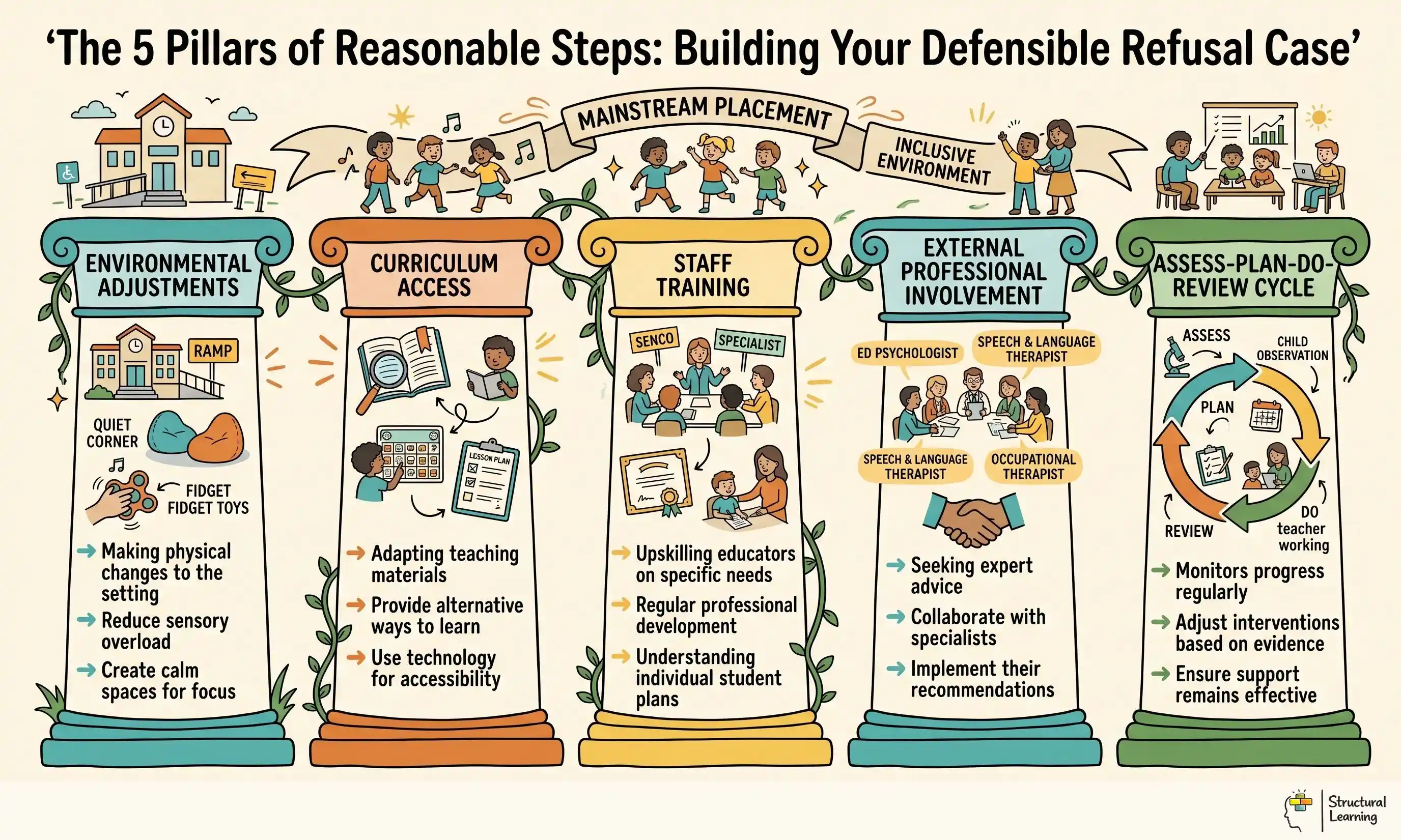
The SEND Code of Practice does not list reasonable steps in a single tidy table (Department for Education and Department of Health, 2015). They are scattered across chapters six and seven, in the regulations, and in Department for Education statutory guidance. The five categories below consolidate them into a usable audit framework. Schools that can evidence work in all five are in a defensible position.
The physical and sensory layout of the classroom is your first area for adjustment. Reasonable steps include providing visual timetables for learners who need a predictable routine. Teachers can also set up a quiet corner or use individual workstations to reduce visual overload. Other helpful changes involve offering sensory tools like ear defenders, or planning quiet routes through the school to avoid crowded corridors between lessons.
A school that has not tried any of these for a learner with sensory or behavioural needs will struggle to argue the placement is incompatible. The starting question at Tribunal is always: "What did you change about the environment first?"
The second category covers what happens once the learner is in the classroom. Teachers can take several reasonable steps to help. These include using worksheets that match the child's thinking level and offering different ways to record work, like voice notes or photos. Staff can also teach key words before the lesson and use technology like text-to-speech or symbol-supported reading to help learners show what they know.
These adjustments must be sustained, not one-off. A single trial of a coloured overlay does not count. The Tribunal looks for adjustments embedded in routine planning, evidenced by lesson resources and learner work over several weeks.
Schools often assume reasonable steps in staffing mean appointing a one-to-one TA. They do not. The SEND Code of Practice and EEF guidance warn against using TAs as the main educators for learners with high needs (Department for Education and Department of Health, 2015, para. 6.36; Education Endowment Foundation, 2021).
Reasonable staffing steps involve training your current staff to understand specific needs. This may include courses on autism awareness, positive handling, or trauma-informed practice. You should also name a key adult that the learner can go to when they feel upset. Finally, make sure to brief all subject teachers on the learner's profile and keep a record of who steps in when behaviour becomes difficult.
The class teacher remains responsible for the learner's progress at all times. This still applies during one-to-one or small-group withdrawal (Department for Education and Department of Health, 2015, para. 6.52). It is not a TA duty that the teacher can hand over completely.
Reasonable steps sometimes mean you must look for expert help outside the school. This often involves talking to the local authority Educational Psychologist or making a referral to CAMHS for mental health needs. You may also ask for advice from Speech and Language Therapy, Occupational Therapy, or the local autism Outreach service. Finally, schools should hold clear meetings with parents to share strategies that work at home.
A school that has not contacted the EP service or local outreach team for a learner presenting with complex needs has not exhausted the reasonable steps test, regardless of how hard the school is trying internally.
The fifth category is documentation, and it often decides cases at Tribunal. The SEND Code of Practice says the Assess-Plan-Do-Review cycle is how SEN Support should work in practice (Department for Education and Department of Health, 2015, para. 6.44).
Reasonable APDR evidence starts with a baseline assessment of the learner. It then needs a written plan with short-term SMART targets and dated progress data from at least two review cycles. Schools should also include evaluations shared with parents and formal contact with the local authority SEN team if school support falls short.
In 2026, AI-assisted APDR tracking can help SENCOs organise frequent evidence, but a person must still review it. Use it to summarise transition incidents, lesson minutes lost, sensory-break use and recovery time against the intervention plan. EEF guidance on selecting SEND interventions stresses that progress, not simply doing an intervention, is the success criterion (Education Endowment Foundation, 2025).
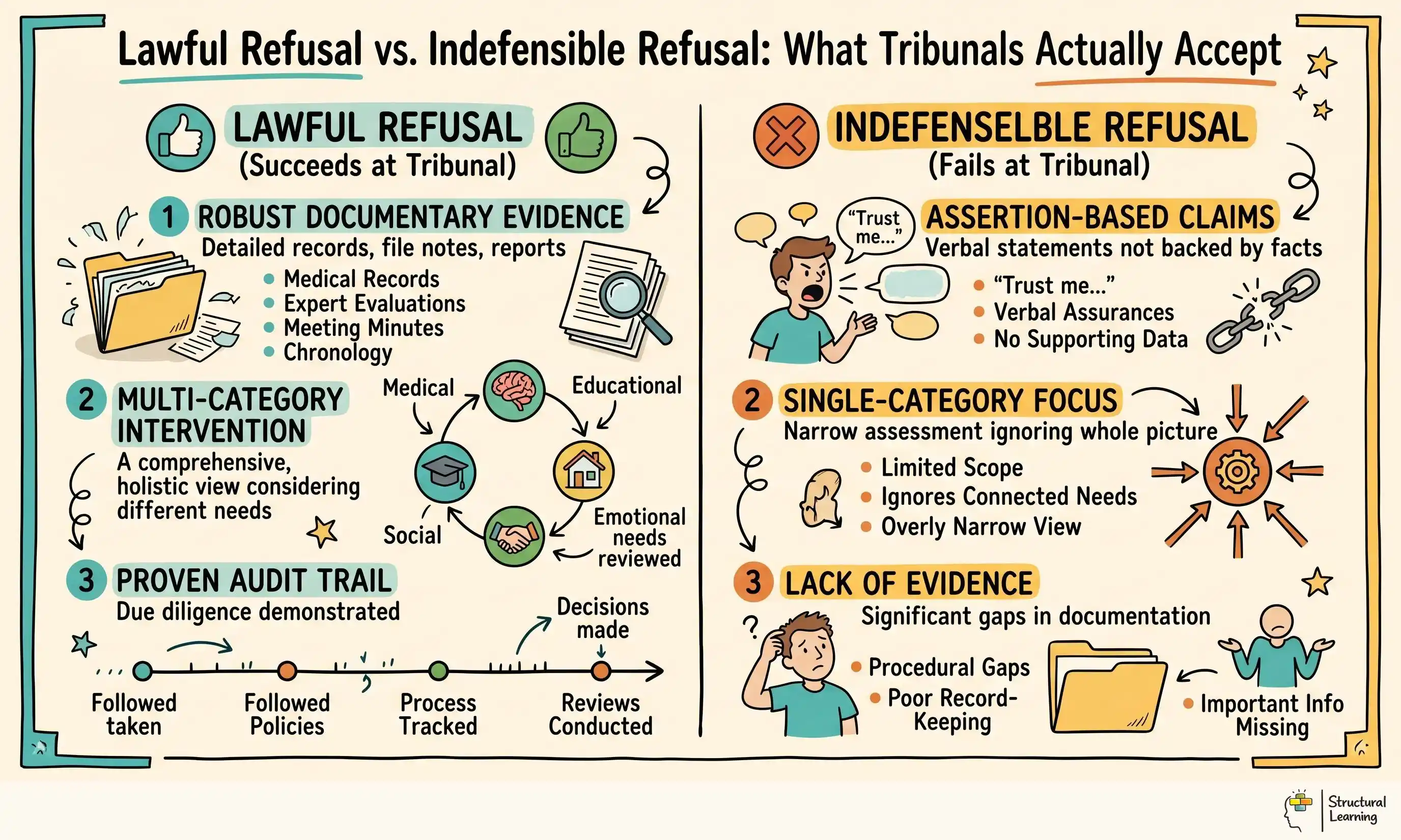
If you can produce the dated evidence of two completed APDR cycles showing genuine attempts followed by genuine review, you are in strong territory. If you cannot, the Tribunal will generally find that the reasonable steps test has not been met and will direct continued mainstream placement.
Documentation is not paperwork for its own sake. It is the only mechanism by which your reasonable steps work becomes legally visible. SEND Tribunal Judges decide cases on evidence: dated records, written plans, contemporaneous notes, parent communications, and outcomes against targets. Verbal accounts of "we tried lots of things" carry almost no weight.
Use three documentation habits. First, give every adjustment a date, a named person responsible, and a measurable outcome. "Tried sensory breaks" is not evidence. "From 14 January, three timed sensory breaks per day in the calming room, evaluated weekly by class teacher; reduced classroom incidents from 4 per day to 1 per day by 11 February" is evidence.
Second, keep parent communication in writing, not only as verbal updates at the gate. Email summaries of meetings, signed APDR review forms, and dated correspondence about strategies all become disclosable evidence at Tribunal. Third, document the final escalation to the local authority: when you wrote, what you asked for, what response you received, and what you did next.
The learner's class teacher should be the named author of most of this documentation. Reviewers and Judges look for the teacher's voice, not the SENCO's summary, because the teacher is the person delivering the provision day to day.
The strongest evidence is boring, dated and specific. It quantifies the adjustment, the learner response, the impact on others and the next review point: minutes of learning lost, number of learners moved, frequency per week, adult deployment, curriculum content missed, recovery time and what changed afterwards. In a Year 9 science practical, write "12 learners left the room for eight minutes during the heating task; the practical was restarted next lesson after a revised seating plan", not "the class was disrupted".
| Evidence area | Strong evidence | Weak evidence |
|---|---|---|
| Environmental adjustment | Room map, sensory plan, transition route, behaviour log and two review dates showing what changed. | "The classroom is unsuitable." |
| Curriculum access | Adapted task samples, vocabulary scaffolds, assistive technology records and work evidence over time. | "The learner cannot access the lesson." |
| Impact on others | Dated record of which learners were affected, for how long, what lesson was lost and what recovery action was needed. | "Other learners are disrupted." |
| Professional advice | EP, OT, SaLT, advisory teacher or specialist teacher recommendations linked to actions and review outcomes. | "We need specialist provision." |
Environmental adjustment
Strong evidence
Room map, sensory plan, transition route, behaviour log and two review dates showing what changed. Avoid bare statements such as "the classroom is unsuitable".
Curriculum access
Strong evidence
Use adapted task samples, vocabulary scaffolds, assistive technology records and work evidence collected over time. Do not claim that the learner cannot access the lesson unless the evidence supports it.
Impact on others
Strong evidence
Dated records of who was affected, for how long, what lesson was lost and what recovery action was needed. Avoid vague disruption claims.
Professional advice
Strong evidence
Link EP, OT, SaLT, advisory teacher or specialist teacher recommendations to the actions taken and the review outcomes. Do not present specialist provision as the answer unless you can show the full chain of evidence.
A consultation response should avoid emotional or absolute wording. It should say what the school can do, what it has already tried, what further steps would be needed and what risk remains after those steps. This keeps the response evidence-led rather than defensive.
Use wording such as: "The school has trialled a predictable entry routine, a reduced writing load, a visual task board and adult check-ins every ten minutes. Over three weeks, these steps reduced transition incidents from five each morning to two. The remaining concern is that two named practical lessons still require evacuation or removal of the wider group. We need local authority advice on whether additional specialist support, timetable adaptation or alternative provision can remove that remaining incompatibility."
This wording does not refuse the learner. It shows the reasonable steps already taken and invites the local authority to consider what additional support or review is required. That is safer than saying the school "cannot cope".
Five mistakes recur in cases where schools lose at Tribunal despite genuine effort. Watch for them in your own practice.
The first mistake is to confuse poor behaviour with SEN. Persistent challenging or withdrawn behaviour does not automatically mean a child has a special educational need (Department for Education and Department of Health, 2015, para. 6.21). Sometimes schools label behaviour as SEMH before checking communication, learning, or environmental causes. This weakens any later claim that the child cannot fit into the school, because staff have not assessed the correct underlying issues.
The second is over-relying on the TA. A one-to-one TA who has not been trained in the learner's specific need, who is supervised by no one, and who delivers withdrawn intervention disconnected from class teaching, is not evidence of reasonable steps. It shows a school passing its duty to the lowest-paid member of staff.
The third is skipping APDR cycles. Schools that move from initial concern straight to "this isn't working, request specialist placement" without two documented review cycles will routinely lose at Tribunal. The APDR cycle is not optional.
The fourth is failing to involve external professionals. A school that argues a learner cannot be educated in mainstream but has never requested EP involvement, never engaged outreach, and never sought OT or SLT input, has not exhausted reasonable steps by definition.
The fifth is misunderstanding the duty around medical needs. A learner with a medical condition who is hitting academic targets does not have an SEN simply because they require monitoring (Department for Education and Department of Health, 2015, para. 6.11). Their needs are met through an individual healthcare plan under the Children and Families Act 2014, section 100, not the SEN register.
You may have worked through all five types of reasonable steps over at least two APDR cycles. You must also have clear evidence and advice from outside professionals. If the child's placement is still causing real harm to other learners' education, escalation can be lawful and ethical.
Inclusion does not mean keeping a SEND learner in a setting that repeatedly overwhelms them. The SEND and AP improvement plan frames reform around the phrase "right support, right place, right time" because the current system does not consistently meet need (Department for Education, 2023). When a SENCO asks for a review after exhausting reasonable steps, they are setting a protective boundary. They are also asking the local authority to provide support that can keep everyone learning safely.
Escalation means writing to the local authority SEN team to request a review of the EHCP placement section. Provide your evidence file and explain what alternative provision you believe would meet need. The local authority then has a statutory duty to consider the request and respond.
If a learner is moving from Year 6 to Year 7, there is a statutory deadline. The EHCP must be amended by 15 February in the calendar year of the transfer, including the name of the new school (Department for Education and Department of Health, 2015, para. 9.179).
A request to the local authority is not the same as refusing to admit a child. The 2026 SEND reform consultation proposes changes to when local authorities must name a setting. This includes cases where a school is full, or where the placement would have a seriously detrimental effect. These proposals should not be treated as current law unless enacted (Department for Education and Department of Health and Social Care, 2026).
If the child has already been placed at your school in their EHCP, you cannot unilaterally end that placement. You must continue to deliver provision while the local authority works through review.
Your next move is concrete: open the audit checklist below, walk through it for the learner who currently concerns you most, and identify which of the five categories has the thinnest evidence file. That is where this term's work needs to start.
Reviewing the legal steps required before claiming a SEND placement is incompatible
As you mark steps that are evidenced in your school, this audit will provide a realistic assessment of your position if challenged.
Legal basis: SEND Code of Practice 2015, paragraph 1.27. A school or local authority must keep clear records of their reasonable steps. They must document these actions before they can claim that a mainstream placement will disrupt the education of other children.
This guide uses the statutory test to support fair decisions, but this approach has limits. Legal records can favour schools with strong admin systems. Slee (2011) argues that inclusion policies often fail when market pressures, accountability measures and scarce support services stay the same. As a result, a school with neat paperwork may look more reasonable than a school doing careful work but keeping weaker records.
Second, the language of individual need can create a dilemma of difference. Norwich (2008) notes that naming difference can help secure support, but it can also mark learners as separate from ordinary classroom life. Florian and Black-Hawkins (2011) make a related point: if adaptations are planned only for selected learners, teachers may leave whole-class pedagogy unchanged. This can stop schools from widening what is normally available.
The scholarly problem is that "reasonable" has no single classroom measure. Goodley, Runswick-Cole and colleagues argue that inclusion can be renamed without changing the structures disabled learners experience (Goodley et al., 2020). In practice, that judgement can create a postcode lottery. A low-arousal timetable that counts as reasonable in one authority may be unavailable, unaffordable or poorly evidenced in another.
Third, cultural background matters. Schools may read distress behaviours in working-class and racialised neurodivergent boys as disruption, rather than unmet communication, trauma or language need. Tomlinson (1982) warned that special education labels can increase social inequality if schools treat social disadvantage as a personal failing. Gillborn et al. (2021) also show why racism must be treated as a system issue, not only an individual prejudice.
That means an incompatibility file should include evidence of language need, poverty, racism, trauma and environmental mismatch. It should do this before it describes behaviour as a threat to others' education. The reasonable steps test remains useful. It slows refusal decisions, asks for clear evidence and keeps the focus on practical changes before schools consider exclusion from mainstream settings.
Upper Tribunal Administrative Appeals Chamber (2025). AA v London Borough of Hounslow (SEN): [2025] UKUT 226 (AAC). GOV.UK. View source.
IPSEA (2024). ME v London Borough of Southwark [2017] UKUT 73 (AAC). View source.
Department for Education and Department of Health (2015). SEND code of practice: 0 to 25 years. GOV.UK. View source.
UK Parliament (2014). Children and Families Act 2014, section 33. legislation.gov.uk. View source.
UK Parliament (2014). The Special Educational Needs and Disability Regulations 2014. legislation.gov.uk. View source.
Education Endowment Foundation (2021). Teaching Assistant Interventions. Education Endowment Foundation. View source.
Department for Education and Department of Health and Social Care (2026). SEND reform: putting children and young people first. GOV.UK. View source.
Florian, L., & Black-Hawkins, K. (2011). Exploring inclusive pedagogy. British Educational Research Journal, 37(5), 813-828.
Norwich, B. (2008). Dilemmas of difference, inclusion and disability. Routledge.
Slee, R. (2011). The irregular school: Exclusion, schooling and inclusive education. Routledge.
Tomlinson, S. (1982). A sociology of special education. Routledge.
These official sources are the safest starting point for SENCOs reviewing whether reasonable steps have been evidenced before any incompatibility argument is made.