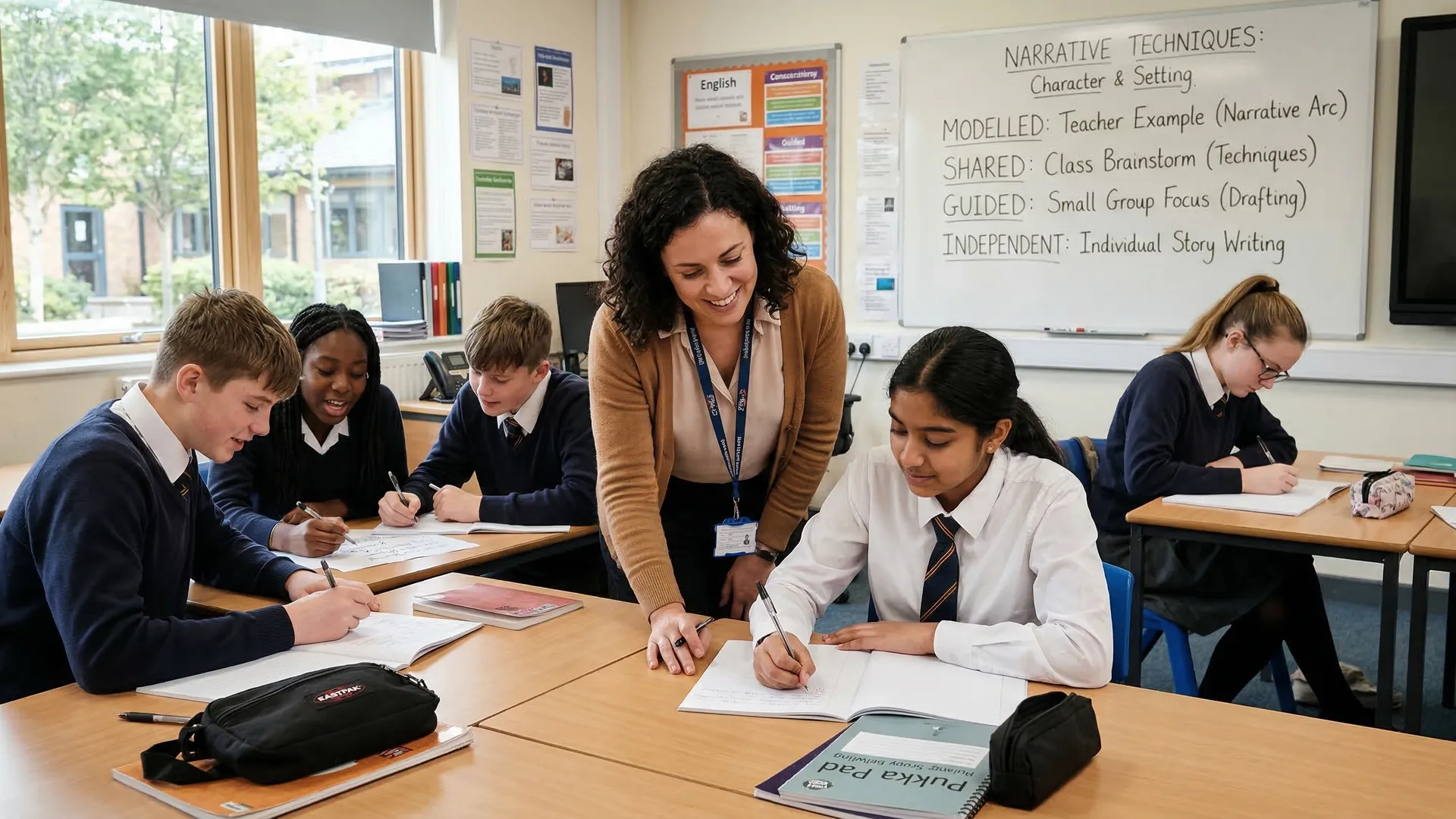
Modelled, Shared, Guided, and Independent Writing: A Teacher's GuideModelled, Shared, Guided, and Independent Writing: A Teacher's Guide: practical strategies for teachers

Updated on  

March 19, 2026

Modelled, Shared, Guided, and Independent Writing: A Teacher's Guide

|

March 19, 2026

Master the modelled shared guided independent writing progression teachers use to build confident writers, reduce cognitive load, and structure better lessons.

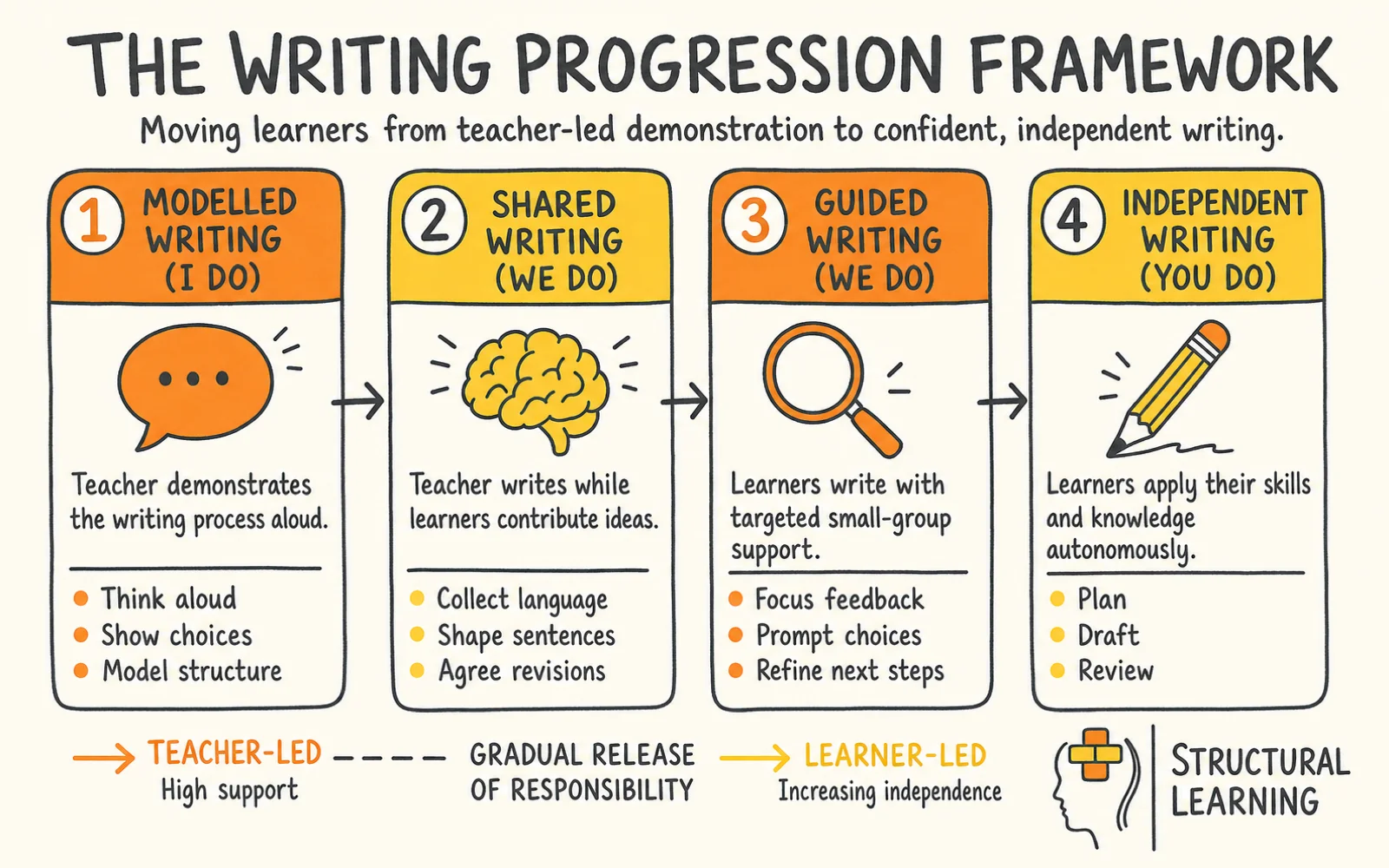
The Writing Progression Journey: From 'I Do' to 'You Do' infographic for teachers
The Writing Progression Journey: From 'I Do' to 'You Do'

Key Takeaways

* The writing progression follows the Gradual Release of Responsibility framework, moving pupils from novice to capable authors.

* Modelled writing requires explicit 'Think Aloud' narration to reveal the hidden cognitive processes of an expert writer.

* Shared writing keeps the pen in the teacher's hand while pupils actively co-construct meaning using mini-whiteboards.

* Guided writing bridges the gap to independence using targeted scaffolds and physical manipulatives like Writer's Blocks.

* Cognitive load must be managed carefully by separating transcription skills from composition demands.

* Structured oracy is vital; pupils must 'Say It' out loud before drafting sentences.

* The progression is a fluid cycle, allowing teachers to step back into modelling if pupils struggle.

What Is The Writing Progression?

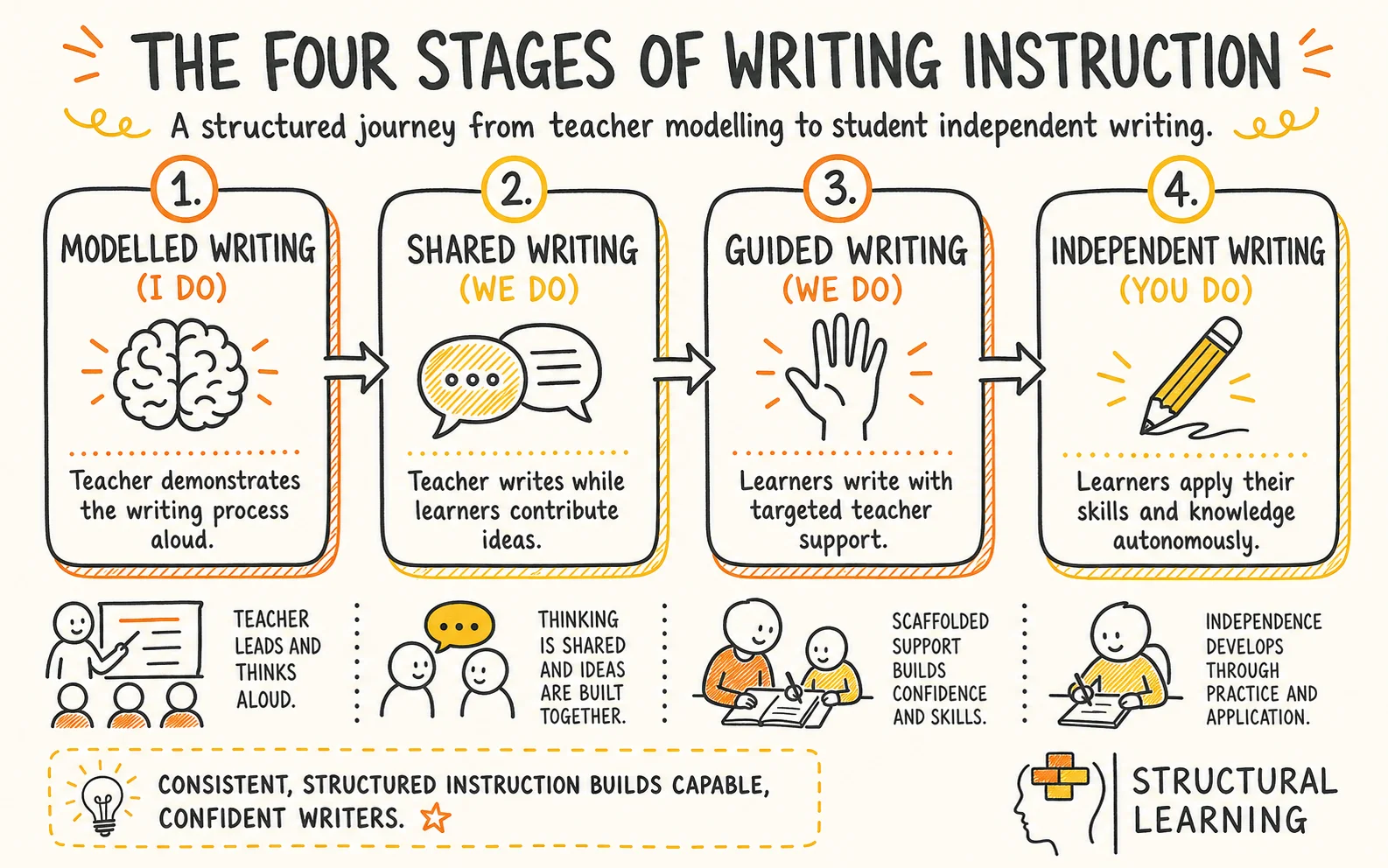
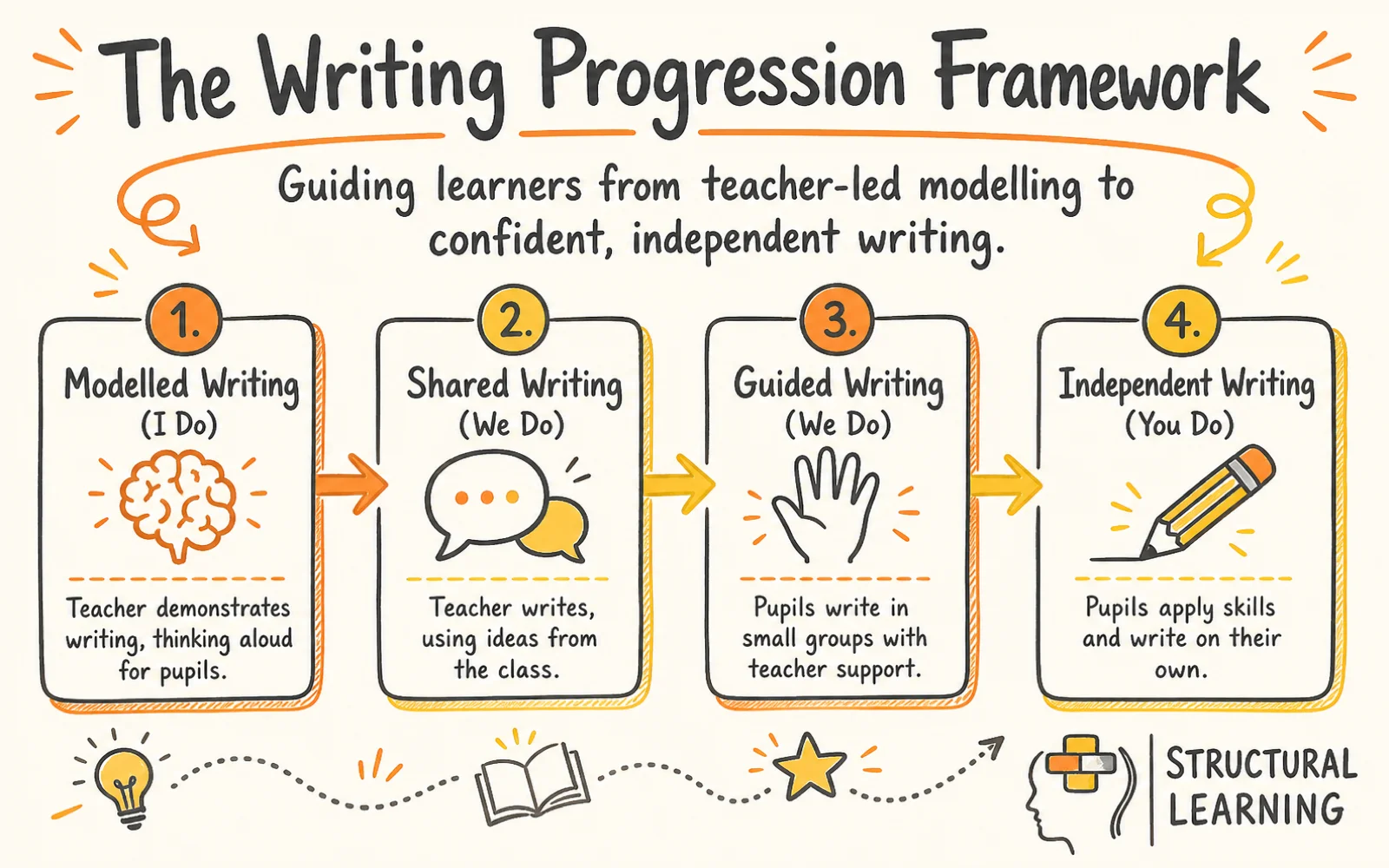
The modelled shared guided independent writing progression is a structured framework designed to teach writing skills systematically. It applies the Gradual Release of Responsibility model, often summarised as 'I do, We do, You do'. This progression shifts the cognitive burden from teacher to pupil across planned phases.

The progression acknowledges that writing is not a natural function like speaking, but a complex, learned skill. Novice writers need an expert to break down the processes of planning, drafting, and editing. This framework provides that explicit breakdown.

The foundation rests on Vygotsky's Zone of Proximal Development (Vygotsky, 1978). By providing scaffolding during shared and guided phases, teachers help pupils achieve what they could not alone. As competence grows, the scaffolding is removed until the pupil reaches independence.

Example: A Year 4 class is learning to write instructions. The teacher first models writing instructions for making a jam sandwich, explicitly stating each step and explaining why it's necessary. Pupils then contribute ideas for instructions on how to play a familiar game, with the teacher writing on the board.

Why The Progression Matters for Teachers

Writing is a cognitively demanding task. Cognitive Load Theory (Sweller, 1988) states that working memory has limited capacity. When a pupil writes, they juggle multiple demands: generating ideas, sequencing thoughts, selecting vocabulary, applying grammar, and handwriting.

This creates a risk of cognitive overload. Kellogg (2008) highlights the split between transcription (spelling and handwriting) and composition (generating and structuring ideas). When transcription is not automatic, it consumes working memory, leaving no capacity for composition.

The progression manages this cognitive load. During modelled and shared writing, the teacher handles transcription, freeing pupils to focus on composition and vocabulary. By independent writing, pupils have mapped ideas and rehearsed sentences, reducing cognitive demands.

Example: In a Year 6 class, pupils struggle to write descriptive paragraphs. The teacher realises their handwriting speed is slow, impacting their ability to generate ideas. The teacher introduces a short burst of handwriting practice before the next writing task.

The Progression in the Classroom

To apply this framework, teachers must understand the mechanics of each phase. Moving through stages requires shifts in teacher behaviour and pupil expectation.

Phase 1: Modelled Writing

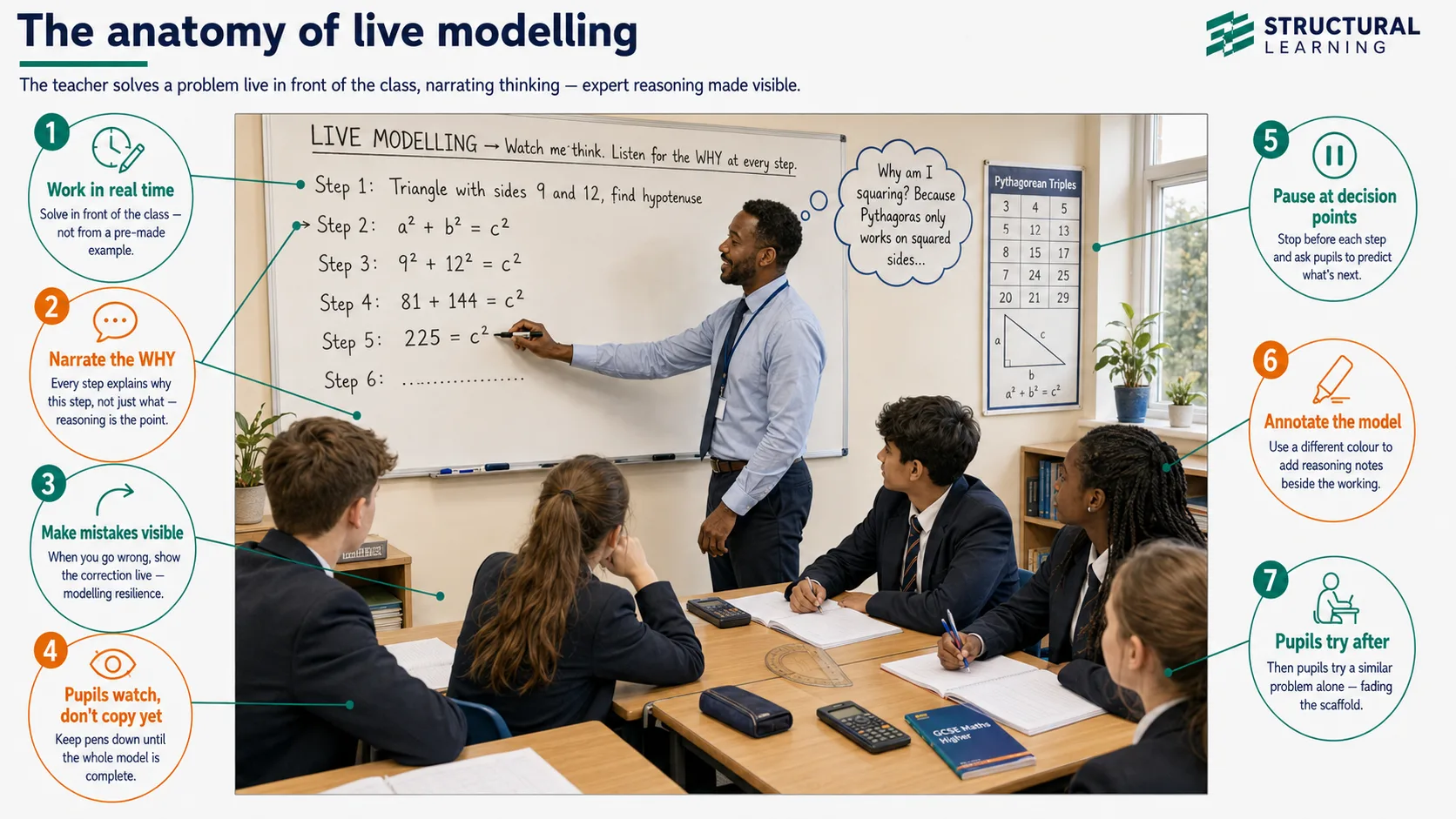
Modelled writing is the 'I do' phase. The teacher acts as the expert writer, demonstrating the writing process. The critical element is the 'Think Aloud' protocol. The teacher verbalises their internal monologue, exposing the choices experts make when composing.
For example, a teacher writing a persuasive letter might say, "I want to start with a question to grab the reader's attention. Should I ask 'Do you care about the environment?' or 'Are you concerned about pollution?' The second one sounds stronger." The teacher models making mistakes, crossing words out, and checking against success criteria.

Pupils actively observe. They are not writing or calling out ideas. Their cognitive load focuses on listening to the teacher's reasoning and watching the drafting process. The output is a teacher-generated text that serves as a benchmark ('WAGOLL') for the unit.

Example: A Year 2 teacher models writing a simple sentence about a character, saying, "I want to say the cat is black. 'The cat is black.' That's okay, but I want to add more detail. 'The cat is black and fluffy.' That's better!" Pupils listen and observe the changes.

Phase 2: Shared Writing

Shared writing transitions the class into the 'We do' phase. The motto is 'Pen in hand, ideas from the floor'. The teacher retains physical control, managing transcription. Pupils are responsible for generating ideas, vocabulary, and sentence structures.

The teacher acts as a selective filter, guiding pupils towards better choices. For example, the teacher might ask the class to draft an opening sentence for a story. Pupils write suggestions on mini-whiteboards and hold them up. The teacher scans, selecting strong examples to discuss, refine, and add to the shared text.

This phase provides formative assessment. By scanning mini-whiteboards, the teacher identifies which pupils grasp the concept and which need support. The output is a collaborative text that belongs to the whole class, built upon the grammatical structures modelled previously.

Example: A Year 5 class is writing a newspaper report. The teacher asks, "What's a good headline?" Pupils suggest ideas on whiteboards. The teacher chooses "Local School Wins National Award" and explains why it's effective.

Phase 3: Guided Writing

Guided writing bridges whole-class instruction and individual practice. Pupils hold the pen but work in small groups with targeted teacher support. The teacher provides feedback to specific groups based on formative assessment from shared writing.

This phase relies on physical manipulatives and constraints. Using 'Writer's Blocks' or word cards is effective. Pupils arrange these cards to build sentences before writing them. This aligns with Hochman and Wexler (2017), ensuring pupils master sentence-level mechanics before extended paragraphs.

The teacher provides prompts, such as "Can you add a simile to your sentence?" Pupils experiment, discuss choices with peers, and draft short sections of text. The output is scaffolded sentences or paragraphs produced by the pupils.

Example: A Year 3 class is writing descriptions of monsters. The teacher gives a group struggling with adjectives cards with different adjectives on them. The pupils arrange the cards to create descriptive sentences.

Phase 4: Independent Writing

The final phase is the 'You do' component, where pupils apply their knowledge autonomously. The teacher steps back, allowing pupils to write without interruption. However, independent writing does not mean unsupported writing.

Pupils work using a co-constructed success criteria checklist developed during the shared phase. They should also have access to graphic organisers, vocabulary banks, and sentence maps built earlier. The teacher monitors progress but resists correcting every minor error, allowing pupils to build writing stamina.

The output is the pupil's original work. Because cognitive load has been managed, the quality of independent work is higher than if they had drafted from scratch.

Example: A Year 1 class is writing about their favourite animal. They use a picture prompt and a word bank created during the shared writing phase to help them write simple sentences.

Teacher vs. Student: Role Shifts Across the Writing Progression infographic for teachers
Teacher vs. Student: Role Shifts Across the Writing Progression

Bridging the Gaps Between Phases

The transitions between phases are the most dangerous points. The leap from shared writing to guided writing often causes breakdowns.

The Role of Oracy

To bridge these gaps, teachers must prioritise structured oracy. The rule is 'Say It' before you 'Write It'. Pupils should never write a sentence they cannot articulate verbally.
During the transition from shared to guided writing, teachers should mandate partner talk. Pupils verbalise their proposed sentence to their partner, listening for sense and flow. The partner provides feedback, and the sentence is refined before writing. This dialogic rehearsal reduces errors.

Example: Before writing a paragraph about a historical figure, Year 6 pupils must first explain their main point and supporting evidence to a partner.

Using Graphic Organisers

Another critical bridge is visual mapping tools. Moving from abstract thoughts to linear text is difficult. Graphic organisers allow pupils to map ideas spatially before sequencing them grammatically.

If a class is preparing to write a persuasive text, they should first populate a 'Map It' framework. This visual scaffold separates arguments, evidence, and counter-arguments into boxes. During the independent phase, the pupil translates their pre-prepared visual map into prose.

Example: Year 4 pupils use a mind map to organise their ideas for a story before writing it. The mind map includes sections for characters, setting, problem, and solution.

Common Misconceptions

Even experienced teachers can misinterpret the mechanics of the writing progression. Correcting these misconceptions is vital.

The first misconception is that the progression is a linear timeline. Teachers believe they must do modelled writing on Monday, shared on Tuesday, guided on Wednesday, and independent on Thursday. In reality, the progression is a fluid, iterative cycle. If pupils struggle during independent writing on Thursday, the teacher must pause and step back into a quick modelled writing session.

A second misconception is that guided writing is simply a time for marking work. Guided writing must be an active, pre-emptive scaffolding process. It is about coaching pupils through sentence construction in real-time, not retrospectively marking a finished product.

A third misconception assumes that modelling only needs to happen at the start of a new unit. While macro-modelling happens at the beginning, micro-modelling should occur constantly. Before asking pupils to write a specific sentence type during the guided phase, the teacher should perform a 60-second 'Think Aloud' demonstrating how to construct that sentence.

Example: A teacher notices pupils are struggling with using commas in complex sentences. They stop the independent writing and do a quick modelled writing session on comma usage.

Practical Implementation Guide

Implementing this progression requires lesson design. Here is a step-by-step guide for planning a writing sequence.

First, map the writing task and define the final independent outcome. Determine what vocabulary, sentence structures, and paragraph formats pupils will need. Write the ideal final piece yourself to identify the cognitive hurdles pupils will face.

Second, script your 'Think Aloud' for the modelled phase. Do not attempt to ad-lib this. Write down the mistakes you intend to make and the internal dialogue you will use to correct them. Decide which vocabulary choices you will pretend to struggle with.

Third, plan the constraints for your shared writing phase. Do not ask broad questions like, "What should we write next?" Instead, provide grammatical constraints: "Use your mini-whiteboards to write the next sentence, and it must include a fronted adverbial."
Fourth, prepare physical scaffolds for the guided phase. Print sentence stems, vocabulary cards, or 'Writer's Blocks'. Plan which specific group of pupils you will target based on prior assessment data, ensuring they have the tactile tools necessary to build sentences.

A Worked Example

Imagine teaching Year 5 to write a persuasive letter about reducing plastic waste.

  • Modelled: You stand at the board and 'Think Aloud' about your opening. "I need to grab their attention. 'Plastic is bad.' No, too simple. 'Imagine a world drowning in plastic.' That's better, it creates a strong image."
  • Shared: You ask the class, "Now we need a sentence stating the problem, using a statistic. Draft it on your boards." You select a strong pupil example, discuss why the statistic is impactful, and add it to your board.
  • Guided: You gather six pupils struggling with persuasive language. You provide them with sentence stems (e.g., "It is clear that...") and ask them to complete the sentences with their own ideas.
  • Independent: The class uses a 'Map It' organiser they completed earlier in the week to draft their own letters, referring back to the shared text for structural inspiration.
  • The Progression Across Subjects

    The writing progression is not confined to the English classroom. It is a tool for structuring thought and managing cognitive load across the curriculum.

    In Maths, the progression can be used to teach mathematical reasoning. During the modelled phase, the teacher solves a word problem, verbalising their choice of operations. In the shared phase, the teacher holds the pen while pupils suggest the next logical step in the proof. During guided practice, pupils use visual scaffolds to structure their written explanations.

    In Science, writing a laboratory report requires explicit instruction. The teacher models how to write a clear hypothesis. During shared writing, the class co-constructs a method section, ensuring all variables are defined. In the independent phase, pupils write their own conclusions, using a success criteria checklist.

    In History, pupils must learn to write analytical essays. The teacher models how to construct a paragraph that evaluates a primary source. The class then works together in the shared phase to draft a paragraph comparing two conflicting historical accounts. Finally, pupils independently write an essay, supported by sentence stems.

    Example: In a Geography lesson, the teacher models writing a paragraph describing a specific type of landscape. The pupils then work together to write a description of a different landscape, using the same structure.

    Managing Cognitive Load: Scaffolding Strategies at Each Stage infographic for teachers
    Managing Cognitive Load: Scaffolding Strategies at Each Stage

    Common Questions About The Writing Progression

    How long should modelled writing last?

    Modelled writing should be brief and focused. A 'Think Aloud' session should rarely exceed ten minutes. Longer sessions risk overloading working memory and losing attention. Keep it sharp, model a specific skill, and move on.

    What do the rest of the class do during guided writing?

    While you are working with a guided group, the rest of the class must be engaged in deliberate practice. They should be working on tasks they can already complete with success, such as vocabulary retrieval, reading comprehension, or drafting sections they have already mapped out.

    How does this progression support pupils with SEND?

    This progression is effective for pupils with Special Educational Needs and Disabilities because it manages cognitive load. By separating transcription from composition and relying on visual and physical scaffolds during the guided phase, it prevents working memory bottlenecks that frequently derail SEND learners.

    Can you skip the shared writing phase?

    Skipping shared writing leads to failure in the independent phase. Shared writing is the bridge where pupils test their understanding in a low-stakes environment. Without the 'We do' phase, the jump from watching the teacher to writing alone is too demanding.

    How do you assess during these phases?

    Formative assessment is continuous. During shared writing, mini-whiteboards provide instant data on grammatical understanding. During guided writing, the teacher assesses by listening to pupils' oracy and watching how they construct sentences using physical manipulatives. This data dictates whether the teacher needs to step back into modelling.
    Example: During shared writing, the teacher notices that several pupils are struggling to use commas correctly. The teacher plans a mini-lesson on comma usage for the next day.

    Review your upcoming week of planning and script what you will say during your next 'Think Aloud' modelling session.

    Further Reading: Key Research Papers

    These peer-reviewed studies provide the evidence base for the strategies discussed above.

    Why Did All the Residents Resign? Key Takeaways From the Junior Physicians' Mass Walkout in South Korea. View study ↗
    23 citations

    Park et al. (2024)

    This paper examines a mass resignation of junior physicians in South Korea. For teachers, it offers insights into workplace conditions and professional burnout that could inform discussions about maintaining sustainable teaching careers and understanding systemic pressures in educational settings.

    Determining the Most Effective Stage of the Think-Pair-Share Teaching Strategy View study ↗

    A. et al. (2023)

    This research investigates which stage of the think-pair-share strategy is most effective for teaching fractions to high school students. Teachers can use these findings to optimise their implementation of collaborative learning techniques and improve student engagement in mathematics lessons.

    Cultivating connectedness and elevating educational experiences for international students in blended learning: reflections from the pandemic era and key takeaways View study ↗

    He et al. (2024)

    This study explores how videoconferencing enhances blended learning experiences for international students during the pandemic. Teachers can apply these insights to create more inclusive and connected learning environments, particularly when supporting diverse student populations in hybrid classroom settings.

    Who Benefits and under What Conditions from Developmental Education Reform? Key Takeaways from Florida’s Statewide Initiative View study ↗

    Mokher et al. (2023)

    This paper analyses Florida's developmental education reforms and identifies which students benefit most from these changes. Teachers working with struggling students can gain valuable insights into effective support strategies and understand conditions that promote academic success for at-risk learners.

    Why are some students “not into” computational thinking activities embedded within high school science units? Key takeaways from a microethnographic discourse analysis study View study ↗

    Aslan et al. (2024)

    This research examines why some students disengage from computational thinking activities in science classes. Teachers can use these findings to better understand student resistance to technology integration and develop more engaging approaches to incorporating computational thinking in their lessons.

    Free Resource Pack

    MSG I Writing: Teacher's Toolkit

    3 essential resources to master and implement Modelled, Shared, Guided, and Independent Writing in your classroom.

    MSG I Writing: Teacher's Toolkit — 3 resources
    CPD Briefing Visual Writing Instruction Teacher Development Planning Template Quick Reference Guide Scaffolding Learning

    Download your free bundle

    Fill in your details below and we'll send the resource pack straight to your inbox.

    Quick survey (helps us create better resources)

    How confident are you in implementing all four distinct stages of Modelled, Shared, Guided, and Independent (MSG I) Writing effectively in your lessons?

    Not at all confident
    Slightly confident
    Moderately confident
    Very confident
    Extremely confident

    To what extent do you feel your school culture and colleagues consistently support and encourage the use of the MSG I writing framework?

    Not at all
    To a small extent
    To some extent
    To a large extent
    To a very large extent

    How regularly do you intentionally plan for and execute the progression through all four stages of the MSG I writing framework in your units or sequences of writing instruction?

    Never
    Rarely
    Sometimes
    Often
    Always

    Your resource pack is ready

    We've also sent a copy to your email. Check your inbox.

    Loading audit...

    The Writing Progression Journey: From 'I Do' to 'You Do' infographic for teachers
    The Writing Progression Journey: From 'I Do' to 'You Do'

    Key Takeaways

    * The writing progression follows the Gradual Release of Responsibility framework, moving pupils from novice to capable authors.

    * Modelled writing requires explicit 'Think Aloud' narration to reveal the hidden cognitive processes of an expert writer.

    * Shared writing keeps the pen in the teacher's hand while pupils actively co-construct meaning using mini-whiteboards.

    * Guided writing bridges the gap to independence using targeted scaffolds and physical manipulatives like Writer's Blocks.

    * Cognitive load must be managed carefully by separating transcription skills from composition demands.

    * Structured oracy is vital; pupils must 'Say It' out loud before drafting sentences.

    * The progression is a fluid cycle, allowing teachers to step back into modelling if pupils struggle.

    What Is The Writing Progression?

    The modelled shared guided independent writing progression is a structured framework designed to teach writing skills systematically. It applies the Gradual Release of Responsibility model, often summarised as 'I do, We do, You do'. This progression shifts the cognitive burden from teacher to pupil across planned phases.

    The progression acknowledges that writing is not a natural function like speaking, but a complex, learned skill. Novice writers need an expert to break down the processes of planning, drafting, and editing. This framework provides that explicit breakdown.

    The foundation rests on Vygotsky's Zone of Proximal Development (Vygotsky, 1978). By providing scaffolding during shared and guided phases, teachers help pupils achieve what they could not alone. As competence grows, the scaffolding is removed until the pupil reaches independence.

    Example: A Year 4 class is learning to write instructions. The teacher first models writing instructions for making a jam sandwich, explicitly stating each step and explaining why it's necessary. Pupils then contribute ideas for instructions on how to play a familiar game, with the teacher writing on the board.

    Why The Progression Matters for Teachers

    Writing is a cognitively demanding task. Cognitive Load Theory (Sweller, 1988) states that working memory has limited capacity. When a pupil writes, they juggle multiple demands: generating ideas, sequencing thoughts, selecting vocabulary, applying grammar, and handwriting.

    This creates a risk of cognitive overload. Kellogg (2008) highlights the split between transcription (spelling and handwriting) and composition (generating and structuring ideas). When transcription is not automatic, it consumes working memory, leaving no capacity for composition.

    The progression manages this cognitive load. During modelled and shared writing, the teacher handles transcription, freeing pupils to focus on composition and vocabulary. By independent writing, pupils have mapped ideas and rehearsed sentences, reducing cognitive demands.

    Example: In a Year 6 class, pupils struggle to write descriptive paragraphs. The teacher realises their handwriting speed is slow, impacting their ability to generate ideas. The teacher introduces a short burst of handwriting practice before the next writing task.

    The Progression in the Classroom

    To apply this framework, teachers must understand the mechanics of each phase. Moving through stages requires shifts in teacher behaviour and pupil expectation.

    Phase 1: Modelled Writing

    Modelled writing is the 'I do' phase. The teacher acts as the expert writer, demonstrating the writing process. The critical element is the 'Think Aloud' protocol. The teacher verbalises their internal monologue, exposing the choices experts make when composing.

    For example, a teacher writing a persuasive letter might say, "I want to start with a question to grab the reader's attention. Should I ask 'Do you care about the environment?' or 'Are you concerned about pollution?' The second one sounds stronger." The teacher models making mistakes, crossing words out, and checking against success criteria.

    Pupils actively observe. They are not writing or calling out ideas. Their cognitive load focuses on listening to the teacher's reasoning and watching the drafting process. The output is a teacher-generated text that serves as a benchmark ('WAGOLL') for the unit.

    Example: A Year 2 teacher models writing a simple sentence about a character, saying, "I want to say the cat is black. 'The cat is black.' That's okay, but I want to add more detail. 'The cat is black and fluffy.' That's better!" Pupils listen and observe the changes.

    Phase 2: Shared Writing

    Shared writing transitions the class into the 'We do' phase. The motto is 'Pen in hand, ideas from the floor'. The teacher retains physical control, managing transcription. Pupils are responsible for generating ideas, vocabulary, and sentence structures.

    The teacher acts as a selective filter, guiding pupils towards better choices. For example, the teacher might ask the class to draft an opening sentence for a story. Pupils write suggestions on mini-whiteboards and hold them up. The teacher scans, selecting strong examples to discuss, refine, and add to the shared text.

    This phase provides formative assessment. By scanning mini-whiteboards, the teacher identifies which pupils grasp the concept and which need support. The output is a collaborative text that belongs to the whole class, built upon the grammatical structures modelled previously.

    Example: A Year 5 class is writing a newspaper report. The teacher asks, "What's a good headline?" Pupils suggest ideas on whiteboards. The teacher chooses "Local School Wins National Award" and explains why it's effective.

    Phase 3: Guided Writing

    Guided writing bridges whole-class instruction and individual practice. Pupils hold the pen but work in small groups with targeted teacher support. The teacher provides feedback to specific groups based on formative assessment from shared writing.

    This phase relies on physical manipulatives and constraints. Using 'Writer's Blocks' or word cards is effective. Pupils arrange these cards to build sentences before writing them. This aligns with Hochman and Wexler (2017), ensuring pupils master sentence-level mechanics before extended paragraphs.

    The teacher provides prompts, such as "Can you add a simile to your sentence?" Pupils experiment, discuss choices with peers, and draft short sections of text. The output is scaffolded sentences or paragraphs produced by the pupils.

    Example: A Year 3 class is writing descriptions of monsters. The teacher gives a group struggling with adjectives cards with different adjectives on them. The pupils arrange the cards to create descriptive sentences.

    Phase 4: Independent Writing

    The final phase is the 'You do' component, where pupils apply their knowledge autonomously. The teacher steps back, allowing pupils to write without interruption. However, independent writing does not mean unsupported writing.

    Pupils work using a co-constructed success criteria checklist developed during the shared phase. They should also have access to graphic organisers, vocabulary banks, and sentence maps built earlier. The teacher monitors progress but resists correcting every minor error, allowing pupils to build writing stamina.

    The output is the pupil's original work. Because cognitive load has been managed, the quality of independent work is higher than if they had drafted from scratch.

    Example: A Year 1 class is writing about their favourite animal. They use a picture prompt and a word bank created during the shared writing phase to help them write simple sentences.

    Teacher vs. Student: Role Shifts Across the Writing Progression infographic for teachers
    Teacher vs. Student: Role Shifts Across the Writing Progression

    Bridging the Gaps Between Phases

    The transitions between phases are the most dangerous points. The leap from shared writing to guided writing often causes breakdowns.

    The Role of Oracy

    To bridge these gaps, teachers must prioritise structured oracy. The rule is 'Say It' before you 'Write It'. Pupils should never write a sentence they cannot articulate verbally.

    During the transition from shared to guided writing, teachers should mandate partner talk. Pupils verbalise their proposed sentence to their partner, listening for sense and flow. The partner provides feedback, and the sentence is refined before writing. This dialogic rehearsal reduces errors.

    Example: Before writing a paragraph about a historical figure, Year 6 pupils must first explain their main point and supporting evidence to a partner.

    Using Graphic Organisers

    Another critical bridge is visual mapping tools. Moving from abstract thoughts to linear text is difficult. Graphic organisers allow pupils to map ideas spatially before sequencing them grammatically.

    If a class is preparing to write a persuasive text, they should first populate a 'Map It' framework. This visual scaffold separates arguments, evidence, and counter-arguments into boxes. During the independent phase, the pupil translates their pre-prepared visual map into prose.

    Example: Year 4 pupils use a mind map to organise their ideas for a story before writing it. The mind map includes sections for characters, setting, problem, and solution.

    Common Misconceptions

    Even experienced teachers can misinterpret the mechanics of the writing progression. Correcting these misconceptions is vital.

    The first misconception is that the progression is a linear timeline. Teachers believe they must do modelled writing on Monday, shared on Tuesday, guided on Wednesday, and independent on Thursday. In reality, the progression is a fluid, iterative cycle. If pupils struggle during independent writing on Thursday, the teacher must pause and step back into a quick modelled writing session.

    A second misconception is that guided writing is simply a time for marking work. Guided writing must be an active, pre-emptive scaffolding process. It is about coaching pupils through sentence construction in real-time, not retrospectively marking a finished product.

    A third misconception assumes that modelling only needs to happen at the start of a new unit. While macro-modelling happens at the beginning, micro-modelling should occur constantly. Before asking pupils to write a specific sentence type during the guided phase, the teacher should perform a 60-second 'Think Aloud' demonstrating how to construct that sentence.

    Example: A teacher notices pupils are struggling with using commas in complex sentences. They stop the independent writing and do a quick modelled writing session on comma usage.

    Practical Implementation Guide

    Implementing this progression requires lesson design. Here is a step-by-step guide for planning a writing sequence.

    First, map the writing task and define the final independent outcome. Determine what vocabulary, sentence structures, and paragraph formats pupils will need. Write the ideal final piece yourself to identify the cognitive hurdles pupils will face.

    Second, script your 'Think Aloud' for the modelled phase. Do not attempt to ad-lib this. Write down the mistakes you intend to make and the internal dialogue you will use to correct them. Decide which vocabulary choices you will pretend to struggle with.

    Third, plan the constraints for your shared writing phase. Do not ask broad questions like, "What should we write next?" Instead, provide grammatical constraints: "Use your mini-whiteboards to write the next sentence, and it must include a fronted adverbial."

    Fourth, prepare physical scaffolds for the guided phase. Print sentence stems, vocabulary cards, or 'Writer's Blocks'. Plan which specific group of pupils you will target based on prior assessment data, ensuring they have the tactile tools necessary to build sentences.

    A Worked Example

    Imagine teaching Year 5 to write a persuasive letter about reducing plastic waste.

  • Modelled: You stand at the board and 'Think Aloud' about your opening. "I need to grab their attention. 'Plastic is bad.' No, too simple. 'Imagine a world drowning in plastic.' That's better, it creates a strong image."
  • Shared: You ask the class, "Now we need a sentence stating the problem, using a statistic. Draft it on your boards." You select a strong pupil example, discuss why the statistic is impactful, and add it to your board.
  • Guided: You gather six pupils struggling with persuasive language. You provide them with sentence stems (e.g., "It is clear that...") and ask them to complete the sentences with their own ideas.
  • Independent: The class uses a 'Map It' organiser they completed earlier in the week to draft their own letters, referring back to the shared text for structural inspiration.
  • The Progression Across Subjects

    The writing progression is not confined to the English classroom. It is a tool for structuring thought and managing cognitive load across the curriculum.

    In Maths, the progression can be used to teach mathematical reasoning. During the modelled phase, the teacher solves a word problem, verbalising their choice of operations. In the shared phase, the teacher holds the pen while pupils suggest the next logical step in the proof. During guided practice, pupils use visual scaffolds to structure their written explanations.

    In Science, writing a laboratory report requires explicit instruction. The teacher models how to write a clear hypothesis. During shared writing, the class co-constructs a method section, ensuring all variables are defined. In the independent phase, pupils write their own conclusions, using a success criteria checklist.

    In History, pupils must learn to write analytical essays. The teacher models how to construct a paragraph that evaluates a primary source. The class then works together in the shared phase to draft a paragraph comparing two conflicting historical accounts. Finally, pupils independently write an essay, supported by sentence stems.

    Example: In a Geography lesson, the teacher models writing a paragraph describing a specific type of landscape. The pupils then work together to write a description of a different landscape, using the same structure.

    Managing Cognitive Load: Scaffolding Strategies at Each Stage infographic for teachers
    Managing Cognitive Load: Scaffolding Strategies at Each Stage

    Common Questions About The Writing Progression

    How long should modelled writing last?

    Modelled writing should be brief and focused. A 'Think Aloud' session should rarely exceed ten minutes. Longer sessions risk overloading working memory and losing attention. Keep it sharp, model a specific skill, and move on.

    What do the rest of the class do during guided writing?

    While you are working with a guided group, the rest of the class must be engaged in deliberate practice. They should be working on tasks they can already complete with success, such as vocabulary retrieval, reading comprehension, or drafting sections they have already mapped out.

    How does this progression support pupils with SEND?

    This progression is effective for pupils with Special Educational Needs and Disabilities because it manages cognitive load. By separating transcription from composition and relying on visual and physical scaffolds during the guided phase, it prevents working memory bottlenecks that frequently derail SEND learners.

    Can you skip the shared writing phase?

    Skipping shared writing leads to failure in the independent phase. Shared writing is the bridge where pupils test their understanding in a low-stakes environment. Without the 'We do' phase, the jump from watching the teacher to writing alone is too demanding.

    How do you assess during these phases?

    Formative assessment is continuous. During shared writing, mini-whiteboards provide instant data on grammatical understanding. During guided writing, the teacher assesses by listening to pupils' oracy and watching how they construct sentences using physical manipulatives. This data dictates whether the teacher needs to step back into modelling.

    Example: During shared writing, the teacher notices that several pupils are struggling to use commas correctly. The teacher plans a mini-lesson on comma usage for the next day.

    Review your upcoming week of planning and script what you will say during your next 'Think Aloud' modelling session.

    Further Reading: Key Research Papers

    These peer-reviewed studies provide the evidence base for the strategies discussed above.

    Why Did All the Residents Resign? Key Takeaways From the Junior Physicians' Mass Walkout in South Korea. View study ↗
    23 citations

    Park et al. (2024)

    This paper examines a mass resignation of junior physicians in South Korea. For teachers, it offers insights into workplace conditions and professional burnout that could inform discussions about maintaining sustainable teaching careers and understanding systemic pressures in educational settings.

    Determining the Most Effective Stage of the Think-Pair-Share Teaching Strategy View study ↗

    A. et al. (2023)

    This research investigates which stage of the think-pair-share strategy is most effective for teaching fractions to high school students. Teachers can use these findings to optimise their implementation of collaborative learning techniques and improve student engagement in mathematics lessons.

    Cultivating connectedness and elevating educational experiences for international students in blended learning: reflections from the pandemic era and key takeaways View study ↗

    He et al. (2024)

    This study explores how videoconferencing enhances blended learning experiences for international students during the pandemic. Teachers can apply these insights to create more inclusive and connected learning environments, particularly when supporting diverse student populations in hybrid classroom settings.

    Who Benefits and under What Conditions from Developmental Education Reform? Key Takeaways from Florida’s Statewide Initiative View study ↗

    Mokher et al. (2023)

    This paper analyses Florida's developmental education reforms and identifies which students benefit most from these changes. Teachers working with struggling students can gain valuable insights into effective support strategies and understand conditions that promote academic success for at-risk learners.

    Why are some students “not into” computational thinking activities embedded within high school science units? Key takeaways from a microethnographic discourse analysis study View study ↗

    Aslan et al. (2024)

    This research examines why some students disengage from computational thinking activities in science classes. Teachers can use these findings to better understand student resistance to technology integration and develop more engaging approaches to incorporating computational thinking in their lessons.

    Free Resource Pack

    MSG I Writing: Teacher's Toolkit

    3 essential resources to master and implement Modelled, Shared, Guided, and Independent Writing in your classroom.

    MSG I Writing: Teacher's Toolkit — 3 resources
    CPD Briefing Visual Writing Instruction Teacher Development Planning Template Quick Reference Guide Scaffolding Learning

    Download your free bundle

    Fill in your details below and we'll send the resource pack straight to your inbox.

    Quick survey (helps us create better resources)

    How confident are you in implementing all four distinct stages of Modelled, Shared, Guided, and Independent (MSG I) Writing effectively in your lessons?

    Not at all confident
    Slightly confident
    Moderately confident
    Very confident
    Extremely confident

    To what extent do you feel your school culture and colleagues consistently support and encourage the use of the MSG I writing framework?

    Not at all
    To a small extent
    To some extent
    To a large extent
    To a very large extent

    How regularly do you intentionally plan for and execute the progression through all four stages of the MSG I writing framework in your units or sequences of writing instruction?

    Never
    Rarely
    Sometimes
    Often
    Always

    Your resource pack is ready

    We've also sent a copy to your email. Check your inbox.

    Educational Technology

    Back to Blog

    {"@context":"https://schema.org","@graph":[{"@type":"Organization","@id":"https://www.structural-learning.com/#org","name":"Structural Learning","url":"https://www.structural-learning.com/","logo":{"@type":"ImageObject","url":"https://cdn.prod.website-files.com/5b69a01ba2e409501de055d1/5b69a01ba2e40996a5e055f4_structural-learning-logo.png"}},{"@type":"Person","@id":"https://www.structural-learning.com/team/paul-main/#person","name":"Paul Main","url":"https://www.structural-learning.com/team/paul-main","jobTitle":"Founder","affiliation":{"@id":"https://www.structural-learning.com/#org"}},{"@type":"BreadcrumbList","@id":"https://www.structural-learning.com/post/modelled-shared-guided-independent-writing#breadcrumb","itemListElement":[{"@type":"ListItem","position":1,"name":"Home","item":"https://www.structural-learning.com/"},{"@type":"ListItem","position":2,"name":"Blog","item":"https://www.structural-learning.com/blog"},{"@type":"ListItem","position":3,"name":"Modelled, Shared, Guided, and Independent Writing: A Teacher's Guide","item":"https://www.structural-learning.com/post/modelled-shared-guided-independent-writing"}]},{"@type":"BlogPosting","@id":"https://www.structural-learning.com/post/modelled-shared-guided-independent-writing#article","headline":"Modelled, Shared, Guided, and Independent Writing: A Teacher's Guide","description":"Master the modelled shared guided independent writing progression teachers use to build confident writers, reduce cognitive load, and structure better lessons.","author":{"@id":"https://www.structural-learning.com/team/paul-main/#person"},"publisher":{"@id":"https://www.structural-learning.com/#org"},"datePublished":"2026-03-19","dateModified":"2026-03-19","inLanguage":"en-GB"}]}