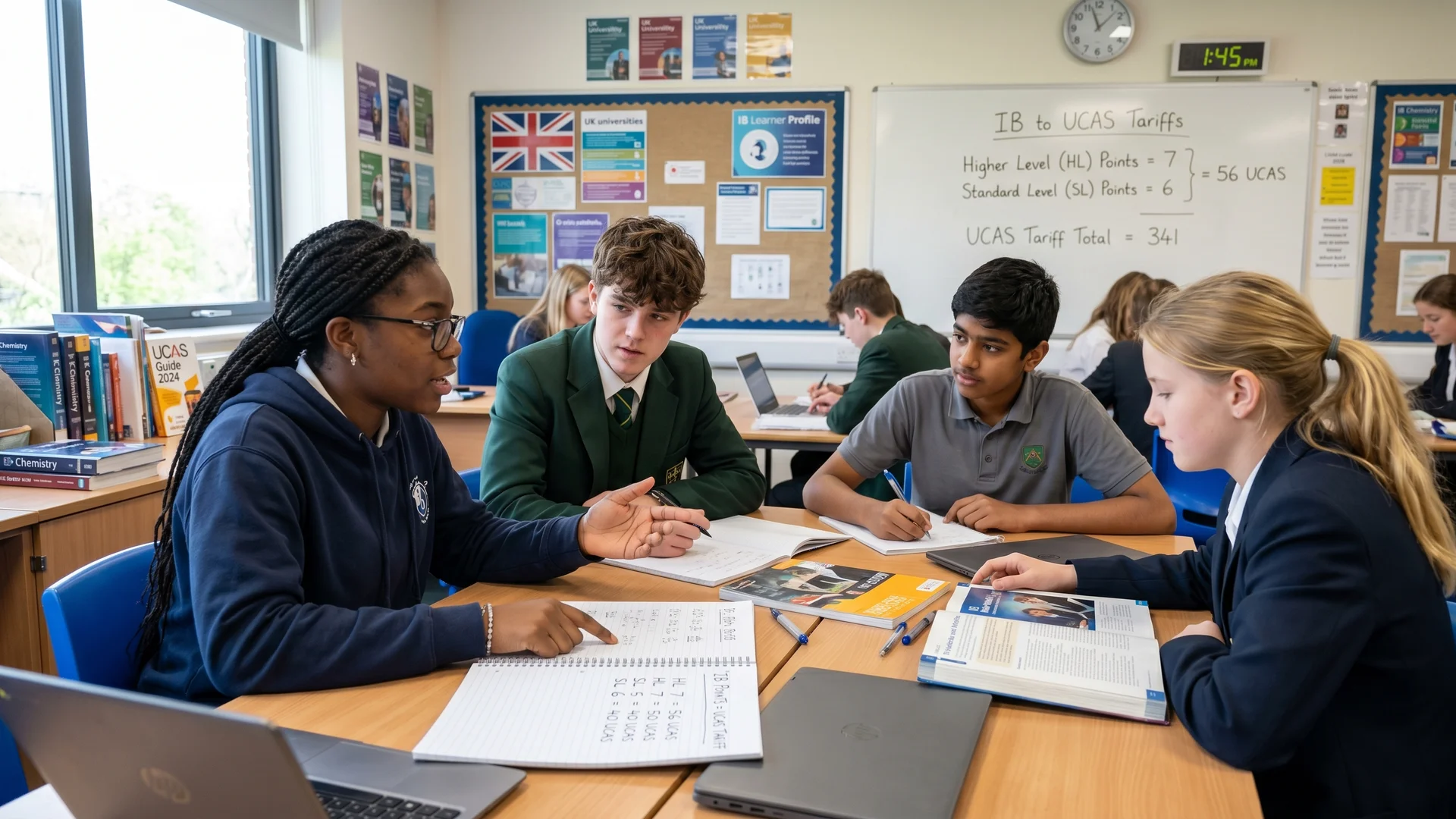
Translating IB Diploma Points to UCAS Tariffs: The Unvarnished TruthTranslating IB Diploma Points to UCAS Tariffs: The Unvarnished Truth: practical strategies for teachers

Updated on  

April 22, 2026

Translating IB Diploma Points to UCAS Tariffs: The Unvarnished Truth

|

April 22, 2026

How IB diploma points convert to UCAS tariffs. Real offer data from Cambridge, Oxford, LSE. HL 6 6 6 explained. Debunks myths about IB vs A-level equivalence.

Key Takeaways

  1. IB 38 converts to 479 UCAS points: roughly equivalent to AAB, not A* A* A*. Strong for UCL and LSE, but below Cambridge and Oxford's typical shortlist thresholds.
  2. HL 6 6 6 is approximately AAA at A-level: not A* A* A*. Individual HL 7s are needed for Oxbridge competitiveness in STEM subjects.
  3. Russell Group universities set higher IB thresholds because IB students score higher on average: not because they prefer IB. This is a selection effect, not a preference.
  4. Meeting the threshold does not guarantee an interview: Cambridge and Oxford shortlist only 30-40% of threshold-meeting applicants; admissions tests and references matter equally.

Your child's IB diploma arrives at the end of Year 13: 38 points. You've both heard that IB is "worth more" at top universities. But will Cambridge look at it the same way they'd look at A* A* A*? Will the extended essay count as an extra qualification? The truth is messier than university prospectuses suggest.

IB 38 converts to 479 UCAS tariff points, roughly equivalent to AAB at A-level. That's a strong score, but not the A* A* A* tier that Oxbridge typically shortlists. It's good enough for UCL, LSE, and Manchester. It's not enough for Cambridge and Oxford in competitive courses like Medicine or Philosophy, Politics and Economics.

This article translates the real numbers using official university admissions data and UCAS tariff tables. By the end, you'll know exactly where your child's IB points stand, what meets a shortlist threshold versus what gets an interview, and when A-level might actually be the better choice for UK universities.

<a href=IB Diploma Points vs UCAS Tariffs vs A-Level: Side-by-Side Decoder infographic for teachers" loading="lazy">
IB Diploma Points vs UCAS Tariffs vs A-Level: Side-by-Side Decoder

What Is the UCAS Tariff and How Do IB Scores Convert?

The UCAS tariff is a points system that standardises qualifications. A-level, IB, BTEC, and other qualifications all convert into a single points scale, allowing universities to compare students fairly. Think of it as a translator: it turns an IB diploma into a number that admissions offices can line up against A-level students.

Here's the formula. UCAS allocates 1 point per 7.89 IB diploma points. A perfect 45-point diploma becomes 568 UCAS points. Individual Higher Level (HL) subjects add more: 2 UCAS points per IB point, capped at 12 per subject. Standard Level (SL) subjects add 1 point per IB point, capped at 6 per subject.

Let's work through an example. A student scores HL 6 6 6 (Maths, Chemistry, Biology) = 18 points. Add SL 6 6 5 (English, History, Language) = 17 points. Add 3 core points (Extended Essay 5, Theory of Knowledge 4) = 8 points. Total: 39 IB points. That converts to 487 UCAS points, which roughly equals AAA at A-level.

The conversion is mechanical, not subjective. Every IB 39-point diploma converts to 487 UCAS points, whether the student scored 7 7 7 7 6 5 or 6 6 6 6 6 5. The formula treats all 39-point diplomas the same. This is why individual subject grades matter so much: universities care not just about the total, but whether you have HL 7 in Maths or HL 6. That distinction doesn't affect the tariff calculation directly, but it affects whether you meet a course-specific requirement.

The HL 6 6 6 Myth: What It Actually Equals in A-Level Terms

You'll hear parents say: "My child got HL 6 6 6, so that's basically A* A* A* at A-level, isn't it?" The answer is no. It's roughly AAA, maybe AAB depending on the core points.

Here's why the gap exists. A-level is a three-subject system in the UK. You get A*, A, B, or C in each. An A is roughly 70-80% of marks. An A* is roughly 90%+. The IB is a six-subject system on a 7-point scale. An IB 7 is roughly 85-100% of marks. An IB 6 is roughly 70-84%.

This means an HL 6 sits between A and A*, depending on the subject boundaries. But because IB students study six subjects (not three), their overall time per subject is lower. Compressed across six subjects, an HL 6 in Maths is approximately an A in A-level Maths, not an A*.

To reach A* A* A* at A-level is approximately IB 41-42. HL 7 7 7 (the top grade in three subjects) comes close, but even HL 7 7 7 with strong core points typically lands at IB 40-41, which is A* A* A to A* A* A* territory.

UCAS data confirms this. Cambridge and Oxford admit A* A* A and A* A* A* students at roughly 2-3% of applicants. They admit IB students scoring 40+ at roughly the same rate. IB 38-39 (HL 6 6 6 range) sits lower in the distribution. It's still excellent, but it's not the top tier.

Real Russell Group Offers: Course-by-Course

Here's what the universities actually ask for, based on their 2024-25 published admissions statistics and course pages.

University Course IB Offer HL Requirements A-Level Equivalent
Cambridge PPE 40-41 HL 7s in Maths, Economics, History A* A* A* / A* A* A
Cambridge Medicine 40+ HL 7 in Maths, Chemistry, Biology A* A* A*
Oxford Law 38-39 HL 7 preferred in 2 subjects A* AA / A* A* A
Oxford Engineering 39-40 HL 7 in Maths, Physics A* A* A / A* A* A*
LSE Economics 38-39 HL Maths HL 7 preferred A* AA / AAA
UCL Medicine 36-38 HL Maths, Chemistry, Biology A* AA / AAA
Manchester Engineering 32-34 HL Maths 6+ AAB-ABB
Edinburgh Law 34-36 HL English preferred AAA-ABB

Notice the pattern. Cambridge and Oxford sit at 39-41 for most courses. LSE and UCL sit at 36-39. Manchester and Edinburgh sit at 32-36. This is not a hierarchy of university quality; it's a distribution effect. Oxbridge shortlists fewer students overall, so they set higher numeric thresholds. But LSE and UCL are highly selective too; they just use slightly lower tariff cuts.

The HL requirements matter more than the total. An IB 39 with HL 6 in Maths will not meet "HL Maths 7 required" for Cambridge Medicine, even though the total is in range. Course requirements are gates, not guidelines. Always read the small print on the university website.

Why Russell Group Set Higher IB Thresholds (And What That Means for You)

A common misconception: Russell Group universities prefer IB students and give them easier entry terms. The truth is the opposite. They set higher thresholds because IB students arrive pre-screened.

Here's the selection effect. In the UK, about 58% of independent schools offer IB. Most state schools don't. This means IB cohorts are self-selected: students from schools wealthy enough to offer six subjects, families where parents value breadth over specialisation. This cohort tends to score higher across all qualifications.

UCAS data shows the average IB student scores 34 points in the UK independent sector. The global average is 30. For A-level, the typical strong student gets AAA, which translates to about 38-39 IB points. So the average IB cohort is stronger than the average A-level cohort, but not as strong as the very top A-level students (A* A* A* = 41-42 IB).

Russell Group universities respond to this by setting higher IB thresholds. They're not saying IB is better; they're saying "our IB applicants average 34, so we can afford to ask for 38+" because the applicant pool will include enough strong candidates. An A-level student scoring AAA will go through the same interview process as an IB student scoring 39. The threshold difference reflects the selection effect, not institutional preference.

This matters psychologically. If your child scores IB 38, don't interpret a Cambridge rejection as "IB wasn't good enough." Interpret it as "the Cambridge applicant pool averaged 39-40 this year, and your child was at the lower end." That's honest, not devastating. It doesn't mean your child is weak; it means Cambridge's filter was set higher because the overall cohort was strong.

The Oxbridge Interview Question: Meeting the Threshold vs Getting an Interview

Parents often ask: "If my child meets Cambridge's IB 40 threshold, will they get an interview?" The answer is no. Meeting the threshold is necessary but not sufficient.

Cambridge and Oxford shortlist only 30-40% of threshold-meeting applicants for interview. The 40 IB offer is a floor, not a guarantee. Admissions offices look at the whole application: personal statement, school reference, results of admissions tests (STEP, MAT, BMAT depending on course), and interview performance.

Your child might score IB 40 in June, after final exams. But the interview shortlist goes out in October, based on predicted grades and the UCAS application submitted in October. By that time, predicted grades are the proxy. A student predicted IB 40 with strong teacher references and a compelling personal statement has a real shot at an interview. The same student with weak predicted grades or a generic statement might miss out, even if they ultimately achieve the 40.

This is why students worry. The process feels binary (interview or not), but it's actually cumulative. Every component, grades, tests, references, personal statement, interview performance, adds weight. Your IB score is one component. A strong IB score (40+) opens the door to an interview. A weak reference or poor STEM test score might close it even if the IB is strong.

Honest expectation-setting: aim for IB 40+ if Oxbridge is the goal, but plan for contingency offers from LSE, UCL, and Manchester at IB 36-38. These are not consolation prizes; they're world-class universities. Your child will thrive there.

Individual Subject Requirements: When HL Maths Matters (And When It Doesn't)

University course requirements fall into two categories: tariff thresholds and subject gates.

Tariff thresholds are the total points. A course might ask for "IB 36 overall." Any student with 36+ points qualifies on tariff alone.

Subject gates are different. A course might ask for "HL Maths 6" or "HL Chemistry and Biology, one at 7." These are non-negotiable. A student scoring IB 39 without HL Maths cannot apply to Cambridge Engineering, even though 39 exceeds the tariff threshold.

STEM subjects (Medicine, Engineering, Physics) almost always demand HL Maths at 6 or 7. Some ask for HL Chemistry or Biology too. Humanities subjects (Law, Languages, History) sometimes specify HL requirements but often don't. PPE, Classics, and Philosophy tend to ask for HL Maths or Economics. Check the specific course page on the university website; don't assume.

The IB makes this easy because you declare your HL subjects upfront. If your child is unsure about Engineering, they can take HL Maths just in case. The downside: HL subjects are more time-intensive. Taking three HL STEM subjects (Maths, Chemistry, Physics) is roughly 150 teaching hours per subject; three SL humanities subjects are roughly 100 hours each. The workload is real.

Plan subject choices by Year 11, before IB starts. Changing HL subjects mid-diploma is possible but disruptive. If your child aspires to Medicine, Maths and Sciences should be HL from day one.

The Oxbridge Admissions Filter: From UCAS Points to Interview Seat infographic for teachers
The Oxbridge Admissions Filter: From UCAS Points to Interview Seat

EPQ, Extended Essay and Other Qualifications: What Actually Counts

Parents often ask: Can my child do EPQ (Extended Project Qualification) alongside IB to boost their university application?

The short answer: EPQ is separate from IB and counts separately. It awards up to 28 UCAS points for a Grade A, worth roughly the same as a single A-level. However, universities typically do not stack EPQ tariff points on top of IB tariff points. You don't get your full IB tariff (479 for IB 38) plus 28 for EPQ to reach 507.

The longer answer: IB's Extended Essay is not the same as EPQ. The Extended Essay is a 4,000-word research project graded 0-34, contributing up to 3 points to your final diploma. It's mandatory, built into the six-subject structure, and takes about 150 hours. EPQ is an optional A-level qualification, 8,000-word project, graded A-E, taking about 100 hours.

Universities view EPQ-with-IB students as over-extending themselves. The admissions office might note it in context ("Good self-management to juggle six subjects plus a project"), but it won't add tariff points. If anything, a student attempting EPQ alongside IB and then dropping it or underperforming might signal poor judgement.

Theory of Knowledge (ToK) is compulsory for IB and worth 1 point (combined with Extended Essay). It's not separately useful for university admissions in the UK. It's a course requirement, not a resume booster. Admissions offices don't ask "How strong was your ToK essay?"; they just check that you completed it.

CAS (Creativity, Action, Service) is an IB requirement but entirely invisible to UK admissions. Universities don't see CAS records. It's internal to your school. Don't mention it in your personal statement; it adds no weight.

IB vs A-Level for UK University Admissions: When A-Level Is Actually Better

IB has advantages: breadth, interdisciplinary thinking, strong completion rates in selective schools. But A-level has genuine advantages too, and families should know when A-level is the stronger path.

A-level is better if your child wants depth in three subjects rather than breadth across six. An A-level student studying Maths, Physics, and Chemistry can go 150 hours deeper in each subject than an IB student spreading 150 hours across six subjects plus Extended Essay. Some students thrive with this depth; they get A* A* A* easier than their IB peers achieve HL 7 7 7.

A-level is better if your child might want to resit. A-level allows subject-level resits in January or the following summer. IB is all-or-nothing in May and November. A student scoring AAB first time can resit one A-level and aim for AAA the following summer without losing two months of university time. An IB student retaking the entire diploma (or individual subjects in November) effectively loses a year.

A-level is better if your child is uncertain about university major. A-level students often change their subject choice between Year 12 and Year 13, or switch again at university. IB locks you into six subjects and a core, reducing flexibility. If your 15-year-old is unsure about whether they want Maths or Modern Languages, A-level lets them explore both; IB might force a choice sooner.

A-level is arguably better if your child's English isn't native. IB demands English at a high level across all six subjects, plus extensive essay writing in the Extended Essay and ToK. A-level students can take English Language and Literature as one of three subjects, or skip English entirely. For ESL students, A-level can feel less punishing.

None of this makes A-level objectively better. But the "IB is obviously superior" narrative is wrong. Real families sometimes choose A-level and thrive. It's a legitimate choice, especially if your child's learning style suits depth over breadth, or if your school's IB cohort is weak.

International Comparisons: How IB Translates in the US, EU and Asia-Pacific

IB was invented internationally, and universities worldwide accept it. But the UK's UCAS tariff system is unusual: it's the only system that converts IB to a standardised points formula. Other countries treat IB more holistically.

In the United States, IB applicants typically score 40+ and provide SAT or ACT scores alongside. Ivy League universities value IB highly, but the score is one factor among test scores, grades, essays, and extracurriculars. There's no single "IB 40 means you're in" rule. Top US universities are more selective (single-digit admit rates) and don't use tariff systems.

In the European Union, IB acceptance varies by country. Germany and the Netherlands treat IB as equivalent to the local leaving certificate (Abitur, VWO) with minimal conversion. France has treaties with IB and treats it as roughly equivalent to the Baccalauréat. Spain and Italy vary by university. No country uses a tariff system quite like UCAS; admission is usually based on the IB score directly or a simple conversion table, without subject-level gates.

In Hong Kong and other Asia-Pacific regions, IB is well-established. Hong Kong universities (HKUST, HKU, CUHK) admit IB students via separate pathways, typically expecting IB 30+. Again, no tariff system; the score is used directly.

The key difference: the UK's UCAS tariff makes IB into a precise, comparable number. This is useful for admissions transparency. It's also slightly rigid, because equivalence is assumed to be standardised (IB 38 always equals 479 UCAS points). Other countries allow admissions offices more discretion. A US university might admit one IB 39 student and reject another, depending on the strength of the essays and extracurriculars. UCAS operates more mechanically: if your tariff meets the threshold and you have the required HL subjects, the gate opens.

This is not necessarily a bad thing. Transparency is valuable. But it does mean that IB students applying to the UK face a slightly more formulaic system than their US or EU counterparts.

Six Myths About IB and UK University Admissions: Debunked

Myth 1: IB is worth more at Russell Group because it's harder.

Truth: UCAS applies the same tariff formula to all students. Russell Group doesn't weight IB differently. They set higher thresholds because IB cohorts are self-selected and score higher on average. It's a selection effect, not a preference.

Myth 2: IB 40 = A A A* = guaranteed Oxbridge interview.**

Truth: IB 40 meets the threshold, but 30-40% of threshold-meeting applicants get interviews. Your admissions test score, personal statement, school reference, and interview performance matter equally. IB 40 opens the door; it doesn't guarantee entry.

Myth 3: All Russell Group universities treat IB 38 the same.

Truth: Each institution sets its own offers. LSE might offer 38 for Law; Cambridge might ask for 41. Check course-specific requirements on the university website, not generic thresholds.

Myth 4: IB is easier to get into university than A-levels.

Truth: IB completion rates are high in UK independent schools (around 90%), and thresholds are higher because students score higher. But the diploma itself is harder to complete. IB requires six subjects, a 4,000-word essay, and Theory of Knowledge seminars. A-level allows three subjects with more depth. IB isn't inherently easier; it's different.

Myth 5: HL subjects count more at university than SL.

Truth: UCAS tariff gives more points for HL (2 per point vs. 1 for SL), but universities don't re-weight them at admissions. An IB 39 is an IB 39, whether it's HL 7 6 6 + SL 6 6 6 or HL 6 6 6 + SL 6 6 6. However, course-specific requirements (HL Maths required) do gate entry.

Myth 6: Extended Essay counts as an extra qualification like EPQ.

Truth: Extended Essay is part of the IB diploma, not supplementary. It contributes up to 3 points to your total (combined with ToK). It's mandatory, not optional. EPQ is an optional A-level qualification that awards up to 28 points separately. Universities don't stack Extended Essay tariff on top of the diploma.

Your 10-Point Action Plan: IB Student Preparing UCAS Applications

These steps will help your child present their IB candidacy clearly and meet university deadlines.

1. Research courses (Year 12, start of Year 13): Use university websites, not league tables. Check HL subject requirements for each course your child is considering. Bookmark the course pages.

2. Understand your predicted grades (October of Year 13): Ask your IB coordinator what predicted grade they'll submit to UCAS in October. This is separate from your final exam score in May. The predicted grade drives interview shortlisting. Predicted IB 40 with strong references gives a real shot; predicted IB 35 might miss shortlist despite potentially achieving 40 after exams.

3. Write your personal statement (August-October of Year 13): Don't mention IB vs. A-level. Focus on your intellectual curiosity and why the course matters to you. Admissions offices care about your engagement, not your qualification choice. Mention specific interests, books, research, or problems you've explored.

4. Secure strong school references (October of Year 13): Your reference is crucial for shortlisting. Admissions offices read references deeply. If your reference is generic or lukewarm, no IB score will compensate. Talk to your teachers about specific contributions you've made in class discussions or projects.

5. Prepare for admissions tests (October-November of Year 13): Many courses (especially STEM, Law, PPE) require tests like STEP, MAT, BMAT, LNAT. These are not skippable. Start practising in summer. Strong test scores boost your candidacy above the tariff floor.

6. Apply early (1 October deadline): UCAS applications go out in October. Submitting on day one doesn't give advantage, but submitting in late October (last two weeks) can delay shortlisting slightly. Early application signals seriousness.

7. Apply for realistic reach schools (October of Year 13): Don't apply for five Oxbridge courses or five LSE programmes. Spread across reach (Cambridge, Oxford), target (LSE, UCL, Durham), and comfortable (Manchester, Edinburgh) institutions. You have five choices; use them strategically.

8. Prepare for interviews (November-December of Year 13): Oxbridge and some Russell Group courses invite shortlisted candidates to interviews in December. Interviews are not about grades; they're about thinking aloud. Practice thinking through problems with your teachers. Bring intellectual humility.

9. Monitor your exam performance (May of Year 13): Your actual IB score arrives in July. If it's higher than predicted, great. If it's lower, you might still firm your choice (the university can't withdraw a conditional offer for meeting the conditions). If it's much lower, your insurance choice becomes important.

10. Finalise your choice (July-August of Year 13): You'll have offers from multiple universities by May. You firm one (your choice) and insure one (backup). Think carefully. Your firm choice is where you'll go if you meet conditions. Your insurance is where you go if you miss your firm but hit your insurance conditions. Don't waste your insurance on a reach; use it for a school you genuinely want to attend and realistically expect to meet.

Frequently Asked Questions

HL 6 6 6 Decoded: What It Actually Means for Russell Group & Oxbridge infographic for teachers
HL 6 6 6 Decoded: What It Actually Means for Russell Group & Oxbridge

Further Reading: Official Sources and Data

The following sources provide verified data on UCAS tariffs, IB entry requirements, and UK university admissions:

  1. UCAS Tariff Guide 2024-25 , The official UCAS tariff conversion tables for all qualifications, updated annually. https://www.ucas.com/undergraduate/applying-to-university/making-your-application/ucas-tariff-points

  2. Cambridge University Undergraduate Admissions Statistics 2024 , Published course-by-course entry data, including IB thresholds and HL subject preferences. https://www.cam.ac.uk/admissions/undergraduate/

  3. Oxford University Undergraduate Admissions Statistics 2024 , Course-specific IB requirements and interview data for Oxford colleges. https://www.ox.ac.uk/admissions/undergraduate

  4. London School of Economics Undergraduate Admissions Guide 2024-25 , Entry requirements for LSE courses, including IB score thresholds and HL subject requirements. https://www.lse.ac.uk/study-at-lse/undergraduate/

  5. University College London Undergraduate Prospectus 2024-25 , UCL course-specific entry requirements and admissions data. https://www.ucl.ac.uk/prospective-students/undergraduate/

  6. IBO Programme Standards and Practices 2020 , Official IB curriculum structure, subject grading, and Extended Essay standards. https://www.ibo.org/

  7. IBO May 2024 Statistical Bulletin , Global IB examination statistics, including mean scores, completion rates, and regional data. https://www.ibo.org/data-research/find-ib-documents/

    Further Reading: Key Research Papers

    These peer-reviewed studies provide the evidence base for the strategies discussed above.

    Course-Based Undergraduate Research Experiences as a Potential CURE-All for Applied Research Training and Real-World Knowledge Acquisition View study ↗

    Brown et al. (2023)

    This research examines hands-on undergraduate research courses that provide real-world experience. For teachers, this demonstrates how incorporating authentic research projects into coursework can enhance student engagement and practical skill development, particularly relevant when preparing IB students for university-level independent research.

    Integrating real-world skills and diabetes lifestyle coach training into a revised health promotion and communications course. View study ↗

    Sisson et al. (2024)

    This study shows how communication skills training was integrated with real-world healthcare practice in pharmacy education. Teachers can apply this approach by embedding practical, industry-relevant activities into their courses, helping IB students develop transferable skills valued by universities.

    The Impact of Empathy-Centered Team-Based Practice Activities on Communication Competence: A Case Study of the “Service Communication” Course at a Korean Community College View study ↗

    Lee (2025)

    Research on empathy-centred team activities improving communication competence in Korean students. This approach could benefit IB teachers by demonstrating how collaborative, empathy-focused activities enhance student communication skills essential for university success and the IB's international-mindedness goals.

    WIP: Engineering, Art, and Education - Designing Practical Robots in an Engineering Course View study ↗

    Bredder et al. (2024)

    An engineering course combining robotics, art, and education to solve real-world problems. This interdisciplinary approach exemplifies the IB's holistic education philosophy, showing teachers how to integrate practical problem-solving across subjects whilst developing creativity and technical skills.

    A User-Centric Evaluation of a Continuing Education Course Recommender System View study ↗

    Scherb et al. (2025)

    Evaluation of AI-based systems for recommending continuing education courses to address skill gaps. This research highlights the importance of adaptive learning pathways, relevant for IB teachers considering how to personalise student preparation for diverse university requirements and career paths.

Free Resource Pack

IB Diploma to UCAS Tariff: The Unvarnished Truth

A comprehensive resource pack for educators and students navigating the complexities of IB Diploma points and UCAS Tariff conversions.

IB Diploma to UCAS Tariff: The Unvarnished Truth, 4 resources
IB Diploma UCAS Tariff University Admissions Careers Guidance CPD Briefing Visual Quick Reference Guide Student Support Teacher Strategy Post-16 Education

Download your free bundle

Fill in your details below and we'll send the resource pack straight to your inbox.

Quick survey (helps us create better resources)

How confident are you in accurately advising IB Diploma students on the translation of their points to UCAS Tariffs?

Not at all confident
Slightly confident
Moderately confident
Very confident
Extremely confident

How well-equipped do you feel your school/department is to provide comprehensive guidance on IB-UCAS Tariff translation?

Not well-equipped
Slightly equipped
Moderately equipped
Well-equipped
Extremely well-equipped

To what extent do you currently incorporate detailed IB-UCAS Tariff discussions into your student guidance?

Not at all
Rarely
Sometimes
Often
Consistently

Your resource pack is ready

We've also sent a copy to your email. Check your inbox.

Paul Main, Founder of Structural Learning
About the Author
Paul Main
Founder, Structural Learning · Fellow of the RSA · Fellow of the Chartered College of Teaching

Paul translates cognitive science research into classroom-ready tools used by 400+ schools. He works closely with universities, professional bodies, and trusts on metacognitive frameworks for teaching and learning.

More from Paul →

Classroom Practice

Back to Blog

{"@context":"https://schema.org","@graph":[{"@type":"Organization","@id":"https://www.structural-learning.com/#org","name":"Structural Learning","url":"https://www.structural-learning.com/","logo":{"@type":"ImageObject","url":"https://cdn.prod.website-files.com/5b69a01ba2e409501de055d1/5b69a01ba2e40996a5e055f4_structural-learning-logo.png"}},{"@type":"Person","@id":"https://www.structural-learning.com/team/paul-main/#person","name":"Paul Main","url":"https://www.structural-learning.com/team/paul-main","jobTitle":"Founder","affiliation":{"@id":"https://www.structural-learning.com/#org"}},{"@type":"BreadcrumbList","@id":"https://www.structural-learning.com/post/translating-ib-diploma-points-ucas-tariffs#breadcrumb","itemListElement":[{"@type":"ListItem","position":1,"name":"Home","item":"https://www.structural-learning.com/"},{"@type":"ListItem","position":2,"name":"Blog","item":"https://www.structural-learning.com/blog"},{"@type":"ListItem","position":3,"name":"Translating IB Diploma Points to UCAS Tariffs: The Unvarnished Truth","item":"https://www.structural-learning.com/post/translating-ib-diploma-points-ucas-tariffs"}]},{"@type":"BlogPosting","@id":"https://www.structural-learning.com/post/translating-ib-diploma-points-ucas-tariffs#article","headline":"Translating IB Diploma Points to UCAS Tariffs: The Unvarnished Truth","description":"How IB diploma points convert to UCAS tariffs. Real offer data from Cambridge, Oxford, LSE. HL 6 6 6 explained. Debunks myths about IB vs A-level equivalence.","author":{"@id":"https://www.structural-learning.com/team/paul-main/#person"},"publisher":{"@id":"https://www.structural-learning.com/#org"},"datePublished":"2026-04-22","dateModified":"2026-04-22","inLanguage":"en-GB"}]}