Deeper Learning: Moving Beyond Surface-Level KnowledgeRetrieval Practice: Secondary School Guide: practical strategies and classroom examples for teachers

Updated on  

April 4, 2026

Deeper Learning: Moving Beyond Surface-Level Knowledge

|

April 4, 2026

How to design lessons that promote deep learning rather than surface memorisation. Practical strategies using Bloom's taxonomy, metacognition and transfer.

Retrieval Practice for Secondary Teachers (KS3-4)

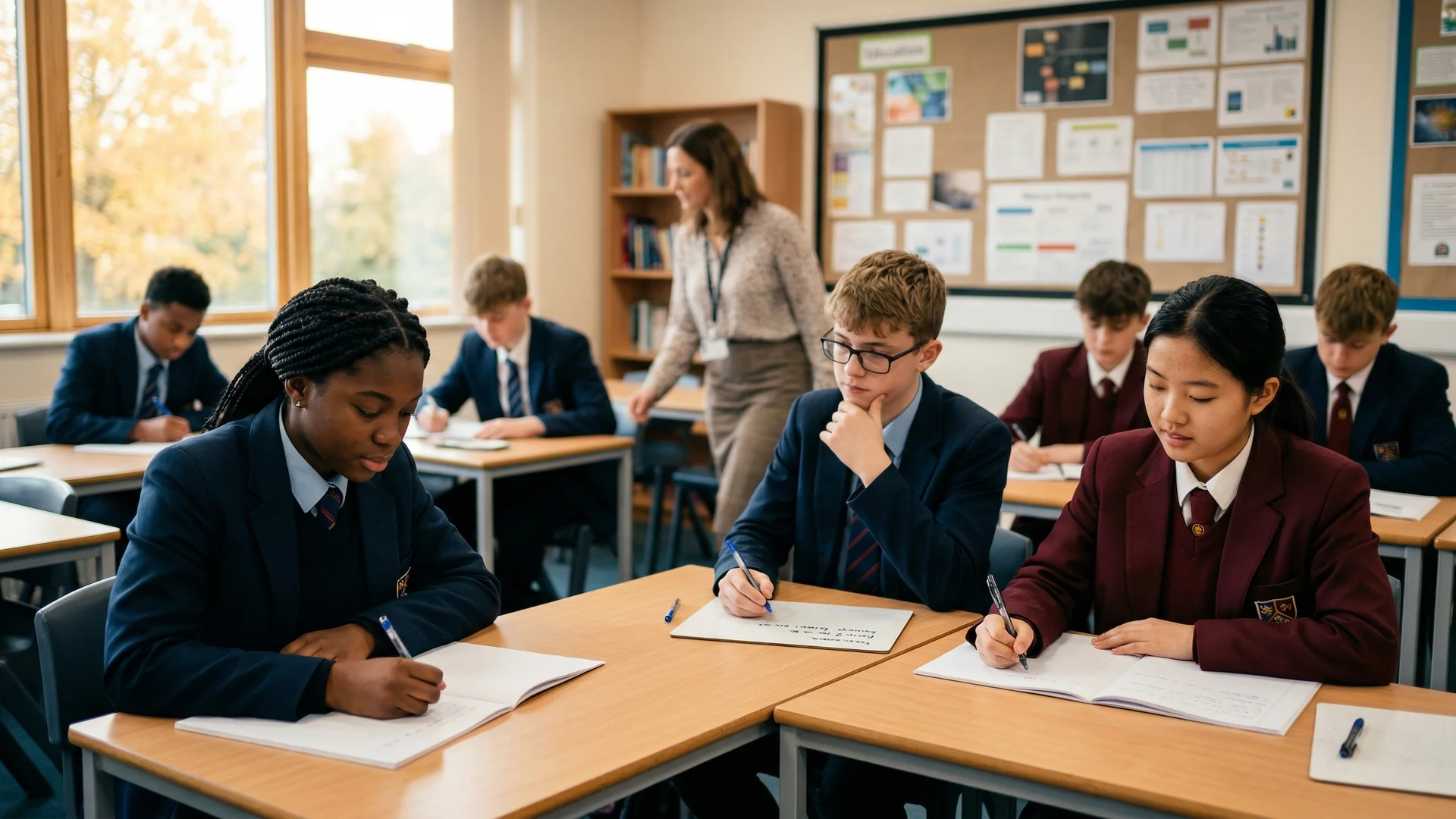
Retrieval practice—the act of pulling information from memory—is the single most effective learning strategy for secondary learners preparing for GCSE and A-Level exams. When you test learners, quiz them, or make them solve problems without support, you're not just assessing; you're dramatically strengthening memory. Research by Henry Roediger III and Jeffrey Karpicke (2006) shows that a single test produces more learning than multiple study sessions. In secondary, where content volume is high and exams are cumulative, retrieval practice is non-negotiable for success.

Key Takeaways

  1. Testing Effect is Real and Measurable: A single test strengthens memory more than extra study sessions. This means frequent low-stakes quizzes during lessons produce more GCSE learning than revision sessions outside class.
  2. Spacing and Interleaving Multiply the Effect: Spacing retrievals over time (quiz on Monday, again Thursday, again next week) produces memory that lasts months. Mixing topics during practice forces learners to discriminate between concepts, improving exam performance.
  3. Retrieval Reveals Misconceptions: Tests aren't just assessment; they're diagnostic. A learner's errors in retrieval show exactly where understanding breaks down, allowing targeted reteaching.
  4. Exam Technique is Retrieval Practice: Past papers aren't just practice; they're learning tools. A learner who does past papers with spacing and reflection improves more than one who revises notes passively.

Why Retrieval Practice Works in Secondary

Secondary education has different demands than primary: higher content volume, multiple subjects, cumulative exams, independent learning, and transfer to novel contexts. Retrieval practice addresses all of these.

Volume Management: GCSE learners must master 9+ subjects with hundreds of facts, concepts, and procedures. Retrieval practice is the most efficient memory system for managing this volume. Spacing retrievals means you don't have to re-teach; learners maintain knowledge through testing.

Cumulative Exams: GCSE and A-Level exams aren't unit tests; they're cumulative. Learners must retrieve information from months ago. Retrieval practice with spacing maintains old knowledge while building new knowledge.

Transfer Demands: Exam questions require applying knowledge to novel contexts. Interleaved retrieval practice (mixing topics and problem types during learning) trains transfer better than blocked practice (same type repeated).

Independent Learning: Learners revise outside lessons. Retrieval practice (self-testing, past papers, problem-solving) is more effective than passive review for home learning.

The EEF Teaching and Learning Toolkit rates retrieval practice as "very high impact" for secondary, with evidence of 7+ months' progress gain from implementation. This is equivalent to months of additional instruction.

Types of Retrieval Practice

Type What It Is Example in Secondary When to Use
Low-Stakes Quiz Brief test at start/end of lesson, not graded, feedback-focused Biology: 5-minute quiz on photosynthesis from last lesson. Maths: 3 problems on yesterday's topic mixed with others. Every lesson. Maintains knowledge while teaching new content.
Interleaved Practice Mix problem types or topics during homework/classwork instead of blocking by type Maths homework: mix simultaneous equations, quadratics, and linear graphs instead of "solve 10 simultaneous equations then 10 quadratics." During practice. Forces discrimination between concepts and improves transfer.
Spaced Retrieval Quiz same topic multiple times with time gaps (not back-to-back) History: "English Civil War" quiz Monday. Same quiz (or similar) Thursday. Same topic mixed into revision quiz next week. During teaching unit and revision. Maintains memory long-term.
Past Paper Practice Learners do exam questions without answer sheets, then check GCSE revision: Do past paper questions 2-3 times with weeks between attempts. First time as retrieval, third time as spacing reminder. During revision. Single most effective revision tool.
Self-Explanation Learner explains their solution process, retrieving reasoning and checking understanding Chemistry: After balancing an equation, explain *why* those coefficients. Physics: Solve a problem, then explain the reasoning to a peer. During problem-solving. Reveals misconceptions and deepens understanding.

The Testing Effect: Why It Works

The testing effect, first documented by Roediger and Karpicke (2006), is simple: retrieving information makes it stronger than studying the same information repeatedly without retrieval.

Mechanism 1: Retrieval Strengthens Encoding
When you retrieve information, you reactivate and reconsolidate the memory. The act of retrieval itself strengthens the neural pathway. This is different from rereading notes, which just refreshes short-term working memory.

Mechanism 2: Retrieval Reveals Gaps
A quiz shows exactly what you know and don't know. Studying notes is passive; you can't tell if you actually know something until you retrieve it. This diagnostic function lets you target studying where it's needed.

Mechanism 3: Retrieval Creates Flexible Knowledge
Information retrieved in different contexts (written, verbal, problem-solving) becomes more flexible and transferable. A learner who retrieves a concept by solving a problem can apply it to new problems; a learner who only rereads notes may have recitation knowledge but not transferable knowledge.

Spacing: The Multiplier Effect

Spacing—retrieving information with time gaps between retrievals—multiplies the testing effect dramatically.

Poor spacing (massed practice): Quiz on mitochondria Monday through Friday. By the following Monday, 60% is forgotten. Memory decay hasn't been interrupted.

Better spacing (distributed practice): Quiz Monday, then Thursday, then next Tuesday. Each retrieval comes after some decay, requiring effort. This effort-based retrieval produces stronger, longer-lasting memory. See also our guide on cognitive load in secondary schools.

The spacing effect is robust: retrievals spaced over weeks or months produce memory that lasts years. This is why a GCSE learner who does past papers spaced across the revision period learns more than one who does them all in one week.

Optimal spacing formula (Cepeda et al., 2006): Space the next retrieval at about 10-20% of the desired retention interval. If you want knowledge to last 6 months (to an exam), space next quiz at 6 weeks before.

In practice: quiz on Day 1, Day 7, Day 21, then every 4 weeks. Simple systems (Quizlet, anki) automate this.

Interleaving: Transfer Through Discrimination

Interleaving—mixing different problem types or topics during practice—forces learners to discriminate between concepts and improves transfer to novel problems.

Blocked practice (less effective):
Maths: "Solve 10 simultaneous equations using elimination."
Learners master the procedure for this specific type. But they only retrieve the "elimination method" because that's all they see.

Interleaved practice (more effective):
"Solve these 10 problems. Choose the best method: elimination, substitution, or graphical."
Learners must discriminate between problem types AND retrieve the right method. This forces deeper processing and transfers better to exam questions where learners don't know which method to use.

Research by Rohrer and Taylor (2007) shows interleaving produces transfer improvements of 20-50% over blocked practice, at the cost of feeling slightly harder during learning.

Implementing Retrieval Practice in Lessons

‍ For related guidance, see our article on selective mutism support.

1. Open Every Lesson With a Quiz (5-10 minutes)

Start each lesson with low-stakes retrieval. Not homework review. Not re-teaching. A quiz on recent content (last week, last month, from a previous unit).

Format options:

  • Multiple choice on a board (learners answer on miniwhiteboards)
  • Short-answer written quiz (3-5 questions)
  • Think-pair-share (think individually, discuss with peer, share with class)
  • Online quiz (Kahoot, Quizlet Live, Google Forms)

Why this works: This 5-minute investment produces retrieval of knowledge from previous lessons, maintaining it while you teach new content. Research shows that opening lessons with retrieval quizzes improves GCSE performance by 5-15%.

2. Use Interleaved Homework

Instead of "Do Problems 1-20 on Chapter 5," use mixed problems:

"Do these 15 problems. Some are from Chapter 5, some from Chapter 3, some from Chapter 7. Choose the best method for each."

Learners must retrieve the relevant concept for each problem, not just apply the chapter's method. This is harder but produces better learning.

3. Space Formative Assessments

Don't cluster assessments (test on the unit right after teaching). Space them out.

Timeline: Introduce topic on Monday. Quiz Friday (retrieval after 4 days). Quiz again next Tuesday (spaced retrieval). Mix into revision quiz 3 weeks later. This spacing maintains knowledge through the unit and beyond.

4. Make Past Papers Central to Revision

For GCSE/A-Level, past papers are the single most effective revision tool. A learner who does 10 past papers over 8 weeks (spaced retrievals) learns vastly more than one who revises notes and does past papers in one week.

Protocol: Do a past paper with minimal support (retrieval). Check answers. Identify gaps. Reteach gaps. Do another past paper (same or different) 2 weeks later (spaced retrieval). The retrieval + spacing combination is unbeatable for exam preparation.

5. Use Error Analysis for Feedback

When learners make errors on quizzes/assessments, analyse the error to reveal misconceptions. This diagnostic function turns tests into learning tools.

Example: A Year 10 learner writes "3x² + 2x" instead of "x(3x + 2)" when asked to factorise. This reveals: they understand factorising conceptually but haven't mastered the procedure. Reteach the procedure. Quiz again (retrieval). The error revealed exactly where learning was needed.

Retrieval Practice and Revision Strategy

Many secondary learners revise passively: rereading notes, watching YouTube videos, making pretty mind maps. Retrieval practice is the evidence-based alternative.

Effective revision strategy (Dunlosky et al., 2013):

  1. Retrieval Practice (HIGH effectiveness): Do past papers, quizzes, practice problems without notes
  2. Spacing (HIGH effectiveness): Space revision over weeks, not days. Do past papers with gaps between them
  3. Interleaving (MEDIUM-HIGH effectiveness): Mix topics during revision, don't revise one topic at a time
  4. Self-Explanation (MEDIUM effectiveness): Explain your answer and your reasoning after solving a problem
  5. Rereading (LOW effectiveness): Reading notes again produces minimal benefit. Do this only if other strategies haven't worked

Unfortunately, learners often do the opposite: rereading (low effectiveness), cramming (no spacing, high stress), blocking by topic (no interleaving).

Your role: Teach learners the evidence-based approach. Show them that retrieval practice produces better exam results than the passive methods they naturally default to.

Addressing Common Misconceptions

"Won't Frequent Testing Stress Learners?"

Low-stakes testing (quizzes that don't count toward grades, feedback-focused) reduces anxiety. Learners feel prepared for high-stakes exams because they've been quizzed regularly. It's the uncertainty that stresses them, not the testing.

"Doesn't Spacing Just Spread Out Learning?"

No. Spacing concentrates learning. A learner who retrieves information 3 times spaced over 6 weeks learns more than one who does the same information 10 times in one week. The spacing is the efficiency, not the drawback.

"If Learners Get It Wrong on Tests, Doesn't That Mean They're Failing?"

The opposite. Struggle during learning (getting some wrong, having to think) produces stronger memory than easy retrieval. Low-stakes quizzes where learners get 60-70% correct are optimally challenging. Easy 100% quizzes aren't producing learning; they're just confirming what's already known.

Tech Tools for Spaced Retrieval

Several tools automate spacing and make retrieval practice efficient:

  • Quizlet: Flashcard app with automatic spacing. Learners can study from your decks.
  • Anki: Open-source spaced repetition software. More sophisticated spacing algorithm.
  • Google Forms/Kahoot: Quick quizzes. You can manually space them over lessons.
  • Retrieval Practice Sheets: PDFs with mixed-topic problems for interleaving.

Many of these are free or low-cost. Implementation requires minimal setup once configured.

FAQ

Q: If I quiz at the start of every lesson, when do I teach new content?
A: A 5-minute quiz doesn't displace teaching. You've gained 55 minutes of uninterrupted teaching plus retrieval practice. The quiz also activates prior knowledge, making new teaching connect better to old knowledge.

Q: Should I tell learners they'll be quizzed, or surprise them?
A: Tell them. The testing effect works whether quizzes are expected or surprising. But knowing they'll be quizzed motivates study at home, which benefits learning.

Q: How do I handle learners who consistently do poorly on quizzes?
A: Poor quiz performance is diagnostic: they didn't learn the concept or haven't retrieved it yet. Use errors to reteach, then quiz again (spaced retrieval). Low quiz scores are information, not failure. The quiz revealed the gap; you fix it.

Q: Can I use retrieval practice with SEND learners?
A: Yes, but adapt. Shorter quizzes, simpler questions, more spacing, concrete retrieval (drawing, physical retrieval) in addition to recall. SEND learners often benefit *more* from retrieval practice because it consolidates learning better than passive methods.

Q: Does retrieval practice work for subjects like PE or Art?
A: Yes. PE: quiz on rules, tactics, technique. Art: quiz on artists, movements, techniques. Any subject with knowledge benefits from retrieval practice.

Further Reading: Key Research Papers

Further Reading: Key Research Papers

These papers provide the evidence base for retrieval practice and its application to secondary GCSE preparation.

The Test Effect: Retrieval Strengthens Memory More Than Studying View study ↗
Roediger III, H., & Karpicke, J. (2006)
Landmark review of 317 experiments showing that testing produces stronger, longer-lasting memory than equivalent study time. The most replicated effect in cognitive psychology.

Spacing and the Testing Effect in GCSE Learning View study ↗
Dunlosky, J., Rawson, K., Marsh, E., Nathan, M., & Willingham, D. (2013)
Meta-analysis of revision strategies. Spaced retrieval practice (self-testing with gaps between tests) produces high-impact learning. Rereading produces low-impact learning. Critical for GCSE revision guidance.

Interleaving Improves Discrimination and Transfer View study ↗
Rohrer, D., & Taylor, K. (2007)
Shows that interleaved practice (mixing problem types) produces 20-50% greater transfer to novel problems compared to blocked practice. Essential for secondary maths and science problem-solving.

Retrieval Practice in the Classroom: Implementation and Impact View study ↗
Education Endowment Foundation (2022)
Reviews classroom implementation of retrieval practice. Shows that frequent low-stakes quizzing improves GCSE attainment by 7+ months equivalent. Low-cost, high-impact intervention for secondary schools.

The Optimal Gap: Spacing Retrieval Over Time View study ↗
Cepeda, N., Coburn, N., Rohrer, D., Wixted, J., Morey, C., & Bjork, R. (2006)
Meta-analysis of 317 spacing studies. Identifies optimal spacing as 10-20% of desired retention interval. If knowledge must last 6 months, space retrievals 6-8 weeks apart. Provides guidance for planning retrieval practice schedules.

Loading audit...

Retrieval Practice for Secondary Teachers (KS3-4)

Retrieval practice—the act of pulling information from memory—is the single most effective learning strategy for secondary learners preparing for GCSE and A-Level exams. When you test learners, quiz them, or make them solve problems without support, you're not just assessing; you're dramatically strengthening memory. Research by Henry Roediger III and Jeffrey Karpicke (2006) shows that a single test produces more learning than multiple study sessions. In secondary, where content volume is high and exams are cumulative, retrieval practice is non-negotiable for success.

Key Takeaways

  1. Testing Effect is Real and Measurable: A single test strengthens memory more than extra study sessions. This means frequent low-stakes quizzes during lessons produce more GCSE learning than revision sessions outside class.
  2. Spacing and Interleaving Multiply the Effect: Spacing retrievals over time (quiz on Monday, again Thursday, again next week) produces memory that lasts months. Mixing topics during practice forces learners to discriminate between concepts, improving exam performance.
  3. Retrieval Reveals Misconceptions: Tests aren't just assessment; they're diagnostic. A learner's errors in retrieval show exactly where understanding breaks down, allowing targeted reteaching.
  4. Exam Technique is Retrieval Practice: Past papers aren't just practice; they're learning tools. A learner who does past papers with spacing and reflection improves more than one who revises notes passively.

Why Retrieval Practice Works in Secondary

Secondary education has different demands than primary: higher content volume, multiple subjects, cumulative exams, independent learning, and transfer to novel contexts. Retrieval practice addresses all of these.

Volume Management: GCSE learners must master 9+ subjects with hundreds of facts, concepts, and procedures. Retrieval practice is the most efficient memory system for managing this volume. Spacing retrievals means you don't have to re-teach; learners maintain knowledge through testing.

Cumulative Exams: GCSE and A-Level exams aren't unit tests; they're cumulative. Learners must retrieve information from months ago. Retrieval practice with spacing maintains old knowledge while building new knowledge.

Transfer Demands: Exam questions require applying knowledge to novel contexts. Interleaved retrieval practice (mixing topics and problem types during learning) trains transfer better than blocked practice (same type repeated).

Independent Learning: Learners revise outside lessons. Retrieval practice (self-testing, past papers, problem-solving) is more effective than passive review for home learning.

The EEF Teaching and Learning Toolkit rates retrieval practice as "very high impact" for secondary, with evidence of 7+ months' progress gain from implementation. This is equivalent to months of additional instruction.

Types of Retrieval Practice

Type What It Is Example in Secondary When to Use
Low-Stakes Quiz Brief test at start/end of lesson, not graded, feedback-focused Biology: 5-minute quiz on photosynthesis from last lesson. Maths: 3 problems on yesterday's topic mixed with others. Every lesson. Maintains knowledge while teaching new content.
Interleaved Practice Mix problem types or topics during homework/classwork instead of blocking by type Maths homework: mix simultaneous equations, quadratics, and linear graphs instead of "solve 10 simultaneous equations then 10 quadratics." During practice. Forces discrimination between concepts and improves transfer.
Spaced Retrieval Quiz same topic multiple times with time gaps (not back-to-back) History: "English Civil War" quiz Monday. Same quiz (or similar) Thursday. Same topic mixed into revision quiz next week. During teaching unit and revision. Maintains memory long-term.
Past Paper Practice Learners do exam questions without answer sheets, then check GCSE revision: Do past paper questions 2-3 times with weeks between attempts. First time as retrieval, third time as spacing reminder. During revision. Single most effective revision tool.
Self-Explanation Learner explains their solution process, retrieving reasoning and checking understanding Chemistry: After balancing an equation, explain *why* those coefficients. Physics: Solve a problem, then explain the reasoning to a peer. During problem-solving. Reveals misconceptions and deepens understanding.

The Testing Effect: Why It Works

The testing effect, first documented by Roediger and Karpicke (2006), is simple: retrieving information makes it stronger than studying the same information repeatedly without retrieval.

Mechanism 1: Retrieval Strengthens Encoding
When you retrieve information, you reactivate and reconsolidate the memory. The act of retrieval itself strengthens the neural pathway. This is different from rereading notes, which just refreshes short-term working memory.

Mechanism 2: Retrieval Reveals Gaps
A quiz shows exactly what you know and don't know. Studying notes is passive; you can't tell if you actually know something until you retrieve it. This diagnostic function lets you target studying where it's needed.

Mechanism 3: Retrieval Creates Flexible Knowledge
Information retrieved in different contexts (written, verbal, problem-solving) becomes more flexible and transferable. A learner who retrieves a concept by solving a problem can apply it to new problems; a learner who only rereads notes may have recitation knowledge but not transferable knowledge.

Spacing: The Multiplier Effect

Spacing—retrieving information with time gaps between retrievals—multiplies the testing effect dramatically.

Poor spacing (massed practice): Quiz on mitochondria Monday through Friday. By the following Monday, 60% is forgotten. Memory decay hasn't been interrupted.

Better spacing (distributed practice): Quiz Monday, then Thursday, then next Tuesday. Each retrieval comes after some decay, requiring effort. This effort-based retrieval produces stronger, longer-lasting memory. See also our guide on cognitive load in secondary schools.

The spacing effect is robust: retrievals spaced over weeks or months produce memory that lasts years. This is why a GCSE learner who does past papers spaced across the revision period learns more than one who does them all in one week.

Optimal spacing formula (Cepeda et al., 2006): Space the next retrieval at about 10-20% of the desired retention interval. If you want knowledge to last 6 months (to an exam), space next quiz at 6 weeks before.

In practice: quiz on Day 1, Day 7, Day 21, then every 4 weeks. Simple systems (Quizlet, anki) automate this.

Interleaving: Transfer Through Discrimination

Interleaving—mixing different problem types or topics during practice—forces learners to discriminate between concepts and improves transfer to novel problems.

Blocked practice (less effective):
Maths: "Solve 10 simultaneous equations using elimination."
Learners master the procedure for this specific type. But they only retrieve the "elimination method" because that's all they see.

Interleaved practice (more effective):
"Solve these 10 problems. Choose the best method: elimination, substitution, or graphical."
Learners must discriminate between problem types AND retrieve the right method. This forces deeper processing and transfers better to exam questions where learners don't know which method to use.

Research by Rohrer and Taylor (2007) shows interleaving produces transfer improvements of 20-50% over blocked practice, at the cost of feeling slightly harder during learning.

Implementing Retrieval Practice in Lessons

‍ For related guidance, see our article on selective mutism support.

1. Open Every Lesson With a Quiz (5-10 minutes)

Start each lesson with low-stakes retrieval. Not homework review. Not re-teaching. A quiz on recent content (last week, last month, from a previous unit).

Format options:

  • Multiple choice on a board (learners answer on miniwhiteboards)
  • Short-answer written quiz (3-5 questions)
  • Think-pair-share (think individually, discuss with peer, share with class)
  • Online quiz (Kahoot, Quizlet Live, Google Forms)

Why this works: This 5-minute investment produces retrieval of knowledge from previous lessons, maintaining it while you teach new content. Research shows that opening lessons with retrieval quizzes improves GCSE performance by 5-15%.

2. Use Interleaved Homework

Instead of "Do Problems 1-20 on Chapter 5," use mixed problems:

"Do these 15 problems. Some are from Chapter 5, some from Chapter 3, some from Chapter 7. Choose the best method for each."

Learners must retrieve the relevant concept for each problem, not just apply the chapter's method. This is harder but produces better learning.

3. Space Formative Assessments

Don't cluster assessments (test on the unit right after teaching). Space them out.

Timeline: Introduce topic on Monday. Quiz Friday (retrieval after 4 days). Quiz again next Tuesday (spaced retrieval). Mix into revision quiz 3 weeks later. This spacing maintains knowledge through the unit and beyond.

4. Make Past Papers Central to Revision

For GCSE/A-Level, past papers are the single most effective revision tool. A learner who does 10 past papers over 8 weeks (spaced retrievals) learns vastly more than one who revises notes and does past papers in one week.

Protocol: Do a past paper with minimal support (retrieval). Check answers. Identify gaps. Reteach gaps. Do another past paper (same or different) 2 weeks later (spaced retrieval). The retrieval + spacing combination is unbeatable for exam preparation.

5. Use Error Analysis for Feedback

When learners make errors on quizzes/assessments, analyse the error to reveal misconceptions. This diagnostic function turns tests into learning tools.

Example: A Year 10 learner writes "3x² + 2x" instead of "x(3x + 2)" when asked to factorise. This reveals: they understand factorising conceptually but haven't mastered the procedure. Reteach the procedure. Quiz again (retrieval). The error revealed exactly where learning was needed.

Retrieval Practice and Revision Strategy

Many secondary learners revise passively: rereading notes, watching YouTube videos, making pretty mind maps. Retrieval practice is the evidence-based alternative.

Effective revision strategy (Dunlosky et al., 2013):

  1. Retrieval Practice (HIGH effectiveness): Do past papers, quizzes, practice problems without notes
  2. Spacing (HIGH effectiveness): Space revision over weeks, not days. Do past papers with gaps between them
  3. Interleaving (MEDIUM-HIGH effectiveness): Mix topics during revision, don't revise one topic at a time
  4. Self-Explanation (MEDIUM effectiveness): Explain your answer and your reasoning after solving a problem
  5. Rereading (LOW effectiveness): Reading notes again produces minimal benefit. Do this only if other strategies haven't worked

Unfortunately, learners often do the opposite: rereading (low effectiveness), cramming (no spacing, high stress), blocking by topic (no interleaving).

Your role: Teach learners the evidence-based approach. Show them that retrieval practice produces better exam results than the passive methods they naturally default to.

Addressing Common Misconceptions

"Won't Frequent Testing Stress Learners?"

Low-stakes testing (quizzes that don't count toward grades, feedback-focused) reduces anxiety. Learners feel prepared for high-stakes exams because they've been quizzed regularly. It's the uncertainty that stresses them, not the testing.

"Doesn't Spacing Just Spread Out Learning?"

No. Spacing concentrates learning. A learner who retrieves information 3 times spaced over 6 weeks learns more than one who does the same information 10 times in one week. The spacing is the efficiency, not the drawback.

"If Learners Get It Wrong on Tests, Doesn't That Mean They're Failing?"

The opposite. Struggle during learning (getting some wrong, having to think) produces stronger memory than easy retrieval. Low-stakes quizzes where learners get 60-70% correct are optimally challenging. Easy 100% quizzes aren't producing learning; they're just confirming what's already known.

Tech Tools for Spaced Retrieval

Several tools automate spacing and make retrieval practice efficient:

  • Quizlet: Flashcard app with automatic spacing. Learners can study from your decks.
  • Anki: Open-source spaced repetition software. More sophisticated spacing algorithm.
  • Google Forms/Kahoot: Quick quizzes. You can manually space them over lessons.
  • Retrieval Practice Sheets: PDFs with mixed-topic problems for interleaving.

Many of these are free or low-cost. Implementation requires minimal setup once configured.

FAQ

Q: If I quiz at the start of every lesson, when do I teach new content?
A: A 5-minute quiz doesn't displace teaching. You've gained 55 minutes of uninterrupted teaching plus retrieval practice. The quiz also activates prior knowledge, making new teaching connect better to old knowledge.

Q: Should I tell learners they'll be quizzed, or surprise them?
A: Tell them. The testing effect works whether quizzes are expected or surprising. But knowing they'll be quizzed motivates study at home, which benefits learning.

Q: How do I handle learners who consistently do poorly on quizzes?
A: Poor quiz performance is diagnostic: they didn't learn the concept or haven't retrieved it yet. Use errors to reteach, then quiz again (spaced retrieval). Low quiz scores are information, not failure. The quiz revealed the gap; you fix it.

Q: Can I use retrieval practice with SEND learners?
A: Yes, but adapt. Shorter quizzes, simpler questions, more spacing, concrete retrieval (drawing, physical retrieval) in addition to recall. SEND learners often benefit *more* from retrieval practice because it consolidates learning better than passive methods.

Q: Does retrieval practice work for subjects like PE or Art?
A: Yes. PE: quiz on rules, tactics, technique. Art: quiz on artists, movements, techniques. Any subject with knowledge benefits from retrieval practice.

Further Reading: Key Research Papers

Further Reading: Key Research Papers

These papers provide the evidence base for retrieval practice and its application to secondary GCSE preparation.

The Test Effect: Retrieval Strengthens Memory More Than Studying View study ↗
Roediger III, H., & Karpicke, J. (2006)
Landmark review of 317 experiments showing that testing produces stronger, longer-lasting memory than equivalent study time. The most replicated effect in cognitive psychology.

Spacing and the Testing Effect in GCSE Learning View study ↗
Dunlosky, J., Rawson, K., Marsh, E., Nathan, M., & Willingham, D. (2013)
Meta-analysis of revision strategies. Spaced retrieval practice (self-testing with gaps between tests) produces high-impact learning. Rereading produces low-impact learning. Critical for GCSE revision guidance.

Interleaving Improves Discrimination and Transfer View study ↗
Rohrer, D., & Taylor, K. (2007)
Shows that interleaved practice (mixing problem types) produces 20-50% greater transfer to novel problems compared to blocked practice. Essential for secondary maths and science problem-solving.

Retrieval Practice in the Classroom: Implementation and Impact View study ↗
Education Endowment Foundation (2022)
Reviews classroom implementation of retrieval practice. Shows that frequent low-stakes quizzing improves GCSE attainment by 7+ months equivalent. Low-cost, high-impact intervention for secondary schools.

The Optimal Gap: Spacing Retrieval Over Time View study ↗
Cepeda, N., Coburn, N., Rohrer, D., Wixted, J., Morey, C., & Bjork, R. (2006)
Meta-analysis of 317 spacing studies. Identifies optimal spacing as 10-20% of desired retention interval. If knowledge must last 6 months, space retrievals 6-8 weeks apart. Provides guidance for planning retrieval practice schedules.
No Posts found.
Back to Blog