Decolonising the Curriculum: A Teacher's GuideDecolonising the Curriculum: A Teacher's Guide: practical strategies for teachers

Updated on  

March 17, 2026

Decolonising the Curriculum: A Teacher's Guide

|

March 17, 2026

Decolonising the curriculum means examining whose knowledge is taught and why. Practical strategies, key frameworks, and examples for UK teachers.

Decolonising the curriculum means critically examining which knowledge, voices, and ways of knowing are valued in schools, and why. It is not simply adding a few new authors to a reading list or running a Black History Month assembly. It is a structural process of questioning whose knowledge is treated as universal, whose is treated as specialist, and what that communicates to every pupil who walks through your door.

For UK teachers, this question is both professionally urgent and personally complex. Around 33% of pupils in state-funded schools in England are from ethnic minority backgrounds (DfE, 2023), yet the curriculum in many schools still reflects a largely Eurocentric view of knowledge, history, and culture. Research from the Runnymede Trust (2020) shows that pupils from Black Caribbean heritage are 1.5 times more likely to be excluded than their white peers. The evidence linking school belonging to academic attainment (Rumberger, 2011) suggests this is not coincidental. When pupils do not see themselves reflected in what is taught, the cost is measurable.

This guide gives you the theoretical grounding, practical tools, and subject-specific strategies to begin that process in your school.
Key Takeaways

    • Decolonising is structural, not additive: It means questioning the knowledge hierarchy itself, not simply adding diverse content to an unchanged framework.
    • Three levels of change: The process operates at content (what is taught), pedagogy (how it is taught), and epistemology (whose ways of knowing are valued).
    • Theoretical grounding matters: Freire, Bhambra, Andrews, Apple, and Fanon provide the intellectual framework for why this work is necessary.
    • A curriculum audit is the practical starting point: A structured five-step audit helps identify what is present, what is absent, and whose perspective is the default.
    • Legal context supports the work: The Equality Act 2010 and Ofsted's breadth criteria do not mandate decolonisation by name, but they create the professional conditions in which curriculum review is prudent.
    • Start small: One subject, one unit, one term. Document what changes and what pupils say.

What Decolonising the Curriculum Really Means: Beyond the Checkbox infographic for teachers
What Decolonising the Curriculum Really Means: Beyond the Checkbox

What Does Decolonising the Curriculum Mean?

Decolonising the curriculum means critically examining which knowledge, voices, and perspectives are treated as the default standard in schools; some are treated as additional, supplementary, or exotic. It asks a fundamental question: whose knowledge is valued, and whose is marginalised?

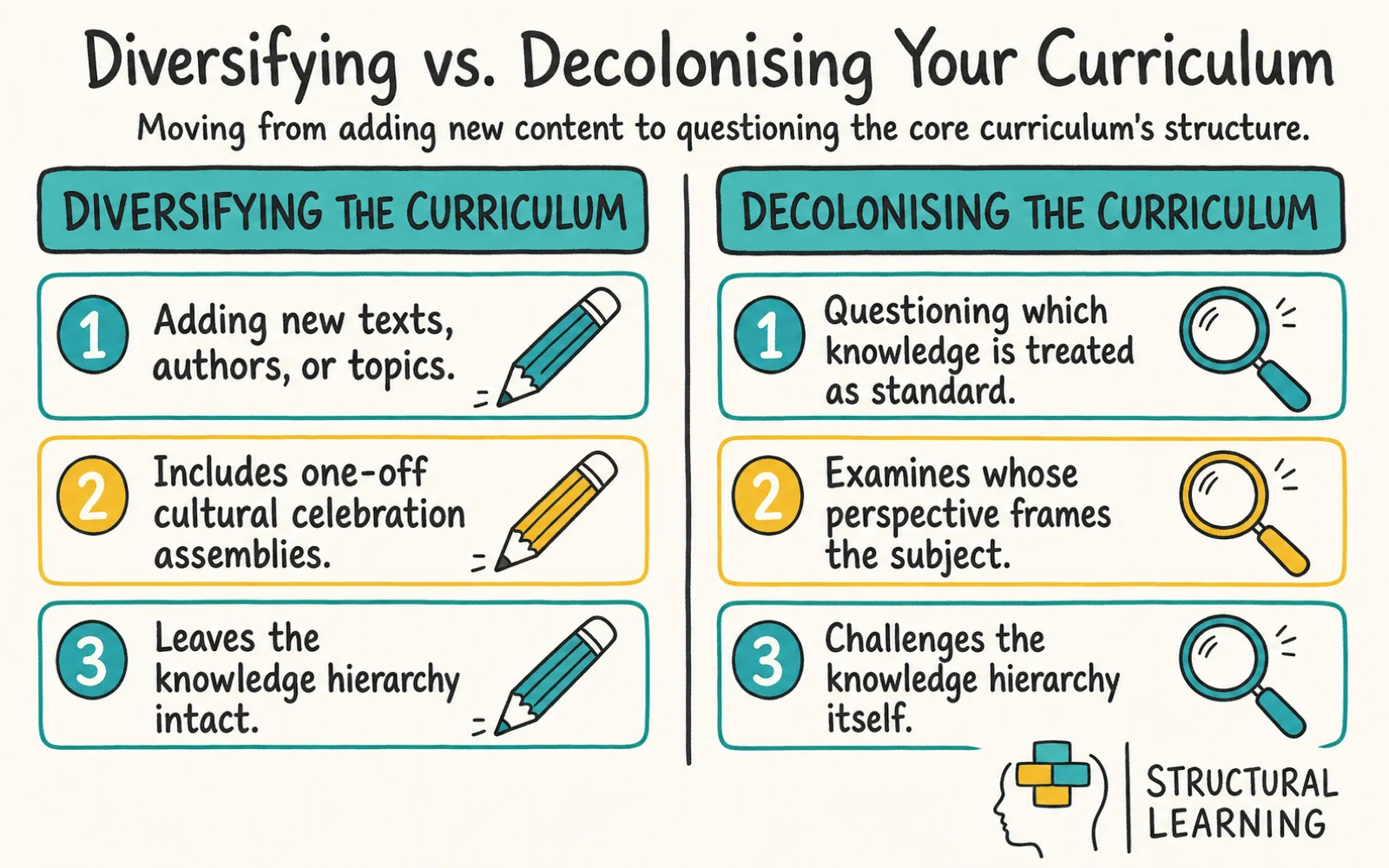
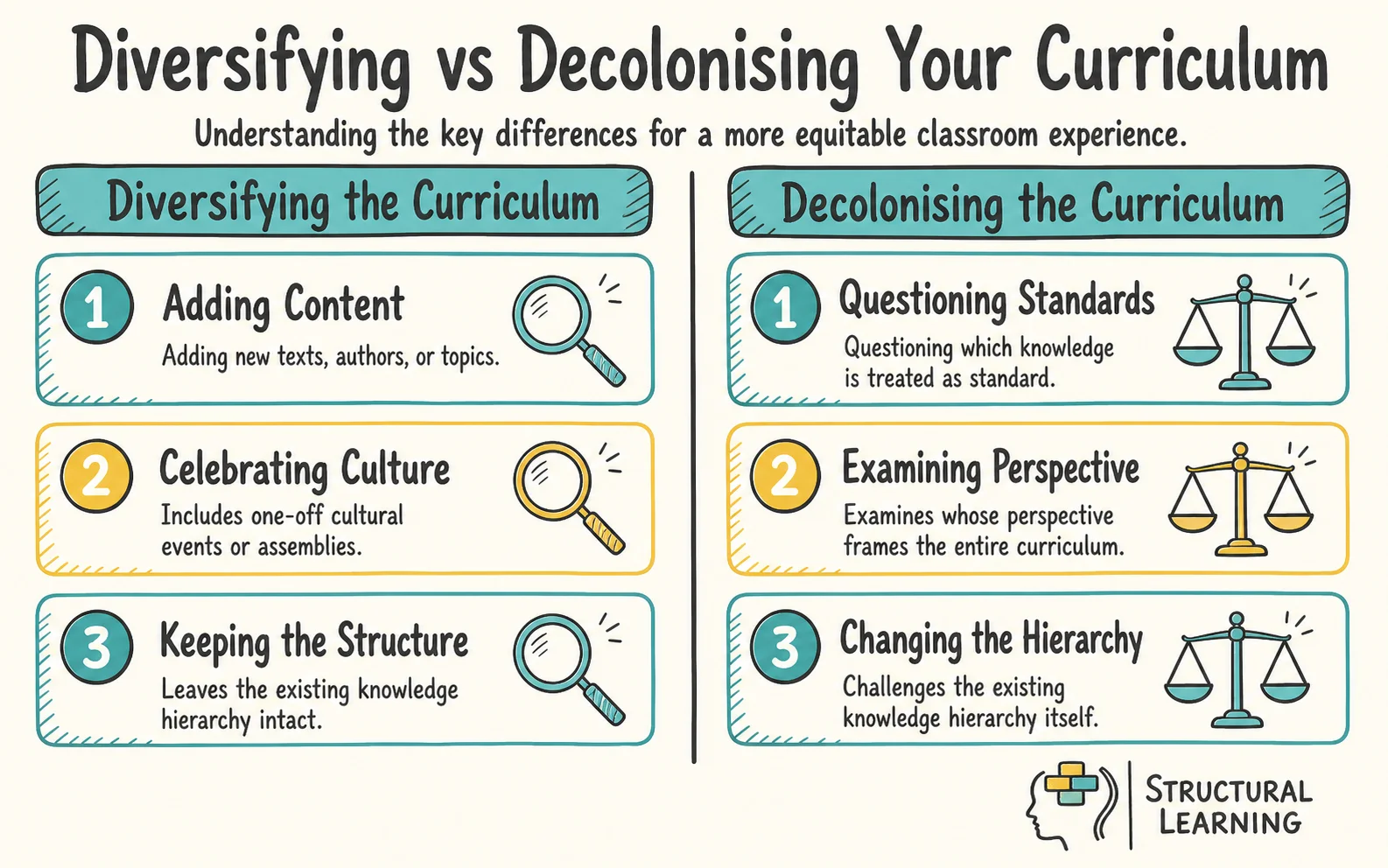
The distinction between "diversifying" and "decolonising" is important. Diversification is additive. It means including more authors, more historical figures, more cultural references within a curriculum that otherwise stays the same. Decolonisation is structural. It means questioning the knowledge hierarchy itself: why certain traditions are treated as universal (Western philosophy, European history, English literature) and others as particular (African philosophy, Indian mathematics, oral literary traditions).

Kehinde Andrews, Professor of Black Studies at Birmingham City University, makes this distinction clearly: race equality, he argues, means creating access to existing structures; decolonisation means questioning whether those structures should exist in their current form (Andrews, 2016). Ngugi wa Thiong'o, in his foundational text "Decolonising the Mind" (1986), locates the problem at the level of language and knowledge itself. Colonial education, he argued, did not just teach a curriculum; it taught pupils to see the world through a particular lens, and to regard that lens as neutral and universal.

The concept of the "hidden curriculum" (Giroux, 1983; Apple, 1979) is useful here. What schools communicate through omission is as powerful as what they communicate through inclusion. When pupils study two years of European history without encountering a single African intellectual tradition, the message is not neutral. It is a statement about what counts as knowledge.

Diversifying the curriculum Decolonising the curriculum
Adding new texts, authors, or topics to the existing curriculum Questioning which knowledge is treated as standard and why
Including Black History Month or Diwali assemblies Examining whose perspective frames history year-round
Adding a novel by a Black author to the reading list Examining which literary traditions are taught as "the canon" and which are taught as exceptions
Leaves the knowledge hierarchy intact Challenges the knowledge hierarchy itself

Why Does It Matter in UK Classrooms?

The statistical case is clear. Pupils from Black Caribbean heritage are 1.5 times more likely to be excluded from school than their white peers (ONS, 2022). Research consistently links a sense of school belonging to academic achievement (Rumberger, 2011). When pupils see no reflection of themselves in what is taught, that belonging is harder to build.

But this is not only about outcomes for minority-heritage pupils. A curriculum that presents one cultural tradition as universal produces graduates who are poorly prepared for a diverse society and a global economy. It narrows everyone's understanding.

Michael Apple, in "Ideology and Curriculum" (1979), argued that the school curriculum is never neutral. It is always a selection from the culture: a choice about which knowledge is worth transmitting. The question is not whether the curriculum reflects a set of values and priorities, but whose values and priorities it reflects. Stuart Hall (1997) extended this through his analysis of representation: when the West is always the subject of knowledge and non-Western cultures are always the object, a particular view of the world is naturalised as common sense.

The 2020 Commission on Race and Ethnic Disparities (sometimes called the Sewell Report) took the view that there was no evidence of institutional racism in UK schools. Many researchers and educators strongly disputed this reading of the evidence. Regardless of where you stand on that debate, the underlying data about exclusions, attainment gaps, and representation in the curriculum gives teachers concrete reasons to act. The question of whether it is "institutional racism" or "systemic disadvantage" does not change the professional obligation to ensure every pupil can access a rigorous, relevant education.

The Runnymede Trust's survey data on pupil voice is telling. Pupils from Black and mixed-heritage backgrounds consistently report feeling that the curriculum does not reflect their histories or experiences (Runnymede Trust, 2020). Research from the field of culturally responsive teaching shows that when teachers build on pupils' cultural knowledge, engagement and achievement improve (Gay, 2010; Ladson-Billings, 1994).

The Theoretical Framework Behind the Movement

Understanding the intellectual roots of decolonising education helps you speak about it with clarity and confidence, particularly when you need to make the case to sceptical colleagues.

Paulo Freire (1970) is the most widely cited theorist in this space. In "Pedagogy of the Oppressed," he identified what he called "banking education": the model in which teachers deposit knowledge into passive pupils, who receive, memorise, and repeat it. Freire contrasted this with "problem-posing education," in which pupils and teachers engage critically with the world together. His concept of "conscientisation", meaning the development of critical awareness of one's own social position, remains central to decolonising pedagogy. For Freire, education was always a political act. The question was whether it served to maintain existing power structures or to challenge them.

Frantz Fanon (1961) approached colonial education from a different angle. In "The Wretched of the Earth," he argued that colonial education worked through identity erasure: by teaching colonised peoples to see themselves through the eyes of the coloniser, it undermined their sense of cultural worth. The implications for classroom practice are not simply about which texts you teach. They are about what messages your curriculum sends about who is capable, who has contributed to human knowledge, and who has a future.

Gurminder K Bhambra (2007) offers a more contemporary academic framework. Her concept of "connected histories" challenges the idea that modernity was a European invention. European industrialisation, she argues, was built on colonial extraction. To teach the Industrial Revolution without teaching the Atlantic slave trade is to present a distorted picture. Her critique of "methodological nationalism", the tendency to treat nation-states as the natural unit of analysis, and it has direct implications for how history and social sciences are taught.

Michael Apple (1979) places the curriculum question within a structural analysis of power. The curriculum is not a neutral selection of the best that has been thought and said. It is a cultural selection that reflects the interests of dominant groups. This does not mean that everything in the current curriculum is wrong. It means that teachers have a professional obligation to ask whose interests a given selection of knowledge serves.

Boaventura de Sousa Santos (2014) introduces the concept of "epistemicide": the systematic destruction of non-Western knowledge systems through the process of colonisation. The implication is that indigenous knowledge traditions (in mathematics, medicine, ecology, and philosophy) were not simply different from Western science but were actively suppressed. Recognising epistemicide is not an argument against teaching Western science. It is an argument for teaching it alongside other knowledge traditions, and for acknowledging what was lost.

For classroom teachers, these theorists provide something specific: a vocabulary for explaining why the current curriculum is the way it is, and a principled basis for change.

What a Decolonised Curriculum Looks Like in Practice

There is no single "decolonised curriculum." It is a process of critical questioning rather than a finished product. That process operates at three levels.

Content refers to what is taught. This includes the texts, historical figures, scientists, mathematicians, and events that appear on the timetable. Content change is the most visible and often the easiest starting point. You can audit who appears in your reading lists, your history units, and your science lessons.

Pedagogy refers to how it is taught. This includes the classroom methods you use and the kind of thinking you ask pupils to do. A decolonising pedagogy does not simply add diverse content to a teacher-led lecture. It invites pupils to question sources, consider perspectives, and examine whose point of view frames a given account. Dialogic pedagogy and critical literacy are natural partners here.

Epistemology refers to whose ways of knowing are valued. This is the deepest level and the one most schools do not yet reach. It asks: do we treat Western scientific method as the only valid form of inquiry? Do we treat academic writing as the only legitimate way to demonstrate knowledge? Oral traditions, collective knowledge-making, and non-linear ways of organising information are knowledge practices too.

In practice, decolonising the curriculum looks like this:

  • A History teacher teaching the British Empire using primary sources from colonised peoples alongside the standard "civilising mission" narrative, asking pupils to identify whose perspective each source represents.
  • An English teacher teaching Chinua Achebe's "Things Fall Apart" not as a "diverse" addition but as a text that challenges pupils to read Conrad's "Heart of Darkness" differently.
  • A Science teacher acknowledging the Islamic Golden Age contributions of Ibn al-Haytham (optics), al-Khwarizmi (algebra), and Brahmagupta and Aryabhata (zero and positional number systems).
  • A Geography teacher questioning the Mercator projection and showing pupils how map projections carry political choices about which land masses to enlarge.
  • A PSHE teacher designing lessons that reflect the full range of family structures and identities present in UK schools, rather than using a default white, nuclear-family model.

None of these changes requires dismantling the entire curriculum. Each of them requires you to ask a single question before any unit of teaching: whose perspective is the default here, and is that choice explicit or invisible?

Subject-Specific Strategies for Teachers

History

The Historical Association's "Diverse and Inclusive History" guidance (2022) provides a practical framework for history teachers. Three principles are especially useful.

First, teach primary source interrogation as a skill that asks not just "what does this source tell us?" but "who wrote this, from what position, and what does its existence tell us about power?" A letter from a colonial administrator tells us something about colonial administration. It tells us very little about the experience of colonised people unless we treat its silences as evidence.

Second, teach the "Scramble for Africa" from multiple perspectives. Walter Rodney's "How Europe Underdeveloped Africa" (1972) is an accessible starting point for older pupils. A.G. Hopkins' work on African economic history provides a research-grounded counterpoint to the idea that Africa lacked complexity before European arrival.

Third, connect KS3 migration and empire units explicitly. The history of the British Empire and the history of post-war immigration to the UK are the same history. Teaching them in isolation produces pupils who cannot make the connection.

English and Media

Diversifying your reading lists is not the same as tokenism. Tokenism means including one "diverse" text in a list of otherwise standard texts, treating it as a concession rather than as a work with its own intellectual tradition. A more rigorous approach:

Teach Bernardine Evaristo's "Girl, Woman, Other" alongside Virginia Woolf, not instead of Virginia Woolf. Teach Chimamanda Ngozi Adichie's "We Should All Be Feminists" as a political essay in dialogue with Mary Wollstonecraft's "A Vindication of the Rights of Woman." Teach the Harlem Renaissance alongside Modernism. These connections are intellectually richer than simply adding texts to a list.

Critical media literacy is also part of this work. The Runnymede Trust's media representations toolkit gives teachers structured activities for examining how news sources cover stories from the Global South, and how those representations differ from coverage of comparable events in Europe.

Science and Maths

The history of science offers specific entry points here. Rosalind Franklin's contribution to the discovery of DNA's structure, and how that contribution was sidelined, is a well-documented story that combines the history of science with a lesson in how attribution works. Charles Drew's development of blood banks and his treatment by the US medical establishment is another.

In mathematics, the Arabic numeral system we use every day is not European. Al-Khwarizmi, a ninth-century Persian mathematician, gave us the word "algorithm." Brahmagupta (598-668 CE) and Aryabhata (476-550 CE) developed the concept of zero as a number. Teaching these facts does not undermine the rigour of mathematics. It gives mathematics a richer and more accurate history.

Challenging "discovery" language in science is also worth doing explicitly with pupils. Who "discovered" penicillin, and what does that mean for the other researchers whose work contributed? Who "discovered" America? These questions develop the critical thinking skills that science education needs.

PSHE, Citizenship, and SMSC

Global citizenship education (UNESCO, 2015) provides a curriculum framework that explicitly addresses power, rights, and responsibility at a global scale. Critical media literacy, examining how news coverage shapes our understanding of different parts of the world, belongs here.

Guest speakers from diverse backgrounds are most effective when they are integrated into learning, not confined to celebration events. A scientist from a South Asian background speaking about their career path in the context of a science unit on the history of mathematics is more powerful than an assembly on cultural diversity.
The Three Levels of Curriculum Change: Content, Pedagogy & Epistemology infographic for teachers
The Three Levels of Curriculum Change: Content, Pedagogy & Epistemology

How to Audit Your Curriculum

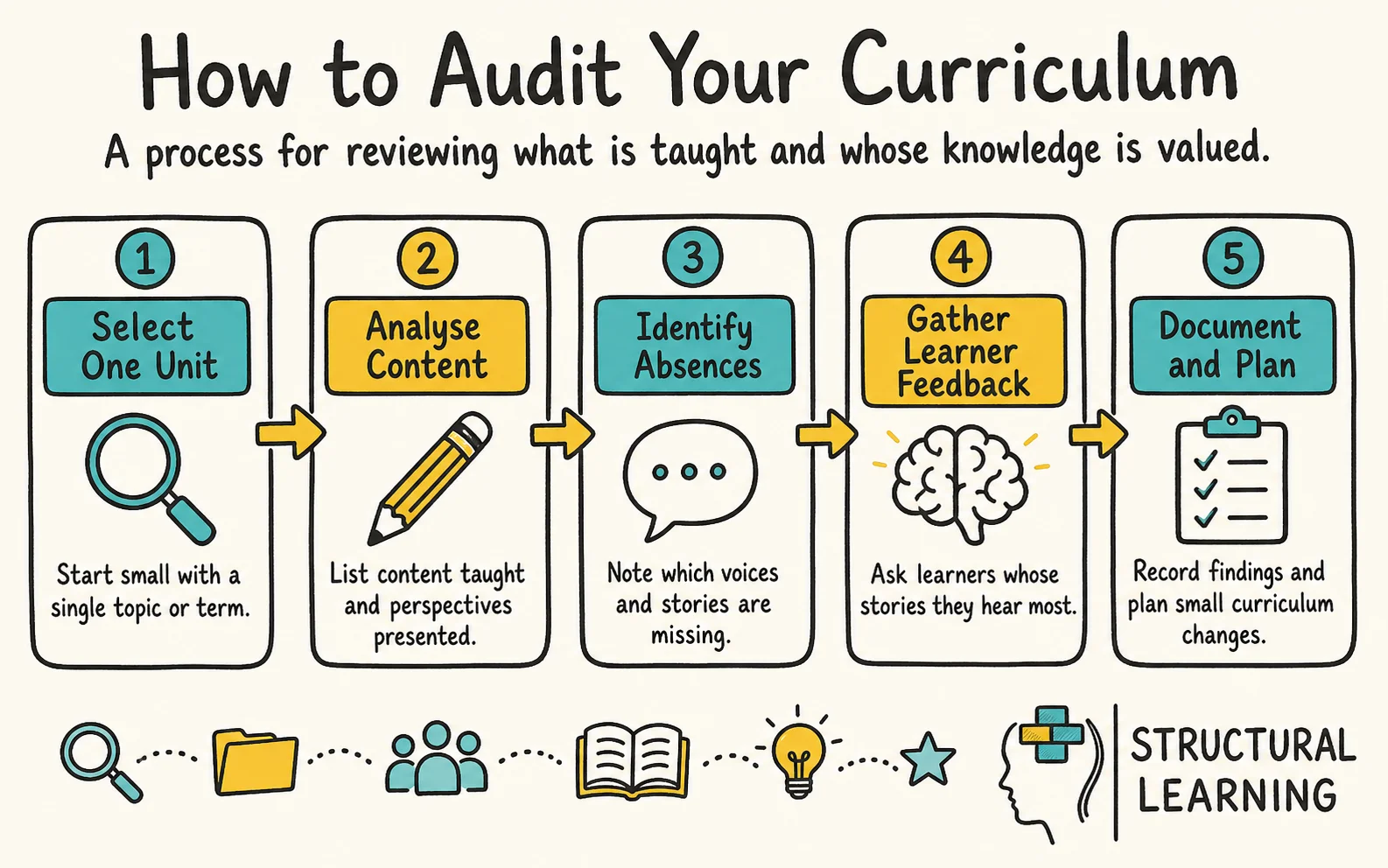
A curriculum audit is the most concrete starting point for most schools. The following five-step framework can be adapted for a single department or run across the whole school.

Step 1: Map representation across year groups. For each subject, create a simple list of every named author, historical figure, scientist, mathematician, and cultural tradition that appears on the timetable. Note their cultural heritage and nationality. Look at the pattern: is the list overwhelmingly European and North American? This step is about creating data, not about making immediate judgements.

Step 2: Identify omissions. Which civilisations, intellectual movements, or ways of knowing are entirely absent? A history curriculum that covers ancient Greece, Rome, and medieval Europe but never addresses the Mali Empire, the Songhai Empire, or pre-colonial India is making a choice. Name that choice explicitly.

Step 3: Question framing. For each major unit, ask: whose perspective is the "default" narrator? In a unit on the British Empire, is the default perspective British or colonial? In a unit on the Industrial Revolution, is the connection to the Atlantic slave trade made explicit? This step is harder than the content audit because framing is often invisible.

Step 4: Examine assessment questions. Do your exam questions and essay prompts privilege knowledge of particular cultural contexts? A question that asks pupils to compare two European political movements implicitly assumes European history is the relevant frame of reference for all pupils. This is not always wrong, but it should be a conscious choice.

Step 5: Consult pupil and community voice. Ask pupils, particularly those from ethnic minority backgrounds, what they notice about the curriculum. The Runnymede Trust's pupil voice framework provides structured questions. Talk to parents and community organisations. This step closes the gap between what teachers intend the curriculum to communicate and what pupils actually experience.

Subject Representation audit Framing audit Epistemology audit
History Who are the named figures? Which civilisations appear? Whose perspective frames each unit? Are oral histories or non-documentary sources valued?
English Who are the authors? Which literary traditions are present? Which tradition is "the canon" and which is "alternative"? Are oral literary traditions treated as valid?
Science Who are the scientists named? Which cultures' contributions appear? Is science presented as exclusively Western? Are non-Western scientific methods ever acknowledged?
Maths Are non-European mathematicians named? Is the history of mathematics framed as a European story? Are multiple problem-solving approaches valued?

Common Objections and How to Address Them

This section addresses the concerns teachers most frequently encounter when they raise decolonising the curriculum with colleagues or school leadership. The tone here is deliberately balanced. These are real concerns, not bad-faith arguments, and they deserve substantive responses.

Objection 1: "We already cover Black History Month."

Black History Month is valuable. It is also insufficient as a response to curriculum decolonisation. Andrews (2016) draws the distinction clearly: a one-month focus on exceptional Black individuals, largely framed around the American civil rights movement, does not change the underlying curriculum structure. It can reinforce the message that Black history is a special topic rather than a thread running through all history. The response is not to remove Black History Month but to ask what the rest of the curriculum communicates the other eleven months of the year.

Objection 2: "It will lower academic rigour."

This is the most common objection and deserves direct engagement. Bhambra (2007) argues that epistemically diverse curricula do not reduce rigour; they deepen it. Asking pupils to read two accounts of the same event from different perspectives, and to evaluate the evidence in each, is a higher-order cognitive task than reading a single authoritative account. Teaching pupils to interrogate whose knowledge counts as knowledge is one of the most rigorous intellectual exercises available to a school curriculum. The objection assumes that the current curriculum represents the highest-rigour selection. That assumption needs to be examined, not accepted.

Objection 3: "Parents will complain."

Some parents will express concerns, particularly if they perceive the work as politically motivated. The most effective response is to frame the work accurately: this is about curriculum breadth and intellectual rigour, not ideology. The Equality Act 2010 and Ofsted's curriculum breadth requirements (see Section 8) provide professional and legal grounding for the work. Clear communication about what is changing and why (sent home in advance, in plain language) reduces the chance of misunderstanding. Schools that have undertaken this work often find that parent responses are more positive than anticipated, particularly when they can see the specific changes being made.

Objection 4: "I don't know enough about other cultures to teach this."

This concern is both honest and pedagogically interesting. You do not need to be an expert in African history, Indian mathematics, or Islamic philosophy to teach decolonisingly. What you need is the willingness to model intellectual inquiry. Teaching pupils that you are learning alongside them, and that the question of whose knowledge is included in the curriculum is itself an important question, is an act of pedagogical integrity. Subject associations, the Historical Association's guidance, and resources from Diverse Educators (UK) provide practical support. Your uncertainty is not a reason to defer the work indefinitely.

Objection 5: "This is political."

Yes. But so is the current curriculum. Apple (1979) makes this point with precision: there is no neutral curriculum. Every curriculum reflects a set of choices about whose knowledge is worth transmitting. The choice to teach Shakespeare but not Chinua Achebe is a political choice. The choice to teach the Industrial Revolution without teaching the Atlantic slave trade is a political choice. The question is not whether the curriculum is political but whether those political choices are acknowledged or concealed. Decolonising the curriculum means making the choices visible and subjecting them to rational scrutiny. That is the opposite of ideological imposition.

Decolonising the Curriculum and the Law

Understanding the legal framework helps you make the case to leadership and governors with confidence.

The Equality Act 2010 places a Public Sector Equality Duty (PSED) on all public bodies, including schools. The duty requires schools to have due regard to three aims: eliminating unlawful discrimination, harassment, and victimisation; advancing equality of opportunity between people who share a protected characteristic and those who do not; and fostering good relations between people who share a protected characteristic and those who do not.

"Race" is a protected characteristic under the Act. The PSED does not require schools to decolonise the curriculum by name. It does require schools to actively consider how their practices, including their curriculum, affect pupils from different racial backgrounds. A school that has never examined whether its curriculum serves all pupils equally is not meeting the spirit of the PSED.

Ofsted's Education Inspection Framework (September 2024) evaluates curriculum under the Quality of Education judgement using the framework of "intent, implementation, and impact." Inspectors assess whether the curriculum is "broad and balanced," whether it "reflects the needs of all pupils," and whether it "prepares pupils for life in modern Britain." A curriculum that is narrowly Eurocentric in its content and framing may struggle to demonstrate that it is genuinely broad, genuinely balanced, and genuinely reflective of the needs of all pupils.

Ofsted has also, in recent inspection handbooks, noted the importance of schools having considered diversity in their curriculum intent. This is not a requirement to implement a specific "decolonised curriculum." It is an expectation that school leaders have thought carefully about whose knowledge their curriculum includes and excludes.

What the law does not say: There is no specific legal requirement to "decolonise" the curriculum. The National Curriculum for England specifies content requirements, particularly in core subjects, but leaves significant room for schools and teachers to make choices. The legal and inspection framework creates conditions in which curriculum review is professionally prudent, not professionally mandatory.

The DfE's Relationships, Sex and Health Education (RSHE) guidance requires schools to ensure that teaching reflects the diversity of pupils' lives and family structures. This creates a specific legal hook for the PSHE and citizenship dimensions of decolonising work.

Working with Colleagues and Leadership

Curriculum change at scale requires a whole-school approach. But most whole-school change begins with a single teacher, in a single department, doing something differently.

Making the case to a sceptical SLT is easier when you frame the work in terms of curriculum excellence rather than ideology. Leadership teams respond to evidence about pupil outcomes, inspection readiness, and professional standards. The PSED, the Ofsted breadth criteria, and the research on belonging and attainment (Rumberger, 2011) give you a professional case. Framing the work as "improving the rigour and reach of our curriculum" is both honest and more likely to secure buy-in than framing it as "addressing injustice."

CPD approaches that have worked in schools include structured lesson study groups focused on specific curriculum units, book clubs using accessible texts (Reni Eddo-Lodge's "Why I'm No Longer Talking to White People About Race" (2017) is widely used in education CPD), and cross-departmental working groups tasked with completing a curriculum audit. The key is to give colleagues structured tasks rather than open-ended discussion. Open-ended discussion about race and curriculum can become uncomfortable and unproductive quickly. A focused audit question ("which civilisations appear in our KS3 history curriculumand which are absent?") is easier to engage with.

The emotional labour dimension requires acknowledgement. Rollock (2019) documents how staff from global majority backgrounds in UK schools carry a disproportionate burden of the work of addressing race inequality, often without institutional recognition or support. If you are a white teacher taking this work forward, be conscious that colleagues from Black, Asian, and mixed-heritage backgrounds may have complex and deep feelings about a topic that affects their own experience, not just their professional practice. Do not ask colleagues to represent their communities in discussions about the curriculum. Ask them, as colleagues, to contribute their expertise.

A middle leader strategy that has worked in multiple schools: identify one subject, one year group, one unit. Design a modified version of that unit that incorporates two or three of the changes outlined in this guide. Teach it. Collect pupil feedback. Bring the feedback to the department meeting. The evidence of what pupils say and how they engage is more persuasive than any theoretical argument.

Communicating with parents before changes are made is consistently identified as the most important factor in preventing backlash. A brief letter home explaining what is changing and why, focused on curriculum breadth, intellectual rigour, and pupil engagement, is generally received positively. Schools in Birmingham, Hackney, and Bristol that have undertaken systematic curriculum reviews have found that community engagement, rather than top-down imposition, produces the most durable change.

The Impact of Inclusive Curriculum: Student Belonging, Attainment & Equity infographic for teachers
The Impact of Inclusive Curriculum: Student Belonging, Attainment & Equity

Key Takeaways

Decolonising the curriculum is a process of critical inquiry, not a single act or a political statement. It operates at three levels: the content of what is taught, the pedagogy through which it is taught, and the epistemological assumptions about whose ways of knowing are valid. Freire's concept of problem-posing education, Bhambra's framework of connected histories, Andrews' distinction between race equality and structural change, and Apple's analysis of curriculum as cultural selection provide the intellectual foundations.

A curriculum audit is the practical starting point for most schools. It identifies what is present, what is absent, and whose perspective is the default. The Equality Act 2010 and the Public Sector Equality Duty create conditions in which that audit is professionally prudent. Ofsted's curriculum breadth criteria reinforce it.

The most effective change happens when individual teachers act with clarity and confidence, document what they do and what pupils say, and bring that evidence to colleagues. Start with one subject, one unit, one term. The complexity of the theoretical debate should not prevent the simplicity of the practical step.

Further Reading: Key Research Papers

These peer-reviewed studies provide the evidence base for the strategies discussed above.

Decolonising Teacher Education Curriculum in South African Higher Education View study ↗
17 citations

Ajani et al. (2021)

This paper examines how South African student protests highlighted the need to decolonise teacher education curricula. It provides practical guidance for teacher educators on incorporating African knowledge systems and perspectives into training programmes, helping prepare teachers to deliver more culturally relevant and inclusive education.

On the Mis-Education of Teachers of Color: A Letter to Teacher Educators View study ↗
27 citations

Collective et al. (2021)

Teacher of Color Collective addresses the exclusion of teachers of colour voices in teacher education research and practice. The paper offers practical recommendations for teacher educators to better support and prepare teachers of colour, ultimately improving educational outcomes for students of colour in classrooms.

A Teacher’s Practical Knowledge in an SSI-STEAM Program Dealing with Climate Change View study ↗

Won et al. (2021)

This research explores how teachers' personal values, beliefs, and experiences shape their delivery of climate change education through STEAM programmes. It demonstrates how teachers adapt curriculum content based on their practical knowledge, offering insights for professional development in environmental education.

Interpreting, translating, and embedding school curriculum in physical education teacher education: the need for collective action within and across the teacher education continuum View study ↗

Scanlon et al. (2024)

The paper examines how physical education teachers interpret and adapt curriculum requirements during their training and career development. It emphasises the need for collaborative approaches in teacher education to better prepare educators for implementing curriculum changes effectively in schools.

Teaching teachers: what [should] teacher educators “know” and “do” and how and why it matters View study ↗
12 citations

Rowan et al. (2019)

This research addresses the gap between teacher education and classroom reality, showing that early career teachers often feel unprepared for diverse learners. It provides recommendations for teacher educators on improving preparation programmes to better equip new teachers for contemporary classroom challenges.

Free Resource Pack

Decolonising The Curriculum Guide

Essential resources for teachers to audit, plan, and implement a decolonised curriculum.

Decolonising The Curriculum Guide — 4 resources
CPD Visual Curriculum Audit Planning Template Inclusivity Global Perspectives Decolonisation

Download your free bundle

Fill in your details below and we'll send the resource pack straight to your inbox.

Quick survey (helps us create better resources)

How confident are you in understanding and applying the principles of decolonising the curriculum in your teaching practice?

Not at all confident
Slightly confident
Moderately confident
Very confident
Extremely confident

To what extent does your school currently support or discuss initiatives related to decolonising the curriculum?

Not at all
Slightly
Moderately
Significantly
Extensively

How often do you consciously review your teaching materials and methods for colonial biases or limitations?

Never
Rarely
Sometimes
Often
Always

Your resource pack is ready

We've also sent a copy to your email. Check your inbox.

Loading audit...

Decolonising the curriculum means critically examining which knowledge, voices, and ways of knowing are valued in schools, and why. It is not simply adding a few new authors to a reading list or running a Black History Month assembly. It is a structural process of questioning whose knowledge is treated as universal, whose is treated as specialist, and what that communicates to every pupil who walks through your door.

For UK teachers, this question is both professionally urgent and personally complex. Around 33% of pupils in state-funded schools in England are from ethnic minority backgrounds (DfE, 2023), yet the curriculum in many schools still reflects a largely Eurocentric view of knowledge, history, and culture. Research from the Runnymede Trust (2020) shows that pupils from Black Caribbean heritage are 1.5 times more likely to be excluded than their white peers. The evidence linking school belonging to academic attainment (Rumberger, 2011) suggests this is not coincidental. When pupils do not see themselves reflected in what is taught, the cost is measurable.

This guide gives you the theoretical grounding, practical tools, and subject-specific strategies to begin that process in your school.

Key Takeaways

    • Decolonising is structural, not additive: It means questioning the knowledge hierarchy itself, not simply adding diverse content to an unchanged framework.
    • Three levels of change: The process operates at content (what is taught), pedagogy (how it is taught), and epistemology (whose ways of knowing are valued).
    • Theoretical grounding matters: Freire, Bhambra, Andrews, Apple, and Fanon provide the intellectual framework for why this work is necessary.
    • A curriculum audit is the practical starting point: A structured five-step audit helps identify what is present, what is absent, and whose perspective is the default.
    • Legal context supports the work: The Equality Act 2010 and Ofsted's breadth criteria do not mandate decolonisation by name, but they create the professional conditions in which curriculum review is prudent.
    • Start small: One subject, one unit, one term. Document what changes and what pupils say.

What Decolonising the Curriculum Really Means: Beyond the Checkbox infographic for teachers
What Decolonising the Curriculum Really Means: Beyond the Checkbox

What Does Decolonising the Curriculum Mean?

Decolonising the curriculum means critically examining which knowledge, voices, and perspectives are treated as the default standard in schools; some are treated as additional, supplementary, or exotic. It asks a fundamental question: whose knowledge is valued, and whose is marginalised?

The distinction between "diversifying" and "decolonising" is important. Diversification is additive. It means including more authors, more historical figures, more cultural references within a curriculum that otherwise stays the same. Decolonisation is structural. It means questioning the knowledge hierarchy itself: why certain traditions are treated as universal (Western philosophy, European history, English literature) and others as particular (African philosophy, Indian mathematics, oral literary traditions).

Kehinde Andrews, Professor of Black Studies at Birmingham City University, makes this distinction clearly: race equality, he argues, means creating access to existing structures; decolonisation means questioning whether those structures should exist in their current form (Andrews, 2016). Ngugi wa Thiong'o, in his foundational text "Decolonising the Mind" (1986), locates the problem at the level of language and knowledge itself. Colonial education, he argued, did not just teach a curriculum; it taught pupils to see the world through a particular lens, and to regard that lens as neutral and universal.

The concept of the "hidden curriculum" (Giroux, 1983; Apple, 1979) is useful here. What schools communicate through omission is as powerful as what they communicate through inclusion. When pupils study two years of European history without encountering a single African intellectual tradition, the message is not neutral. It is a statement about what counts as knowledge.

Diversifying the curriculum Decolonising the curriculum
Adding new texts, authors, or topics to the existing curriculum Questioning which knowledge is treated as standard and why
Including Black History Month or Diwali assemblies Examining whose perspective frames history year-round
Adding a novel by a Black author to the reading list Examining which literary traditions are taught as "the canon" and which are taught as exceptions
Leaves the knowledge hierarchy intact Challenges the knowledge hierarchy itself

Why Does It Matter in UK Classrooms?

The statistical case is clear. Pupils from Black Caribbean heritage are 1.5 times more likely to be excluded from school than their white peers (ONS, 2022). Research consistently links a sense of school belonging to academic achievement (Rumberger, 2011). When pupils see no reflection of themselves in what is taught, that belonging is harder to build.

But this is not only about outcomes for minority-heritage pupils. A curriculum that presents one cultural tradition as universal produces graduates who are poorly prepared for a diverse society and a global economy. It narrows everyone's understanding.

Michael Apple, in "Ideology and Curriculum" (1979), argued that the school curriculum is never neutral. It is always a selection from the culture: a choice about which knowledge is worth transmitting. The question is not whether the curriculum reflects a set of values and priorities, but whose values and priorities it reflects. Stuart Hall (1997) extended this through his analysis of representation: when the West is always the subject of knowledge and non-Western cultures are always the object, a particular view of the world is naturalised as common sense.

The 2020 Commission on Race and Ethnic Disparities (sometimes called the Sewell Report) took the view that there was no evidence of institutional racism in UK schools. Many researchers and educators strongly disputed this reading of the evidence. Regardless of where you stand on that debate, the underlying data about exclusions, attainment gaps, and representation in the curriculum gives teachers concrete reasons to act. The question of whether it is "institutional racism" or "systemic disadvantage" does not change the professional obligation to ensure every pupil can access a rigorous, relevant education.

The Runnymede Trust's survey data on pupil voice is telling. Pupils from Black and mixed-heritage backgrounds consistently report feeling that the curriculum does not reflect their histories or experiences (Runnymede Trust, 2020). Research from the field of culturally responsive teaching shows that when teachers build on pupils' cultural knowledge, engagement and achievement improve (Gay, 2010; Ladson-Billings, 1994).

The Theoretical Framework Behind the Movement

Understanding the intellectual roots of decolonising education helps you speak about it with clarity and confidence, particularly when you need to make the case to sceptical colleagues.

Paulo Freire (1970) is the most widely cited theorist in this space. In "Pedagogy of the Oppressed," he identified what he called "banking education": the model in which teachers deposit knowledge into passive pupils, who receive, memorise, and repeat it. Freire contrasted this with "problem-posing education," in which pupils and teachers engage critically with the world together. His concept of "conscientisation", meaning the development of critical awareness of one's own social position, remains central to decolonising pedagogy. For Freire, education was always a political act. The question was whether it served to maintain existing power structures or to challenge them.

Frantz Fanon (1961) approached colonial education from a different angle. In "The Wretched of the Earth," he argued that colonial education worked through identity erasure: by teaching colonised peoples to see themselves through the eyes of the coloniser, it undermined their sense of cultural worth. The implications for classroom practice are not simply about which texts you teach. They are about what messages your curriculum sends about who is capable, who has contributed to human knowledge, and who has a future.

Gurminder K Bhambra (2007) offers a more contemporary academic framework. Her concept of "connected histories" challenges the idea that modernity was a European invention. European industrialisation, she argues, was built on colonial extraction. To teach the Industrial Revolution without teaching the Atlantic slave trade is to present a distorted picture. Her critique of "methodological nationalism", the tendency to treat nation-states as the natural unit of analysis, and it has direct implications for how history and social sciences are taught.

Michael Apple (1979) places the curriculum question within a structural analysis of power. The curriculum is not a neutral selection of the best that has been thought and said. It is a cultural selection that reflects the interests of dominant groups. This does not mean that everything in the current curriculum is wrong. It means that teachers have a professional obligation to ask whose interests a given selection of knowledge serves.

Boaventura de Sousa Santos (2014) introduces the concept of "epistemicide": the systematic destruction of non-Western knowledge systems through the process of colonisation. The implication is that indigenous knowledge traditions (in mathematics, medicine, ecology, and philosophy) were not simply different from Western science but were actively suppressed. Recognising epistemicide is not an argument against teaching Western science. It is an argument for teaching it alongside other knowledge traditions, and for acknowledging what was lost.

For classroom teachers, these theorists provide something specific: a vocabulary for explaining why the current curriculum is the way it is, and a principled basis for change.

What a Decolonised Curriculum Looks Like in Practice

There is no single "decolonised curriculum." It is a process of critical questioning rather than a finished product. That process operates at three levels.

Content refers to what is taught. This includes the texts, historical figures, scientists, mathematicians, and events that appear on the timetable. Content change is the most visible and often the easiest starting point. You can audit who appears in your reading lists, your history units, and your science lessons.

Pedagogy refers to how it is taught. This includes the classroom methods you use and the kind of thinking you ask pupils to do. A decolonising pedagogy does not simply add diverse content to a teacher-led lecture. It invites pupils to question sources, consider perspectives, and examine whose point of view frames a given account. Dialogic pedagogy and critical literacy are natural partners here.

Epistemology refers to whose ways of knowing are valued. This is the deepest level and the one most schools do not yet reach. It asks: do we treat Western scientific method as the only valid form of inquiry? Do we treat academic writing as the only legitimate way to demonstrate knowledge? Oral traditions, collective knowledge-making, and non-linear ways of organising information are knowledge practices too.

In practice, decolonising the curriculum looks like this:

  • A History teacher teaching the British Empire using primary sources from colonised peoples alongside the standard "civilising mission" narrative, asking pupils to identify whose perspective each source represents.
  • An English teacher teaching Chinua Achebe's "Things Fall Apart" not as a "diverse" addition but as a text that challenges pupils to read Conrad's "Heart of Darkness" differently.
  • A Science teacher acknowledging the Islamic Golden Age contributions of Ibn al-Haytham (optics), al-Khwarizmi (algebra), and Brahmagupta and Aryabhata (zero and positional number systems).
  • A Geography teacher questioning the Mercator projection and showing pupils how map projections carry political choices about which land masses to enlarge.
  • A PSHE teacher designing lessons that reflect the full range of family structures and identities present in UK schools, rather than using a default white, nuclear-family model.

None of these changes requires dismantling the entire curriculum. Each of them requires you to ask a single question before any unit of teaching: whose perspective is the default here, and is that choice explicit or invisible?

Subject-Specific Strategies for Teachers

History

The Historical Association's "Diverse and Inclusive History" guidance (2022) provides a practical framework for history teachers. Three principles are especially useful.

First, teach primary source interrogation as a skill that asks not just "what does this source tell us?" but "who wrote this, from what position, and what does its existence tell us about power?" A letter from a colonial administrator tells us something about colonial administration. It tells us very little about the experience of colonised people unless we treat its silences as evidence.

Second, teach the "Scramble for Africa" from multiple perspectives. Walter Rodney's "How Europe Underdeveloped Africa" (1972) is an accessible starting point for older pupils. A.G. Hopkins' work on African economic history provides a research-grounded counterpoint to the idea that Africa lacked complexity before European arrival.

Third, connect KS3 migration and empire units explicitly. The history of the British Empire and the history of post-war immigration to the UK are the same history. Teaching them in isolation produces pupils who cannot make the connection.

English and Media

Diversifying your reading lists is not the same as tokenism. Tokenism means including one "diverse" text in a list of otherwise standard texts, treating it as a concession rather than as a work with its own intellectual tradition. A more rigorous approach:

Teach Bernardine Evaristo's "Girl, Woman, Other" alongside Virginia Woolf, not instead of Virginia Woolf. Teach Chimamanda Ngozi Adichie's "We Should All Be Feminists" as a political essay in dialogue with Mary Wollstonecraft's "A Vindication of the Rights of Woman." Teach the Harlem Renaissance alongside Modernism. These connections are intellectually richer than simply adding texts to a list.

Critical media literacy is also part of this work. The Runnymede Trust's media representations toolkit gives teachers structured activities for examining how news sources cover stories from the Global South, and how those representations differ from coverage of comparable events in Europe.

Science and Maths

The history of science offers specific entry points here. Rosalind Franklin's contribution to the discovery of DNA's structure, and how that contribution was sidelined, is a well-documented story that combines the history of science with a lesson in how attribution works. Charles Drew's development of blood banks and his treatment by the US medical establishment is another.

In mathematics, the Arabic numeral system we use every day is not European. Al-Khwarizmi, a ninth-century Persian mathematician, gave us the word "algorithm." Brahmagupta (598-668 CE) and Aryabhata (476-550 CE) developed the concept of zero as a number. Teaching these facts does not undermine the rigour of mathematics. It gives mathematics a richer and more accurate history.

Challenging "discovery" language in science is also worth doing explicitly with pupils. Who "discovered" penicillin, and what does that mean for the other researchers whose work contributed? Who "discovered" America? These questions develop the critical thinking skills that science education needs.

PSHE, Citizenship, and SMSC

Global citizenship education (UNESCO, 2015) provides a curriculum framework that explicitly addresses power, rights, and responsibility at a global scale. Critical media literacy, examining how news coverage shapes our understanding of different parts of the world, belongs here.

Guest speakers from diverse backgrounds are most effective when they are integrated into learning, not confined to celebration events. A scientist from a South Asian background speaking about their career path in the context of a science unit on the history of mathematics is more powerful than an assembly on cultural diversity.

The Three Levels of Curriculum Change: Content, Pedagogy & Epistemology infographic for teachers
The Three Levels of Curriculum Change: Content, Pedagogy & Epistemology

How to Audit Your Curriculum

A curriculum audit is the most concrete starting point for most schools. The following five-step framework can be adapted for a single department or run across the whole school.

Step 1: Map representation across year groups. For each subject, create a simple list of every named author, historical figure, scientist, mathematician, and cultural tradition that appears on the timetable. Note their cultural heritage and nationality. Look at the pattern: is the list overwhelmingly European and North American? This step is about creating data, not about making immediate judgements.

Step 2: Identify omissions. Which civilisations, intellectual movements, or ways of knowing are entirely absent? A history curriculum that covers ancient Greece, Rome, and medieval Europe but never addresses the Mali Empire, the Songhai Empire, or pre-colonial India is making a choice. Name that choice explicitly.

Step 3: Question framing. For each major unit, ask: whose perspective is the "default" narrator? In a unit on the British Empire, is the default perspective British or colonial? In a unit on the Industrial Revolution, is the connection to the Atlantic slave trade made explicit? This step is harder than the content audit because framing is often invisible.

Step 4: Examine assessment questions. Do your exam questions and essay prompts privilege knowledge of particular cultural contexts? A question that asks pupils to compare two European political movements implicitly assumes European history is the relevant frame of reference for all pupils. This is not always wrong, but it should be a conscious choice.

Step 5: Consult pupil and community voice. Ask pupils, particularly those from ethnic minority backgrounds, what they notice about the curriculum. The Runnymede Trust's pupil voice framework provides structured questions. Talk to parents and community organisations. This step closes the gap between what teachers intend the curriculum to communicate and what pupils actually experience.

Subject Representation audit Framing audit Epistemology audit
History Who are the named figures? Which civilisations appear? Whose perspective frames each unit? Are oral histories or non-documentary sources valued?
English Who are the authors? Which literary traditions are present? Which tradition is "the canon" and which is "alternative"? Are oral literary traditions treated as valid?
Science Who are the scientists named? Which cultures' contributions appear? Is science presented as exclusively Western? Are non-Western scientific methods ever acknowledged?
Maths Are non-European mathematicians named? Is the history of mathematics framed as a European story? Are multiple problem-solving approaches valued?

Common Objections and How to Address Them

This section addresses the concerns teachers most frequently encounter when they raise decolonising the curriculum with colleagues or school leadership. The tone here is deliberately balanced. These are real concerns, not bad-faith arguments, and they deserve substantive responses.

Objection 1: "We already cover Black History Month."

Black History Month is valuable. It is also insufficient as a response to curriculum decolonisation. Andrews (2016) draws the distinction clearly: a one-month focus on exceptional Black individuals, largely framed around the American civil rights movement, does not change the underlying curriculum structure. It can reinforce the message that Black history is a special topic rather than a thread running through all history. The response is not to remove Black History Month but to ask what the rest of the curriculum communicates the other eleven months of the year.

Objection 2: "It will lower academic rigour."

This is the most common objection and deserves direct engagement. Bhambra (2007) argues that epistemically diverse curricula do not reduce rigour; they deepen it. Asking pupils to read two accounts of the same event from different perspectives, and to evaluate the evidence in each, is a higher-order cognitive task than reading a single authoritative account. Teaching pupils to interrogate whose knowledge counts as knowledge is one of the most rigorous intellectual exercises available to a school curriculum. The objection assumes that the current curriculum represents the highest-rigour selection. That assumption needs to be examined, not accepted.

Objection 3: "Parents will complain."

Some parents will express concerns, particularly if they perceive the work as politically motivated. The most effective response is to frame the work accurately: this is about curriculum breadth and intellectual rigour, not ideology. The Equality Act 2010 and Ofsted's curriculum breadth requirements (see Section 8) provide professional and legal grounding for the work. Clear communication about what is changing and why (sent home in advance, in plain language) reduces the chance of misunderstanding. Schools that have undertaken this work often find that parent responses are more positive than anticipated, particularly when they can see the specific changes being made.

Objection 4: "I don't know enough about other cultures to teach this."

This concern is both honest and pedagogically interesting. You do not need to be an expert in African history, Indian mathematics, or Islamic philosophy to teach decolonisingly. What you need is the willingness to model intellectual inquiry. Teaching pupils that you are learning alongside them, and that the question of whose knowledge is included in the curriculum is itself an important question, is an act of pedagogical integrity. Subject associations, the Historical Association's guidance, and resources from Diverse Educators (UK) provide practical support. Your uncertainty is not a reason to defer the work indefinitely.

Objection 5: "This is political."

Yes. But so is the current curriculum. Apple (1979) makes this point with precision: there is no neutral curriculum. Every curriculum reflects a set of choices about whose knowledge is worth transmitting. The choice to teach Shakespeare but not Chinua Achebe is a political choice. The choice to teach the Industrial Revolution without teaching the Atlantic slave trade is a political choice. The question is not whether the curriculum is political but whether those political choices are acknowledged or concealed. Decolonising the curriculum means making the choices visible and subjecting them to rational scrutiny. That is the opposite of ideological imposition.

Decolonising the Curriculum and the Law

Understanding the legal framework helps you make the case to leadership and governors with confidence.

The Equality Act 2010 places a Public Sector Equality Duty (PSED) on all public bodies, including schools. The duty requires schools to have due regard to three aims: eliminating unlawful discrimination, harassment, and victimisation; advancing equality of opportunity between people who share a protected characteristic and those who do not; and fostering good relations between people who share a protected characteristic and those who do not.

"Race" is a protected characteristic under the Act. The PSED does not require schools to decolonise the curriculum by name. It does require schools to actively consider how their practices, including their curriculum, affect pupils from different racial backgrounds. A school that has never examined whether its curriculum serves all pupils equally is not meeting the spirit of the PSED.

Ofsted's Education Inspection Framework (September 2024) evaluates curriculum under the Quality of Education judgement using the framework of "intent, implementation, and impact." Inspectors assess whether the curriculum is "broad and balanced," whether it "reflects the needs of all pupils," and whether it "prepares pupils for life in modern Britain." A curriculum that is narrowly Eurocentric in its content and framing may struggle to demonstrate that it is genuinely broad, genuinely balanced, and genuinely reflective of the needs of all pupils.

Ofsted has also, in recent inspection handbooks, noted the importance of schools having considered diversity in their curriculum intent. This is not a requirement to implement a specific "decolonised curriculum." It is an expectation that school leaders have thought carefully about whose knowledge their curriculum includes and excludes.

What the law does not say: There is no specific legal requirement to "decolonise" the curriculum. The National Curriculum for England specifies content requirements, particularly in core subjects, but leaves significant room for schools and teachers to make choices. The legal and inspection framework creates conditions in which curriculum review is professionally prudent, not professionally mandatory.

The DfE's Relationships, Sex and Health Education (RSHE) guidance requires schools to ensure that teaching reflects the diversity of pupils' lives and family structures. This creates a specific legal hook for the PSHE and citizenship dimensions of decolonising work.

Working with Colleagues and Leadership

Curriculum change at scale requires a whole-school approach. But most whole-school change begins with a single teacher, in a single department, doing something differently.

Making the case to a sceptical SLT is easier when you frame the work in terms of curriculum excellence rather than ideology. Leadership teams respond to evidence about pupil outcomes, inspection readiness, and professional standards. The PSED, the Ofsted breadth criteria, and the research on belonging and attainment (Rumberger, 2011) give you a professional case. Framing the work as "improving the rigour and reach of our curriculum" is both honest and more likely to secure buy-in than framing it as "addressing injustice."

CPD approaches that have worked in schools include structured lesson study groups focused on specific curriculum units, book clubs using accessible texts (Reni Eddo-Lodge's "Why I'm No Longer Talking to White People About Race" (2017) is widely used in education CPD), and cross-departmental working groups tasked with completing a curriculum audit. The key is to give colleagues structured tasks rather than open-ended discussion. Open-ended discussion about race and curriculum can become uncomfortable and unproductive quickly. A focused audit question ("which civilisations appear in our KS3 history curriculumand which are absent?") is easier to engage with.

The emotional labour dimension requires acknowledgement. Rollock (2019) documents how staff from global majority backgrounds in UK schools carry a disproportionate burden of the work of addressing race inequality, often without institutional recognition or support. If you are a white teacher taking this work forward, be conscious that colleagues from Black, Asian, and mixed-heritage backgrounds may have complex and deep feelings about a topic that affects their own experience, not just their professional practice. Do not ask colleagues to represent their communities in discussions about the curriculum. Ask them, as colleagues, to contribute their expertise.

A middle leader strategy that has worked in multiple schools: identify one subject, one year group, one unit. Design a modified version of that unit that incorporates two or three of the changes outlined in this guide. Teach it. Collect pupil feedback. Bring the feedback to the department meeting. The evidence of what pupils say and how they engage is more persuasive than any theoretical argument.

Communicating with parents before changes are made is consistently identified as the most important factor in preventing backlash. A brief letter home explaining what is changing and why, focused on curriculum breadth, intellectual rigour, and pupil engagement, is generally received positively. Schools in Birmingham, Hackney, and Bristol that have undertaken systematic curriculum reviews have found that community engagement, rather than top-down imposition, produces the most durable change.

The Impact of Inclusive Curriculum: Student Belonging, Attainment & Equity infographic for teachers
The Impact of Inclusive Curriculum: Student Belonging, Attainment & Equity

Key Takeaways

Decolonising the curriculum is a process of critical inquiry, not a single act or a political statement. It operates at three levels: the content of what is taught, the pedagogy through which it is taught, and the epistemological assumptions about whose ways of knowing are valid. Freire's concept of problem-posing education, Bhambra's framework of connected histories, Andrews' distinction between race equality and structural change, and Apple's analysis of curriculum as cultural selection provide the intellectual foundations.

A curriculum audit is the practical starting point for most schools. It identifies what is present, what is absent, and whose perspective is the default. The Equality Act 2010 and the Public Sector Equality Duty create conditions in which that audit is professionally prudent. Ofsted's curriculum breadth criteria reinforce it.

The most effective change happens when individual teachers act with clarity and confidence, document what they do and what pupils say, and bring that evidence to colleagues. Start with one subject, one unit, one term. The complexity of the theoretical debate should not prevent the simplicity of the practical step.

Further Reading: Key Research Papers

These peer-reviewed studies provide the evidence base for the strategies discussed above.

Decolonising Teacher Education Curriculum in South African Higher Education View study ↗
17 citations

Ajani et al. (2021)

This paper examines how South African student protests highlighted the need to decolonise teacher education curricula. It provides practical guidance for teacher educators on incorporating African knowledge systems and perspectives into training programmes, helping prepare teachers to deliver more culturally relevant and inclusive education.

On the Mis-Education of Teachers of Color: A Letter to Teacher Educators View study ↗
27 citations

Collective et al. (2021)

Teacher of Color Collective addresses the exclusion of teachers of colour voices in teacher education research and practice. The paper offers practical recommendations for teacher educators to better support and prepare teachers of colour, ultimately improving educational outcomes for students of colour in classrooms.

A Teacher’s Practical Knowledge in an SSI-STEAM Program Dealing with Climate Change View study ↗

Won et al. (2021)

This research explores how teachers' personal values, beliefs, and experiences shape their delivery of climate change education through STEAM programmes. It demonstrates how teachers adapt curriculum content based on their practical knowledge, offering insights for professional development in environmental education.

Interpreting, translating, and embedding school curriculum in physical education teacher education: the need for collective action within and across the teacher education continuum View study ↗

Scanlon et al. (2024)

The paper examines how physical education teachers interpret and adapt curriculum requirements during their training and career development. It emphasises the need for collaborative approaches in teacher education to better prepare educators for implementing curriculum changes effectively in schools.

Teaching teachers: what [should] teacher educators “know” and “do” and how and why it matters View study ↗
12 citations

Rowan et al. (2019)

This research addresses the gap between teacher education and classroom reality, showing that early career teachers often feel unprepared for diverse learners. It provides recommendations for teacher educators on improving preparation programmes to better equip new teachers for contemporary classroom challenges.

Free Resource Pack

Decolonising The Curriculum Guide

Essential resources for teachers to audit, plan, and implement a decolonised curriculum.

Decolonising The Curriculum Guide — 4 resources
CPD Visual Curriculum Audit Planning Template Inclusivity Global Perspectives Decolonisation

Download your free bundle

Fill in your details below and we'll send the resource pack straight to your inbox.

Quick survey (helps us create better resources)

How confident are you in understanding and applying the principles of decolonising the curriculum in your teaching practice?

Not at all confident
Slightly confident
Moderately confident
Very confident
Extremely confident

To what extent does your school currently support or discuss initiatives related to decolonising the curriculum?

Not at all
Slightly
Moderately
Significantly
Extensively

How often do you consciously review your teaching materials and methods for colonial biases or limitations?

Never
Rarely
Sometimes
Often
Always

Your resource pack is ready

We've also sent a copy to your email. Check your inbox.

Educational Technology

Back to Blog

{"@context":"https://schema.org","@graph":[{"@type":"Organization","@id":"https://www.structural-learning.com/#org","name":"Structural Learning","url":"https://www.structural-learning.com/","logo":{"@type":"ImageObject","url":"https://cdn.prod.website-files.com/5b69a01ba2e409501de055d1/5b69a01ba2e40996a5e055f4_structural-learning-logo.png"}},{"@type":"Person","@id":"https://www.structural-learning.com/team/paul-main/#person","name":"Paul Main","url":"https://www.structural-learning.com/team/paul-main","jobTitle":"Founder","affiliation":{"@id":"https://www.structural-learning.com/#org"}},{"@type":"BreadcrumbList","@id":"https://www.structural-learning.com/post/decolonising-curriculum-teachers-guide#breadcrumb","itemListElement":[{"@type":"ListItem","position":1,"name":"Home","item":"https://www.structural-learning.com/"},{"@type":"ListItem","position":2,"name":"Blog","item":"https://www.structural-learning.com/blog"},{"@type":"ListItem","position":3,"name":"Decolonising the Curriculum: A Teacher's Guide","item":"https://www.structural-learning.com/post/decolonising-curriculum-teachers-guide"}]},{"@type":"BlogPosting","@id":"https://www.structural-learning.com/post/decolonising-curriculum-teachers-guide#article","headline":"Decolonising the Curriculum: A Teacher's Guide","description":"Decolonising the curriculum means examining whose knowledge is taught and why. Practical strategies, key frameworks, and examples for UK teachers.","author":{"@id":"https://www.structural-learning.com/team/paul-main/#person"},"publisher":{"@id":"https://www.structural-learning.com/#org"},"datePublished":"2026-03-17","dateModified":"2026-03-17","inLanguage":"en-GB"}]}