Updated on
September 24, 2026
Section F EHCP: Delivering Provision Without a 1:1 TA
A practical SENCO guide to delivering quantified Section F EHCP provision in mainstream classrooms without defaulting to a 1:1 teaching assistant.


Updated on
September 24, 2026
A practical SENCO guide to delivering quantified Section F EHCP provision in mainstream classrooms without defaulting to a 1:1 teaching assistant.
You've just opened your email and found it: a new EHCP with a Section F that reads "10 minutes daily pre-teaching of key vocabulary" or "small-group phonics intervention three times weekly" or "access to visual timetables and now/next boards".
Your stomach drops. You don't have a dedicated teaching assistant. Your class is full. And you feel legally exposed.
Definition: Section F is the part of an education, health and care plan (EHCP) that lists the legal special educational provision. It must meet the needs identified in Section B and should state the type, hours, frequency, and staff expertise needed. The local authority must then provide exactly what is written (Children and Families Act, 2014; Department for Education and Department of Health, 2015). EEF guidance on teaching assistant deployment draws on 52 studies, so this article treats TA support as one delivery route, not the only lawful route (Education Endowment Foundation, 2025).
Here's what you need to know: that feeling is wrong, and the SEND Code of Practice is on your side.
Section F doesn't require a 1:1 TA. It requires specific, quantified provision. And there's a legally defensible way to deliver it within your existing classroom, using strategies every teacher can implement. This guide walks you through it.
Section F delivery in plain SENCO language. Consensus cache: not yet populated.
Legal duty
The local authority must make sure the special educational provision in an EHC plan is put in place. This duty comes under section 42 of the Children and Families Act 2014.
Specificity test
The SEND Code says provision must be detailed, specific and normally quantified by type, hours, frequency and expertise.
Teaching model
EEF evidence supports targeted teaching assistant work when it is planned, trained and linked back to classroom teaching.
The fear is real, and it's understandable. Section F sits at the sharp end of statutory obligation. It's specific, it's quantified, and it carries the weight of the Equality Act 2010 and SEND Code of Practice behind it.
A teacher reads "10 minutes daily" and thinks: I don't have a TA. How am I supposed to do that?
What's missing from that thought is context. Section F provision isn't a separate thing bolted onto the side of your class. It's not a TA's job to deliver on behalf of the school.
And it's not you, the class teacher, who pays if it doesn't happen. The local authority is legally responsible for funding and ensuring the provision is delivered (SEND Code of Practice, 2015, paragraph 6.50).
Your job is to work with those delivering it, to plan it into your curriculum, and to measure whether it's working. That's a very different and much more manageable position.
Read this slowly, because it changes how you see your role: the teacher is not a substitute 1:1 TA. The teacher owns planning, curriculum connection and impact review with the SENCO, parent or carer, while the local authority remains responsible for securing the provision written in the plan.
The class or subject teacher must stay responsible for the learner. This is still true even if a teaching assistant or specialist delivers interventions somewhere else (SEND Code of Practice, 2015, paragraph 6.52).
Notice what that does not say: it doesn't say the teacher has to deliver the intervention. It says the teacher has to retain responsibility for the outcome. That means:
This is your responsibility, yes. However, it is a shared effort. You do not have to do everything by yourself.
The safest way to deliver Section F without defaulting to a 1:1 TA is to map each legal provision back to the need in Section B. This stops a provision map becoming a list of adult hours and keeps the evidence focussed on learning barriers.
Use this as a weekly SENCO review structure within Assess, Plan, Do, Review. It is simple enough for teachers to maintain, useful for co-production with parents and carers, and detailed enough for a headteacher to show the local authority or SEND Tribunal what was delivered, by whom, for how long and with what learning effect.
| Section B need | Section F wording | Classroom delivery record | Escalate when |
|---|---|---|---|
| Weak vocabulary affects access to class texts. | Ten minutes of pre-teaching for key vocabulary before each new text. | Date, text title, target words, adult delivering, recall check and lesson transfer note. | The timetable cannot provide the minutes or the learner cannot transfer words into the main lesson. |
| Working memory difficulties affect multi-step tasks. | Visual task board and chunked instructions for independent written work. | Photo/sample of task board, work output, prompt frequency and independence rating. | The learner still needs continuous adult prompting after the scaffold is in place. |
| Speech and language needs affect discussion and explanation. | Structured sentence stems and weekly small-group oral rehearsal. | Group date, sentence stem used, learner response and next target. | Specialist SaLT advice is needed to adapt the programme or review intensity. |
Vocabulary access
Ten minutes of pre-teaching before each new text
Record the date, text title, target words, adult delivering, recall check and whether the learner used the words in the main lesson. Escalate if the timetable cannot provide the minutes or transfer is not happening.
Working memory
Visual task board and chunked written instructions
Keep a photo or sample, work output, prompt frequency and independence rating. Escalate if continuous adult prompting is still needed after the scaffold is in place.
Speech and language
Sentence stems and weekly oral rehearsal
Log the group date, sentence stem, learner response and next target. Escalate if SaLT advice is needed to adapt the programme or review intensity.
Section F comes in many forms. If a 1:1 TA is missing, treat this as a design problem as well as a staffing crisis. Constant adult proximity can reduce independence, teacher access and peer interaction. For many learners, better provision may be teacher-led adaptive teaching, Universal Design for Learning principles, small-group routines, assistive technology and planned environmental supports (CAST, 2018; Blatchford, Russell and Webster, 2012; Webster and de Boer, 2021; Pinkard, 2021).
This is the workhorse of Section F. If a learner's Section F says "adapted phonics programme linked to whole-class phonics teaching," you don't need a separate space or a separate adult. You need a differentiated phoneme set.
Your whole class does phoneme jigsaw on /ai/, /oa/, /oi/. The learner you're thinking of does those same phonemes, but on word cards at their desk with syllable supports. Younger, easier, same lesson structure. This counts as delivering quantified provision.
You've adapted the resources; the time comes from your normal lesson structure. And it's legal because the learner is accessing the same curriculum as everyone else, just at their level.
The SEND Review 2022, SEND and Alternative Provision Improvement Plan 2023 and 2026 SEND reform consultation all put stronger mainstream inclusion, teacher development and earlier support at the centre of reform (Department for Education, 2023; Department for Education, 2026). You do not need specialist status to begin. Use adaptive teaching, clear modelling and flexible ways for the learner to respond. Then check quickly that the scaffold helped the learner access the same curriculum.
Let's say the EHCP says "10 minutes daily small-group phonics". You don't have a dedicated TA. But you do have: a teaching assistant who works across the school, a higher-level teaching assistant, or a parent volunteer trained in phonics.
That person delivers the 10-minute group four times a week. You deliver it once a week yourself. The TA or staff member is pulling the group from the main class during independent work time.
You've met the quantified need. The learner gets the intervention; you've not had to hire a new TA.
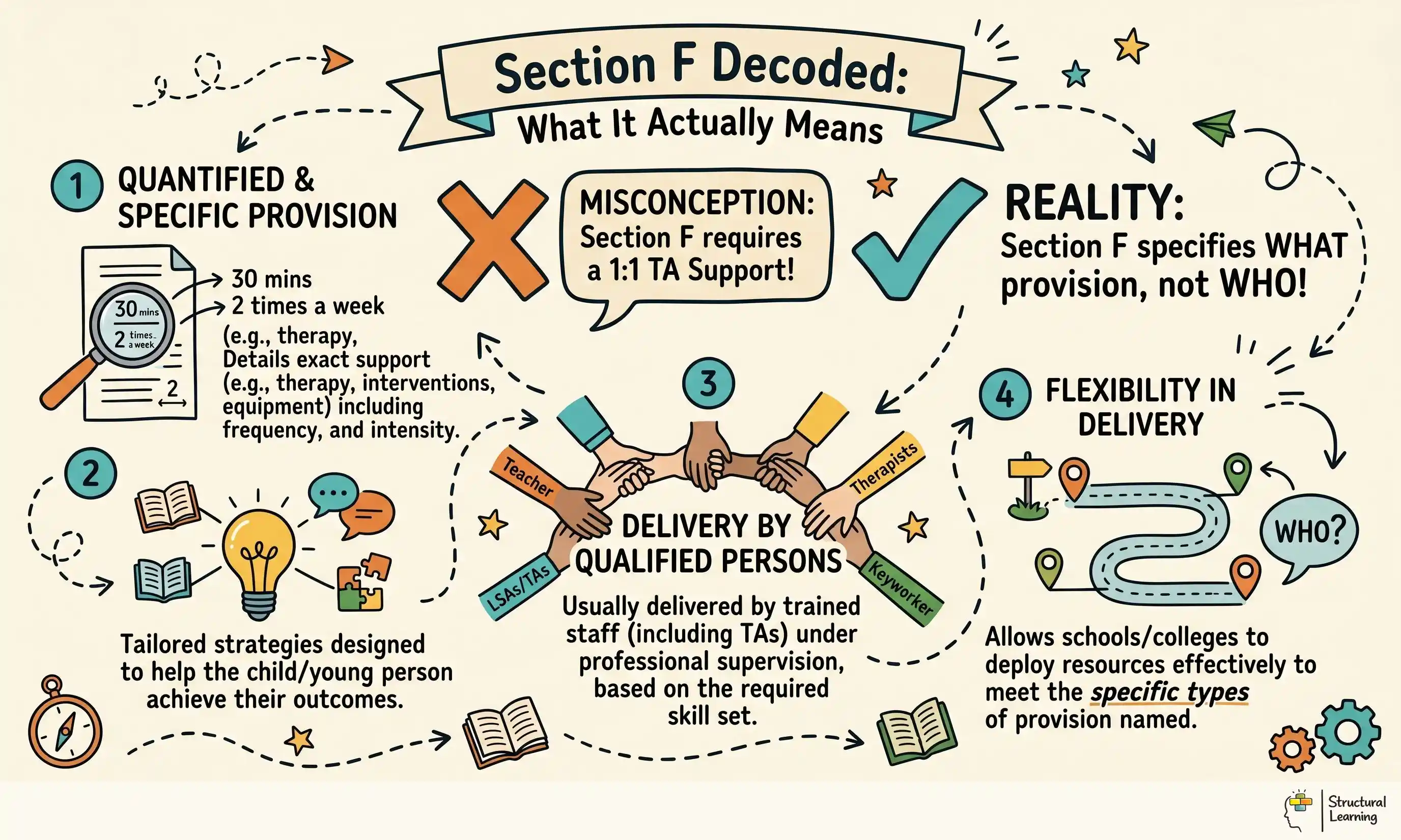
The key move: get the timetable and adult script right. If independent work time overlaps with phonics, the group can be pulled without disruption. If it does not, ask the SENCO to shift the slot and coach the teacher or TA on the routine: entry cue, model, guided practice, exit check and link back to the main lesson. That is upskilling, not merely rota-filling.
Some Section F items are about the learning environment, not just adult time. These may include "Visual timetables," "now/next boards," "quiet workspace," "noise-cancelling headphones," "individualised behaviour board."
These are provision. They're quantified ("visual timetable in place by [date]"; "headphones available during independent work").
And they're free. You're not paying for a TA. You're using design and resources to remove the barrier.
Print the visual timetable on a laminated A4 sheet and clip it to the learner's desk. Draw the now/next board with dry-wipe. Borrow a corner of a cupboard for a quiet workspace.
Noise-cancelling headphones cost £15 on Amazon. These are reasonable adjustments, and many mainstream schools are delivering them already.
Not all Section F is about separate adult time. Some is about teacher attention. For example: "Explicit feedback from teacher on phoneme formation twice daily," or "Planned teacher check-ins during guided reading to assess comprehension."
This happens in your lesson, with you, no extra staff needed. You build it into your lesson plan. Your guided reading group has five learners; this learner is in the group.
You ask them targeted questions about what they've read. You mark their phoneme formation and give instant feedback. That's the provision, and it's logged as evidence.
The time doesn't have to be vast. Thirty seconds per learner, five days a week, is 2.5 minutes of targeted teacher time per day per learner. Across your whole group, that's doable within a normal guided reading slot.
Some schools treat EHCP provision as if it means a TA must be present. It doesn't. Sometimes it means the school buys specialist software, gets advice from the educational psychologist, or accesses equipment like standing desks, sloped boards, or speech and language therapy materials.
Those are provision. They cost money (local authority responsibility), but not staff. Once bought or put in place, the learner uses them independently or with normal classroom routines.
A speech and language therapy worksheet done as part of your normal literacy session counts. A phonological awareness game run in small group time counts.
The move: ask your SENCO if any unmet Section F need can be met through equipment, assistive technology or specialist access instead of extra adult time. Speech-to-text, text-to-speech, visual timers, coloured overlays, communication aids and structured writing frames can all deliver provision. They can also preserve learner independence, as long as the tool is named, taught, reviewed and matched to the Section B need.
Let's say you're a Year 4 teacher. The new EHCP arrives. Section F says:
You have no dedicated TA. Here's how you deliver it all in one week.
Monday morning (9.15, 9.45 am): Whole-class word work
You're about to start a unit on "The Stone Age". Before the whole class gets the story, three learners, including the one with the EHCP, come in early or work in a small group during early finisher time. You go through five words: flint, shelter, tribe, mammoth and spear.
You make the words, feel them and draw them. By 9.45, the main class arrives and they have already heard the words. When the whole-class read starts, they recognise them.

That is pre-teaching of key vocabulary. Evidence: a simple checklist of words covered, plus a photo of the learner's drawings.
Tuesday 10.30, 10.40 am: Small-group guided reading
While the rest of the class is doing independent word searches, you sit with a group of four (including the learner). You ask: "Why did the tribe move to the river?" "What does it look like when someone runs away?" "What would you do?" That's structured inference questioning. The learner answers (perhaps with a scaffolded prompt from you: "Was it because... or because...?"). You jot a note: "Inferred reason for migration after prompted choice." That's your daily small-group guided reading, logged.
Wednesday, Friday (all literacy lessons): Visual phoneme supports
The learner uses a writing sheet with phoneme sound-buttons printed underneath the lines. Instead of a blank line, they see /m/ /a/ /t/ and they finger-trace the sounds as they form the letters. On Friday, they also get a laminated card showing correct letter formation (starting point marked with a dot, arrows showing direction). That's visual support for phoneme formation, delivered in the main writing lesson, no extra adult needed.
Section F: delivered. No additional TA required.
You've timetabled it into your existing lessons. You've linked it to the curriculum. You've kept evidence. And when you go to the annual review, you can show impact: vocabulary was unfamiliar in week one, but by week three, the learner was using those words independently in their own sentences.
You cannot meet every EHCP without extra staff. Some learners have Section F items that truly require an adult. They may need frequent help to calm their behaviour. They could also need personal care, safety supervision, or constant prompts to stay on task.
If you've genuinely exhausted the above five approaches, and the learner is not progressing, here's what you do:
Document it clearly. Keep a brief log. Write what you tried and what happened: "Attempted pre-teaching using [method]. Learner still unable to retain vocabulary." "Tried small-group phonics withdrawal; learner unable to access without adult redirection every 30 seconds." Be honest and specific.
Raise it at the annual review or via amendment. Tell the SENCO: "I've tried [strategies]. The learner is making minimal progress.
This Section F item may need additional staffing." Put it in writing. The school and LA will then consider: Can we add a TA? Can we increase provision funding? Does the learner need a different setting?
Don't shrug and say "I need a TA". The LA's first move is always to ask: "What reasonable steps have the school taken?" If you can't articulate them, you've handed the LA an easy exit. If you can, the burden shifts to them to resource it.
Understand the legal position. The local authority is responsible for making sure the provision is delivered (Children and Families Act, 2014; Department for Education and Department of Health, 2015, paragraph 6.50). Recent SEND reform papers recognise real funding and workforce pressures.
But those pressures do not make Section F optional. If the provision cannot be delivered in a mainstream setting with reasonable adjustments, record the gap, escalate it through the SENCO and annual review, and let the school and local authority resolve the resource issue.
Some plans make delivery harder because the wording is too loose. IPSEA warns that phrases such as "access to", "opportunities for", "regular" and "as appropriate" may be difficult to enforce because they do not commit to a definite type or amount of provision (IPSEA, 2024).
A teacher should not rewrite an EHC plan alone. The practical move is to deliver the best reasonable version now, record the ambiguity and ask the SENCO to raise the wording at review.
| Wording in the plan | Classroom-safe interpretation | Review question for the SENCO |
|---|---|---|
| "Access to adult support" | Record when adult support is used, what it is for and whether the learner can complete the task after prompts are faded. | How many minutes, for which tasks and what level of adult expertise is required? |
| "Regular reading intervention" | Choose a fixed short routine and log frequency, duration, programme and decoding measure. | Does the plan mean daily, three times weekly or another quantified frequency? |
| "Quiet space as needed" | Name the space, record triggers, duration and return-to-learning routine. | When should the quiet space be offered and who decides that threshold? |
Access to adult support
Make the support visible
Record when adult support is used, why it is used and whether prompts are faded. Ask how many minutes, which tasks and what adult expertise are required.
Regular reading intervention
Turn "regular" into a timetable
Choose a fixed routine and log frequency, duration, programme and decoding measure. Ask whether the plan means daily, three times weekly or another frequency.
Quiet space as needed
Define the threshold
Name the space and record triggers, duration and the return-to-learning routine. Ask when it should be offered and who decides.
There's a legal test that comes up in school admissions and disputes: the "reasonable steps" test (Schools Admissions Code, 2021, sections 3.64, 3.66). Before a mainstream school can turn a learner away or claim their admission is "incompatible with the efficient education of others", the school must prove it has exhausted reasonable steps such as:
If a teacher walks into a meeting and says "we've tried nothing except waiting for a TA", that school has not met the reasonable steps test. The learner may have a case to stay, or to be admitted in the first place.
But if you can walk in and say:
"We've adapted our phonics teaching. We've tried small-group withdrawal. We've got visual supports in place.
The learner is making progress, but slowly. This item may genuinely need additional staffing."
Then you've met it. And the LA has to act. The reasonable steps test is your shield, not the other way around.
Evidence protects the learner as well as the school. Keep records that show the Graduated Approach in motion: what was assessed, what was planned, what was done, what changed, and what the SENCO, teacher, parent or carer agreed to try next.
Weekly log of Section F delivery. A simple table: Date | Section F item | How delivered (e.g. "differentiated whole-class phoneme jigsaw") | Evidence (e.g. "phoneme card completed, 4/5 words correct") | Review point. Where your school has an approved, privacy-checked tool, a secure local transcription or note-summary system can draft this log from classroom notes, but a professional must check it against DfE AI and data-protection guidance before it is used as evidence (Department for Education, 2025).
Before-and-after snapshots. On the day the EHCP is received, do a baseline: "Currently reads 10 words per minute; vocabulary age 4.5 years; cannot blend CVC phonemes." Three months later, retest: "Now reads 18 words per minute; vocabulary age 5.2 years; can blend CVC phonemes in familiar texts." That's impact.
Photos and samples. If visual supports are part of Section F, photograph them in use or keep a sample. If the learner's work improves, keep before-and-after writing samples. If you deliver pre-teaching, jot a two-line note of what was covered.
Communication log with TA or specialist. If a TA delivers part of Section F, keep a simple log of what they did and how the learner responded. "3 Nov: phonics group, learnt /ai/ phoneme, recalled 3/4 words. 4 Nov: phonics group, phoneme introduced, but learner fatigued after 6 min, ended early." Share this with the TA weekly. This shows the school is monitoring impact, not just delivering blind.
Email or meeting notes. If you speak to the SENCO about barriers, send a follow-up email: "Following our chat, I'm trying [strategy] with [learner]. I'll report back on progress at the next check-in." Gets it on record without being confrontational.
You're not building a lawsuit file. You're building evidence that you're doing your job. That means planning, delivering, assessing and adjusting, then checking whether the learner relies less on adults over time. A strong log records both legal delivery and learning quality, because 15 minutes only matters if the learner is attending, practising and using the idea in the main lesson.

Pick the Section F item that feels most overwhelming. Not the one that needs a TA. The one that you can influence this week.
If it's vocabulary pre-teaching, grab a sticky note and write the five words from next week's text. Say them out loud to the learner once before the lesson starts. That's pre-teaching. Done.
If it's small-group guided reading, add three inference questions to your guided reading plans: "Why did the character...?" "What does the author think about...?" "What would you do?" That's structured questioning. Done.
If it's visual supports, print a phoneme sound-button sheet and tape it to the learner's desk. Done.
You're not waiting. You're not overwhelmed. You're delivering. Section F stops being a threat the moment you stop thinking "I need help" and start thinking "here's how I use what I've got."
This guidance has to balance law and classroom practice. Quantified Section F provision makes support enforceable. But it can also make schools count minutes, adults and programmes instead of outcomes.
This is the compliance paradox: 15 minutes of vocabulary pre-teaching may meet the timetable, yet fail to build schema if the learner is overloaded, disengaged or unable to use the words in the main lesson (Sweller, 2020). Keep the provision specific enough to deliver and review, then check whether it improves participation, learning and independence.
Second, reducing a plan to "not 1:1" can play down the risk of adult dependency. But reducing it to "minutes of adult help" creates another problem. A dosage model can make neurodivergent learners seem like recipients of treatment, rather than learners whose environment should be adapted. The Education Endowment Foundation's guidance on teaching assistant deployment stresses that adult support works best when teachers help plan it, link it to classroom instruction and use it to build independence rather than replace teacher interaction.
Third, the evidence base is local and contextual. English SEND law, mainstream class sizes, SENCO roles and local authority processes do not transfer cleanly to every devolved UK, independent or international setting. Treat this article as a practical guide for mainstream schools in England, then check the learner's EHCP wording, local procedures and professional advice.
Inclusive education brings a "dilemma of difference". Naming an extra need can show support, but it may also make a learner feel separate (Norwich, 2008).
However, this theory remains highly valuable. It protects legal rights and keeps subject teaching at the centre. It also checks if the support actually improves learning.
SEND Code of Practice 2015: 0-25 years
Department for Education (2015)
The statutory guidance that defines how EHCPs must be implemented in schools, including Section F provision and the role of class teachers. Paragraphs 6.50, 6.52 are directly relevant to teacher responsibility and TA deployment.
SEND Review 2022: Right Support, Right Place, Right Time (Green Paper)
Department for Education (2022)
Sets out the government's approach to SEND reform, emphasising quality-first teaching and differentiation as the baseline for meeting many SEND needs. Frames staffing and intervention as complementary to, not replacements for, good teaching.
SEND and Alternative Provision Improvement Plan 2023, 2024
Department for Education (2023)
Updates the implementation of the SEND Review, with focus on ensuring mainstream schools have the capacity and training to deliver EHCP provision. Specifically addresses the gap between staffing levels and the need for schools to adapt teaching.
Special Educational Needs in Mainstream Schools: A Guidance Report
Education Endowment Foundation (2020)
This guide offers proven ways for mainstream schools to support learners with SEND. It focuses on universal methods.
These include quality-first teaching, small-group interventions, and adapted resources. They require only a small amount of extra staff. This shows that not all provision needs 1:1 support.
IPSEA. (2024). Enforcing your EHC plan: special educational provision (Section F).
IPSEA. (2024). What should be in the sections relating to education (Sections B and F).
Russell-Cooke. (2026). EHCP section F explained: why this provision must be specific and quantified.
Children and Families Act. (2014). Children and Families Act 2014. UK Parliament.
Department for Education and Department of Health. (2015). Special educational needs and disability code of practice: 0 to 25 years. UK Government.
Education Endowment Foundation. (2025). Deployment of Teaching Assistants: Guidance Report. Education Endowment Foundation.
Education Endowment Foundation. (2021). Teaching Assistant Interventions. Teaching and Learning Toolkit.
Department for Education. (2026). Inclusive mainstream fund: best practice for schools. UK Government.