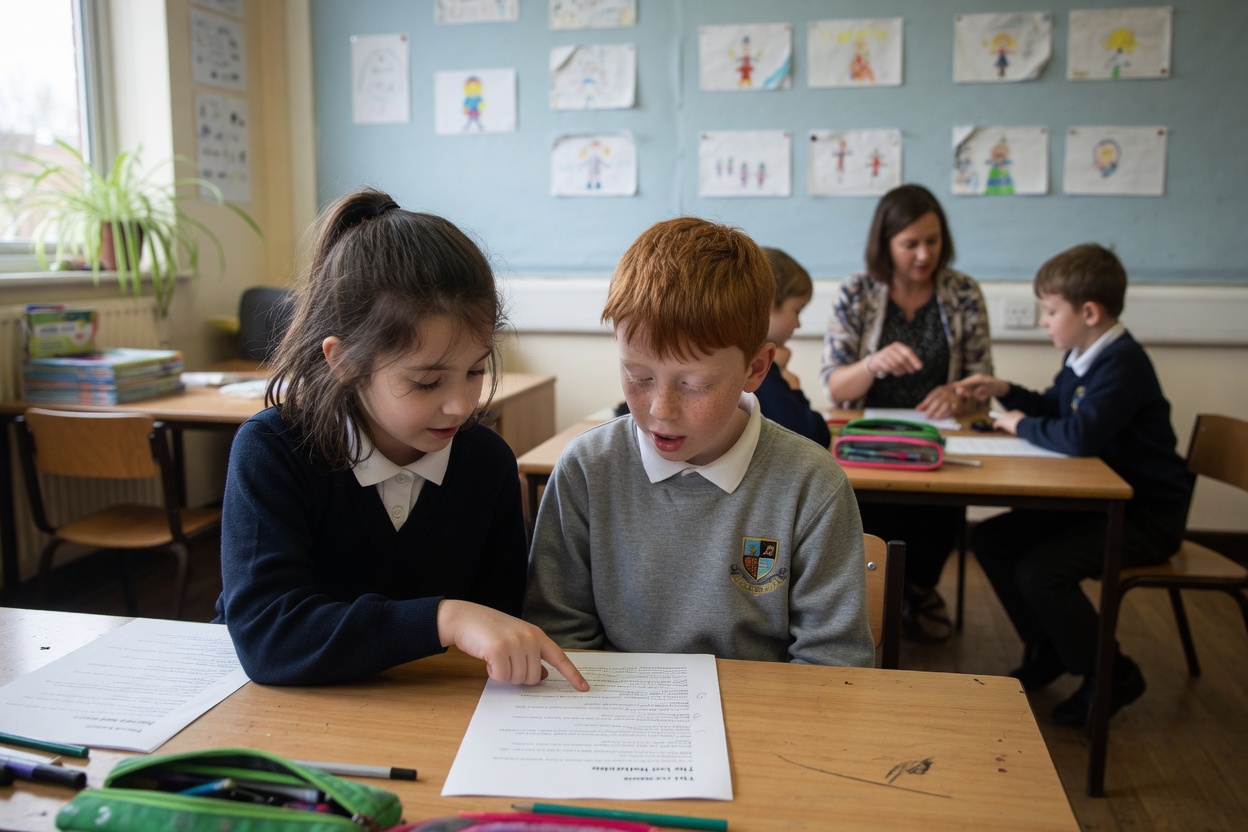
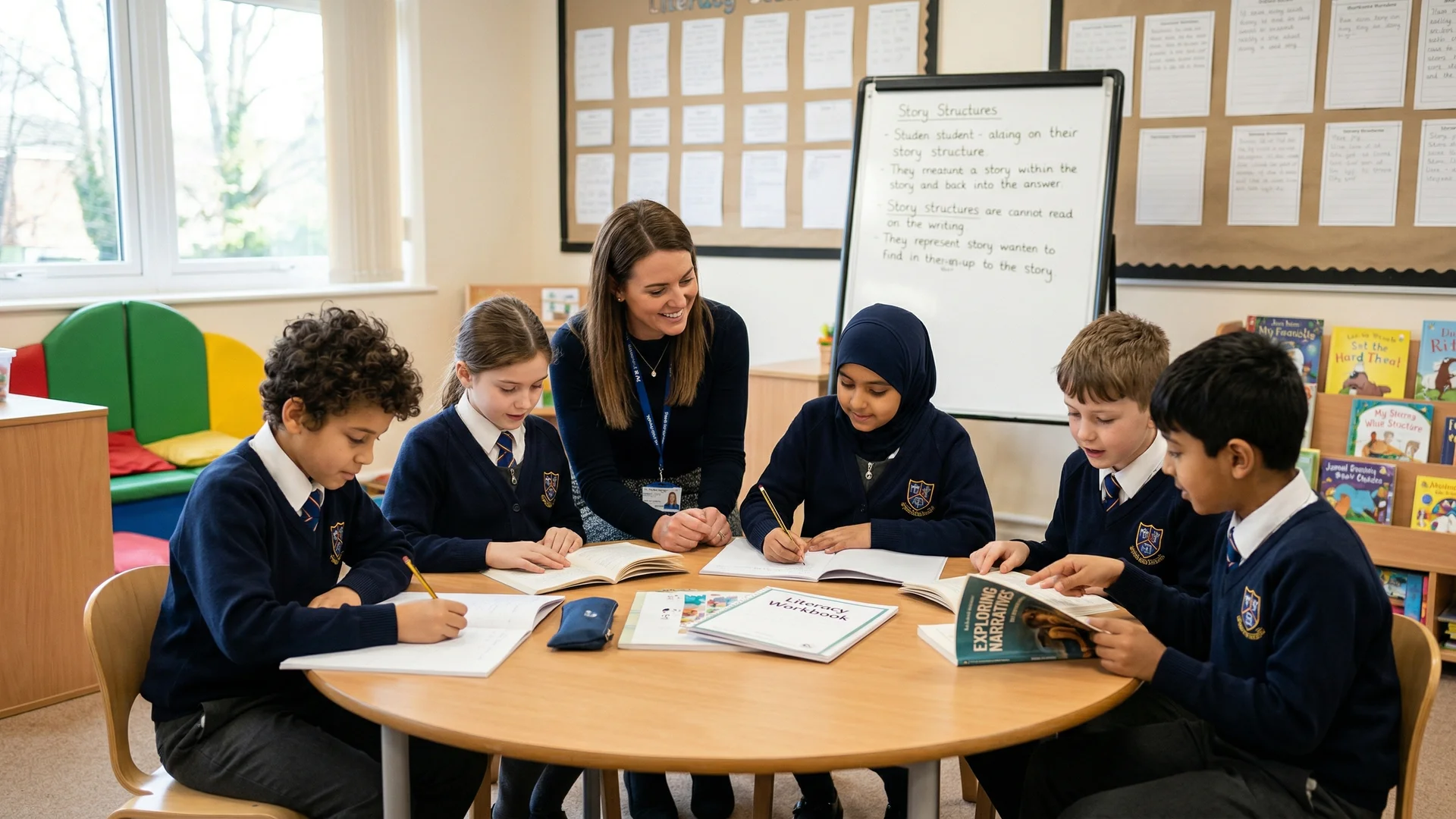
Reading Fluency Strategies: A Teacher's GuideReading Fluency Strategies: A Teacher's Guide: practical strategies for teachers

Updated on  

March 19, 2026

Reading Fluency Strategies: A Teacher's Guide

|

March 19, 2026

This reading fluency strategies teachers guide outlines how to build accuracy, rate, and prosody across all key stages to boost comprehension.

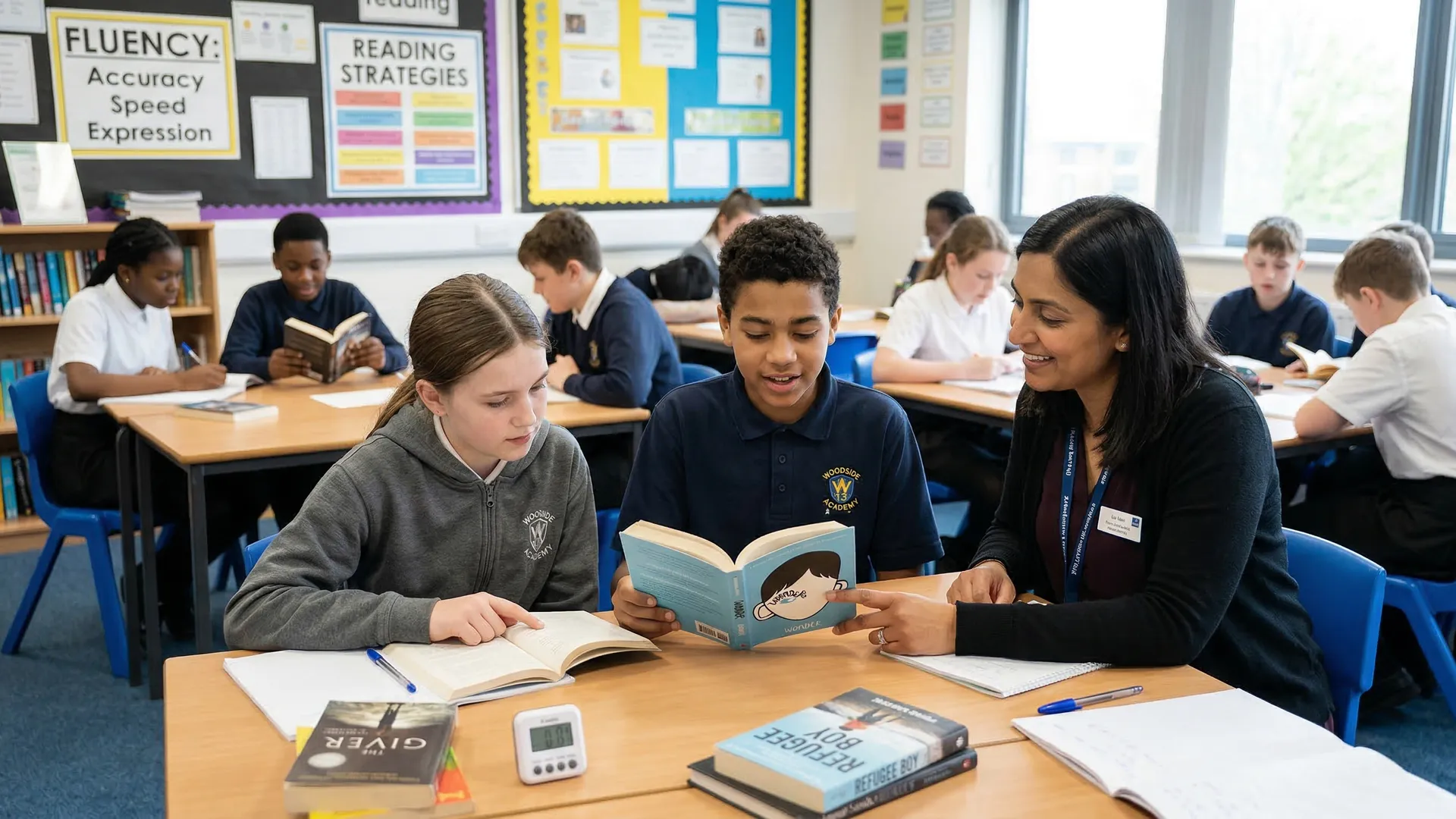
The Reading Fluency Triad: Accuracy, Rate & Prosody Explained infographic for teachers
The Reading Fluency Triad: Accuracy, Rate & Prosody Explained

Key Takeaways

  • Reading fluency consists of three core components: accuracy, speed of word recognition, and expressive prosody.
  • Fluency is the essential bridge between basic word decoding and deep reading comprehension.
  • Developing reading automaticity reduces cognitive load, freeing up working memory for critical thinking and analysis.
  • Secondary pupils often experience a hidden fluency gap that limits their access to disciplinary literacy and complex texts.
  • Effective interventions move beyond tracking words per minute to explicitly teaching vocal inflection and text phrasing.
  • Teachers across all subjects must model fluent reading of complex, domain-specific texts to support their pupils.
  • Regular, brief, repeated oral reading sessions yield better academic results than prolonged silent reading blocks.

What Is Reading Fluency?

Reading fluency is the ability to read a text accurately, quickly, and with appropriate expression. It is the developmental stage where a pupil stops decoding individual letters and begins reading for meaning. Early research defined fluency primarily as speed. Modern educational psychology views it as a triad of interconnected skills: accuracy, rate, and prosody.

Accuracy involves identifying words correctly and effortlessly. Rate refers to the speed and pacing of word recognition. Prosody encompasses the rhythm, stress, intonation, and phrasing of spoken language. When these three elements work together, a reader processes text with fluid ease.

LaBerge & Samuels (1974) showed that attention has a limited capacity. If a pupil spends most cognitive energy decoding words, they have little mental bandwidth left to understand the message. Reading fluency automates the mechanical process of reading, shifting the brain's focus from identifying letters to processing ideas.

Prosody is frequently the missing link in fluency instruction. Rasinski (2004) highlighted that reading with expression indicates that the reader is actively comprehending the text structure. A pupil who groups words into meaningful phrases rather than reading word by word demonstrates active comprehension. Fluency is not an isolated mechanical skill but the physical manifestation of comprehension.

Example: A teacher models fluent reading of a poem, exaggerating the rhythm and intonation. Pupils then discuss how the teacher's expression helped them understand the poem's meaning.

Why Reading Fluency Matters for Teachers

Reading fluency matters because it directly affects a pupil's cognitive load during learning. The brain has a restricted working memory capacity. When pupils lack reading fluency, every sentence becomes a demanding decoding puzzle. This heavy cognitive demand overwhelms their working memory, leaving no capacity for higher order thinking or analysis.

Castles, Rastle, & Nation (2018) demonstrated that fluent word recognition must become subconscious before readers can engage deeply with complex texts. When fluency is low, working memory drops the beginning of a sentence before the pupil has decoded the end. This makes extracting meaning from a paragraph impossible. Fluency resolves this bottleneck by automating lower level processes.

The fluency gap becomes a hidden crisis in secondary schools. Many pupils arrive in secondary education with adequate decoding skills but poor reading fluency. Secondary teachers frequently assume a pupil has a comprehension deficit or a behavioural issue when they actually possess a fluency deficit. Because secondary reading relies heavily on silent independent study, these fluency gaps go unnoticed. A pupil struggling to read fluently will find disciplinary texts in science, history, and geography inaccessible.

Fluency also affects academic confidence and motivation. Pupils who read slowly often avoid reading, creating a negative feedback loop known as the Matthew Effect. Fluent readers read more and expand their vocabulary, while struggling readers read less and fall further behind. By explicitly teaching reading fluency strategies, teachers provide the scaffolding needed to break this cycle. Fluent reading makes learning accessible and manageable for all pupils.

Example: A teacher notices a Year 9 pupil avoiding reading aloud in class. After a one-on-one assessment, the teacher identifies a fluency deficit. The teacher then implements targeted fluency interventions, leading to increased participation and confidence.

Reading Fluency in the Classroom

Bringing reading fluency into daily instruction requires moving away from passive reading blocks and embracing active, oral practice. Teachers must view themselves as reading coaches, regardless of their subject area. The following strategies provide structured methods for building the fluency triad.

Strategy 1: Echo Reading

Echo reading involves the teacher reading a short segment of text aloud while pupils follow along, after which the pupils read the same segment aloud together. This provides an auditory model of accurate pronunciation, appropriate pacing, and expressive prosody. It removes the anxiety of reading unseen text and allows pupils to practice the melody of language in a supportive environment.

The teacher selects a complex paragraph and reads the first sentence using exaggerated expression to highlight the punctuation. The teacher then pauses and signals the class to read the same sentence back, matching the teacher's intonation and pace. For pupils transitioning from primary to secondary school, the teacher can pair echo reading with graphic organisers to support visible thinking. While the teacher models the fluent reading, pupils simultaneously map the core concepts on a whiteboard to connect the vocal prosody directly to the text structure.

What the teacher does: The teacher models fluent reading of a sentence, emphasizing punctuation and intonation.

What pupils produce: Pupils echo the sentence, mimicking the teacher's expression and pace.

In a Year 7 geography lesson, the teacher reads a challenging paragraph about tectonic plates, emphasising the pause at commas and the dropping pitch at full stops. The pupils then echo the sentence back in unison. The teacher listens for the correct pronunciation of complex terms and ensures the class mimics the explanatory tone before moving to the next sentence.

Strategy 2: Micro Reader's Theatre

Reader's theatre involves pupils reading scripts aloud to an audience, focusing on vocal expression rather than memorising lines. Micro reader's theatre adapts this concept for busy classrooms by using short, emotion heavy dialogue scripts. This format allows pupils to practice tone and prosody without the cognitive load of tracking a full play or extended narrative.

The teacher provides pairs of pupils with a short script containing just four to six lines of dialogue. The script includes explicit stage directions regarding emotion, such as whispering fearfully or shouting in frustration. Pupils practice reading the script to each other, giving feedback solely on the expression and volume used. The teacher circulates, modelling how a change in vocal stress changes the meaning of a sentence.

What the teacher does: The teacher provides short scripts with emotional cues and models expressive reading.

What pupils produce: Pupils perform the scripts in pairs, focusing on conveying the intended emotion through their voice.

In a primary classroom, the teacher distributes a short script between a wolf and a pig. Pupil A reads the wolf's line with a slow, menacing pace. Pupil B reads the pig's response with a rapid, squeaky pitch. The teacher then asks them to swap roles and practice again. This forces pupils to connect the punctuation and context clues directly to their vocal output, cementing the link between prosody and comprehension.

Strategy 3: Repeated Reading

Repeated reading requires a pupil to read the same short passage multiple times until they reach a predetermined level of fluency. This builds automaticity rapidly because the decoding burden decreases with every subsequent read. As the cognitive demand of word recognition drops, the pupil naturally begins to group words into meaningful phrases and add appropriate expression.

The teacher selects a passage of around 100 to 200 words at the pupil's independent instructional reading level. The pupil reads the passage aloud to the teacher or a peer partner while specific errors are noted. The pupil then reviews the errors, practices the difficult words in isolation, and reads the text again. This cycle repeats three to four times until the reading is smooth, accurate, and expressive.

What the teacher does: The teacher selects a short passage and provides feedback on errors during repeated readings.

What pupils produce: Pupils read the passage multiple times, focusing on accuracy, speed, and expression, while tracking their progress.

A teaching assistant works with a pupil who reads in a robotic, word by word manner. The assistant times the first read and notes three mispronounced words. They practice these three words together on a whiteboard. On the second read, the assistant asks the pupil to focus entirely on pausing at the full stops. By the fourth read, the pupil is reading the passage with natural phrasing and appropriate speed, demonstrating true automaticity.

Strategy 4: Choral Reading

Choral reading involves the teacher and the entire class reading a passage aloud together in unison. This is particularly powerful for tackling complex, dense academic texts that pupils would struggle to read independently. It provides auditory support, allowing struggling readers to participate without the fear of public failure.

The teacher projects a crucial paragraph on the interactive whiteboard and provides a brief overview of the context. The teacher reads the text aloud once to provide the initial model. Next, the teacher counts down, and the entire class reads the paragraph aloud together at a steady, conversational pace. The teacher monitors the room, ensuring the collective voice respects the punctuation marks and grammatical phrasing.

What the teacher does: The teacher models fluent reading and leads the class in reading aloud together.

What pupils produce: Pupils read the text in unison, following the teacher's pace and intonation.

In a secondary science classroom, the teacher uses choral reading to introduce the definition of cellular respiration. The text contains multiple tier three vocabulary words and complex clauses. By reading it chorally, the teacher ensures every single pupil physically articulates the difficult terminology. This shared vocalisation builds communal confidence and breaks down the barrier of academic text anxiety.

From Word Decoding to Comprehension: The Fluency Pipeline infographic for teachers
From Word Decoding to Comprehension: The Fluency Pipeline

Common Misconceptions

One common misconception is that reading fluency simply means reading as fast as possible. Many school interventions focus exclusively on increasing a pupil's words per minute score. However, Rasinski (2004) established that reading too fast degrades comprehension just as much as reading too slowly. Fast readers often skip critical punctuation and flatten their expression, treating reading as a race rather than a communication process. Effective instruction prioritises prosody and meaningful phrasing over raw speed.

Another widespread myth is that fluency is exclusively a primary school issue. Many secondary educators believe that once a child can decode words, reading instruction is complete. In reality, as sentence structures become more complex and vocabulary becomes highly technical, fluency demands increase drastically. Secondary pupils require explicit modelling of how to fluently navigate dense academic texts, passive voice, and complex subordinate clauses.

A third misconception is that fluency develops naturally simply by reading more books. While practice is important, unguided practice often reinforces bad habits. If a pupil reads with poor prosody and frequent errors, reading silently for twenty minutes just cements those errors into their long term memory. Fluency requires explicit teaching, auditory modelling, and immediate corrective feedback to develop correctly.

A final misconception is that prolonged silent reading is the best way to build fluency. While independent reading builds stamina, silent reading completely hides fluency errors from the teacher. A struggling reader practicing silently will continue to mispronounce words and ignore punctuation in their internal monologue. Fluency must be developed through oral reading, where teachers can provide immediate corrective feedback and model correct phrasing.

Example: A teacher challenges the misconception that fluency is only about speed by demonstrating how changing the pace and intonation of a sentence can alter its meaning.

Practical Implementation Guide

Implementing a whole school approach to reading fluency requires moving away from silent reading blocks and moving towards active oral practice. Start by establishing a baseline for your pupils using a standardised metric. Hasbrouck & Tindal (2006) provide oral reading fluency norms that help teachers identify which pupils are reading below expected rates. You cannot fix a fluency gap until you accurately measure it.

Next, integrate brief fluency practice directly into your daily routines. Dedicate five minutes at the start of a lesson to choral reading. Choose a complex paragraph from the lesson's main text. Read it aloud to the class, emphasising new vocabulary and complex syntax. Then, ask the entire class to read it aloud together. This low stakes environment allows struggling readers to practice complex phrasing while hidden within the group's voice.

Move towards explicitly teaching prosody using the 'punctuation walk' method. Project a text on the board and highlight all the commas and full stops in different bright colours. Tell the pupils that a comma requires a one second pause and a full stop requires a two second pause with a deliberate drop in pitch. Read the text aloud deliberately following these rules, then have the pupils mirror you. This transforms abstract punctuation marks into concrete vocal instructions.

Finally, connect fluency directly to Webb's Depth of Knowledge framework. Once pupils can read a paragraph fluently at Level 1 (Recall), use that automated fluency to push them to Level 3 (Strategic Thinking). Ask them to re-read the text using a sarcastic tone, an angry tone, or a persuasive tone. Discuss how changing the vocal delivery changes the underlying meaning of the text. This forces pupils to use their newly freed working memory to analyse the author's intent.

Example: A teacher uses a diagnostic assessment to identify pupils with fluency deficits and then implements targeted interventions, such as repeated reading and choral reading.

Reading Fluency Across Subjects

Reading fluency is not just an English department responsibility. Disciplinary literacy requires pupils to read fluently across different subject domains, each with their own unique vocabulary and text structures.

In Science, teachers must address the challenge of tier three vocabulary. Pupils often stumble over multi-syllabic scientific terms, which shatters their reading fluency and destroys their working memory capacity. Teachers should use pre-teaching vocabulary fluency strategies. Before reading a textbook chapter, the teacher writes words like 'photosynthesis' and 'chlorophyll' on the board. The class practices pronouncing these isolated words rapidly as a choral response. When pupils encounter these words in the text, they can read them automatically without cognitive overload.

What the teacher does: The teacher pre-teaches scientific vocabulary using choral repetition.

What pupils produce: Pupils practice pronouncing complex scientific terms in unison before reading the text.

In History, teachers can use 'Prosody for Perspective' to teach source analysis and historical empathy. Historical documents often contain archaic language, long winding sentences, and heavy political bias. The teacher provides a primary source document and asks pupils to read it aloud using different vocal inflections to match the author's emotional state. One pupil reads a political speech sounding aggressively angry, while another reads it sounding quiet and desperate. The class then discusses which prosody best matches the historical context.

What the teacher does: The teacher provides historical documents and asks pupils to read them with different emotional inflections.

What pupils produce: Pupils read the documents aloud with varying tones, analysing how prosody affects the interpretation of the text.

In Maths, fluency is critical for decoding complex word problems. Pupils often fail maths problems because they read them with the wrong phrasing, grouping the wrong numbers and operations together in their heads. The teacher models how to read a word problem aloud, explicitly pausing at the operational keywords. The teacher highlights how changing the vocal pause changes the mathematical meaning of the sentence. Pupils then practice reading equations aloud to a partner, ensuring their vocal phrasing matches the mathematical order of operations.

What the teacher does: The teacher models how to read maths word problems aloud, emphasizing key operational words.

What pupils produce: Pupils practice reading word problems aloud, focusing on phrasing and intonation to accurately represent the mathematical operations.

In Geography, fluency connects directly to spatial reasoning and interpreting case studies. Case studies often mix narrative text with heavy statistical data. The teacher models how to shift reading pace when transitioning from a descriptive paragraph about a volcano to a data dense paragraph about casualty figures. The teacher demonstrates slowing down the reading rate to ensure the numerical data is processed accurately. Pupils echo read this shifting pace, learning how to adapt their reading speed based on the type of information presented.

What the teacher does: The teacher models how to adjust reading pace based on the type of information presented in a geography case study.

What pupils produce: Pupils practice echo reading passages with varying levels of data density, adjusting their reading speed accordingly.

5 High-Impact Fluency Strategies Teachers Can Implement Today infographic for teachers
5 High-Impact Fluency Strategies Teachers Can Implement Today

Common Questions About Reading Fluency

How do I assess prosody and expression?

Assessing prosody requires listening to a pupil read aloud and evaluating their phrasing, smoothness, and pace. Teachers can use a multidimensional fluency rubric to score pupils on a scale of one to four for expression. Look for pupils who group words into meaningful clauses rather than reading mechanically word by word.

How can I support SEND pupils with reading fluency?

SEND pupils often benefit from tracked reading, where they use a physical marker or reading ruler to guide their eyes across the page. Providing texts with increased line spacing and larger fonts reduces visual crowding. Pairing these physical scaffolds with repeated reading of familiar texts builds their automaticity and confidence simultaneously.

What is the role of fluency for EAL learners?

For pupils with English as an Additional Language, fluency practice is vital for mastering the rhythm and stress patterns of spoken English. Echo reading is effective here, as it provides an auditory model. It allows EAL learners to practice pronunciation and intonation long before they fully grasp the underlying vocabulary.

Should we completely stop silent reading in class?

Silent reading still has value for building reading stamina and vocabulary in proficient readers. However, it should not replace oral fluency instruction for pupils who are still developing automaticity. Teachers should balance independent silent reading with targeted, active oral reading sessions to ensure all pupils progress.

How do I fit fluency practice into a packed curriculum?

Fluency practice does not require entire dedicated lessons to be effective. It is most effective when integrated into existing subject reading. Dedicating just three to five minutes to choral reading or echo reading the core text of your lesson will boost comprehension without sacrificing curriculum time.

At what age should fluency instruction stop?

Fluency instruction should never truly stop, it simply evolves. Primary instruction focuses on decoding automaticity and basic prosody. Secondary instruction must shift focus toward disciplinary fluency, helping pupils navigate complex, domain specific academic texts. Whenever the text complexity jumps, fluency instruction must return to support the transition.

Action Point: Choose a challenging paragraph from your next lesson plan and practice reading it aloud yourself to identify where pupils will stumble.

Further Reading: Key Research Papers

These peer-reviewed studies provide the evidence base for the strategies discussed above.

Speech Enabled Reading Fluency Assessment: a Validation Study View study ↗

Velde et al. (2025)

This study validates speech-enabled technology for assessing reading fluency, offering teachers a digital tool to efficiently evaluate students' reading skills. The technology could streamline assessment processes and provide more accurate, objective measurements of reading fluency in classroom settings.

Thinking outside the phonological box: Combining repeated reading and action video games to develop reading fluency in year 7 children with dyslexia View study ↗

Murray et al. (2023)

This research combines traditional repeated reading with action video games to support Year 7 students with dyslexia, demonstrating that innovative approaches beyond phonics can improve reading fluency. Teachers can consider incorporating engaging digital elements alongside established reading intervention strategies.

Impact of a Digital Tool to Improve Metacognitive Strategies for Self-Regulation During Text Reading in Online Teacher Education View study ↗

Ortega-Ruipérez et al. (2024)

This study examines how digital tools can help teacher education students develop metacognitive strategies for self-regulated reading. The findings suggest teachers can use similar digital platforms to help students plan, monitor, and self-assess their reading comprehension more effectively.

Effectiveness of Using the Padlet Application in Extensive Reading Courses for English Language Education Study Program Students at Wiralodra University View study ↗

Suryana et al. (2024)

This research explores using Padlet, a collaborative digital platform, for extensive reading courses in English language education. Teachers can utilise such Learning Management Systems to create interactive reading environments that engage students and facilitate collaborative learning experiences.

Counting and rapid naming predict the fluency of arithmetic and reading skills View study ↗
83 citations

Koponen et al. (2016)

This study identifies connections between counting skills, rapid naming abilities, and both arithmetic and reading fluency development. Teachers should recognise that strengthening these foundational skills can simultaneously support students' progress in both mathematical and literacy domains.

Free Resource Pack

Reading Fluency Strategies Guide

A practical guide and ready-to-use resources for developing reading fluency in your primary or secondary classroom.

Reading Fluency Strategies Guide — 4 resources
Reading Fluency Teacher Guide CPD Visual Classroom Strategy Student Resource Assessment Checklist Primary Education Secondary Education

Download your free bundle

Fill in your details below and we'll send the resource pack straight to your inbox.

Quick survey (helps us create better resources)

How confident do you feel in implementing a range of reading fluency strategies in your classroom?

Not at all confident
Slightly confident
Moderately confident
Very confident
Extremely confident

To what extent do you feel supported by your school or colleagues in developing reading fluency amongst students?

Not at all supported
Slightly supported
Moderately supported
Well supported
Extremely well supported

How regularly do you explicitly teach and practice reading fluency strategies with your students?

Never
Rarely
Sometimes
Often
Daily/Almost Daily

Your resource pack is ready

We've also sent a copy to your email. Check your inbox.

Loading audit...

The Reading Fluency Triad: Accuracy, Rate & Prosody Explained infographic for teachers
The Reading Fluency Triad: Accuracy, Rate & Prosody Explained

Key Takeaways

  • Reading fluency consists of three core components: accuracy, speed of word recognition, and expressive prosody.
  • Fluency is the essential bridge between basic word decoding and deep reading comprehension.
  • Developing reading automaticity reduces cognitive load, freeing up working memory for critical thinking and analysis.
  • Secondary pupils often experience a hidden fluency gap that limits their access to disciplinary literacy and complex texts.
  • Effective interventions move beyond tracking words per minute to explicitly teaching vocal inflection and text phrasing.
  • Teachers across all subjects must model fluent reading of complex, domain-specific texts to support their pupils.
  • Regular, brief, repeated oral reading sessions yield better academic results than prolonged silent reading blocks.

What Is Reading Fluency?

Reading fluency is the ability to read a text accurately, quickly, and with appropriate expression. It is the developmental stage where a pupil stops decoding individual letters and begins reading for meaning. Early research defined fluency primarily as speed. Modern educational psychology views it as a triad of interconnected skills: accuracy, rate, and prosody.

Accuracy involves identifying words correctly and effortlessly. Rate refers to the speed and pacing of word recognition. Prosody encompasses the rhythm, stress, intonation, and phrasing of spoken language. When these three elements work together, a reader processes text with fluid ease.

LaBerge & Samuels (1974) showed that attention has a limited capacity. If a pupil spends most cognitive energy decoding words, they have little mental bandwidth left to understand the message. Reading fluency automates the mechanical process of reading, shifting the brain's focus from identifying letters to processing ideas.

Prosody is frequently the missing link in fluency instruction. Rasinski (2004) highlighted that reading with expression indicates that the reader is actively comprehending the text structure. A pupil who groups words into meaningful phrases rather than reading word by word demonstrates active comprehension. Fluency is not an isolated mechanical skill but the physical manifestation of comprehension.

Example: A teacher models fluent reading of a poem, exaggerating the rhythm and intonation. Pupils then discuss how the teacher's expression helped them understand the poem's meaning.

Why Reading Fluency Matters for Teachers

Reading fluency matters because it directly affects a pupil's cognitive load during learning. The brain has a restricted working memory capacity. When pupils lack reading fluency, every sentence becomes a demanding decoding puzzle. This heavy cognitive demand overwhelms their working memory, leaving no capacity for higher order thinking or analysis.

Castles, Rastle, & Nation (2018) demonstrated that fluent word recognition must become subconscious before readers can engage deeply with complex texts. When fluency is low, working memory drops the beginning of a sentence before the pupil has decoded the end. This makes extracting meaning from a paragraph impossible. Fluency resolves this bottleneck by automating lower level processes.

The fluency gap becomes a hidden crisis in secondary schools. Many pupils arrive in secondary education with adequate decoding skills but poor reading fluency. Secondary teachers frequently assume a pupil has a comprehension deficit or a behavioural issue when they actually possess a fluency deficit. Because secondary reading relies heavily on silent independent study, these fluency gaps go unnoticed. A pupil struggling to read fluently will find disciplinary texts in science, history, and geography inaccessible.

Fluency also affects academic confidence and motivation. Pupils who read slowly often avoid reading, creating a negative feedback loop known as the Matthew Effect. Fluent readers read more and expand their vocabulary, while struggling readers read less and fall further behind. By explicitly teaching reading fluency strategies, teachers provide the scaffolding needed to break this cycle. Fluent reading makes learning accessible and manageable for all pupils.

Example: A teacher notices a Year 9 pupil avoiding reading aloud in class. After a one-on-one assessment, the teacher identifies a fluency deficit. The teacher then implements targeted fluency interventions, leading to increased participation and confidence.

Reading Fluency in the Classroom

Bringing reading fluency into daily instruction requires moving away from passive reading blocks and embracing active, oral practice. Teachers must view themselves as reading coaches, regardless of their subject area. The following strategies provide structured methods for building the fluency triad.

Strategy 1: Echo Reading

Echo reading involves the teacher reading a short segment of text aloud while pupils follow along, after which the pupils read the same segment aloud together. This provides an auditory model of accurate pronunciation, appropriate pacing, and expressive prosody. It removes the anxiety of reading unseen text and allows pupils to practice the melody of language in a supportive environment.

The teacher selects a complex paragraph and reads the first sentence using exaggerated expression to highlight the punctuation. The teacher then pauses and signals the class to read the same sentence back, matching the teacher's intonation and pace. For pupils transitioning from primary to secondary school, the teacher can pair echo reading with graphic organisers to support visible thinking. While the teacher models the fluent reading, pupils simultaneously map the core concepts on a whiteboard to connect the vocal prosody directly to the text structure.

What the teacher does: The teacher models fluent reading of a sentence, emphasizing punctuation and intonation.

What pupils produce: Pupils echo the sentence, mimicking the teacher's expression and pace.

In a Year 7 geography lesson, the teacher reads a challenging paragraph about tectonic plates, emphasising the pause at commas and the dropping pitch at full stops. The pupils then echo the sentence back in unison. The teacher listens for the correct pronunciation of complex terms and ensures the class mimics the explanatory tone before moving to the next sentence.

Strategy 2: Micro Reader's Theatre

Reader's theatre involves pupils reading scripts aloud to an audience, focusing on vocal expression rather than memorising lines. Micro reader's theatre adapts this concept for busy classrooms by using short, emotion heavy dialogue scripts. This format allows pupils to practice tone and prosody without the cognitive load of tracking a full play or extended narrative.

The teacher provides pairs of pupils with a short script containing just four to six lines of dialogue. The script includes explicit stage directions regarding emotion, such as whispering fearfully or shouting in frustration. Pupils practice reading the script to each other, giving feedback solely on the expression and volume used. The teacher circulates, modelling how a change in vocal stress changes the meaning of a sentence.

What the teacher does: The teacher provides short scripts with emotional cues and models expressive reading.

What pupils produce: Pupils perform the scripts in pairs, focusing on conveying the intended emotion through their voice.

In a primary classroom, the teacher distributes a short script between a wolf and a pig. Pupil A reads the wolf's line with a slow, menacing pace. Pupil B reads the pig's response with a rapid, squeaky pitch. The teacher then asks them to swap roles and practice again. This forces pupils to connect the punctuation and context clues directly to their vocal output, cementing the link between prosody and comprehension.

Strategy 3: Repeated Reading

Repeated reading requires a pupil to read the same short passage multiple times until they reach a predetermined level of fluency. This builds automaticity rapidly because the decoding burden decreases with every subsequent read. As the cognitive demand of word recognition drops, the pupil naturally begins to group words into meaningful phrases and add appropriate expression.

The teacher selects a passage of around 100 to 200 words at the pupil's independent instructional reading level. The pupil reads the passage aloud to the teacher or a peer partner while specific errors are noted. The pupil then reviews the errors, practices the difficult words in isolation, and reads the text again. This cycle repeats three to four times until the reading is smooth, accurate, and expressive.

What the teacher does: The teacher selects a short passage and provides feedback on errors during repeated readings.

What pupils produce: Pupils read the passage multiple times, focusing on accuracy, speed, and expression, while tracking their progress.

A teaching assistant works with a pupil who reads in a robotic, word by word manner. The assistant times the first read and notes three mispronounced words. They practice these three words together on a whiteboard. On the second read, the assistant asks the pupil to focus entirely on pausing at the full stops. By the fourth read, the pupil is reading the passage with natural phrasing and appropriate speed, demonstrating true automaticity.

Strategy 4: Choral Reading

Choral reading involves the teacher and the entire class reading a passage aloud together in unison. This is particularly powerful for tackling complex, dense academic texts that pupils would struggle to read independently. It provides auditory support, allowing struggling readers to participate without the fear of public failure.

The teacher projects a crucial paragraph on the interactive whiteboard and provides a brief overview of the context. The teacher reads the text aloud once to provide the initial model. Next, the teacher counts down, and the entire class reads the paragraph aloud together at a steady, conversational pace. The teacher monitors the room, ensuring the collective voice respects the punctuation marks and grammatical phrasing.

What the teacher does: The teacher models fluent reading and leads the class in reading aloud together.

What pupils produce: Pupils read the text in unison, following the teacher's pace and intonation.

In a secondary science classroom, the teacher uses choral reading to introduce the definition of cellular respiration. The text contains multiple tier three vocabulary words and complex clauses. By reading it chorally, the teacher ensures every single pupil physically articulates the difficult terminology. This shared vocalisation builds communal confidence and breaks down the barrier of academic text anxiety.

From Word Decoding to Comprehension: The Fluency Pipeline infographic for teachers
From Word Decoding to Comprehension: The Fluency Pipeline

Common Misconceptions

One common misconception is that reading fluency simply means reading as fast as possible. Many school interventions focus exclusively on increasing a pupil's words per minute score. However, Rasinski (2004) established that reading too fast degrades comprehension just as much as reading too slowly. Fast readers often skip critical punctuation and flatten their expression, treating reading as a race rather than a communication process. Effective instruction prioritises prosody and meaningful phrasing over raw speed.

Another widespread myth is that fluency is exclusively a primary school issue. Many secondary educators believe that once a child can decode words, reading instruction is complete. In reality, as sentence structures become more complex and vocabulary becomes highly technical, fluency demands increase drastically. Secondary pupils require explicit modelling of how to fluently navigate dense academic texts, passive voice, and complex subordinate clauses.

A third misconception is that fluency develops naturally simply by reading more books. While practice is important, unguided practice often reinforces bad habits. If a pupil reads with poor prosody and frequent errors, reading silently for twenty minutes just cements those errors into their long term memory. Fluency requires explicit teaching, auditory modelling, and immediate corrective feedback to develop correctly.

A final misconception is that prolonged silent reading is the best way to build fluency. While independent reading builds stamina, silent reading completely hides fluency errors from the teacher. A struggling reader practicing silently will continue to mispronounce words and ignore punctuation in their internal monologue. Fluency must be developed through oral reading, where teachers can provide immediate corrective feedback and model correct phrasing.

Example: A teacher challenges the misconception that fluency is only about speed by demonstrating how changing the pace and intonation of a sentence can alter its meaning.

Practical Implementation Guide

Implementing a whole school approach to reading fluency requires moving away from silent reading blocks and moving towards active oral practice. Start by establishing a baseline for your pupils using a standardised metric. Hasbrouck & Tindal (2006) provide oral reading fluency norms that help teachers identify which pupils are reading below expected rates. You cannot fix a fluency gap until you accurately measure it.

Next, integrate brief fluency practice directly into your daily routines. Dedicate five minutes at the start of a lesson to choral reading. Choose a complex paragraph from the lesson's main text. Read it aloud to the class, emphasising new vocabulary and complex syntax. Then, ask the entire class to read it aloud together. This low stakes environment allows struggling readers to practice complex phrasing while hidden within the group's voice.

Move towards explicitly teaching prosody using the 'punctuation walk' method. Project a text on the board and highlight all the commas and full stops in different bright colours. Tell the pupils that a comma requires a one second pause and a full stop requires a two second pause with a deliberate drop in pitch. Read the text aloud deliberately following these rules, then have the pupils mirror you. This transforms abstract punctuation marks into concrete vocal instructions.

Finally, connect fluency directly to Webb's Depth of Knowledge framework. Once pupils can read a paragraph fluently at Level 1 (Recall), use that automated fluency to push them to Level 3 (Strategic Thinking). Ask them to re-read the text using a sarcastic tone, an angry tone, or a persuasive tone. Discuss how changing the vocal delivery changes the underlying meaning of the text. This forces pupils to use their newly freed working memory to analyse the author's intent.

Example: A teacher uses a diagnostic assessment to identify pupils with fluency deficits and then implements targeted interventions, such as repeated reading and choral reading.

Reading Fluency Across Subjects

Reading fluency is not just an English department responsibility. Disciplinary literacy requires pupils to read fluently across different subject domains, each with their own unique vocabulary and text structures.

In Science, teachers must address the challenge of tier three vocabulary. Pupils often stumble over multi-syllabic scientific terms, which shatters their reading fluency and destroys their working memory capacity. Teachers should use pre-teaching vocabulary fluency strategies. Before reading a textbook chapter, the teacher writes words like 'photosynthesis' and 'chlorophyll' on the board. The class practices pronouncing these isolated words rapidly as a choral response. When pupils encounter these words in the text, they can read them automatically without cognitive overload.

What the teacher does: The teacher pre-teaches scientific vocabulary using choral repetition.

What pupils produce: Pupils practice pronouncing complex scientific terms in unison before reading the text.

In History, teachers can use 'Prosody for Perspective' to teach source analysis and historical empathy. Historical documents often contain archaic language, long winding sentences, and heavy political bias. The teacher provides a primary source document and asks pupils to read it aloud using different vocal inflections to match the author's emotional state. One pupil reads a political speech sounding aggressively angry, while another reads it sounding quiet and desperate. The class then discusses which prosody best matches the historical context.

What the teacher does: The teacher provides historical documents and asks pupils to read them with different emotional inflections.

What pupils produce: Pupils read the documents aloud with varying tones, analysing how prosody affects the interpretation of the text.

In Maths, fluency is critical for decoding complex word problems. Pupils often fail maths problems because they read them with the wrong phrasing, grouping the wrong numbers and operations together in their heads. The teacher models how to read a word problem aloud, explicitly pausing at the operational keywords. The teacher highlights how changing the vocal pause changes the mathematical meaning of the sentence. Pupils then practice reading equations aloud to a partner, ensuring their vocal phrasing matches the mathematical order of operations.

What the teacher does: The teacher models how to read maths word problems aloud, emphasizing key operational words.

What pupils produce: Pupils practice reading word problems aloud, focusing on phrasing and intonation to accurately represent the mathematical operations.

In Geography, fluency connects directly to spatial reasoning and interpreting case studies. Case studies often mix narrative text with heavy statistical data. The teacher models how to shift reading pace when transitioning from a descriptive paragraph about a volcano to a data dense paragraph about casualty figures. The teacher demonstrates slowing down the reading rate to ensure the numerical data is processed accurately. Pupils echo read this shifting pace, learning how to adapt their reading speed based on the type of information presented.

What the teacher does: The teacher models how to adjust reading pace based on the type of information presented in a geography case study.

What pupils produce: Pupils practice echo reading passages with varying levels of data density, adjusting their reading speed accordingly.

5 High-Impact Fluency Strategies Teachers Can Implement Today infographic for teachers
5 High-Impact Fluency Strategies Teachers Can Implement Today

Common Questions About Reading Fluency

How do I assess prosody and expression?

Assessing prosody requires listening to a pupil read aloud and evaluating their phrasing, smoothness, and pace. Teachers can use a multidimensional fluency rubric to score pupils on a scale of one to four for expression. Look for pupils who group words into meaningful clauses rather than reading mechanically word by word.

How can I support SEND pupils with reading fluency?

SEND pupils often benefit from tracked reading, where they use a physical marker or reading ruler to guide their eyes across the page. Providing texts with increased line spacing and larger fonts reduces visual crowding. Pairing these physical scaffolds with repeated reading of familiar texts builds their automaticity and confidence simultaneously.

What is the role of fluency for EAL learners?

For pupils with English as an Additional Language, fluency practice is vital for mastering the rhythm and stress patterns of spoken English. Echo reading is effective here, as it provides an auditory model. It allows EAL learners to practice pronunciation and intonation long before they fully grasp the underlying vocabulary.

Should we completely stop silent reading in class?

Silent reading still has value for building reading stamina and vocabulary in proficient readers. However, it should not replace oral fluency instruction for pupils who are still developing automaticity. Teachers should balance independent silent reading with targeted, active oral reading sessions to ensure all pupils progress.

How do I fit fluency practice into a packed curriculum?

Fluency practice does not require entire dedicated lessons to be effective. It is most effective when integrated into existing subject reading. Dedicating just three to five minutes to choral reading or echo reading the core text of your lesson will boost comprehension without sacrificing curriculum time.

At what age should fluency instruction stop?

Fluency instruction should never truly stop, it simply evolves. Primary instruction focuses on decoding automaticity and basic prosody. Secondary instruction must shift focus toward disciplinary fluency, helping pupils navigate complex, domain specific academic texts. Whenever the text complexity jumps, fluency instruction must return to support the transition.

Action Point: Choose a challenging paragraph from your next lesson plan and practice reading it aloud yourself to identify where pupils will stumble.

Further Reading: Key Research Papers

These peer-reviewed studies provide the evidence base for the strategies discussed above.

Speech Enabled Reading Fluency Assessment: a Validation Study View study ↗

Velde et al. (2025)

This study validates speech-enabled technology for assessing reading fluency, offering teachers a digital tool to efficiently evaluate students' reading skills. The technology could streamline assessment processes and provide more accurate, objective measurements of reading fluency in classroom settings.

Thinking outside the phonological box: Combining repeated reading and action video games to develop reading fluency in year 7 children with dyslexia View study ↗

Murray et al. (2023)

This research combines traditional repeated reading with action video games to support Year 7 students with dyslexia, demonstrating that innovative approaches beyond phonics can improve reading fluency. Teachers can consider incorporating engaging digital elements alongside established reading intervention strategies.

Impact of a Digital Tool to Improve Metacognitive Strategies for Self-Regulation During Text Reading in Online Teacher Education View study ↗

Ortega-Ruipérez et al. (2024)

This study examines how digital tools can help teacher education students develop metacognitive strategies for self-regulated reading. The findings suggest teachers can use similar digital platforms to help students plan, monitor, and self-assess their reading comprehension more effectively.

Effectiveness of Using the Padlet Application in Extensive Reading Courses for English Language Education Study Program Students at Wiralodra University View study ↗

Suryana et al. (2024)

This research explores using Padlet, a collaborative digital platform, for extensive reading courses in English language education. Teachers can utilise such Learning Management Systems to create interactive reading environments that engage students and facilitate collaborative learning experiences.

Counting and rapid naming predict the fluency of arithmetic and reading skills View study ↗
83 citations

Koponen et al. (2016)

This study identifies connections between counting skills, rapid naming abilities, and both arithmetic and reading fluency development. Teachers should recognise that strengthening these foundational skills can simultaneously support students' progress in both mathematical and literacy domains.

Free Resource Pack

Reading Fluency Strategies Guide

A practical guide and ready-to-use resources for developing reading fluency in your primary or secondary classroom.

Reading Fluency Strategies Guide — 4 resources
Reading Fluency Teacher Guide CPD Visual Classroom Strategy Student Resource Assessment Checklist Primary Education Secondary Education

Download your free bundle

Fill in your details below and we'll send the resource pack straight to your inbox.

Quick survey (helps us create better resources)

How confident do you feel in implementing a range of reading fluency strategies in your classroom?

Not at all confident
Slightly confident
Moderately confident
Very confident
Extremely confident

To what extent do you feel supported by your school or colleagues in developing reading fluency amongst students?

Not at all supported
Slightly supported
Moderately supported
Well supported
Extremely well supported

How regularly do you explicitly teach and practice reading fluency strategies with your students?

Never
Rarely
Sometimes
Often
Daily/Almost Daily

Your resource pack is ready

We've also sent a copy to your email. Check your inbox.

Educational Technology

Back to Blog

{"@context":"https://schema.org","@graph":[{"@type":"Organization","@id":"https://www.structural-learning.com/#org","name":"Structural Learning","url":"https://www.structural-learning.com/","logo":{"@type":"ImageObject","url":"https://cdn.prod.website-files.com/5b69a01ba2e409501de055d1/5b69a01ba2e40996a5e055f4_structural-learning-logo.png"}},{"@type":"Person","@id":"https://www.structural-learning.com/team/paul-main/#person","name":"Paul Main","url":"https://www.structural-learning.com/team/paul-main","jobTitle":"Founder","affiliation":{"@id":"https://www.structural-learning.com/#org"}},{"@type":"BreadcrumbList","@id":"https://www.structural-learning.com/post/reading-fluency-strategies-teachers-guide#breadcrumb","itemListElement":[{"@type":"ListItem","position":1,"name":"Home","item":"https://www.structural-learning.com/"},{"@type":"ListItem","position":2,"name":"Blog","item":"https://www.structural-learning.com/blog"},{"@type":"ListItem","position":3,"name":"Reading Fluency Strategies: A Teacher's Guide","item":"https://www.structural-learning.com/post/reading-fluency-strategies-teachers-guide"}]},{"@type":"BlogPosting","@id":"https://www.structural-learning.com/post/reading-fluency-strategies-teachers-guide#article","headline":"Reading Fluency Strategies: A Teacher's Guide","description":"This reading fluency strategies teachers guide outlines how to build accuracy, rate, and prosody across all key stages to boost comprehension.","author":{"@id":"https://www.structural-learning.com/team/paul-main/#person"},"publisher":{"@id":"https://www.structural-learning.com/#org"},"datePublished":"2026-03-19","dateModified":"2026-03-19","inLanguage":"en-GB"}]}