Updated on
September 18, 2026
Colourful Semantics: Colour Key, Stages and Sentence Builder
Colourful semantics for teachers: the colour key, the stages, worked example sentences, a classroom routine, prompt fading and an interactive builder.


Updated on
September 18, 2026
Colourful semantics for teachers: the colour key, the stages, worked example sentences, a classroom routine, prompt fading and an interactive builder.
What is colourful semantics?
Colourful semantics, developed by Alison Bryan, is a therapy and teaching approach that uses colour to represent the parts of a sentence, for example orange for who, yellow for what doing, and green for what. For teachers, it helps learners with language and communication needs build grammatical sentences by seeing how the parts fit together.
Colourful Semantics gives a learner visible prompts for the meaning roles in a sentence. It can make sentence building easier to discuss and practise, but it is not a diagnosis, a complete language programme or a guaranteed intervention. The main clinical group study involved just six children (Bolderson et al., 2011). Its encouraging results justify a careful trial, not a promise.
Colourful Semantics is a language-therapy and teaching approach developed by Alison Bryan. It links sentence roles to question prompts and colours, commonly orange for who?, yellow for what doing?, green for what? and blue for where?. Learners use the cues to build spoken or written sentences. Schools should set a specific target, monitor independent use and fade the prompts rather than assume the colours alone will improve language.
A teacher may use the colours while modelling The dog is chasing the ball, then present a new picture and remove one prompt. The useful question is whether a particular learner can produce and understand the target pattern with less help and use it beyond the practised cards.
Key takeaways
Colourful Semantics began as thematic role therapy. A thematic role describes the part a person, thing or place plays in the meaning of an event. In The dog is chasing the ball in the park, the dog is the person or animal carrying out the action, chasing is the action, the ball is affected by it and the park is the location. The approach gives these parts visible question prompts.
This is different from colouring every noun or verb according to its grammatical word class. Colourful Semantics starts with meaning in the event: who is involved, what they are doing, what is affected and where it happens. That can support work on verb argument structure, because different verbs invite different combinations.
Sleeping can form a complete event with a sleeper. Giving normally needs someone who gives, something given and a recipient.
The prompt does not replace ordinary language. The learner still needs vocabulary, grammar, speech or another means of expression, attention to the picture or event, and a reason to communicate. The colours are a temporary map. Their value must be judged by what the learner can do with and eventually without that map.
For a busy teacher: choose one sentence pattern, model it aloud, let the learner assemble it, say the complete sentence together, and check whether the learner can use the pattern with a new picture. Do not add more coloured boxes merely because they exist.
The widely used core mapping is orange for who?, yellow for what doing?, green for what? and blue for where?. Some services extend the system with prompts such as when?, who to? or what like?. Local materials may vary. Consistency between the adults supporting one learner matters more than policing a precise digital shade.
| Prompt | Common colour | Role in the example | Adult prompt |
|---|---|---|---|
| Who? | Orange | The dog | Who can you see? |
| What doing? | Yellow | is chasing | What is the dog doing? |
| What? | Green | the ball | What is being chased? |
| Where? | Blue | in the park | Where is it happening? |
Keep the question and the semantic role together. Calling orange simply “the noun colour” is misleading because a sentence can contain several nouns with different roles. Calling yellow merely “the verb colour” can also hide the reason the verb matters: it organises the event and affects which other roles make sense.
Colour vision, visual stress, symbol preferences, motor access and communication modality all matter. Use text labels, symbols or tactile and high-contrast cues as needed. Never make colour the only way to identify a role.
This small builder demonstrates the four core roles. Use it to model an oral sentence, then change one part and ask what changed in the meaning. Its examples are practice items, not an assessment.
Your sentence
The dog is eating the food in the kitchen.
The approach fits best when a learner has a known difficulty with putting sentences together. It also suits learners who struggle to understand or use the parts that go with a verb, to organise their spoken language, or to carry a practised sentence pattern into their own speech or writing.
A speech and language therapist may recommend it as part of a wider plan. A teacher may also use a simple colour-coded sentence frame as ordinary classroom scaffolding, as long as they check whether it works.
A diagnosis does not tell you whether the method will help. Autistic learners, learners with developmental language disorder, deaf or hard-of-hearing learners and learners with other speech, language and communication needs are diverse groups. The evidence for Colourful Semantics within each group is limited.
Start from the learner's observed language task, not a label. The wider speech and language classroom guide gives schools a broader planning context.
A learner who uses English as an additional language may benefit from pictures, modelling and visible sentence patterns, just as other learners may. EAL is not a special educational need by itself. Do not use an English-language gap as evidence of disorder.
Do not apply fixed “silent period” deadlines or infer ability from a first-language group. Follow the school's EAL assessment process. Seek specialist advice when concerns appear across languages or persist despite suitable teaching.
Do not use Colourful Semantics as a screening test. A child may struggle to finish a coloured sentence for many reasons. The words may be new, the picture may be unclear, or attention, hearing, vision, motor skills or experience of English may get in the way. The task itself may be the problem. None of this can give you a diagnosis.
Alison Bryan's foundational chapter described thematic role therapy and the programme that became known as Colourful Semantics. It is an important clinical source, but it was a description of the approach, not a controlled trial, and it reports no average gains.
Bolderson, Dosanjh, Milligan, Pring and Chiat (2011) studied six children aged five to six under clinical conditions. The children completed a nine-week period without therapy, then received Colourful Semantics twice a week for eight weeks. Expressive measures on the Renfrew Action Picture Test and Bus Story improved during therapy but not during baseline. The authors described the findings as encouraging and called for a larger study.
It was not a randomised trial and it had no control group. Its baseline design is useful, but six children cannot tell a school what will happen in its own classrooms.
Ebbels (2014) reviewed grammar teaching for school-aged children with primary language impairments. The review placed Colourful Semantics among explicit, metalinguistic approaches. In plain terms, these are methods that teach children to notice and talk about how sentences work. It also summed up the expressive gains in Bolderson's group.
The review noted one caution. Receptive progress (understanding) happened during both the baseline period and the therapy itself. So growing up or simple practice could explain that change. The review does not support the claim that Colourful Semantics beats naturalistic language teaching in general.
A 2018 PenCRU evidence briefing reached a cautious conclusion: small studies were promising, but the evidence base was limited. Its question concerned children with autism. It reported finding no autism-specific Colourful Semantics study at that time.
Absence of that study is not proof of no benefit. Evidence from other populations cannot simply be relabelled as autism evidence.
Newer school studies add useful but limited information. Atwell (2024) reported a small mixed-methods group programme. Additional Support for Learning teachers ran it in primary schools. The standardised test results were mixed, but story responses, bespoke measures and teacher reports all pointed to gains.
Hettiarachchi and Ranaweera (2019) ran a 12-week whole-class programme in Sri Lanka with 30 deaf or hard-of-hearing children. They found improvement from start to finish in how well the children understood and used the target wh-questions. Neither study was large enough, or designed well enough, to support a claim about every classroom.
Evidence summary: Colourful Semantics is a plausible, established visual approach. Small studies show encouraging results for specific language outcomes. The evidence does not give a secure average effect, and it offers no guarantee based on a diagnosis. Nor does it prove that a whole-school display improves language.
A school should treat it as a targeted approach. Use it with named children, and monitor the results.
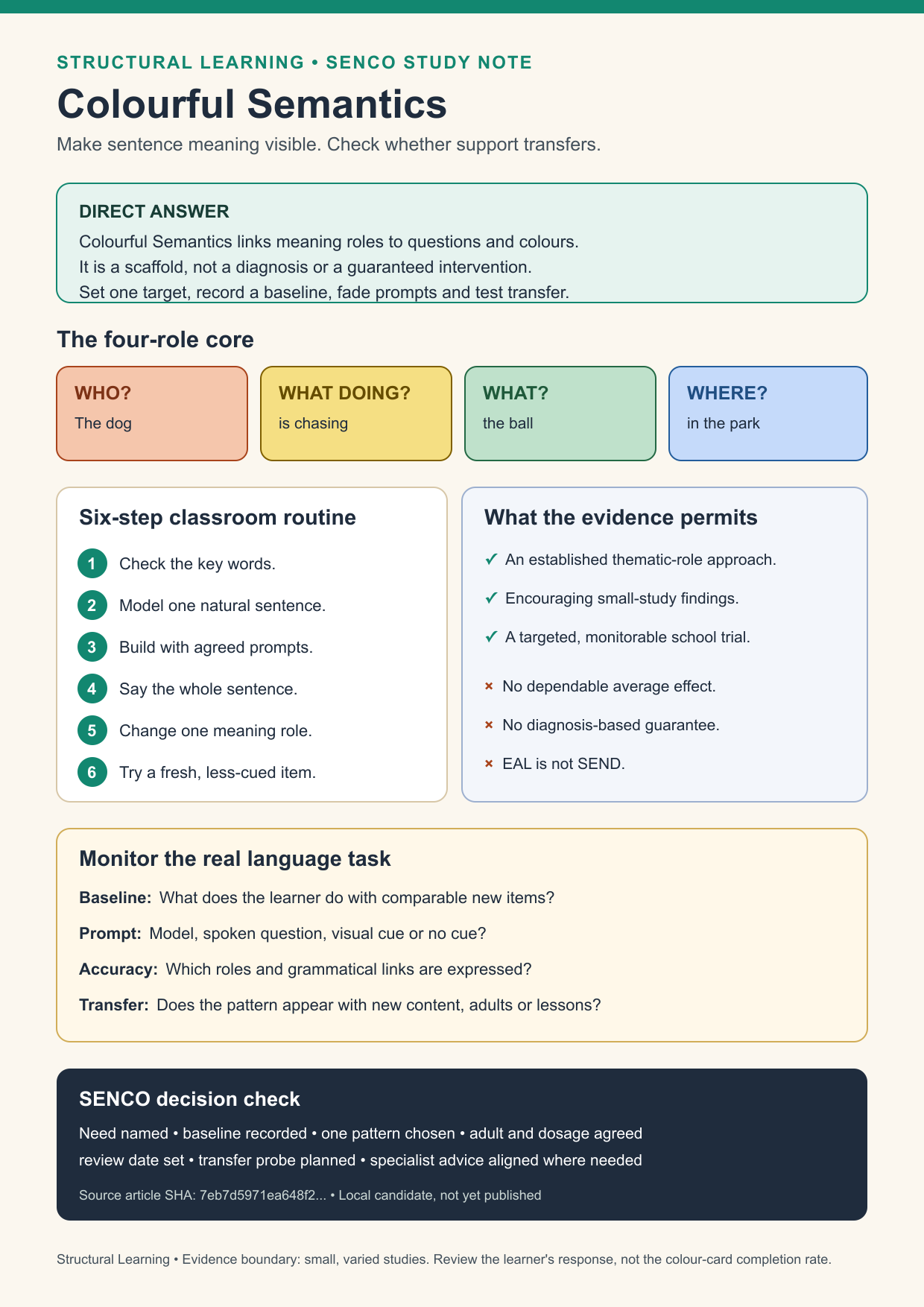
The common four-role core is orange for who, yellow for what doing, green for what and blue for where. Every role also needs a text, symbol or accessible cue.
Use a six-step routine: check vocabulary, model a natural sentence, build with agreed prompts, say the whole sentence, change one role and try a fresh item with less support.
The evidence supports a well-established thematic-role approach. Small studies are encouraging, and a targeted school trial is a fair next step. It does not give a reliable average effect, nor does it promise results based on a diagnosis. EAL is not SEND.
Monitor the learner's response on comparable new items. Record role accuracy, sentence or message completeness, the least prompt required and transfer to new content, adults or lessons.
Printable implementation record: use the two-page A4 sheet to keep a record of your work. It covers the target, the starting point (baseline), the role cues and how you delivered the sessions. It also records how you faded the prompts, the review check and your final decision.
Download the Colourful Semantics implementation record (PDF)
The file is a working record, not a diagnostic assessment. Use it alongside your assessment evidence and any specialist advice. Keep the learner's usual communication supports in place too.
A SENCO should decide whether the proposed use addresses a clearly described language need, fits existing assessment and specialist advice, and can be reviewed fairly. The plan needs a baseline, one initial sentence target, a named adult, a prompt hierarchy, a transfer probe and a review date. Appearance or engagement alone is not enough.
Where Colourful Semantics forms part of provision for persistent or complex speech, language and communication needs, align the trial with advice from a speech and language therapist. The school remains responsible for high-quality teaching and for following normal assess-plan-do-review processes. The coloured cards are not the provision map. This sits within wider SEND-friendly classroom practice, not outside it.
A short routine works in six steps. First, teach the vocabulary and model one natural sentence. Then build it using the agreed role prompts, say the whole sentence aloud, change one element, and finish with a fresh item.
Keep the purpose clear. The routine rehearses a language pattern you can see and hear. It does not ask the learner to fill every colour every time.
For a larger bank of practice ideas, use the dedicated Colourful Semantics activities page. For printable sentence frames, use the Colourful Semantics worksheets page. Keeping those jobs separate makes this guide easier to use and reduces repeated search content.
Colour-coded practice belongs inside a joined-up set of primary school teaching strategies. It should support rich teacher talk, shared reading, saying sentences aloud and real communication. It should never replace them.
The levels add one meaning role at a time. Start where the learner is secure, add the next role, and stay there until the learner can produce that pattern on a fresh picture without a prompt. In a Year 1 intervention group the teacher shows a photograph of a dog in a park and asks the agreed questions in order; each learner says the sentence aloud before touching a card. Local schemes number the levels differently, and the order of roles matters less than adding one at a time.
In early years and KS1 the work is oral and it starts with real objects and photographs, not worksheets. A Reception teacher puts a toy cat on a chair, asks who? and what doing?, and the learners answer in a two-part spoken sentence: The cat is sitting. One role is added at a time, and nothing is written until the spoken pattern is secure on new pictures. The Colourful Semantics in EYFS and KS1 guide gives the full sequence for those phases.
In KS2 the same colour key becomes a planning frame for written sentences. A Year 4 teacher gives a four-colour strip beside a history picture, learners say the sentence first, then write it with each part in order: The Roman soldier is building a wall near the river. Over a few weeks the colours are faded to plain question labels (who? what doing? what? where?), then to nothing, so the learner is writing from the pattern rather than from the card. Keep the question labels only as long as the independent writing needs them.
A learner can get very good at arranging familiar cards without becoming more independent in talk or writing. That is learning the task, not necessarily transfer.
So plan to fade support from the start. Remove one kind of help at a time, then test with new content, a different adult or a curriculum task. Keep any access supports that the learner still needs for the long term.
Reduce help one dimension at a time. An adult can move from modelling every answer, to asking the colour questions, to showing the coloured strip without speaking, to using plain question labels, and finally to an ordinary picture or classroom task. The order should respond to the learner rather than follow a fixed timetable.
Test transfer across examples, adults and settings. A learner who builds The boy is kicking the ball from practised cards can next describe a different action picture, report what happened in science, or write one sentence about a story. Keep vocabulary and background knowledge within reach when the purpose is to test sentence organisation.
Do not fade useful accessibility support simply to make the work look independent. A symbol, communication aid or visual timetable may remain essential. Fade the prompt only when it is a temporary teaching cue and the learner can perform the target more independently without it.
A short record is more useful than a broad claim that the learner “engaged well”. For each probe, note the target pattern, number of opportunities, roles expressed accurately, grammatical completeness, least prompt needed and whether the item was practised or new.
| Measure | Baseline example | Review question | Avoid |
|---|---|---|---|
| Role accuracy | Action named in 2 of 6 new pictures | Is the action now expressed in more comparable new items? | Counting memorised card placement as spontaneous language |
| Prompt level | Adult model required | Can the learner respond to a question, visual cue or no cue? | Changing prompts between baseline and review without noting it |
| Sentence completeness | Person named; action often omitted | Does the target combination occur accurately? | Scoring length alone when words do not form the intended event |
| Transfer | No unprompted use in curriculum talk | Does the pattern appear with a new adult, picture or lesson? | Assuming success at the intervention table has generalised |
Review both accuracy and burden. A method that produces a small gain but requires lengthy preparation, creates visual confusion or crowds out more useful communication practice may not be the best option. Record the learner's response and, where appropriate, their view.
Common problems arise when staff introduce too many roles, mistake card sorting for independent language, use different cues or retain prompts without checking transfer. Correct the smallest barrier first. Return to the observed target, reduce task demands where needed, align adult practice and collect a fresh unprompted example before deciding what to change.
Return to the smallest useful pattern. Teach the relationship between the question, role and sentence, then add one role when the earlier combination is secure enough for the target task.
Build the whole sentence every time. Model natural phrasing, then practise it out loud or through the learner's communication system. Move to writing only if writing is the goal. Check whether speech, vocabulary, working memory or physical demands need their own support.
Agree the main prompts, colours and terms for that learner. Put a one-page key where the learner works, and explain any change you have made on purpose. Keeping things the same should help the learner get in, not stop a sensible change.
Check whether they are an accessibility aid or a teaching prompt. If they are a prompt, collect an unprompted probe and reduce support gradually. If independence falls, adjust the step rather than removing all cues at once.
Go back to the language need you have seen. Neither label on its own shows that Colourful Semantics is the right choice. For EAL, use the school's multilingual assessment and teaching processes. For an individual communication need, bring in the right specialists and keep track of the chosen target.
Shape Coding is a related explicit visual system that can represent grammatical structures using shapes, colours and arrows. It is not another name for Colourful Semantics. The dedicated guide to Colourful Semantics versus Shape Coding explains the distinction in more detail.
PECS is a specific augmentative and alternative communication protocol. A coloured sentence strip does not become PECS just because it has pictures on it. Colourful Semantics does not set out the PECS phases either. Follow the learner's communication plan and the guidance from trained staff.
Visual scaffolding is a wider classroom practice. A teacher can use pictures, worked examples and sentence frames without claiming to deliver the full Colourful Semantics therapy programme. Precise naming helps staff evaluate what was actually done. The broader account of language development theories helps keep one intervention separate from a general theory of language.
For early-years examples and play-based adaptation, use the separate Colourful Semantics in EYFS and KS1 guide.
The research base is small, includes varied populations and outcomes, and offers no dependable average effect for ordinary classrooms. Many reports use uncontrolled or pre-post designs. Colour coding can also become an end in itself, obscure natural sentence prosody or create dependence if staff do not plan transfer. Schools should preserve the method's useful semantic focus while testing whether it improves the learner's real communication task.
Colourful Semantics cannot meet every grammar need. It does not cover word endings, complex sentences, longer stretches of talk, vocabulary or social communication in full. A learner who builds a good two-role or four-role sentence has not shown wider language skill.
So use normal formative assessment principles. Gather evidence that matches the goal, read it with care, and then choose the next teaching step.
The practical answers below keep the method within its evidence and purpose. Use the common colour sequence as a shared cue and adapt it for access. Keep classroom scaffolding separate from an individual intervention.
Judge success through the learner's target language and transfer, not through completion of a coloured activity. There is a free printable strip and cue-card set on the worksheets page linked above.
A common core sequence is orange who?, yellow what doing?, green what? and blue where?. The sentence pattern should be chosen for the learner and verb, not treated as a rule that every sentence must contain four boxes.
Use the colour mapping your school or therapist has agreed, and use it the same way every time. Make sure each role can be recognised by words or symbols as well as by colour. Access for every learner and shared practice matter more than an exact shade on screen.
It has a published clinical foundation, and several small studies report encouraging findings. Even so, the evidence is limited and the studies vary a great deal. It is fairer to call it a plausible, established approach that you can monitor. It is not a programme proved to work everywhere.
A teacher can use simple colour-coded semantic prompts as a classroom scaffold. When the work is a one-to-one intervention for lasting or complex communication needs, link it to assessment and specialist advice. In either case, name the target and check whether the skill transfers without support.
No. It began in spoken-language therapy and in the study of who does what to whom in a sentence. Learners often build sentences out loud before they write them. Pick the task that matches the goal you want, whether that is talking, writing, understanding or communicating.
Bryan, A. (2003). Colourful Semantics: Thematic Role Therapy. Wiley online edition of the foundational chapter.