Updated on
September 24, 2026
MYP vs GCSE: What UK State School Heads Should Know
A head teacher's comparison of the MYP and GCSE: what each curriculum actually involves, the real running costs, and the authorisation timeline.


Updated on
September 24, 2026
A head teacher's comparison of the MYP and GCSE: what each curriculum actually involves, the real running costs, and the authorisation timeline.
Over the past decade, fewer than 10 UK state schools have adopted the International Baccalaureate Middle Years Programme, even though it is better known internationally. Wellington Academy is one of the few state-funded schools in England linked with the MYP route. It does not show that MYP has become a normal state-school pathway. By contrast, about 680,000 learners sat GCSEs in summer 2024, so GCSE qualification remains the clear standard for UK secondary education (JCQ, 2024).
For a school leader considering curriculum change, the practical question is simple. Will MYP protect learners' future options while also improving curriculum thinking?
This article tests the decision against cost, staffing, assessment, accountability and learner progression. It does not claim that MYP is better than GCSE, or that GCSE should be left untouched. Instead, it asks what a state school must prove before asking families, staff and governors to swap. They would swap a familiar national qualification pathway for a less familiar International Baccalaureate framework.
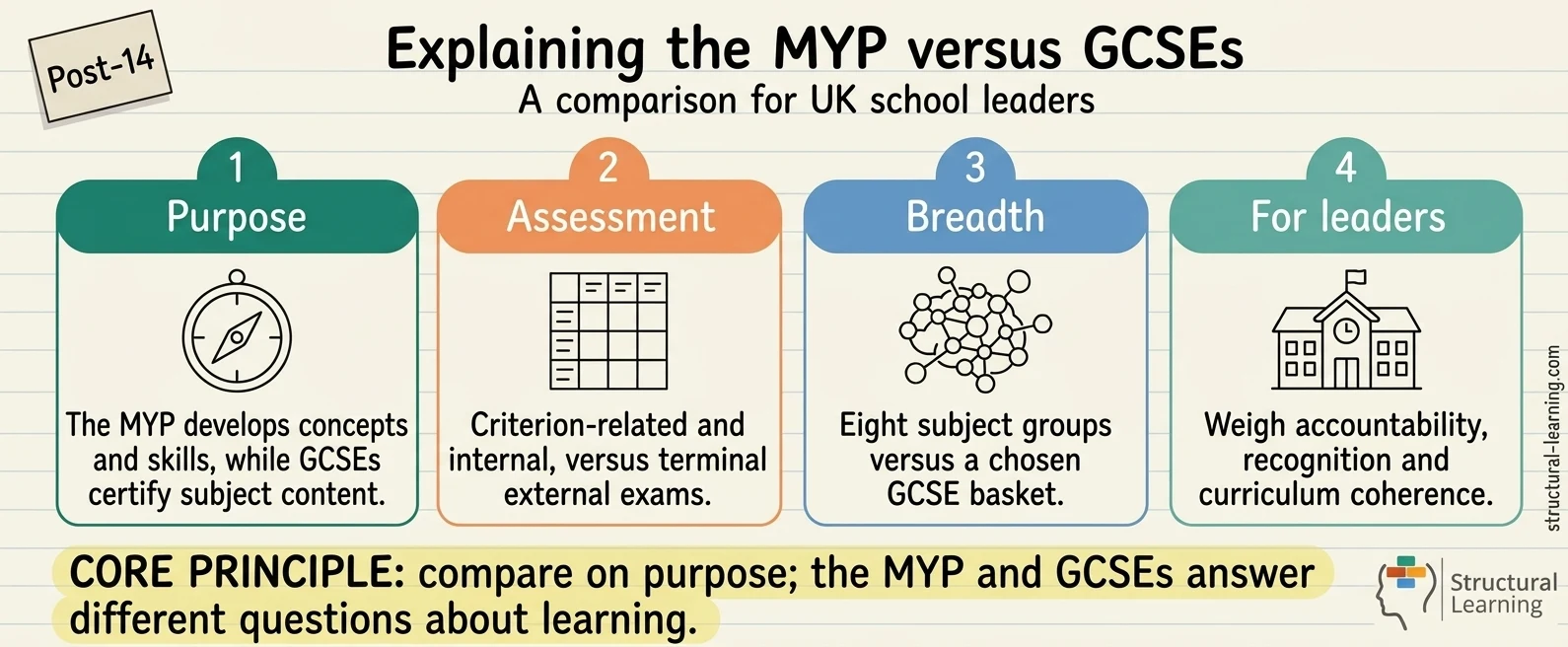
The Middle Years Programme is a four-to-six-year curriculum framework for learners aged 11 to 16. It typically spans Years 7 to 11 in UK schools (IBO, 2024). GCSE organises knowledge around separate subjects and success in final examinations. MYP instead organises learning around eight subject groups: Language and Literature, Language Acquisition, Individuals and Societies, Sciences, Mathematics, Arts, Physical and Health Education, and Design.
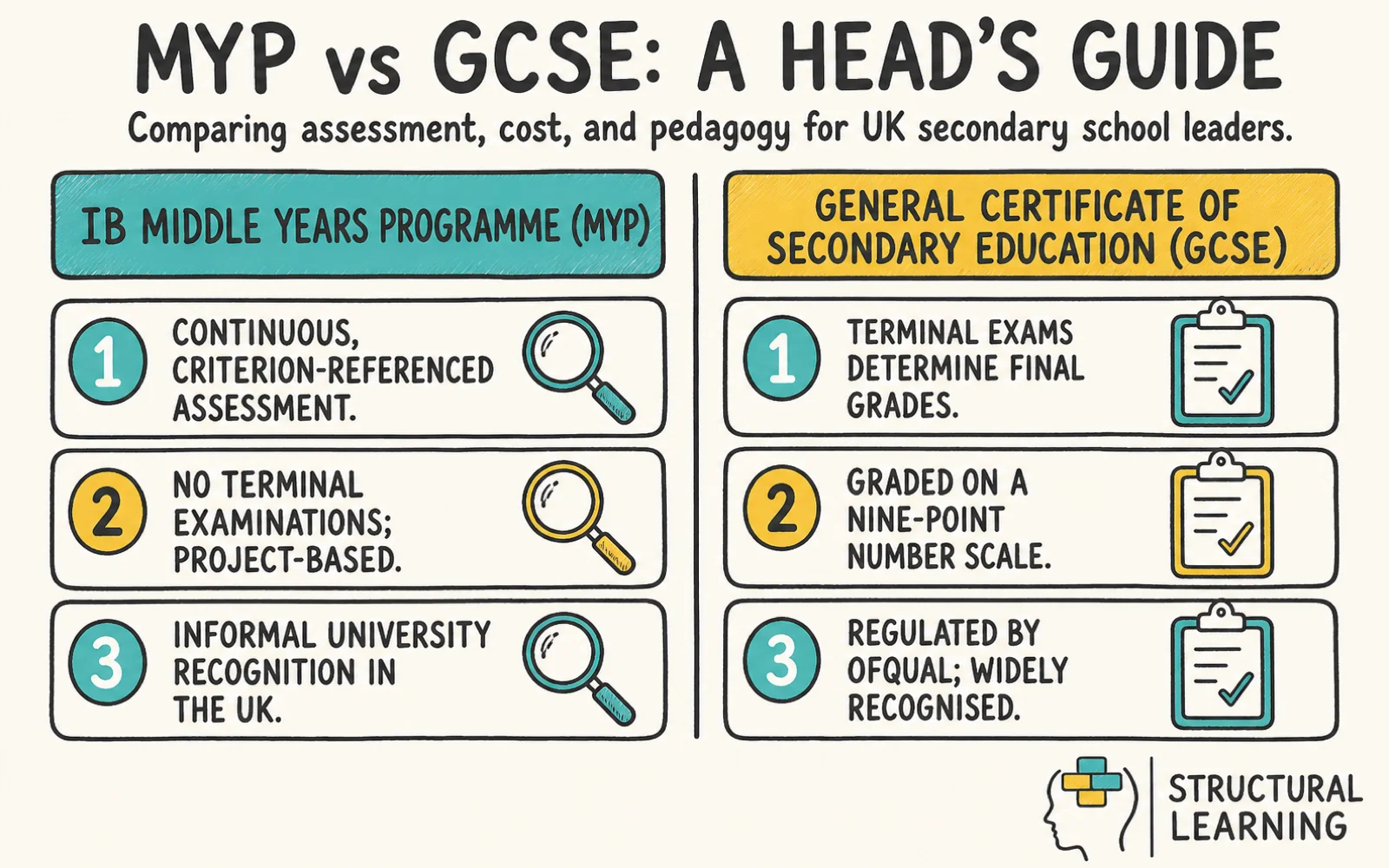
The MYP assessment uses four main criteria. These cover knowing, understanding, applying, analysing, evaluating, synthesising, and using language. These criteria do not work like GCSE points or grades. Instead, teachers use rubrics scored from band 1 to band 8, with each band linked to learner behaviours they can see. Schools assess every unit in school, and externally moderated projects (eAssessment) are sent digitally to the IBO for moderation.
There are no terminal examinations in MYP. Instead, teachers assess learners over time through classroom-based projects, reflective writing, and practical tasks. This is a major change from GCSE, where the final exam typically counts for 50, 100 per cent of the grade.
Learners in MYP also develop the IB Learner Profile. This is a set of ten attributes, including being "inquirers," "principled," and "open-minded". Schools build these qualities across the curriculum (IBO Curriculum Framework, 2024).
GCSE is the General Certificate of Secondary Education, the qualification sat by nearly all learners in England at the end of Key Stage 4, typically Years 10 and 11. The system uses a nine-point grading scale: 9 (highest), 8, 7, 6, 5, 4, 3, 2, 1 (lowest). Grade 4 is officially recognised as a "standard pass", Grade 5 as a "strong pass", and Grade 7 is broadly equivalent to the old A grade.
GCSE assessment varies by subject. It usually combines coursework or controlled assessment, from 0 to 50 per cent depending on the subject, with written exams at the end of the course. Mathematics, English Language, and English Literature have heavy exam weighting, at 80 to 100 per cent. Subjects like Science, Design Technology, and Drama balance coursework with exams. Schools can offer 16 to 20 GCSE subjects to help learners specialise.
GCSEs carry strong weight in the UK. Universities look at GCSE results when they set A-Level entry criteria. Employers recognise GCSEs for vocational and apprenticeship routes, and parents can understand the grading system easily.
Ofqual, the Office of Qualifications and Examinations Regulation, oversees GCSEs. This helps keep standards steady. It also makes results easier to compare across schools and exam boards (Ofqual, 2024).
This section gives leaders a simple cost test. Can the school pay for authorisation, training, cover, curriculum mapping and parent communication, without weakening core GCSE provision? Use this to start professional discussions. First, identify the learner's needs. Next, gather evidence from several lessons. Finally, agree on classroom adjustments with the SENCO or family.
For a typical secondary school with 500 learners, first-year MYP costs fall into several areas. The IBO charges an initial licensing fee of £15,000 to £45,000, depending on school size. It also charges an annual renewal fee of £8,000 to £20,000.
Teacher training costs £20,000 to £50,000 in year one. This includes workshop fees of £300 to £500 per teacher, cover for up to 40 staff attending mandatory 1.5-day induction sessions, and travel.

Schools usually spend £10,000 to £25,000 on curriculum development and buying resources. This covers textbooks, digital platforms like Managebac, learning management systems, and assessment rubric templates. Optional consultancy support can help with pre-authorisation curriculum design. It costs £5,000 to £15,000.
Total first-year investment: £58,000, 155,000.
Ongoing annual costs are lower, but schools still need to budget for them. These include annual IBO licensing (£8,000, 20,000), some staff training and refresher workshops (£3,000, 8,000), and occasional resource updates (£2,000, 5,000). These figures show a real long-term commitment, not a one-time expenditure.
These figures show direct costs only. Indirect costs often cost more than the direct line items. They include extra administrative work during authorisation, staff time for curriculum mapping, and release time for curriculum design workshops. Wellington Academy has not publicly shared exact costs, but likely invested £300,000 to £500,000 across its first three years of total implementation.
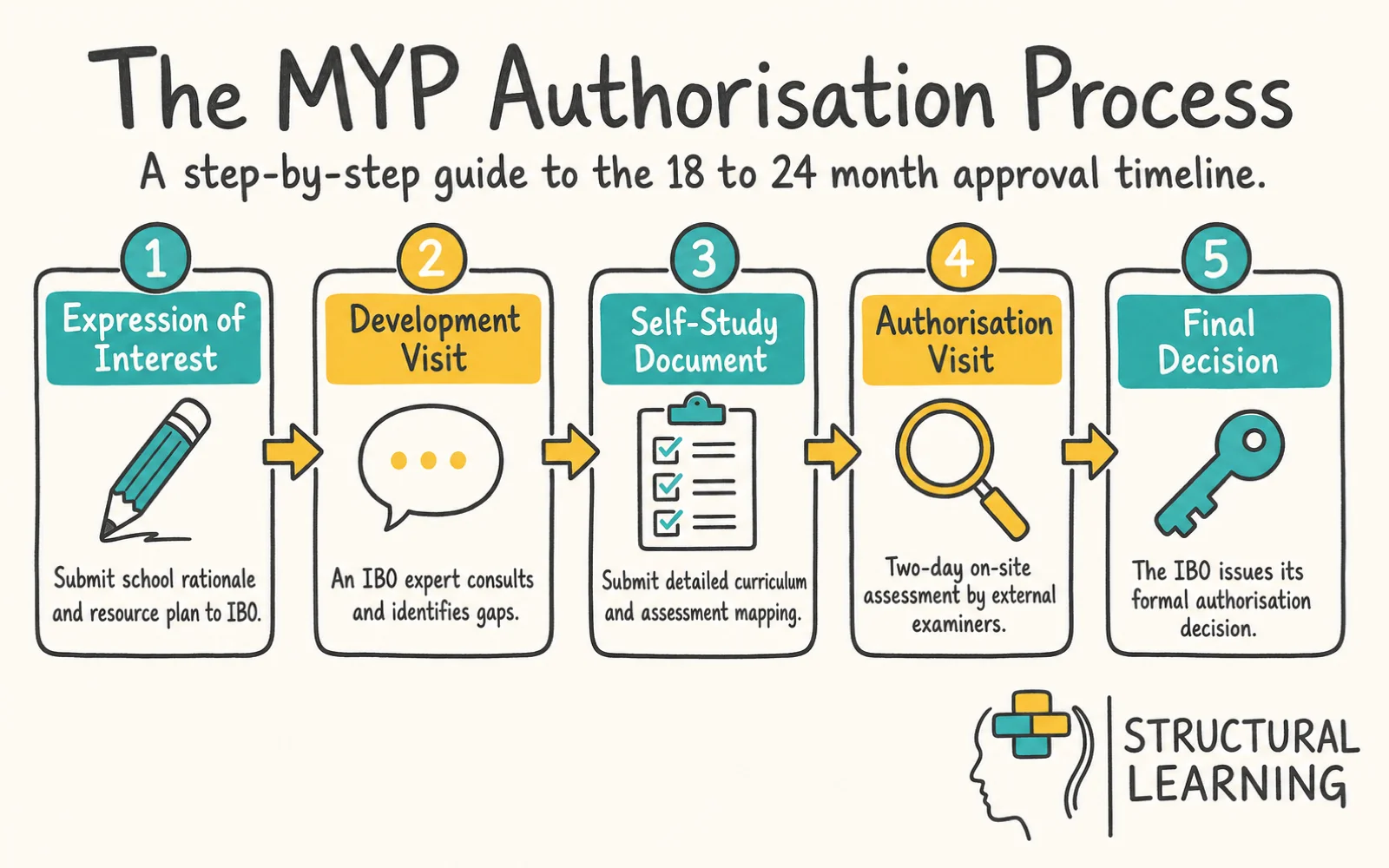
Before any learner enters MYP, your school must be formally authorised by the IB. This process is not quick. Use this to start professional discussions. First, identify the learner's needs. Next, gather evidence from several lessons. Finally, agree on classroom adjustments with the SENCO or family.
The timeline usually runs 18 to 24 months from decision to first cohort launch. It begins with an Expression of Interest to the IB, setting out the school's rationale, leadership commitment and resource plan. A development visit then tests curriculum design, staff readiness and gaps in implementation planning.
Next comes the self-study document, a detailed 40 to 60-page submission. It covers curriculum mapping, assessment procedures, staff training schedules, resource allocation, and alignment to the MYP framework. Schools usually spend three to four months on it, often with consultant support. The IBO then schedules a two-day Authorisation Visit at the school. External examiners will interview staff, check documents, evaluate readiness, and observe lessons if pilot units are running.
Within three months of the visit, the IBO gives its decision. About 85 per cent of schools that enter this process receive authorisation (IBO, 2023), so success is likely if you have invested properly. For the 15 per cent that are unsuccessful, the usual problems are staff unreadiness, weak curriculum planning, or inadequate resource allocation. These issues should normally be found during pre-authorisation work.
Rushing this timeline is false economy. Schools that compress the 12, 18-month pre-authorisation window often face weak staff buy-in, incomplete curriculum design, and higher failure rates at the formal visit.
The financial cost may surprise school leaders. However, the staffing burden is the bigger implementation risk. Use this to start a professional discussion. Identify the learner's current needs and gather evidence from multiple lessons. Then, agree classroom changes with the SENCO or family.
Every teacher delivering MYP must complete IBO-mandated professional development. This starts with a 1.5-day workshop on the curriculum framework, assessment model, Learner Profile, and inquiry pedagogy. Staff then complete annual refresher training of 0.5, 1 day per year.
Workshop fees range from £300, 500 per participant. Supply cover to release 25, 40 staff for training costs £3,000, 8,000 per cohort per year, at current cover rates.
Fees and cover are only part of the story. Teachers trained in UK GCSE assessment are used to a points-based, criterion-referenced model focused on exams. They must move to rubric-based internal assessment, project-based learning, and conceptual understanding. This retraining affects mindsets as well as teaching methods. As a result, many experienced teachers resist the change. Others embrace it, but leave for independent or international schools where the MYP is more established.

Recruitment is another challenge. The UK does not have a large pool of MYP-trained teachers. Schools usually recruit internationally or retrain current staff, which carries more risk. Keeping staff is also difficult. Teachers who gain confidence with MYP teaching often move to private or international schools. These schools usually offer higher pay, smaller classes, and better resources.
Wellington Academy's experience shows this clearly. As the pioneering state MYP school, Wellington invested heavily in CPD, ordered bespoke training, and built strong staff groups around the pedagogy. Even so, staff turnover in early years was significant. Ongoing CPD remains non-negotiable.
A 500-learner school can expect per-teacher training costs of £2,000, 4,000 in year one, including fees and cover. After that, costs drop to £500, 1,000 each year.
Many school leaders consider a hybrid model: MYP in Years 7 to 9, then GCSE in Years 10 and 11. This preserves qualification currency while giving learners an inquiry-led Key Stage 3. It also creates a transition cliff. Departments must decide which MYP units build the knowledge, vocabulary and routines learners need when they enter GCSE courses.
Running both programmes at the same time makes timetabling harder. It typically increases administrative burden by 20 to 30 per cent. You also manage two assessment approaches: rubric-based (MYP) and points-based (GCSE).
Some subjects overlap. For example, Science in MYP is taught as one unified, interdisciplinary unit, but GCSE requires separate Biology, Chemistry, and Physics qualifications. If you teach Science as MYP in Years 7 to 9, then move to triple-award GCSE in Years 10 and 11, you risk content gaps or duplication.
Pastoral care becomes complicated. Learners in Year 9 (final MYP year) face a transition decision: continue into MYP Years 10, 11 (a rare pathway), or drop MYP and enter GCSE. This creates anxiety for learners and parents worried about "losing" MYP investment. Exam hall logistics diverge: MYP projects are submitted digitally; GCSE exams are sat on specific dates with invigilators.
Most successful dual-pathway schools manage this by rolling MYP out in stages. Years 7 to 9 are MYP-only, then from Year 10 learners move to GCSE or, if the school offers IBDP post-16, to the full Diploma track. The trade-off is that learners in Years 10 and 11 miss the full MYP advantage. A single-track model is easier to run and keeps the same assessment approach. This means teaching MYP in Years 7 to 11 and IBDP from Year 12.
The uncomfortable truth is that MYP is not formally recognised in the UK qualifications framework. Use MYP as a starting point for professional discussion. Identify the learner's current need and record evidence from more than one lesson. Then agree the next classroom adjustment with the SENCO or family.
Ofqual governs GCSE and publishes comparability studies. These studies check that grades stay reliable across exam boards and from year to year. Universities name GCSE results in their A-Level entry criteria, and employers recognise them in apprenticeship and vocational routes. In short, GCSE is well understood in UK culture.
MYP has no such official status. The IB provides an informal guide to compare grades (IBO, 2023). For example, an MYP Grade 5 matches a GCSE Grade 7 or 8, and an MYP Grade 6 matches an 8 or 9. This is admissions guidance, not Ofqual recognition, and universities can ask for transcripts or course descriptors.
That creates a social mobility risk. GCSE qualifications act as a common currency for A-Level entry, apprenticeships, sixth-form admissions and employer screening. This matters most for learners who may move school or leave before the Diploma Programme. Social Mobility Commission reporting on qualification pathways warns that less clear routes tend to favour families with more cultural and institutional knowledge (Social Mobility Commission, 2023).
A-Level entry is a key tension. Most A-Level programmes require strong GCSE passes in similar subjects. Therefore, an MYP-only school needs a transition plan. This must map subject requirements, bridging assessments, and summer transition work. It also requires command-word practice and clear evidence for sixth-form admissions. Without that plan, learners can arrive at highly structured A-Level courses with good conceptual habits but too little fluency in exam routines.

Employer recognition is clearer, but it is less favourable for MYP. Apprenticeship schemes and vocational providers usually ask for GCSE passes in English, mathematics and relevant subjects, not MYP grades. If learners leave secondary school without DP, CP or GCSE evidence, MYP gives them little vocational advantage in the UK labour market.
For international mobility, the picture is different. MYP is recognised around the world by International Baccalaureate schools, international businesses, and overseas universities. In the UK labour market, though, GCSE remains the gold standard.
MYP and GCSE follow different teaching ideas. Each route has clear strengths, but each also involves trade-offs. Use it to start a professional discussion. Identify the learner's current needs and gather evidence from multiple lessons. Then, agree classroom changes with the SENCO or family.
MYP puts strong focus on conceptual understanding and cross-curricular inquiry. In simple terms, this means linking ideas across subjects. For example, a Science unit on "Energy" might begin with a real-world question: "How can a school reduce its carbon footprint?" Learners then study renewable energy, thermodynamics, and material science with that clear purpose in mind.
The Learner Profile attribute "inquirers" runs through the unit. Assessment looks at how well learners understand conceptual patterns and use them in new situations.
GCSE focuses on secure subject knowledge and exam technique. Learners study the periodic table, chemical equations, energy calculations, and other clear pieces of knowledge needed for the final examination. Inquiry projects can happen, but teachers choose whether to use them. GCSE assessment is criterion-referenced, which means work is judged against set subject objectives: AO1 (Knowledge and Understanding), AO2 (Apply knowledge), AO3 (Evaluate), AO4 (Written expression, subject-dependent).
The trade-off is real. MYP's conceptual, inquiry-led approach builds deep understanding and transfer skills. This means learners can apply knowledge to unfamiliar contexts, but content coverage can be slower.
Some learners find open-ended inquiry unclear and mentally demanding. They may do less well in assessments that ask them to recall factual knowledge directly. GCSE's content-focused approach makes sure all learners cover the specification, while clear teaching and scaffolding support lower-attaining learners. However, it can also lead to surface learning and weak transfer to new contexts.
Research on cognitive load theory suggests that inquiry-based learning works best when learners already have knowledge to draw on (Sweller et al., cited in educational psychology texts). In a mixed-attainment secondary cohort, MYP's open approach helps some learners thrive. Others struggle when they do not have explicit structure. GCSE's structured specification gives them this safety net.
Wellington Academy opened in Wiltshire in 2012. It is a rare example of a state-funded, mixed-gender secondary school authorised to teach MYP from Year 7 onwards, with full IBDP provision post-16.
Wellington chose MYP as part of a clear strategic vision. It wanted to offer learners an internationally-recognised, inquiry-centred curriculum. It also wanted to stand out among local secondary schools in a competitive Wiltshire context.
The school's first years were difficult. Parents and carers worried about "non-standard" qualifications. Many families feared that MYP would disadvantage learners when they applied to university.
Wellington invested heavily in communication. It hosted information events, published university progression data, and showed sceptical audiences that MYP had rigour. By Year 5 (around 2017), roll growth had stabilised. Parent confidence had also increased.
| Cost Category | Year 1 Estimate (500-learner school) | Years 2+ Annual Estimate |
|---|---|---|
| IBO initial licensing | £15,000, 45,000 | £0, 0 |
| IBO annual fee | £8,000, 20,000 | £8,000, 20,000 |
| Teacher training (fees + cover) | £20,000, 50,000 | £3,000, 8,000 |
| Curriculum development & resources | £10,000, 25,000 | £2,000, 5,000 |
| Consultancy support (optional) | £5,000, 15,000 | £0, 3,000 |
| Total | £58,000, 155,000 | £13,000, 36,000 |
Staff recruitment was difficult. Wellington looked overseas for staff, especially in European IB schools. It also retrained experienced UK teachers.
Early staff turnover was high enough to notice. Some teachers joined because of MYP's pedagogy, or teaching approach. They then moved to better-resourced independent schools. Wellington responded by improving induction, building collaborative communities, and making professional learning part of routine practice.
On outcomes, Wellington's results have shown that the investment was worthwhile. Learners who moved from MYP to IBDP and then to university have done well, with strong A-Level and university entry rates. University feedback suggests that MYP learners show stronger research and conceptual thinking skills than GCSE-trained peers, though this evidence is anecdotal. Ofsted ratings have remained positive (Ofsted reports available publicly via the regulator's database, 2024).
The lessons Wellington shares with other schools considering MYP are clear. First, do not underestimate parent and carer communication. Cultural trust in MYP takes time to build. Second, CPD is never finished; ongoing training is non-negotiable, not a one-time investment.
Third, mixed pathways create more operational complexity than single-track solutions. This includes MYP in Years 7, 9, and GCSE in Years 10, 11. Wellington's success partly reflects its commitment to a full MYP-to-IBDP track, not hybrid approaches.
Before committing to MYP, ask yourselves these five questions honestly. Use it to start a professional discussion. Identify the learner's current needs and gather evidence from multiple lessons. Then, agree classroom changes with the SENCO or family.
Question 1: Budget reality. Can your school afford £60,000, 150,000 in year one, plus ongoing annual costs of £13,000, 36,000? If your school is already financially stretched or cash flow is tight, MYP is a luxury you cannot yet afford. GCSE strengthening is a lower-cost alternative that delivers measurable impact.
Question 2: Staffing capacity. Can you release 25 to 40 staff for mandatory training without destabilising teaching? Do you have confidence that trained staff will remain with the school, or are you worried about retention to international schools? If staff morale is already fragile, a rubric-heavy assessment shift may backfire. Build trust in your existing curriculum first.
Question 3: Parent and carer community. Are families asking for other routes, or does GCSE meet your cohort's aims? If your community values GCSE's clarity and its status with universities above all else, promoting MYP will be hard. If your cohort wants a more international outlook or more independent learning, there may be demand to meet.
Question 4: Strategic fit. Does MYP fit your school's or MAT's strategic vision? Is international mindedness a priority? Are you trying to stand out in the local market? Are you aiming to recruit international learners or attract families moving from international schools?
If MYP is only a short-term response to a falling roll, or simply a fad, it will fail. If it reflects a genuine strategic direction, it has a chance.
Question 5: Contingency planning. If authorisation fails, or uptake is lower than expected, can you sustain a hybrid model, or will you pivot back to GCSE? Failure at the authorisation visit is costly (lost investment, staff morale); low uptake means you've invested heavily but serve only a fraction of your learner cohort. Map the downside risk.
If your answers are: Yes, Yes, Yes, Yes, and Yes, MYP is worth serious exploration. If you answer No, Unsure, or No to any question, GCSE strengthening is the safer choice.
Consider a typical state secondary school with 500 learners and three forms of entry. Learners have mixed prior attainment and come from mixed socioeconomic backgrounds. The school currently teaches only GCSE courses. Its progress measures are broadly in line, but leaders want to raise aspiration and improve post-16 progression.
Scenario A: Stay with GCSE (baseline). The school keeps its current curriculum, assessment system, and staffing. The upfront investment is £0. Teacher development continues to focus on GCSE technique, exam success, and post-16 progression mentoring.
Parent confidence stays high. Routes to university are clear, with A-Level options and explicit grade-to-university mapping. Learners can choose from 16 to 20 GCSE subjects, so the school can support different aptitudes.
Annual cost: near-zero capital, plus modest CPD of £5,000 to £10,000. Outcome: reliable, culturally trusted, and with lower innovation risk.
Scenario B: Adopt MYP Years 7, 11 (full commitment). Introduce MYP to Year 7 cohort; roll out across Years 8, 11 over four years. Transition post-16 to IBDP (or A-Levels, though IBDP is more natural progression). For related guidance, see our article on Appreciative Inquiry.
Year 1 costs £58,000 to £155,000 for licensing, training, resources, and consultancy. Year 2 to Year 4 annual costs are £13,000 to £36,000. The total four-year investment is about £180,000 to £300,000.
Staff training covers 40 teachers, with 1.5 days at the start and ongoing annual training. Parent communication is intense in years 1 to 3, then moderates by year 4 as a track record emerges. University progression remains ambiguous until IBDP results are available, because learners will have MYP credentials plus IBDP results post-18. The assessment burden is higher at first because of rubric training, then stabilises by year 3.
Outcome: strategic differentiation and an inquiry-led culture. The model also made operations more complex. At first, the IBDP pathway helped reduce the risk around university recognition.
Scenario C: Hybrid pathway, MYP Years 7, 9, GCSE Years 10, 11. Introduce MYP to Year 7; Years 10, 11 learners remain on GCSE path (existing staff, existing qualifications).
Year 1 cost: £40,000, 100,000. This is lower than a full rollout because only Years 7, 9 staff need training. Annual cost: £8,000, 20,000. Operational complexity: moderate-to-high.
Learners transition at Year 9. Some continue into dual pathways, but most drop MYP and enter GCSE. Staff must teach two assessment systems at the same time: MYP in Years 7, 9, and GCSE in Years 10, 11. Parent communication is moderate: explain that MYP is a "foundation" leading to GCSE.
Outcome: option value and lower upfront cost. The model also creates higher timetabling complexity. It may reduce the benefit of MYP because full Learner Profile development is truncated at Year 9.
Recommendation: Scenarios A and B are simpler to run and easier to justify to parents. Scenario C keeps costs lower, but the curriculum may feel less coherent.
If you proceed with MYP, you enter an extended conversation with parents and carers. GCSE is culturally trusted in the UK; parents understand the grading system, the university progression pathway, and the competitive advantage. MYP is unknown, often perceived as "risky."
Your communication must be planned and sustained. Before applying for authorisation, survey parent and carer attitudes. Hold information sessions that explain MYP, the Learner Profile, inquiry pedagogy, and, with clear caveats, how learners will move on to A-Level and university.
Publish clear equivalences, even if informal, between MYP grades and GCSE grades. This helps demystify the qualification. Share case study evidence from Wellington Academy and other UK schools.
Anticipate three objections you will hear repeatedly. First: "Is MYP recognised by universities?" Answer: yes, informally, with stronger credibility when progression into DP or CP is clear. Second: "What if my child wants to change schools?" Answer: other MYP schools will recognise the programme, but moving into a GCSE-only school creates transition complexity. Third: "Isn't GCSE safer?" Answer: for many learners, especially those who may move school, enter an apprenticeship or apply through standard A-Level routes, GCSE is the safer currency. The case for MYP must show a stronger learning benefit and a credible progression plan.
Build confidence by being open. Each year, publish progression data: which universities accepted your IBDP and MYP learners, which courses they chose, and how they performed. Also identify parent champions, especially parents educated in international schools or those with global careers, as they can speak for MYP in your community.
Under pressure to reduce costs, schools sometimes cut corners on MYP implementation. Resist this urge. Use it to start a professional discussion. Identify the learner's current needs and gather evidence from multiple lessons. Then, agree classroom changes with the SENCO or family.
IBO professional development is non-negotiable. Cheap, generic training will not give teachers the conceptual depth they need. IBO workshops are expensive, but they are built around the curriculum framework and assessment model.
Generic inquiry pedagogy courses are not a substitute. Weak CPD can lead to poor implementation, lower assessment grades, demotivated staff, and eventual programme failure.
Curriculum resources matter. Schools need textbooks designed for MYP, digital platforms like Managebac that scaffold internal assessment, and learning management systems that support project-based workflows. These tools cost a lot at the start, but they are essential. Adapting GCSE textbooks for MYP will not work because the conceptual scaffolding is wrong.
Authorisation failure is not a rare edge case; it is a real risk if due diligence is skipped. Schools that rush the pre-authorisation phase, cut consultancy support, or fail to secure genuine staff buy-in often face adverse authorisation decisions. The cost of failure, lost investment, staff demoralisation, reputational damage, far exceeds the cost of doing it properly the first time.
GCSE is not a static, rote-based qualification. It can be taught with rigour, depth, and inquiry. Use this to start a professional discussion. First, identify the learner's current needs and record evidence from multiple lessons. Then, agree the next classroom adjustment with the SENCO or family.
Many strong schools keep GCSE as the foundation. They then add inquiry projects, cross-curricular links, and conceptual thinking. This lets them keep GCSE's clear subjects and exam structure, which learners understand. At the same time, they can build in unit-based inquiry projects, collaborative learning, and real-world application.
This approach costs far less than adopting MYP. It may cost £10,000, 20,000 each year for resources and CPD. Even so, it can still help learners develop deeper thinking.
GCSE also has clear structural advantages. Parents, universities, and employers trust the qualification. Learners can see how grades link to future outcomes.
Teachers are abundant, so recruitment is not a challenge. Progression to A-Level is clear and well supported by examination boards. If your school is not positioned for a radical curriculum overhaul, strengthening GCSE is a pragmatic, high-impact choice.
Also ask whether your school has the leadership capacity for this change. Can leaders manage a 24-month authorisation process, secure board and trust approval, keep trained staff, and maintain long-term commitment? If the answer is uncertain, GCSE enhancement is likely to be a better fit.
Related reading: Full IB Diploma vs Certificate for struggling students
IBO (2024).
IBO (2023).
JCQ (2024).
Ofqual (2024).
Sweller (1988) gives school leaders a useful test for pure inquiry in MYP classrooms, but cognitive load theory should not be treated as a veto on inquiry. Kirschner, Sweller and Clark (2006) criticised lessons with little guidance. However, Hmelo-Silver, Duncan and Chinn (2007) argued that scaffolded, inquiry-based learning is not the same as unguided discovery. In a Year 8 science class, the difference is whether learners receive worked examples, vocabulary, diagrams and staged prompts before they design an investigation.
A second limitation is methodological. Cognitive load studies often use short, controlled tasks with beginner learners. Therefore, the findings do not apply easily to a five-year curriculum, mixed-attainment classes, or bilingual International Baccalaureate schools (de Jong, 2010). Load is also hard to measure directly; self-report scales, performance data and teacher observation can point in different directions.
There are cultural limits too. Much of the evidence base assumes that success means faster acquisition of predefined content. UK state schools also have to consider SEND access, Progress 8, GCSE qualification currency and family trust. These are social and policy questions, not only cognitive ones. Even with these limits, Sweller's work retains value because it helps leaders ask whether inquiry tasks give learners enough prior knowledge, worked models and feedback to think well.
These peer-reviewed studies provide the evidence base for the strategies discussed above.
DAFNE is agile and responsive, a beacon of best practice
Elliott et al. (2024)
This study highlights structured education programmes for managing Type 1 diabetes. For teachers, understanding these health initiatives is vital to support learners' physical wellbeing in the classroom, ensuring safety and minimising learning disruptions.
An Exploratory Study into the Association between School Expenditure Levels per Student and School Performance in High Stake Examinations
Blake (2014)
This paper explores how funding levels per learner correlate with high-stakes exam results. For school leaders and teachers, it highlights the impact of resource allocation, helping them target classroom funding effectively to maximise learner attainment.
Meta-Analysis of Inquiry-Based Learning: Effects of Guidance
Lazonder, A. W. & Harmsen, R. (2016), Review of Educational Research. A 72-study synthesis showing inquiry-based approaches succeed when learners receive adequate guidance, the evidence base behind the IB's scaffolded-inquiry model.
IBO Middle Years Programme: Curriculum Framework (2024). The definitive curriculum document outlining the eight subject groups, assessment criteria (A, D), and inquiry philosophy. Available at ibo.org/programmes/middle-years-programme/.
IBO Middle Years Programme Guide to School Authorization (2024). Step-by-step documentation of the authorisation timeline, requirements, and assessment criteria. See ibo.org/programmes/middle-years-programme/authorisation-and-evaluation/.
UK Department for Education: Key Stage 4 Curriculum and GCSE Regulations. Official specification of GCSE subject content, grading, and statutory framework. Available at gov.uk/dfe (curriculum section).
Ofqual Regulatory Framework: GCSE Qualifications (2024). Ofqual's governance of GCSE standard-setting, comparability, and quality assurance. See analytics.ofqual.gov.uk/ or the main Ofqual publications portal.
JCQ GCSE Statistics (2024). Annual release of GCSE candidature, pass rates, subject breakdown, and gender analysis. Search JCQ GCSE statistics at jcq.org.uk.
Wellington Academy, Wiltshire: Ofsted Inspection Report (2023). Public inspection report available via Ofsted's school inspection database at reports.ofsted.gov.uk. Search "Wellington Academy, Wiltshire."
ASCL/NFER Secondary Curriculum Briefing Series (2024). Research and briefing papers examining curriculum design, assessment models, and implementation challenges in UK secondary schools. Available at nfer.ac.uk and ascl.org.uk.