Discover how to transition literature circles and book talk beyond rigid roles. Learn practical strategies for classroom reading discussion groups that engage all learners.
Literature Circles Unpacked: From Reader-Response Theory to Classroom Practice
Key Takeaways
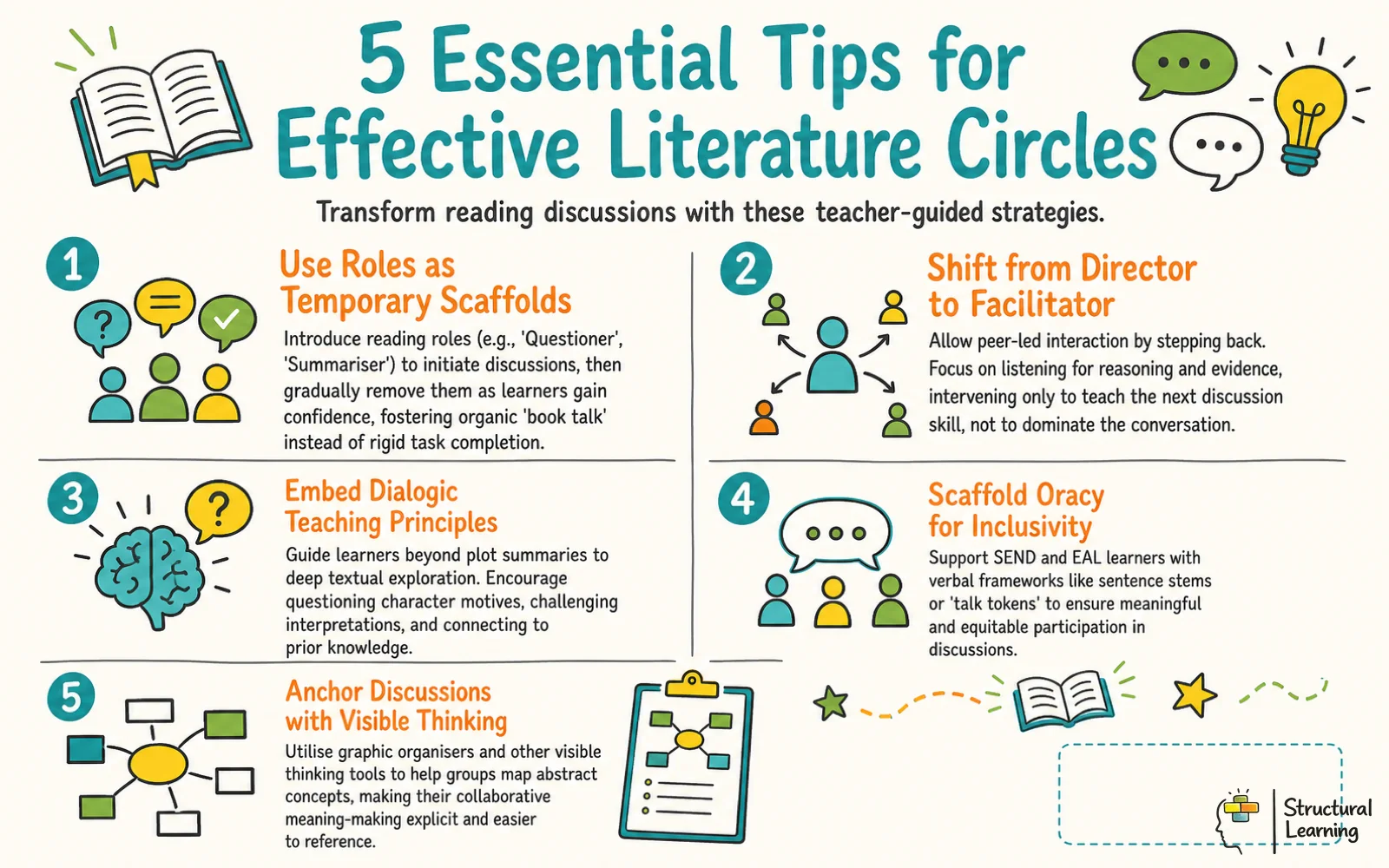
Literature circles are peer-led reading discussion groups where learners construct meaning collaboratively through structured talk.
Assigned roles provide an initial scaffold but should eventually give way to fluid, natural book talk.
Dialogic teaching principles turn superficial task completion into deep, exploratory conversations that build cognitive schema.
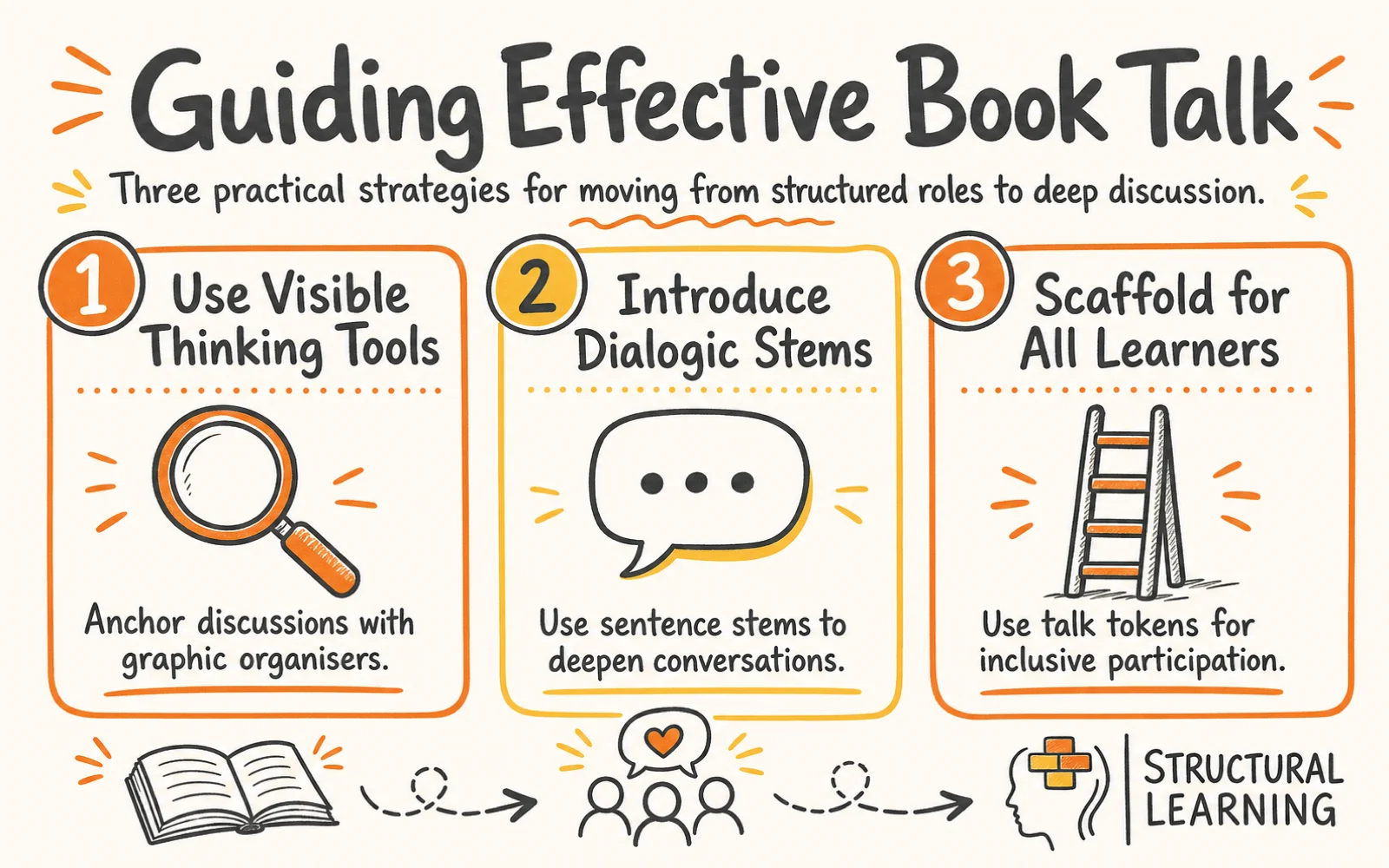
Visible thinking tools, such as graphic organisers, anchor abstract reading concepts and make group thinking explicit.
Scaffolded oracy frameworks, including sentence stems and talk tokens, ensure SEND and EAL learners participate meaningfully.
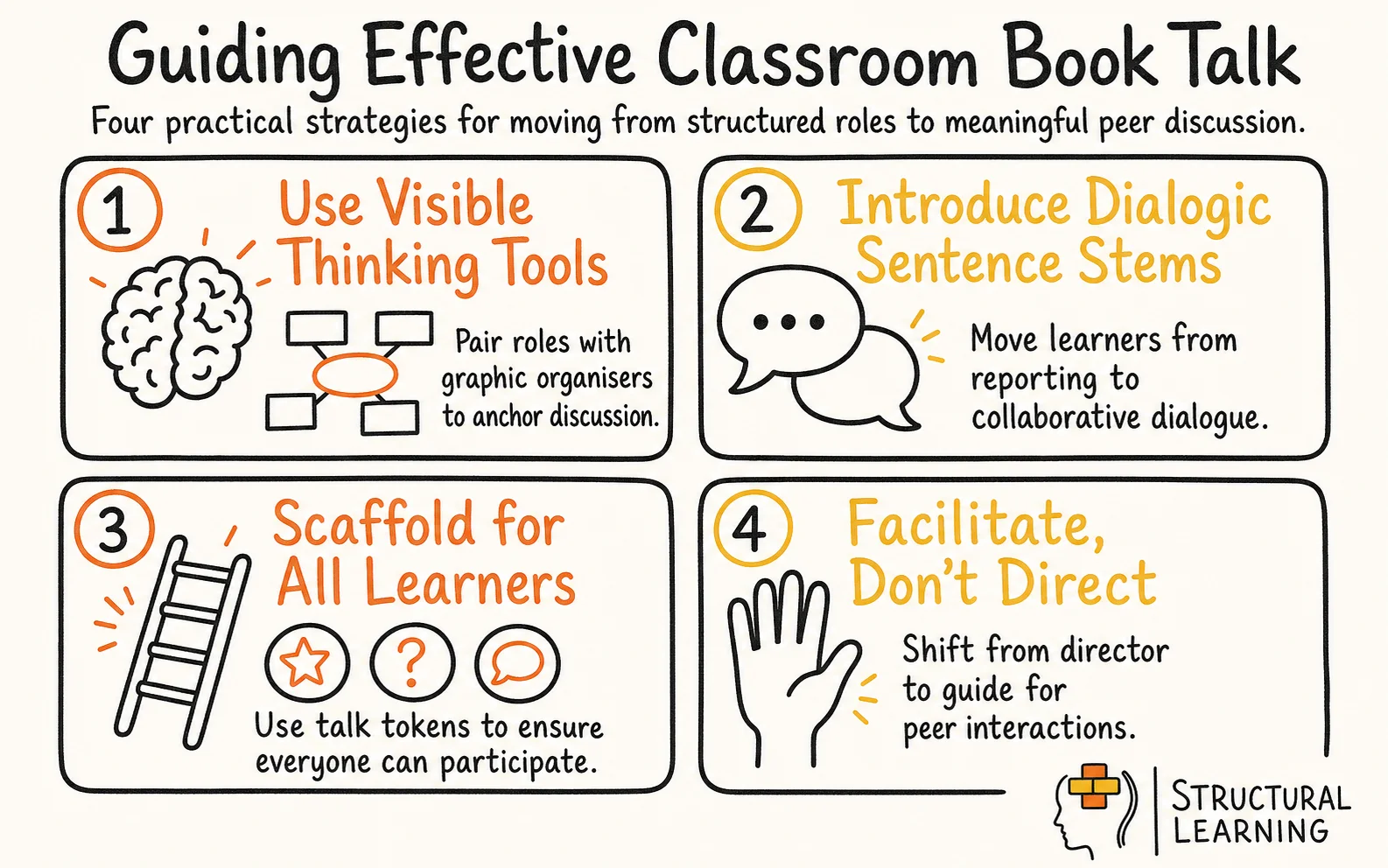
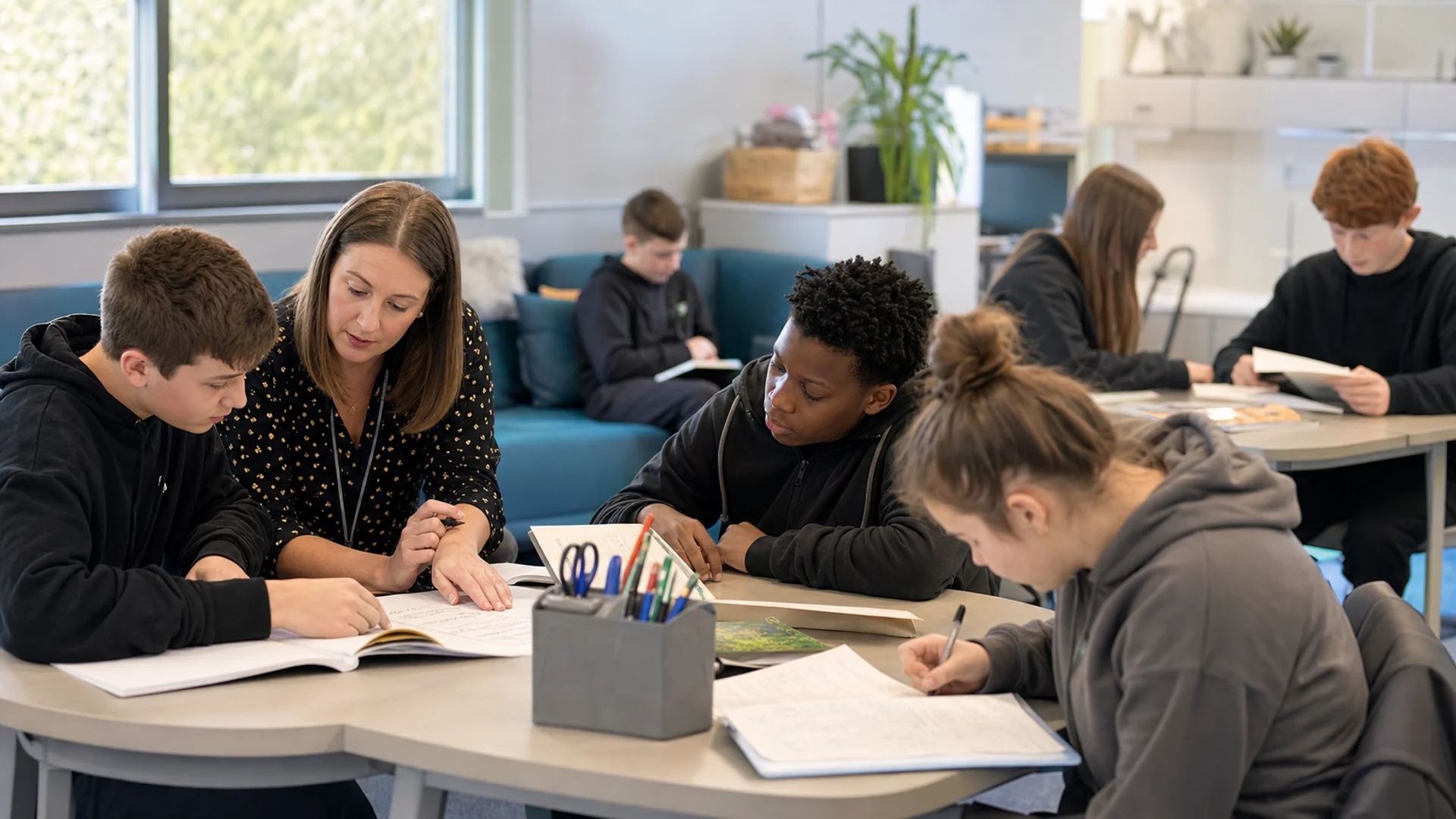
The teacher's role shifts from director to facilitator, monitoring and gently guiding peer interactions.
What Are Literature Circles?
Literature circles are small, peer-led discussion groups where learners gather to discuss a shared text. The purpose is to allow pupils to take ownership of their reading, collaboratively constructing meaning rather than passively receiving an interpretation from the teacher. Harvey Daniels (1994) formalised the concept, initially structuring these groups around roles such as 'Questioner', 'Summariser', and 'Word Master'. These roles act as cognitive training wheels, giving each learner a specific lens through which to analyse the text before sharing their findings.
The practice is rooted in reader-response theory. Louise Rosenblatt (1978) argued that reading is a transaction between the reader and the text, where meaning is created at the intersection of the two. Literature circles capitalise on this by making the reading experience social. When pupils bring their individual transactions to the group, they negotiate a broader, shared understanding of the narrative. This social interaction transforms reading from an isolated decoding exercise into an active, analytical process.
Classroom practice has shifted from rigid adherence to predefined roles towards authentic 'book talk'. While roles provide structure for novices, the ultimate goal is fluid, dialogic engagement. Robin Alexander (2008) highlights the importance of dialogic teaching, where talk is used to stimulate and extend pupils' thinking. In a mature literature circle, learners move beyond reporting their role-based findings; they challenge ideas, build upon each other's points, and engage in exploratory talk (Mercer, 2000) to interrogate the text.
Example: The teacher models how to move beyond simple summarising. The teacher asks, "Instead of just telling us what happened, can you explain why the character made that choice, and how it impacted the other characters?" Pupils then practise this deeper analysis in their groups.
Why Book Talk Matters for Teachers
Classroom reading discussion groups are not simply an alternative to silent reading. They are a mechanism for developing higher-order comprehension and critical thinking. When pupils engage in structured book talk, they articulate their thoughts, defend their interpretations with evidence, and consider alternative viewpoints. This aligns with cognitive science principles regarding schema construction. As learners articulate their understanding, they organise new information and integrate it with their existing knowledge structures.
The shift towards dialogic teaching in reading is supported by evidence. Alexander (2008) demonstrates that classrooms prioritising dialogic interactions see gains in reading comprehension and cognitive development. When teachers replace recitation scripts with exploratory peer talk, pupils learn to reason collaboratively. Mercer (2000) emphasises that this type of talk makes reasoning visible, allowing learners to hear how their peers arrive at conclusions and internalise those cognitive processes.
Literature circles also address the affective domain of reading. By giving pupils autonomy over their discussion, teachers increase reading motivation and engagement. When learners feel their interpretations are valued, they are more likely to tackle challenging texts. The social accountability inherent in a small group also encourages consistent reading habits. Instead of reading for a teacher-led test, pupils read to participate in a shared social experience.
Example: The teacher observes that pupils are more enthusiastic about reading when they know they will be discussing the book with their friends. The teacher notes increased completion rates for assigned reading.
Book Talk in the Classroom
Transitioning from traditional reading groups to effective literature circles requires explicit instruction in oracy and collaborative thinking. Teachers must model how to discuss texts before expecting pupils to do so independently.
Strategy 1: Visible Thinking and Structured Roles
In early stages, pupils need scaffolding to manage both the cognitive load of reading and the social dynamics of a group. Teachers can pair traditional literature circle roles with visible thinking routines to anchor the discussion.
The teacher introduces the 'Connector' role using a Double Bubble Map. The teacher explains that the Connector's job is to find links between the text and their own experiences or other books. The teacher models this by reading a passage aloud and filling in a Double Bubble Map on the board, placing the protagonist's emotional journey in one bubble and a personal experience in the other, writing shared emotions in the connecting bubbles.
During the literature circle, Year 4 pupils use their own Double Bubble Maps to prepare for the discussion. A pupil acting as the Connector shares their map, explaining how the main character's anxiety about moving school is similar to how they felt joining a new sports club. The rest of the group uses this visual anchor to add their own connections, moving the conversation from a basic summary to a discussion of universal themes. The graphic organiser prevents the discussion from drifting and ensures the connection remains rooted in the text.
Example: Pupils produce completed Double Bubble Maps showing connections between the text and their own lives. The teacher observes that the maps provide a concrete starting point for discussion.
Strategy 2: Transitioning to Dialogic Book Talk
As learners become comfortable with basic roles, teachers must deliberately remove these scaffolds to encourage natural, exploratory talk. Rigid worksheets can stifle genuine conversation. The goal is to move from 'reporting' to 'dialoguing'.
The teacher introduces dialogic sentence stems designed to provoke deeper interaction. Instead of assigning roles like 'Summariser', the teacher provides cards with prompts such as "I want to challenge that idea because..." and "Building on what you said, I also noticed...". The teacher models a Socratic seminar approach, showing how a statement is not an endpoint but a starting point. The teacher praises pupils who respectfully disagree and provide text-based evidence to support their counter-claims.
In a Year 8 group discussing a dystopian novel, pupils abandon their previous role sheets. One pupil suggests the antagonist is purely evil. Another uses a 'Challenge' stem: "I want to challenge that idea because in chapter four, he shows regret when the child is injured." A third uses a 'Build' stem: "Building on what you said, maybe the author is showing that the system makes people cruel, rather than them being born that way." The teacher, observing from the perimeter, notes the shift from recalling facts to synthesising complex themes.
Example: Pupils use sentence stems to challenge and build upon each other's ideas. The teacher records the frequency of stem usage as a measure of dialogic engagement.
Strategy 3: Scaffolding for SEND and EAL
Literature circles rely heavily on verbal communication, which can present barriers for pupils with Special Educational Needs and Disabilities (SEND) or those with English as an Additional Language (EAL). Teachers must provide alternative access points to ensure these learners can participate in knowledge construction without overwhelming cognitive load.
The teacher identifies that a non-verbal pupil or a learner with severe language processing difficulties struggles to interject in fast-paced group discussions. The teacher introduces 'Talk Tokens' for the group. These are physical cards with visual symbols representing 'Agree', 'Disagree', 'Question', and 'Evidence'. The teacher models how to use these tokens silently to participate in the flow of conversation, establishing a rule that when a token is played, the group must pause and address it.
During the discussion, the group is debating a character's motive. The pupil with SEND places a 'Disagree' token on the table. The group immediately stops. A peer asks, "Do you disagree with my point about his choice?" The pupil nods. Another peer asks, "Can you point to the paragraph that made you think differently?" The pupil points to a specific highlighted section in the text. The group then reads that section aloud and adjusts their interpretation based on the pupil's contribution. The visual scaffold allows the learner to direct the cognitive work of the group without requiring complex expressive language.
Example: The pupil with SEND uses talk tokens to participate in the discussion. The teacher observes and records the pupil's contributions based on the tokens used.
Literature Circles Evolution: From Structured Roles to Fluid Book Talk
Common Misconceptions
Many teachers implement literature circles but fail to see the promised gains in comprehension because of misunderstandings about how these groups function.
A primary misconception is that completing the role worksheet equates to a successful literature circle. Teachers often grade the worksheet rather than the quality of the discussion. However, worksheets are merely preparation tools. If pupils simply read their worksheets aloud and then move on, no collaborative meaning-making has occurred. The learning happens in the responsive space between pupils, not in the isolated completion of a graphic organiser.
Another misconception is that pupils naturally know how to have an academic discussion. Teachers sometimes group pupils, assign a text, and expect deep analysis to occur spontaneously. Without explicit teaching of oracy skills, active listening, and how to disagree respectfully, groups quickly devolve into off-task behaviour or domination by a single confident speaker. Dialogic talk must be taught as rigorously as decoding.
A third error is assuming that struggling readers need easier texts to participate in literature circles. While independent reading levels matter, the power of a heterogeneous discussion group is that strong readers can model comprehension strategies for their peers. If texts are simplified too much, there is nothing complex enough to warrant a discussion. Teachers should provide struggling readers with audiobooks or pre-read the text with them, allowing them to access the complex ideas necessary for participation.
Finally, teachers often believe they must direct every conversation to ensure pupils do not develop incorrect interpretations. When teachers constantly intervene to correct or guide the narrative, pupils learn to look to the adult for validation rather than negotiating meaning with their peers. Teachers must tolerate some productive struggle and allow groups the space to self-correct through continued reading and discussion.
Example: The teacher observes a group struggling with a complex theme. Instead of directly explaining it, the teacher asks, "What evidence in the text supports your current understanding?" This prompts the group to revisit the text and refine their interpretation.
Practical Implementation Guide
Launching effective book talk requires careful planning and a phased rollout. You cannot introduce the text, the roles, and the social expectations all in one lesson.
Step 1: Choose rich, ambiguous texts. Select books, articles, or short stories that feature moral dilemmas, complex characters, or multiple perspectives. If a text has a single, obvious interpretation, there is nothing for the group to discuss.
Step 2: Explicitly teach oracy and discussion norms. Before introducing roles, spend a week practising how to talk. Use non-academic prompts (like "Should school uniform be banned?") to teach active listening, turn-taking, and how to use sentence stems to build on or challenge an idea. Create a visible class charter for discussion behaviour.
Step 3: Introduce preparation scaffolds gradually. Introduce one literature circle role or thinking routine at a time. Model the 'Questioner' role explicitly, distinguishing between literal recall questions and deep, inferential questions. Have the whole class practise generating questions for a shared read-aloud before expecting them to do it independently.
Step 4: Form dynamic groups. Create groups of four to five pupils. While heterogeneous grouping exposes weaker readers to complex thinking, occasionally grouping by specific interest or reading level can allow for targeted interventions. Ensure every group has a clear protocol for what to do if they finish early or encounter a dispute.
Step 5: Shift to observation. Once groups are running, your job is to observe, not to lead. Carry a clipboard and track the types of talk occurring (e.g. reporting, agreeing, challenging, synthesising). Only intervene if the group dynamics break down completely or if you need to inject a challenging question to elevate a stalled discussion.
Worked Example: A Year 5 teacher wants to start literature circles using a historical fiction novel. In week one, the teacher uses a short story read aloud to the whole class, modelling how to use a 'Summariser' and 'Questioner' framework. In week two, the class is divided into groups of four. They read chapter one independently. Before the discussion, the teacher provides ten minutes of silent preparation time for pupils to complete their specific role notes. During the 15-minute discussion, the teacher circulates, noting that Group A is just reading their notes aloud. The teacher pauses Group A and says, "You have shared great facts. Now, put your papers face down. What is the most confusing thing the main character did in this chapter?" The teacher stays just long enough to ensure the conversation restarts as a dialogue, then steps away.
Example: The teacher uses an observation checklist to track the frequency of different types of talk (e.g., summarising, questioning, challenging) within each group. This data informs future instruction on oracy skills.
Book Talk Across Subjects
While literature circles are traditionally associated with English lessons, the principles of peer-led, text-based discussion are effective across the curriculum. The goal remains the same: using structured talk to process complex information collaboratively.
Book Talk in Maths
In mathematics, book talk strategies help pupils decode complex word problems and articulate mathematical reasoning. The focus shifts from the narrative to the logical structure of the problem.
The teacher presents a complex, multi-step word problem to groups of four. Instead of literature roles, the teacher assigns analytical roles: the 'Visualiser' draws a diagram of the problem, the 'Estimator' predicts a reasonable answer range, the 'Vocabulary Checker' identifies key mathematical terms, and the 'Strategist' suggests the first operation to perform.
The pupils read the problem silently. The Vocabulary Checker clarifies that 'product' means they need to multiply. The Visualiser shares a bar model representing the quantities. The Strategist proposes a sequence of calculations based on the visual model. The group discusses the proposed strategy, referencing the visual model to ensure it aligns with the original text of the word problem. The teacher observes how the structured talk prevents pupils from rushing to a calculation without fully comprehending the parameters of the problem.
Example: The pupils produce a shared solution to the word problem, annotated with explanations of each step and justifications for their choices. The teacher assesses the clarity and accuracy of their reasoning.
Book Talk in Science
In science, discussion groups are vital for analysing non-fiction texts, scientific articles, or experimental procedures. The focus is on evaluating evidence and understanding cause and effect.
The teacher assigns a short article about the environmental impact of microplastics. The teacher provides sentence stems specifically geared towards scientific evaluation: "The evidence suggests that...", "A variable they didn't consider is...", and "This conclusion is supported by...".
The Year 9 pupils read the article and prepare their thoughts. During the discussion, one pupil notes the alarming statistics about ocean pollution. Another pupil uses a stem: "The evidence suggests that the primary source is washing synthetic clothing. But a variable they didn't consider is the impact of industrial waste." The group begins debating the validity of the article's claims, moving beyond simply recalling facts to evaluating the strength of the scientific argument presented.
Example: Pupils produce a summary of the article, including a critical evaluation of the evidence presented and suggestions for further research. The teacher assesses their understanding of scientific methodology.
Book Talk in History
Historical analysis requires pupils to navigate bias, perspective, and conflicting accounts. Literature circle structures can manage the cognitive load of evaluating multiple primary sources.
The teacher provides three conflicting primary source accounts of a historical event. The groups are tasked with determining the most reliable narrative. Roles are adapted for historical inquiry: the 'Contextualiser' examines the background of the authors, the 'Corroborator' looks for details that match across the texts, and the 'Sceptic' identifies inconsistencies or obvious biases.
The group analyses the texts. The Sceptic points out that Source A was written by someone paid by the monarch, suggesting heavy bias. The Corroborator notes that both Source B and C mention the same specific weather conditions on the day of the event, making that detail highly reliable. Through structured, role-based discussion, the pupils synthesize a nuanced understanding of the event, learning that history is an interpretation of evidence rather than a single fixed narrative.
Example: The pupils produce a written report comparing and contrasting the three primary source accounts, explaining which sources they found most reliable and why. The teacher assesses their ability to analyse historical evidence and identify bias.
Teacher Facilitation Toolkit: Scaffolds That Support Deep Discussion
Common Questions About Literature Circles
How do I assess pupils during literature circles?
Assess the process, not just the product. Use observation checklists to track who is participating, the quality of their questions, and their ability to build on others' ideas. You can also ask pupils to complete a brief self-reflection or peer-evaluation after the discussion to gauge group dynamics.
What do I do with pupils who refuse to read the text?
Do not let one pupil derail the group. If a pupil arrives unprepared, they cannot participate in the main circle. Have a designated 'catch-up' area where they must sit and read the text. Once they have finished the reading, they can rejoin their group as an active listener, but they lose the privilege of leading that day's discussion.
How much time should a literature circle take?
Timing depends on the age and stamina of the pupils. For younger or less experienced groups, 10 to 15 minutes of focused discussion is sufficient. As pupils become more skilled in dialogic talk, discussions can easily sustain 30 to 40 minutes of independent engagement.
Should I assign the texts or let pupils choose?
Choice increases motivation. Whenever possible, provide a selection of four or five appropriate texts and allow pupils to rank their preferences. Form groups based on these choices. If teaching a whole-class novel, you can still use the circle format by breaking the class into smaller groups to discuss specific chapters or themes.
How often should we do reading discussion groups?
Consistency is key to building the necessary social and academic habits. Aim for at least one dedicated book talk session per week. In a dedicated reading unit, you might run preparation and reading sessions on Mondays and Tuesdays, with the formal group discussions occurring on Thursdays.
What if a group finishes their discussion very quickly?
Groups finish quickly when they are merely reporting facts rather than exploring ideas. Provide 'emergency prompts' on the board, such as "If the author changed the setting to our school, how would the story change?" Alternatively, teach the group how to use 'Challenge' sentence stems to interrogate the facts they have just shared.
Introduce one structured talk protocol tomorrow.
Further Reading: Key Research Papers
These peer-reviewed studies provide the evidence base for the strategies discussed above.
Why Did All the Residents Resign? Key Takeaways From the Junior Physicians' Mass Walkout in South Korea.View study ↗ 23 citations
Park et al. (2024)
This paper examines the mass resignation of junior physicians in South Korea. Whilst not directly education-focused, it offers insights into professional burnout and workplace conditions that teachers may relate to, particularly regarding staff retention and institutional support systems.
Cultivating connectedness and elevating educational experiences for international students in blended learning: reflections from the pandemic era and key takeawaysView study ↗
He et al. (2024)
This study explores how videoconferencing enhances blended learning for international students during the pandemic. Teachers can apply these findings to improve online engagement strategies, foster student connections in mixed learning environments, and better support diverse learners through technology integration.
Who Benefits and under What Conditions from Developmental Education Reform? Key Takeaways from Florida’s Statewide InitiativeView study ↗
Mokher et al. (2023)
This research analyses Florida's developmental education reform outcomes. Teachers working with struggling students can benefit from understanding which interventions work best for different student populations and under what conditions remedial education programmes achieve success.
Why are some students “not into” computational thinking activities embedded within high school science units? Key takeaways from a microethnographic discourse analysis studyView study ↗
Aslan et al. (2024)
This study examines why some students resist computational thinking activities in science classes through detailed classroom observation. Teachers can use these insights to better understand student engagement barriers and adapt their approach to make STEM activities more inclusive and appealing.
Establishing a distance PharmD program: An overview and key takeaways.View study ↗
Rao et al. (2025)
This paper outlines the establishment of distance pharmacy education programmes. Teachers in higher education can extract valuable lessons about designing effective online curricula, maintaining programme quality remotely, and adapting professional training for digital delivery methods.
Literature Circles Unpacked: From Reader-Response Theory to Classroom Practice
Key Takeaways
Literature circles are peer-led reading discussion groups where learners construct meaning collaboratively through structured talk.
Assigned roles provide an initial scaffold but should eventually give way to fluid, natural book talk.
Dialogic teaching principles turn superficial task completion into deep, exploratory conversations that build cognitive schema.
Visible thinking tools, such as graphic organisers, anchor abstract reading concepts and make group thinking explicit.
Scaffolded oracy frameworks, including sentence stems and talk tokens, ensure SEND and EAL learners participate meaningfully.
The teacher's role shifts from director to facilitator, monitoring and gently guiding peer interactions.
What Are Literature Circles?
Literature circles are small, peer-led discussion groups where learners gather to discuss a shared text. The purpose is to allow pupils to take ownership of their reading, collaboratively constructing meaning rather than passively receiving an interpretation from the teacher. Harvey Daniels (1994) formalised the concept, initially structuring these groups around roles such as 'Questioner', 'Summariser', and 'Word Master'. These roles act as cognitive training wheels, giving each learner a specific lens through which to analyse the text before sharing their findings.
The practice is rooted in reader-response theory. Louise Rosenblatt (1978) argued that reading is a transaction between the reader and the text, where meaning is created at the intersection of the two. Literature circles capitalise on this by making the reading experience social. When pupils bring their individual transactions to the group, they negotiate a broader, shared understanding of the narrative. This social interaction transforms reading from an isolated decoding exercise into an active, analytical process.
Classroom practice has shifted from rigid adherence to predefined roles towards authentic 'book talk'. While roles provide structure for novices, the ultimate goal is fluid, dialogic engagement. Robin Alexander (2008) highlights the importance of dialogic teaching, where talk is used to stimulate and extend pupils' thinking. In a mature literature circle, learners move beyond reporting their role-based findings; they challenge ideas, build upon each other's points, and engage in exploratory talk (Mercer, 2000) to interrogate the text.
Example: The teacher models how to move beyond simple summarising. The teacher asks, "Instead of just telling us what happened, can you explain why the character made that choice, and how it impacted the other characters?" Pupils then practise this deeper analysis in their groups.
Why Book Talk Matters for Teachers
Classroom reading discussion groups are not simply an alternative to silent reading. They are a mechanism for developing higher-order comprehension and critical thinking. When pupils engage in structured book talk, they articulate their thoughts, defend their interpretations with evidence, and consider alternative viewpoints. This aligns with cognitive science principles regarding schema construction. As learners articulate their understanding, they organise new information and integrate it with their existing knowledge structures.
The shift towards dialogic teaching in reading is supported by evidence. Alexander (2008) demonstrates that classrooms prioritising dialogic interactions see gains in reading comprehension and cognitive development. When teachers replace recitation scripts with exploratory peer talk, pupils learn to reason collaboratively. Mercer (2000) emphasises that this type of talk makes reasoning visible, allowing learners to hear how their peers arrive at conclusions and internalise those cognitive processes.
Literature circles also address the affective domain of reading. By giving pupils autonomy over their discussion, teachers increase reading motivation and engagement. When learners feel their interpretations are valued, they are more likely to tackle challenging texts. The social accountability inherent in a small group also encourages consistent reading habits. Instead of reading for a teacher-led test, pupils read to participate in a shared social experience.
Example: The teacher observes that pupils are more enthusiastic about reading when they know they will be discussing the book with their friends. The teacher notes increased completion rates for assigned reading.
Book Talk in the Classroom
Transitioning from traditional reading groups to effective literature circles requires explicit instruction in oracy and collaborative thinking. Teachers must model how to discuss texts before expecting pupils to do so independently.
Strategy 1: Visible Thinking and Structured Roles
In early stages, pupils need scaffolding to manage both the cognitive load of reading and the social dynamics of a group. Teachers can pair traditional literature circle roles with visible thinking routines to anchor the discussion.
The teacher introduces the 'Connector' role using a Double Bubble Map. The teacher explains that the Connector's job is to find links between the text and their own experiences or other books. The teacher models this by reading a passage aloud and filling in a Double Bubble Map on the board, placing the protagonist's emotional journey in one bubble and a personal experience in the other, writing shared emotions in the connecting bubbles.
During the literature circle, Year 4 pupils use their own Double Bubble Maps to prepare for the discussion. A pupil acting as the Connector shares their map, explaining how the main character's anxiety about moving school is similar to how they felt joining a new sports club. The rest of the group uses this visual anchor to add their own connections, moving the conversation from a basic summary to a discussion of universal themes. The graphic organiser prevents the discussion from drifting and ensures the connection remains rooted in the text.
Example: Pupils produce completed Double Bubble Maps showing connections between the text and their own lives. The teacher observes that the maps provide a concrete starting point for discussion.
Strategy 2: Transitioning to Dialogic Book Talk
As learners become comfortable with basic roles, teachers must deliberately remove these scaffolds to encourage natural, exploratory talk. Rigid worksheets can stifle genuine conversation. The goal is to move from 'reporting' to 'dialoguing'.
The teacher introduces dialogic sentence stems designed to provoke deeper interaction. Instead of assigning roles like 'Summariser', the teacher provides cards with prompts such as "I want to challenge that idea because..." and "Building on what you said, I also noticed...". The teacher models a Socratic seminar approach, showing how a statement is not an endpoint but a starting point. The teacher praises pupils who respectfully disagree and provide text-based evidence to support their counter-claims.
In a Year 8 group discussing a dystopian novel, pupils abandon their previous role sheets. One pupil suggests the antagonist is purely evil. Another uses a 'Challenge' stem: "I want to challenge that idea because in chapter four, he shows regret when the child is injured." A third uses a 'Build' stem: "Building on what you said, maybe the author is showing that the system makes people cruel, rather than them being born that way." The teacher, observing from the perimeter, notes the shift from recalling facts to synthesising complex themes.
Example: Pupils use sentence stems to challenge and build upon each other's ideas. The teacher records the frequency of stem usage as a measure of dialogic engagement.
Strategy 3: Scaffolding for SEND and EAL
Literature circles rely heavily on verbal communication, which can present barriers for pupils with Special Educational Needs and Disabilities (SEND) or those with English as an Additional Language (EAL). Teachers must provide alternative access points to ensure these learners can participate in knowledge construction without overwhelming cognitive load.
The teacher identifies that a non-verbal pupil or a learner with severe language processing difficulties struggles to interject in fast-paced group discussions. The teacher introduces 'Talk Tokens' for the group. These are physical cards with visual symbols representing 'Agree', 'Disagree', 'Question', and 'Evidence'. The teacher models how to use these tokens silently to participate in the flow of conversation, establishing a rule that when a token is played, the group must pause and address it.
During the discussion, the group is debating a character's motive. The pupil with SEND places a 'Disagree' token on the table. The group immediately stops. A peer asks, "Do you disagree with my point about his choice?" The pupil nods. Another peer asks, "Can you point to the paragraph that made you think differently?" The pupil points to a specific highlighted section in the text. The group then reads that section aloud and adjusts their interpretation based on the pupil's contribution. The visual scaffold allows the learner to direct the cognitive work of the group without requiring complex expressive language.
Example: The pupil with SEND uses talk tokens to participate in the discussion. The teacher observes and records the pupil's contributions based on the tokens used.
Literature Circles Evolution: From Structured Roles to Fluid Book Talk
Common Misconceptions
Many teachers implement literature circles but fail to see the promised gains in comprehension because of misunderstandings about how these groups function.
A primary misconception is that completing the role worksheet equates to a successful literature circle. Teachers often grade the worksheet rather than the quality of the discussion. However, worksheets are merely preparation tools. If pupils simply read their worksheets aloud and then move on, no collaborative meaning-making has occurred. The learning happens in the responsive space between pupils, not in the isolated completion of a graphic organiser.
Another misconception is that pupils naturally know how to have an academic discussion. Teachers sometimes group pupils, assign a text, and expect deep analysis to occur spontaneously. Without explicit teaching of oracy skills, active listening, and how to disagree respectfully, groups quickly devolve into off-task behaviour or domination by a single confident speaker. Dialogic talk must be taught as rigorously as decoding.
A third error is assuming that struggling readers need easier texts to participate in literature circles. While independent reading levels matter, the power of a heterogeneous discussion group is that strong readers can model comprehension strategies for their peers. If texts are simplified too much, there is nothing complex enough to warrant a discussion. Teachers should provide struggling readers with audiobooks or pre-read the text with them, allowing them to access the complex ideas necessary for participation.
Finally, teachers often believe they must direct every conversation to ensure pupils do not develop incorrect interpretations. When teachers constantly intervene to correct or guide the narrative, pupils learn to look to the adult for validation rather than negotiating meaning with their peers. Teachers must tolerate some productive struggle and allow groups the space to self-correct through continued reading and discussion.
Example: The teacher observes a group struggling with a complex theme. Instead of directly explaining it, the teacher asks, "What evidence in the text supports your current understanding?" This prompts the group to revisit the text and refine their interpretation.
Practical Implementation Guide
Launching effective book talk requires careful planning and a phased rollout. You cannot introduce the text, the roles, and the social expectations all in one lesson.
Step 1: Choose rich, ambiguous texts. Select books, articles, or short stories that feature moral dilemmas, complex characters, or multiple perspectives. If a text has a single, obvious interpretation, there is nothing for the group to discuss.
Step 2: Explicitly teach oracy and discussion norms. Before introducing roles, spend a week practising how to talk. Use non-academic prompts (like "Should school uniform be banned?") to teach active listening, turn-taking, and how to use sentence stems to build on or challenge an idea. Create a visible class charter for discussion behaviour.
Step 3: Introduce preparation scaffolds gradually. Introduce one literature circle role or thinking routine at a time. Model the 'Questioner' role explicitly, distinguishing between literal recall questions and deep, inferential questions. Have the whole class practise generating questions for a shared read-aloud before expecting them to do it independently.
Step 4: Form dynamic groups. Create groups of four to five pupils. While heterogeneous grouping exposes weaker readers to complex thinking, occasionally grouping by specific interest or reading level can allow for targeted interventions. Ensure every group has a clear protocol for what to do if they finish early or encounter a dispute.
Step 5: Shift to observation. Once groups are running, your job is to observe, not to lead. Carry a clipboard and track the types of talk occurring (e.g. reporting, agreeing, challenging, synthesising). Only intervene if the group dynamics break down completely or if you need to inject a challenging question to elevate a stalled discussion.
Worked Example: A Year 5 teacher wants to start literature circles using a historical fiction novel. In week one, the teacher uses a short story read aloud to the whole class, modelling how to use a 'Summariser' and 'Questioner' framework. In week two, the class is divided into groups of four. They read chapter one independently. Before the discussion, the teacher provides ten minutes of silent preparation time for pupils to complete their specific role notes. During the 15-minute discussion, the teacher circulates, noting that Group A is just reading their notes aloud. The teacher pauses Group A and says, "You have shared great facts. Now, put your papers face down. What is the most confusing thing the main character did in this chapter?" The teacher stays just long enough to ensure the conversation restarts as a dialogue, then steps away.
Example: The teacher uses an observation checklist to track the frequency of different types of talk (e.g., summarising, questioning, challenging) within each group. This data informs future instruction on oracy skills.
Book Talk Across Subjects
While literature circles are traditionally associated with English lessons, the principles of peer-led, text-based discussion are effective across the curriculum. The goal remains the same: using structured talk to process complex information collaboratively.
Book Talk in Maths
In mathematics, book talk strategies help pupils decode complex word problems and articulate mathematical reasoning. The focus shifts from the narrative to the logical structure of the problem.
The teacher presents a complex, multi-step word problem to groups of four. Instead of literature roles, the teacher assigns analytical roles: the 'Visualiser' draws a diagram of the problem, the 'Estimator' predicts a reasonable answer range, the 'Vocabulary Checker' identifies key mathematical terms, and the 'Strategist' suggests the first operation to perform.
The pupils read the problem silently. The Vocabulary Checker clarifies that 'product' means they need to multiply. The Visualiser shares a bar model representing the quantities. The Strategist proposes a sequence of calculations based on the visual model. The group discusses the proposed strategy, referencing the visual model to ensure it aligns with the original text of the word problem. The teacher observes how the structured talk prevents pupils from rushing to a calculation without fully comprehending the parameters of the problem.
Example: The pupils produce a shared solution to the word problem, annotated with explanations of each step and justifications for their choices. The teacher assesses the clarity and accuracy of their reasoning.
Book Talk in Science
In science, discussion groups are vital for analysing non-fiction texts, scientific articles, or experimental procedures. The focus is on evaluating evidence and understanding cause and effect.
The teacher assigns a short article about the environmental impact of microplastics. The teacher provides sentence stems specifically geared towards scientific evaluation: "The evidence suggests that...", "A variable they didn't consider is...", and "This conclusion is supported by...".
The Year 9 pupils read the article and prepare their thoughts. During the discussion, one pupil notes the alarming statistics about ocean pollution. Another pupil uses a stem: "The evidence suggests that the primary source is washing synthetic clothing. But a variable they didn't consider is the impact of industrial waste." The group begins debating the validity of the article's claims, moving beyond simply recalling facts to evaluating the strength of the scientific argument presented.
Example: Pupils produce a summary of the article, including a critical evaluation of the evidence presented and suggestions for further research. The teacher assesses their understanding of scientific methodology.
Book Talk in History
Historical analysis requires pupils to navigate bias, perspective, and conflicting accounts. Literature circle structures can manage the cognitive load of evaluating multiple primary sources.
The teacher provides three conflicting primary source accounts of a historical event. The groups are tasked with determining the most reliable narrative. Roles are adapted for historical inquiry: the 'Contextualiser' examines the background of the authors, the 'Corroborator' looks for details that match across the texts, and the 'Sceptic' identifies inconsistencies or obvious biases.
The group analyses the texts. The Sceptic points out that Source A was written by someone paid by the monarch, suggesting heavy bias. The Corroborator notes that both Source B and C mention the same specific weather conditions on the day of the event, making that detail highly reliable. Through structured, role-based discussion, the pupils synthesize a nuanced understanding of the event, learning that history is an interpretation of evidence rather than a single fixed narrative.
Example: The pupils produce a written report comparing and contrasting the three primary source accounts, explaining which sources they found most reliable and why. The teacher assesses their ability to analyse historical evidence and identify bias.
Teacher Facilitation Toolkit: Scaffolds That Support Deep Discussion
Common Questions About Literature Circles
How do I assess pupils during literature circles?
Assess the process, not just the product. Use observation checklists to track who is participating, the quality of their questions, and their ability to build on others' ideas. You can also ask pupils to complete a brief self-reflection or peer-evaluation after the discussion to gauge group dynamics.
What do I do with pupils who refuse to read the text?
Do not let one pupil derail the group. If a pupil arrives unprepared, they cannot participate in the main circle. Have a designated 'catch-up' area where they must sit and read the text. Once they have finished the reading, they can rejoin their group as an active listener, but they lose the privilege of leading that day's discussion.
How much time should a literature circle take?
Timing depends on the age and stamina of the pupils. For younger or less experienced groups, 10 to 15 minutes of focused discussion is sufficient. As pupils become more skilled in dialogic talk, discussions can easily sustain 30 to 40 minutes of independent engagement.
Should I assign the texts or let pupils choose?
Choice increases motivation. Whenever possible, provide a selection of four or five appropriate texts and allow pupils to rank their preferences. Form groups based on these choices. If teaching a whole-class novel, you can still use the circle format by breaking the class into smaller groups to discuss specific chapters or themes.
How often should we do reading discussion groups?
Consistency is key to building the necessary social and academic habits. Aim for at least one dedicated book talk session per week. In a dedicated reading unit, you might run preparation and reading sessions on Mondays and Tuesdays, with the formal group discussions occurring on Thursdays.
What if a group finishes their discussion very quickly?
Groups finish quickly when they are merely reporting facts rather than exploring ideas. Provide 'emergency prompts' on the board, such as "If the author changed the setting to our school, how would the story change?" Alternatively, teach the group how to use 'Challenge' sentence stems to interrogate the facts they have just shared.
Introduce one structured talk protocol tomorrow.
Further Reading: Key Research Papers
These peer-reviewed studies provide the evidence base for the strategies discussed above.
Why Did All the Residents Resign? Key Takeaways From the Junior Physicians' Mass Walkout in South Korea.View study ↗ 23 citations
Park et al. (2024)
This paper examines the mass resignation of junior physicians in South Korea. Whilst not directly education-focused, it offers insights into professional burnout and workplace conditions that teachers may relate to, particularly regarding staff retention and institutional support systems.
Cultivating connectedness and elevating educational experiences for international students in blended learning: reflections from the pandemic era and key takeawaysView study ↗
He et al. (2024)
This study explores how videoconferencing enhances blended learning for international students during the pandemic. Teachers can apply these findings to improve online engagement strategies, foster student connections in mixed learning environments, and better support diverse learners through technology integration.
Who Benefits and under What Conditions from Developmental Education Reform? Key Takeaways from Florida’s Statewide InitiativeView study ↗
Mokher et al. (2023)
This research analyses Florida's developmental education reform outcomes. Teachers working with struggling students can benefit from understanding which interventions work best for different student populations and under what conditions remedial education programmes achieve success.
Why are some students “not into” computational thinking activities embedded within high school science units? Key takeaways from a microethnographic discourse analysis studyView study ↗
Aslan et al. (2024)
This study examines why some students resist computational thinking activities in science classes through detailed classroom observation. Teachers can use these insights to better understand student engagement barriers and adapt their approach to make STEM activities more inclusive and appealing.
Establishing a distance PharmD program: An overview and key takeaways.View study ↗
Rao et al. (2025)
This paper outlines the establishment of distance pharmacy education programmes. Teachers in higher education can extract valuable lessons about designing effective online curricula, maintaining programme quality remotely, and adapting professional training for digital delivery methods.
{"@context":"https://schema.org","@graph":[{"@type":"Organization","@id":"https://www.structural-learning.com/#org","name":"Structural Learning","url":"https://www.structural-learning.com/","logo":{"@type":"ImageObject","url":"https://cdn.prod.website-files.com/5b69a01ba2e409501de055d1/5b69a01ba2e40996a5e055f4_structural-learning-logo.png"}},{"@type":"Person","@id":"https://www.structural-learning.com/team/paul-main/#person","name":"Paul Main","url":"https://www.structural-learning.com/team/paul-main","jobTitle":"Founder","affiliation":{"@id":"https://www.structural-learning.com/#org"}},{"@type":"BreadcrumbList","@id":"https://www.structural-learning.com/post/literature-circles-book-talk-teachers-guide#breadcrumb","itemListElement":[{"@type":"ListItem","position":1,"name":"Home","item":"https://www.structural-learning.com/"},{"@type":"ListItem","position":2,"name":"Blog","item":"https://www.structural-learning.com/blog"},{"@type":"ListItem","position":3,"name":"Literature Circles & Book Talk: A Teacher's Guide","item":"https://www.structural-learning.com/post/literature-circles-book-talk-teachers-guide"}]},{"@type":"BlogPosting","@id":"https://www.structural-learning.com/post/literature-circles-book-talk-teachers-guide#article","headline":"Literature Circles & Book Talk: A Teacher's Guide","description":"Discover how to transition literature circles and book talk beyond rigid roles. Learn practical strategies for classroom reading discussion groups that engage all learners.","author":{"@id":"https://www.structural-learning.com/team/paul-main/#person"},"publisher":{"@id":"https://www.structural-learning.com/#org"},"datePublished":"2026-03-19","dateModified":"2026-03-19","inLanguage":"en-GB"}]}