AI as a Metacognitive Scaffold for Neurodivergent LearnersSENCO working with a neurodivergent learner using a tablet in a UK secondary classroom

Updated on  

March 31, 2026

AI as a Metacognitive Scaffold for Neurodivergent Learners

|

March 31, 2026

How AI tools can serve as external metacognitive regulators for learners with ADHD, autism, and dyslexia. Covers cognitive load redistribution, teacher-mediated scaffolding, and practical strategies by condition.

A Year 8 learner with ADHD sits in front of a blank page. He knows he needs to write an essay about the causes of World War One. He has the knowledge. He revised the content last night. But the executive function demands of structuring an argument, sequencing paragraphs, monitoring word count, and checking relevance simultaneously overwhelm his working memory before he writes a single sentence. Yuan, Chen and Wang (2025) found that AI-based scaffolding significantly improved both problem-solving performance and metacognitive awareness in learners aged 15-22, with the experimental group showing measurable gains in their ability to plan, monitor, and evaluate their own learning. For neurodivergent learners, who face disproportionate barriers to these exact metacognitive processes, AI tools represent not a luxury but a necessary scaffold that redistributes cognitive load in the same way that a wheelchair redistributes physical load. Sweller's cognitive load theory (1988) explains why: when the intrinsic demands of a task exceed working memory capacity, performance collapses. For learners with ADHD, autism, dyslexia, and other neurodevelopmental conditions, that collapse point arrives sooner and more frequently than for neurotypical peers.

Key Takeaways

  1. AI-based scaffolding significantly improves metacognitive awareness in learners, particularly in planning, monitoring, and self-regulation (Yuan et al., 2025).
  2. Neurodivergent learners face disproportionate barriers to metacognition because executive function differences reduce the cognitive resources available for self-monitoring (Kahneman, 2011).
  3. AI tools can serve as external metacognitive regulators, handling routine planning and monitoring tasks so that learners can focus their limited working memory on content learning.
  4. Teacher-guided AI scaffolding, where the adult mediates how the learner uses the AI tool, produces better outcomes than unsupported AI use (Li, Zhang and Chen, 2025).

The Metacognitive Gap for Neurodivergent Learners

Metacognition requires executive function. Planning what to learn, monitoring comprehension during a task, evaluating performance afterwards, and selecting strategies when things go wrong all depend on the prefrontal cortex's capacity for working memory, inhibition, and cognitive flexibility. These are precisely the functions that are atypical in ADHD, autism spectrum conditions, dyslexia, and developmental coordination disorder.

Comparison infographic showing cognitive differences between neurotypical and neurodivergent learners in metacognitive processing
Metacognitive Processing: Neurotypical vs. Neurodivergent Learners

Kahneman (2011) described two systems of thinking: System 1 (fast, automatic, effortless) and System 2 (slow, deliberate, effortful). Metacognition is entirely a System 2 process. It requires the learner to step back from the task, evaluate their progress, and make deliberate decisions about next steps. For neurotypical learners, this is cognitively expensive but manageable. For learners with executive function differences, System 2 processing is chronically under-resourced because the same neural systems needed for metacognition are also needed for basic task completion.

Comparison chart showing metacognitive processing differences between neurotypical and neurodivergent learners
Metacognitive Processing: Neurotypical vs. Neurodivergent Learners

The result is a double disadvantage. Neurodivergent learners often need more metacognitive support than their peers (because their learning is less automatic and requires more deliberate regulation) while simultaneously having fewer cognitive resources available for metacognition (because executive function differences consume those resources). This is not a paradox that can be resolved through willpower or repeated instruction in metacognitive strategies. It requires an external system that handles some of the metacognitive load on the learner's behalf.

Infographic comparing metacognitive processing between neurotypical and neurodivergent learners showing resource differences
Metacognitive Processing: Neurotypical vs. Neurodivergent Learners

Alqahtani (2025), in a systematic literature review published in Sodobna Pedagogika, found that generative AI tools improve communication skills in neurodivergent learners by breaking down linguistic and cognitive barriers. The review demonstrated that AI tools reduce cognitive load, improve focus, and provide personalised scaffolding that addresses individual learners' multimodal needs. Critically, the review found that AI tools support gradual independence through a process of "deskilling," providing heavy scaffolding initially and reducing support as the learner develops competence.

Classroom Example: The AI Planning Partner

A learner with ADHD is given a writing task. Instead of staring at a blank page, he opens an AI chatbot and types: "Help me plan an essay about the causes of World War One. I need to write 500 words with three main paragraphs." The AI returns a structured plan with three cause headings and two supporting points for each. The learner has not outsourced the thinking. He has outsourced the executive function task of structuring, which was the barrier preventing him from accessing his existing knowledge. He now writes the content using the AI-generated plan as a scaffold.

How AI Redistributes Cognitive Load

Sweller's cognitive load theory (1988) identifies three types of load: intrinsic (the inherent complexity of the content), extraneous (unnecessary load created by poor instructional design), and germane (the productive load of building schemas and understanding). Effective instruction minimises extraneous load and maximises germane load.

For neurodivergent learners, many standard classroom tasks inadvertently create massive extraneous load. A writing task requires simultaneous management of content, structure, grammar, spelling, handwriting, and time, each of which competes for the same limited working memory resources. The content learning (germane load) gets crowded out by the procedural demands (extraneous load).

Cheng, Cheng, Wu and Gong (2025), in a study published in Brain Sciences with 61 citations, demonstrated that AI-driven adaptive learning systems can dynamically manage cognitive load by adjusting task demands in real time based on neurophysiological data. While their study focused on EEG-based load detection, the principle translates directly to classroom AI tools: an AI system that handles the structural and procedural elements of a task (outlining, formatting, spell-checking, time management) reduces extraneous load and frees working memory for content engagement.

Brown (2023), examining how large language models support people with ADHD and learning differences, proposed a model of executive-cognitive capacity that maps which cognitive demands can be safely offloaded to AI without undermining learning. The key distinction is between cognitive offloading (handing over thinking that the learner should be doing) and executive offloading (handing over organisational and monitoring tasks that are barriers to thinking). The first undermines learning. The second enables it.

Classroom Example: The Structured Revision Session

A learner with autism finds unstructured revision paralysing because she cannot prioritise topics or decide how long to spend on each one. Her teacher sets up an AI tool that takes her list of topics and upcoming test dates and generates a structured revision timetable with specific time blocks, break reminders, and topic sequences. The AI handles the executive function task of planning. The learner does the actual revision. The metacognitive act of following and adjusting the plan becomes manageable because the initial planning barrier has been removed.

AI as an External Metacognitive Monitor

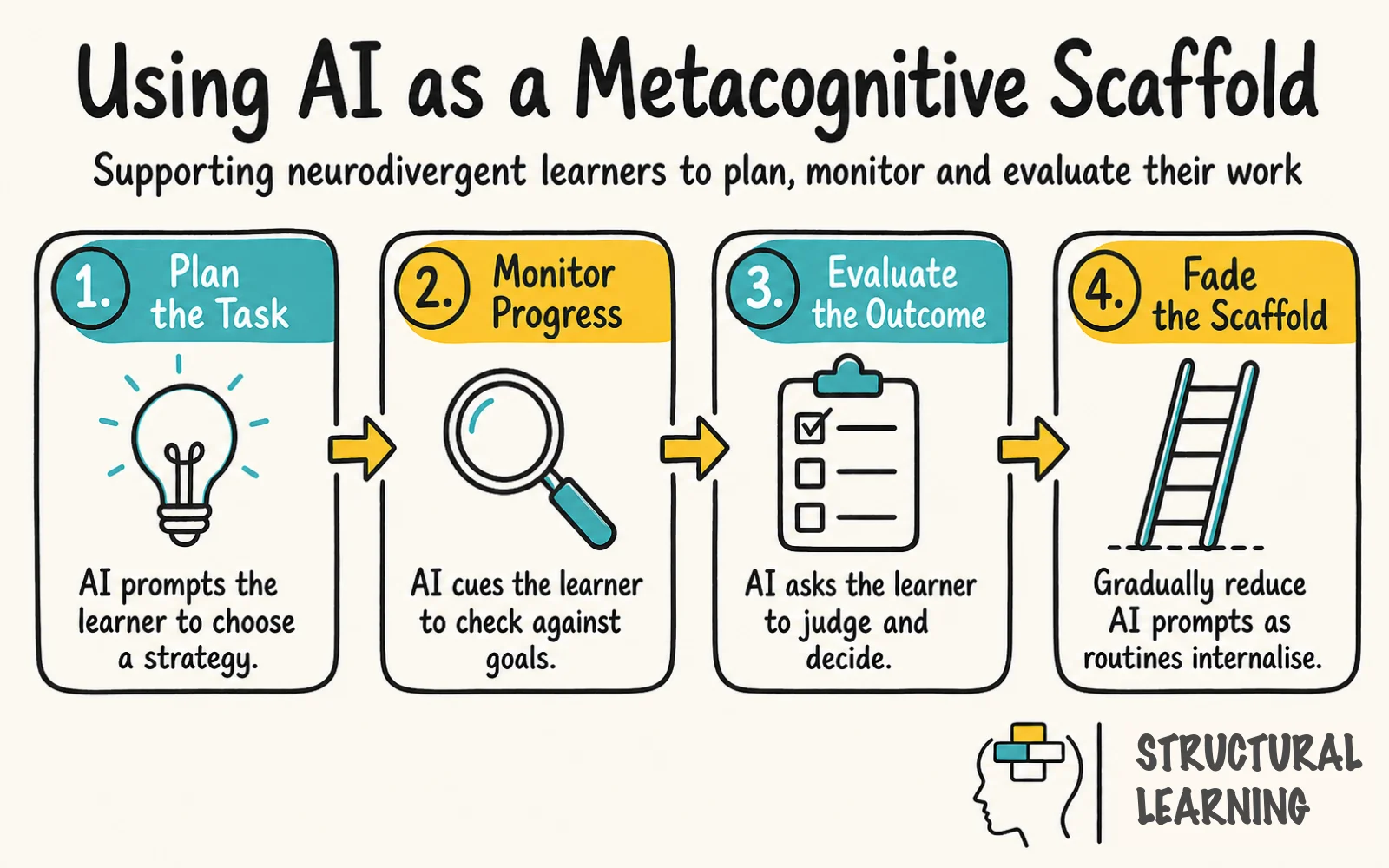
The most powerful application of AI for neurodivergent learners is not content generation but metacognitive monitoring. An AI system that prompts a learner to check their understanding, compare their work against criteria, or reflect on their progress is performing the monitoring function that executive function differences make difficult.

Zhang, Liu and Chen (2025), writing in Interactive Learning Environments, studied the impact of metacognitive scaffolding in a generative AI learning environment. Their quasi-experimental study found that learners who received explicit metacognitive prompts from the AI system showed significantly deeper learning approaches and higher cognitive proficiency levels than those who used AI without scaffolding. The experimental group demonstrated better task strategy use and self-evaluation, both core metacognitive regulation skills.

This has direct implications for SEND practice. A SENCO who configures an AI chatbot to ask structured metacognitive questions at set intervals during a task ("You have been working for 10 minutes. Can you summarise what you have written so far in one sentence?" or "Before you move to the next paragraph, check: does this paragraph answer the question?") is creating an external metacognitive monitor. The AI does not do the thinking for the learner. It reminds the learner to think about their thinking at moments when their executive function might otherwise let the monitoring lapse.

Li, Zhang and Chen (2025) examined teacher-guided AI scaffolding specifically with special education learners. Their survey of 562 learners with disabilities found that teacher AI scaffolding had a significant direct impact on learners' readiness to use academic chatbots for learning. Critically, the majority of the effect worked through two mediators: perceived pedagogical intelligence of the chatbot and digital self-regulated learning. This means that the AI tool alone is insufficient. The teacher's role in mediating the AI-learner interaction, setting up the right prompts, monitoring usage, and gradually reducing support, is essential.

Classroom Example: The Comprehension Check Bot

During a reading comprehension task, a learner with dyslexia uses an AI tool that pauses after every two paragraphs and asks: "What was the main idea of what you just read?" If the learner's summary does not match the content, the AI suggests re-reading the specific paragraph. This is automated comprehension monitoring, the exact metacognitive process that fluent readers perform automatically but that dyslexic readers often skip because decoding consumes all available cognitive resources.

Practical AI Scaffolding Strategies by Condition

Different neurodevelopmental conditions create different metacognitive barriers. AI scaffolding should be tailored accordingly.

ADHD: Sustained Monitoring and Time Management. Learners with ADHD typically struggle with sustained metacognitive monitoring. They begin tasks with reasonable plans but lose track of their progress as attention drifts. AI tools that provide periodic check-in prompts, time warnings, and progress summaries address this specific deficit. The AI acts as an external clock and progress tracker, compensating for the internal monitoring system that is underactive in ADHD.

Garcia Rodriguez (2025), in a qualitative case study of a university student with executive dysfunction, documented how AI tools for task management, idea generation, and writing support produced "enhanced metacognitive awareness, more efficient task breakdown, and steadily improved academic performance." The researcher noted that the student used AI as an assistive scaffold rather than a replacement for critical thought, and that the key benefit was the AI's patience and availability for repeated metacognitive prompting.

Autism Spectrum Conditions: Structured Decision-Making. Learners with autism often excel at following structured procedures but struggle with open-ended metacognitive tasks ("What strategy should I use?"). AI tools can convert open-ended metacognitive decisions into structured choices: "You are stuck on this maths problem. Would you like to (a) re-read the question, (b) draw a diagram, (c) try a simpler version first, or (d) ask your teacher?" This transforms an overwhelming metacognitive regulation task into a manageable selection from pre-defined options.

Dyslexia: Reducing Monitoring Load During Reading. Dyslexic learners spend so much cognitive resource on decoding that comprehension monitoring collapses. AI text-to-speech tools with comprehension check-points redistribute the load: the AI handles the decoding (through audio), freeing the learner's working memory for comprehension monitoring. Gonzalez (2025) found that AI-powered text-to-speech tools with human-like narration reduced cognitive load and enhanced attention in adults with ADHD, with similar benefits likely for dyslexic learners.

Developmental Coordination Disorder (DCD): Removing Handwriting Barriers. For learners with DCD, the physical act of handwriting consumes cognitive resources that should be available for content and metacognition. AI speech-to-text tools remove the motor barrier entirely, allowing the learner to focus working memory on what they want to say and how well they are saying it rather than on forming letters.

Classroom Example: The Personalised Prompt Schedule

A SENCO creates a shared document with AI prompt scripts for each learner's specific metacognitive needs. A learner with ADHD gets time-based prompts every 8 minutes. A learner with autism gets structured choice menus at decision points. A learner with dyslexia gets comprehension summaries after every section. The class teacher activates the relevant script on each learner's device at the start of the lesson. The AI provides individualised metacognitive scaffolding at scale.

The Teacher's Role: Mediating AI-Learner Interaction

AI tools without teacher mediation risk two failures. First, learners may become dependent on the AI for metacognitive processes they should be developing independently. Second, learners may use AI for cognitive offloading (getting the AI to do the thinking) rather than executive offloading (getting the AI to support the process of thinking).

Zhu, Chen, Liu and Gao (2025), writing in the British Journal of Educational Technology, found that learners who used generative AI without metacognitive support showed decreased self-regulated learning over time. The AI made tasks easier, which reduced the perceived need for self-regulation. Only learners who received explicit metacognitive prompts maintained and improved their self-regulation skills while using AI. This finding is a direct warning: AI without metacognitive scaffolding makes neurodivergent learners more dependent, not more independent.

The teacher's role is therefore threefold. First, set up the AI scaffolding with appropriate prompts for each learner's needs. Second, monitor how learners use the AI and redirect when usage shifts from executive offloading to cognitive offloading. Third, gradually reduce the AI scaffolding as the learner internalises the metacognitive processes, following the same fading principle that applies to all scaffolding.

Ahmad, Ibrahim, Mohd Yusof, Atan and Noor (2024), in a study of 300 preservice teachers, found that ChatGPT significantly enhanced metacognitive self-regulated learning when users were trained in how to use it as a learning tool rather than an answer generator. The key moderating factor was the user's understanding of how to frame questions that promoted reflection rather than passive consumption. Teachers need to model this reflective questioning approach explicitly.

Classroom Example: The Three-Column Check

When a learner uses an AI tool during a lesson, the teacher checks the interaction using three columns: "AI did the organising" (acceptable), "AI provided choices and learner decided" (ideal), and "AI wrote the content" (problematic). This simple framework helps teaching assistants and SENCOs monitor AI usage in real time and redirect learners who are drifting from scaffolding to substitution.

Ethical Considerations and Safeguarding

Using AI as a metacognitive scaffold for neurodivergent learners raises specific ethical questions that schools must address.

Data privacy. AI chatbot interactions may contain sensitive information about a learner's cognitive difficulties, emotional state, and learning barriers. Schools need clear policies about which AI tools are approved, where data is stored, and who has access. Local, school-hosted AI tools are preferable to cloud-based commercial platforms for SEND applications.

Equity of access. If AI metacognitive scaffolding is effective, it must be available to all learners who need it, not just those whose parents can afford devices or subscriptions. Schools should treat AI scaffolding tools as assistive technology, funded and provisioned through the same channels as other SEND resources.

Assessment validity. When a learner uses AI scaffolding during formative assessment, the assessment measures a combination of the learner's ability and the AI's support. Schools need clear protocols for when AI scaffolding is permitted (classroom learning, homework, revision) and when it is removed (formal assessment, examinations) to ensure that assessment data remains valid.

Avoiding learned helplessness. The fading principle is essential. AI scaffolding should be explicitly temporary, with clear criteria for reduction. A learner who uses AI planning prompts for every task in September should be using them for complex tasks only by December and generating their own plans for routine tasks. Without deliberate fading, the scaffold becomes a crutch.

Giannakopoulou, Mitsea and Drigas (2025), in a bibliometric review of 135 studies on AI scaffolding of metacognition in STEM, noted emerging concerns about "posthumanist framings" where AI systems are positioned as co-regulators of learning rather than temporary supports. They argued for maintaining human-centred conceptions of metacognition where AI serves the learner's developing independence rather than replacing it.

Classroom Example: The Scaffolding Fade Plan

For each learner receiving AI metacognitive support, the SENCO creates a "Fade Plan" in the provision map. The plan specifies the current level of AI support, the target level for each half-term, and the criteria for reduction. For example: "Currently receives AI planning prompts for all extended writing. By Spring 1, reduce to AI planning for new text types only. By Summer 1, learner generates own plans with AI available as a check." This makes the temporary nature of the scaffold explicit and trackable.

Measuring Impact: What to Track

Schools implementing AI metacognitive scaffolding for neurodivergent learners should track three categories of outcome.

Task completion and quality. Compare task completion rates and quality scores before and after AI scaffolding is introduced. For learners with ADHD, task completion often improves dramatically because the executive function barriers to starting and sustaining work have been removed.

Metacognitive independence. Track the frequency and type of AI prompts each learner needs over time. A decreasing trend indicates that the learner is internalising the metacognitive processes. A stable or increasing trend signals that the scaffolding is creating dependency rather than building capacity.

Learner self-report. Ask learners how they feel about their learning and their ability to manage it. Neurodivergent learners who have spent years feeling overwhelmed by tasks they know they should be able to complete often report significant improvements in self-efficacy when AI scaffolding removes the executive function barrier. This affective outcome matters as much as the academic one.

Malik, Khan and Hussain (2025) found that AI-assisted learning tools significantly enhanced engagement, comprehension, retention, and overall academic achievement among learners with autism when the tools were appropriately tailored. The key finding was that AI tools reduced cognitive overload and promoted individualised pacing, both of which are metacognitive benefits rather than purely academic ones.

Your Next Lesson

Identify one learner in your class whose metacognitive skills are weaker than their content knowledge. This is the learner who knows the material but cannot organise, monitor, or evaluate their own work effectively. For that learner's next extended task, set up a simple AI scaffolding protocol: provide an AI planning prompt at the start, a monitoring prompt at the midpoint ("Summarise your progress so far"), and an evaluation prompt at the end ("Check your work against these three criteria"). Observe whether the scaffolding changes the learner's output. If it does, the barrier was never understanding. It was executive function. And that is a barrier that AI can help remove.

References

Ahmad, N. A., Ibrahim, R., Mohd Yusof, A. F., Atan, N. A. and Noor, N. M. (2024). Extended TAM based acceptance of AI-powered ChatGPT for supporting metacognitive self-regulated learning in education. Heliyon, 10(5), e26983.

Alqahtani, A. (2025). Generative AI in inclusive classrooms: Enhancing social interactions, personalised learning, and metacognitive skills. Sodobna Pedagogika, 76(1), 120-138.

Brown, A. (2023). Designing AI writing workflow UX for reduced cognitive loads. Proceedings of the ACM Conference on Human Factors in Computing Systems.

Cheng, L., Cheng, Z., Wu, H. and Gong, S. (2025). Challenging cognitive load theory: The role of educational neuroscience and artificial intelligence in redefining learning efficacy. Brain Sciences, 15(2), 140.

Garcia Rodriguez, T. (2025). Harnessing generative AI to overcome executive dysfunction in higher education: A case study. 11th International Conference on Higher Education Advances (HEAd'25).

Giannakopoulou, A., Mitsea, E. and Drigas, A. (2025). Mapping the scaffolding of metacognition and learning by AI tools in STEM classrooms: A bibliometric-systematic review approach. Journal of Intelligence, 13(3), 87.

Gonzalez, R. (2025). Assistive technology and AI-driven narration: ADHD adults' experiences in digital reading environments. The Journal of Applied Instructional Design, 14(1).

Kahneman, D. (2011). Thinking, Fast and Slow. Farrar, Straus and Giroux.

Li, H., Zhang, W. and Chen, X. (2025). Scaffolds, screens, and readiness: How teacher-guided AI lifts special-education students into conversational agents. Acta Psychologica, 243, 104567.

Malik, A., Khan, S. and Hussain, T. (2025). The impact of AI-assisted learning tools on the academic performance of students with autism spectrum disorder. International Journal for Multidisciplinary Research, 7(2).

Sweller, J. (1988). Cognitive load during problem solving: Effects on learning. Cognitive Science, 12(2), 257-285.

Yuan, L., Chen, J. and Wang, Y. (2025). The effect of AI-based scaffolding on problem solving and metacognitive awareness in learners. The Critical Review of Social Sciences Studies, 3(1), 45-62.

Zhang, W., Liu, Y. and Chen, H. (2025). The impact of metacognitive scaffolding on deep learning in a GenAI-supported learning environment. Interactive Learning Environments, 33(2), 1-18.

Zhu, M., Chen, G., Liu, Q. and Gao, H. (2025). Enhancing self-regulated learning and learning experience in generative AI environments: The critical role of metacognitive support. British Journal of Educational Technology, 56(1), 89-108.

Free Resource Pack

AI Metacognitive Scaffolds for ND Learners

3 practical resources to help educators understand and implement AI as a metacognitive scaffold for neurodivergent students.

AI Metacognitive Scaffolds for ND Learners — 3 resources
CPD Visual Quick Reference Guide Strategy Card AI in Education Neurodiversity Metacognition SEND Support Teaching Strategies

Download your free bundle

Fill in your details below and we'll send the resource pack straight to your inbox.

Quick survey (helps us create better resources)

How confident are you in understanding and applying AI as a metacognitive scaffold for neurodivergent learners?

Not Confident
Slightly Confident
Moderately Confident
Confident
Very Confident

To what extent do your colleagues or school leadership discuss or support the use of AI for neurodivergent learners' metacognition?

Not At All
Rarely
Occasionally
Frequently
Actively & Consistently

How often do you currently incorporate AI tools with the explicit aim of metacognitive scaffolding for neurodivergent learners in your teaching?

Never
Rarely
Sometimes
Often
Routinely

Your resource pack is ready

We've also sent a copy to your email. Check your inbox.

Loading audit...

A Year 8 learner with ADHD sits in front of a blank page. He knows he needs to write an essay about the causes of World War One. He has the knowledge. He revised the content last night. But the executive function demands of structuring an argument, sequencing paragraphs, monitoring word count, and checking relevance simultaneously overwhelm his working memory before he writes a single sentence. Yuan, Chen and Wang (2025) found that AI-based scaffolding significantly improved both problem-solving performance and metacognitive awareness in learners aged 15-22, with the experimental group showing measurable gains in their ability to plan, monitor, and evaluate their own learning. For neurodivergent learners, who face disproportionate barriers to these exact metacognitive processes, AI tools represent not a luxury but a necessary scaffold that redistributes cognitive load in the same way that a wheelchair redistributes physical load. Sweller's cognitive load theory (1988) explains why: when the intrinsic demands of a task exceed working memory capacity, performance collapses. For learners with ADHD, autism, dyslexia, and other neurodevelopmental conditions, that collapse point arrives sooner and more frequently than for neurotypical peers.

Key Takeaways

  1. AI-based scaffolding significantly improves metacognitive awareness in learners, particularly in planning, monitoring, and self-regulation (Yuan et al., 2025).
  2. Neurodivergent learners face disproportionate barriers to metacognition because executive function differences reduce the cognitive resources available for self-monitoring (Kahneman, 2011).
  3. AI tools can serve as external metacognitive regulators, handling routine planning and monitoring tasks so that learners can focus their limited working memory on content learning.
  4. Teacher-guided AI scaffolding, where the adult mediates how the learner uses the AI tool, produces better outcomes than unsupported AI use (Li, Zhang and Chen, 2025).

The Metacognitive Gap for Neurodivergent Learners

Metacognition requires executive function. Planning what to learn, monitoring comprehension during a task, evaluating performance afterwards, and selecting strategies when things go wrong all depend on the prefrontal cortex's capacity for working memory, inhibition, and cognitive flexibility. These are precisely the functions that are atypical in ADHD, autism spectrum conditions, dyslexia, and developmental coordination disorder.

Comparison infographic showing cognitive differences between neurotypical and neurodivergent learners in metacognitive processing
Metacognitive Processing: Neurotypical vs. Neurodivergent Learners

Kahneman (2011) described two systems of thinking: System 1 (fast, automatic, effortless) and System 2 (slow, deliberate, effortful). Metacognition is entirely a System 2 process. It requires the learner to step back from the task, evaluate their progress, and make deliberate decisions about next steps. For neurotypical learners, this is cognitively expensive but manageable. For learners with executive function differences, System 2 processing is chronically under-resourced because the same neural systems needed for metacognition are also needed for basic task completion.

Comparison chart showing metacognitive processing differences between neurotypical and neurodivergent learners
Metacognitive Processing: Neurotypical vs. Neurodivergent Learners

The result is a double disadvantage. Neurodivergent learners often need more metacognitive support than their peers (because their learning is less automatic and requires more deliberate regulation) while simultaneously having fewer cognitive resources available for metacognition (because executive function differences consume those resources). This is not a paradox that can be resolved through willpower or repeated instruction in metacognitive strategies. It requires an external system that handles some of the metacognitive load on the learner's behalf.

Infographic comparing metacognitive processing between neurotypical and neurodivergent learners showing resource differences
Metacognitive Processing: Neurotypical vs. Neurodivergent Learners

Alqahtani (2025), in a systematic literature review published in Sodobna Pedagogika, found that generative AI tools improve communication skills in neurodivergent learners by breaking down linguistic and cognitive barriers. The review demonstrated that AI tools reduce cognitive load, improve focus, and provide personalised scaffolding that addresses individual learners' multimodal needs. Critically, the review found that AI tools support gradual independence through a process of "deskilling," providing heavy scaffolding initially and reducing support as the learner develops competence.

Classroom Example: The AI Planning Partner

A learner with ADHD is given a writing task. Instead of staring at a blank page, he opens an AI chatbot and types: "Help me plan an essay about the causes of World War One. I need to write 500 words with three main paragraphs." The AI returns a structured plan with three cause headings and two supporting points for each. The learner has not outsourced the thinking. He has outsourced the executive function task of structuring, which was the barrier preventing him from accessing his existing knowledge. He now writes the content using the AI-generated plan as a scaffold.

How AI Redistributes Cognitive Load

Sweller's cognitive load theory (1988) identifies three types of load: intrinsic (the inherent complexity of the content), extraneous (unnecessary load created by poor instructional design), and germane (the productive load of building schemas and understanding). Effective instruction minimises extraneous load and maximises germane load.

For neurodivergent learners, many standard classroom tasks inadvertently create massive extraneous load. A writing task requires simultaneous management of content, structure, grammar, spelling, handwriting, and time, each of which competes for the same limited working memory resources. The content learning (germane load) gets crowded out by the procedural demands (extraneous load).

Cheng, Cheng, Wu and Gong (2025), in a study published in Brain Sciences with 61 citations, demonstrated that AI-driven adaptive learning systems can dynamically manage cognitive load by adjusting task demands in real time based on neurophysiological data. While their study focused on EEG-based load detection, the principle translates directly to classroom AI tools: an AI system that handles the structural and procedural elements of a task (outlining, formatting, spell-checking, time management) reduces extraneous load and frees working memory for content engagement.

Brown (2023), examining how large language models support people with ADHD and learning differences, proposed a model of executive-cognitive capacity that maps which cognitive demands can be safely offloaded to AI without undermining learning. The key distinction is between cognitive offloading (handing over thinking that the learner should be doing) and executive offloading (handing over organisational and monitoring tasks that are barriers to thinking). The first undermines learning. The second enables it.

Classroom Example: The Structured Revision Session

A learner with autism finds unstructured revision paralysing because she cannot prioritise topics or decide how long to spend on each one. Her teacher sets up an AI tool that takes her list of topics and upcoming test dates and generates a structured revision timetable with specific time blocks, break reminders, and topic sequences. The AI handles the executive function task of planning. The learner does the actual revision. The metacognitive act of following and adjusting the plan becomes manageable because the initial planning barrier has been removed.

AI as an External Metacognitive Monitor

The most powerful application of AI for neurodivergent learners is not content generation but metacognitive monitoring. An AI system that prompts a learner to check their understanding, compare their work against criteria, or reflect on their progress is performing the monitoring function that executive function differences make difficult.

Zhang, Liu and Chen (2025), writing in Interactive Learning Environments, studied the impact of metacognitive scaffolding in a generative AI learning environment. Their quasi-experimental study found that learners who received explicit metacognitive prompts from the AI system showed significantly deeper learning approaches and higher cognitive proficiency levels than those who used AI without scaffolding. The experimental group demonstrated better task strategy use and self-evaluation, both core metacognitive regulation skills.

This has direct implications for SEND practice. A SENCO who configures an AI chatbot to ask structured metacognitive questions at set intervals during a task ("You have been working for 10 minutes. Can you summarise what you have written so far in one sentence?" or "Before you move to the next paragraph, check: does this paragraph answer the question?") is creating an external metacognitive monitor. The AI does not do the thinking for the learner. It reminds the learner to think about their thinking at moments when their executive function might otherwise let the monitoring lapse.

Li, Zhang and Chen (2025) examined teacher-guided AI scaffolding specifically with special education learners. Their survey of 562 learners with disabilities found that teacher AI scaffolding had a significant direct impact on learners' readiness to use academic chatbots for learning. Critically, the majority of the effect worked through two mediators: perceived pedagogical intelligence of the chatbot and digital self-regulated learning. This means that the AI tool alone is insufficient. The teacher's role in mediating the AI-learner interaction, setting up the right prompts, monitoring usage, and gradually reducing support, is essential.

Classroom Example: The Comprehension Check Bot

During a reading comprehension task, a learner with dyslexia uses an AI tool that pauses after every two paragraphs and asks: "What was the main idea of what you just read?" If the learner's summary does not match the content, the AI suggests re-reading the specific paragraph. This is automated comprehension monitoring, the exact metacognitive process that fluent readers perform automatically but that dyslexic readers often skip because decoding consumes all available cognitive resources.

Practical AI Scaffolding Strategies by Condition

Different neurodevelopmental conditions create different metacognitive barriers. AI scaffolding should be tailored accordingly.

ADHD: Sustained Monitoring and Time Management. Learners with ADHD typically struggle with sustained metacognitive monitoring. They begin tasks with reasonable plans but lose track of their progress as attention drifts. AI tools that provide periodic check-in prompts, time warnings, and progress summaries address this specific deficit. The AI acts as an external clock and progress tracker, compensating for the internal monitoring system that is underactive in ADHD.

Garcia Rodriguez (2025), in a qualitative case study of a university student with executive dysfunction, documented how AI tools for task management, idea generation, and writing support produced "enhanced metacognitive awareness, more efficient task breakdown, and steadily improved academic performance." The researcher noted that the student used AI as an assistive scaffold rather than a replacement for critical thought, and that the key benefit was the AI's patience and availability for repeated metacognitive prompting.

Autism Spectrum Conditions: Structured Decision-Making. Learners with autism often excel at following structured procedures but struggle with open-ended metacognitive tasks ("What strategy should I use?"). AI tools can convert open-ended metacognitive decisions into structured choices: "You are stuck on this maths problem. Would you like to (a) re-read the question, (b) draw a diagram, (c) try a simpler version first, or (d) ask your teacher?" This transforms an overwhelming metacognitive regulation task into a manageable selection from pre-defined options.

Dyslexia: Reducing Monitoring Load During Reading. Dyslexic learners spend so much cognitive resource on decoding that comprehension monitoring collapses. AI text-to-speech tools with comprehension check-points redistribute the load: the AI handles the decoding (through audio), freeing the learner's working memory for comprehension monitoring. Gonzalez (2025) found that AI-powered text-to-speech tools with human-like narration reduced cognitive load and enhanced attention in adults with ADHD, with similar benefits likely for dyslexic learners.

Developmental Coordination Disorder (DCD): Removing Handwriting Barriers. For learners with DCD, the physical act of handwriting consumes cognitive resources that should be available for content and metacognition. AI speech-to-text tools remove the motor barrier entirely, allowing the learner to focus working memory on what they want to say and how well they are saying it rather than on forming letters.

Classroom Example: The Personalised Prompt Schedule

A SENCO creates a shared document with AI prompt scripts for each learner's specific metacognitive needs. A learner with ADHD gets time-based prompts every 8 minutes. A learner with autism gets structured choice menus at decision points. A learner with dyslexia gets comprehension summaries after every section. The class teacher activates the relevant script on each learner's device at the start of the lesson. The AI provides individualised metacognitive scaffolding at scale.

The Teacher's Role: Mediating AI-Learner Interaction

AI tools without teacher mediation risk two failures. First, learners may become dependent on the AI for metacognitive processes they should be developing independently. Second, learners may use AI for cognitive offloading (getting the AI to do the thinking) rather than executive offloading (getting the AI to support the process of thinking).

Zhu, Chen, Liu and Gao (2025), writing in the British Journal of Educational Technology, found that learners who used generative AI without metacognitive support showed decreased self-regulated learning over time. The AI made tasks easier, which reduced the perceived need for self-regulation. Only learners who received explicit metacognitive prompts maintained and improved their self-regulation skills while using AI. This finding is a direct warning: AI without metacognitive scaffolding makes neurodivergent learners more dependent, not more independent.

The teacher's role is therefore threefold. First, set up the AI scaffolding with appropriate prompts for each learner's needs. Second, monitor how learners use the AI and redirect when usage shifts from executive offloading to cognitive offloading. Third, gradually reduce the AI scaffolding as the learner internalises the metacognitive processes, following the same fading principle that applies to all scaffolding.

Ahmad, Ibrahim, Mohd Yusof, Atan and Noor (2024), in a study of 300 preservice teachers, found that ChatGPT significantly enhanced metacognitive self-regulated learning when users were trained in how to use it as a learning tool rather than an answer generator. The key moderating factor was the user's understanding of how to frame questions that promoted reflection rather than passive consumption. Teachers need to model this reflective questioning approach explicitly.

Classroom Example: The Three-Column Check

When a learner uses an AI tool during a lesson, the teacher checks the interaction using three columns: "AI did the organising" (acceptable), "AI provided choices and learner decided" (ideal), and "AI wrote the content" (problematic). This simple framework helps teaching assistants and SENCOs monitor AI usage in real time and redirect learners who are drifting from scaffolding to substitution.

Ethical Considerations and Safeguarding

Using AI as a metacognitive scaffold for neurodivergent learners raises specific ethical questions that schools must address.

Data privacy. AI chatbot interactions may contain sensitive information about a learner's cognitive difficulties, emotional state, and learning barriers. Schools need clear policies about which AI tools are approved, where data is stored, and who has access. Local, school-hosted AI tools are preferable to cloud-based commercial platforms for SEND applications.

Equity of access. If AI metacognitive scaffolding is effective, it must be available to all learners who need it, not just those whose parents can afford devices or subscriptions. Schools should treat AI scaffolding tools as assistive technology, funded and provisioned through the same channels as other SEND resources.

Assessment validity. When a learner uses AI scaffolding during formative assessment, the assessment measures a combination of the learner's ability and the AI's support. Schools need clear protocols for when AI scaffolding is permitted (classroom learning, homework, revision) and when it is removed (formal assessment, examinations) to ensure that assessment data remains valid.

Avoiding learned helplessness. The fading principle is essential. AI scaffolding should be explicitly temporary, with clear criteria for reduction. A learner who uses AI planning prompts for every task in September should be using them for complex tasks only by December and generating their own plans for routine tasks. Without deliberate fading, the scaffold becomes a crutch.

Giannakopoulou, Mitsea and Drigas (2025), in a bibliometric review of 135 studies on AI scaffolding of metacognition in STEM, noted emerging concerns about "posthumanist framings" where AI systems are positioned as co-regulators of learning rather than temporary supports. They argued for maintaining human-centred conceptions of metacognition where AI serves the learner's developing independence rather than replacing it.

Classroom Example: The Scaffolding Fade Plan

For each learner receiving AI metacognitive support, the SENCO creates a "Fade Plan" in the provision map. The plan specifies the current level of AI support, the target level for each half-term, and the criteria for reduction. For example: "Currently receives AI planning prompts for all extended writing. By Spring 1, reduce to AI planning for new text types only. By Summer 1, learner generates own plans with AI available as a check." This makes the temporary nature of the scaffold explicit and trackable.

Measuring Impact: What to Track

Schools implementing AI metacognitive scaffolding for neurodivergent learners should track three categories of outcome.

Task completion and quality. Compare task completion rates and quality scores before and after AI scaffolding is introduced. For learners with ADHD, task completion often improves dramatically because the executive function barriers to starting and sustaining work have been removed.

Metacognitive independence. Track the frequency and type of AI prompts each learner needs over time. A decreasing trend indicates that the learner is internalising the metacognitive processes. A stable or increasing trend signals that the scaffolding is creating dependency rather than building capacity.

Learner self-report. Ask learners how they feel about their learning and their ability to manage it. Neurodivergent learners who have spent years feeling overwhelmed by tasks they know they should be able to complete often report significant improvements in self-efficacy when AI scaffolding removes the executive function barrier. This affective outcome matters as much as the academic one.

Malik, Khan and Hussain (2025) found that AI-assisted learning tools significantly enhanced engagement, comprehension, retention, and overall academic achievement among learners with autism when the tools were appropriately tailored. The key finding was that AI tools reduced cognitive overload and promoted individualised pacing, both of which are metacognitive benefits rather than purely academic ones.

Your Next Lesson

Identify one learner in your class whose metacognitive skills are weaker than their content knowledge. This is the learner who knows the material but cannot organise, monitor, or evaluate their own work effectively. For that learner's next extended task, set up a simple AI scaffolding protocol: provide an AI planning prompt at the start, a monitoring prompt at the midpoint ("Summarise your progress so far"), and an evaluation prompt at the end ("Check your work against these three criteria"). Observe whether the scaffolding changes the learner's output. If it does, the barrier was never understanding. It was executive function. And that is a barrier that AI can help remove.

References

Ahmad, N. A., Ibrahim, R., Mohd Yusof, A. F., Atan, N. A. and Noor, N. M. (2024). Extended TAM based acceptance of AI-powered ChatGPT for supporting metacognitive self-regulated learning in education. Heliyon, 10(5), e26983.

Alqahtani, A. (2025). Generative AI in inclusive classrooms: Enhancing social interactions, personalised learning, and metacognitive skills. Sodobna Pedagogika, 76(1), 120-138.

Brown, A. (2023). Designing AI writing workflow UX for reduced cognitive loads. Proceedings of the ACM Conference on Human Factors in Computing Systems.

Cheng, L., Cheng, Z., Wu, H. and Gong, S. (2025). Challenging cognitive load theory: The role of educational neuroscience and artificial intelligence in redefining learning efficacy. Brain Sciences, 15(2), 140.

Garcia Rodriguez, T. (2025). Harnessing generative AI to overcome executive dysfunction in higher education: A case study. 11th International Conference on Higher Education Advances (HEAd'25).

Giannakopoulou, A., Mitsea, E. and Drigas, A. (2025). Mapping the scaffolding of metacognition and learning by AI tools in STEM classrooms: A bibliometric-systematic review approach. Journal of Intelligence, 13(3), 87.

Gonzalez, R. (2025). Assistive technology and AI-driven narration: ADHD adults' experiences in digital reading environments. The Journal of Applied Instructional Design, 14(1).

Kahneman, D. (2011). Thinking, Fast and Slow. Farrar, Straus and Giroux.

Li, H., Zhang, W. and Chen, X. (2025). Scaffolds, screens, and readiness: How teacher-guided AI lifts special-education students into conversational agents. Acta Psychologica, 243, 104567.

Malik, A., Khan, S. and Hussain, T. (2025). The impact of AI-assisted learning tools on the academic performance of students with autism spectrum disorder. International Journal for Multidisciplinary Research, 7(2).

Sweller, J. (1988). Cognitive load during problem solving: Effects on learning. Cognitive Science, 12(2), 257-285.

Yuan, L., Chen, J. and Wang, Y. (2025). The effect of AI-based scaffolding on problem solving and metacognitive awareness in learners. The Critical Review of Social Sciences Studies, 3(1), 45-62.

Zhang, W., Liu, Y. and Chen, H. (2025). The impact of metacognitive scaffolding on deep learning in a GenAI-supported learning environment. Interactive Learning Environments, 33(2), 1-18.

Zhu, M., Chen, G., Liu, Q. and Gao, H. (2025). Enhancing self-regulated learning and learning experience in generative AI environments: The critical role of metacognitive support. British Journal of Educational Technology, 56(1), 89-108.

Free Resource Pack

AI Metacognitive Scaffolds for ND Learners

3 practical resources to help educators understand and implement AI as a metacognitive scaffold for neurodivergent students.

AI Metacognitive Scaffolds for ND Learners — 3 resources
CPD Visual Quick Reference Guide Strategy Card AI in Education Neurodiversity Metacognition SEND Support Teaching Strategies

Download your free bundle

Fill in your details below and we'll send the resource pack straight to your inbox.

Quick survey (helps us create better resources)

How confident are you in understanding and applying AI as a metacognitive scaffold for neurodivergent learners?

Not Confident
Slightly Confident
Moderately Confident
Confident
Very Confident

To what extent do your colleagues or school leadership discuss or support the use of AI for neurodivergent learners' metacognition?

Not At All
Rarely
Occasionally
Frequently
Actively & Consistently

How often do you currently incorporate AI tools with the explicit aim of metacognitive scaffolding for neurodivergent learners in your teaching?

Never
Rarely
Sometimes
Often
Routinely

Your resource pack is ready

We've also sent a copy to your email. Check your inbox.

No Posts found.
Back to Blog