How to Map IB ATL Skills Without Adding a Single Minute to Your Planning
|
March 24, 2026
IB teachers spend unnecessary time documenting ATL skills that are already embedded in their teaching. This guide shows how the Thinking Framework maps directly onto ATL Thinking Skills, how one well-designed task can evidence all five ATL categories, and how a five-question coordinator audit replaces complex tracking systems without losing any evidential value.
Every IB teacher knows the feeling. A coordinator announces that ATL skills must be mapped in unit planners, and the room quietly deflates. Another column. Another expectation. Another thing to document on top of everything already in the planner. The problem is not that teachers resist ATL skills; it is that they assume ATL is something extra, added on top of what they already do.
It is not. And once you see why, the documentation burden almost disappears.
Key Takeaways
ATL is already in your teaching: When pupils explain their reasoning, work in pairs, or evaluate sources, they are already using ATL skills. The gap is labelling, not doing.
The Thinking Framework maps directly onto ATL Thinking Skills: Choosing a cognitive operation (Compare, Cause and Effect, Systems Thinking) automatically satisfies ATL Thinking documentation with no extra planning step.
One well-designed task can evidence all five ATL categories: Research, Social, Communication, Self-Management, and Thinking skills can all emerge from a single Thinking Framework activity.
Coordinators need evidence of embedding, not separate tracking spreadsheets: The IB requires ATL to be visible in teaching and learning, not recorded in a separate document from lessons.
The five-question audit turns compliance into recognition: Asking "did pupils explain something to a partner?" is faster than completing a tracking grid and gives more honest evidence of ATL in practice.
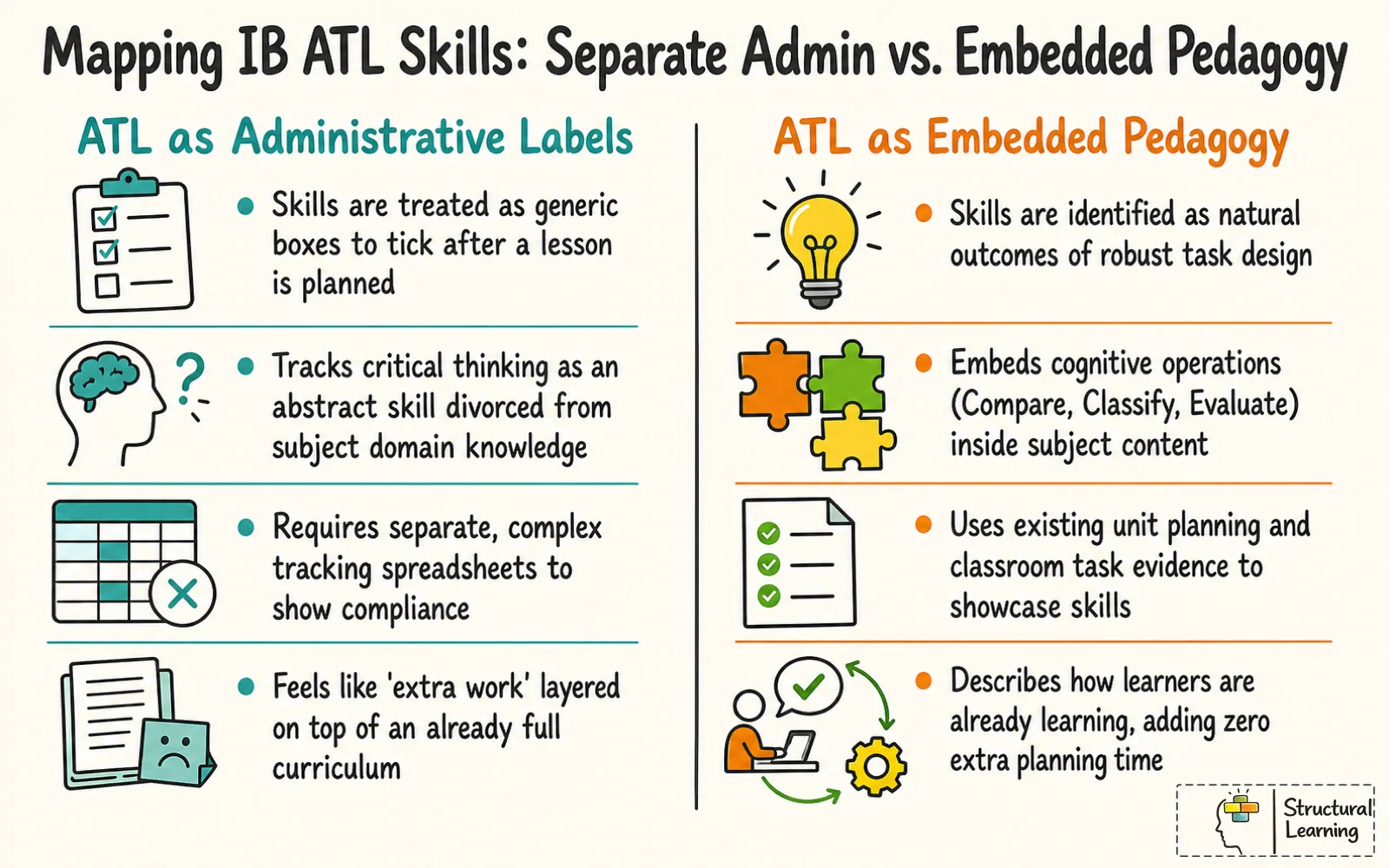
The ATL Admin Problem
The planning conversation usually goes like this. A teacher has a well-structured lesson on ecosystem interdependence, a paired discussion activity, a source evaluation task, and a reflection question. Then someone says: "Have you mapped the ATL skills?" And the teacher adds a column to the planner, writes "Thinking Skills: Critical Thinking" in it, and moves on. Nothing about the lesson changed. Only the documentation did.
This is the failure mode of ATL implementation in most schools. The skills framework becomes a labelling exercise rather than a teaching approach. Teachers experience it as administrative overhead, and they are not wrong to feel that way, because in this model, it genuinely is overhead. The IB Organisation (2014) describes ATL skills as "the bedrock of how students learn," not an additional record-keeping system. The mismatch between that aspiration and the lived experience of teachers is the problem this article addresses.
The fix is not a better spreadsheet. It is a shift in how teachers understand the relationship between what they already plan and what ATL actually requires.
ATL Is Already in Your Teaching
Consider what happens in a typical MYP lesson. The teacher opens with a retrieval question (Thinking Skills: recall and application). Pupils discuss their answers in pairs (Social Skills: listening and collaboration). The teacher then shows two conflicting sources and asks pupils to evaluate them (Research Skills: information literacy; Thinking Skills: critical and creative thinking). Pupils write a short explanation of their conclusion (Communication Skills: written expression). Before leaving, they rate their confidence on the day's learning objective (Self-Management Skills: reflection).
That is five ATL categories in one lesson, none of which were planned as ATL activities. They were planned as good pedagogy. This is what Erickson and Lanning (2014) mean when they argue that concept-based learning requires students to transfer thinking across contexts: the vehicle is always a content task, but the thinking operation is always transferable. ATL lives inside the task, not alongside it.
The documentation problem arises because teachers look at their planning and see subject content. They have been trained to plan in terms of topics, learning objectives, and activities. ATL skills are invisible in that lens because they are embedded in the how, not the what. The solution is a lens shift, not more planning time. Teachers who use a Thinking Framework to design their activities already have that lens built in.
The Thinking Framework Shortcut
The Thinking Framework uses eight cognitive operations: Compare, Classify, Sequence, Cause and Effect, Part-Whole, Analogy, Perspective, and Systems Thinking. These operations are not subject-specific. They describe the type of thinking a task requires, and they map directly onto the IB's ATL Thinking Skills subcategories.
Thinking Framework Operation
ATL Thinking Skills Subcategory
Example Task
Compare
Critical thinking: evaluating evidence
Compare two historians' interpretations of the same event
Classify
Critical thinking: identifying categories
Sort organisms into consumer categories by feeding behaviour
Sequence
Transfer: applying thinking across contexts
Order the steps in a chemical reaction process
Cause and Effect
Critical thinking: considering ideas and perspectives
Analyse why a character's decision changed the story
Part-Whole
Creative thinking: making connections
Identify how each organ system contributes to homeostasis
Analogy
Creative thinking: generating novel ideas
Explain economic supply and demand using a school tuck shop
Perspective
Critical thinking: considering perspectives and viewpoints
Write from the viewpoint of a refugee in a historical event
Systems Thinking
Transfer: seeing interconnections
Map how industrial farming affects global food security
When a teacher plans a lesson using any of these operations, they have already planned their ATL Thinking Skills. The planning column does not need to be filled in separately; it is filled in the moment the cognitive operation is chosen. This is the shortcut that removes the administrative burden without compromising documentation quality.
Sweller's (1988) Cognitive Load Theory explains why this matters practically. When teachers are asked to plan subject content and ATL skills separately, they carry two parallel cognitive demands. Merging them through the Thinking Framework reduces extraneous load, freeing working memory for the aspects of planning that genuinely require attention, such as differentiation and pacing. For more on how cognitive architecture affects teacher planning, see Cognitive Load Theory.
The Five ATL Categories: What You Are Already Doing
Each of the five ATL skill categories maps onto teaching decisions teachers make as a matter of routine. The table below shows the most common lesson structures that generate ATL evidence without any additional design.
ATL Category
Already in Your Planning When You...
Observable Pupil Behaviour
Thinking
Assign a Thinking Framework operation as the lesson task
Pupils analyse, evaluate, categorise, or connect ideas
Communication
Ask pupils to explain, present, write, or justify
Pupils express understanding through language, visual, or multimodal means
Social
Use paired discussion, group tasks, or peer feedback
Pupils listen, negotiate, delegate, and support each other
Self-Management
Include reflection, goal-setting, or time management in a task
Pupils monitor their understanding, manage materials, or pace their work
Research
Set an inquiry task, source evaluation, or note-taking activity
Pupils gather, select, record, and cite information
Zimmerman's (2002) model of self-regulated learning is instructive here. His forethought, performance, and self-reflection phases map onto what the IB calls Self-Management Skills. When teachers ask pupils to set a learning target at the start of a lesson and reflect on it at the end, they are teaching Zimmerman's self-regulation cycle. They do not need to plan a separate "self-management activity"; the existing lesson structure already contains it. For a fuller treatment of self-regulation in the classroom, see self-regulation of learning.
The same logic applies across all five categories. Communication Skills emerge whenever pupils speak, write, or represent their thinking. Social Skills emerge whenever a task requires coordination with another person. Research Skills emerge whenever pupils encounter information they did not already hold. Teachers who plan any of these into their lessons, which is virtually every teacher, every day, are already teaching all five categories.
One Lesson, All Five ATLs
The most persuasive argument for this approach is not theoretical; it is practical. Here is a Year 8 MYP Science lesson on pond ecosystems, planned using a single Thinking Framework operation: Systems Thinking.
The teacher's planning note reads: "Systems Thinking task: pupils map the feeding relationships in a pond ecosystem and identify what happens if one species disappears." That is one sentence in the planning document. What actually happens in the lesson covers all five ATL categories.
Pupils spend ten minutes researching the organisms in a pond ecosystem using a provided reading and two short video clips. That is Research Skills: accessing and recording information, evaluating sources for relevance. They then work in pairs to build a food web diagram, negotiating which organisms belong where. That is Social Skills: listening and collaborating, respecting different contributions. Each pair then writes a two-sentence explanation of what would happen if frogs were removed from the system. That is Communication Skills: expressing understanding in written form. At the end of the lesson, pupils answer a self-assessment question: "What surprised you about how connected the system is?" That is Self-Management Skills: reflection on learning. And running through all of it is the Systems Thinking operation itself: recognising interdependence, tracing feedback loops, and anticipating consequences. That is Thinking Skills: critical and creative thinking, transfer.
The teacher planned one task. The ATL documentation covers all five categories. This is not a coincidence; it is what happens when the task design is cognitively rich. Hattie (2012) identifies self-reported grades and self-evaluation as among the highest-effect instructional strategies because they make the thinking process visible to pupils. The self-assessment question at the end of the pond lesson does exactly this, and it requires no additional planning time.
A significant part of the ATL planning burden comes from misunderstanding what the IB actually asks for. The IB Organisation's (2014) ATL framework does not require a separate tracking spreadsheet. It does not require every ATL subcategory to be documented in every lesson. It requires that ATL skills are "embedded in all subject groups" and that schools "provide students with opportunities to develop and use" these skills across programmes.
That phrase, "provide opportunities," is doing a great deal of work. It does not mean "demonstrate in a separate column that each skill was explicitly taught." It means that pupils who pass through an MYP classroom should leave it having practised the skills. The evidence for this can come from unit planners showing inquiry tasks (Research Skills), group activities (Social Skills), and reflective questions (Self-Management Skills). It does not need to come from a lesson-by-lesson ATL tracker.
Schools that have built elaborate ATL spreadsheets have often done so in response to a perceived compliance requirement that is stricter than the actual requirement. IB programme evaluations look for coherent ATL integration across a school, not perfect documentation of every lesson. This distinction matters enormously for how coordinators frame the expectation to teachers.
For teachers working across IB programmes, the ATL framework runs from PYP through MYP to DP, increasing in sophistication and pupil autonomy at each stage. At PYP level, ATL skills are largely teacher-led and scaffolded. At MYP, pupils begin to self-identify which skills they are using. At DP, students are expected to deploy ATL skills with significant independence. Grounding your approach in the IB Learner Profile helps clarify how ATL skills serve the broader goal of developing internationally minded students.
Why Metacognition Is the Key to ATL Thinking Skills
Of the five ATL categories, Thinking Skills receive the most attention in IB documentation and the least practical guidance in training sessions. The subcategory of "metacognitive skills" within Thinking Skills is particularly underdeveloped in most school implementations. The EEF Metacognition and Self-Regulated Learning guidance report (2018) rates metacognition as one of the highest-impact, lowest-cost teaching strategies available, with an effect size of seven additional months of progress. Yet most ATL Thinking Skills documentation reduces to "pupils used critical thinking in this lesson."
Metacognition, as Flavell (1979) defines it, is the knowledge and regulation of one's own cognitive processes. In a classroom, this means pupils knowing what they are doing when they think, being able to monitor whether it is working, and being able to adjust their approach when it is not. These are exactly the capacities described in ATL Thinking Skills subcategories: transfer, critical thinking, creative thinking, and reflection.
The Thinking Framework makes metacognition visible because it gives pupils a shared vocabulary for the type of thinking they are doing. When a teacher says "we are going to use Systems Thinking today," pupils know what cognitive operation is expected. They can ask themselves mid-task: "Am I tracking the connections between parts, or am I just describing each part separately?" That is metacognitive monitoring, and it emerges from naming the thinking operation in the first place. For practical classroom approaches, see metacognition in the classroom and the closely related skills covered in critical thinking in education.
Communication and Social Skills: The Oracy Connection
ATL Communication Skills are frequently documented in the most superficial way: "pupils wrote a paragraph" or "pupils completed a worksheet." Neither of these demonstrates Communication Skills in the ATL sense, which includes: reading, writing, speaking, listening, presenting, and using information and media literacy. Similarly, Social Skills documentation often reduces to "group work occurred," which tells an evaluator nothing about the quality of collaboration.
The richer approach treats Communication Skills as requiring genuine communicative acts where meaning is constructed and negotiated, not merely transmitted. When a teacher asks pupils to explain their Systems Thinking diagram to another pair, not just present it but explain and respond to questions, pupils are using Communication Skills in a substantive way. When that explanation involves justifying a claim, pupils are also using Thinking Skills: evaluating evidence and considering counterarguments.
This is the oracy connection. Structured talk, where pupils are accountable for explaining, justifying, and responding, generates both Communication and Social ATL evidence in a single activity. The teacher plans one talk task. The ATL evidence spans two categories. For strategies that develop this kind of academic dialogue, see oracy in language development and collaborative learning approaches.
The Coordinator's Five-Question Audit
For coordinators who need to support teachers in evidencing ATL without creating more paperwork, the following five questions work as a rapid audit of any lesson or unit. They can be used in a post-lesson conversation, a planning review, or a department meeting. Each question takes the evidence from teacher memory, not from a documentation system, and links it to a specific ATL category.
"In your last lesson, did pupils explain something to a partner or to the class?" If yes, that is Communication Skills: speaking and listening. Ask them to note it in the unit planner under Communication.
"Did pupils make a choice about how to approach a task, or manage their time to complete something?" If yes, that is Self-Management Skills: organisation and self-regulation. Zimmerman (2002) describes this as the performance phase of self-regulated learning.
"Did pupils use any information they did not already have, from a text, video, or database?" If yes, that is Research Skills: information literacy and media literacy. Even a reading comprehension task qualifies.
"Did pupils work with someone else to produce or discuss something?" If yes, that is Social Skills: collaboration. The quality of the collaboration is what matters for assessment, not its occurrence.
"Which Thinking Framework operation did the task require?" Whatever the answer, that is Thinking Skills. Compare maps to critical thinking and evaluating evidence. Systems Thinking maps to transfer and seeing interconnections. The specific subcategory follows from the operation.
This audit takes five minutes. It converts a compliance exercise into a recognition exercise, helping teachers see that they are already doing what is asked. It also produces more honest ATL evidence than a pre-filled planning column because it reflects what actually happened in the lesson, not what was anticipated.
For coordinators working across the MYP or PYP, pairing this audit with the broader resources available under MYP planning frameworks and IB programme guidance builds a more coherent school-wide ATL culture than any tracking spreadsheet can achieve.
Research Skills Without a Research Project
One persistent myth about ATL Research Skills is that they only apply during inquiry projects, personal projects, or extended essays. This leads teachers in non-inquiry lessons to assume Research Skills do not apply to their unit, and to leave that row in the ATL planner blank.
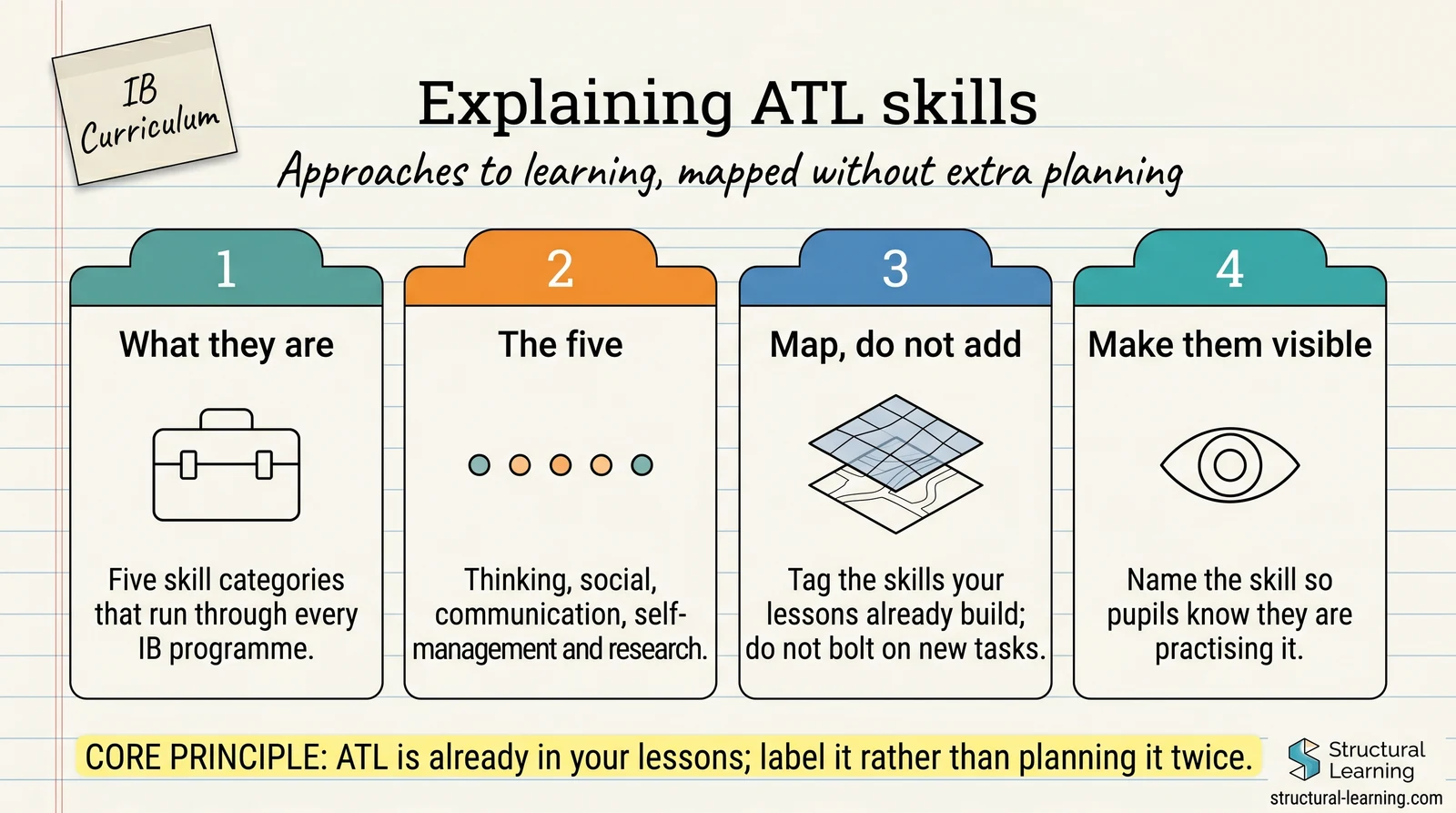
Research Skills in the IB ATL framework include: formulating questions, using information literacy (evaluating sources for credibility, currency, and relevance), collecting and recording data, and referencing sources ethically. None of these require a formal research project. They require any moment where a pupil encounters information from a source other than the teacher's spoken explanation and has to make sense of it.
A Year 10 geography lesson on urbanisation where pupils read two contrasting case studies and identify one similarity and one difference is a Research Skills lesson. The pupils are using information literacy: reading critically, selecting relevant evidence, and synthesising across sources. A Year 7 English lesson where pupils look up the etymology of a vocabulary word and use it in a sentence is a Research Skills lesson. The Thinking Framework operation of Compare structures the geography task and makes the cognitive demand explicit. The operation of Analogy might structure the vocabulary task. In both cases, the teacher's existing task design already generates Research Skills evidence.
This matters for ATL documentation across the school because it dramatically increases the number of lessons that can legitimately be recorded as containing Research Skills, without changing what teachers plan.
What to Try Before Your Next Planning Meeting
Take your next lesson plan. Do not add an ATL column. Instead, ask one question: "Which Thinking Framework operation am I asking pupils to perform?" If the answer is Cause and Effect, you have Thinking Skills documented. If pupils discuss their answer in pairs, you have Social Skills. If they write their conclusion, you have Communication Skills. If they look at a source to find the evidence, you have Research Skills. If they check their own understanding at the end, you have Self-Management Skills.
That single question, asked at the planning stage, generates the ATL evidence without changing the lesson design. It also improves the lesson design because it forces the teacher to be explicit about what type of thinking the task requires. Willingham's (2009) work on cognitive science in education shows that pupils remember material better when they have thought about it in a meaningful way, not merely encountered it. Naming the thinking operation before the lesson helps both teacher and pupil approach the content with the right cognitive disposition.
Share this approach with one colleague before the next department planning meeting. Ask them to identify the Thinking Framework operation in one of their upcoming lessons. Then ask the five coordinator questions together. The ATL documentation almost writes itself, and neither of you will have spent extra planning time to produce it.
Further Reading: Key Research Papers on ATL Skills and Thinking Frameworks
Approaches to Learning in the IB ProgrammesView study ↗ IB Organisation (2014) The foundational IB document outlining the five ATL skill categories, their subcategories, and expectations across PYP, MYP, and DP programmes. Essential reading for any coordinator designing school-wide ATL implementation, as it clarifies that ATL is meant to be embedded in subject teaching rather than tracked as a separate discipline.
Transitioning to Concept-Based Curriculum and InstructionView study ↗ Erickson, H. L. and Lanning, L. A. (2014) Erickson and Lanning's framework for concept-based teaching explains how transferable thinking skills are inherently embedded in conceptual understanding tasks. Teachers designing lessons around big concepts and key questions are simultaneously designing ATL Thinking Skills opportunities without additional planning effort.
Promoting Self-Efficacy in Self-Regulated LearnersView study ↗ Zimmerman, B. J. (2002). Journal of Educational Psychology Zimmerman's model of self-regulated learning (forethought, performance, self-reflection) maps directly onto IB ATL Self-Management Skills. This paper provides the theoretical grounding for why goal-setting and reflection activities at the start and end of lessons generate genuine ATL evidence, not mere compliance documentation.
Metacognition and Self-Regulated Learning: Guidance ReportView study ↗ Education Endowment Foundation (2018) The EEF guidance report on metacognition and self-regulated learning rates these skills as among the highest-impact, lowest-cost interventions available to teachers (seven additional months of progress). The report's seven recommendations translate directly into ATL Thinking and Self-Management skill development, providing robust evidence for why embedding these skills improves outcomes.
Visible Learning: A Synthesis of Over 800 Meta-Analyses Relating to AchievementView study ↗ Hattie, J. (2012). Routledge Hattie's synthesis of meta-analyses identifies self-reported grades (effect size 1.33) and self-evaluation (effect size 0.75) as among the most powerful influences on student achievement. Both are ATL Self-Management Skills. This evidence base strengthens the case for reflective activities in every lesson as both an ATL requirement and a high-yield teaching strategy.
Every IB teacher knows the feeling. A coordinator announces that ATL skills must be mapped in unit planners, and the room quietly deflates. Another column. Another expectation. Another thing to document on top of everything already in the planner. The problem is not that teachers resist ATL skills; it is that they assume ATL is something extra, added on top of what they already do.
It is not. And once you see why, the documentation burden almost disappears.
Key Takeaways
ATL is already in your teaching: When pupils explain their reasoning, work in pairs, or evaluate sources, they are already using ATL skills. The gap is labelling, not doing.
The Thinking Framework maps directly onto ATL Thinking Skills: Choosing a cognitive operation (Compare, Cause and Effect, Systems Thinking) automatically satisfies ATL Thinking documentation with no extra planning step.
One well-designed task can evidence all five ATL categories: Research, Social, Communication, Self-Management, and Thinking skills can all emerge from a single Thinking Framework activity.
Coordinators need evidence of embedding, not separate tracking spreadsheets: The IB requires ATL to be visible in teaching and learning, not recorded in a separate document from lessons.
The five-question audit turns compliance into recognition: Asking "did pupils explain something to a partner?" is faster than completing a tracking grid and gives more honest evidence of ATL in practice.
The ATL Admin Problem
The planning conversation usually goes like this. A teacher has a well-structured lesson on ecosystem interdependence, a paired discussion activity, a source evaluation task, and a reflection question. Then someone says: "Have you mapped the ATL skills?" And the teacher adds a column to the planner, writes "Thinking Skills: Critical Thinking" in it, and moves on. Nothing about the lesson changed. Only the documentation did.
This is the failure mode of ATL implementation in most schools. The skills framework becomes a labelling exercise rather than a teaching approach. Teachers experience it as administrative overhead, and they are not wrong to feel that way, because in this model, it genuinely is overhead. The IB Organisation (2014) describes ATL skills as "the bedrock of how students learn," not an additional record-keeping system. The mismatch between that aspiration and the lived experience of teachers is the problem this article addresses.
The fix is not a better spreadsheet. It is a shift in how teachers understand the relationship between what they already plan and what ATL actually requires.
ATL Is Already in Your Teaching
Consider what happens in a typical MYP lesson. The teacher opens with a retrieval question (Thinking Skills: recall and application). Pupils discuss their answers in pairs (Social Skills: listening and collaboration). The teacher then shows two conflicting sources and asks pupils to evaluate them (Research Skills: information literacy; Thinking Skills: critical and creative thinking). Pupils write a short explanation of their conclusion (Communication Skills: written expression). Before leaving, they rate their confidence on the day's learning objective (Self-Management Skills: reflection).
That is five ATL categories in one lesson, none of which were planned as ATL activities. They were planned as good pedagogy. This is what Erickson and Lanning (2014) mean when they argue that concept-based learning requires students to transfer thinking across contexts: the vehicle is always a content task, but the thinking operation is always transferable. ATL lives inside the task, not alongside it.
The documentation problem arises because teachers look at their planning and see subject content. They have been trained to plan in terms of topics, learning objectives, and activities. ATL skills are invisible in that lens because they are embedded in the how, not the what. The solution is a lens shift, not more planning time. Teachers who use a Thinking Framework to design their activities already have that lens built in.
The Thinking Framework Shortcut
The Thinking Framework uses eight cognitive operations: Compare, Classify, Sequence, Cause and Effect, Part-Whole, Analogy, Perspective, and Systems Thinking. These operations are not subject-specific. They describe the type of thinking a task requires, and they map directly onto the IB's ATL Thinking Skills subcategories.
Thinking Framework Operation
ATL Thinking Skills Subcategory
Example Task
Compare
Critical thinking: evaluating evidence
Compare two historians' interpretations of the same event
Classify
Critical thinking: identifying categories
Sort organisms into consumer categories by feeding behaviour
Sequence
Transfer: applying thinking across contexts
Order the steps in a chemical reaction process
Cause and Effect
Critical thinking: considering ideas and perspectives
Analyse why a character's decision changed the story
Part-Whole
Creative thinking: making connections
Identify how each organ system contributes to homeostasis
Analogy
Creative thinking: generating novel ideas
Explain economic supply and demand using a school tuck shop
Perspective
Critical thinking: considering perspectives and viewpoints
Write from the viewpoint of a refugee in a historical event
Systems Thinking
Transfer: seeing interconnections
Map how industrial farming affects global food security
When a teacher plans a lesson using any of these operations, they have already planned their ATL Thinking Skills. The planning column does not need to be filled in separately; it is filled in the moment the cognitive operation is chosen. This is the shortcut that removes the administrative burden without compromising documentation quality.
Sweller's (1988) Cognitive Load Theory explains why this matters practically. When teachers are asked to plan subject content and ATL skills separately, they carry two parallel cognitive demands. Merging them through the Thinking Framework reduces extraneous load, freeing working memory for the aspects of planning that genuinely require attention, such as differentiation and pacing. For more on how cognitive architecture affects teacher planning, see Cognitive Load Theory.
The Five ATL Categories: What You Are Already Doing
Each of the five ATL skill categories maps onto teaching decisions teachers make as a matter of routine. The table below shows the most common lesson structures that generate ATL evidence without any additional design.
ATL Category
Already in Your Planning When You...
Observable Pupil Behaviour
Thinking
Assign a Thinking Framework operation as the lesson task
Pupils analyse, evaluate, categorise, or connect ideas
Communication
Ask pupils to explain, present, write, or justify
Pupils express understanding through language, visual, or multimodal means
Social
Use paired discussion, group tasks, or peer feedback
Pupils listen, negotiate, delegate, and support each other
Self-Management
Include reflection, goal-setting, or time management in a task
Pupils monitor their understanding, manage materials, or pace their work
Research
Set an inquiry task, source evaluation, or note-taking activity
Pupils gather, select, record, and cite information
Zimmerman's (2002) model of self-regulated learning is instructive here. His forethought, performance, and self-reflection phases map onto what the IB calls Self-Management Skills. When teachers ask pupils to set a learning target at the start of a lesson and reflect on it at the end, they are teaching Zimmerman's self-regulation cycle. They do not need to plan a separate "self-management activity"; the existing lesson structure already contains it. For a fuller treatment of self-regulation in the classroom, see self-regulation of learning.
The same logic applies across all five categories. Communication Skills emerge whenever pupils speak, write, or represent their thinking. Social Skills emerge whenever a task requires coordination with another person. Research Skills emerge whenever pupils encounter information they did not already hold. Teachers who plan any of these into their lessons, which is virtually every teacher, every day, are already teaching all five categories.
One Lesson, All Five ATLs
The most persuasive argument for this approach is not theoretical; it is practical. Here is a Year 8 MYP Science lesson on pond ecosystems, planned using a single Thinking Framework operation: Systems Thinking.
The teacher's planning note reads: "Systems Thinking task: pupils map the feeding relationships in a pond ecosystem and identify what happens if one species disappears." That is one sentence in the planning document. What actually happens in the lesson covers all five ATL categories.
Pupils spend ten minutes researching the organisms in a pond ecosystem using a provided reading and two short video clips. That is Research Skills: accessing and recording information, evaluating sources for relevance. They then work in pairs to build a food web diagram, negotiating which organisms belong where. That is Social Skills: listening and collaborating, respecting different contributions. Each pair then writes a two-sentence explanation of what would happen if frogs were removed from the system. That is Communication Skills: expressing understanding in written form. At the end of the lesson, pupils answer a self-assessment question: "What surprised you about how connected the system is?" That is Self-Management Skills: reflection on learning. And running through all of it is the Systems Thinking operation itself: recognising interdependence, tracing feedback loops, and anticipating consequences. That is Thinking Skills: critical and creative thinking, transfer.
The teacher planned one task. The ATL documentation covers all five categories. This is not a coincidence; it is what happens when the task design is cognitively rich. Hattie (2012) identifies self-reported grades and self-evaluation as among the highest-effect instructional strategies because they make the thinking process visible to pupils. The self-assessment question at the end of the pond lesson does exactly this, and it requires no additional planning time.
A significant part of the ATL planning burden comes from misunderstanding what the IB actually asks for. The IB Organisation's (2014) ATL framework does not require a separate tracking spreadsheet. It does not require every ATL subcategory to be documented in every lesson. It requires that ATL skills are "embedded in all subject groups" and that schools "provide students with opportunities to develop and use" these skills across programmes.
That phrase, "provide opportunities," is doing a great deal of work. It does not mean "demonstrate in a separate column that each skill was explicitly taught." It means that pupils who pass through an MYP classroom should leave it having practised the skills. The evidence for this can come from unit planners showing inquiry tasks (Research Skills), group activities (Social Skills), and reflective questions (Self-Management Skills). It does not need to come from a lesson-by-lesson ATL tracker.
Schools that have built elaborate ATL spreadsheets have often done so in response to a perceived compliance requirement that is stricter than the actual requirement. IB programme evaluations look for coherent ATL integration across a school, not perfect documentation of every lesson. This distinction matters enormously for how coordinators frame the expectation to teachers.
For teachers working across IB programmes, the ATL framework runs from PYP through MYP to DP, increasing in sophistication and pupil autonomy at each stage. At PYP level, ATL skills are largely teacher-led and scaffolded. At MYP, pupils begin to self-identify which skills they are using. At DP, students are expected to deploy ATL skills with significant independence. Grounding your approach in the IB Learner Profile helps clarify how ATL skills serve the broader goal of developing internationally minded students.
Why Metacognition Is the Key to ATL Thinking Skills
Of the five ATL categories, Thinking Skills receive the most attention in IB documentation and the least practical guidance in training sessions. The subcategory of "metacognitive skills" within Thinking Skills is particularly underdeveloped in most school implementations. The EEF Metacognition and Self-Regulated Learning guidance report (2018) rates metacognition as one of the highest-impact, lowest-cost teaching strategies available, with an effect size of seven additional months of progress. Yet most ATL Thinking Skills documentation reduces to "pupils used critical thinking in this lesson."
Metacognition, as Flavell (1979) defines it, is the knowledge and regulation of one's own cognitive processes. In a classroom, this means pupils knowing what they are doing when they think, being able to monitor whether it is working, and being able to adjust their approach when it is not. These are exactly the capacities described in ATL Thinking Skills subcategories: transfer, critical thinking, creative thinking, and reflection.
The Thinking Framework makes metacognition visible because it gives pupils a shared vocabulary for the type of thinking they are doing. When a teacher says "we are going to use Systems Thinking today," pupils know what cognitive operation is expected. They can ask themselves mid-task: "Am I tracking the connections between parts, or am I just describing each part separately?" That is metacognitive monitoring, and it emerges from naming the thinking operation in the first place. For practical classroom approaches, see metacognition in the classroom and the closely related skills covered in critical thinking in education.
Communication and Social Skills: The Oracy Connection
ATL Communication Skills are frequently documented in the most superficial way: "pupils wrote a paragraph" or "pupils completed a worksheet." Neither of these demonstrates Communication Skills in the ATL sense, which includes: reading, writing, speaking, listening, presenting, and using information and media literacy. Similarly, Social Skills documentation often reduces to "group work occurred," which tells an evaluator nothing about the quality of collaboration.
The richer approach treats Communication Skills as requiring genuine communicative acts where meaning is constructed and negotiated, not merely transmitted. When a teacher asks pupils to explain their Systems Thinking diagram to another pair, not just present it but explain and respond to questions, pupils are using Communication Skills in a substantive way. When that explanation involves justifying a claim, pupils are also using Thinking Skills: evaluating evidence and considering counterarguments.
This is the oracy connection. Structured talk, where pupils are accountable for explaining, justifying, and responding, generates both Communication and Social ATL evidence in a single activity. The teacher plans one talk task. The ATL evidence spans two categories. For strategies that develop this kind of academic dialogue, see oracy in language development and collaborative learning approaches.
The Coordinator's Five-Question Audit
For coordinators who need to support teachers in evidencing ATL without creating more paperwork, the following five questions work as a rapid audit of any lesson or unit. They can be used in a post-lesson conversation, a planning review, or a department meeting. Each question takes the evidence from teacher memory, not from a documentation system, and links it to a specific ATL category.
"In your last lesson, did pupils explain something to a partner or to the class?" If yes, that is Communication Skills: speaking and listening. Ask them to note it in the unit planner under Communication.
"Did pupils make a choice about how to approach a task, or manage their time to complete something?" If yes, that is Self-Management Skills: organisation and self-regulation. Zimmerman (2002) describes this as the performance phase of self-regulated learning.
"Did pupils use any information they did not already have, from a text, video, or database?" If yes, that is Research Skills: information literacy and media literacy. Even a reading comprehension task qualifies.
"Did pupils work with someone else to produce or discuss something?" If yes, that is Social Skills: collaboration. The quality of the collaboration is what matters for assessment, not its occurrence.
"Which Thinking Framework operation did the task require?" Whatever the answer, that is Thinking Skills. Compare maps to critical thinking and evaluating evidence. Systems Thinking maps to transfer and seeing interconnections. The specific subcategory follows from the operation.
This audit takes five minutes. It converts a compliance exercise into a recognition exercise, helping teachers see that they are already doing what is asked. It also produces more honest ATL evidence than a pre-filled planning column because it reflects what actually happened in the lesson, not what was anticipated.
For coordinators working across the MYP or PYP, pairing this audit with the broader resources available under MYP planning frameworks and IB programme guidance builds a more coherent school-wide ATL culture than any tracking spreadsheet can achieve.
Research Skills Without a Research Project
One persistent myth about ATL Research Skills is that they only apply during inquiry projects, personal projects, or extended essays. This leads teachers in non-inquiry lessons to assume Research Skills do not apply to their unit, and to leave that row in the ATL planner blank.
Research Skills in the IB ATL framework include: formulating questions, using information literacy (evaluating sources for credibility, currency, and relevance), collecting and recording data, and referencing sources ethically. None of these require a formal research project. They require any moment where a pupil encounters information from a source other than the teacher's spoken explanation and has to make sense of it.
A Year 10 geography lesson on urbanisation where pupils read two contrasting case studies and identify one similarity and one difference is a Research Skills lesson. The pupils are using information literacy: reading critically, selecting relevant evidence, and synthesising across sources. A Year 7 English lesson where pupils look up the etymology of a vocabulary word and use it in a sentence is a Research Skills lesson. The Thinking Framework operation of Compare structures the geography task and makes the cognitive demand explicit. The operation of Analogy might structure the vocabulary task. In both cases, the teacher's existing task design already generates Research Skills evidence.
This matters for ATL documentation across the school because it dramatically increases the number of lessons that can legitimately be recorded as containing Research Skills, without changing what teachers plan.
What to Try Before Your Next Planning Meeting
Take your next lesson plan. Do not add an ATL column. Instead, ask one question: "Which Thinking Framework operation am I asking pupils to perform?" If the answer is Cause and Effect, you have Thinking Skills documented. If pupils discuss their answer in pairs, you have Social Skills. If they write their conclusion, you have Communication Skills. If they look at a source to find the evidence, you have Research Skills. If they check their own understanding at the end, you have Self-Management Skills.
That single question, asked at the planning stage, generates the ATL evidence without changing the lesson design. It also improves the lesson design because it forces the teacher to be explicit about what type of thinking the task requires. Willingham's (2009) work on cognitive science in education shows that pupils remember material better when they have thought about it in a meaningful way, not merely encountered it. Naming the thinking operation before the lesson helps both teacher and pupil approach the content with the right cognitive disposition.
Share this approach with one colleague before the next department planning meeting. Ask them to identify the Thinking Framework operation in one of their upcoming lessons. Then ask the five coordinator questions together. The ATL documentation almost writes itself, and neither of you will have spent extra planning time to produce it.
Further Reading: Key Research Papers on ATL Skills and Thinking Frameworks
Approaches to Learning in the IB ProgrammesView study ↗ IB Organisation (2014) The foundational IB document outlining the five ATL skill categories, their subcategories, and expectations across PYP, MYP, and DP programmes. Essential reading for any coordinator designing school-wide ATL implementation, as it clarifies that ATL is meant to be embedded in subject teaching rather than tracked as a separate discipline.
Transitioning to Concept-Based Curriculum and InstructionView study ↗ Erickson, H. L. and Lanning, L. A. (2014) Erickson and Lanning's framework for concept-based teaching explains how transferable thinking skills are inherently embedded in conceptual understanding tasks. Teachers designing lessons around big concepts and key questions are simultaneously designing ATL Thinking Skills opportunities without additional planning effort.
Promoting Self-Efficacy in Self-Regulated LearnersView study ↗ Zimmerman, B. J. (2002). Journal of Educational Psychology Zimmerman's model of self-regulated learning (forethought, performance, self-reflection) maps directly onto IB ATL Self-Management Skills. This paper provides the theoretical grounding for why goal-setting and reflection activities at the start and end of lessons generate genuine ATL evidence, not mere compliance documentation.
Metacognition and Self-Regulated Learning: Guidance ReportView study ↗ Education Endowment Foundation (2018) The EEF guidance report on metacognition and self-regulated learning rates these skills as among the highest-impact, lowest-cost interventions available to teachers (seven additional months of progress). The report's seven recommendations translate directly into ATL Thinking and Self-Management skill development, providing robust evidence for why embedding these skills improves outcomes.
Visible Learning: A Synthesis of Over 800 Meta-Analyses Relating to AchievementView study ↗ Hattie, J. (2012). Routledge Hattie's synthesis of meta-analyses identifies self-reported grades (effect size 1.33) and self-evaluation (effect size 0.75) as among the most powerful influences on student achievement. Both are ATL Self-Management Skills. This evidence base strengthens the case for reflective activities in every lesson as both an ATL requirement and a high-yield teaching strategy.