Updated on
April 22, 2026
Meaningful CAS Reflections: Beyond Box-Ticking
Learn to write CAS reflections that examiners reward. Move beyond tick-box thinking with Kolb's framework, worked examples, and the 7 Learner Outcomes decoded for real growth.


Updated on
April 22, 2026
Learn to write CAS reflections that examiners reward. Move beyond tick-box thinking with Kolb's framework, worked examples, and the 7 Learner Outcomes decoded for real growth.
Let's be honest: most CAS reflections are box-ticking exercises. You've probably written something like this: "I worked at the food bank for 4 weeks. It was a good experience. I learned that helping others is important. I met Learner Outcomes 1, 3, and 5." And then you moved on. But CAS coordinators and examiners see through this instantly. They're not looking for feel-good stories. They're hunting for something much rarer: evidence that your experience changed how you think.
This guide shows you how to write reflections that do exactly that. We'll dig into what examiners actually reward, map your experience onto Kolb's reflective practice framework, and work through concrete examples showing the difference between weak and strong reflections on the same activity. By the end, you'll have a practical 4-paragraph structure you can apply to any CAS moment, and a checklist to catch yourself before you slip back into description mode.

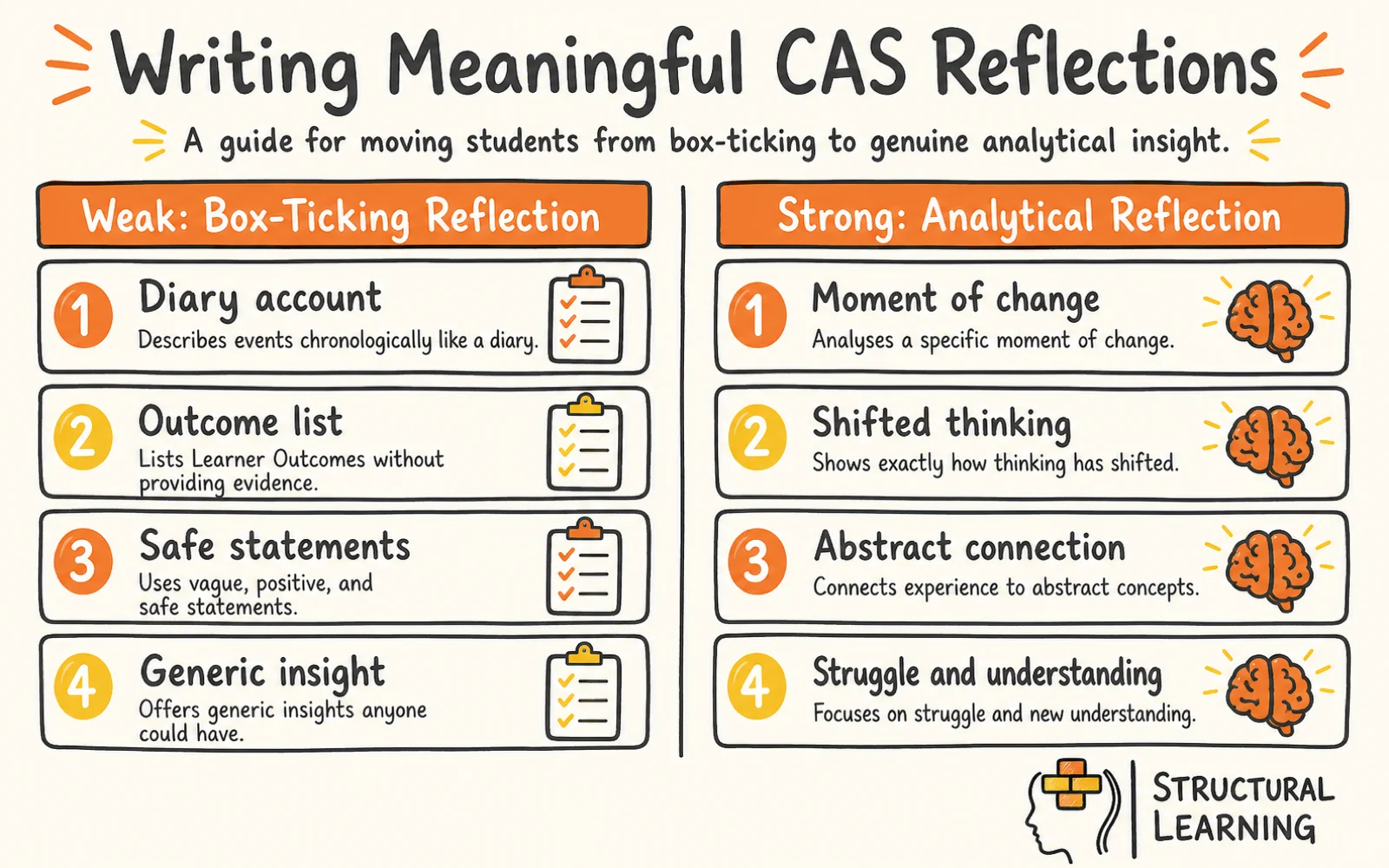
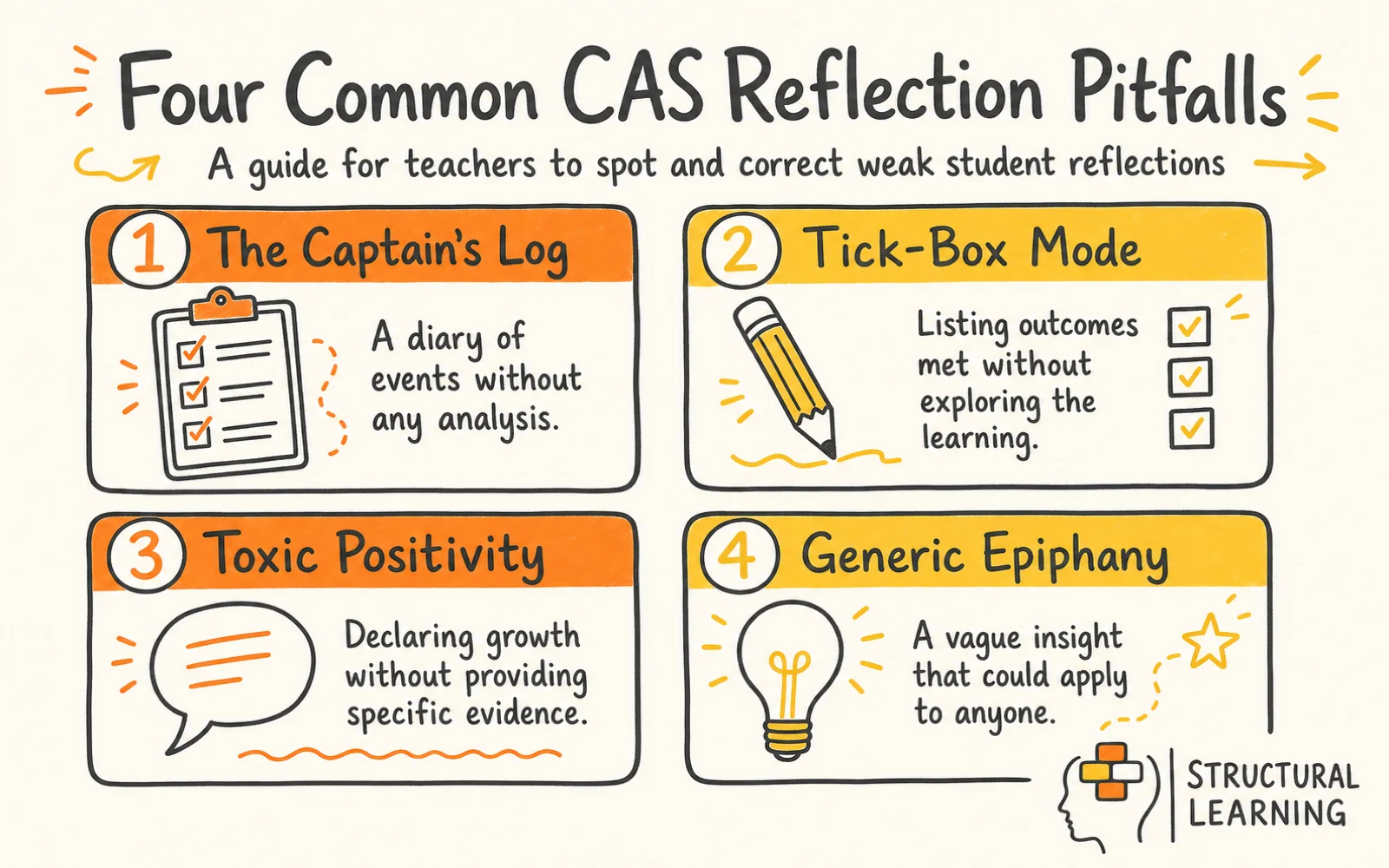
Most student reflections fall into four predictable patterns, and examiners spot them immediately.
The first is the Captain's Log: a chronological diary of what you did. "Week 1: I arrived at 9 a.m. The building was old. I met the coordinator. Week 2: I taught a lesson on fractions. The kids struggled at first. By Friday, they got it." This reads like a ship's log. It happened, but there's no analysis. You're describing the experience, not reflecting on what it taught you.
The second is Tick-Box Mode: you list which Learner Outcomes you met, as though filling a form. "I met Outcome 1 because I showed initiative. I met Outcome 3 because I planned the event. I met Outcome 5 because I collaborated." This isn't reflection; it's bureaucracy. You're checking boxes, not exploring what you learned.
The third is Toxic Positivity: you declare that the experience was meaningful and you grew, without showing any actual growth. "It was rewarding. Helping others is important. I am a good person." This feels safe, but it's hollow. Examiners have read thousands of these. They reward specificity and struggle, not blanket affirmations.
The fourth is Generic Epiphany: you land on a vague insight that could apply to anyone. "I learned that teamwork is important" or "I discovered that persistence pays off." These truths are so broad that they prove nothing about what you specifically learned.
Here's a weak reflection that combines all four flaws:
"I tutored a Year 3 student struggling with reading for 8 weeks. It was challenging but rewarding. I realized that patience is important when teaching. The child's confidence grew, and I felt proud. I learned Outcome 1 (I showed perseverance), Outcome 2 (I developed teaching skills), and Outcome 5 (I collaborated with the coordinator). This experience will help me in my future career. CAS was a great opportunity."
What's missing? Evidence of struggle, real analysis, specific insight tied to your thinking, connection to learning frameworks. It reads like a thank-you card, not a reflection. Examiners are looking for the moment you realized you were wrong about something, or the moment you had to rethink your approach mid-activity. That's where the learning lives.
The IBO's CAS guide lists seven Learner Outcomes. Most students read them and shrug. But examiners use these outcomes as a lens, and they reward a very specific kind of evidence. Let's decode what "good" actually looks like for each one.
| Learner Outcome | Surface-Level Reflection | What Examiners Reward |
|---|---|---|
| 1. Strengths & Growth | "I am a strong organizer." | "I avoided leadership roles because I feared being judged. In CAS, I led a workshop for 15 people. When the projector failed, I had to improvise. I discovered I can think quickly under pressure, something I didn't know about myself before." |
| 2. Challenge & Skill | "Painting a mural was challenging, but I finished it." | "I'd never used acrylic on a large scale. My first draft looked amateurish. I researched colour theory, tested three techniques on scrap material, and iterated. The final mural received local media coverage. I learned that mastery requires iteration, not just effort." |
| 3. Initiative & Planning | "I planned a fundraiser." | "I proposed a fundraiser to the school council. They rejected my first idea as too costly. I redesigned it, built a budget, secured sponsorship from three local businesses. This taught me that leadership is often negotiation, not command." |
| 4. Commitment & Perseverance | "I attended all 20 sessions." | "By week 4, I wanted to quit. The activity felt repetitive and I questioned why I was doing it. I recommitted by setting a personal challenge (mentor a new member), which renewed my motivation. I realized perseverance isn't the absence of doubt; it's choosing to continue despite it." |
| 5. Collaboration | "The team worked well together." | "Two team members had conflicting visions for the project. I facilitated a conversation where we mapped their ideas and found overlap. We adopted a hybrid approach. This taught me that collaboration isn't agreement; it's negotiation plus mutual respect." |
| 6. Global Engagement | "We did a beach cleanup for the environment." | "We cleaned the beach and documented microplastics. This led me to research ocean pollution. I realized a single beach cleanup is performative unless it's part of a larger advocacy effort. I'm now working with the city council to reduce single-use plastics at public events." |
| 7. Ethics & Actions | "Helping others was rewarding." | "We built a school library in a village. Midway, I realized we hadn't asked the community what they actually wanted. We assumed they needed books, but they needed training to use the library. This challenged my assumptions about whose voice matters in service work. Future projects will be co-designed with the community." |
Notice the pattern. Examiners reward specific moments where your thinking shifted. Not accomplishments. Not effort. Changed minds.
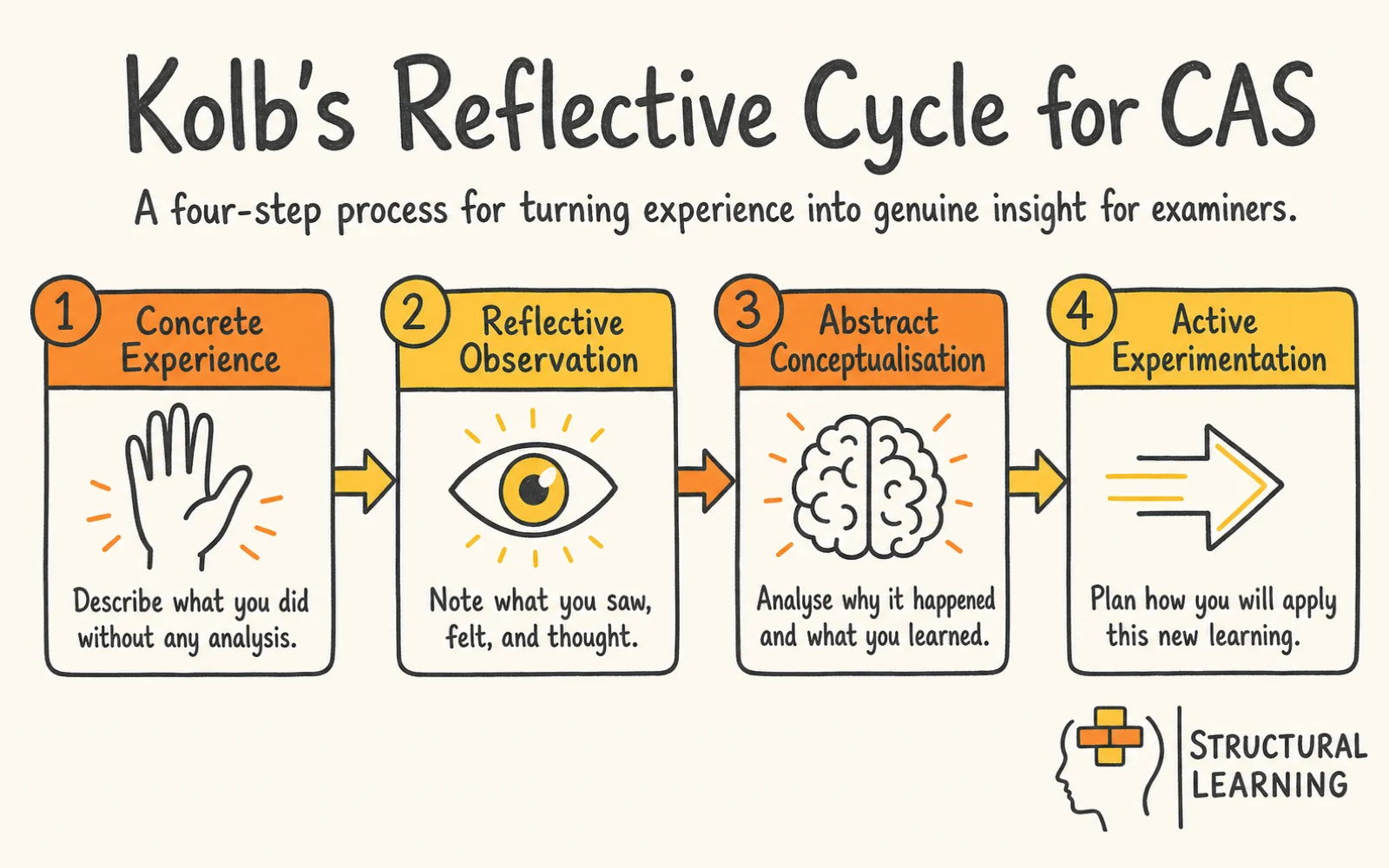
Most strong reflections, without knowing it, follow a structure developed by learning scientist David Kolb in the 1980s. Kolb's Experiential Learning Cycle (Kolb, 1984) maps how humans learn from experience through four stages. Understanding these stages will transform how you write reflections.
Stage 1: Concrete Experience. "I did the activity." This is the raw event. You tutored a student. You ran a fundraiser. You cleaned a beach. Most reflections stop here, just describing what happened.
Stage 2: Reflective Observation. "I noticed what happened and how I felt." You observed the student's frustration. You saw which fundraising tactics worked. You documented the microplastics. This is emotional and observational, not yet analytical. Again, many reflections stall here.
Stage 3: Abstract Conceptualization. "I analysed why it happened and what I learned." Here's where examiners perk up. You're now connecting the experience to a concept. You realized that your explanation was too complex, so you simplified it. You discovered that smaller, personal asks generate more donations than broad campaigns. You understood that beach cleanups are a symptom, not a solution. This is where you name what you learned.
Stage 4: Active Experimentation. "I'll apply this learning next time." You plan a future action based on what you learned. Next week, I'll use scaffolding with visuals. Next fundraiser, I'll start with a personal story. Next beach cleanup, I'll connect it to a policy change. Examiners love this stage because it proves you're not just reflecting; you're growing.
Here's a tutoring reflection mapped onto Kolb's cycle:
"For 4 weeks, I tutored Maya, age 7, who reads two years below her level (Concrete Experience). My initial approach, teaching phonetics rules, backfired. She shut down and refused to participate (Reflective Observation). In week 2, I realized I'd imposed my teaching method without meeting her needs. I switched to visual storytelling and colour-coded sounds. Her confidence returned (Abstract Conceptualization). This taught me that skill development requires iteration, not just effort. Next term, I'll apply this insight to a new student by starting with a diagnostic conversation to understand their learning preference before choosing a method (Active Experimentation)."
Notice how this reflection moves through all four stages. Weak reflections often stop at stage 2 (observation). Strong ones reach stage 4 (and plan future action).
Now that you understand Kolb's cycle, here's a practical 4-paragraph structure you can use immediately. Each paragraph answers one question.
Paragraph 1: What? (100-150 words) Describe the experience concretely. What happened? Who was involved? What was the challenge or goal? Stay factual and specific. Avoid vague language.
Paragraph 2: So What? (100-150 words) What did you observe, learn, or realize? This is where you name the insight. What surprised you? What contradicted your assumptions? What did you notice about yourself or others? This paragraph is the analytical heart of your reflection.
Paragraph 3: Now What? (100-150 words) How will you act on this learning? What will you do differently next time? What question will you investigate further? This forward-facing paragraph proves you're not just reminiscing; you're growing.
Paragraph 4: Connections (100-150 words) How does this experience connect to your other learning? Link it to a subject concept, an ATL skill, a TOK question, or the IB Learner Profile. This paragraph elevates your reflection from personal anecdote to integrated learning.
Here's a beach cleanup reflection using this structure:
"For our CAS service project, our team cleaned Silverstone Beach and documented the waste we collected (What). Afterwards, I was struck by how much plastic was single-use packaging. I assumed the problem was individual carelessness, but when I researched ocean pollution, I learned that systemic issues, corporate packaging standards and municipal waste infrastructure, drive most ocean plastic. I'd been thinking too small (So What). I'm now working with our local council to establish a single-use plastic policy for council-sanctioned events. I'll draft a proposal and present it next month (Now What). This connects to my Geography IA on sustainable supply chains and my TOK essay on how policy change happens. I'm also developing Learner Outcome 6 (Global Engagement) by moving from cleanup activities to advocacy (Connections)."
This structure forces you past description into real analysis. Try it on any CAS moment.
Let's compare two reflections on the same activity: tutoring a struggling reader.
Weak Reflection (Descriptive + Tick-Box):
"I tutored a Year 4 student in reading for 6 weeks. I created lesson plans and taught phonics strategies. The student's reading age improved from 6.2 to 6.8. I attended all sessions and communicated with the coordinator. I learned that teaching is rewarding. I met Learner Outcomes 1, 2, 3, and 5 through this activity."
What's the problem? There's no struggle, no analysis, no moment where the student's thinking, or the tutor's thinking, shifted. It's a résumé bullet point.
Strong Reflection (Analytical + Kolb-Aligned):
"I tutored Rajesh, age 8, who read 18 months below grade level. My first three sessions used a structured phonics programme, but Rajesh's confidence collapsed. He avoided reading and said 'I'm bad at this.' I realized I'd treated him as a deficit to fix, not a person with strengths. In week 4, I shifted strategy: I started sessions with texts he loved (comic books, graphic novels) and only introduced phonics when he was engaged. His participation and confidence returned. Within two weeks, he was choosing to read at home. This experience taught me (Outcome 1) that I can adapt my approach when something isn't working, something I didn't know about myself before. It also taught me (Outcome 2) that skill development requires understanding the learner, not just delivering content. Next term, I'll start every tutoring relationship with a strength-based diagnostic conversation instead of jumping to a standard programme. This connects to my Psychology study of growth mindset and to our school's Learner Profile commitment to 'open-minded' inquiry."
The difference is stark. The strong reflection shows a moment of failure, a conceptual realization, and a concrete change in approach. It's not perfect, but it's real.
The IBO explicitly encourages reflection through multiple mediums, not just written text. If writing isn't your strength, choose the medium that lets you think deepest.
A video reflection can follow the same structure as written reflection. A student might film themselves explaining a CAS experience, showing the stages of a project, or walking through a location while discussing what they learned. The advantage: you can show your thinking in real time, with visual evidence. The same analytical depth applies, don't just narrate what happened; analyze what you learned.
An audio reflection might be a voice memo recorded immediately after a CAS session, then transcribed and refined. This captures immediacy (reflection-in-action) without requiring formal writing. Again, move past description into analysis.
A visual reflection (sketch, infographic, photo essay) can show your learning visually. A student might create an annotated diagram of Kolb's cycle mapping their experience, or a photo essay contrasting "before and after" moments in a project. The constraint is the same: prove that something changed in your thinking.
An artistic reflection (poem, sculpture, music composition) can express learning emotionally and conceptually, though it requires a written explanation so examiners understand your analytical thinking. Don't let the medium become an excuse to avoid reflection.
Here's a secret examiners won't tell you: your worst CAS experience probably makes the best reflection.
Most students hide failures. They reflect on successes, polished outcomes, and activities where they felt confident. But examiners know that real learning happens when things go wrong.
If your fundraiser flopped, that's rich material. What did you assume would work? Why didn't it? What will you try differently? A reflection on failure, if it shows adaptive thinking, is far stronger than a reflection on smooth success.
Here's an example:
"I organized a school fundraiser for a local food bank. My original plan was to hold a fun run. We promoted it heavily, but only 12 students participated. We raised £85. I felt defeated. I could have written, 'The event was disappointing, but I learned that fundraising is hard.' Instead, I dug in. I interviewed the 12 who participated and found that most hadn't trained and felt unprepared. I asked the 88 who didn't: they said they preferred indoor activities in winter. For our next fundraiser, I designed an indoor quiz night with prizes donated by local businesses. We got 120 participants and raised £1,200. This taught me (Outcome 3) that planning requires testing assumptions with your audience, not just assuming what will work. My first failure was data. I learned to listen before deciding."
Failure reflections show resilience, adaptability, and intellectual honesty. They're gold.

The strongest CAS reflections don't stand alone. They connect to your DP subjects, your TOK essay, and the broader IB Learner Profile.
When you write the "Connections" paragraph, ask yourself: What concept from my subjects does this CAS experience illuminate? What TOK question does this raise? Which Learner Profile attribute did I develop?
Here's an example connecting a service project to multiple areas:
"Our service project documented air pollution near our school using low-cost particle sensors. The data showed pollution spikes during school arrival and dismissal times. This directly connects to my Chemistry IA on pollutant dispersion and to our TOK essay on 'How do we know what we know?' We validated our hypothesis using peer-reviewed environmental methods, but we also realized that community members' lived experience of pollution, what they feel versus what sensors measure, is valid knowledge too. This connects to the Learner Profile attribute 'open-minded': I learned to value both scientific data and community expertise. Next, I'm working with the school council to stagger arrival times to reduce congestion. This is Outcome 6 (Global Engagement) because I've moved from data collection to advocacy."
When your CAS reflection links to your subjects and to broader IB values, it becomes part of an integrated learning narrative, not an isolated activity.
The IB's five clusters of Approaches to Learning (ATL) are embedded in every CAS activity. Making these explicit strengthens your reflection.
Thinking Skills appear when you analyse what went wrong or hypothesize how to improve. Communication Skills emerge when you negotiate, present, or listen across a team. Social Skills show when you collaborate, support others, or navigate conflict. Self-Management surfaces when you manage time, regulate emotions, or show resilience. Research Skills come up when you investigate root causes or justify your project choice.
A reflection that names these skills is more credible than one that assumes they happened implicitly. Here's how:
Weak: "I developed teamwork skills."
Strong: "During our project, my co-coordinator and I disagreed on timeline. I asked clarifying questions about her concerns (Communication Skill: Listening), proposed a phased approach that addressed both our needs (Thinking Skill: Creative Problem-Solving), and documented our agreement (Self-Management Skill: Organization). This was a conscious practice of collaborative skills, not an accident."
Name the skill. Show the evidence. That's what examiners reward.
Before you submit your reflection, run through this checklist.
Does it start with a concrete experience (Kolb Stage 1)? Not vague themes, but specific people, places, moments?
Does it include a moment where you noticed something (Stage 2)? An observation, surprise, or contradiction?
Does it analyze why that moment mattered (Stage 3)? Not just "I felt good," but "I realized I was wrong about X" or "This taught me that Y"?
Does it point to a future action (Stage 4)? What will you do differently or investigate further?
Does it name specific Learner Outcomes with evidence? Not "I met Outcome 1," but "Outcome 1 is evident here because [specific evidence]"?
Does it avoid surface platitudes? No "helping others is rewarding" or "teamwork is important" without backing them up?
Have you used specific names, numbers, and details? Not "a student" but "Maya, age 7, reading 18 months below grade level"?
Does it connect to something beyond CAS? A subject concept, a TOK question, or a Learner Profile attribute?
Does it show vulnerability? A struggle, failure, or misconception you had to work through?
Have you read it aloud? Does it sound like your thinking, or like a template you filled in?
Is it 400-600 words of quality over 1,500 words of filler? Depth, not length?
Have you checked your grammar and spelling? Sloppy writing undermines strong thinking.
If you can tick all 12, you're ready to submit.
If you're a tutor or coordinator reading this, here's how to shepherd students toward deeper reflection without doing it for them.
Instead of asking, "Reflect on your CAS experience," ask, "Tell me a moment in your CAS when something didn't go the way you expected. What did you learn?" This prompts for struggle and insight, not description.
Use one-on-one reflection conferences. Ask a student to read their reflection aloud, then ask: "Where is your biggest realization in this piece? What surprised you about yourself?" This trains students to locate and articulate insight.
Offer a peer review protocol. Have students swap reflections and ask: "What did the writer change their mind about? What will they do differently next time?" This gives feedback on depth, not length.
Model reflection yourself. Share a time you tried something, failed, and changed your approach. Show the thinking process. Students learn by watching adults reflect critically.
Don't accept surface reflections without pushing back. "You said teamwork was important. Show me a specific moment where collaboration was difficult. How did you navigate it?" This nudge toward specificity is coaching, not criticism.
Finally, celebrate reflections on failure. When a student reflects critically on a flopped project, highlight what made that reflection excellent. You're training students to see failure as the richest learning material available.
Do I need to reflect on every single CAS hour?
No. The IBO guide emphasizes "quality over quantity." Reflect deeply on significant moments: a challenge you overcame, a failure that forced you to rethink, a collaboration that changed how you see teamwork, a moment when you realized you were wrong about something. One profound reflection is worth more than a dozen surface-level logs.
Can I submit a reflection on a failed CAS project?
Yes, absolutely. In fact, well-reflected failures are often stronger than successful projects with shallow reflection. Examiners reward critical thinking and evidence of learning. A project that didn't achieve its goal but taught you something about planning, resilience, or systems change? That's excellent material.
How honest can I be about conflicts with my team in a reflection?
Very honest. Reflection is for learning, not performance. Naming a conflict, explaining how you worked through it, and articulating what you learned about collaboration is exactly what examiners want to see. Pretending everything was harmonious rings hollow.
Should my reflection be written, or can it be a video, audio, or artwork?
The IBO explicitly encourages multimodality. Choose the medium where you think deepest. A video reflection that narrates your thinking step-by-step is valid. A visual essay showing before-and-after learning is valid. Audio recorded immediately after a session is valid. But whatever medium you choose, apply the same analytical structure: What happened? What did you realize? What will you do differently? How does it connect to your learning?
Is it OK if my reflection is short (under 300 words)?
Yes, if it's analytical. A 200-word reflection that moves through all four Kolb stages and lands a specific insight is stronger than a 1,000-word description. Quality matters; length doesn't. That said, don't use brevity as an excuse to avoid depth. "I did X and learned Y" is too thin. Show the reasoning.
How do I connect my CAS experience to my DP subjects or TOK?
Ask: What concept from my subject did I encounter in CAS? Here are examples: "My service project on ocean pollution connects to my Biology IA on nutrient cycles. My team fundraiser connects to my Economics IA on behavioural decision-making. My community mentoring connects to my Psychology unit on social influence." For TOK, ask: What knowledge question does this raise? "How do we know if a service project has actually helped?" "What counts as evidence of real learning?" Then write the connection explicitly in your reflection.
What if my CAS experience seems ordinary or boring?
The most powerful reflections come from ordinary moments where you changed your mind. You don't need a dramatic project to write a strong reflection. You need a moment where you realized something was more complex than you thought. Maybe you tutored and discovered you're impatient. Maybe you volunteered and found out you dislike the work you thought you'd love. Maybe you collaborated and realized how much you rely on one person's approval. That's gold. Ordinary moments + genuine insight = strong reflection.

IB Official Documents
IB. (2017). Creativity, Activity and Service (CAS) Guide. International Baccalaureate. https://www.ibo.org/contentassets/fcfbddfbf14e41e496af5cc45d2e28a5/cas-guide-2017-en.pdf
IB. (2019). Approaches to Learning: Strategies for Learning in the DP. International Baccalaureate. Available at: https://www.ibo.org
Foundational Research on Reflective Practice
Kolb, D. A. (1984). Experiential Learning: Experience as the Source of Learning and Development. Prentice Hall.
Schön, D. A. (1983). The Reflective Practitioner: How Professionals Think in Action. Basic Books.
Moon, J. A. (2004). A Handbook of Reflective and Experiential Learning: Theory and Practice. Routledge.
Gillet, J. (2017). Approaches to Learning in the IB Diploma Programme. International Baccalaureate. Available at: https://www.ibo.org
IB Subject Reports (CAS Analysis)
Explore deeper learning on IB frameworks and reflective practice:
These peer-reviewed studies provide the evidence base for the strategies discussed above.
Decolonising the curriculum beyond the surge: Conceptualisation, positionality and conduct View study ↗
27 citations
Moghli et al. (2021)
This paper examines how to meaningfully integrate diverse perspectives into curricula rather than simply adding tokenistic content. Teachers can use this research to develop more inclusive lesson plans that genuinely represent different cultural viewpoints and encourage students to think critically about knowledge construction.
Step-by-Step Method Combined with Simulation-Enhanced Learner Outcomes in Minimally Invasive Breast Surgery Education View study ↗
Wang et al. (2022)
This study demonstrates how combining step-by-step instruction with simulation improves practical skill development in medical education. Teachers in technical subjects can apply these findings by incorporating hands-on simulations alongside traditional lectures to enhance students' analytical thinking and practical application abilities.
Fostering Social Justice through Qualitative Inquiry View study ↗
25 citations
Johnson et al. (2022)
This resource provides methods for conducting research that addresses social inequalities and supports marginalised communities. Teachers can use these qualitative inquiry approaches to help students engage with social justice issues meaningfully, moving beyond theoretical discussions to practical action and advocacy.
GenAI-Enabled AI Teachers and Student Learning Engagement Across International Higher Education Contexts View study ↗
Berglund et al. (2026)
This research explores how AI teaching tools affect student engagement across different cultural contexts. Teachers can gain insights into effectively integrating AI technologies whilst maintaining meaningful human interaction and ensuring these tools enhance rather than replace authentic learning experiences.
Becoming a Doctor: One Physician's Journey Beyond Competence. View study ↗
Ventres (2014)
Without an available abstract, this appears to explore professional development beyond basic competency requirements. Teachers may find relevant insights about continuous professional growth, reflective practice, and developing expertise that extends beyond meeting minimum standards in their educational practice.
{"@context":"https://schema.org","@graph":[{"@type":"Organization","@id":"https://www.structural-learning.com/#org","name":"Structural Learning","url":"https://www.structural-learning.com/","logo":{"@type":"ImageObject","url":"https://cdn.prod.website-files.com/5b69a01ba2e409501de055d1/5b69a01ba2e40996a5e055f4_structural-learning-logo.png"}},{"@type":"Person","@id":"https://www.structural-learning.com/team/paul-main/#person","name":"Paul Main","url":"https://www.structural-learning.com/team/paul-main","jobTitle":"Founder","affiliation":{"@id":"https://www.structural-learning.com/#org"}},{"@type":"BreadcrumbList","@id":"https://www.structural-learning.com/post/meaningful-cas-reflections-beyond-box-ticking#breadcrumb","itemListElement":[{"@type":"ListItem","position":1,"name":"Home","item":"https://www.structural-learning.com/"},{"@type":"ListItem","position":2,"name":"Blog","item":"https://www.structural-learning.com/blog"},{"@type":"ListItem","position":3,"name":"Meaningful CAS Reflections: Beyond Box-Ticking","item":"https://www.structural-learning.com/post/meaningful-cas-reflections-beyond-box-ticking"}]},{"@type":"BlogPosting","@id":"https://www.structural-learning.com/post/meaningful-cas-reflections-beyond-box-ticking#article","headline":"Meaningful CAS Reflections: Beyond Box-Ticking","description":"Learn to write CAS reflections that examiners reward. Move beyond tick-box thinking with Kolb's framework, worked examples, and the 7 Learner Outcomes decoded for real growth.","author":{"@id":"https://www.structural-learning.com/team/paul-main/#person"},"publisher":{"@id":"https://www.structural-learning.com/#org"},"datePublished":"2026-04-22","dateModified":"2026-04-22","inLanguage":"en-GB"}]}