The Simple View of Reading: Gough & Tunmer's Framework Explained for TeachersThe Simple View of Reading: Gough & Tunmer's Framework Explained for Teachers: practical strategies for teachers

Updated on  

March 20, 2026

The Simple View of Reading: Gough & Tunmer's Framework Explained for Teachers

|

March 19, 2026

The simple view of reading gough tunmer word recognition language comprehension model explained for UK teachers. A guide to RC = D x LC, assessment & intervention.

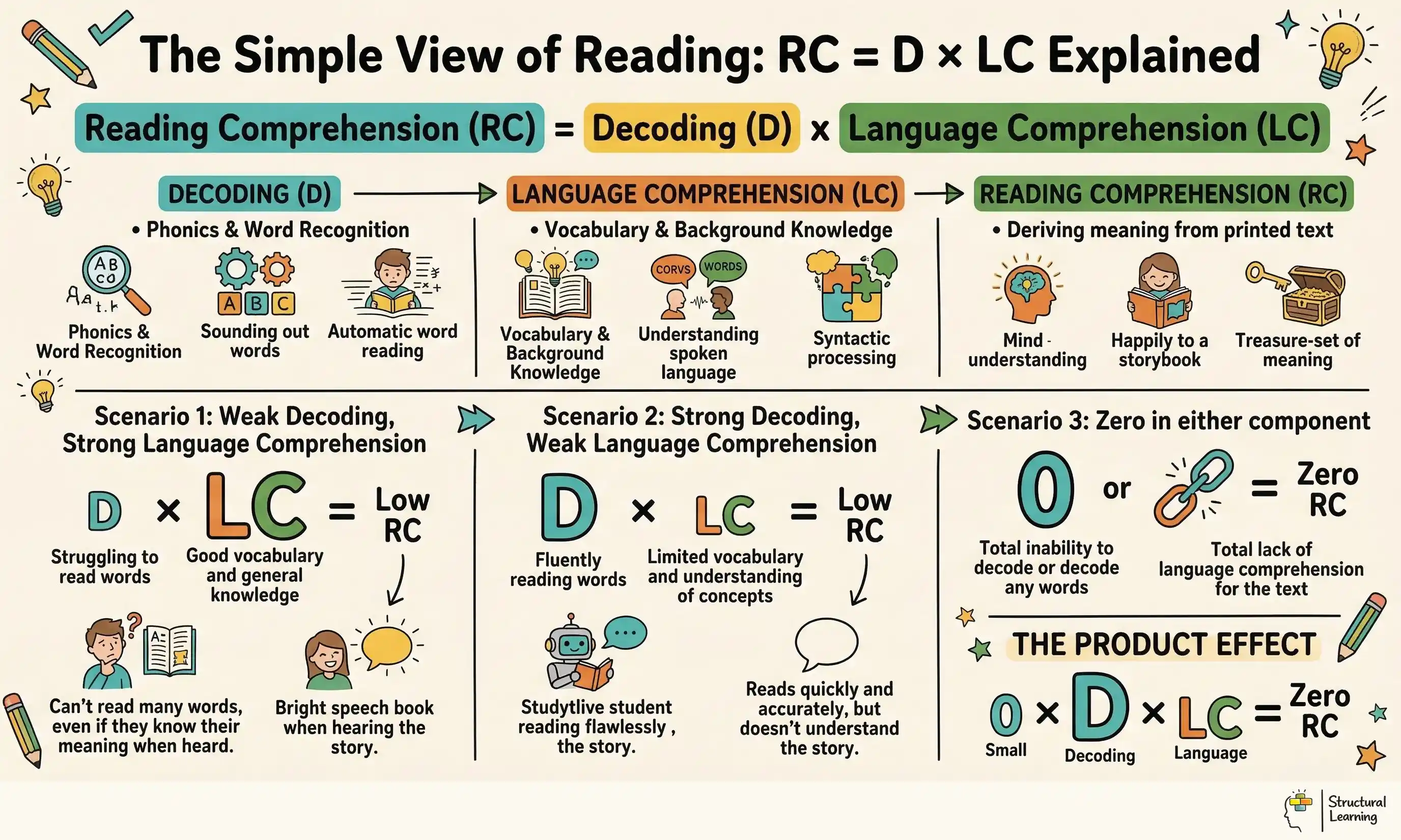
The Simple View <a href=of Reading: RC = D × LC Explained infographic for teachers" loading="lazy">
The Simple View of Reading: RC = D × LC Explained

Key Takeaways

  • The Simple View of Reading is a formula: Reading Comprehension = Decoding × Language Comprehension. If either skill is zero, comprehension fails.
  • Decoding (Word Recognition) is the ability to translate printed words into speech, relying on phonological awareness, phonics knowledge, and sight recognition.
  • Language Comprehension is the ability to understand spoken language, including vocabulary, background knowledge, and understanding of sentence structure (syntax).
  • The model identifies four reader profiles: Typical (good D, good LC), Dyslexic (poor D, good LC), Hyperlexic (good D, poor LC), and Mixed Difficulties (poor D, poor LC).
  • To diagnose a reading issue, assess decoding and language comprehension separately. Use nonsense words to test pure decoding. Read a text aloud to a pupil to test decoding-free language comprehension.
  • Intervention must be specific. If decoding is the bottleneck, focus on systematic phonics. If language comprehension is weak, focus on vocabulary, background knowledge and structured talk.
  • Scarborough's Reading Rope (2001) details the sub-skills woven into Decoding and Language Comprehension, rather than presenting a different theory.

What is the Simple View of Reading?

The Simple View of Reading is an evidence-based model defining reading comprehension as the product of decoding and language comprehension. Proposed by Gough and Tunmer (1986), it provides a framework for understanding how reading works.

The model is expressed as: Reading Comprehension = Decoding × Language Comprehension. This highlights that successful reading requires proficiency in both. A weakness in one area cannot be compensated for by strength in the other.

The core purpose is to give teachers a diagnostic tool. By understanding these distinct components, educators can identify the root cause of reading difficulties and provide targeted support, rather than generic intervention.

Why The Formula Matters for Teachers

The formula’s use of multiplication is critical. If the skills were additive (Decoding + Language Comprehension), a pupil with strong listening comprehension could understand a text without decoding, which is impossible.

Because the skills are multiplicative, a weakness in one area impacts the outcome. If either skill is zero, the entire product is zero. A pupil who cannot decode any words (Decoding = 0) will have zero reading comprehension, regardless of vocabulary and background knowledge.

This "zero effect" is fundamental. A pupil who decodes fluently but has weak language comprehension (e.g., Decoding = 1, Language Comprehension = 0.2) will have poor comprehension (1 x 0.2 = 0.2). Conversely, a pupil with excellent language skills but weak decoding (e.g., Decoding = 0.2, Language Comprehension = 1) will also have poor comprehension (0.2 x 1 = 0.2). This helps teachers target the correct intervention.

Decoding (Word Recognition) in the Classroom

Decoding is converting printed text into spoken language. It is the mechanical, print-based part of reading and encompasses sub-skills. Without fast, accurate decoding, a pupil's cognitive resources are spent on word recognition, leaving no capacity for understanding (Sweller, 1988).

What the teacher does: The teacher explicitly teaches systematic synthetic phonics. To assess pure decoding, they present pupils with nonsense words (e.g., "vib", "terg", "plom") that follow English phonetic rules. This prevents pupils relying on known words.

What the pupils do: Pupils look at the nonsense words and say the corresponding sounds aloud. For example, seeing "jound", the pupil says "/j/ /ou/ /n/ /d/". This demonstrates their ability to apply phonic knowledge to unfamiliar words.

Language Comprehension in the Classroom

Language Comprehension is deriving meaning from spoken language. It involves non-print skills, including vocabulary, understanding sentence structure (syntax), and relevant background knowledge. It is the "meaning making" part of the equation.

Castles, Rastle, and Nation (2018) affirmed that decoding and language comprehension are essential and distinct contributors to reading ability. A child's reading comprehension will never exceed their listening comprehension.

What the teacher does: To isolate Language Comprehension, the teacher removes the burden of decoding. They select a challenging, age-appropriate text and read it aloud to a pupil. They then ask comprehension questions.

What the pupils do: The pupil listens to the text. They then answer questions requiring inference and understanding of vocabulary and sentence structure. For example, after hearing "The exhausted explorer stumbled towards the oasis," the teacher might ask, "How was the explorer feeling? What does 'oasis' mean here?" The pupil's ability to answer reveals their Language Comprehension, independent of decoding skill.

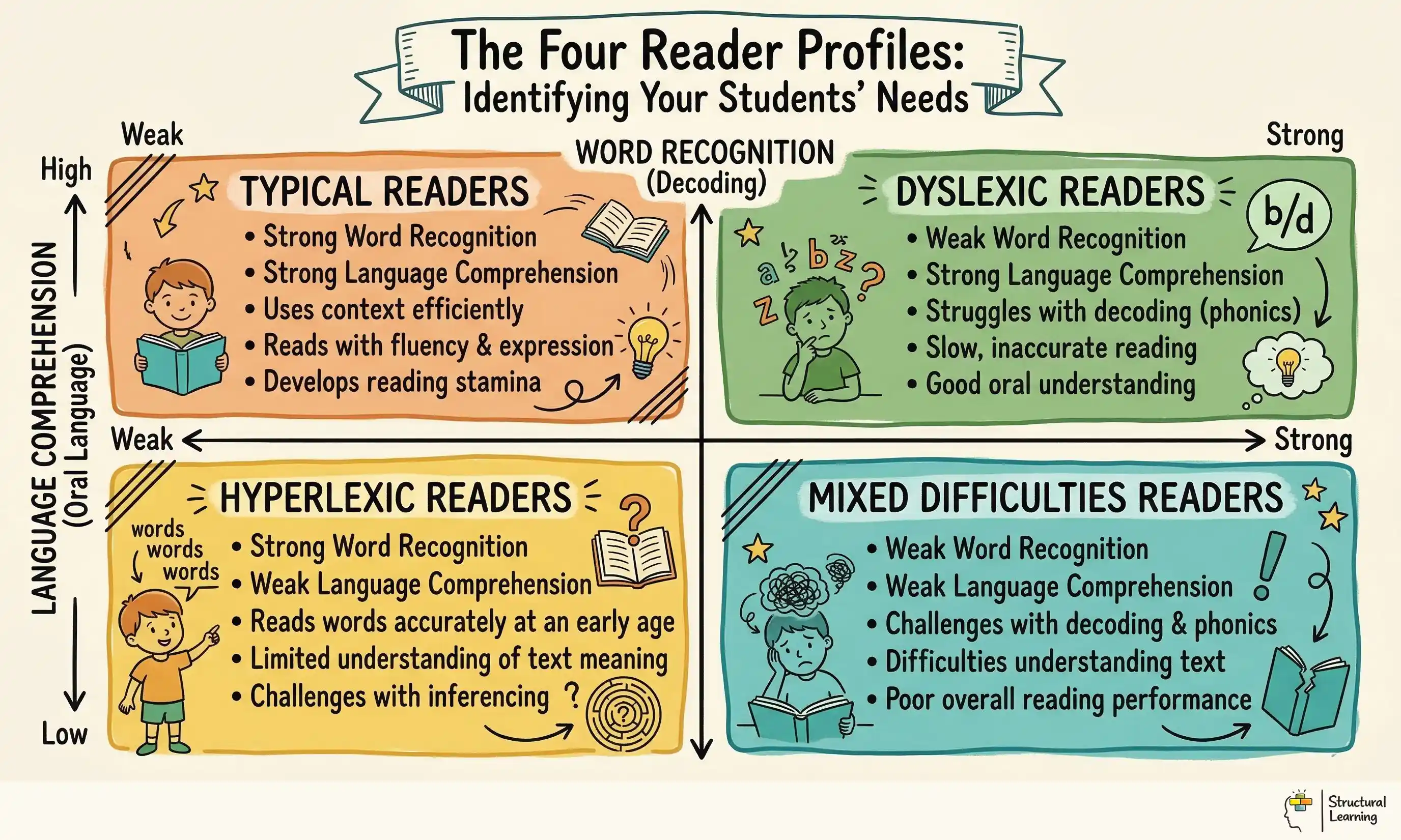
The Four Reader Profiles: Identifying Your Students' Needs infographic for teachers
The Four Reader Profiles: Identifying Your Students' Needs

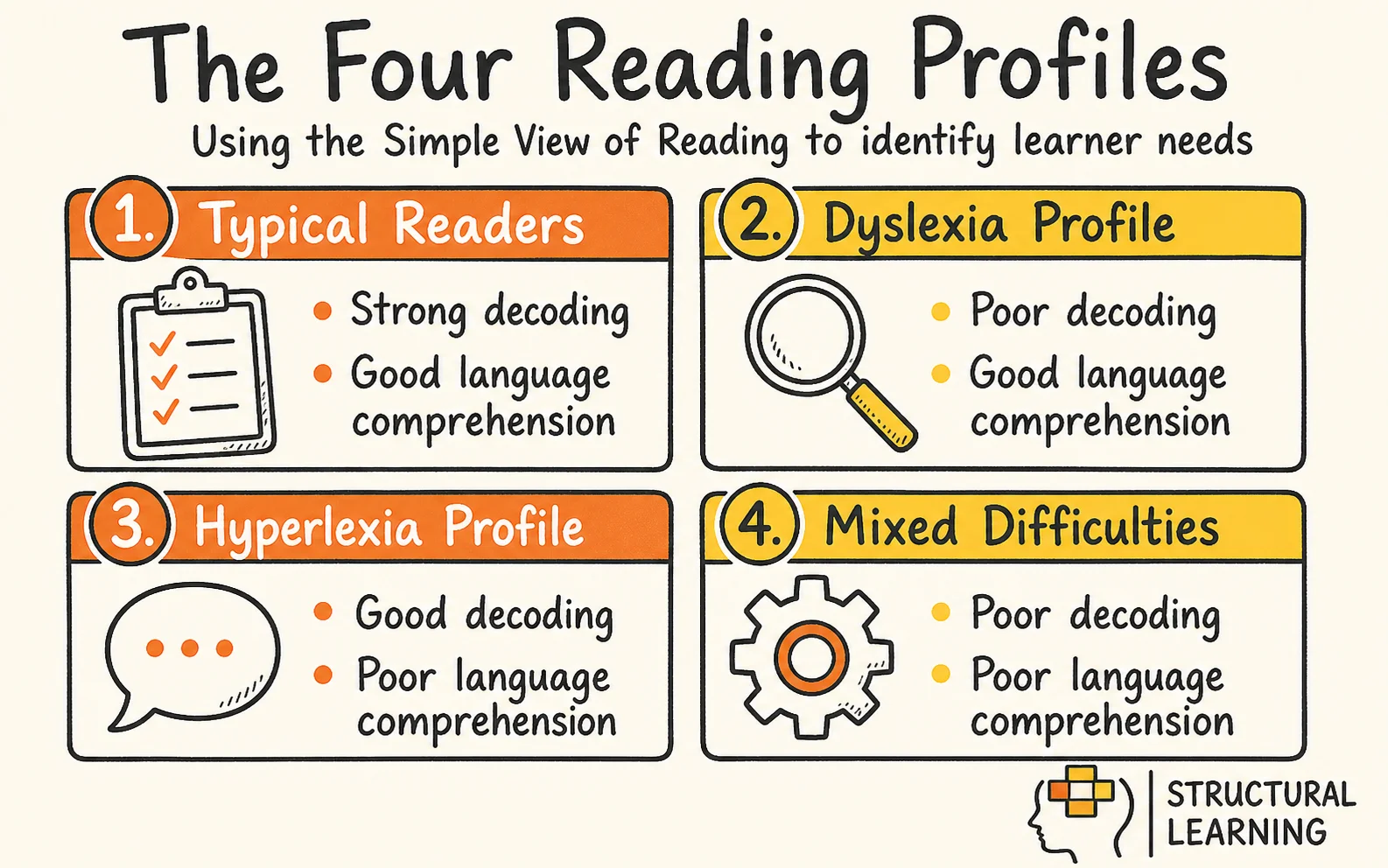
The Four Reading Profiles

The Simple View generates a diagnostic grid categorising readers into four profiles. By assessing decoding (D) and language comprehension (LC) independently, teachers can place a pupil in one of the quadrants and provide appropriate support.

Profile 1: Typical Readers (Good D, Good LC)

These pupils have strong skills in both areas. They decode accurately and have the language skills to understand what they read. They require continued instruction to progress.

Profile 2: Dyslexia (Poor D, Good LC)

This is the classic profile for dyslexia. These pupils have difficulties with word recognition and spelling. However, when a text is read aloud, their comprehension is strong. The intervention is intensive, systematic support in decoding.

Profile 3: Hyperlexia (Good D, Poor LC)

These pupils are "word callers." They decode fluently and accurately, often beyond their age. However, their understanding is weak. They require targeted intervention focused on vocabulary, background knowledge, and making connections in a text.

What the teacher does: The teacher uses graphic organisers to help pupils make connections between different parts of the text. For example, they might use a concept map to link characters, events, and themes. They also explicitly teach vocabulary, pre-teaching key words before reading.

What the pupils do: Pupils complete the graphic organiser, filling in details about the text and making connections between different elements. They also participate in discussions about the meaning of new vocabulary words.

Profile 4: Mixed Difficulties (Poor D, Poor LC)

These pupils have weaknesses in both decoding and language comprehension. They require intensive intervention in both areas, often starting with foundational decoding skills while simultaneously building oral vocabulary and knowledge.

Connection to Scarborough's Reading Rope

Scarborough's Reading Rope (2001) elaborates on the Simple View. It visualises how Decoding and Language Comprehension are made of smaller strands.
The "Lower Strands" represent Word Recognition (Decoding) and include phonological awareness, decoding, and sight recognition. The "Upper Strands" represent Language Comprehension, including background knowledge, vocabulary, language structures, verbal reasoning, and literacy knowledge.

Scarborough's metaphor shows that for a beginner reader, these strands are separate. Through practice, they become intertwined and automatic, weaving together into the rope of a skilled reader. This helps teachers see how specific sub-skill interventions (like phonemic awareness) contribute to proficient reading comprehension.

Common Misconceptions

1. "The Simple View is just about phonics."

Incorrect. The model gives equal weight to Language Comprehension. Phonics is essential for decoding, but it is only half of the equation.

2. "You can add the skills together."

The multiplicative relationship (D × LC) is non-negotiable. If a teacher believes the skills are additive (D + LC), they might misdiagnose a problem, assuming strong oral language can compensate for an inability to decode.

3. "It's a complete reading programme."

The Simple View is a diagnostic framework, not a curriculum. It tells you what needs to be taught by identifying the area of weakness, but it does not prescribe a specific programme or teaching method, other than ensuring the intervention matches the need.

4. "It only applies to young children."

The framework is relevant for readers of all ages. While decoding issues are more common in primary school, language comprehension difficulties can become more apparent in secondary school as texts become more abstract and complex. An older pupil who struggles with comprehension may have underlying language weaknesses masked by simpler texts.

Practical Implementation Guide

A teacher can use the Simple View to diagnose a struggling reader with this plan.

Step 1: Create a Hypothesis.
You have a pupil, Tom, who reads haltingly and cannot answer basic questions. Your initial hypothesis is that he has a decoding problem, but you need to be sure.

Step 2: Assess Decoding in Isolation.

Use a list of nonsense words. You give Tom a list containing "plood," "snig," and "framble." He struggles, mispronouncing them or guessing. This provides evidence that his decoding (D) is weak.

Step 3: Assess Language Comprehension in Isolation.

Choose a short, engaging text at Tom's chronological age level. You read the text aloud to him, ensuring he is only listening. You then ask him five comprehension questions. He answers four correctly, demonstrating strong oral language and background knowledge. This provides evidence his language comprehension (LC) is strong.

Step 4: Plot the Profile and Plan Intervention.

Tom has poor decoding and good language comprehension. He fits the Dyslexic profile. The intervention is clear: you do not need to work on general comprehension strategies. You must provide targeted, systematic synthetic phonics instruction to improve his decoding (D) variable.

The Simple View Across Subjects

English: When analysing a poem, a pupil must first decode the words accurately. Then, they need the language comprehension to understand the vocabulary, syntax, and figurative language (metaphor, simile).

What the teacher does: The teacher models how to decode a complex sentence from a poem, breaking it down into smaller parts. They then ask pupils to identify examples of figurative language and explain their meaning.

What the pupils do: Pupils work in pairs to decode and analyse a different sentence from the poem. They then share their findings with the class, explaining the meaning of the sentence and identifying any examples of figurative language.

Maths: A pupil reads a word problem: "A shopkeeper has 37 apples and sells 19. How many are left?" They must first decode every word. Then, they need the language comprehension to understand the vocabulary ('sells', 'left') and the syntax that signals a subtraction operation is required.

Science: During an experiment, a pupil reads the instruction: "Carefully add the saline solution to the beaker." Decoding allows them to read the words. Language comprehension, drawing on background knowledge, tells them what 'saline solution' and 'beaker' are, and that 'carefully' implies a specific manner of action.

Targeted Interventions: Matching Solutions to Reading Difficulties infographic for teachers
Targeted Interventions: Matching Solutions to Reading Difficulties

Common Questions About The Simple View

Is the Simple View of Reading still relevant?

Yes. Research (Hoover & Gough, 1990; Castles, Rastle, & Nation, 2018) has confirmed its validity. It remains the most scientifically robust and practical model of reading for classroom teachers.

How does reading fluency fit into the model?

Fluency (reading with accuracy, speed, and prosody) is the bridge between decoding and comprehension. When decoding becomes automatic, it frees up cognitive capacity, allowing the brain to focus on meaning. Therefore, fluency is the outcome of expert decoding, not a separate component in the initial formula.

What about older pupils in secondary school?

The Simple View is crucial for secondary teachers. While most older pupils have mastered basic decoding, many struggle with the increasing demands on their Language Comprehension. Subject-specific vocabulary, complex sentence structures, and the need for deep background knowledge all fall under the LC component.

Can I use the Simple View for my EAL pupils?

Yes. The model is effective for pupils with English as an Additional Language. It helps distinguish between a pupil who is struggling to decode English print and a pupil who has good decoding but needs more support with English vocabulary and sentence structures (Language Comprehension).

For your next lesson with a struggling reader, remove the decoding demand. Read a challenging text to them and ask questions. Their answers will tell you everything you need to know about the strength of their language comprehension and will show you exactly where to focus your support.

Further Reading: Key Research Papers

These peer-reviewed studies provide the evidence base for the strategies discussed above.

Why Did All the Residents Resign? Key Takeaways From the Junior Physicians' Mass Walkout in South Korea. View study ↗
23 citations

Park et al. (2024)

This paper examines a healthcare workforce crisis in South Korea but offers limited direct relevance to classroom teachers. However, it may provide insights into professional retention and workplace conditions that could inform discussions about teacher retention and educational policy reforms.

Cultivating connectedness and elevating educational experiences for international students in blended learning: reflections from the pandemic era and key takeaways View study ↗

He et al. (2024)

This study explores how videoconferencing technology enhances blended learning for international students during the pandemic. Teachers can apply these findings to improve online engagement strategies, build stronger connections with diverse learners, and integrate technology more effectively in hybrid classroom environments.

Who Benefits and under What Conditions from Developmental Education Reform? Key Takeaways from Florida’s Statewide Initiative View study ↗

Mokher et al. (2023)

This research examines developmental education reforms in Florida's higher education system. Secondary teachers can gain insights into how their students might transition to post-secondary education and understand which support strategies are most effective for students requiring developmental coursework.

Why are some students “not into” computational thinking activities embedded within high school science units? Key takeaways from a microethnographic discourse analysis study View study ↗

Aslan et al. (2024)

This study investigates why some students disengage from computational thinking activities in science lessons. It provides valuable insights for teachers about student motivation, helping them identify barriers to engagement and develop more inclusive approaches to integrating computational thinking across subjects.

Establishing a distance PharmD program: An overview and key takeaways. View study ↗

Rao et al. (2025)

This paper discusses establishing distance pharmacy education programmes during COVID-19. Whilst subject-specific, it offers teachers insights into effective online programme delivery, student support systems, and maintaining educational quality in distance learning environments across different disciplines.

Free Resource Pack

The Simple View Of Reading Toolkit

An essential toolkit for understanding and applying Gough & Tunmer's framework in your classroom.

The Simple View Of Reading Toolkit — 3 resources
Simple View of Reading Gough & Tunmer Reading Comprehension Decoding Language Comprehension Teacher CPD Lesson Planning Reading Instruction Reading Strategy

Download your free bundle

Fill in your details below and we'll send the resource pack straight to your inbox.

Quick survey (helps us create better resources)

How confident do you feel applying the Simple View of Reading (Gough & Tunmer's framework) to inform your teaching practice?

Not at all confident
Slightly confident
Moderately confident
Very confident
Extremely confident

To what extent do your colleagues and school leadership actively integrate the Simple View of Reading framework into teaching discussions and strategies?

Not at all
Rarely
Sometimes
Often
Consistently

How frequently do you currently use the Simple View of Reading framework to diagnose reading difficulties or plan targeted interventions for your students?

Never
Rarely
Sometimes
Often
Always

Your resource pack is ready

We've also sent a copy to your email. Check your inbox.

Loading audit...

The Simple View <a href=of Reading: RC = D × LC Explained infographic for teachers" loading="lazy">
The Simple View of Reading: RC = D × LC Explained

Key Takeaways

  • The Simple View of Reading is a formula: Reading Comprehension = Decoding × Language Comprehension. If either skill is zero, comprehension fails.
  • Decoding (Word Recognition) is the ability to translate printed words into speech, relying on phonological awareness, phonics knowledge, and sight recognition.
  • Language Comprehension is the ability to understand spoken language, including vocabulary, background knowledge, and understanding of sentence structure (syntax).
  • The model identifies four reader profiles: Typical (good D, good LC), Dyslexic (poor D, good LC), Hyperlexic (good D, poor LC), and Mixed Difficulties (poor D, poor LC).
  • To diagnose a reading issue, assess decoding and language comprehension separately. Use nonsense words to test pure decoding. Read a text aloud to a pupil to test decoding-free language comprehension.
  • Intervention must be specific. If decoding is the bottleneck, focus on systematic phonics. If language comprehension is weak, focus on vocabulary, background knowledge and structured talk.
  • Scarborough's Reading Rope (2001) details the sub-skills woven into Decoding and Language Comprehension, rather than presenting a different theory.

What is the Simple View of Reading?

The Simple View of Reading is an evidence-based model defining reading comprehension as the product of decoding and language comprehension. Proposed by Gough and Tunmer (1986), it provides a framework for understanding how reading works.

The model is expressed as: Reading Comprehension = Decoding × Language Comprehension. This highlights that successful reading requires proficiency in both. A weakness in one area cannot be compensated for by strength in the other.

The core purpose is to give teachers a diagnostic tool. By understanding these distinct components, educators can identify the root cause of reading difficulties and provide targeted support, rather than generic intervention.

Why The Formula Matters for Teachers

The formula’s use of multiplication is critical. If the skills were additive (Decoding + Language Comprehension), a pupil with strong listening comprehension could understand a text without decoding, which is impossible.

Because the skills are multiplicative, a weakness in one area impacts the outcome. If either skill is zero, the entire product is zero. A pupil who cannot decode any words (Decoding = 0) will have zero reading comprehension, regardless of vocabulary and background knowledge.

This "zero effect" is fundamental. A pupil who decodes fluently but has weak language comprehension (e.g., Decoding = 1, Language Comprehension = 0.2) will have poor comprehension (1 x 0.2 = 0.2). Conversely, a pupil with excellent language skills but weak decoding (e.g., Decoding = 0.2, Language Comprehension = 1) will also have poor comprehension (0.2 x 1 = 0.2). This helps teachers target the correct intervention.

Decoding (Word Recognition) in the Classroom

Decoding is converting printed text into spoken language. It is the mechanical, print-based part of reading and encompasses sub-skills. Without fast, accurate decoding, a pupil's cognitive resources are spent on word recognition, leaving no capacity for understanding (Sweller, 1988).

What the teacher does: The teacher explicitly teaches systematic synthetic phonics. To assess pure decoding, they present pupils with nonsense words (e.g., "vib", "terg", "plom") that follow English phonetic rules. This prevents pupils relying on known words.

What the pupils do: Pupils look at the nonsense words and say the corresponding sounds aloud. For example, seeing "jound", the pupil says "/j/ /ou/ /n/ /d/". This demonstrates their ability to apply phonic knowledge to unfamiliar words.

Language Comprehension in the Classroom

Language Comprehension is deriving meaning from spoken language. It involves non-print skills, including vocabulary, understanding sentence structure (syntax), and relevant background knowledge. It is the "meaning making" part of the equation.

Castles, Rastle, and Nation (2018) affirmed that decoding and language comprehension are essential and distinct contributors to reading ability. A child's reading comprehension will never exceed their listening comprehension.

What the teacher does: To isolate Language Comprehension, the teacher removes the burden of decoding. They select a challenging, age-appropriate text and read it aloud to a pupil. They then ask comprehension questions.

What the pupils do: The pupil listens to the text. They then answer questions requiring inference and understanding of vocabulary and sentence structure. For example, after hearing "The exhausted explorer stumbled towards the oasis," the teacher might ask, "How was the explorer feeling? What does 'oasis' mean here?" The pupil's ability to answer reveals their Language Comprehension, independent of decoding skill.

The Four Reader Profiles: Identifying Your Students' Needs infographic for teachers
The Four Reader Profiles: Identifying Your Students' Needs

The Four Reading Profiles

The Simple View generates a diagnostic grid categorising readers into four profiles. By assessing decoding (D) and language comprehension (LC) independently, teachers can place a pupil in one of the quadrants and provide appropriate support.

Profile 1: Typical Readers (Good D, Good LC)

These pupils have strong skills in both areas. They decode accurately and have the language skills to understand what they read. They require continued instruction to progress.

Profile 2: Dyslexia (Poor D, Good LC)

This is the classic profile for dyslexia. These pupils have difficulties with word recognition and spelling. However, when a text is read aloud, their comprehension is strong. The intervention is intensive, systematic support in decoding.

Profile 3: Hyperlexia (Good D, Poor LC)

These pupils are "word callers." They decode fluently and accurately, often beyond their age. However, their understanding is weak. They require targeted intervention focused on vocabulary, background knowledge, and making connections in a text.

What the teacher does: The teacher uses graphic organisers to help pupils make connections between different parts of the text. For example, they might use a concept map to link characters, events, and themes. They also explicitly teach vocabulary, pre-teaching key words before reading.

What the pupils do: Pupils complete the graphic organiser, filling in details about the text and making connections between different elements. They also participate in discussions about the meaning of new vocabulary words.

Profile 4: Mixed Difficulties (Poor D, Poor LC)

These pupils have weaknesses in both decoding and language comprehension. They require intensive intervention in both areas, often starting with foundational decoding skills while simultaneously building oral vocabulary and knowledge.

Connection to Scarborough's Reading Rope

Scarborough's Reading Rope (2001) elaborates on the Simple View. It visualises how Decoding and Language Comprehension are made of smaller strands.

The "Lower Strands" represent Word Recognition (Decoding) and include phonological awareness, decoding, and sight recognition. The "Upper Strands" represent Language Comprehension, including background knowledge, vocabulary, language structures, verbal reasoning, and literacy knowledge.

Scarborough's metaphor shows that for a beginner reader, these strands are separate. Through practice, they become intertwined and automatic, weaving together into the rope of a skilled reader. This helps teachers see how specific sub-skill interventions (like phonemic awareness) contribute to proficient reading comprehension.

Common Misconceptions

1. "The Simple View is just about phonics."

Incorrect. The model gives equal weight to Language Comprehension. Phonics is essential for decoding, but it is only half of the equation.

2. "You can add the skills together."

The multiplicative relationship (D × LC) is non-negotiable. If a teacher believes the skills are additive (D + LC), they might misdiagnose a problem, assuming strong oral language can compensate for an inability to decode.

3. "It's a complete reading programme."

The Simple View is a diagnostic framework, not a curriculum. It tells you what needs to be taught by identifying the area of weakness, but it does not prescribe a specific programme or teaching method, other than ensuring the intervention matches the need.

4. "It only applies to young children."

The framework is relevant for readers of all ages. While decoding issues are more common in primary school, language comprehension difficulties can become more apparent in secondary school as texts become more abstract and complex. An older pupil who struggles with comprehension may have underlying language weaknesses masked by simpler texts.

Practical Implementation Guide

A teacher can use the Simple View to diagnose a struggling reader with this plan.

Step 1: Create a Hypothesis.

You have a pupil, Tom, who reads haltingly and cannot answer basic questions. Your initial hypothesis is that he has a decoding problem, but you need to be sure.

Step 2: Assess Decoding in Isolation.

Use a list of nonsense words. You give Tom a list containing "plood," "snig," and "framble." He struggles, mispronouncing them or guessing. This provides evidence that his decoding (D) is weak.

Step 3: Assess Language Comprehension in Isolation.

Choose a short, engaging text at Tom's chronological age level. You read the text aloud to him, ensuring he is only listening. You then ask him five comprehension questions. He answers four correctly, demonstrating strong oral language and background knowledge. This provides evidence his language comprehension (LC) is strong.

Step 4: Plot the Profile and Plan Intervention.

Tom has poor decoding and good language comprehension. He fits the Dyslexic profile. The intervention is clear: you do not need to work on general comprehension strategies. You must provide targeted, systematic synthetic phonics instruction to improve his decoding (D) variable.

The Simple View Across Subjects

English: When analysing a poem, a pupil must first decode the words accurately. Then, they need the language comprehension to understand the vocabulary, syntax, and figurative language (metaphor, simile).

What the teacher does: The teacher models how to decode a complex sentence from a poem, breaking it down into smaller parts. They then ask pupils to identify examples of figurative language and explain their meaning.

What the pupils do: Pupils work in pairs to decode and analyse a different sentence from the poem. They then share their findings with the class, explaining the meaning of the sentence and identifying any examples of figurative language.

Maths: A pupil reads a word problem: "A shopkeeper has 37 apples and sells 19. How many are left?" They must first decode every word. Then, they need the language comprehension to understand the vocabulary ('sells', 'left') and the syntax that signals a subtraction operation is required.

Science: During an experiment, a pupil reads the instruction: "Carefully add the saline solution to the beaker." Decoding allows them to read the words. Language comprehension, drawing on background knowledge, tells them what 'saline solution' and 'beaker' are, and that 'carefully' implies a specific manner of action.

Targeted Interventions: Matching Solutions to Reading Difficulties infographic for teachers
Targeted Interventions: Matching Solutions to Reading Difficulties

Common Questions About The Simple View

Is the Simple View of Reading still relevant?

Yes. Research (Hoover & Gough, 1990; Castles, Rastle, & Nation, 2018) has confirmed its validity. It remains the most scientifically robust and practical model of reading for classroom teachers.

How does reading fluency fit into the model?

Fluency (reading with accuracy, speed, and prosody) is the bridge between decoding and comprehension. When decoding becomes automatic, it frees up cognitive capacity, allowing the brain to focus on meaning. Therefore, fluency is the outcome of expert decoding, not a separate component in the initial formula.

What about older pupils in secondary school?

The Simple View is crucial for secondary teachers. While most older pupils have mastered basic decoding, many struggle with the increasing demands on their Language Comprehension. Subject-specific vocabulary, complex sentence structures, and the need for deep background knowledge all fall under the LC component.

Can I use the Simple View for my EAL pupils?

Yes. The model is effective for pupils with English as an Additional Language. It helps distinguish between a pupil who is struggling to decode English print and a pupil who has good decoding but needs more support with English vocabulary and sentence structures (Language Comprehension).

For your next lesson with a struggling reader, remove the decoding demand. Read a challenging text to them and ask questions. Their answers will tell you everything you need to know about the strength of their language comprehension and will show you exactly where to focus your support.

Further Reading: Key Research Papers

These peer-reviewed studies provide the evidence base for the strategies discussed above.

Why Did All the Residents Resign? Key Takeaways From the Junior Physicians' Mass Walkout in South Korea. View study ↗
23 citations

Park et al. (2024)

This paper examines a healthcare workforce crisis in South Korea but offers limited direct relevance to classroom teachers. However, it may provide insights into professional retention and workplace conditions that could inform discussions about teacher retention and educational policy reforms.

Cultivating connectedness and elevating educational experiences for international students in blended learning: reflections from the pandemic era and key takeaways View study ↗

He et al. (2024)

This study explores how videoconferencing technology enhances blended learning for international students during the pandemic. Teachers can apply these findings to improve online engagement strategies, build stronger connections with diverse learners, and integrate technology more effectively in hybrid classroom environments.

Who Benefits and under What Conditions from Developmental Education Reform? Key Takeaways from Florida’s Statewide Initiative View study ↗

Mokher et al. (2023)

This research examines developmental education reforms in Florida's higher education system. Secondary teachers can gain insights into how their students might transition to post-secondary education and understand which support strategies are most effective for students requiring developmental coursework.

Why are some students “not into” computational thinking activities embedded within high school science units? Key takeaways from a microethnographic discourse analysis study View study ↗

Aslan et al. (2024)

This study investigates why some students disengage from computational thinking activities in science lessons. It provides valuable insights for teachers about student motivation, helping them identify barriers to engagement and develop more inclusive approaches to integrating computational thinking across subjects.

Establishing a distance PharmD program: An overview and key takeaways. View study ↗

Rao et al. (2025)

This paper discusses establishing distance pharmacy education programmes during COVID-19. Whilst subject-specific, it offers teachers insights into effective online programme delivery, student support systems, and maintaining educational quality in distance learning environments across different disciplines.

Free Resource Pack

The Simple View Of Reading Toolkit

An essential toolkit for understanding and applying Gough & Tunmer's framework in your classroom.

The Simple View Of Reading Toolkit — 3 resources
Simple View of Reading Gough & Tunmer Reading Comprehension Decoding Language Comprehension Teacher CPD Lesson Planning Reading Instruction Reading Strategy

Download your free bundle

Fill in your details below and we'll send the resource pack straight to your inbox.

Quick survey (helps us create better resources)

How confident do you feel applying the Simple View of Reading (Gough & Tunmer's framework) to inform your teaching practice?

Not at all confident
Slightly confident
Moderately confident
Very confident
Extremely confident

To what extent do your colleagues and school leadership actively integrate the Simple View of Reading framework into teaching discussions and strategies?

Not at all
Rarely
Sometimes
Often
Consistently

How frequently do you currently use the Simple View of Reading framework to diagnose reading difficulties or plan targeted interventions for your students?

Never
Rarely
Sometimes
Often
Always

Your resource pack is ready

We've also sent a copy to your email. Check your inbox.

Educational Technology

Back to Blog

{"@context":"https://schema.org","@graph":[{"@type":"Organization","@id":"https://www.structural-learning.com/#org","name":"Structural Learning","url":"https://www.structural-learning.com/","logo":{"@type":"ImageObject","url":"https://cdn.prod.website-files.com/5b69a01ba2e409501de055d1/5b69a01ba2e40996a5e055f4_structural-learning-logo.png"}},{"@type":"Person","@id":"https://www.structural-learning.com/team/paul-main/#person","name":"Paul Main","url":"https://www.structural-learning.com/team/paul-main","jobTitle":"Founder","affiliation":{"@id":"https://www.structural-learning.com/#org"}},{"@type":"BreadcrumbList","@id":"https://www.structural-learning.com/post/simple-view-reading-gough-tunmers-framework#breadcrumb","itemListElement":[{"@type":"ListItem","position":1,"name":"Home","item":"https://www.structural-learning.com/"},{"@type":"ListItem","position":2,"name":"Blog","item":"https://www.structural-learning.com/blog"},{"@type":"ListItem","position":3,"name":"The Simple View of Reading: Gough & Tunmer's Framework Explained for Teachers","item":"https://www.structural-learning.com/post/simple-view-reading-gough-tunmers-framework"}]},{"@type":"BlogPosting","@id":"https://www.structural-learning.com/post/simple-view-reading-gough-tunmers-framework#article","headline":"The Simple View of Reading: Gough & Tunmer's Framework Explained for Teachers","description":"The simple view of reading gough tunmer word recognition language comprehension model explained for UK teachers. A guide to RC = D x LC, assessment & intervention.","author":{"@id":"https://www.structural-learning.com/team/paul-main/#person"},"publisher":{"@id":"https://www.structural-learning.com/#org"},"datePublished":"2026-03-19","dateModified":"2026-03-19","inLanguage":"en-GB"}]}