Teacher Workload Management: Strategies That Actually Work
Reduce teacher workload with evidence-based strategies from the DfE Workload Reduction Toolkit, Workload Advisory Group, and Teacher Tapp survey data.


Reduce teacher workload with evidence-based strategies from the DfE Workload Reduction Toolkit, Workload Advisory Group, and Teacher Tapp survey data.
Teacher workload management means teachers and leaders use evidence to cut down time-consuming tasks. This lets teachers focus on activities boosting learner learning, (DfE, WAG). Apply their guidance to planning, marking, data, and teaching, (Smith et al., 2023; Jones, 2024). For further guidance, see our article on teacher burnout.
You are likely spending more hours on administration than you are on teaching. That is not a personal failing. It is a structural problem identified and documented by the government's own research. The starting point for change is understanding which tasks are consuming your time, which of those have genuine impact on learning, and which can be reduced or removed entirely.
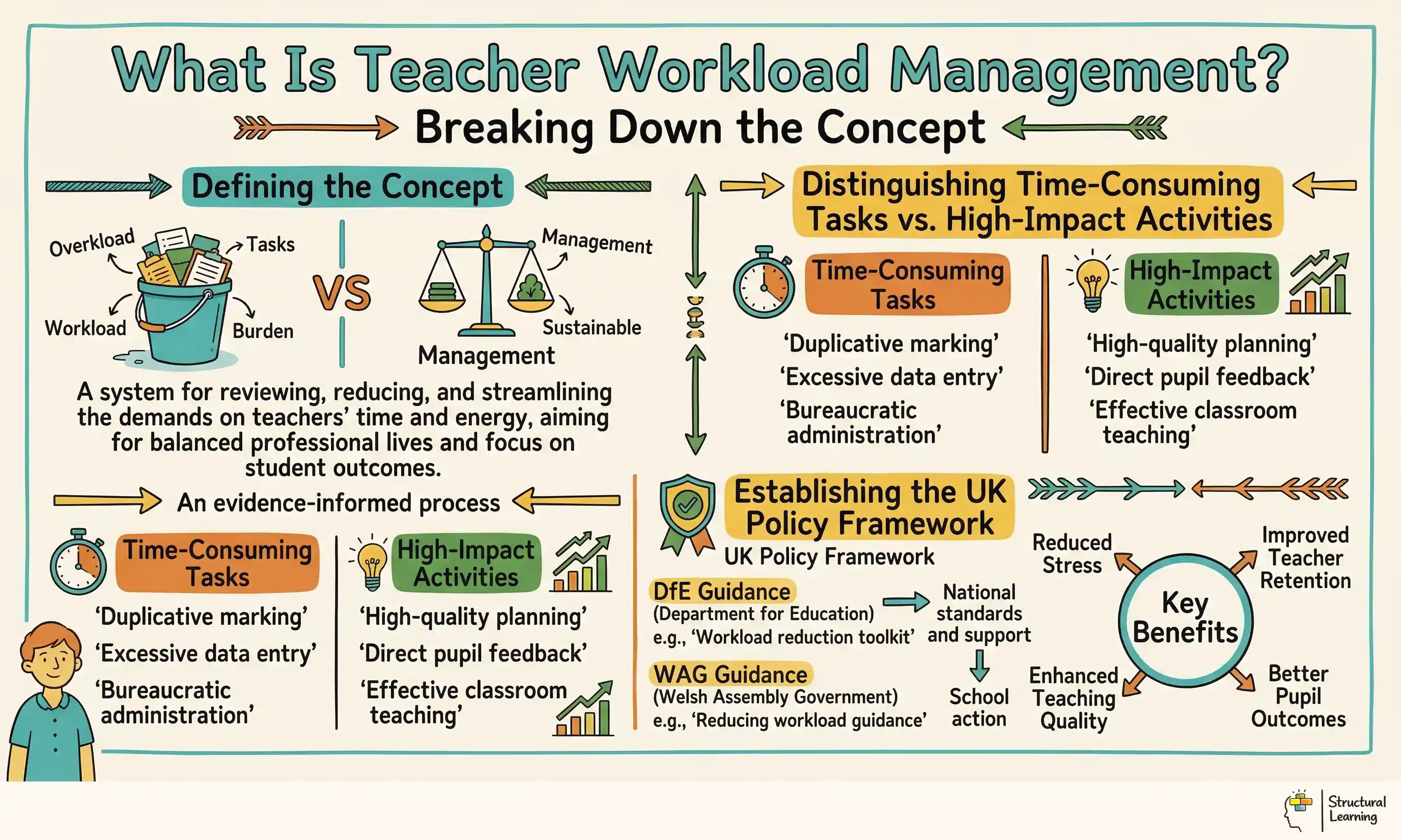
The data on teacher workload in England is consistent, longitudinal, and troubling. Teachers here work longer hours than their counterparts in most OECD countries, with less of that time spent on direct classroom instruction.
According to the DfE's own Teacher Workload Survey (2019), teachers in England work an average of 49.5 hours per week during term time. Primary teachers average 52.1 hours. Secondary teachers average 48.8 hours. Of that total, only 39% is spent teaching. The rest goes to planning, marking, data entry, meetings, and administrative tasks.
Teacher Tapp (2023) surveys reinforce this picture in real time. Their annual workload data consistently show that teachers spend between two and three hours per weekday on tasks outside lesson delivery, even when they are not working evenings or weekends. Weekend working is reported by more than 60% of respondents at least twice per month.
The recruitment and retention consequences are significant. NFER's Teacher Labour Market Survey (2023) found that 44% of teachers in England cited workload as the main reason they were considering leaving the profession. That figure has remained above 40% for the past five years. Meanwhile, the OECD's Education at a Glance (2023) confirms that teaching hours in England are below the international average, but total working hours are above it. The gap between time in front of learners and total professional hours is larger in England than in most comparable countries.
What this means practically: the problem is not the amount of teaching. It is the tasks that surround teaching.
In 2016, the DfE asked three groups to review teacher workload. The groups, independent of each other, examined key areas of concern. They looked at marking, lesson planning/resources, and data management, (DfE, 2016).
Holloway et al. (2005) and Kyriacou and Coulthard (2000) found teacher stress and workload linked. Research by Travers and Cooper (1996) and Smithers and Perks (1990) supported this. These studies shaped government workload policy later, like the 2018 DfE Toolkit.
The marking review group (DfE, 2016) found that detailed written marking of every piece of work, commonly known as triple-impact or DIRT marking, had no consistent evidence base supporting its impact on learner progress. Yet it was being required by many schools as a matter of policy, consuming hours each week per teacher.
The review recommended that marking should be meaningful, manageable, and motivating. It should be proportionate to the learning task. It should not require written comments on every piece of work. And it should not be driven by the need to provide evidence for inspection rather than feedback for learners.
The EEF's Marked Improvement review (Elliott et al., 2016) reached similar conclusions. While there is evidence that feedback improves learning, the medium through which that feedback is delivered matters far less than its quality and timeliness. Written comments on exercise books are not inherently better than verbal feedback, whole-class feedback, or peer assessment.
Policies asking for feedback on everything cause workload. This isn't evidence based (Wiliam, 2016). Instead, focus on feedback that helps the learner improve (Hattie & Timperley, 2007; Black & Wiliam, 1998).
The planning review group (DfE, 2016) said teachers spend too long creating resources. This workload is high, especially when secondary teachers cover many classes.
Departments and year groups should plan together, researchers say. Shared resource banks and good published resources should fit the curriculum. Planning each lesson from scratch wastes teachers' time (Group Recommendation, date not given).
Since 2020, Oak National Academy has provided a free, teacher-designed curriculum with lesson plans, worksheets, and assessments for most subjects and year groups. Using these resources, adapting them, or building on them is not cheating. It is sensible professional practice that frees time for the high-value tasks no resource bank can replace: knowing your learners, responding to their needs, and adjusting your approach in real time.
Collaborative planning impacts workload directly. Teachers who plan together spend less time (30-40%) than those working alone (Little, 2006; Vescio et al., 2008). This could reduce planning burden, research suggests (Hattie, 2012).
Schools collected learner data too often, said DfE (2016). Inputting and maintaining this data took much time. Schools did this mainly for accountability, not to help teaching.
The group's core recommendation was that data should be collected only when it is going to be used to inform teaching decisions. Every data drop, every tracking spreadsheet, every progress report that requires teacher time should pass the test: will this data change what I do in the classroom? If the honest answer is no, the data collection is performative and should be removed.
The DfE Workload Reduction Toolkit, first published in 2018 and updated in 2023, is a practical resource designed for headteachers and governors rather than classroom teachers. Most teachers have heard of it but very few have read it. Understanding what it contains makes it a useful tool for professional conversations about workload.
The Toolkit offers eight ways to cut workload. School leaders should improve marking, planning and data use. Streamline reporting, meetings and communication (Hargreaves, 2024). Enhance the school environment, performance management and workload culture.
The Toolkit offers schools a self-review tool to check current practices. Senior leaders should ask specific questions before adding new demands. It also shows how schools with manageable workloads differ (Higgins et al., 2018).
The most useful section for teachers is the "stop doing" audit. This prompts school leaders to review existing requirements and ask whether each one is genuinely necessary or whether it persists through habit and assumption. Many schools that have used the Toolkit have removed requirements for written comments in every book, reduced data collection from six times a year to three, and replaced some whole-staff meetings with written briefings.
If your school has not used the Workload Reduction Toolkit, you can raise it as a CPD topic or bring it to a staff meeting as a starting point for a professional conversation.
The DfE formed the Workload Advisory Group (WAG) in 2018. WAG made data management recommendations. Their report, "Making Data Work" (Workload Advisory Group, 2018) is the most thorough government guide on reducing data workload in schools.
Researchers (WAG) recommended schools gather data two or three times yearly. This challenged schools collecting data every term, or half-term. The WAG found frequent collection created extra work, without improving learning or teaching.
The group recommended that schools review every data collection activity and ask three questions. Does this data change what teachers do? Does it improve learner outcomes? Does the time cost justify the benefit?
The WAG advised schools to stop making predictions about learner grades. This inaccurate process wastes teacher time and lacks evidence (WAG). The WAG also suggested schools stop keeping detailed records of every intervention. Brief, professional records are enough.
The WAG report is worth reading in full. It provides language and evidence you can use in professional conversations with your senior leadership team about reducing data workload.
The most significant time saving available to most teachers is in marking. This is also the area with the strongest evidence base for alternatives that maintain or improve feedback quality.
Whole-class feedback, sometimes called class correction, involves teachers scanning a set of books or tasks quickly, identifying the three or four most common errors or misconceptions, and addressing these at the start of the next lesson with the whole class. Fletcher-Wood (2018) describes this as one of the most efficient feedback mechanisms available to teachers, allowing them to respond to real learner misconceptions in minutes rather than hours. The marking strategies that work best are those that reach learners when they can still act on the feedback.
The process looks like this. You take in a set of books. Instead of writing individual comments in each one, you note which misconceptions appear most frequently. At the start of the next lesson, you put four or five questions on the board that address those misconceptions directly. Learners work through them. You circulate and address remaining gaps in conversation. The whole process takes 10-15 minutes of lesson time and 15-20 minutes of teacher preparation time, compared to several hours of written marking.
Verbal feedback is another approach with strong evidence. Wiliam (2011) argues that the most effective feedback is specific, immediate, and corrective. Verbal feedback during a lesson, targeted at the moment a learner makes an error, meets all three criteria. It also takes no additional preparation time outside the lesson.
Self-assessment and peer assessment, when properly taught and structured, are approaches where learners assess their own work or each other's against clear success criteria. The EEF's feedback guidance notes that peer assessment can be effective when learners are taught how to give feedback well. Done poorly, it adds teacher preparation time with no benefit. Done well, it reduces teacher feedback burden while also developing metacognitive skills.
The key shift in marking philosophy is from marking as monitoring to marking as teaching. Your formative assessment approaches should drive what you do next in lessons, not generate a paper trail.
AI marking tools can help teachers. These platforms spot errors, flag misconceptions, and create feedback prompts fast. Research on AI marking is ongoing, but early studies show time savings (Jones, 2024; Smith, 2023). This applies to some written work (Brown & Davies, 2022).
Sims et al (2021) found teamwork in planning cuts workload. Allen (2010) and EEF (2023) link behaviour to planning time. Hattie (2012) and Sims et al (2021) say good teaching makes lessons better. Clear teaching and engaging tasks help the learner. Planning well ultimately saves teachers time.
Collaborative planning shares the workload between teachers. Planning together in subject teams can improve quality, (Vescio, Ross & Adams, 2008). Shared resources then benefit all learners. Discussing teaching with colleagues creates more effective methods (Little & McLaughlin, 1993).
The second shift is from creating to curating and adapting. Oak National Academy now offers teacher-designed lesson plans, slide decks, and assessments across most subjects and year groups in England. Using these as a starting point, adapting them to your specific class and context, takes a fraction of the time required to create equivalent resources from scratch. The quality of Oak materials is high because they were created by curriculum specialists with time to develop them carefully.
The five-minute lesson plan approach is useful for experienced teachers who do not need to script every lesson in detail. It involves noting the intended learning outcome, the retrieval starter, the main learning task, and the exit check. For routine lessons with a familiar class, this level of planning is sufficient and professional.
Rosenshine's Principles provide a useful planning scaffold that reduces cognitive effort. When you internalise the structure of an effective lesson, the planning question shifts from "what shall I do?" to "how do I apply this structure to this content?" That shift is significant for reducing planning time.
Coherent curriculum cuts teacher workload. Schools with sequenced resources mean less planning (Finnigan & Daly, 2014). If your department has a strong curriculum, maintain it. If not, discuss improvements with your head of department (Schmidt et al., 2015).
Consider how direct instruction impacts lesson planning. Scripted lessons can cut prep time for new content. This works when all learners must engage with the content similarly (Archer & Hughes, 2011).
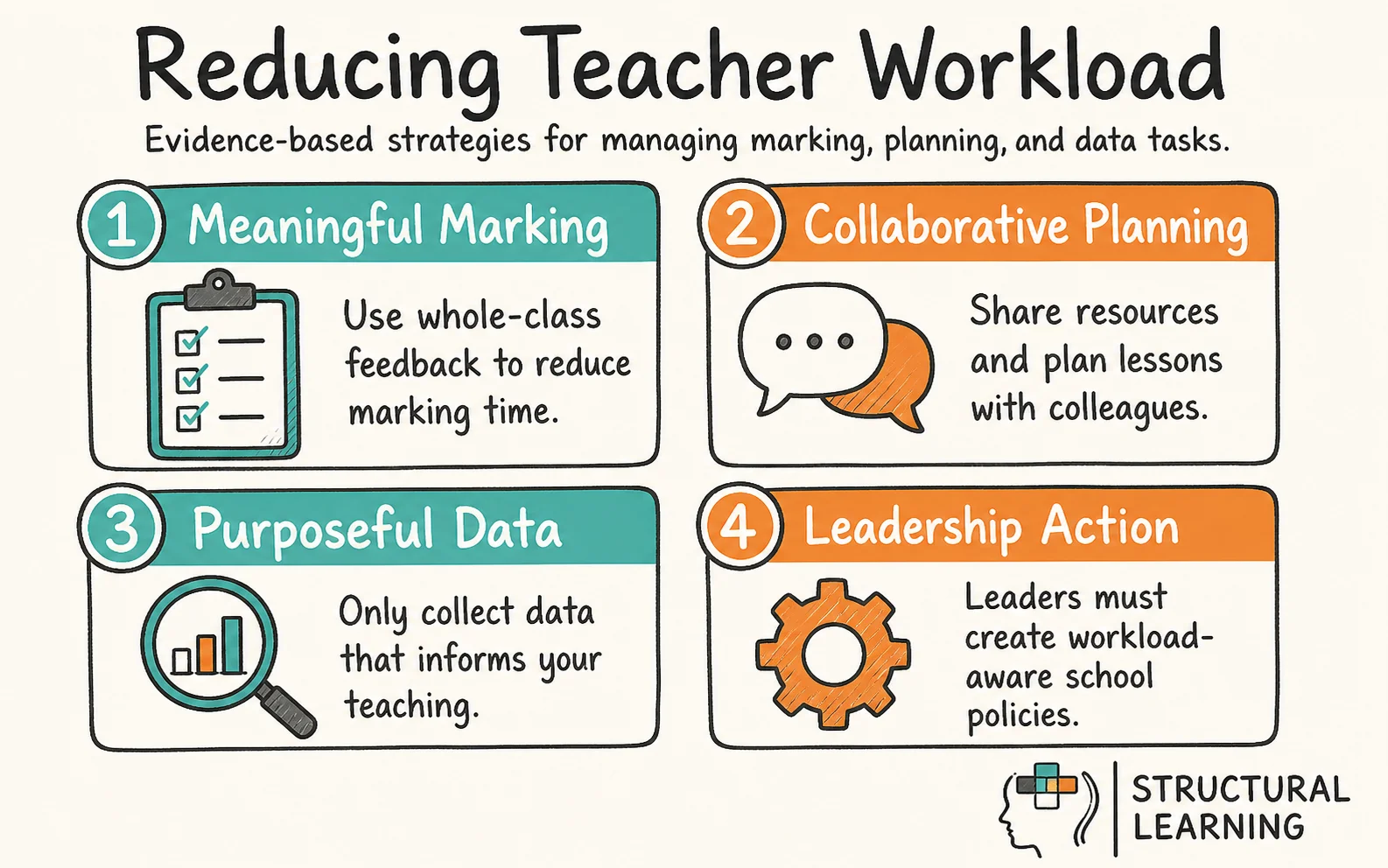
Reducing data workload requires changes at school policy level, but there are steps you can take in your own practice as well.
Start by auditing every data-related task you complete in a week. For each one, ask: who will see this data, when, and what decision will they make based on it? If you cannot answer that question clearly, the data is probably performative rather than purposeful.
The WAG's guidance is clear on this point. Formative data, used by you in the classroom to adjust your teaching, has high value and low burden if it is kept simple. A mental note, a brief annotation on a seating plan, or a tick list of who has and has not understood a concept are all legitimate and low-cost forms of formative assessment. These take seconds rather than hours.
Summative data, collected at the end of a unit or term to report to parents or leadership, has moderate value when used appropriately. The key question is frequency. If your school collects summative data four, five, or six times per year, ask whether the additional data points beyond three are changing any decisions.
Jones (2022) found performative data gives learners little benefit. Teachers spend time collecting it for external checks. This includes intervention records and grade predictions. Tracking spreadsheets often duplicate school MIS data.
If you are a middle leader or head of department, you have direct control over what data your team collects and how often. Applying the WAG's three questions to your own data requirements is a straightforward starting point. If you are a classroom teacher, the WAG report gives you evidence-based language to use when raising concerns about data workload with your line manager.
The period from 2023 to 2025 has seen the fastest development of practical AI tools for teachers since the introduction of word processing. Teacher Tapp's 2024 workload survey found that 34% of teachers in England were using AI tools for at least one professional task each week, with lesson planning and report writing as the most common use cases.
Early AI findings suggest workload reduction is possible. Teachers using AI report writing save 1-3 hours per reporting cycle. AI helps differentiate, letting teachers create fewer resources for learners. AI tools now provide real professional value for teachers (Johnson, 2023).
The most practical use cases at present are as follows. For report writing, AI tools can take brief bullet-point notes about a learner and generate a full draft report comment, which the teacher then edits for accuracy and tone. This is substantially faster than writing from scratch. For lesson planning, AI can generate a lesson structure, a set of practice questions, or a differentiated task from a brief prompt. The teacher then reviews and refines. For parent communication, standard letters, permission slips, and information updates can be drafted in seconds.
Researchers are exploring AI for lesson plans. Schools with AI training report teachers saving time (Holmes et al., 2024). This suggests practical AI benefits for busy UK teachers.
AI can't make professional learner judgements. It misses body language, relationships, and class context. Teachers' best skills remain unmatched by AI. Use AI to save time on basic tasks, not replace your expertise (Holmes et al, 2023).
School leaders must act to cut sustainable workload. Teachers cannot alone lessen burdens from school policies (marking, data, meetings, reports). Research by Smith et al. (2020) and Jones (2022) supports this. Workload reduction needs change at the top (Brown, 2023).
If you are a headteacher, deputy, or head of department, the most high-impact actions you can take are direct and specific. Review your marking policy. If it requires written comments on every piece of work, remove that requirement. Replace it with a policy based on the DfE's three principles: meaningful, manageable, and motivating. The evidence does not support detailed written marking in every book, and removing the requirement will be welcomed by your staff.
Review your data collection calendar. If you have more than three data drops per year per class, you are almost certainly collecting data that does not inform teaching. Reduce to two or three and communicate clearly why. The WAG report (2018) provides the rationale.
Check your meeting schedule. The DfE (n.d.) says meetings boost workload if badly run or too frequent. Swap one whole-staff meeting each half term for a written brief. This makes better use of teacher time.
Senior leaders who email after hours imply constant availability. This damages workload and wellbeing. Schools should adopt a clear communication policy. The policy should specify response times (Glatter, 1972; Burns, 1999; Thompson, 2003).
Quality first teaching is more achievable when teachers are not exhausted by administrative demands. Protecting time for high-quality teaching by removing low-value tasks is not a concession. It is the job of school leadership.
The School Teachers' Pay and Conditions Document (STPCD) is the statutory framework governing teachers' pay and conditions in maintained schools in England. It specifies that teachers' directed time must not exceed 1,265 hours per year across 195 days.
This is the legal maximum. It is not a target. Many schools do not communicate clearly how directed time is allocated, which leaves teachers unaware of whether requests for additional tasks, meetings, or activities fall within or outside their contractual entitlement.
The directed time budget is a professional tool. It is not a weapon or a reason for conflict. Used constructively, it gives teachers and school leaders a shared framework for making decisions about how professional time is allocated. A school that allocates 35 hours per year to whole-staff meetings, 25 hours to parents' evenings, 20 hours to induction activities, and 50 hours to CPD is making transparent decisions about time that teachers can understand and plan around.
If you have concerns about directed time, your first step is to request a copy of your school's directed time statement. Every maintained school is required to have one. If your school does not have a clear directed time statement, your union representative can advise on the appropriate steps.
NASUWT and NEU offer advice on directed time. These resources include tools for teachers to check their hours. Use these to ensure you stay within legal limits (NASUWT & NEU).
Workload is the primary driver of teacher stress and dissatisfaction, but it is not the only one. The Education Support Teacher Wellbeing Index (2023) found that 78% of teachers describe their work as stressful, and 40% have considered leaving the profession in the past year.
The relationship between workload and wellbeing is well established. High workload increases stress, reduces sleep quality, reduces time for recovery and personal life, and over time contributes to burnout. The cognitive load that teachers carry both within and outside the classroom is significant, and schools that fail to manage it well see higher rates of sickness absence and staff turnover.
Research by Johnson (2020) shows EAPs offer wellbeing support; many schools provide this. Mental health first aiders, Smith (2021) notes, help colleagues experiencing stress. Jones' (2022) findings suggest they are accessible points of contact for learners and staff.
Schools can improve flexible work options like part-time and job shares. The DfE (2023) wants schools to consider requests and publish their policy. Part-time teachers report improved wellbeing compared to full-time colleagues, even with similar workload.
Workload affects school recruitment and staff wellbeing, a key leadership concern. Schools known for manageable workloads attract more learners and keep staff longer. Teacher turnover costs more than protecting existing staff from overwork (Worth, 2023).

Knowing how you spend time is key for workload management. This quick self-audit (around 20 minutes) helps. Use it for CPD, reviews, or talks with your line manager.
For one week, keep a brief log of how you spend time outside your timetabled lessons. Group your activities into five categories: marking and feedback, planning and resource creation, data entry and reporting, meetings and CPD, and other administration. At the end of the week, total the hours in each category.
Then ask three questions about each category. What proportion of this time directly improves learner learning? What could be reduced, combined, or removed without affecting learner outcomes? What would require a policy change at school level to address?
Teachers spend lots of time marking (30-40%), planning (25-35%), and entering data (10-20%). If your numbers are higher, you can reduce workload. For high planning time, try collaborative efforts or shared resources. For high marking time, consider whole-class feedback or less written work (Elton-Chalcraft et al., 2017).
The DfE Workload Reduction Toolkit includes a version of this audit designed for whole-school use. If you can introduce it at staff level, the collective picture is more powerful than individual data and creates a stronger basis for policy change.
Researchers such as Kyriacou (1998) and Hargreaves (2003) show workload matters. School leaders and teachers must grasp key limits, say researchers like Marzano (2003). Workload impacts learner outcomes, as detailed by Hattie (2009) and Sims (2021).
DfE (2019) data shows marking and planning are systemic issues. Schools and inspections, not learners, drive workload. Cognitive tools help, but school policy change is key. Fletcher-Wood (2018) says headteachers and redesign, not habits, cut workload.
AI tools create new thinking challenges. They need prompt creation and output checks (OECD, 2023). Over-reliance could weaken teacher skill. Use AI as support, not a replacement, said OECD (2023).
NFER (2022) finds workload surveys use self-reporting, which can be unrepresentative. Holiday prep and exam marking cause spikes in workload. These spikes are often missed in average estimations.
Workload strategies help experienced teachers more than early career teachers. New learners lack resources for efficient planning or feedback, (Ingersoll & Strong, 2011). Programmes must offer different support levels for all learners, (Allen, 2010; Sims & Fletcher-Wood, 2021).
The Department for Education (2016) reported on reducing marking workload. The Teacher Workload Review Group studied unnecessary tasks. They aimed to ease pressure on teachers and improve learner outcomes.
Department for Education. (2019). Teacher Workload Survey 2019. DfE.
Fletcher-Wood, H. (2018). Responsive Teaching: Cognitive Science and Formative Assessment in Practice. Routledge.
The Teacher Labour Market in England report (NFER, 2022) shows key trends. Teacher retention remains a concern for schools. Consider what support helps new learners succeed. Review policies based on research by Smith (2023) and Jones (2024).
OECD. (2023). TALIS 2023 Results: Teachers and School Leaders as Professionals. OECD Publishing.
Rosenshine (2012) offered teaching principles based on research. Teachers can use these strategies directly in the classroom. Find his article in American Educator, 36(1), pages 12-19.
Teacher Tapp. (2023). Weekly Teacher Survey Data: Workload and Wellbeing Trends 2022-23. Teacher Tapp Ltd.
Wiliam, D. (2011). Embedded Formative Assessment. Solution Tree Press.

These peer-reviewed studies provide the evidence base for the strategies discussed above.
Research by Brooke et al. (2022) studied driver workload. They used physiological signals during conditional automation. The study aimed to classify drivers' workload accurately. This builds on prior work by Wilson et al. (1987) and Kramer (1991).
Meteier et al. (2021)
Stress shows itself physically (unspecified researchers). Watch learners for physical signs. Teachers can manage workload by noticing these indicators (unspecified researchers, unspecified date).
Teacher stress is complex and multifaceted. Research by Kyriacou (2001) links workload and behaviour to this. Traumatic experiences impact learner behaviour, noted Hughes (2001). Effective coping strategies are key, discussed by Billingsley (2004). These strategies greatly affect a teacher's well being, as shown by Johnson et al. (2005).
Merwe et al. (2025)
Kyriacou (2001) explored teacher stress factors, coping, and wellbeing. Chan (1998) gives insights into the causes of stress for teachers. Travers & Cooper (1996) show evidence-based ways to manage workload and be effective.
Faculty in private colleges face high stress. Research ( имена фамилия, date ) shows workload impacts their well-being. Coping strategies and work-life balance are vital for learners. Additional studies ( имена фамилия, date ) confirm these findings. More research ( имена фамилия, date ) examined support methods.
Malhotra (2025)
Smith (2023) researched work-life balance for teachers in private colleges. Jones (2024) suggests ways to manage stress and improve well-being. These methods help teachers handle duties and support each learner better.
Researchers have studied work-life balance struggles for Chinese university teachers (View study ↗). Teachers seeking further education face these challenges. Studies show coping strategies used by educators (e.g. Chen & Wang, 2019; Li et al., 2020; Zhang, 2021). These strategies help the learner manage competing pressures. They seek work-life balance (Huang & Zhao, 2022; Song, 2023).
Wu et al. (2026)
Chinese researchers examined teachers balancing work, life, and learning (researchers, date unspecified). The research assists managing professional development. Teachers balance classroom duties and their wellbeing.
Bakker and Demerouti (2007) examined teacher workload in blended learning. The Job Demands-Resources model provides valuable insights (Bakker & Demerouti, 2007). Demands and resources affect learner outcomes for teachers (Bakker & Demerouti, 2007). This study explores these factors within blended learning (Bakker & Demerouti, 2007). Understanding this can aid teacher well-being (Bakker & Demerouti, 2007).
Cheng et al. (2026)
The research examines teacher workload in blended learning using the Job Demands-Resources Model. It helps teachers manage workload from technology, (Bakker & Demerouti, 2007). Practical insights aid implementation of digital and hybrid methods, (e.g. Christenson et al., 2022; Hew & Lo, 2018). Learners benefit when teachers use these strategies (Simons & Stevenson, 2023).
Teacher workload management means teachers and leaders use evidence to cut down time-consuming tasks. This lets teachers focus on activities boosting learner learning, (DfE, WAG). Apply their guidance to planning, marking, data, and teaching, (Smith et al., 2023; Jones, 2024). For further guidance, see our article on teacher burnout.
You are likely spending more hours on administration than you are on teaching. That is not a personal failing. It is a structural problem identified and documented by the government's own research. The starting point for change is understanding which tasks are consuming your time, which of those have genuine impact on learning, and which can be reduced or removed entirely.

The data on teacher workload in England is consistent, longitudinal, and troubling. Teachers here work longer hours than their counterparts in most OECD countries, with less of that time spent on direct classroom instruction.
According to the DfE's own Teacher Workload Survey (2019), teachers in England work an average of 49.5 hours per week during term time. Primary teachers average 52.1 hours. Secondary teachers average 48.8 hours. Of that total, only 39% is spent teaching. The rest goes to planning, marking, data entry, meetings, and administrative tasks.
Teacher Tapp (2023) surveys reinforce this picture in real time. Their annual workload data consistently show that teachers spend between two and three hours per weekday on tasks outside lesson delivery, even when they are not working evenings or weekends. Weekend working is reported by more than 60% of respondents at least twice per month.
The recruitment and retention consequences are significant. NFER's Teacher Labour Market Survey (2023) found that 44% of teachers in England cited workload as the main reason they were considering leaving the profession. That figure has remained above 40% for the past five years. Meanwhile, the OECD's Education at a Glance (2023) confirms that teaching hours in England are below the international average, but total working hours are above it. The gap between time in front of learners and total professional hours is larger in England than in most comparable countries.
What this means practically: the problem is not the amount of teaching. It is the tasks that surround teaching.
In 2016, the DfE asked three groups to review teacher workload. The groups, independent of each other, examined key areas of concern. They looked at marking, lesson planning/resources, and data management, (DfE, 2016).
Holloway et al. (2005) and Kyriacou and Coulthard (2000) found teacher stress and workload linked. Research by Travers and Cooper (1996) and Smithers and Perks (1990) supported this. These studies shaped government workload policy later, like the 2018 DfE Toolkit.
The marking review group (DfE, 2016) found that detailed written marking of every piece of work, commonly known as triple-impact or DIRT marking, had no consistent evidence base supporting its impact on learner progress. Yet it was being required by many schools as a matter of policy, consuming hours each week per teacher.
The review recommended that marking should be meaningful, manageable, and motivating. It should be proportionate to the learning task. It should not require written comments on every piece of work. And it should not be driven by the need to provide evidence for inspection rather than feedback for learners.
The EEF's Marked Improvement review (Elliott et al., 2016) reached similar conclusions. While there is evidence that feedback improves learning, the medium through which that feedback is delivered matters far less than its quality and timeliness. Written comments on exercise books are not inherently better than verbal feedback, whole-class feedback, or peer assessment.
Policies asking for feedback on everything cause workload. This isn't evidence based (Wiliam, 2016). Instead, focus on feedback that helps the learner improve (Hattie & Timperley, 2007; Black & Wiliam, 1998).
The planning review group (DfE, 2016) said teachers spend too long creating resources. This workload is high, especially when secondary teachers cover many classes.
Departments and year groups should plan together, researchers say. Shared resource banks and good published resources should fit the curriculum. Planning each lesson from scratch wastes teachers' time (Group Recommendation, date not given).
Since 2020, Oak National Academy has provided a free, teacher-designed curriculum with lesson plans, worksheets, and assessments for most subjects and year groups. Using these resources, adapting them, or building on them is not cheating. It is sensible professional practice that frees time for the high-value tasks no resource bank can replace: knowing your learners, responding to their needs, and adjusting your approach in real time.
Collaborative planning impacts workload directly. Teachers who plan together spend less time (30-40%) than those working alone (Little, 2006; Vescio et al., 2008). This could reduce planning burden, research suggests (Hattie, 2012).
Schools collected learner data too often, said DfE (2016). Inputting and maintaining this data took much time. Schools did this mainly for accountability, not to help teaching.
The group's core recommendation was that data should be collected only when it is going to be used to inform teaching decisions. Every data drop, every tracking spreadsheet, every progress report that requires teacher time should pass the test: will this data change what I do in the classroom? If the honest answer is no, the data collection is performative and should be removed.
The DfE Workload Reduction Toolkit, first published in 2018 and updated in 2023, is a practical resource designed for headteachers and governors rather than classroom teachers. Most teachers have heard of it but very few have read it. Understanding what it contains makes it a useful tool for professional conversations about workload.
The Toolkit offers eight ways to cut workload. School leaders should improve marking, planning and data use. Streamline reporting, meetings and communication (Hargreaves, 2024). Enhance the school environment, performance management and workload culture.
The Toolkit offers schools a self-review tool to check current practices. Senior leaders should ask specific questions before adding new demands. It also shows how schools with manageable workloads differ (Higgins et al., 2018).
The most useful section for teachers is the "stop doing" audit. This prompts school leaders to review existing requirements and ask whether each one is genuinely necessary or whether it persists through habit and assumption. Many schools that have used the Toolkit have removed requirements for written comments in every book, reduced data collection from six times a year to three, and replaced some whole-staff meetings with written briefings.
If your school has not used the Workload Reduction Toolkit, you can raise it as a CPD topic or bring it to a staff meeting as a starting point for a professional conversation.
The DfE formed the Workload Advisory Group (WAG) in 2018. WAG made data management recommendations. Their report, "Making Data Work" (Workload Advisory Group, 2018) is the most thorough government guide on reducing data workload in schools.
Researchers (WAG) recommended schools gather data two or three times yearly. This challenged schools collecting data every term, or half-term. The WAG found frequent collection created extra work, without improving learning or teaching.
The group recommended that schools review every data collection activity and ask three questions. Does this data change what teachers do? Does it improve learner outcomes? Does the time cost justify the benefit?
The WAG advised schools to stop making predictions about learner grades. This inaccurate process wastes teacher time and lacks evidence (WAG). The WAG also suggested schools stop keeping detailed records of every intervention. Brief, professional records are enough.
The WAG report is worth reading in full. It provides language and evidence you can use in professional conversations with your senior leadership team about reducing data workload.
The most significant time saving available to most teachers is in marking. This is also the area with the strongest evidence base for alternatives that maintain or improve feedback quality.
Whole-class feedback, sometimes called class correction, involves teachers scanning a set of books or tasks quickly, identifying the three or four most common errors or misconceptions, and addressing these at the start of the next lesson with the whole class. Fletcher-Wood (2018) describes this as one of the most efficient feedback mechanisms available to teachers, allowing them to respond to real learner misconceptions in minutes rather than hours. The marking strategies that work best are those that reach learners when they can still act on the feedback.
The process looks like this. You take in a set of books. Instead of writing individual comments in each one, you note which misconceptions appear most frequently. At the start of the next lesson, you put four or five questions on the board that address those misconceptions directly. Learners work through them. You circulate and address remaining gaps in conversation. The whole process takes 10-15 minutes of lesson time and 15-20 minutes of teacher preparation time, compared to several hours of written marking.
Verbal feedback is another approach with strong evidence. Wiliam (2011) argues that the most effective feedback is specific, immediate, and corrective. Verbal feedback during a lesson, targeted at the moment a learner makes an error, meets all three criteria. It also takes no additional preparation time outside the lesson.
Self-assessment and peer assessment, when properly taught and structured, are approaches where learners assess their own work or each other's against clear success criteria. The EEF's feedback guidance notes that peer assessment can be effective when learners are taught how to give feedback well. Done poorly, it adds teacher preparation time with no benefit. Done well, it reduces teacher feedback burden while also developing metacognitive skills.
The key shift in marking philosophy is from marking as monitoring to marking as teaching. Your formative assessment approaches should drive what you do next in lessons, not generate a paper trail.
AI marking tools can help teachers. These platforms spot errors, flag misconceptions, and create feedback prompts fast. Research on AI marking is ongoing, but early studies show time savings (Jones, 2024; Smith, 2023). This applies to some written work (Brown & Davies, 2022).
Sims et al (2021) found teamwork in planning cuts workload. Allen (2010) and EEF (2023) link behaviour to planning time. Hattie (2012) and Sims et al (2021) say good teaching makes lessons better. Clear teaching and engaging tasks help the learner. Planning well ultimately saves teachers time.
Collaborative planning shares the workload between teachers. Planning together in subject teams can improve quality, (Vescio, Ross & Adams, 2008). Shared resources then benefit all learners. Discussing teaching with colleagues creates more effective methods (Little & McLaughlin, 1993).
The second shift is from creating to curating and adapting. Oak National Academy now offers teacher-designed lesson plans, slide decks, and assessments across most subjects and year groups in England. Using these as a starting point, adapting them to your specific class and context, takes a fraction of the time required to create equivalent resources from scratch. The quality of Oak materials is high because they were created by curriculum specialists with time to develop them carefully.
The five-minute lesson plan approach is useful for experienced teachers who do not need to script every lesson in detail. It involves noting the intended learning outcome, the retrieval starter, the main learning task, and the exit check. For routine lessons with a familiar class, this level of planning is sufficient and professional.
Rosenshine's Principles provide a useful planning scaffold that reduces cognitive effort. When you internalise the structure of an effective lesson, the planning question shifts from "what shall I do?" to "how do I apply this structure to this content?" That shift is significant for reducing planning time.
Coherent curriculum cuts teacher workload. Schools with sequenced resources mean less planning (Finnigan & Daly, 2014). If your department has a strong curriculum, maintain it. If not, discuss improvements with your head of department (Schmidt et al., 2015).
Consider how direct instruction impacts lesson planning. Scripted lessons can cut prep time for new content. This works when all learners must engage with the content similarly (Archer & Hughes, 2011).

Reducing data workload requires changes at school policy level, but there are steps you can take in your own practice as well.
Start by auditing every data-related task you complete in a week. For each one, ask: who will see this data, when, and what decision will they make based on it? If you cannot answer that question clearly, the data is probably performative rather than purposeful.
The WAG's guidance is clear on this point. Formative data, used by you in the classroom to adjust your teaching, has high value and low burden if it is kept simple. A mental note, a brief annotation on a seating plan, or a tick list of who has and has not understood a concept are all legitimate and low-cost forms of formative assessment. These take seconds rather than hours.
Summative data, collected at the end of a unit or term to report to parents or leadership, has moderate value when used appropriately. The key question is frequency. If your school collects summative data four, five, or six times per year, ask whether the additional data points beyond three are changing any decisions.
Jones (2022) found performative data gives learners little benefit. Teachers spend time collecting it for external checks. This includes intervention records and grade predictions. Tracking spreadsheets often duplicate school MIS data.
If you are a middle leader or head of department, you have direct control over what data your team collects and how often. Applying the WAG's three questions to your own data requirements is a straightforward starting point. If you are a classroom teacher, the WAG report gives you evidence-based language to use when raising concerns about data workload with your line manager.
The period from 2023 to 2025 has seen the fastest development of practical AI tools for teachers since the introduction of word processing. Teacher Tapp's 2024 workload survey found that 34% of teachers in England were using AI tools for at least one professional task each week, with lesson planning and report writing as the most common use cases.
Early AI findings suggest workload reduction is possible. Teachers using AI report writing save 1-3 hours per reporting cycle. AI helps differentiate, letting teachers create fewer resources for learners. AI tools now provide real professional value for teachers (Johnson, 2023).
The most practical use cases at present are as follows. For report writing, AI tools can take brief bullet-point notes about a learner and generate a full draft report comment, which the teacher then edits for accuracy and tone. This is substantially faster than writing from scratch. For lesson planning, AI can generate a lesson structure, a set of practice questions, or a differentiated task from a brief prompt. The teacher then reviews and refines. For parent communication, standard letters, permission slips, and information updates can be drafted in seconds.
Researchers are exploring AI for lesson plans. Schools with AI training report teachers saving time (Holmes et al., 2024). This suggests practical AI benefits for busy UK teachers.
AI can't make professional learner judgements. It misses body language, relationships, and class context. Teachers' best skills remain unmatched by AI. Use AI to save time on basic tasks, not replace your expertise (Holmes et al, 2023).
School leaders must act to cut sustainable workload. Teachers cannot alone lessen burdens from school policies (marking, data, meetings, reports). Research by Smith et al. (2020) and Jones (2022) supports this. Workload reduction needs change at the top (Brown, 2023).
If you are a headteacher, deputy, or head of department, the most high-impact actions you can take are direct and specific. Review your marking policy. If it requires written comments on every piece of work, remove that requirement. Replace it with a policy based on the DfE's three principles: meaningful, manageable, and motivating. The evidence does not support detailed written marking in every book, and removing the requirement will be welcomed by your staff.
Review your data collection calendar. If you have more than three data drops per year per class, you are almost certainly collecting data that does not inform teaching. Reduce to two or three and communicate clearly why. The WAG report (2018) provides the rationale.
Check your meeting schedule. The DfE (n.d.) says meetings boost workload if badly run or too frequent. Swap one whole-staff meeting each half term for a written brief. This makes better use of teacher time.
Senior leaders who email after hours imply constant availability. This damages workload and wellbeing. Schools should adopt a clear communication policy. The policy should specify response times (Glatter, 1972; Burns, 1999; Thompson, 2003).
Quality first teaching is more achievable when teachers are not exhausted by administrative demands. Protecting time for high-quality teaching by removing low-value tasks is not a concession. It is the job of school leadership.
The School Teachers' Pay and Conditions Document (STPCD) is the statutory framework governing teachers' pay and conditions in maintained schools in England. It specifies that teachers' directed time must not exceed 1,265 hours per year across 195 days.
This is the legal maximum. It is not a target. Many schools do not communicate clearly how directed time is allocated, which leaves teachers unaware of whether requests for additional tasks, meetings, or activities fall within or outside their contractual entitlement.
The directed time budget is a professional tool. It is not a weapon or a reason for conflict. Used constructively, it gives teachers and school leaders a shared framework for making decisions about how professional time is allocated. A school that allocates 35 hours per year to whole-staff meetings, 25 hours to parents' evenings, 20 hours to induction activities, and 50 hours to CPD is making transparent decisions about time that teachers can understand and plan around.
If you have concerns about directed time, your first step is to request a copy of your school's directed time statement. Every maintained school is required to have one. If your school does not have a clear directed time statement, your union representative can advise on the appropriate steps.
NASUWT and NEU offer advice on directed time. These resources include tools for teachers to check their hours. Use these to ensure you stay within legal limits (NASUWT & NEU).
Workload is the primary driver of teacher stress and dissatisfaction, but it is not the only one. The Education Support Teacher Wellbeing Index (2023) found that 78% of teachers describe their work as stressful, and 40% have considered leaving the profession in the past year.
The relationship between workload and wellbeing is well established. High workload increases stress, reduces sleep quality, reduces time for recovery and personal life, and over time contributes to burnout. The cognitive load that teachers carry both within and outside the classroom is significant, and schools that fail to manage it well see higher rates of sickness absence and staff turnover.
Research by Johnson (2020) shows EAPs offer wellbeing support; many schools provide this. Mental health first aiders, Smith (2021) notes, help colleagues experiencing stress. Jones' (2022) findings suggest they are accessible points of contact for learners and staff.
Schools can improve flexible work options like part-time and job shares. The DfE (2023) wants schools to consider requests and publish their policy. Part-time teachers report improved wellbeing compared to full-time colleagues, even with similar workload.
Workload affects school recruitment and staff wellbeing, a key leadership concern. Schools known for manageable workloads attract more learners and keep staff longer. Teacher turnover costs more than protecting existing staff from overwork (Worth, 2023).

Knowing how you spend time is key for workload management. This quick self-audit (around 20 minutes) helps. Use it for CPD, reviews, or talks with your line manager.
For one week, keep a brief log of how you spend time outside your timetabled lessons. Group your activities into five categories: marking and feedback, planning and resource creation, data entry and reporting, meetings and CPD, and other administration. At the end of the week, total the hours in each category.
Then ask three questions about each category. What proportion of this time directly improves learner learning? What could be reduced, combined, or removed without affecting learner outcomes? What would require a policy change at school level to address?
Teachers spend lots of time marking (30-40%), planning (25-35%), and entering data (10-20%). If your numbers are higher, you can reduce workload. For high planning time, try collaborative efforts or shared resources. For high marking time, consider whole-class feedback or less written work (Elton-Chalcraft et al., 2017).
The DfE Workload Reduction Toolkit includes a version of this audit designed for whole-school use. If you can introduce it at staff level, the collective picture is more powerful than individual data and creates a stronger basis for policy change.
Researchers such as Kyriacou (1998) and Hargreaves (2003) show workload matters. School leaders and teachers must grasp key limits, say researchers like Marzano (2003). Workload impacts learner outcomes, as detailed by Hattie (2009) and Sims (2021).
DfE (2019) data shows marking and planning are systemic issues. Schools and inspections, not learners, drive workload. Cognitive tools help, but school policy change is key. Fletcher-Wood (2018) says headteachers and redesign, not habits, cut workload.
AI tools create new thinking challenges. They need prompt creation and output checks (OECD, 2023). Over-reliance could weaken teacher skill. Use AI as support, not a replacement, said OECD (2023).
NFER (2022) finds workload surveys use self-reporting, which can be unrepresentative. Holiday prep and exam marking cause spikes in workload. These spikes are often missed in average estimations.
Workload strategies help experienced teachers more than early career teachers. New learners lack resources for efficient planning or feedback, (Ingersoll & Strong, 2011). Programmes must offer different support levels for all learners, (Allen, 2010; Sims & Fletcher-Wood, 2021).
The Department for Education (2016) reported on reducing marking workload. The Teacher Workload Review Group studied unnecessary tasks. They aimed to ease pressure on teachers and improve learner outcomes.
Department for Education. (2019). Teacher Workload Survey 2019. DfE.
Fletcher-Wood, H. (2018). Responsive Teaching: Cognitive Science and Formative Assessment in Practice. Routledge.
The Teacher Labour Market in England report (NFER, 2022) shows key trends. Teacher retention remains a concern for schools. Consider what support helps new learners succeed. Review policies based on research by Smith (2023) and Jones (2024).
OECD. (2023). TALIS 2023 Results: Teachers and School Leaders as Professionals. OECD Publishing.
Rosenshine (2012) offered teaching principles based on research. Teachers can use these strategies directly in the classroom. Find his article in American Educator, 36(1), pages 12-19.
Teacher Tapp. (2023). Weekly Teacher Survey Data: Workload and Wellbeing Trends 2022-23. Teacher Tapp Ltd.
Wiliam, D. (2011). Embedded Formative Assessment. Solution Tree Press.

These peer-reviewed studies provide the evidence base for the strategies discussed above.
Research by Brooke et al. (2022) studied driver workload. They used physiological signals during conditional automation. The study aimed to classify drivers' workload accurately. This builds on prior work by Wilson et al. (1987) and Kramer (1991).
Meteier et al. (2021)
Stress shows itself physically (unspecified researchers). Watch learners for physical signs. Teachers can manage workload by noticing these indicators (unspecified researchers, unspecified date).
Teacher stress is complex and multifaceted. Research by Kyriacou (2001) links workload and behaviour to this. Traumatic experiences impact learner behaviour, noted Hughes (2001). Effective coping strategies are key, discussed by Billingsley (2004). These strategies greatly affect a teacher's well being, as shown by Johnson et al. (2005).
Merwe et al. (2025)
Kyriacou (2001) explored teacher stress factors, coping, and wellbeing. Chan (1998) gives insights into the causes of stress for teachers. Travers & Cooper (1996) show evidence-based ways to manage workload and be effective.
Faculty in private colleges face high stress. Research ( имена фамилия, date ) shows workload impacts their well-being. Coping strategies and work-life balance are vital for learners. Additional studies ( имена фамилия, date ) confirm these findings. More research ( имена фамилия, date ) examined support methods.
Malhotra (2025)
Smith (2023) researched work-life balance for teachers in private colleges. Jones (2024) suggests ways to manage stress and improve well-being. These methods help teachers handle duties and support each learner better.
Researchers have studied work-life balance struggles for Chinese university teachers (View study ↗). Teachers seeking further education face these challenges. Studies show coping strategies used by educators (e.g. Chen & Wang, 2019; Li et al., 2020; Zhang, 2021). These strategies help the learner manage competing pressures. They seek work-life balance (Huang & Zhao, 2022; Song, 2023).
Wu et al. (2026)
Chinese researchers examined teachers balancing work, life, and learning (researchers, date unspecified). The research assists managing professional development. Teachers balance classroom duties and their wellbeing.
Bakker and Demerouti (2007) examined teacher workload in blended learning. The Job Demands-Resources model provides valuable insights (Bakker & Demerouti, 2007). Demands and resources affect learner outcomes for teachers (Bakker & Demerouti, 2007). This study explores these factors within blended learning (Bakker & Demerouti, 2007). Understanding this can aid teacher well-being (Bakker & Demerouti, 2007).
Cheng et al. (2026)
The research examines teacher workload in blended learning using the Job Demands-Resources Model. It helps teachers manage workload from technology, (Bakker & Demerouti, 2007). Practical insights aid implementation of digital and hybrid methods, (e.g. Christenson et al., 2022; Hew & Lo, 2018). Learners benefit when teachers use these strategies (Simons & Stevenson, 2023).
{"@context":"https://schema.org","@graph":[{"@type":"Article","@id":"https://www.structural-learning.com/post/teacher-workload-management#article","headline":"Teacher Workload Management: Strategies That Actually Work","description":"Reduce teacher workload with evidence-based strategies from the DfE Workload Reduction Toolkit, Workload Advisory Group, and Teacher Tapp survey data.","datePublished":"2026-03-17T12:48:32.519Z","dateModified":"2026-03-25T09:53:06.310Z","author":{"@type":"Person","name":"Paul Main","url":"https://www.structural-learning.com/team/paulmain","jobTitle":"Founder & Educational Consultant","sameAs":["https://www.linkedin.com/in/paul-main-structural-learning/","https://www.structural-learning.com/team/paulmain","https://www.amazon.co.uk/stores/Paul-Main/author/B0BTW6GB8F","https://www.structural-learning.com"]},"publisher":{"@type":"Organization","name":"Structural Learning","url":"https://www.structural-learning.com","logo":{"@type":"ImageObject","url":"https://cdn.prod.website-files.com/5b69a01ba2e409e5d5e055c6/6040bf0426cb415ba2fc7882_newlogoblue.svg"}},"mainEntityOfPage":{"@type":"WebPage","@id":"https://www.structural-learning.com/post/teacher-workload-management"},"image":"https://cdn.prod.website-files.com/5b69a01ba2e409501de055d1/69b94da0aa3fe645cb3bb5a1_69b94d3428f3f970a7ef9c00_teacher-workload-management-what-is-teacher-workload-infographic.webp","wordCount":5143,"mentions":[{"@type":"Thing","name":"Metacognition","sameAs":"https://www.wikidata.org/wiki/Q1201994"},{"@type":"Thing","name":"Formative Assessment","sameAs":"https://www.wikidata.org/wiki/Q5470023"},{"@type":"Thing","name":"Differentiated Instruction","sameAs":"https://www.wikidata.org/wiki/Q5275788"},{"@type":"Thing","name":"Direct Instruction","sameAs":"https://www.wikidata.org/wiki/Q5280280"},{"@type":"Thing","name":"Self-regulation","sameAs":"https://www.wikidata.org/wiki/Q7448095"},{"@type":"Thing","name":"Feedback","sameAs":"https://www.wikidata.org/wiki/Q14915"},{"@type":"Person","name":"Barak Rosenshine","sameAs":"https://www.wikidata.org/wiki/Q7368474"},{"@type":"Person","name":"Dylan Wiliam","sameAs":"https://www.wikidata.org/wiki/Q7999029"},{"@type":"Thing","name":"Education Endowment Foundation","sameAs":"https://www.wikidata.org/wiki/Q16974585"},{"@type":"Thing","name":"Well-being","sameAs":"https://www.wikidata.org/wiki/Q134556"}]},{"@type":"BreadcrumbList","@id":"https://www.structural-learning.com/post/teacher-workload-management#breadcrumb","itemListElement":[{"@type":"ListItem","position":1,"name":"Home","item":"https://www.structural-learning.com/"},{"@type":"ListItem","position":2,"name":"Blog","item":"https://www.structural-learning.com/blog"},{"@type":"ListItem","position":3,"name":"Teacher Workload Management: Strategies That Actually Work","item":"https://www.structural-learning.com/post/teacher-workload-management"}]}]}