TOK Is Not a Subject: How to Embed Ways of Knowing into DP Maths and Science
|
March 24, 2026
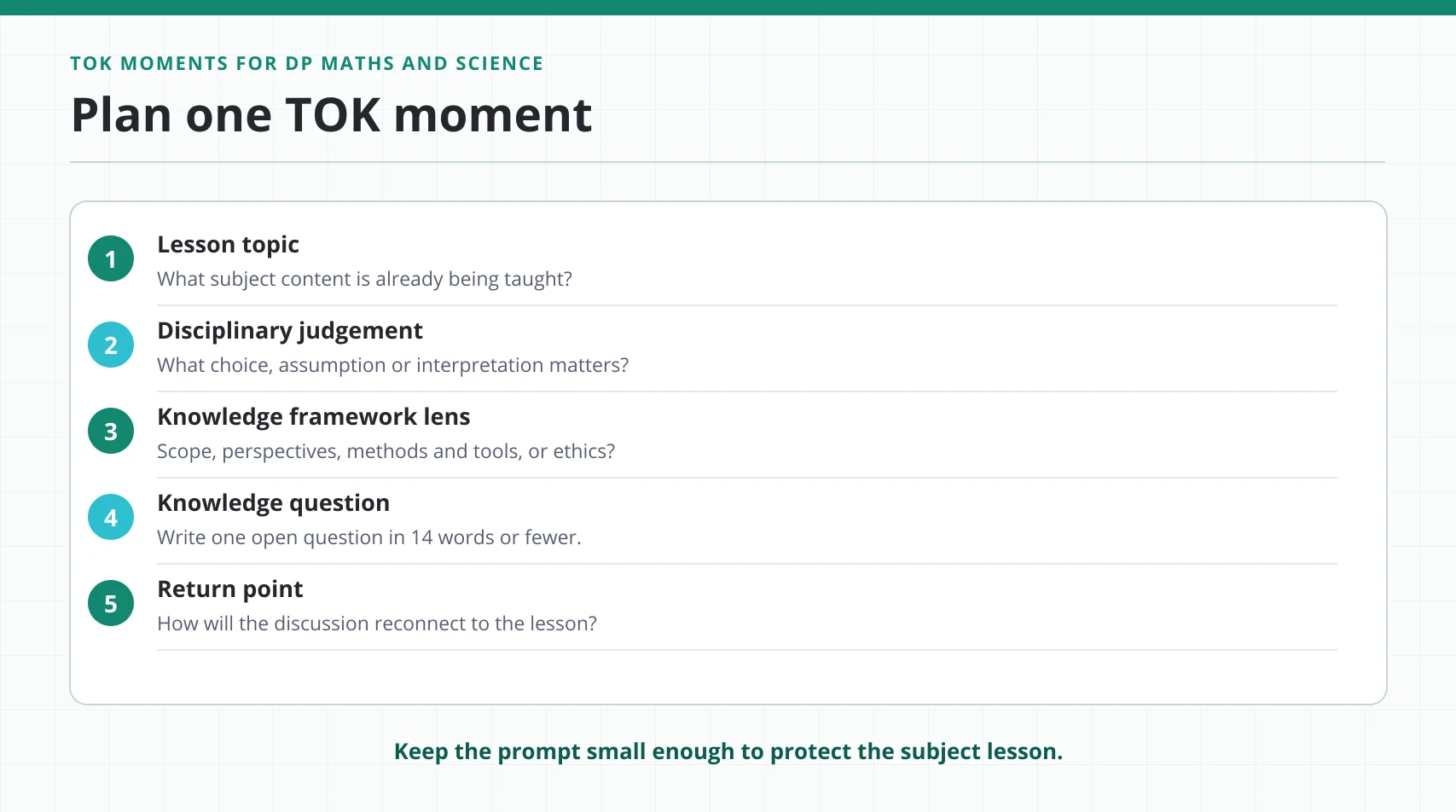
DP Maths and Science teachers guide to embedding Theory of Knowledge into STEM lessons. Copy-paste five-minute starters for Maths and Science, the Thinking Framework TOK mapping table, an Areas of Knowledge reference card, and how TOK integration affects diploma bonus points.
The TOK teacher runs a session on the nature of scientific knowledge. Meanwhile, in the lab next door, a DP Biology teacher explains enzyme activity without once mentioning that the experimental method relies on the assumption that nature is uniform. Both teachers are doing their jobs. Neither realises that the most powerful teaching moment is happening in the gap between them.
This is the structural failure of TOK in most IB schools. The Theory of Knowledge course lives in one room, taught by one or two specialists, while STEM teachers get on with the business of content coverage. The IB Organisation (2022) is explicit: TOK is not a standalone subject but a cross-curricular framework that should infuse all DP teaching. In practice, the infusion rarely happens. STEM teachers say, with some justification, that they have enough to cover without philosophy.
This article removes that excuse. It gives DP Maths and Science teachers five-minute activities, ready-to-use discussion prompts, and a clear map between the Thinking Framework and TOK epistemology. None of it requires a philosophy degree. All of it takes less than five minutes of lesson time.
Key Takeaways
TOK belongs in every DP classroom: The IB Organisation (2022) states explicitly that TOK should be embedded across all subjects. STEM teachers who ignore this are out of alignment with the DP framework, and their pupils miss bonus points on the core.
Ways of Knowing are already in STEM lessons: When a pupil says "I just know this answer is right," they are using Intuition. When they run an experiment, they use Sense Perception and Reason. Naming these turns implicit epistemology into deliberate teaching.
Five minutes is enough: A single TOK starter question at the beginning of a lesson, or a one-sentence epistemological framing mid-lesson, is sufficient to create genuine TOK moments. This article provides copy-paste activities for both Maths and Science.
The Thinking Framework maps directly onto TOK inquiry: The eight cognitive operations (Compare, Perspective, Cause and Effect, Systems Thinking, Analogy, Part-Whole, Classify, Sequence) correspond directly to the epistemological moves TOK requires of pupils.
TOK integration affects diploma scores: The EE/TOK bonus points matrix rewards pupils whose extended essays engage genuinely with epistemological reflection. STEM teachers who embed TOK moments throughout Year 12 and 13 produce pupils who access these points naturally.
The Problem: TOK Lives in Room 14
In a typical IB school, the timetable says "TOK" and points to a specific room. The designation is useful for scheduling. It is catastrophic for learning. Once TOK has a room, it has an owner, and the unspoken implication is that everyone else is off the hook. Science teachers teach science. Maths teachers teach maths. The epistemological questions get outsourced to the TOK specialist and revisited, briefly, when pupils write their essays.
The consequence is that pupils experience a fractured intellectual life. They encounter knowledge as subject-specific fact in most of their lessons, then switch into a questioning mode once a week in TOK. The two modes rarely talk to each other. A pupil studying HL Chemistry learns about Dalton's atomic model, then learns about Bohr's model, then learns about quantum mechanics. Without an epistemological frame, these are just a sequence of theories to memorise. With one, they become a case study in how scientific knowledge develops, how evidence changes consensus, and what it means to say a theory has been "proved wrong." That is the difference TOK makes. And STEM lessons are where that difference is most powerful.
Van de Lagemaat (2015) argues that TOK is most effective when it arises from genuine disciplinary inquiry rather than abstract philosophical questions. The best TOK moment in a school week may not be in the TOK lesson at all. It may be in the moment a Physics teacher pauses and asks: "How do we actually know the speed of light?" That question costs thirty seconds. The intellectual habit it builds lasts a career.
What Ways of Knowing Actually Mean for a STEM Teacher
The IB identifies eight Ways of Knowing: Reason, Language, Sense Perception, Emotion, Imagination, Faith, Intuition, and Memory. STEM teachers often assume these belong to the humanities. This assumption does not survive scrutiny.
Reason is the dominant Way of Knowing in Mathematics. Every proof, every algebraic manipulation, every geometric argument is an exercise in Reason. Most Maths teachers use it every lesson without naming it. Naming it takes one sentence: "Today we are using deductive reasoning to prove this theorem." That sentence connects what happens in the Maths room to what pupils discuss in TOK and it costs nothing.
Sense Perception is central to Science. Experimental data comes through observation. The question of whether observation is theory-laden is a live epistemological debate with direct implications for how pupils interpret their results. Kuhn (1962) argued that scientists see different things through the same data depending on their theoretical commitments. A Science teacher who spends two minutes on this before a practical investigation has given pupils a richer understanding of what experimental evidence actually means.
Intuition appears in both subjects more than teachers acknowledge. When a pupil says "I can just tell this answer is wrong" before checking their working, they are using Intuition. When a mathematician has a "feel" for which proof strategy will work, that is Intuition. Naming it dignifies the experience and opens a productive question: how reliable is mathematical intuition? When should we trust it?
Imagination drives scientific hypothesis formation. Popper (1959) placed imagination at the centre of scientific creativity: before a hypothesis can be tested, it must be conceived. Telling Year 12 pupils this, briefly, before a hypothesis-writing task frames imagination as a legitimate epistemic tool rather than something that belongs only in Art and English.
Language shapes scientific and mathematical thinking in ways that are easy to overlook. The choice between "law" and "theory" in Science carries epistemological weight: a scientific law describes; a theory explains. Many pupils, and some teachers, use these terms interchangeably. A one-minute clarification of the distinction is a TOK moment embedded in a Science lesson. For a deeper look at how language structures thinking, see this guide to critical thinking in education.
Emotion and Memory are less obvious in STEM but no less real. The history of science is full of cases where emotional investment in a theory delayed acceptance of contradictory evidence. Memory shapes what scientists notice and what they discard. Dombrowski (2013) points out that all knowers are situated, and their situatedness includes emotional and memorial dimensions that no scientific method can entirely eliminate. These are not arguments against science; they are arguments for epistemic humility, which is exactly what TOK teaches.
Five-Minute TOK Starters for Maths
Each of the following activities takes between three and six minutes. They can open a lesson, close one, or sit as a mid-lesson break when pupils need a change of cognitive register. None requires preparation beyond reading the prompt.
Activity 1: Discovered or invented?
Ask the class: "Is mathematical knowledge discovered or invented?" Give pupils sixty seconds to choose a position and note one reason. Take a brief show of hands, then hear two or three justifications. The question has no settled answer: Platonists argue mathematics exists independently of human minds; formalists argue it is a human construction. The point is not to resolve it but to notice that the question exists. This positions Mathematics within the broader TOK conversation about the nature of knowledge.
Activity 2: The false proof
Write on the board: Let a = b. Then a² = ab. Therefore a² - b² = ab - b². Factorise: (a+b)(a-b) = b(a-b). Divide both sides: a+b = b. Since a = b, then 2b = b. Therefore 2 = 1.
Ask: "Where does this go wrong?" The error is dividing by (a-b), which equals zero. The pedagogical point is that Reason as a Way of Knowing has a logic: if the premises are valid and the reasoning is sound, the conclusion must be true. The proof shows what happens when one step violates a foundational rule. This is TOK embedded in algebraic thinking. Link to the epistemological question: how do mathematicians know when a proof is correct?
Activity 3: Proof versus empirical evidence
Ask: "Is it enough to check that a pattern holds for the first million cases?" Most pupils say yes. Introduce the concept of mathematical proof: the reason mathematicians require proof rather than extensive testing is that a pattern holding for a trillion cases does not guarantee it holds for the trillion-and-first. The Goldbach conjecture (every even integer greater than 2 is the sum of two primes) has been verified for numbers up to four quintillion and remains unproved. This distinction between empirical evidence and deductive certainty is a Ways of Knowing distinction: Sense Perception (checking cases) versus Reason (proof). It takes four minutes and changes how pupils understand what Mathematics is.
Activity 4: Perspective in Mathematics
Use the Thinking Framework's Perspective operation. Ask: "How would a pure mathematician and an engineer answer this differently: is 0.999... equal to 1?" The pure mathematician says yes, because the limit of the series is exactly 1. The engineer may say it is close enough for any practical purpose and the distinction is meaningless. Neither is wrong within their framing. The question illuminates how the purpose of knowledge shapes how it is understood, which is a TOK insight with broad application.
Activity 5: Intuition audit
Before pupils attempt a problem, ask them: "What does your intuition tell you the answer will be?" Record predictions on the board, then work through the problem. Discuss where intuition was right, where it was wrong, and why. This builds metacognitive awareness about the reliability of intuition as a Way of Knowing in Mathematics. For more on metacognition in the classroom, including how to make thinking visible, the research base is strong.
Five-Minute TOK Starters for Science
Science lessons provide rich natural opportunities for epistemological discussion because the discipline explicitly claims to produce reliable knowledge about the world. That claim is worth examining briefly and productively.
Activity 1: The duck-rabbit
Show the duck-rabbit illusion (or any other ambiguous figure). Ask: "Are you seeing the object, or are you seeing your interpretation of it?" This opens the question of whether observation is theory-laden. Kuhn (1962) argued it always is: what scientists see is shaped by the theories they bring to their observations. A Science teacher who spends three minutes on this before a practical investigation has given pupils a genuine philosophical frame for thinking about their own experimental data.
Activity 2: Scientific consensus
Ask: "When should we trust scientific consensus?" Use climate science as the example, or vaccination, or the germ theory of disease before it was accepted. The question is not whether scientific consensus is right (usually it is) but how we know when to trust it and what makes the scientific community's judgement reliable. This connects to the Ways of Knowing of Reason, Authority, and Language, and it builds the epistemic sophistication that makes pupils better at evaluating evidence throughout their lives.
Activity 3: Fact, theory, law
Write three terms on the board: scientific fact, scientific theory, scientific law. Ask pupils to rank them by certainty. Most rank them: fact (certain), law (very certain), theory (uncertain). The correct epistemological answer is more interesting: a scientific theory is not an uncertain guess but an explanatory framework supported by extensive evidence. Evolution is a theory. Gravity is a theory. A scientific law describes a pattern; a theory explains why the pattern exists. This three-minute correction of a widespread misconception is also a genuine TOK moment about the role of Language as a Way of Knowing.
Activity 4: Compare investigative approaches
Use the Thinking Framework's Compare operation. Ask: "Compare how a physicist and a biologist would investigate the same question: what causes ageing?" The physicist might look for entropy and thermodynamic inevitability. The biologist might look at cellular damage and telomere shortening. The sociologist might look at lifestyle factors. None of these perspectives is wrong; each illuminates a different dimension of the question. This takes five minutes and directly addresses the TOK concept of Areas of Knowledge as different lenses on shared phenomena.
Activity 5: The ethics of experimentation
Before any practical investigation, ask: "What ethical constraints limit what we can test?" This is especially productive in Biology (human subjects, animal welfare) but works in any science. The question connects the Natural Sciences Area of Knowledge to the ethical dimension of TOK and prepares pupils who may reference ethical considerations in their Internal Assessments. A Biology IA that includes a genuine reflection on the ethics of the experimental design, not just a formulaic disclaimer, scores more highly on personal engagement. The connection between TOK and IA quality is direct.
The Thinking Framework as TOK Scaffold
The Thinking Framework's eight cognitive operations are not just pedagogical tools. They are epistemological moves. Each operation corresponds to a type of inquiry that TOK examines explicitly. STEM teachers who already use the Thinking Framework in their lessons are already doing TOK work. The table below makes that correspondence explicit.
Thinking Framework Operation
TOK Epistemological Move
STEM Application
Compare
"How do different knowers approach this?"
Compare how a physicist and biologist investigate the same phenomenon
Perspective
"Whose perspective is missing from this knowledge claim?"
Who benefits from and who is marginalised by this scientific consensus?
Cause and Effect
"What assumptions cause us to reach this conclusion?"
What must we assume about nature for this experiment to be valid?
Systems Thinking
"How does this knowledge connect to other areas?"
How does mathematical modelling change when applied to biological vs physical systems?
Analogy
"What is this knowledge claim LIKE in another Area of Knowledge?"
Is a mathematical proof more like a scientific experiment or a philosophical argument?
Part-Whole
"What does each component contribute to the knowledge system?"
How do observation, hypothesis, and peer review together produce scientific knowledge?
Classify
"What category of knowledge is this?"
Is this a fact, a law, a theory, or a model? What does the classification imply?
Sequence
"How does knowledge develop over time?"
Trace the development of atomic theory from Dalton to quantum mechanics
Each of these operations can be deployed in under five minutes. A teacher who uses even two of them per week across a DP course will produce pupils who enter their TOK assessment with a developed vocabulary for epistemological thinking, drawn from genuine disciplinary experience rather than abstract classroom exercises. For a fuller treatment of how cognitive operations build critical thinking skills across subjects, the evidence base is well-established.
Areas of Knowledge: The STEM Teacher's Quick Reference
The IB identifies five Areas of Knowledge, three of which are directly relevant to STEM teachers: Natural Sciences, Mathematics, and Human Sciences. The following reference card gives each teacher what they need to identify TOK moments in their own subject. Print it, keep it in your planner, and use it once per week.
Area of Knowledge
Two Knowledge Questions
Real-World Situation
Classroom Activity
Natural Sciences
1. What role does falsifiability play in establishing scientific knowledge? 2. To what extent is scientific objectivity possible?
The replication crisis in psychology: many published results cannot be replicated. What does this imply for scientific knowledge claims?
Give pupils two contradictory research findings on the same question. Ask: which do you believe, and why? What would make you change your mind?
Mathematics
1. Is mathematical knowledge certain, and if so, what makes it so? 2. Is mathematics discovered or invented?
Non-Euclidean geometry: for two thousand years, Euclid's parallel postulate was treated as self-evident. Its rejection created entirely new mathematical worlds.
Give pupils a visual proof (e.g., the Pythagorean theorem via squares). Ask: does seeing it make it true, or does it need algebraic proof? Why?
Human Sciences
1. Can human behaviour be studied scientifically in the same way as natural phenomena? 2. How do ethical constraints shape what human scientists can know?
Milgram's obedience experiments: profoundly revealing about human behaviour but impossible to replicate today on ethical grounds. What does this mean for the knowledge they produced?
Ask pupils to design a study to answer a question about human behaviour, then identify every ethical constraint on their design. What can they now not find out?
These questions do not require specialist TOK knowledge to facilitate. They require curiosity and a willingness to sit with uncertainty for five minutes. The IB Learner Profile describes the ideal IB pupil as a reflective thinker who examines their own perspectives. STEM teachers who use the activities above are building that disposition in the context where it matters most: the subject itself.
For STEM teachers who want to develop their own inquiry-based teaching practice more broadly, the principles are closely related: good inquiry teaching and good TOK teaching both begin with a genuinely open question.
How TOK Integration Affects DP Assessment
TOK integration is not merely philosophical enrichment. It has direct consequences for diploma scores through two mechanisms: the EE/TOK bonus points matrix, and the quality of Internal Assessment personal engagement.
The bonus points matrix awards up to three additional points on the diploma for pupils who achieve strong grades in both the Extended Essay and TOK. A pupil who scores an A on their EE and an A on their TOK assessment receives three bonus points. Those three points can make the difference between a 42 and a 45, or between achieving the diploma and falling just short. STEM teachers who embed TOK moments throughout Year 12 and 13 produce pupils who arrive at their TOK assessment with a developed epistemological vocabulary. That vocabulary is built through practice, not through a single term of TOK lessons.
The IA personal engagement criterion rewards authentic connection between the pupil and the investigation. A Biology IA that includes a reflective sentence on the epistemological assumptions underlying the experimental method, or that acknowledges the limitations of Sense Perception in observational data, signals genuine personal engagement. It does not need to be lengthy: one or two sentences that demonstrate the pupil has thought about the nature of the knowledge they are producing is sufficient. STEM teachers can prepare pupils for this by modelling it in class. "This is an interesting result. Before we accept it, what assumptions did we make in designing this experiment?" That question, asked once a week, builds the reflective habit.
For teachers whose pupils are preparing Extended Essays, the connection between EE methodology and TOK is particularly strong. An EE research question about a scientific phenomenon is stronger when the pupil has explicitly considered what counts as evidence in their discipline, and weaker when they treat methodology as a box to tick. That difference comes from the habits of mind built in STEM lessons, not just in TOK class.
Linking TOK to MYP Conceptual Assessment
For schools that run the full IB continuum from PYP through MYP to DP, the epistemological groundwork should be laid well before students encounter TOK. The MYP's concept-based assessment already asks students to make connections, transfer understanding across contexts, and reflect on how they know what they know. Teachers who want to see how this works in practice across the IB curriculum can explore this guide to MYP conceptual assessment.
The transition from MYP to DP TOK is smoother when pupils have spent four years practising epistemological thinking without calling it that. A Year 10 pupil who has regularly asked "how do we know this?" and "what would change our minds?" arrives in Year 12 TOK with a conceptual toolkit. The STEM teacher's role in building that toolkit is not optional; it is part of the programme design. The ATL skills framework makes a similar argument: the best implementation of IB cross-curricular frameworks is invisible because it is embedded in ordinary teaching, not added on top of it.
What to Try Before Your Next STEM Lesson
Pick one topic from your DP syllabus. Ask yourself: what Way of Knowing do pupils primarily use to understand this concept? If it is Reason, name it at the start of the lesson. If it is Sense Perception, tell pupils before the practical that they are using observation as an epistemic tool and that this has limitations. If it is Imagination, tell them before the hypothesis-writing task that forming a hypothesis requires imagining what might be true before any evidence exists.
Naming the Way of Knowing takes one sentence. That sentence connects your lesson to the TOK framework your pupils are working within. It does not require you to become a philosophy teacher. It requires you to notice what is already happening epistemologically in your lesson and say it aloud. The pupils do the rest.
Start with one activity from the lists above. Maths teachers: try the false proof. Science teachers: try the duck-rabbit. Run it once. Notice what happens to the quality of discussion. The pupils who engage most deeply are often not the ones who perform best on content tests. TOK moments reveal different kinds of intelligence, and seeing that tends to change how teachers think about their pupils. For those interested in developing a full school-wide approach to thinking, the Thinking Framework provides the structure. For those starting with one lesson and one question, that is enough.
For further background on the International Baccalaureate as a whole, and how TOK fits within the broader programme philosophy, the full programme description situates TOK within the DP core alongside CAS and the Extended Essay. All three require the same fundamental disposition: willingness to examine knowledge claims rather than simply receive them. STEM teachers build that disposition every time they ask a genuinely open question in a lesson where the answer is already known.
Further Reading: Key Research and Scholarship
These works underpin the epistemological arguments in this article and provide deeper reading for teachers who want to develop their TOK practice.
Theory of Knowledge for the IB Diploma (6th edition)View study ↗ Core IB text
Van de Lagemaat, R. (2015)
The most widely used TOK textbook in IB schools. Van de Lagemaat provides accessible coverage of all eight Ways of Knowing and five Areas of Knowledge, with disciplinary examples that STEM teachers can draw on directly. Particularly useful for the Natural Sciences and Mathematics chapters.
Theory of Knowledge: Perspectives and Possibilities (3rd edition)View study ↗ IB resource
Dombrowski, E. (2013)
Dombrowski's approach emphasises the situated nature of all knowers and is particularly valuable for STEM teachers who want to understand why Emotion, Memory, and Perspective are relevant to scientific and mathematical inquiry, not just to the humanities.
The Structure of Scientific Revolutions (2nd edition)View study ↗ 1,270 citations
Kuhn, T. S. (1962)
The foundational text for understanding how scientific knowledge changes. Kuhn's concept of paradigm shifts and theory-laden observation is directly relevant to DP Science teachers. Reading even the first two chapters provides the epistemological framework for several months of TOK starter questions.
The Logic of Scientific DiscoveryView study ↗ Classic text
Popper, K. (1959)
Popper's argument that falsifiability distinguishes science from non-science is the foundation of the scientific method as IB Science understands it. His emphasis on imagination in hypothesis formation gives STEM teachers a philosophical grounding for valuing creative thinking in their classrooms.
Theory of Knowledge Guide for the IB Diploma (2022 edition)View study ↗ Official IB
IB Organisation (2022)
The official IB guide is the authoritative source for how TOK relates to all DP subjects. Pages 14 to 23 address the role of subject teachers in TOK integration. Every DP STEM teacher should have read these pages: they make clear that TOK is a shared responsibility, not the TOK teacher's alone.
The TOK teacher runs a session on the nature of scientific knowledge. Meanwhile, in the lab next door, a DP Biology teacher explains enzyme activity without once mentioning that the experimental method relies on the assumption that nature is uniform. Both teachers are doing their jobs. Neither realises that the most powerful teaching moment is happening in the gap between them.
This is the structural failure of TOK in most IB schools. The Theory of Knowledge course lives in one room, taught by one or two specialists, while STEM teachers get on with the business of content coverage. The IB Organisation (2022) is explicit: TOK is not a standalone subject but a cross-curricular framework that should infuse all DP teaching. In practice, the infusion rarely happens. STEM teachers say, with some justification, that they have enough to cover without philosophy.
This article removes that excuse. It gives DP Maths and Science teachers five-minute activities, ready-to-use discussion prompts, and a clear map between the Thinking Framework and TOK epistemology. None of it requires a philosophy degree. All of it takes less than five minutes of lesson time.
Key Takeaways
TOK belongs in every DP classroom: The IB Organisation (2022) states explicitly that TOK should be embedded across all subjects. STEM teachers who ignore this are out of alignment with the DP framework, and their pupils miss bonus points on the core.
Ways of Knowing are already in STEM lessons: When a pupil says "I just know this answer is right," they are using Intuition. When they run an experiment, they use Sense Perception and Reason. Naming these turns implicit epistemology into deliberate teaching.
Five minutes is enough: A single TOK starter question at the beginning of a lesson, or a one-sentence epistemological framing mid-lesson, is sufficient to create genuine TOK moments. This article provides copy-paste activities for both Maths and Science.
The Thinking Framework maps directly onto TOK inquiry: The eight cognitive operations (Compare, Perspective, Cause and Effect, Systems Thinking, Analogy, Part-Whole, Classify, Sequence) correspond directly to the epistemological moves TOK requires of pupils.
TOK integration affects diploma scores: The EE/TOK bonus points matrix rewards pupils whose extended essays engage genuinely with epistemological reflection. STEM teachers who embed TOK moments throughout Year 12 and 13 produce pupils who access these points naturally.
The Problem: TOK Lives in Room 14
In a typical IB school, the timetable says "TOK" and points to a specific room. The designation is useful for scheduling. It is catastrophic for learning. Once TOK has a room, it has an owner, and the unspoken implication is that everyone else is off the hook. Science teachers teach science. Maths teachers teach maths. The epistemological questions get outsourced to the TOK specialist and revisited, briefly, when pupils write their essays.
The consequence is that pupils experience a fractured intellectual life. They encounter knowledge as subject-specific fact in most of their lessons, then switch into a questioning mode once a week in TOK. The two modes rarely talk to each other. A pupil studying HL Chemistry learns about Dalton's atomic model, then learns about Bohr's model, then learns about quantum mechanics. Without an epistemological frame, these are just a sequence of theories to memorise. With one, they become a case study in how scientific knowledge develops, how evidence changes consensus, and what it means to say a theory has been "proved wrong." That is the difference TOK makes. And STEM lessons are where that difference is most powerful.
Van de Lagemaat (2015) argues that TOK is most effective when it arises from genuine disciplinary inquiry rather than abstract philosophical questions. The best TOK moment in a school week may not be in the TOK lesson at all. It may be in the moment a Physics teacher pauses and asks: "How do we actually know the speed of light?" That question costs thirty seconds. The intellectual habit it builds lasts a career.
What Ways of Knowing Actually Mean for a STEM Teacher
The IB identifies eight Ways of Knowing: Reason, Language, Sense Perception, Emotion, Imagination, Faith, Intuition, and Memory. STEM teachers often assume these belong to the humanities. This assumption does not survive scrutiny.
Reason is the dominant Way of Knowing in Mathematics. Every proof, every algebraic manipulation, every geometric argument is an exercise in Reason. Most Maths teachers use it every lesson without naming it. Naming it takes one sentence: "Today we are using deductive reasoning to prove this theorem." That sentence connects what happens in the Maths room to what pupils discuss in TOK and it costs nothing.
Sense Perception is central to Science. Experimental data comes through observation. The question of whether observation is theory-laden is a live epistemological debate with direct implications for how pupils interpret their results. Kuhn (1962) argued that scientists see different things through the same data depending on their theoretical commitments. A Science teacher who spends two minutes on this before a practical investigation has given pupils a richer understanding of what experimental evidence actually means.
Intuition appears in both subjects more than teachers acknowledge. When a pupil says "I can just tell this answer is wrong" before checking their working, they are using Intuition. When a mathematician has a "feel" for which proof strategy will work, that is Intuition. Naming it dignifies the experience and opens a productive question: how reliable is mathematical intuition? When should we trust it?
Imagination drives scientific hypothesis formation. Popper (1959) placed imagination at the centre of scientific creativity: before a hypothesis can be tested, it must be conceived. Telling Year 12 pupils this, briefly, before a hypothesis-writing task frames imagination as a legitimate epistemic tool rather than something that belongs only in Art and English.
Language shapes scientific and mathematical thinking in ways that are easy to overlook. The choice between "law" and "theory" in Science carries epistemological weight: a scientific law describes; a theory explains. Many pupils, and some teachers, use these terms interchangeably. A one-minute clarification of the distinction is a TOK moment embedded in a Science lesson. For a deeper look at how language structures thinking, see this guide to critical thinking in education.
Emotion and Memory are less obvious in STEM but no less real. The history of science is full of cases where emotional investment in a theory delayed acceptance of contradictory evidence. Memory shapes what scientists notice and what they discard. Dombrowski (2013) points out that all knowers are situated, and their situatedness includes emotional and memorial dimensions that no scientific method can entirely eliminate. These are not arguments against science; they are arguments for epistemic humility, which is exactly what TOK teaches.
Five-Minute TOK Starters for Maths
Each of the following activities takes between three and six minutes. They can open a lesson, close one, or sit as a mid-lesson break when pupils need a change of cognitive register. None requires preparation beyond reading the prompt.
Activity 1: Discovered or invented?
Ask the class: "Is mathematical knowledge discovered or invented?" Give pupils sixty seconds to choose a position and note one reason. Take a brief show of hands, then hear two or three justifications. The question has no settled answer: Platonists argue mathematics exists independently of human minds; formalists argue it is a human construction. The point is not to resolve it but to notice that the question exists. This positions Mathematics within the broader TOK conversation about the nature of knowledge.
Activity 2: The false proof
Write on the board: Let a = b. Then a² = ab. Therefore a² - b² = ab - b². Factorise: (a+b)(a-b) = b(a-b). Divide both sides: a+b = b. Since a = b, then 2b = b. Therefore 2 = 1.
Ask: "Where does this go wrong?" The error is dividing by (a-b), which equals zero. The pedagogical point is that Reason as a Way of Knowing has a logic: if the premises are valid and the reasoning is sound, the conclusion must be true. The proof shows what happens when one step violates a foundational rule. This is TOK embedded in algebraic thinking. Link to the epistemological question: how do mathematicians know when a proof is correct?
Activity 3: Proof versus empirical evidence
Ask: "Is it enough to check that a pattern holds for the first million cases?" Most pupils say yes. Introduce the concept of mathematical proof: the reason mathematicians require proof rather than extensive testing is that a pattern holding for a trillion cases does not guarantee it holds for the trillion-and-first. The Goldbach conjecture (every even integer greater than 2 is the sum of two primes) has been verified for numbers up to four quintillion and remains unproved. This distinction between empirical evidence and deductive certainty is a Ways of Knowing distinction: Sense Perception (checking cases) versus Reason (proof). It takes four minutes and changes how pupils understand what Mathematics is.
Activity 4: Perspective in Mathematics
Use the Thinking Framework's Perspective operation. Ask: "How would a pure mathematician and an engineer answer this differently: is 0.999... equal to 1?" The pure mathematician says yes, because the limit of the series is exactly 1. The engineer may say it is close enough for any practical purpose and the distinction is meaningless. Neither is wrong within their framing. The question illuminates how the purpose of knowledge shapes how it is understood, which is a TOK insight with broad application.
Activity 5: Intuition audit
Before pupils attempt a problem, ask them: "What does your intuition tell you the answer will be?" Record predictions on the board, then work through the problem. Discuss where intuition was right, where it was wrong, and why. This builds metacognitive awareness about the reliability of intuition as a Way of Knowing in Mathematics. For more on metacognition in the classroom, including how to make thinking visible, the research base is strong.
Five-Minute TOK Starters for Science
Science lessons provide rich natural opportunities for epistemological discussion because the discipline explicitly claims to produce reliable knowledge about the world. That claim is worth examining briefly and productively.
Activity 1: The duck-rabbit
Show the duck-rabbit illusion (or any other ambiguous figure). Ask: "Are you seeing the object, or are you seeing your interpretation of it?" This opens the question of whether observation is theory-laden. Kuhn (1962) argued it always is: what scientists see is shaped by the theories they bring to their observations. A Science teacher who spends three minutes on this before a practical investigation has given pupils a genuine philosophical frame for thinking about their own experimental data.
Activity 2: Scientific consensus
Ask: "When should we trust scientific consensus?" Use climate science as the example, or vaccination, or the germ theory of disease before it was accepted. The question is not whether scientific consensus is right (usually it is) but how we know when to trust it and what makes the scientific community's judgement reliable. This connects to the Ways of Knowing of Reason, Authority, and Language, and it builds the epistemic sophistication that makes pupils better at evaluating evidence throughout their lives.
Activity 3: Fact, theory, law
Write three terms on the board: scientific fact, scientific theory, scientific law. Ask pupils to rank them by certainty. Most rank them: fact (certain), law (very certain), theory (uncertain). The correct epistemological answer is more interesting: a scientific theory is not an uncertain guess but an explanatory framework supported by extensive evidence. Evolution is a theory. Gravity is a theory. A scientific law describes a pattern; a theory explains why the pattern exists. This three-minute correction of a widespread misconception is also a genuine TOK moment about the role of Language as a Way of Knowing.
Activity 4: Compare investigative approaches
Use the Thinking Framework's Compare operation. Ask: "Compare how a physicist and a biologist would investigate the same question: what causes ageing?" The physicist might look for entropy and thermodynamic inevitability. The biologist might look at cellular damage and telomere shortening. The sociologist might look at lifestyle factors. None of these perspectives is wrong; each illuminates a different dimension of the question. This takes five minutes and directly addresses the TOK concept of Areas of Knowledge as different lenses on shared phenomena.
Activity 5: The ethics of experimentation
Before any practical investigation, ask: "What ethical constraints limit what we can test?" This is especially productive in Biology (human subjects, animal welfare) but works in any science. The question connects the Natural Sciences Area of Knowledge to the ethical dimension of TOK and prepares pupils who may reference ethical considerations in their Internal Assessments. A Biology IA that includes a genuine reflection on the ethics of the experimental design, not just a formulaic disclaimer, scores more highly on personal engagement. The connection between TOK and IA quality is direct.
The Thinking Framework as TOK Scaffold
The Thinking Framework's eight cognitive operations are not just pedagogical tools. They are epistemological moves. Each operation corresponds to a type of inquiry that TOK examines explicitly. STEM teachers who already use the Thinking Framework in their lessons are already doing TOK work. The table below makes that correspondence explicit.
Thinking Framework Operation
TOK Epistemological Move
STEM Application
Compare
"How do different knowers approach this?"
Compare how a physicist and biologist investigate the same phenomenon
Perspective
"Whose perspective is missing from this knowledge claim?"
Who benefits from and who is marginalised by this scientific consensus?
Cause and Effect
"What assumptions cause us to reach this conclusion?"
What must we assume about nature for this experiment to be valid?
Systems Thinking
"How does this knowledge connect to other areas?"
How does mathematical modelling change when applied to biological vs physical systems?
Analogy
"What is this knowledge claim LIKE in another Area of Knowledge?"
Is a mathematical proof more like a scientific experiment or a philosophical argument?
Part-Whole
"What does each component contribute to the knowledge system?"
How do observation, hypothesis, and peer review together produce scientific knowledge?
Classify
"What category of knowledge is this?"
Is this a fact, a law, a theory, or a model? What does the classification imply?
Sequence
"How does knowledge develop over time?"
Trace the development of atomic theory from Dalton to quantum mechanics
Each of these operations can be deployed in under five minutes. A teacher who uses even two of them per week across a DP course will produce pupils who enter their TOK assessment with a developed vocabulary for epistemological thinking, drawn from genuine disciplinary experience rather than abstract classroom exercises. For a fuller treatment of how cognitive operations build critical thinking skills across subjects, the evidence base is well-established.
Areas of Knowledge: The STEM Teacher's Quick Reference
The IB identifies five Areas of Knowledge, three of which are directly relevant to STEM teachers: Natural Sciences, Mathematics, and Human Sciences. The following reference card gives each teacher what they need to identify TOK moments in their own subject. Print it, keep it in your planner, and use it once per week.
Area of Knowledge
Two Knowledge Questions
Real-World Situation
Classroom Activity
Natural Sciences
1. What role does falsifiability play in establishing scientific knowledge? 2. To what extent is scientific objectivity possible?
The replication crisis in psychology: many published results cannot be replicated. What does this imply for scientific knowledge claims?
Give pupils two contradictory research findings on the same question. Ask: which do you believe, and why? What would make you change your mind?
Mathematics
1. Is mathematical knowledge certain, and if so, what makes it so? 2. Is mathematics discovered or invented?
Non-Euclidean geometry: for two thousand years, Euclid's parallel postulate was treated as self-evident. Its rejection created entirely new mathematical worlds.
Give pupils a visual proof (e.g., the Pythagorean theorem via squares). Ask: does seeing it make it true, or does it need algebraic proof? Why?
Human Sciences
1. Can human behaviour be studied scientifically in the same way as natural phenomena? 2. How do ethical constraints shape what human scientists can know?
Milgram's obedience experiments: profoundly revealing about human behaviour but impossible to replicate today on ethical grounds. What does this mean for the knowledge they produced?
Ask pupils to design a study to answer a question about human behaviour, then identify every ethical constraint on their design. What can they now not find out?
These questions do not require specialist TOK knowledge to facilitate. They require curiosity and a willingness to sit with uncertainty for five minutes. The IB Learner Profile describes the ideal IB pupil as a reflective thinker who examines their own perspectives. STEM teachers who use the activities above are building that disposition in the context where it matters most: the subject itself.
For STEM teachers who want to develop their own inquiry-based teaching practice more broadly, the principles are closely related: good inquiry teaching and good TOK teaching both begin with a genuinely open question.
How TOK Integration Affects DP Assessment
TOK integration is not merely philosophical enrichment. It has direct consequences for diploma scores through two mechanisms: the EE/TOK bonus points matrix, and the quality of Internal Assessment personal engagement.
The bonus points matrix awards up to three additional points on the diploma for pupils who achieve strong grades in both the Extended Essay and TOK. A pupil who scores an A on their EE and an A on their TOK assessment receives three bonus points. Those three points can make the difference between a 42 and a 45, or between achieving the diploma and falling just short. STEM teachers who embed TOK moments throughout Year 12 and 13 produce pupils who arrive at their TOK assessment with a developed epistemological vocabulary. That vocabulary is built through practice, not through a single term of TOK lessons.
The IA personal engagement criterion rewards authentic connection between the pupil and the investigation. A Biology IA that includes a reflective sentence on the epistemological assumptions underlying the experimental method, or that acknowledges the limitations of Sense Perception in observational data, signals genuine personal engagement. It does not need to be lengthy: one or two sentences that demonstrate the pupil has thought about the nature of the knowledge they are producing is sufficient. STEM teachers can prepare pupils for this by modelling it in class. "This is an interesting result. Before we accept it, what assumptions did we make in designing this experiment?" That question, asked once a week, builds the reflective habit.
For teachers whose pupils are preparing Extended Essays, the connection between EE methodology and TOK is particularly strong. An EE research question about a scientific phenomenon is stronger when the pupil has explicitly considered what counts as evidence in their discipline, and weaker when they treat methodology as a box to tick. That difference comes from the habits of mind built in STEM lessons, not just in TOK class.
Linking TOK to MYP Conceptual Assessment
For schools that run the full IB continuum from PYP through MYP to DP, the epistemological groundwork should be laid well before students encounter TOK. The MYP's concept-based assessment already asks students to make connections, transfer understanding across contexts, and reflect on how they know what they know. Teachers who want to see how this works in practice across the IB curriculum can explore this guide to MYP conceptual assessment.
The transition from MYP to DP TOK is smoother when pupils have spent four years practising epistemological thinking without calling it that. A Year 10 pupil who has regularly asked "how do we know this?" and "what would change our minds?" arrives in Year 12 TOK with a conceptual toolkit. The STEM teacher's role in building that toolkit is not optional; it is part of the programme design. The ATL skills framework makes a similar argument: the best implementation of IB cross-curricular frameworks is invisible because it is embedded in ordinary teaching, not added on top of it.
What to Try Before Your Next STEM Lesson
Pick one topic from your DP syllabus. Ask yourself: what Way of Knowing do pupils primarily use to understand this concept? If it is Reason, name it at the start of the lesson. If it is Sense Perception, tell pupils before the practical that they are using observation as an epistemic tool and that this has limitations. If it is Imagination, tell them before the hypothesis-writing task that forming a hypothesis requires imagining what might be true before any evidence exists.
Naming the Way of Knowing takes one sentence. That sentence connects your lesson to the TOK framework your pupils are working within. It does not require you to become a philosophy teacher. It requires you to notice what is already happening epistemologically in your lesson and say it aloud. The pupils do the rest.
Start with one activity from the lists above. Maths teachers: try the false proof. Science teachers: try the duck-rabbit. Run it once. Notice what happens to the quality of discussion. The pupils who engage most deeply are often not the ones who perform best on content tests. TOK moments reveal different kinds of intelligence, and seeing that tends to change how teachers think about their pupils. For those interested in developing a full school-wide approach to thinking, the Thinking Framework provides the structure. For those starting with one lesson and one question, that is enough.
For further background on the International Baccalaureate as a whole, and how TOK fits within the broader programme philosophy, the full programme description situates TOK within the DP core alongside CAS and the Extended Essay. All three require the same fundamental disposition: willingness to examine knowledge claims rather than simply receive them. STEM teachers build that disposition every time they ask a genuinely open question in a lesson where the answer is already known.
Further Reading: Key Research and Scholarship
These works underpin the epistemological arguments in this article and provide deeper reading for teachers who want to develop their TOK practice.
Theory of Knowledge for the IB Diploma (6th edition)View study ↗ Core IB text
Van de Lagemaat, R. (2015)
The most widely used TOK textbook in IB schools. Van de Lagemaat provides accessible coverage of all eight Ways of Knowing and five Areas of Knowledge, with disciplinary examples that STEM teachers can draw on directly. Particularly useful for the Natural Sciences and Mathematics chapters.
Theory of Knowledge: Perspectives and Possibilities (3rd edition)View study ↗ IB resource
Dombrowski, E. (2013)
Dombrowski's approach emphasises the situated nature of all knowers and is particularly valuable for STEM teachers who want to understand why Emotion, Memory, and Perspective are relevant to scientific and mathematical inquiry, not just to the humanities.
The Structure of Scientific Revolutions (2nd edition)View study ↗ 1,270 citations
Kuhn, T. S. (1962)
The foundational text for understanding how scientific knowledge changes. Kuhn's concept of paradigm shifts and theory-laden observation is directly relevant to DP Science teachers. Reading even the first two chapters provides the epistemological framework for several months of TOK starter questions.
The Logic of Scientific DiscoveryView study ↗ Classic text
Popper, K. (1959)
Popper's argument that falsifiability distinguishes science from non-science is the foundation of the scientific method as IB Science understands it. His emphasis on imagination in hypothesis formation gives STEM teachers a philosophical grounding for valuing creative thinking in their classrooms.
Theory of Knowledge Guide for the IB Diploma (2022 edition)View study ↗ Official IB
IB Organisation (2022)
The official IB guide is the authoritative source for how TOK relates to all DP subjects. Pages 14 to 23 address the role of subject teachers in TOK integration. Every DP STEM teacher should have read these pages: they make clear that TOK is a shared responsibility, not the TOK teacher's alone.
{"@context":"https://schema.org","@graph":[{"@type":"Article","headline":"TOK Is Not a Subject: How to Embed Ways of Knowing into DP Maths and Science","description":"DP Maths and Science teachers guide to embedding Theory of Knowledge Ways of Knowing into STEM lessons. Copy-paste five-minute starters, the Thinking Framework TOK mapping, and a quick-reference Areas of Knowledge card.","datePublished":"2026-03-24T10:00:00.000Z","dateModified":"2026-03-24T10:00:00.000Z","author":{"@type":"Person","name":"Paul Main","jobTitle":"Founder & Educational Consultant"},"publisher":{"@type":"Organization","name":"Structural Learning","logo":{"@type":"ImageObject","url":"https://cdn.prod.website-files.com/5b69a01ba2e409e5d5e055c6/5b7ed3e19e6f9b0001c3b8e4_SL-logo.png"}},"mainEntityOfPage":"https://www.structural-learning.com/post/tok-not-a-subject-embed-ways-of-knowing-stem","about":[{"@type":"Thing","name":"Theory of Knowledge","sameAs":"https://www.wikidata.org/wiki/Q2736222"},{"@type":"Thing","name":"IB Diploma Programme","sameAs":"https://www.wikidata.org/wiki/Q898943"},{"@type":"Thing","name":"Epistemology","sameAs":"https://www.wikidata.org/wiki/Q9471"}]},{"@type":"BreadcrumbList","itemListElement":[{"@type":"ListItem","position":1,"name":"Home","item":"https://www.structural-learning.com"},{"@type":"ListItem","position":2,"name":"Blog","item":"https://www.structural-learning.com/post"},{"@type":"ListItem","position":3,"name":"TOK Is Not a Subject","item":"https://www.structural-learning.com/post/tok-not-a-subject-embed-ways-of-knowing-stem"}]}]}