Updated on
March 8, 2026
The SEND White Paper 2026: What Every Teacher Needs to Know
|
March 8, 2026


Updated on
March 8, 2026
|
March 8, 2026
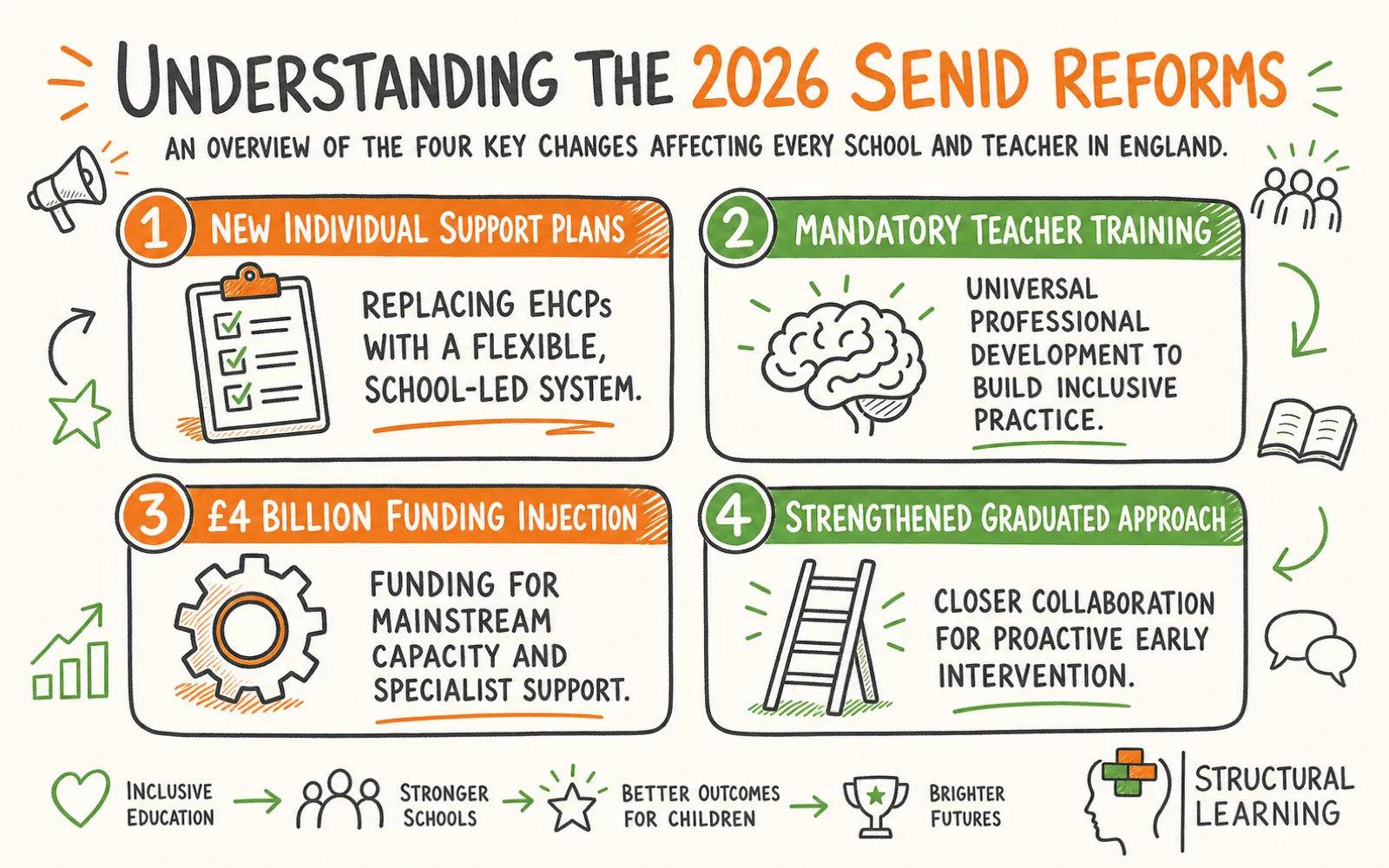
The SEND White Paper "Every Child Achieving and Thriving," published on 23 February 2026, represents the most significant reform to special educational needs provision in England since the Children and Families Act 2014. With £4 billion in new funding, a complete restructure of the EHCP system, and mandatory SEND training for all teachers, these reforms will change how every school in England supports pupils with additional needs. Whether you are a SENCO managing caseloads, a class teacher differentiating lessons, or a headteacher planning budgets, understanding these changes is not optional.

The current SEND system has been under sustained pressure since the Timpson Review (2019) and the SEND Review published in March 2022. Waiting times for Education, Health and Care Plans (EHCPs) have stretched beyond the statutory 20-week limit in many local authorities. SEND Tribunal appeals reached record levels in 2024-25, with over 90% of appeals decided in favour of parents (Ministry of Justice, 2025). The system designed to help children with special educational needs has become adversarial, slow, and inconsistent.
The White Paper addresses these systemic failures directly. Rather than patching the existing framework, it proposes a structural overhaul that moves support closer to the classroom and reduces reliance on formal statutory plans.
The headline figure of £4 billion breaks down into two major programmes, with the remainder funding training, local authority capacity building, and transition costs.
This fund flows directly to mainstream schools to build capacity for supporting pupils with SEND without requiring an EHCP. Schools will receive formula-based allocations calculated from deprivation indicators, prior attainment data, and local SEND prevalence rates.
In practice, a two-form entry primary school might use this funding to employ a dedicated intervention teaching assistant, purchase specialist assessment tools such as B Squared assessment frameworks, or create a sensory regulation space. The fund recognises what SENCOs have argued for years: mainstream schools need resources before a child reaches crisis point, not after.
The Experts at Hand programme creates regional specialist banks staffed by educational psychologists, speech and language therapists, occupational therapists, and specialist teachers. Schools can request assessments, training sessions, or direct pupil support without navigating lengthy referral pathways.
A Year 3 teacher noticing a pupil struggling with speech, language and communication needs could request a speech and language therapist visit within two weeks rather than waiting months for a local authority referral. This model mirrors the consultation service approach already used in some Multi-Academy Trusts and reflects the evidence base on early identification summarised in the Bercow Report (2008).
The centrepiece reform is the phased replacement of EHCPs with Individual Support Plans (ISPs) from 2030 onwards. This is the change that will most directly affect classroom practice.
An EHCP is a lengthy legal document, often running to 15-20 pages, that specifies provision in detail and carries statutory force. The process of obtaining one typically takes 20 weeks (often longer) and frequently involves disagreements between parents, schools, and local authorities.
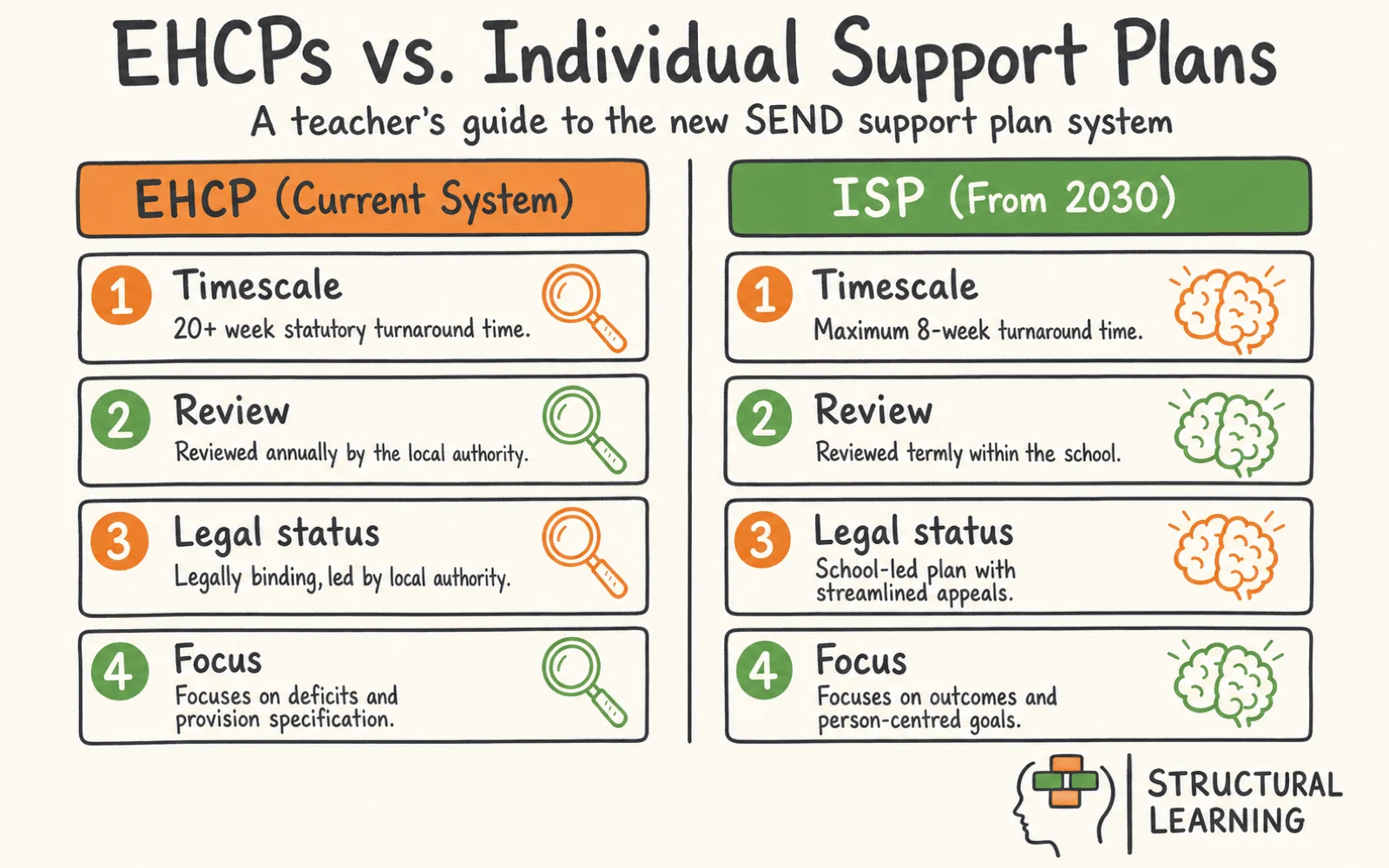
An ISP is designed to be shorter, more focused, and quicker to produce. The White Paper proposes a maximum turnaround of 8 weeks from request to finalised plan. ISPs will be reviewed termly rather than annually, making them living documents that respond to changing needs.
| Feature | EHCP (Current) | ISP (From 2030) |
|---|---|---|
| Turnaround time | 20 weeks statutory (often longer) | 8 weeks maximum |
| Review cycle | Annual | Termly |
| Document length | 15-20 pages typical | 3-5 pages maximum |
| Legal status | Statutory, legally enforceable | Statutory with streamlined appeals |
| Who leads | Local authority | School SENCO with LA oversight |
| Approach | Deficit-focused specification | Outcomes-focused, person-centred |
The shift from annual to termly reviews is significant for class teachers. Rather than writing one lengthy contribution each year, teachers will provide brief, focused updates three times per year. The emphasis moves to recording what is working and what needs adjusting, which aligns with the assess-plan-do-review cycle already embedded in the SEND Code of Practice.
The White Paper confirms a four-year transition period (2030-2034). No existing EHCP will be removed without parental consent. Instead, existing plans will be converted to ISPs at the point of annual review, with families able to retain their EHCP until the end of the transition period if they prefer.
Parents of children with complex needs, particularly those in specialist provision, have expressed concerns about losing legal protections. The White Paper addresses this by confirming that ISPs retain statutory force and that the SEND Tribunal will continue to hear appeals. The mechanism changes; the rights do not.
For the first time, all teachers completing Initial Teacher Training (ITT) from September 2027 will undertake a minimum 30-hour SEND module covering identification, adaptive teaching strategies, and communication with families. This requirement also applies to the Early Career Framework (ECF), extending SEND training across the first three years of a teacher's career.
The content of the mandatory training draws on the Education Endowment Foundation's Special Educational Needs in Mainstream Schools guidance report, which identifies five evidence-based recommendations for supporting pupils with SEND. These include creating a positive environment, deploying teaching assistants effectively, and using explicit instruction with scaffolding.
A Year 5 teacher attending the new training would learn practical strategies for differentiating a maths lesson for a pupil with dyscalculia, including using concrete manipulatives, reducing cognitive load through worked examples, and building number sense through structured practice. This is the kind of operational knowledge that many teachers report lacking (DfE Teacher Workforce Survey, 2025).
The White Paper announces a formal review of the SENCO role, acknowledging that the position has become unsustainable in many schools. SENCOs frequently report working evenings and weekends to manage EHCP paperwork, attend review meetings, and coordinate external agencies while also maintaining a teaching timetable.
The National Award for Special Educational Needs Coordination (NASENCO), currently the mandatory qualification for new SENCOs, will be replaced by a National Professional Qualification (NPQ) for SEND Leadership from September 2028. The new NPQ is expected to be a more rigorous and practice-focused qualification, aligned with the existing NPQ framework for school leaders.
For serving SENCOs who already hold the NASENCO, a bridging module will allow them to convert to the new qualification. The review will also consider whether the SENCO role should carry a mandatory time allocation, something NASEN has campaigned for consistently.
A SENCO in a large primary school currently spending 60% of their time on EHCP administration could see that proportion drop significantly as ISPs replace EHCPs. The freed-up time would shift towards coaching classroom teachers, running co-regulation groups, analysing provision map data, and leading whole-school SEND strategy.
The graduated approach (assess, plan, do, review) remains the cornerstone of SEND support. The White Paper strengthens it in two ways.
First, the "ordinarily available provision" that all mainstream schools must offer will be defined nationally for the first time. Currently, what counts as "reasonable adjustments" varies enormously between schools and local authorities. The White Paper proposes a national minimum standard, building on work already done by local authorities such as Hertfordshire and Norfolk in publishing their own ordinarily available provision frameworks.
Second, the graduated approach will be digitised. Schools will be expected to maintain electronic records of the assess-plan-do-review cycle, making it easier to demonstrate the evidence trail required before requesting an ISP. This connects directly to the growing use of AI tools for SEND administration, which can automate parts of the record-keeping process.

The White Paper references the EEF's evidence on effective teaching assistant deployment, specifically warning against the "velcro model" where a TA is permanently attached to one child. Instead, schools are encouraged to use TAs for targeted interventions, pre-teaching key vocabulary, and supporting small group work.
Rob Webster's research through the MITA (Making the Most of Teaching Assistants) project demonstrated that when TAs supplement rather than replace teacher instruction, pupil outcomes improve significantly (Webster, 2015). The White Paper's emphasis on the Inclusive Mainstream Fund partly aims to give schools the resources to deploy TAs more flexibly, moving away from one-to-one support towards evidence-informed intervention models.
In a typical classroom scenario, rather than a TA sitting next to one pupil for the entire lesson, they might spend the first 15 minutes pre-teaching vocabulary to a small group of pupils with SLCN, then circulate during independent work to check understanding using targeted questioning based on Blank's levels.
The consultation on the White Paper closes on 18 May 2026. Schools should:
Respond to the consultation. Every school's voice matters. The DfE consultation portal allows individual responses, but schools may also wish to respond collectively through their Multi-Academy Trust, local authority, or professional associations. NASEN and the National Education Union have published response guides.
Audit current SEND provision. Use the national minimum standards (when published) to benchmark your school's ordinarily available provision. Identify gaps between what you currently offer and what the White Paper expects.
Review TA deployment models. If your school relies on one-to-one TA support, now is the time to explore evidence-based alternatives. The EEF's guidance report on teaching assistants provides a practical starting point.
Prepare for ISPs. Begin streamlining your current EHCP contribution processes. Practice writing concise, outcomes-focused targets using the assess-plan-do-review format. This will smooth the transition when ISPs become the default system.
Invest in teacher SEND knowledge. While mandatory ITT training begins in September 2027, schools can start building SEND capacity now through CPD programmes. Focus areas include executive function difficulties, emotion regulation strategies, and sensory processing awareness.
The consultation runs from 23 February to 18 May 2026, giving schools approximately 12 weeks to submit responses. The DfE is seeking views on the pace of EHCP-to-ISP transition, the content of mandatory SEND training, and the definition of ordinarily available provision.
Key questions in the consultation include whether the 8-week ISP turnaround is achievable, whether the Inclusive Mainstream Fund allocation formula is fair, and how existing EHCP protections should be safeguarded during transition. Schools and SENCOs are encouraged to respond based on their direct experience of the current system's failings and what practical improvements would make the biggest difference.
The White Paper has received a mixed reception. The National Autistic Society welcomed the additional funding but expressed concern that ISPs might dilute the legal protections currently afforded by EHCPs. IPSEA (Independent Provider of Special Education Advice) highlighted that without ring-fencing, the Inclusive Mainstream Fund could be absorbed into general school budgets.
Teaching unions have questioned whether mandatory SEND training can be meaningfully delivered in 30 hours, particularly given the breadth of SEND categories. The National Education Union noted that teacher workload remains the primary barrier to effective SEND support, and that training alone will not solve staffing shortages in specialist roles.
There is also a legitimate concern about the four-year transition period. Previous SEND reforms (notably the 2014 Children and Families Act) suffered from rushed implementation, with local authorities struggling to convert Statements to EHCPs within the specified timeframe. The DfE has stated that lessons have been learned from 2014, but the challenge of converting approximately 576,000 active EHCPs (DfE SEN Statistics, January 2026) remains substantial.
Understanding these reforms requires context. The current system was established by the Children and Families Act 2014, which introduced EHCPs to replace Statements of SEN. The 2014 reforms aimed to create a more person-centred, joined-up approach spanning education, health, and social care from birth to age 25.
While the principles were sound, implementation was uneven. The House of Commons Education Committee (2019) found that the reforms had "not lived up to their promise" and that the SEND system was characterised by "a postcode lottery of provision." The 2022 SEND and Alternative Provision Green Paper acknowledged systemic failures and proposed reforms, but progress stalled due to ministerial changes and competing priorities.
The 2026 White Paper represents the culmination of this reform journey. Its success will depend on implementation quality, sustained funding, and the willingness of schools, local authorities, and health services to work together in ways the current system has struggled to achieve.
The White Paper's emphasis on early identification and mainstream inclusion aligns with international evidence. The Salamanca Statement (UNESCO, 1994) established the principle that mainstream schools should accommodate all children regardless of their physical, intellectual, social, emotional, linguistic or other conditions. Meta-analyses by Mitchell (2014) found that inclusive practices benefit both pupils with and without SEND when properly resourced and supported.
The evidence base for scaffolding approaches in inclusive classrooms is particularly strong. Wood, Bruner, and Ross (1976) demonstrated that structured support, gradually withdrawn as competence develops, enables learners to achieve beyond their current independent capability. This principle underpins the graduated approach and will be central to effective ISP implementation.
Norwich (2014) identified the "dilemma of difference" in SEND provision: recognising and responding to individual needs without creating stigma or lowered expectations. The White Paper's focus on ordinarily available provision attempts to resolve this by raising the baseline for all pupils, reducing the need for separate identification processes.

The SEND White Paper 2026 is ambitious in scope and significant in its implications for every school in England. The shift from EHCPs to ISPs, the injection of £4 billion in funding, and the mandate for SEND-literate teaching represent a genuine attempt to fix a system that has been failing children and families.
For classroom teachers, the most immediate impact will be the expectation that SEND support is everyone's responsibility, not solely the SENCO's domain. Building confidence in identifying needs, adapting teaching, and contributing to support plans will be essential skills for every teacher entering the profession from 2027 onwards.
Respond to the consultation before 18 May 2026. Your experience of the current system is the most valuable evidence the DfE can receive.
These peer-reviewed studies provide the evidence base for the strategies discussed above.
Industry’s push for computer science education: Is computer science really for all? View study ↗
14 citations
Marshall et al. (2022)
This research examines inequities in computer science education access despite national initiatives promoting CS for all students. Teachers should be aware that whilst CS is increasingly recognised as essential, significant barriers remain in ensuring equitable access across diverse student populations.
Mentoring Experiences of New Nontenured Faculty in Undergraduate Nursing: A Qualitative Study. View study ↗
Sandiford et al. (2024)
This study explores mentoring experiences of new nursing faculty transitioning from clinical practice to teaching. The findings highlight the importance of structured mentoring programmes for supporting new educators, which has relevance for teacher induction and professional development across all subjects.
Georgia View study ↗
Johnson (2025)
Georgia's budget allocation demonstrates continued investment in education at both P-12 and higher education levels. This information helps teachers understand funding priorities and potential resource availability, though specific classroom implications depend on local budget distributions and spending decisions.
Implications of the COVID-19 pandemic on funding basic education View study ↗
Alves et al. (2020)
This research analyses how reduced tax revenues during COVID-19 impacted education funding across different economic scenarios. Teachers can better understand how external economic factors directly affect school budgets, resources, and ultimately classroom provision and educational outcomes.
Volcano - An Extensible and Parallel Query Evaluation System View study ↗
444 citations
Graefe (1994)
Abstract not available for this technical database systems paper. Without sufficient context about the content, it's difficult to establish clear relevance to classroom teaching or the SEND White Paper topic.
The SEND White Paper "Every Child Achieving and Thriving," published on 23 February 2026, represents the most significant reform to special educational needs provision in England since the Children and Families Act 2014. With £4 billion in new funding, a complete restructure of the EHCP system, and mandatory SEND training for all teachers, these reforms will change how every school in England supports pupils with additional needs. Whether you are a SENCO managing caseloads, a class teacher differentiating lessons, or a headteacher planning budgets, understanding these changes is not optional.

The current SEND system has been under sustained pressure since the Timpson Review (2019) and the SEND Review published in March 2022. Waiting times for Education, Health and Care Plans (EHCPs) have stretched beyond the statutory 20-week limit in many local authorities. SEND Tribunal appeals reached record levels in 2024-25, with over 90% of appeals decided in favour of parents (Ministry of Justice, 2025). The system designed to help children with special educational needs has become adversarial, slow, and inconsistent.
The White Paper addresses these systemic failures directly. Rather than patching the existing framework, it proposes a structural overhaul that moves support closer to the classroom and reduces reliance on formal statutory plans.
The headline figure of £4 billion breaks down into two major programmes, with the remainder funding training, local authority capacity building, and transition costs.
This fund flows directly to mainstream schools to build capacity for supporting pupils with SEND without requiring an EHCP. Schools will receive formula-based allocations calculated from deprivation indicators, prior attainment data, and local SEND prevalence rates.
In practice, a two-form entry primary school might use this funding to employ a dedicated intervention teaching assistant, purchase specialist assessment tools such as B Squared assessment frameworks, or create a sensory regulation space. The fund recognises what SENCOs have argued for years: mainstream schools need resources before a child reaches crisis point, not after.
The Experts at Hand programme creates regional specialist banks staffed by educational psychologists, speech and language therapists, occupational therapists, and specialist teachers. Schools can request assessments, training sessions, or direct pupil support without navigating lengthy referral pathways.
A Year 3 teacher noticing a pupil struggling with speech, language and communication needs could request a speech and language therapist visit within two weeks rather than waiting months for a local authority referral. This model mirrors the consultation service approach already used in some Multi-Academy Trusts and reflects the evidence base on early identification summarised in the Bercow Report (2008).
The centrepiece reform is the phased replacement of EHCPs with Individual Support Plans (ISPs) from 2030 onwards. This is the change that will most directly affect classroom practice.
An EHCP is a lengthy legal document, often running to 15-20 pages, that specifies provision in detail and carries statutory force. The process of obtaining one typically takes 20 weeks (often longer) and frequently involves disagreements between parents, schools, and local authorities.
An ISP is designed to be shorter, more focused, and quicker to produce. The White Paper proposes a maximum turnaround of 8 weeks from request to finalised plan. ISPs will be reviewed termly rather than annually, making them living documents that respond to changing needs.
| Feature | EHCP (Current) | ISP (From 2030) |
|---|---|---|
| Turnaround time | 20 weeks statutory (often longer) | 8 weeks maximum |
| Review cycle | Annual | Termly |
| Document length | 15-20 pages typical | 3-5 pages maximum |
| Legal status | Statutory, legally enforceable | Statutory with streamlined appeals |
| Who leads | Local authority | School SENCO with LA oversight |
| Approach | Deficit-focused specification | Outcomes-focused, person-centred |
The shift from annual to termly reviews is significant for class teachers. Rather than writing one lengthy contribution each year, teachers will provide brief, focused updates three times per year. The emphasis moves to recording what is working and what needs adjusting, which aligns with the assess-plan-do-review cycle already embedded in the SEND Code of Practice.
The White Paper confirms a four-year transition period (2030-2034). No existing EHCP will be removed without parental consent. Instead, existing plans will be converted to ISPs at the point of annual review, with families able to retain their EHCP until the end of the transition period if they prefer.
Parents of children with complex needs, particularly those in specialist provision, have expressed concerns about losing legal protections. The White Paper addresses this by confirming that ISPs retain statutory force and that the SEND Tribunal will continue to hear appeals. The mechanism changes; the rights do not.
For the first time, all teachers completing Initial Teacher Training (ITT) from September 2027 will undertake a minimum 30-hour SEND module covering identification, adaptive teaching strategies, and communication with families. This requirement also applies to the Early Career Framework (ECF), extending SEND training across the first three years of a teacher's career.
The content of the mandatory training draws on the Education Endowment Foundation's Special Educational Needs in Mainstream Schools guidance report, which identifies five evidence-based recommendations for supporting pupils with SEND. These include creating a positive environment, deploying teaching assistants effectively, and using explicit instruction with scaffolding.
A Year 5 teacher attending the new training would learn practical strategies for differentiating a maths lesson for a pupil with dyscalculia, including using concrete manipulatives, reducing cognitive load through worked examples, and building number sense through structured practice. This is the kind of operational knowledge that many teachers report lacking (DfE Teacher Workforce Survey, 2025).
The White Paper announces a formal review of the SENCO role, acknowledging that the position has become unsustainable in many schools. SENCOs frequently report working evenings and weekends to manage EHCP paperwork, attend review meetings, and coordinate external agencies while also maintaining a teaching timetable.
The National Award for Special Educational Needs Coordination (NASENCO), currently the mandatory qualification for new SENCOs, will be replaced by a National Professional Qualification (NPQ) for SEND Leadership from September 2028. The new NPQ is expected to be a more rigorous and practice-focused qualification, aligned with the existing NPQ framework for school leaders.
For serving SENCOs who already hold the NASENCO, a bridging module will allow them to convert to the new qualification. The review will also consider whether the SENCO role should carry a mandatory time allocation, something NASEN has campaigned for consistently.
A SENCO in a large primary school currently spending 60% of their time on EHCP administration could see that proportion drop significantly as ISPs replace EHCPs. The freed-up time would shift towards coaching classroom teachers, running co-regulation groups, analysing provision map data, and leading whole-school SEND strategy.
The graduated approach (assess, plan, do, review) remains the cornerstone of SEND support. The White Paper strengthens it in two ways.
First, the "ordinarily available provision" that all mainstream schools must offer will be defined nationally for the first time. Currently, what counts as "reasonable adjustments" varies enormously between schools and local authorities. The White Paper proposes a national minimum standard, building on work already done by local authorities such as Hertfordshire and Norfolk in publishing their own ordinarily available provision frameworks.
Second, the graduated approach will be digitised. Schools will be expected to maintain electronic records of the assess-plan-do-review cycle, making it easier to demonstrate the evidence trail required before requesting an ISP. This connects directly to the growing use of AI tools for SEND administration, which can automate parts of the record-keeping process.

The White Paper references the EEF's evidence on effective teaching assistant deployment, specifically warning against the "velcro model" where a TA is permanently attached to one child. Instead, schools are encouraged to use TAs for targeted interventions, pre-teaching key vocabulary, and supporting small group work.
Rob Webster's research through the MITA (Making the Most of Teaching Assistants) project demonstrated that when TAs supplement rather than replace teacher instruction, pupil outcomes improve significantly (Webster, 2015). The White Paper's emphasis on the Inclusive Mainstream Fund partly aims to give schools the resources to deploy TAs more flexibly, moving away from one-to-one support towards evidence-informed intervention models.
In a typical classroom scenario, rather than a TA sitting next to one pupil for the entire lesson, they might spend the first 15 minutes pre-teaching vocabulary to a small group of pupils with SLCN, then circulate during independent work to check understanding using targeted questioning based on Blank's levels.
The consultation on the White Paper closes on 18 May 2026. Schools should:
Respond to the consultation. Every school's voice matters. The DfE consultation portal allows individual responses, but schools may also wish to respond collectively through their Multi-Academy Trust, local authority, or professional associations. NASEN and the National Education Union have published response guides.
Audit current SEND provision. Use the national minimum standards (when published) to benchmark your school's ordinarily available provision. Identify gaps between what you currently offer and what the White Paper expects.
Review TA deployment models. If your school relies on one-to-one TA support, now is the time to explore evidence-based alternatives. The EEF's guidance report on teaching assistants provides a practical starting point.
Prepare for ISPs. Begin streamlining your current EHCP contribution processes. Practice writing concise, outcomes-focused targets using the assess-plan-do-review format. This will smooth the transition when ISPs become the default system.
Invest in teacher SEND knowledge. While mandatory ITT training begins in September 2027, schools can start building SEND capacity now through CPD programmes. Focus areas include executive function difficulties, emotion regulation strategies, and sensory processing awareness.
The consultation runs from 23 February to 18 May 2026, giving schools approximately 12 weeks to submit responses. The DfE is seeking views on the pace of EHCP-to-ISP transition, the content of mandatory SEND training, and the definition of ordinarily available provision.
Key questions in the consultation include whether the 8-week ISP turnaround is achievable, whether the Inclusive Mainstream Fund allocation formula is fair, and how existing EHCP protections should be safeguarded during transition. Schools and SENCOs are encouraged to respond based on their direct experience of the current system's failings and what practical improvements would make the biggest difference.
The White Paper has received a mixed reception. The National Autistic Society welcomed the additional funding but expressed concern that ISPs might dilute the legal protections currently afforded by EHCPs. IPSEA (Independent Provider of Special Education Advice) highlighted that without ring-fencing, the Inclusive Mainstream Fund could be absorbed into general school budgets.
Teaching unions have questioned whether mandatory SEND training can be meaningfully delivered in 30 hours, particularly given the breadth of SEND categories. The National Education Union noted that teacher workload remains the primary barrier to effective SEND support, and that training alone will not solve staffing shortages in specialist roles.
There is also a legitimate concern about the four-year transition period. Previous SEND reforms (notably the 2014 Children and Families Act) suffered from rushed implementation, with local authorities struggling to convert Statements to EHCPs within the specified timeframe. The DfE has stated that lessons have been learned from 2014, but the challenge of converting approximately 576,000 active EHCPs (DfE SEN Statistics, January 2026) remains substantial.
Understanding these reforms requires context. The current system was established by the Children and Families Act 2014, which introduced EHCPs to replace Statements of SEN. The 2014 reforms aimed to create a more person-centred, joined-up approach spanning education, health, and social care from birth to age 25.
While the principles were sound, implementation was uneven. The House of Commons Education Committee (2019) found that the reforms had "not lived up to their promise" and that the SEND system was characterised by "a postcode lottery of provision." The 2022 SEND and Alternative Provision Green Paper acknowledged systemic failures and proposed reforms, but progress stalled due to ministerial changes and competing priorities.
The 2026 White Paper represents the culmination of this reform journey. Its success will depend on implementation quality, sustained funding, and the willingness of schools, local authorities, and health services to work together in ways the current system has struggled to achieve.
The White Paper's emphasis on early identification and mainstream inclusion aligns with international evidence. The Salamanca Statement (UNESCO, 1994) established the principle that mainstream schools should accommodate all children regardless of their physical, intellectual, social, emotional, linguistic or other conditions. Meta-analyses by Mitchell (2014) found that inclusive practices benefit both pupils with and without SEND when properly resourced and supported.
The evidence base for scaffolding approaches in inclusive classrooms is particularly strong. Wood, Bruner, and Ross (1976) demonstrated that structured support, gradually withdrawn as competence develops, enables learners to achieve beyond their current independent capability. This principle underpins the graduated approach and will be central to effective ISP implementation.
Norwich (2014) identified the "dilemma of difference" in SEND provision: recognising and responding to individual needs without creating stigma or lowered expectations. The White Paper's focus on ordinarily available provision attempts to resolve this by raising the baseline for all pupils, reducing the need for separate identification processes.

The SEND White Paper 2026 is ambitious in scope and significant in its implications for every school in England. The shift from EHCPs to ISPs, the injection of £4 billion in funding, and the mandate for SEND-literate teaching represent a genuine attempt to fix a system that has been failing children and families.
For classroom teachers, the most immediate impact will be the expectation that SEND support is everyone's responsibility, not solely the SENCO's domain. Building confidence in identifying needs, adapting teaching, and contributing to support plans will be essential skills for every teacher entering the profession from 2027 onwards.
Respond to the consultation before 18 May 2026. Your experience of the current system is the most valuable evidence the DfE can receive.
These peer-reviewed studies provide the evidence base for the strategies discussed above.
Industry’s push for computer science education: Is computer science really for all? View study ↗
14 citations
Marshall et al. (2022)
This research examines inequities in computer science education access despite national initiatives promoting CS for all students. Teachers should be aware that whilst CS is increasingly recognised as essential, significant barriers remain in ensuring equitable access across diverse student populations.
Mentoring Experiences of New Nontenured Faculty in Undergraduate Nursing: A Qualitative Study. View study ↗
Sandiford et al. (2024)
This study explores mentoring experiences of new nursing faculty transitioning from clinical practice to teaching. The findings highlight the importance of structured mentoring programmes for supporting new educators, which has relevance for teacher induction and professional development across all subjects.
Georgia View study ↗
Johnson (2025)
Georgia's budget allocation demonstrates continued investment in education at both P-12 and higher education levels. This information helps teachers understand funding priorities and potential resource availability, though specific classroom implications depend on local budget distributions and spending decisions.
Implications of the COVID-19 pandemic on funding basic education View study ↗
Alves et al. (2020)
This research analyses how reduced tax revenues during COVID-19 impacted education funding across different economic scenarios. Teachers can better understand how external economic factors directly affect school budgets, resources, and ultimately classroom provision and educational outcomes.
Volcano - An Extensible and Parallel Query Evaluation System View study ↗
444 citations
Graefe (1994)
Abstract not available for this technical database systems paper. Without sufficient context about the content, it's difficult to establish clear relevance to classroom teaching or the SEND White Paper topic.
{"@context":"https://schema.org","@graph":[{"@type":"Organization","@id":"https://www.structural-learning.com/#org","name":"Structural Learning","url":"https://www.structural-learning.com/","logo":{"@type":"ImageObject","url":"https://cdn.prod.website-files.com/5b69a01ba2e409501de055d1/5b69a01ba2e40996a5e055f4_structural-learning-logo.png"}},{"@type":"Person","@id":"https://www.structural-learning.com/team/paul-main/#person","name":"Paul Main","url":"https://www.structural-learning.com/team/paul-main","jobTitle":"Founder","affiliation":{"@id":"https://www.structural-learning.com/#org"}},{"@type":"BreadcrumbList","@id":"https://www.structural-learning.com/post/send-white-paper-2026-every-teacher-needs#breadcrumb","itemListElement":[{"@type":"ListItem","position":1,"name":"Home","item":"https://www.structural-learning.com/"},{"@type":"ListItem","position":2,"name":"Blog","item":"https://www.structural-learning.com/blog"},{"@type":"ListItem","position":3,"name":"The SEND White Paper 2026: What Every Teacher Needs to Know","item":"https://www.structural-learning.com/post/send-white-paper-2026-every-teacher-needs"}]},{"@type":"BlogPosting","@id":"https://www.structural-learning.com/post/send-white-paper-2026-every-teacher-needs#article","headline":"The SEND White Paper 2026: What Every Teacher Needs to Know","description":"","author":{"@id":"https://www.structural-learning.com/team/paul-main/#person"},"publisher":{"@id":"https://www.structural-learning.com/#org"},"datePublished":"2026-03-08","dateModified":"2026-03-08","inLanguage":"en-GB"}]}