Shared Reading Strategies: A Teacher's GuideShared Reading Strategies: A Teacher's Guide: practical strategies for teachers

Updated on  

March 19, 2026

Shared Reading Strategies: A Teacher's Guide

|

March 19, 2026

Master this shared reading primary school teachers guide strategy. Discover how visible thinking, structured oracy, and active tasks boost literacy outcomes.

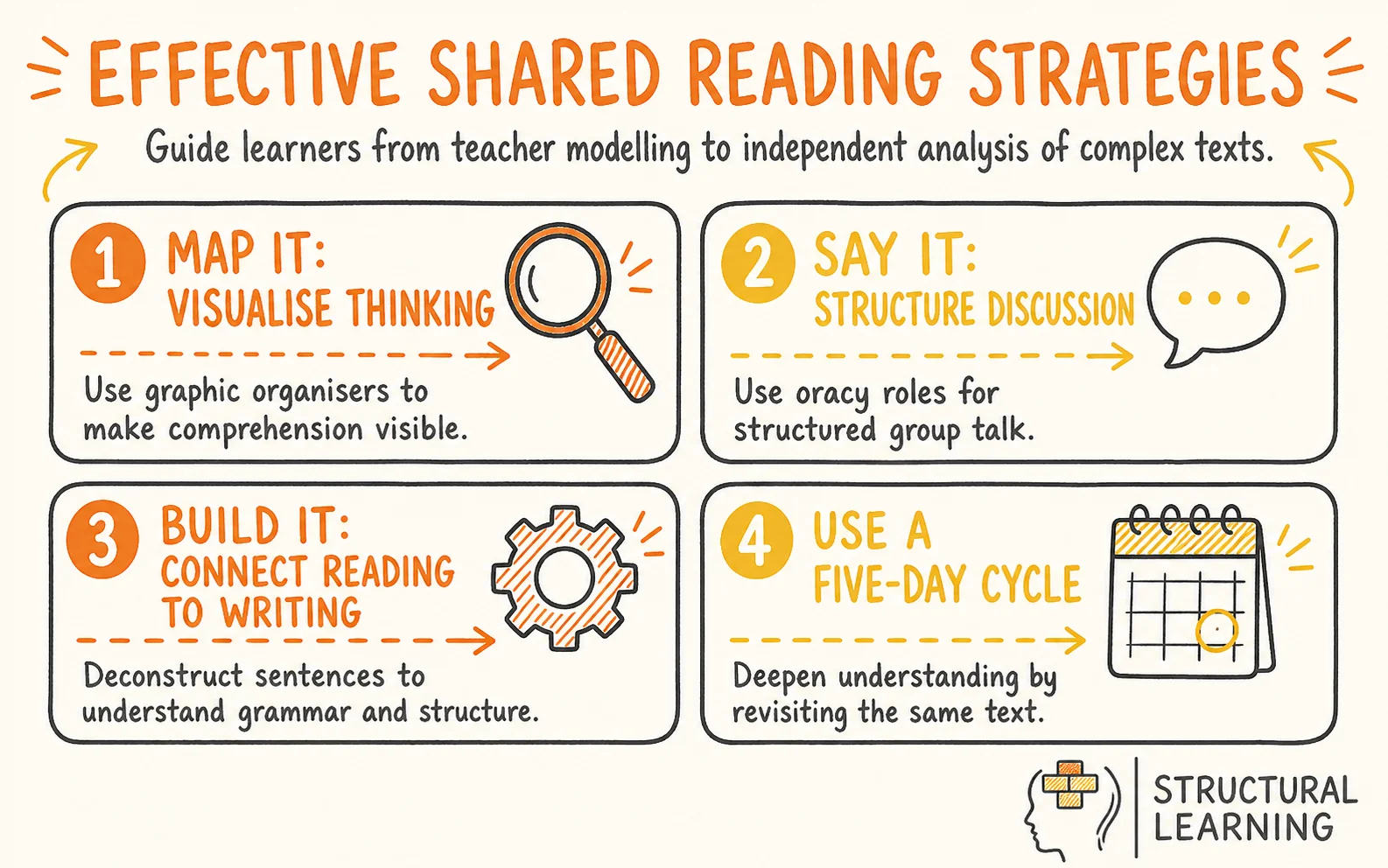
The Gradual <a href=Release of Responsibility: From Teacher Modeling to Independence infographic for teachers" loading="lazy">
The Gradual Release of Responsibility: From Teacher Modeling to Independence

Key Takeaways

  • Shared reading moves learners from passive listening to active text analysis using visible cognitive tools.
  • The practice follows a gradual release of responsibility model, moving from teacher modelling to independent application.
  • Graphic organisers make abstract comprehension processes visible on the whiteboard.
  • Structured oracy roles ensure all pupils participate equally in text discussion.
  • Physical sentence building connects reading comprehension directly to sentence-level writing.
  • A structured five-day reading cycle deepens understanding and engagement.
  • Careful text selection provides conceptual depth and rich vocabulary.

What Is Shared Reading?

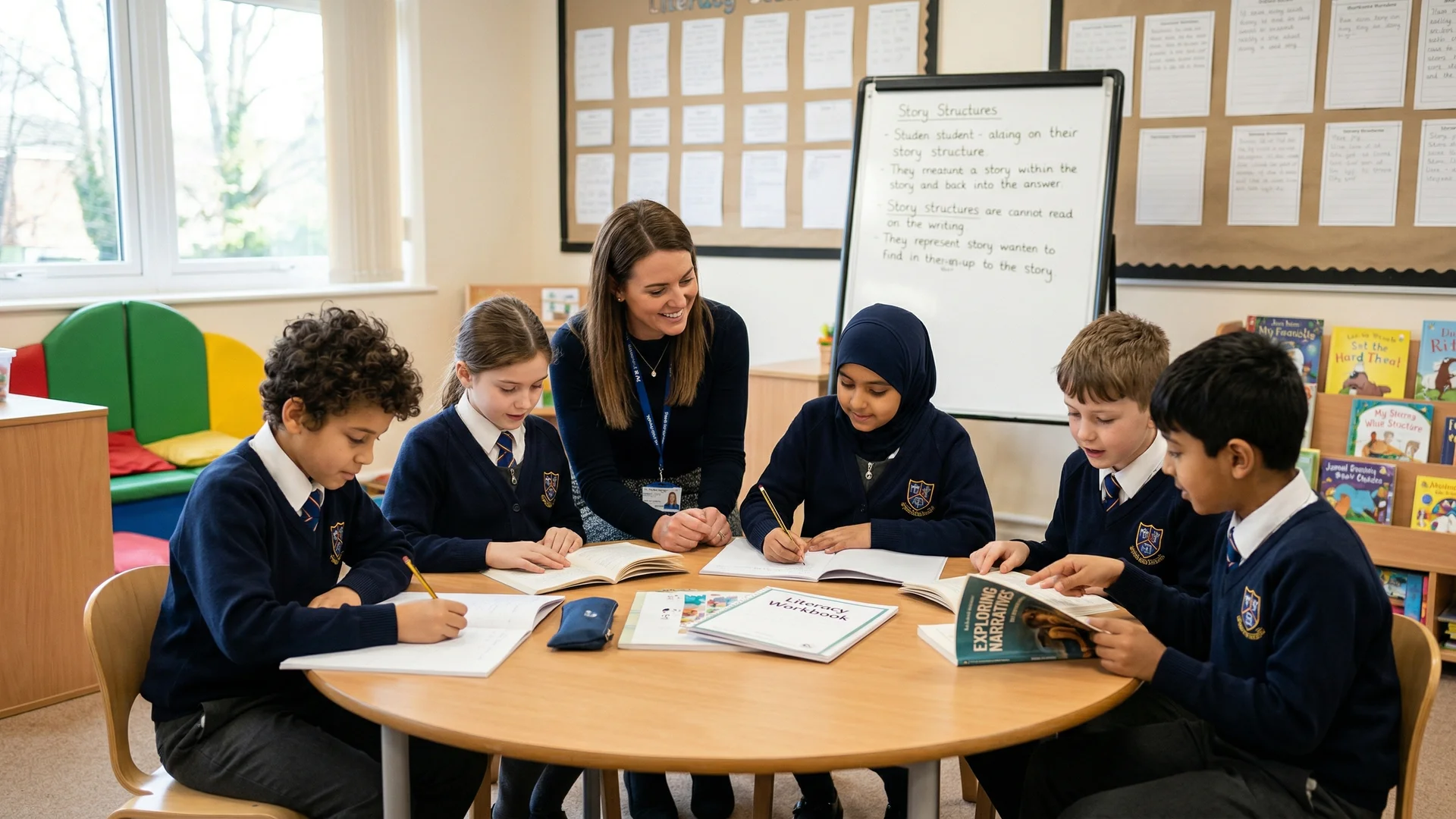
Shared reading is an interactive experience where a teacher guides a group of learners through a visible text. The teacher and pupils read together, with the teacher initially taking primary responsibility. The text must be clearly visible using a visualiser, interactive whiteboard, or large-format books. This allows the teacher to model reading behaviours, prosody, and comprehension strategies. The goal is to engage pupils with texts slightly above their independent reading level.

This practice originates from Holdaway (1979), who sought to replicate the supportive bedtime story environment in the classroom. Holdaway designed the 'big book' format to ensure visibility for all. Today, digital displays are common, but the core mechanism remains: the teacher models fluent reading and makes their cognitive processes visible.

The approach relies on the gradual release of responsibility. The sequence begins with teacher demonstration, moves to shared practice, and ends with independent application. The teacher handles decoding, allowing pupils to focus on meaning. The teacher pauses to think aloud, demonstrating how to navigate vocabulary or sentence structures.

For example, a teacher places a picture book under the visualiser. As they read, they point to the text and pause. The teacher says, "I'm looking at the word 'reluctant', and I see the character dragging their feet, so I think it means they don't want to go." The pupils observe this modelling and then read repeated refrains aloud together, providing a safe environment to practice reading aloud.

Why Shared Reading Matters

Reading comprehension requires simultaneous decoding, vocabulary retrieval, and background knowledge integration. Sweller's (1988) Cognitive Load Theory explains that working memory is limited. When novice readers encounter difficult text, decoding overloads their working memory, leaving little space for understanding. Shared reading circumvents this by transferring the decoding to the teacher.

By removing the decoding barrier, teachers allow pupils to access high-level vocabulary and concepts they could not access independently. Fisher, Frey & Hattie (2016) highlight guided instruction's importance in moving learners from surface knowledge to deep understanding. Shared reading acts as this bridge, exposing learners to academic language and complex syntax, building the background knowledge and vocabulary needed for future independent reading.

Many shared reading models rely too heavily on verbal questioning, leaving the cognitive process abstract. Without visual aids, discussions disappear quickly, disadvantaging pupils with poor working memory. To be effective, teachers must move from passive listening to active visual thinking.

For instance, a teacher introduces a historical text about the Romans. Because the teacher decodes words like "aqueduct" and "centurion", the pupils avoid cognitive overload. The teacher then draws a relational graphic organiser to map the Roman social hierarchy. The pupils use this visual aid to discuss the text. The abstract concept of social class becomes a concrete diagram, allowing all pupils to engage in analysis regardless of their decoding abilities.

Shared Reading Strategies

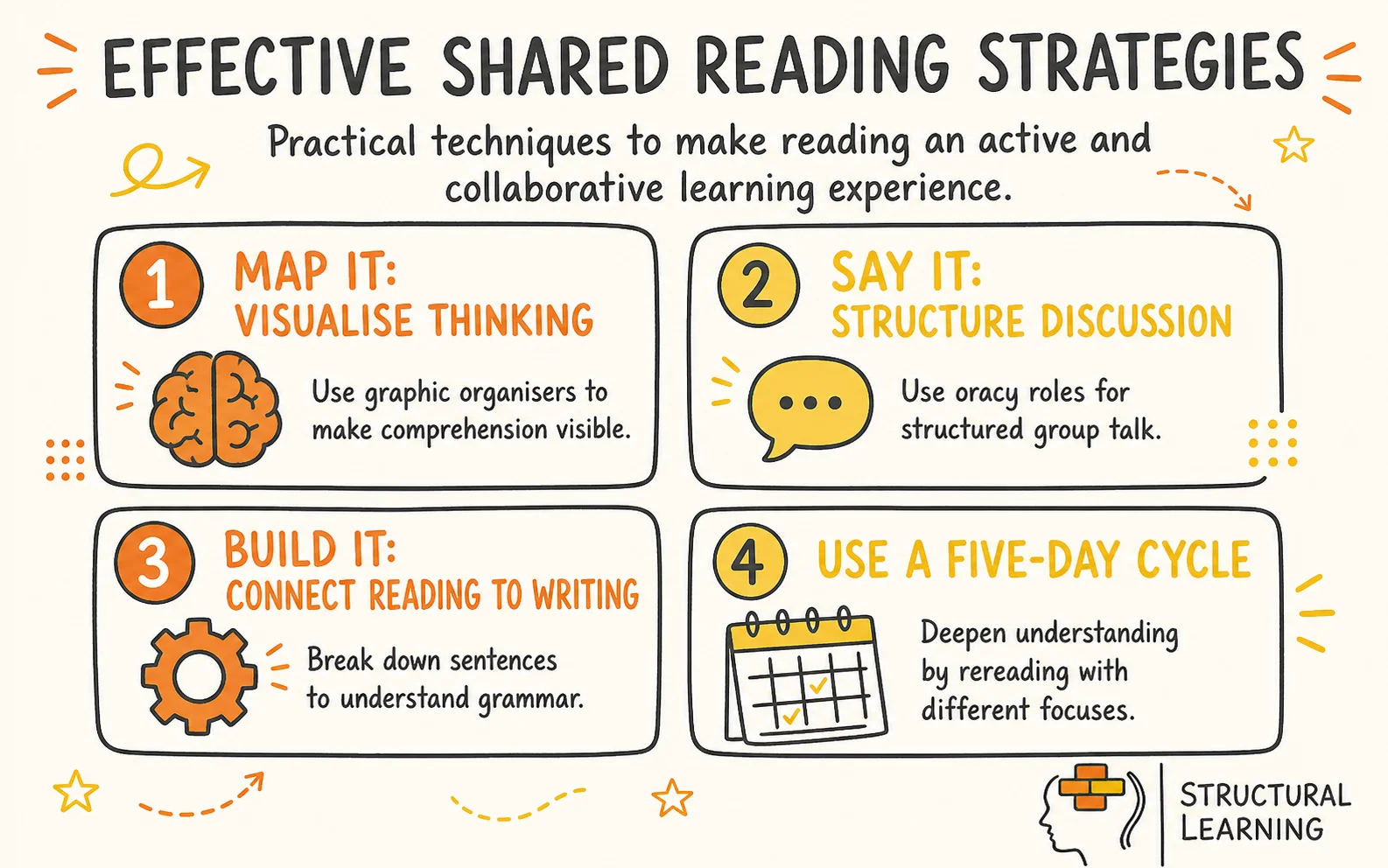
To maximise the impact of shared text analysis, teachers must structure the interaction. Moving beyond simple questions requires frameworks that make thinking tangible. The following strategies provide methods for transforming reading sessions into active cognitive workouts.

The Map It Approach

The Map It approach uses graphic organisers to make comprehension visible. Learners often lose track of how information connects. By drawing a map on the whiteboard, the teacher provides a visual anchor. Different texts require different maps. A story needs a flowchart, while an informational text needs a double bubble map.

During a second reading, the teacher wants the pupils to understand a character's changing motivations. The teacher draws a multi-flow map on the interactive whiteboard. On one side, the teacher writes the character's actions. On the other, the teacher writes the reasons behind those actions. The teacher models the first connection, linking 'hiding the key' to 'fear of discovery'.

The pupils then complete the map. The teacher pauses and asks the pupils to identify the next key action. The pupils suggest the action, and the teacher adds it. The class then finds text evidence that explains the motivation, connecting the two concepts. The pupils produce a visual representation of the character's journey, which they can use as a plan for their own writing.

The Say It Approach

The Say It approach integrates oracy frameworks to ensure all pupils participate in dialogue. Mercer (2000) emphasises exploratory talk, where learners use language to think together. Without structure, discussions are dominated by a few speakers. The Say It strategy uses role cards to distribute the workload and structure turn-taking.

The teacher prepares 'Starter', 'Builder', and 'Challenger' cards. The 'Starter' card provides sentence stems for initiating an idea. The 'Builder' card provides stems for adding evidence. The 'Challenger' card provides stems for respectfully disagreeing. The teacher distributes these cards to small groups before posing a question about a moral dilemma in the text.

The teacher asks, "Why did the villagers ignore the warning in paragraph three?" The pupil with the 'Starter' card begins, "I think they ignored the warning because the text says they were tired." The pupil with the 'Builder' card follows up, "Building on that idea, the author also mentions the harvest was poor, which means they had other worries." Finally, the pupil with the 'Challenger' card says, "I agree they were tired, but I want to challenge that by pointing out they also distrusted the messenger." The pupils produce a collaborative analysis without direct teacher intervention.

The Build It Approach

The Build It approach provides a physical connection between reading comprehension and sentence-level writing. Identifying complex sentences is only the first step. Pupils must understand how sentences are constructed to replicate them. This strategy involves breaking apart a target sentence to understand its grammar.

The teacher selects a complex sentence with a subordinate clause from the text: "Although the journey was treacherous, the explorers refused to abandon their mission." The teacher writes this sentence on sentence strips and cuts the strips into clauses and conjunctions. The teacher displays these pieces on the board in a jumbled order. The teacher explains the function of "Although" in establishing a contrast.

The pupils work in pairs with their own set of cut-up word cards. The teacher challenges the pupils to reconstruct the original sentence. Once the pupils have built the sentence correctly, the teacher asks them to swap "Although" for "Because" and rewrite the main clause to make the new sentence logical. The pupils manipulate the cards to produce new sentences, demonstrating their understanding of how grammatical choices impact meaning.

The Five-Day Reading Cycle

To extract maximum value from a text, teachers should engage with it over a five-day cycle. Reading a text once only allows for surface-level understanding. A structured five-day cycle moves learners from enjoyment to critical analysis. This repeated exposure builds fluency, reinforces vocabulary, and allows for complex tasks.

On Monday, the focus is on enjoyment and fluency. The teacher reads the text aloud without stopping for analysis, using expression and varied pacing. The pupils listen and follow the text visually. On Tuesday, the focus shifts to vocabulary. The teacher selects three or four tier-two words, providing definitions and non-examples. The pupils practice using these words in new contexts.

On Wednesday, the class moves to deep comprehension using the Map It approach. The teacher rereads a section, and the class builds a graphic organiser to track the narrative structure. On Thursday, the focus is on exploratory talk using the Say It approach. The teacher poses a question, and the pupils use their role cards to debate the answer. On Friday, the cycle concludes with the Build It approach. The teacher selects a grammatical structure, and the pupils use word cards to build parallel sentences.

The 5-Day Shared Reading Cycle: Building Understanding Day by Day infographic for teachers
The 5-Day Shared Reading Cycle: Building Understanding Day by Day

Common Reading Misconceptions

The practice is frequently misunderstood, leading to diluted practices. Addressing these errors requires evidence-based instructional design.

The first misconception is that this strategy is simply 'story time' with a larger book. Story time prioritises entertainment, and the cognitive demand is low. Shared text analysis is a structured instructional block with specific learning objectives, pre-planned questions, and targeted vocabulary. Story time requires passive listening. Guided text analysis requires active participation through choral reading, mapped thinking, and structured dialogue.

The second misconception is confusing this whole-class strategy with guided reading. Guided reading involves a teacher working with a small group using a text matched to their independent reading level. The focus is on pupils applying decoding skills independently. In contrast, shared text analysis uses a single, complex text above the independent reading level of most of the class. The focus is on comprehension, vocabulary, and exposure to complex syntax, with the teacher managing the decoding.

The third misconception is the belief that pupils are only learning if they are independently answering written comprehension questions. This ignores the cognitive value of structured oracy and visible thinking. When pupils use role cards to debate a text or build a concept map, they are engaging in rigorous analysis. Written comprehension questions often test memory rather than learning. The Map It and Say It strategies actively teach pupils how to comprehend.

The fourth misconception is that this practice is only suitable for fiction. Non-fiction texts, particularly from science and history, are essential candidates. These texts contain dense academic vocabulary and complex structures like cause and effect. Using graphic organisers to decode a scientific explanation provides pupils with the tools they need to access the wider curriculum.

Practical Implementation Guide

Implementing this framework requires planning and a shift away from ad hoc questioning. A teacher must follow a sequence of steps to ensure the cognitive load is managed and the learning is visible.

Step one is selecting the perfect text. The text must be conceptually rich enough to sustain five days of analysis. It must contain tier-two vocabulary words that are useful across subjects. The text should also feature complex sentence structures that can serve as models. The teacher must ensure the text is digitally scanned or available in a large format.

Step two involves planning the scaffolds required for the week. The teacher must decide which graphic organiser best suits the text. If the text is a historical recount, a timeline map is required. The teacher must also prepare the vocabulary definitions and print the Say It role cards. Every question asked during the week must be scripted in advance to ensure it aligns with the graphic organiser and the learning objective.

Step three focuses on adapting the session for pupils with Special Educational Needs and Disabilities (SEND) and those with English as an Additional Language (EAL). The teacher must identify the core background knowledge required to understand the text and pre-teach this explicitly before the Monday session. The teacher should provide EAL learners with bilingual vocabulary glossaries for the target words. During the mapping phase, the teacher must use dual coding, pairing new vocabulary words with visual icons on the whiteboard.

For example, a teacher prepares for a week exploring a text about the water cycle. The teacher scripts the Monday read-aloud, marking where to pause for dramatic effect. For Tuesday, the teacher prepares visual flashcards for the words 'evaporation' and 'precipitation'. For Wednesday, the teacher draws a cyclical flow map on the board ready to be filled in. On Thursday, the teacher assigns specific pupils to the 'Starter' role to build their confidence. On Friday, the teacher prepares sentence strips focusing on the causal conjunction 'because' for the sentence-building activity.

Reading Across Subjects

The strategies used in shared text analysis are not confined to the English block. The ability to decode complex text, map abstract concepts, and engage in structured dialogue is essential across the entire primary curriculum. Applying these frameworks in other subjects improves subject-specific literacy.

Shared Reading in Maths

Mathematical reasoning relies on the ability to comprehend word problems. Pupils often fail not because they cannot perform the calculation, but because they cannot extract the required variables from the text. The Map It approach provides a scaffold for decoding mathematical language. The teacher uses a part-whole graphic organiser to break down the word problem before any calculation begins.

The teacher displays a multi-step fraction problem on the interactive whiteboard. The teacher reads the problem aloud while tracking the text. The teacher then draws a part-whole model on the board. The teacher asks the pupils, "What is the total amount mentioned in the first sentence?" The pupils identify the total, and the teacher writes it in the top box. The teacher then uses 'Starter' and 'Builder' role cards to help pupils discuss which operation is required to find the missing parts. The pupils produce a fully mapped equation on their whiteboards before attempting the final calculation.

Shared Reading in English

Poetry provides an opportunity for focused text analysis, specifically regarding prosody and authorial intent. The dense nature of poetic language requires a structured approach. The teacher uses echo reading to establish the rhythm before moving into structured oracy to dissect the meaning.

The teacher displays a narrative poem under the visualiser. The teacher reads the first stanza, exaggerating the rhythm and pausing precisely at the line breaks. The pupils echo read the stanza back, matching the teacher's prosody. Following this, the teacher highlights a metaphor. The teacher distributes the 'Challenger' role cards. One pupil suggests a literal meaning for the metaphor. Another pupil uses the 'Challenger' card to respectfully disagree, using evidence from the next line to propose a figurative meaning. The pupils produce a collaborative interpretation of the poem's theme.

Shared Reading in Science

Science curriculums require pupils to understand complex processes. Textbooks often present these processes using informational language. The Build It approach allows teachers to turn a scientific explanation into a physical sequencing task, connecting the reading material directly to the scientific concept.

The teacher introduces an article detailing photosynthesis. The teacher reads the first three paragraphs aloud, handling the decoding of terms like 'chlorophyll' and 'carbon dioxide'. The teacher then selects a sentence explaining the chemical reaction. The teacher provides the pupils with word cards containing the components of the sentence. The teacher asks the pupils to arrange the cards to show the sequence of inputs and outputs in the reaction. The pupils build the sentence, demonstrating their understanding of both the grammatical structure and the biological process.

5 Ways Shared Reading Transforms Literacy Outcomes infographic for teachers
5 Ways Shared Reading Transforms Literacy Outcomes

Common Questions About Reading

How long should a session last?

A focused session should last between fifteen and twenty minutes. Any longer than this and the pupils' cognitive load exceeds capacity. The focus must remain on interaction rather than prolonged sitting.

How do I support struggling decoders during whole-class text analysis?

Struggling decoders benefit because the teacher carries the decoding burden. Ensure these pupils are positioned near the front to see the text and use choral reading techniques so they can practice vocalising the words safely.

Can I use digital texts and interactive whiteboards?

Yes, digital texts and interactive whiteboards are tools for this practice. They allow the teacher to annotate the text live, highlight vocabulary in different colours, and pull up images to support vocabulary development. The text must remain large and legible from the back of the room.

How do I assess comprehension during the session?

Formative assessment occurs through the Map It and Say It strategies. When a pupil suggests a connection for the graphic organiser or uses a 'Builder' card to expand on a peer's point, the teacher receives evidence of their comprehension level.

Should pupils have their own copy of the text?

While individual copies can be useful for older pupils, the defining feature is the shared visual focus. The primary attention must remain on the single text displayed by the teacher to ensure joint attention and allow for modelling of tracking and phrasing.

What do the pupils do while the teacher reads?

Pupils are actively engaged in listening, tracking the text, and participating in choral or echo reading. They are also preparing to contribute to the graphic organiser or the structured oracy tasks that follow.

Design your Monday session today by selecting a text and planning which three vocabulary words you will teach.

Further Reading: Key Research Papers

These peer-reviewed studies provide the evidence base for the strategies discussed above.

What’s the Story with Storytime?: An Examination of Preschool Teachers’ Drama-Based and Shared Reading Practices During Picturebook Read-Aloud View study ↗

Schmidt et al. (2023)

This study examines how preschool teachers incorporate drama-based activities alongside traditional shared reading during picture book read-alouds. Teachers can use these findings to enhance storytelling engagement by combining theatrical elements with reading practices, potentially increasing children's participation and comprehension during storytime activities.

Fostering historical learning in elementary education through whole class shared reading activities (Fomentando el aprendizaje histórico en Educación Primaria mediante actividades de lectura compartida) View study ↗

Sixte et al. (2023)

Research demonstrates how shared reading activities can effectively teach history to primary school students who lack advanced reading strategies. Teachers can use whole-class shared reading approaches to help students contextualise historical information and develop domain-specific reading skills necessary for understanding historical texts.

Conversation Analysis of Shared Reading with Students who Have Significant Support Needs View study ↗

Quick et al. (2023)

This research analyses shared reading interactions specifically with students who have significant support needs, using conversation analysis methods. Teachers working with students requiring substantial support can apply these findings to improve their shared reading practices and create more inclusive literacy experiences.

The relationship between teachers’ teaching style and the number and types of questions they ask during shared book reading: an explorative study in early childhood education View study ↗

Wilt et al. (2025)

This exploratory study examines the relationship between teachers' instructional styles and their questioning patterns during shared book reading in early childhood settings. Early years teachers can use these insights to reflect on their questioning strategies and adapt their approach based on their natural teaching style.

Bilingual Students’ Meaning-Making Strategies When Exploring Wordless Picturebooks in Interactive Shared Reading View study ↗

Lee (2023)

This study investigates how bilingual students create meaning when engaging with wordless picture books during interactive shared reading sessions. Teachers working with bilingual learners can apply these meaning-making strategies to support language development and comprehension through visual storytelling approaches.

Free Resource Pack

Shared Reading Strategies Teacher Toolkit

A comprehensive guide and set of resources to enhance shared reading in your classroom.

Shared Reading Strategies Teacher Toolkit — 4 resources
Shared Reading Literacy Reading Comprehension Teacher Strategies CPD Classroom Planning Primary Education Whole Class Reading Reading Fluency Vocabulary Instruction

Download your free bundle

Fill in your details below and we'll send the resource pack straight to your inbox.

Quick survey (helps us create better resources)

How confident do you feel in implementing a range of shared reading strategies effectively in your classroom?

Not confident
Slightly confident
Moderately confident
Confident
Very confident

To what extent do you feel supported by your school or colleagues in developing and delivering engaging shared reading experiences?

Not supported
Slightly supported
Moderately supported
Supported
Very supported

How regularly do you currently integrate interactive shared reading sessions into your weekly teaching schedule?

Never
Rarely
Sometimes
Often
Always

Your resource pack is ready

We've also sent a copy to your email. Check your inbox.

Loading audit...

The Gradual <a href=Release of Responsibility: From Teacher Modeling to Independence infographic for teachers" loading="lazy">
The Gradual Release of Responsibility: From Teacher Modeling to Independence

Key Takeaways

  • Shared reading moves learners from passive listening to active text analysis using visible cognitive tools.
  • The practice follows a gradual release of responsibility model, moving from teacher modelling to independent application.
  • Graphic organisers make abstract comprehension processes visible on the whiteboard.
  • Structured oracy roles ensure all pupils participate equally in text discussion.
  • Physical sentence building connects reading comprehension directly to sentence-level writing.
  • A structured five-day reading cycle deepens understanding and engagement.
  • Careful text selection provides conceptual depth and rich vocabulary.

What Is Shared Reading?

Shared reading is an interactive experience where a teacher guides a group of learners through a visible text. The teacher and pupils read together, with the teacher initially taking primary responsibility. The text must be clearly visible using a visualiser, interactive whiteboard, or large-format books. This allows the teacher to model reading behaviours, prosody, and comprehension strategies. The goal is to engage pupils with texts slightly above their independent reading level.

This practice originates from Holdaway (1979), who sought to replicate the supportive bedtime story environment in the classroom. Holdaway designed the 'big book' format to ensure visibility for all. Today, digital displays are common, but the core mechanism remains: the teacher models fluent reading and makes their cognitive processes visible.

The approach relies on the gradual release of responsibility. The sequence begins with teacher demonstration, moves to shared practice, and ends with independent application. The teacher handles decoding, allowing pupils to focus on meaning. The teacher pauses to think aloud, demonstrating how to navigate vocabulary or sentence structures.

For example, a teacher places a picture book under the visualiser. As they read, they point to the text and pause. The teacher says, "I'm looking at the word 'reluctant', and I see the character dragging their feet, so I think it means they don't want to go." The pupils observe this modelling and then read repeated refrains aloud together, providing a safe environment to practice reading aloud.

Why Shared Reading Matters

Reading comprehension requires simultaneous decoding, vocabulary retrieval, and background knowledge integration. Sweller's (1988) Cognitive Load Theory explains that working memory is limited. When novice readers encounter difficult text, decoding overloads their working memory, leaving little space for understanding. Shared reading circumvents this by transferring the decoding to the teacher.

By removing the decoding barrier, teachers allow pupils to access high-level vocabulary and concepts they could not access independently. Fisher, Frey & Hattie (2016) highlight guided instruction's importance in moving learners from surface knowledge to deep understanding. Shared reading acts as this bridge, exposing learners to academic language and complex syntax, building the background knowledge and vocabulary needed for future independent reading.

Many shared reading models rely too heavily on verbal questioning, leaving the cognitive process abstract. Without visual aids, discussions disappear quickly, disadvantaging pupils with poor working memory. To be effective, teachers must move from passive listening to active visual thinking.

For instance, a teacher introduces a historical text about the Romans. Because the teacher decodes words like "aqueduct" and "centurion", the pupils avoid cognitive overload. The teacher then draws a relational graphic organiser to map the Roman social hierarchy. The pupils use this visual aid to discuss the text. The abstract concept of social class becomes a concrete diagram, allowing all pupils to engage in analysis regardless of their decoding abilities.

Shared Reading Strategies

To maximise the impact of shared text analysis, teachers must structure the interaction. Moving beyond simple questions requires frameworks that make thinking tangible. The following strategies provide methods for transforming reading sessions into active cognitive workouts.

The Map It Approach

The Map It approach uses graphic organisers to make comprehension visible. Learners often lose track of how information connects. By drawing a map on the whiteboard, the teacher provides a visual anchor. Different texts require different maps. A story needs a flowchart, while an informational text needs a double bubble map.

During a second reading, the teacher wants the pupils to understand a character's changing motivations. The teacher draws a multi-flow map on the interactive whiteboard. On one side, the teacher writes the character's actions. On the other, the teacher writes the reasons behind those actions. The teacher models the first connection, linking 'hiding the key' to 'fear of discovery'.

The pupils then complete the map. The teacher pauses and asks the pupils to identify the next key action. The pupils suggest the action, and the teacher adds it. The class then finds text evidence that explains the motivation, connecting the two concepts. The pupils produce a visual representation of the character's journey, which they can use as a plan for their own writing.

The Say It Approach

The Say It approach integrates oracy frameworks to ensure all pupils participate in dialogue. Mercer (2000) emphasises exploratory talk, where learners use language to think together. Without structure, discussions are dominated by a few speakers. The Say It strategy uses role cards to distribute the workload and structure turn-taking.

The teacher prepares 'Starter', 'Builder', and 'Challenger' cards. The 'Starter' card provides sentence stems for initiating an idea. The 'Builder' card provides stems for adding evidence. The 'Challenger' card provides stems for respectfully disagreeing. The teacher distributes these cards to small groups before posing a question about a moral dilemma in the text.

The teacher asks, "Why did the villagers ignore the warning in paragraph three?" The pupil with the 'Starter' card begins, "I think they ignored the warning because the text says they were tired." The pupil with the 'Builder' card follows up, "Building on that idea, the author also mentions the harvest was poor, which means they had other worries." Finally, the pupil with the 'Challenger' card says, "I agree they were tired, but I want to challenge that by pointing out they also distrusted the messenger." The pupils produce a collaborative analysis without direct teacher intervention.

The Build It Approach

The Build It approach provides a physical connection between reading comprehension and sentence-level writing. Identifying complex sentences is only the first step. Pupils must understand how sentences are constructed to replicate them. This strategy involves breaking apart a target sentence to understand its grammar.

The teacher selects a complex sentence with a subordinate clause from the text: "Although the journey was treacherous, the explorers refused to abandon their mission." The teacher writes this sentence on sentence strips and cuts the strips into clauses and conjunctions. The teacher displays these pieces on the board in a jumbled order. The teacher explains the function of "Although" in establishing a contrast.

The pupils work in pairs with their own set of cut-up word cards. The teacher challenges the pupils to reconstruct the original sentence. Once the pupils have built the sentence correctly, the teacher asks them to swap "Although" for "Because" and rewrite the main clause to make the new sentence logical. The pupils manipulate the cards to produce new sentences, demonstrating their understanding of how grammatical choices impact meaning.

The Five-Day Reading Cycle

To extract maximum value from a text, teachers should engage with it over a five-day cycle. Reading a text once only allows for surface-level understanding. A structured five-day cycle moves learners from enjoyment to critical analysis. This repeated exposure builds fluency, reinforces vocabulary, and allows for complex tasks.

On Monday, the focus is on enjoyment and fluency. The teacher reads the text aloud without stopping for analysis, using expression and varied pacing. The pupils listen and follow the text visually. On Tuesday, the focus shifts to vocabulary. The teacher selects three or four tier-two words, providing definitions and non-examples. The pupils practice using these words in new contexts.

On Wednesday, the class moves to deep comprehension using the Map It approach. The teacher rereads a section, and the class builds a graphic organiser to track the narrative structure. On Thursday, the focus is on exploratory talk using the Say It approach. The teacher poses a question, and the pupils use their role cards to debate the answer. On Friday, the cycle concludes with the Build It approach. The teacher selects a grammatical structure, and the pupils use word cards to build parallel sentences.

The 5-Day Shared Reading Cycle: Building Understanding Day by Day infographic for teachers
The 5-Day Shared Reading Cycle: Building Understanding Day by Day

Common Reading Misconceptions

The practice is frequently misunderstood, leading to diluted practices. Addressing these errors requires evidence-based instructional design.

The first misconception is that this strategy is simply 'story time' with a larger book. Story time prioritises entertainment, and the cognitive demand is low. Shared text analysis is a structured instructional block with specific learning objectives, pre-planned questions, and targeted vocabulary. Story time requires passive listening. Guided text analysis requires active participation through choral reading, mapped thinking, and structured dialogue.

The second misconception is confusing this whole-class strategy with guided reading. Guided reading involves a teacher working with a small group using a text matched to their independent reading level. The focus is on pupils applying decoding skills independently. In contrast, shared text analysis uses a single, complex text above the independent reading level of most of the class. The focus is on comprehension, vocabulary, and exposure to complex syntax, with the teacher managing the decoding.

The third misconception is the belief that pupils are only learning if they are independently answering written comprehension questions. This ignores the cognitive value of structured oracy and visible thinking. When pupils use role cards to debate a text or build a concept map, they are engaging in rigorous analysis. Written comprehension questions often test memory rather than learning. The Map It and Say It strategies actively teach pupils how to comprehend.

The fourth misconception is that this practice is only suitable for fiction. Non-fiction texts, particularly from science and history, are essential candidates. These texts contain dense academic vocabulary and complex structures like cause and effect. Using graphic organisers to decode a scientific explanation provides pupils with the tools they need to access the wider curriculum.

Practical Implementation Guide

Implementing this framework requires planning and a shift away from ad hoc questioning. A teacher must follow a sequence of steps to ensure the cognitive load is managed and the learning is visible.

Step one is selecting the perfect text. The text must be conceptually rich enough to sustain five days of analysis. It must contain tier-two vocabulary words that are useful across subjects. The text should also feature complex sentence structures that can serve as models. The teacher must ensure the text is digitally scanned or available in a large format.

Step two involves planning the scaffolds required for the week. The teacher must decide which graphic organiser best suits the text. If the text is a historical recount, a timeline map is required. The teacher must also prepare the vocabulary definitions and print the Say It role cards. Every question asked during the week must be scripted in advance to ensure it aligns with the graphic organiser and the learning objective.

Step three focuses on adapting the session for pupils with Special Educational Needs and Disabilities (SEND) and those with English as an Additional Language (EAL). The teacher must identify the core background knowledge required to understand the text and pre-teach this explicitly before the Monday session. The teacher should provide EAL learners with bilingual vocabulary glossaries for the target words. During the mapping phase, the teacher must use dual coding, pairing new vocabulary words with visual icons on the whiteboard.

For example, a teacher prepares for a week exploring a text about the water cycle. The teacher scripts the Monday read-aloud, marking where to pause for dramatic effect. For Tuesday, the teacher prepares visual flashcards for the words 'evaporation' and 'precipitation'. For Wednesday, the teacher draws a cyclical flow map on the board ready to be filled in. On Thursday, the teacher assigns specific pupils to the 'Starter' role to build their confidence. On Friday, the teacher prepares sentence strips focusing on the causal conjunction 'because' for the sentence-building activity.

Reading Across Subjects

The strategies used in shared text analysis are not confined to the English block. The ability to decode complex text, map abstract concepts, and engage in structured dialogue is essential across the entire primary curriculum. Applying these frameworks in other subjects improves subject-specific literacy.

Shared Reading in Maths

Mathematical reasoning relies on the ability to comprehend word problems. Pupils often fail not because they cannot perform the calculation, but because they cannot extract the required variables from the text. The Map It approach provides a scaffold for decoding mathematical language. The teacher uses a part-whole graphic organiser to break down the word problem before any calculation begins.

The teacher displays a multi-step fraction problem on the interactive whiteboard. The teacher reads the problem aloud while tracking the text. The teacher then draws a part-whole model on the board. The teacher asks the pupils, "What is the total amount mentioned in the first sentence?" The pupils identify the total, and the teacher writes it in the top box. The teacher then uses 'Starter' and 'Builder' role cards to help pupils discuss which operation is required to find the missing parts. The pupils produce a fully mapped equation on their whiteboards before attempting the final calculation.

Shared Reading in English

Poetry provides an opportunity for focused text analysis, specifically regarding prosody and authorial intent. The dense nature of poetic language requires a structured approach. The teacher uses echo reading to establish the rhythm before moving into structured oracy to dissect the meaning.

The teacher displays a narrative poem under the visualiser. The teacher reads the first stanza, exaggerating the rhythm and pausing precisely at the line breaks. The pupils echo read the stanza back, matching the teacher's prosody. Following this, the teacher highlights a metaphor. The teacher distributes the 'Challenger' role cards. One pupil suggests a literal meaning for the metaphor. Another pupil uses the 'Challenger' card to respectfully disagree, using evidence from the next line to propose a figurative meaning. The pupils produce a collaborative interpretation of the poem's theme.

Shared Reading in Science

Science curriculums require pupils to understand complex processes. Textbooks often present these processes using informational language. The Build It approach allows teachers to turn a scientific explanation into a physical sequencing task, connecting the reading material directly to the scientific concept.

The teacher introduces an article detailing photosynthesis. The teacher reads the first three paragraphs aloud, handling the decoding of terms like 'chlorophyll' and 'carbon dioxide'. The teacher then selects a sentence explaining the chemical reaction. The teacher provides the pupils with word cards containing the components of the sentence. The teacher asks the pupils to arrange the cards to show the sequence of inputs and outputs in the reaction. The pupils build the sentence, demonstrating their understanding of both the grammatical structure and the biological process.

5 Ways Shared Reading Transforms Literacy Outcomes infographic for teachers
5 Ways Shared Reading Transforms Literacy Outcomes

Common Questions About Reading

How long should a session last?

A focused session should last between fifteen and twenty minutes. Any longer than this and the pupils' cognitive load exceeds capacity. The focus must remain on interaction rather than prolonged sitting.

How do I support struggling decoders during whole-class text analysis?

Struggling decoders benefit because the teacher carries the decoding burden. Ensure these pupils are positioned near the front to see the text and use choral reading techniques so they can practice vocalising the words safely.

Can I use digital texts and interactive whiteboards?

Yes, digital texts and interactive whiteboards are tools for this practice. They allow the teacher to annotate the text live, highlight vocabulary in different colours, and pull up images to support vocabulary development. The text must remain large and legible from the back of the room.

How do I assess comprehension during the session?

Formative assessment occurs through the Map It and Say It strategies. When a pupil suggests a connection for the graphic organiser or uses a 'Builder' card to expand on a peer's point, the teacher receives evidence of their comprehension level.

Should pupils have their own copy of the text?

While individual copies can be useful for older pupils, the defining feature is the shared visual focus. The primary attention must remain on the single text displayed by the teacher to ensure joint attention and allow for modelling of tracking and phrasing.

What do the pupils do while the teacher reads?

Pupils are actively engaged in listening, tracking the text, and participating in choral or echo reading. They are also preparing to contribute to the graphic organiser or the structured oracy tasks that follow.

Design your Monday session today by selecting a text and planning which three vocabulary words you will teach.

Further Reading: Key Research Papers

These peer-reviewed studies provide the evidence base for the strategies discussed above.

What’s the Story with Storytime?: An Examination of Preschool Teachers’ Drama-Based and Shared Reading Practices During Picturebook Read-Aloud View study ↗

Schmidt et al. (2023)

This study examines how preschool teachers incorporate drama-based activities alongside traditional shared reading during picture book read-alouds. Teachers can use these findings to enhance storytelling engagement by combining theatrical elements with reading practices, potentially increasing children's participation and comprehension during storytime activities.

Fostering historical learning in elementary education through whole class shared reading activities (Fomentando el aprendizaje histórico en Educación Primaria mediante actividades de lectura compartida) View study ↗

Sixte et al. (2023)

Research demonstrates how shared reading activities can effectively teach history to primary school students who lack advanced reading strategies. Teachers can use whole-class shared reading approaches to help students contextualise historical information and develop domain-specific reading skills necessary for understanding historical texts.

Conversation Analysis of Shared Reading with Students who Have Significant Support Needs View study ↗

Quick et al. (2023)

This research analyses shared reading interactions specifically with students who have significant support needs, using conversation analysis methods. Teachers working with students requiring substantial support can apply these findings to improve their shared reading practices and create more inclusive literacy experiences.

The relationship between teachers’ teaching style and the number and types of questions they ask during shared book reading: an explorative study in early childhood education View study ↗

Wilt et al. (2025)

This exploratory study examines the relationship between teachers' instructional styles and their questioning patterns during shared book reading in early childhood settings. Early years teachers can use these insights to reflect on their questioning strategies and adapt their approach based on their natural teaching style.

Bilingual Students’ Meaning-Making Strategies When Exploring Wordless Picturebooks in Interactive Shared Reading View study ↗

Lee (2023)

This study investigates how bilingual students create meaning when engaging with wordless picture books during interactive shared reading sessions. Teachers working with bilingual learners can apply these meaning-making strategies to support language development and comprehension through visual storytelling approaches.

Free Resource Pack

Shared Reading Strategies Teacher Toolkit

A comprehensive guide and set of resources to enhance shared reading in your classroom.

Shared Reading Strategies Teacher Toolkit — 4 resources
Shared Reading Literacy Reading Comprehension Teacher Strategies CPD Classroom Planning Primary Education Whole Class Reading Reading Fluency Vocabulary Instruction

Download your free bundle

Fill in your details below and we'll send the resource pack straight to your inbox.

Quick survey (helps us create better resources)

How confident do you feel in implementing a range of shared reading strategies effectively in your classroom?

Not confident
Slightly confident
Moderately confident
Confident
Very confident

To what extent do you feel supported by your school or colleagues in developing and delivering engaging shared reading experiences?

Not supported
Slightly supported
Moderately supported
Supported
Very supported

How regularly do you currently integrate interactive shared reading sessions into your weekly teaching schedule?

Never
Rarely
Sometimes
Often
Always

Your resource pack is ready

We've also sent a copy to your email. Check your inbox.

Educational Technology

Back to Blog

{"@context":"https://schema.org","@graph":[{"@type":"Organization","@id":"https://www.structural-learning.com/#org","name":"Structural Learning","url":"https://www.structural-learning.com/","logo":{"@type":"ImageObject","url":"https://cdn.prod.website-files.com/5b69a01ba2e409501de055d1/5b69a01ba2e40996a5e055f4_structural-learning-logo.png"}},{"@type":"Person","@id":"https://www.structural-learning.com/team/paul-main/#person","name":"Paul Main","url":"https://www.structural-learning.com/team/paul-main","jobTitle":"Founder","affiliation":{"@id":"https://www.structural-learning.com/#org"}},{"@type":"BreadcrumbList","@id":"https://www.structural-learning.com/post/shared-reading-strategies-teachers-guide#breadcrumb","itemListElement":[{"@type":"ListItem","position":1,"name":"Home","item":"https://www.structural-learning.com/"},{"@type":"ListItem","position":2,"name":"Blog","item":"https://www.structural-learning.com/blog"},{"@type":"ListItem","position":3,"name":"Shared Reading Strategies: A Teacher's Guide","item":"https://www.structural-learning.com/post/shared-reading-strategies-teachers-guide"}]},{"@type":"BlogPosting","@id":"https://www.structural-learning.com/post/shared-reading-strategies-teachers-guide#article","headline":"Shared Reading Strategies: A Teacher's Guide","description":"Master this shared reading primary school teachers guide strategy. Discover how visible thinking, structured oracy, and active tasks boost literacy outcomes.","author":{"@id":"https://www.structural-learning.com/team/paul-main/#person"},"publisher":{"@id":"https://www.structural-learning.com/#org"},"datePublished":"2026-03-19","dateModified":"2026-03-19","inLanguage":"en-GB"}]}