A current UK state-school guide to IB authorisation, including official fees, flexible timelines, verification visits, local cost planning and a free readiness checklist.
Main, P. (2026, April 22). IB Authorisation for UK State Schools: A 3-Year Roadmap. Structural Learning. https://www.structural-learning.com/post/ib-authorisation-uk-state-schools
IB authorisation can be a sound strategic choice for a UK state school, but it is not a branded curriculum purchase with a guaranteed three-year finish. It is a readiness-led process. Leaders must show that the chosen programme can be implemented, staffed, funded and improved over time.
Start with programme fit and a costed feasibility study. Set review gates rather than promising a fixed completion date.
In practical terms, a school must turn IB standards into daily teaching, assessment and leadership routines (IB, 2020). That takes more than completing forms. For example, a written assessment policy has little value if subject teams cannot explain how they use it when planning units, moderating work and helping learners improve.
Key Takeaways
The IB sets milestones, but it does not set a universal deadline for each authorisation stage.
Current IB fees are only one part of the cost. Staffing, professional development, cover, timetable changes, facilities and visit costs must be modelled locally.
A verification visit normally lasts two days and checks whether the school is ready to sustain the programme. It is not an inspection of individual teachers.
Governors need evidence of classroom practice, leadership capacity and long-term affordability, not only completed policies.
A free one-page readiness checklist is included below for leadership and governor review.
IB Authorisation: The Short Answer
Approval is the process through which a school becomes permitted to offer an IB programme as an IB World School. The school explores a programme, applies for candidacy, works through consultation and rollout, applies for approval, hosts a verification visit and receives the IB's decision. The same broad process applies across programmes, with programme-specific rules.
For a UK state school, the first decision is not “Can we complete the paperwork?” It is “Can this programme improve education for our learners without weakening staffing, finances or existing commitments?” The International Baccalaureate overview explains the wider philosophy. Approval requires the school to translate that philosophy into curriculum, assessment, policies, professional learning and everyday practice.
There are no set deadlines or timeframes for any approval stage. The IB describes the journey as school-focused and school-driven, with progress based on completed milestones and advice from IB educators (International Baccalaureate, 2026). A three-year planning horizon may be useful as an internal scenario, but it is not an official promise.
What Authorisation Means
Approval confirms that a school is prepared to offer one named IB programme in line with IB rules, programme standards and practices. It is programme-specific. A school approved for the Primary Years Programme is not automatically approved for the Middle Years Programme or Diploma Programme.
Candidate status is not the same as approval. It means the school's application for candidacy has been accepted and the school can enter the supported candidacy process. Candidate schools receive access to programme resources and a programme relationship manager. They must describe themselves accurately and must not suggest that final approval is assured.
The process is intended to support development as well as test readiness. Consultation gives the school structured feedback while policies, curriculum and practice are being built. Verification then gathers evidence that rules are in place and that rollout can be sustained. The final approval decision belongs to the IB, not the visiting team.
The Official Process
1. Consideration and feasibility
The school studies the philosophy, programme structure and current rules. It compares them with its mission, learner needs, curriculum, staffing and resources. The head of school or an appropriate senior designee must meet the relevant professional-development rule. The programme coordinator must also complete, or in some circumstances be registered for, the required leadership workshop.
A useful feasibility study should test learner benefit, curriculum compatibility, demand, staffing capacity, timetable consequences, staff training, facilities and long-term affordability. Record assumptions and evidence. A document that simply describes the attractions of the IB is not a feasibility study.
2. Request for candidacy
The school completes its profile, Application for candidacy and supporting documents, then pays the relevant application fee. An IB educator reviews the application and provides feedback. The IB decides whether candidate status is awarded. There are no extra IB charges within this request phase beyond the fee already paid during consideration (International Baccalaureate, 2026).
3. Candidacy and consultation
During candidacy, the school develops or updates curriculum, policies and processes. It completes required staff training and works with an assigned consultant. PYP and MYP schools must complete at least one academic year of trial programme rollout before progressing. That rule matters when leaders build their forecast.
Keep one rule-to-evidence map. For each rule, name the owner, current evidence, gap, next action and review date. Evidence should include what happens in classrooms and meetings, not only polished documents. The Approaches to Learning guide can help teams make skills development more explicit, while the IB learner profile guide can support a review of how values appear in teaching and school culture.
4. Request for authorisation
When the school judges that it is ready, it submits the Application for authorisation with supporting material. The IB reviews it and may identify matters to be addressed. A school moves to verification only when the rules for that phase have been met.
5. Verification visit and decision
The IB arranges a visit to confirm readiness. After the visit, the team reports to the IB. The IB reviews the evidence and issues its decision.
Matters to be addressed may require further evidence or a follow-up visit. Approval is not announced by the team during the visit.
Build a Readiness-Led Timeline
Use an internal forecast with ranges, dependencies and decision gates. Do not turn a planning scenario into an external promise. A school that already has aligned curriculum, stable leadership and protected coordinator time may progress differently from a school changing qualification routes, recruiting new staff or rebuilding assessment systems.
Begin with four gates. First, strategic fit: the programme solves a defined educational problem and fits the school's phase and mission. Second, capacity: leaders can protect staff time and complete professional learning without weakening core provision.
Third, affordability: the school can fund rollout and the continuing annual commitment. Fourth, evidence: curriculum, policy and classroom practice meet rules.
At each gate, governors should choose proceed, pause or stop. A pause is a legitimate governance decision when an assumption has not been tested. Useful dependencies include recruitment, learner numbers, subject demand, partnership agreements, building work and future funding. Put them in the risk register with owners.
Do not schedule the verification visit backwards from a publicity date. Schedule it when the evidence says the school is ready. The official interactive timeline is a planning aid, while the programme relationship manager is the correct source for school-specific advice.
Current UK Fees and the Full Cost Model
On 21 August 2026, the official UK application for candidacy fee is £2,510. The general annual candidacy fee for PYP, MYP or DP is £5,900. Different arrangements apply to standalone childcare centres and some combinations involving the Career-related Programme. The current annual fees after approval are £5,800 for PYP, £6,840 for MYP and £7,930 for DP (International Baccalaureate, 2026).
Budget line
Current official amount
What leaders must add locally
Application for candidacy
£2,510
Feasibility work, initial staff training and staff cover
Annual PYP, MYP or DP candidacy fee
£5,900
Coordinator time, wider staff training, curriculum development and rollout
Annual approved-school fee
PYP £5,800; MYP £6,840; DP £7,930
Continuing professional learning, staffing, resources and programme improvement
Verification visit
Included services vary by phase
Ground transport, meals and, in this region, visiting-team accommodation may be payable
These figures are a dated snapshot, not a quotation. Check the official UK fee table before every budget decision. Candidate and authorisation-service fees are billed annually in the relevant phases, so delays can change total official cost.
Local cost is normally the larger management question. Model at least three scenarios: expected, delayed and high-support. Include leadership time, coordinator allocation, staff training, supply cover, recruitment, curriculum writing, library or laboratory provision, assessment administration, timetable changes, travel, visit hospitality and contingency. DP schools should also model assessment fees and the cost of sustaining viable subject choices.
Keep official fees and local assumptions in separate columns. No single total can be reliable for every state school.
People, Policies and Curriculum
The strongest readiness evidence is coherent practice. Leaders, teachers and governors should be able to explain why the programme was chosen, how it changes learning and how the school knows rollout is improving. A set of policies written by one person shortly before a visit is weak evidence.
Protect the coordinator's role. Name decision rights, time allocation, administrative support and succession cover. Map required staff training early, including the effect of staff turnover. A school can meet an initial workshop rule and still be operationally fragile if knowledge sits with one leader.
Policy work should link with daily practice. Admissions, inclusion, language, academic integrity and assessment decisions need owners, consultation and review. Staff should see how policies affect planning, teaching, feedback and intervention. The IB assessment guide helps teams compare purposes and processes rather than treating assessment as a final administrative task.
Curriculum evidence should show progression, collaboration and review. Teachers need time to plan together and examine learner work. Leaders should sample enacted curriculum as well as written plans. Ask what a learner experiences differently because the school is using the programme.
Build the evidence system around normal improvement work. A department meeting can review a unit plan and examples of learner work. A leadership walk can test whether inquiry and explicit instruction are being combined purposefully.
A learner conversation can reveal whether learners understand feedback, reflection and academic integrity. Each activity can produce useful evidence without creating a parallel bureaucracy.
Inclusion needs particular attention. Leaders should test whether language, access and assessment arrangements are understood by staff and affordable in practice. Do not assume that an international framework automatically removes local barriers. Ask how learners with additional needs will participate, how staff will adapt teaching and where specialist advice sits.
Communication should be timed to decisions. Families need a clear explanation of what is proposed, what remains undecided and how qualification pathways will work. Staff need honest information about workload and professional learning.
Governors need risks and alternatives. Promotional language before candidacy or approval can create expectations that the school is not yet entitled to meet.
The Verification Visit
The verification visit confirms whether required principles, standards and practices are in place and whether the school can sustain and improve the programme. It is not designed to appraise individual teachers or administrators. The visit typically lasts two days, although the length may vary with school size or the planned visit (International Baccalaureate, 2026).
Before the visit, agree dates and an agenda with the relevant IB contacts and visiting team leader. Prepare the community to take part, but do not script identical answers. Leaders should organise accessible evidence and ensure that staff, learners and governors understand their own experience.
The team gathers evidence through documents, conversations, observations and the school context. It identifies whether rules are met and reports its findings. The team does not provide the final decision during the visit. The school participates in an exit meeting, then waits for the formal report and IB decision.
Budget for logistics. Schools provide ground transport and refreshments. In Africa, Europe, Middle East and Asia-Pacific regions, candidate schools also incur visiting-team accommodation costs. If matters to be addressed require a follow-up visit, that visit is at the school's expense.
Replace the language of “passing the visit” with “demonstrating readiness”.
Decision Outcomes and Evaluation
IB staff review the visiting team's feedback. If rules have not yet been met, the school may be asked to resolve matters to be addressed by a stated deadline and supply updated evidence. A follow-up visit may be needed. The IB then decides whether approval is granted or denied.
If approval is denied, the decision is final and is not subject to reconsideration or appeal. A school wishing to try again must wait at least two years from the denial letter before submitting a new application (International Baccalaureate, 2026). Governors should understand that risk before candidacy begins.
Approval begins an improvement cycle. The first programme evaluation visit typically occurs four to five years after approval, depending on the programme. Later evaluation visits take place every five years (International Baccalaureate, 2026). Build annual fees, evaluation preparation and continuing staff training into the sustainable model.
Choosing PYP, MYP or DP
Primary Years Programme
PYP is a framework for primary education. Leaders should test how transdisciplinary planning, inquiry, agency and assessment fit statutory curriculum duties and current school improvement. Use the Primary Years Programme guide and the practical PYP transition guide to identify changes in planning, staff learning and family communication.
Middle Years Programme
MYP covers ages 11 to 16 and requires careful curriculum and qualification planning in England. Leaders should map subject-group expectations, interdisciplinary learning, assessment and the route into GCSE or other qualifications. The Middle Years Programme guide explains the framework, while the MYP and GCSE planning guide focuses on the UK leadership decision.
Diploma Programme
DP is a two-year post-16 programme with six subjects and a core. Feasibility depends on viable subject combinations, staffing, timetabling, assessment administration and learner recruitment. Review the Diploma Programme structure and the IB and A-level comparison before changing a sixth-form offer.
Leaders must also check the current funding position for post-16 qualifications (DfE, 2026). Regulation and qualification details should be checked with Ofqual before the offer is approved (Ofqual, 2026). Families should use current course pages and UCAS information rather than assume one universal admissions conversion (UCAS, 2026).
Governor Decision Gates
Governors should receive a decision paper, not a promotional briefing. It should identify the educational problem, options considered, expected learner benefit, programme choice, current evidence, costs, risks, dependencies and exit criteria. Separate facts from assumptions.
At the first gate, ask whether the programme is the best response to the school's need. At the second, test leadership and workforce capacity. At the third, test affordability under delay and staff-turnover scenarios. At the fourth, review evidence of practice already in use before the school requests approval.
Useful challenge questions include: Which learners benefit, and who could be disadvantaged? Which existing priority receives less time? What happens if the coordinator leaves?
Which costs recur after approval? What evidence would make us pause? What will be visible in classrooms one year from now?
Minutes should record the evidence considered and the assumptions that remain open. Give each assumption an owner and a date for rechecking it. A single red risk does not automatically mean stop, but it should not be hidden inside a general confidence rating. Governors should be able to see how the decision changes if learner numbers fall, a key appointment is delayed or candidacy lasts an extra year.
Set an explicit exit criterion before costs become sunk. For example, the school may pause if it cannot recruit subject specialists, protect coordinator time or demonstrate a sustainable post-approval budget. This makes later decisions evidence-led and reduces pressure to continue simply because work has already begun.
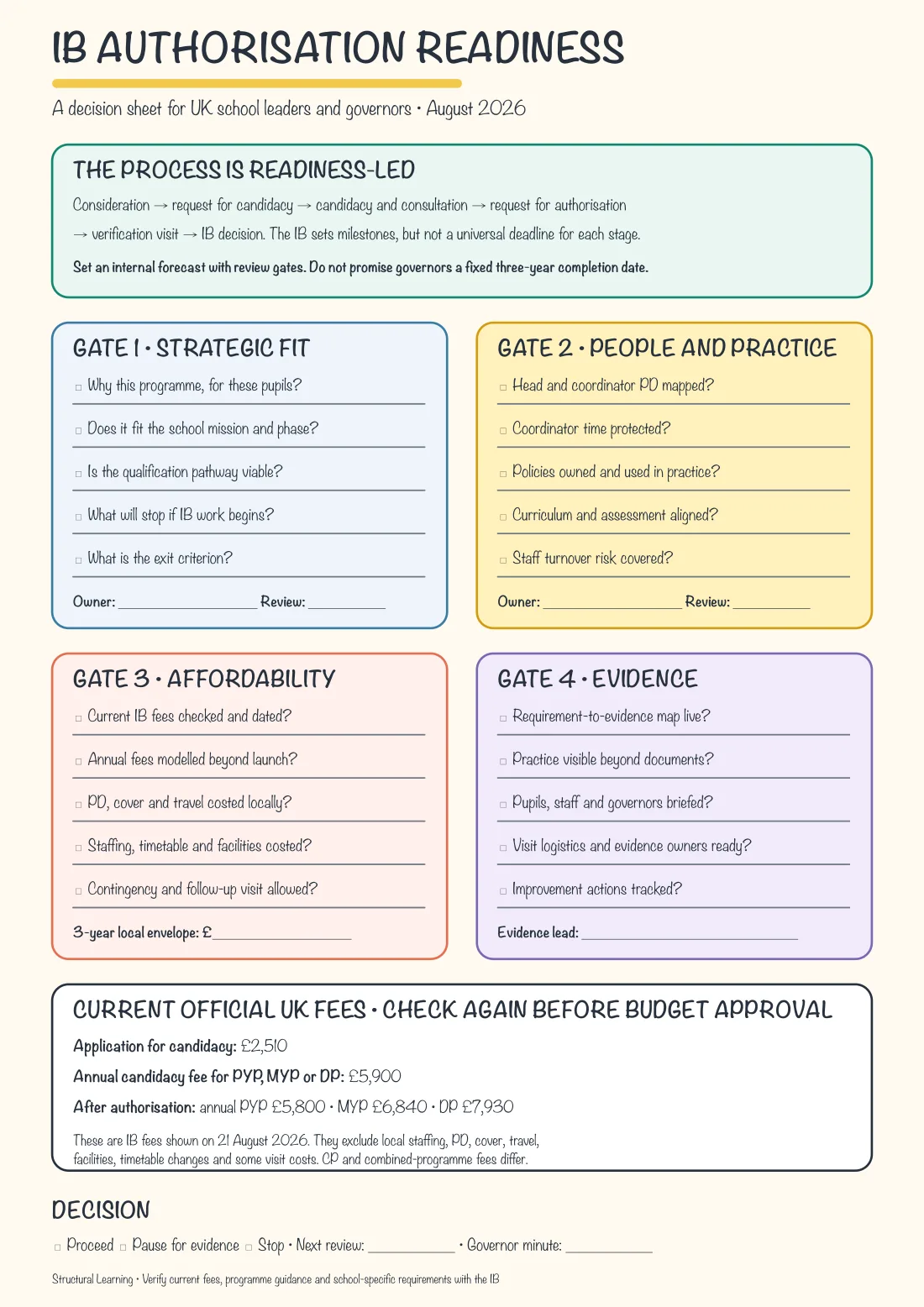
Download the IB Authorisation Readiness Checklist
The one-page checklist turns the process into four review gates. Use it during feasibility work, an SLT checkpoint or a governor meeting. Record owners, review dates and the current cost envelope. Recheck every official fee before approving a budget.
◆ Structural Learning
IB Authorisation Readiness Study Notes
Study notesOne-page revision sheet
Use the four decision gates to structure an SLT review, governor paper or readiness meeting before committing further time and money.
This guide was checked on 21 August 2026. IB fees, professional-development rules and programme documentation can change. School circumstances and national policy also differ. The guide supports due diligence but cannot determine whether a particular school will be approved.
There is no universal official duration. The IB sets milestones but no fixed deadline for each stage. Build a school-specific forecast around programme rules, staff training, trial rollout, evidence and advice from IB contacts.
How much does IB authorisation cost a UK school?
On 21 August 2026, the application for candidacy fee is £2,510 and the general annual PYP, MYP or DP candidacy fee is £5,900. Local staffing, training, cover, facilities, travel and timetable costs are additional. Check current official fees before approval.
What happens during an IB verification visit?
A visiting team gathers evidence that rules are in place and that the programme can be sustained and improved. The visit typically lasts two days. It is not an appraisal of individual teachers, and the team does not give the final approval decision.
Can a school fail IB authorisation?
The IB can grant or deny approval. A school may first be asked to resolve matters to be addressed. If approval is denied, a new application cannot be made until at least two years after the denial letter.
Does authorisation cover every IB programme?
No. Approval is programme-specific. A school must choose and apply for PYP, MYP, DP or CP, and it must meet the relevant programme rules.
What happens after a school is authorised?
The school signs the authorisation agreement, pays the relevant annual fee and continues programme development. The first programme evaluation usually occurs four to five years after approval, followed by evaluation every five years.
Paul Main is an educator and metacognition researcher who founded Structural Learning in 2017. With a psychology degree from the University of Sunderland and a career spent helping schools embed thinking skills, he bridges the gap between educational research and classroom practice. Fellow of the RSA and Chartered College of Teaching, with 128+ Google Scholar citations. More at paulmain.com.