Updated on
September 24, 2026
Metacognition in Primary Schools: A Practical Guide
Teaching metacognition in primary schools. EEF research shows +8 months additional progress on average. Practical KS1 and KS2 strategies and activities.


Updated on
September 24, 2026
Teaching metacognition in primary schools. EEF research shows +8 months additional progress on average. Practical KS1 and KS2 strategies and activities.
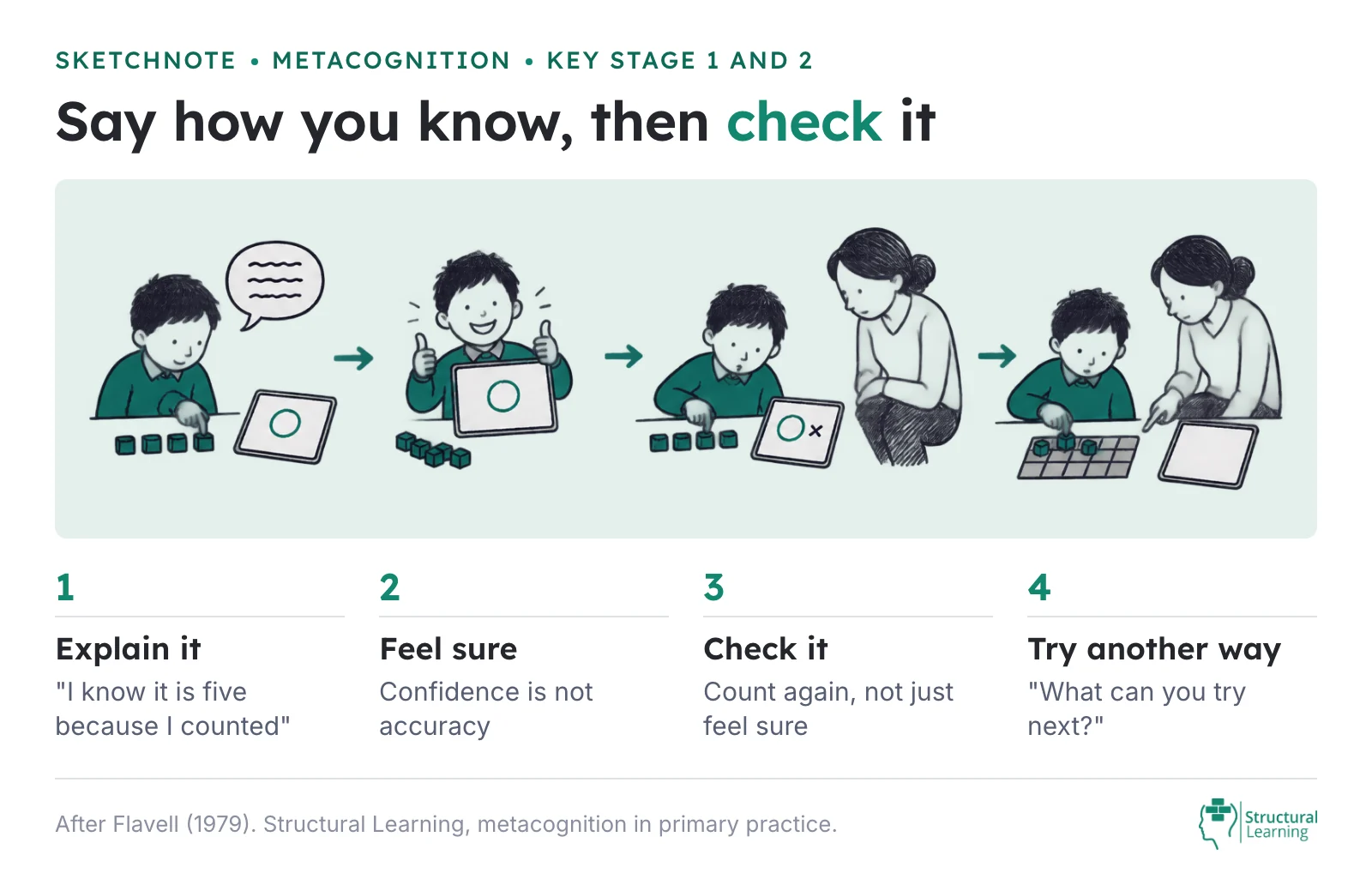
In primary schools, metacognition is taught one strategy at a time: the teacher says the thinking aloud, the class copies the move. Young learners do not automatically notice a misunderstanding, and confidence is not accuracy, so teach them to check their work, not feel sure.
Metacognition in primary schools means teaching young learners to notice what they know, choose a strategy and check whether it is working. Flavell (1979) described this as awareness and regulation of thinking, but in primary classrooms it has to be concrete and visible. For the wider picture of inclusive practice, see our guide to inclusive education.
In a Year 3 reading lesson, a teacher can say, "I am stuck on this word, so I will reread the sentence and look for clues." Learners then practise the same routine: name the difficulty, choose a strategy and explain what changed.
This is not a long reflection sheet after the task. It is a set of small habits built into modelling, questioning, feedback and independent practice so learners learn how to manage confusion before they give up or guess.
Metacognition, first defined by John Flavell, is awareness and regulation of your own thinking processes. It has two components.
Metacognitive Knowledge: Understanding how you learn. Examples: "I'm better at maths when I use counters," "I need quiet to concentrate," "I remember stories better than lists."
Metacognitive Regulation: This means noticing and adjusting your thinking while you work. Examples include spotting that you do not understand something mid-lesson, choosing a learning strategy that worked before, checking your answer, and asking yourself "Does this make sense?" Self-regulated learning is broader than metacognition. It also includes motivation, emotion, effort, help-seeking and managing time and materials (Zimmerman, 2002; Quigley, Muijs and Stringer, 2018).
In primary, learners are developing both. A Year 2 learner may not notice they have misunderstood until you ask "Does that seem right?" By Year 5, strong metacognition means they can check familiar work more independently. However, new or complex tasks still need prompts because executive function and working memory continue developing through childhood (Roebers, 2017).
They assume if something is hard for them, it's hard for everyone. They don't automatically monitor whether their answer makes sense or whether their strategy is working.
This is developmentally normal. It can also change through explicit teaching. Research by Ann Brown (1987) and John Flavell shows that primary learners who receive metacognitive instruction can greatly improve their self-correction and learning transfer.
In practical terms: a Year 3 learner with metacognitive awareness notices their subtraction answer is bigger than their starting number (doesn't make sense) and tries again. A learner without this awareness writes it down confidently and moves on.
The current EEF Teaching and Learning Toolkit rates metacognition and self-regulation as "high impact". It reports an average of +8 months of extra progress (Education Endowment Foundation, 2026). Use this figure as a planning guide, not a promise. Willingham (2008) shows that thinking skills do not transfer well when teachers teach them away from subject knowledge. Build metacognition into reading, writing, maths and science tasks instead of adding it as a general intervention.
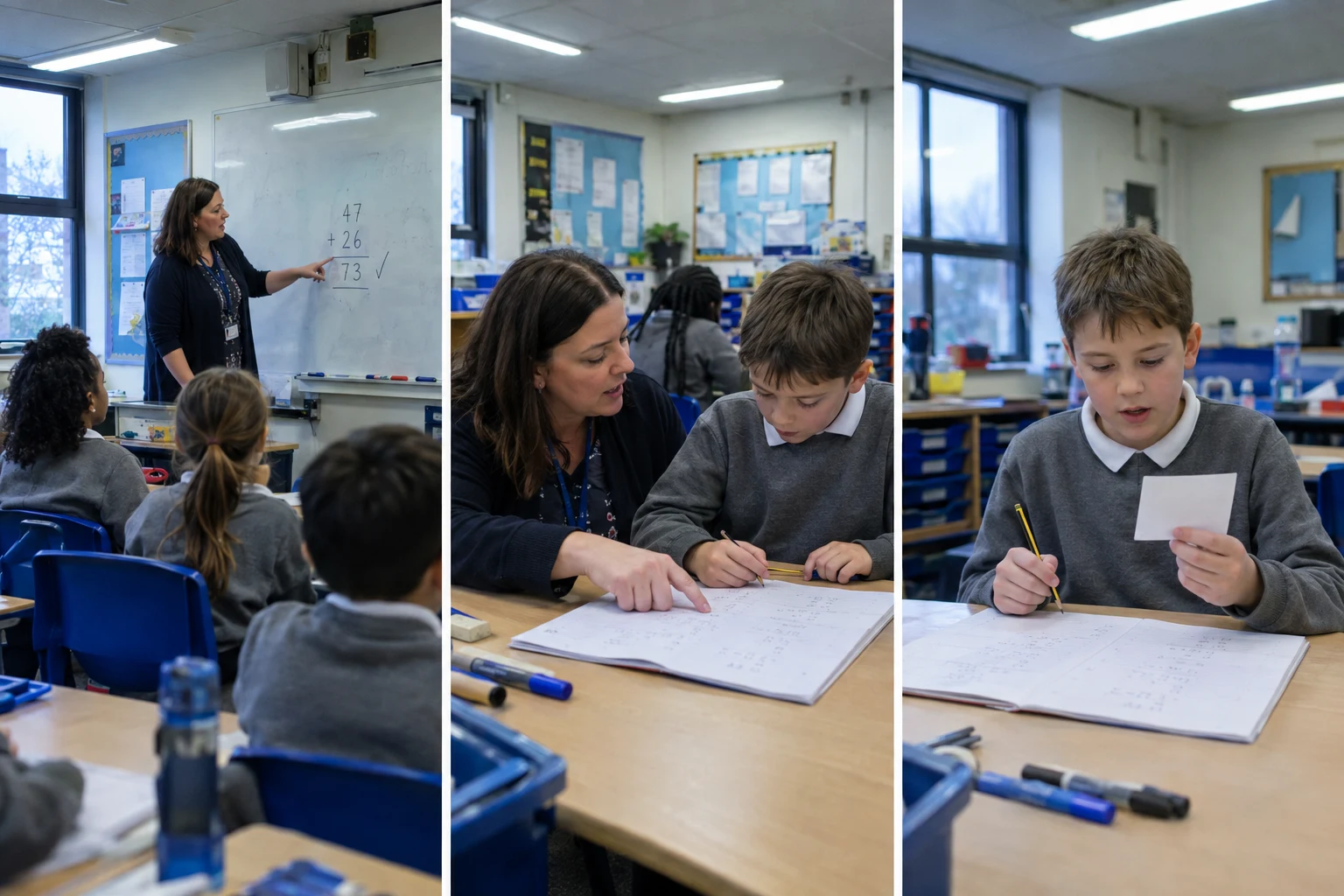
You narrate your thinking process. Not just the procedural steps, but the choices, checks and doubts that guide the work.
Teacher models solving a maths problem: "I see this is 7 + 5. I could count on my fingers, or I could remember that 5 + 5 = 10, so 7 + 5 is 2 more, so it's 12. That second strategy is faster. Let me check: 7 plus 5... yes, 12. That seems right because it's a bit more than 10."
You are not just solving. You are showing how to choose a strategy, check whether the answer seems reasonable and verify the result. This also requires teacher metacognition: before the lesson, decide which hidden decision you will model, where learners are likely to overload working memory and which prompt you will fade first (Quigley, Muijs and Stringer, 2018).
Ask learners to explain their thinking, not just their answer.

Instead of: "What's 8 + 4?"
Ask: "How did you work out 8 + 4? Show me your thinking."
When a learner explains, they become aware of gaps in their reasoning. They can say "I counted on my fingers" but realise they lost count halfway. This awareness is where metacognition happens.
Show learners worked examples with intentional errors. Ask them to find and fix the mistake, explaining why it's wrong.
Example: "Here's how I subtracted 7 from 14. I got 8. Is that right? Why or why not?"
Learners analyse the work step-by-step. They notice where the error happened and why. This is more metacognitive than correcting their own work because they are examining someone else's process more calmly.
Before independent work, ask learners to verbalise their strategy.
Teacher: "You're going to solve three word problems. What will you do first?"
Learner: "Read the problem. Underline the numbers. Decide if it's addition or subtraction."
Teacher: "How will you check your answer?"
Learner: "Read the question again and see if my answer makes sense."
They're thinking about their thinking before they get stuck.
Give learners a simple checklist they refer to during independent work:
At first, use these with the whole class. Then learners can use them on their own. This makes metacognitive monitoring visible, so learners build the habit over time.
Explicitly teach strategy selection. Not "Try harder." Actual strategies:
| Phase | Metacognitive Skills | How to Teach |
|---|---|---|
| EYFS/Year 1 | Notice what's easy vs hard. Respond to "Did you like that?" Notice if they know something. | Simple questions: "Was that easy or hard?" "How did you know that?" Model thinking aloud. Use concrete feedback. |
| Year 2-3 | Explain their thinking. Notice when they don't know. Use simple strategies (counting, drawing). | Think-aloud modelling. "Tell me how you worked that out." Error analysis. Simple strategy posters. |
| Year 4-5 | Check their work. Choose strategies. Reflect on what helped them learn. Plan before starting tasks. | Independent planning sheets. Monitoring checklists. Self-assessment rubrics. Peer explanation. |
| Year 6 | Reflect on learning habits. Evaluate strategy effectiveness. Transfer strategies to new tasks. | Learning journals. Post-task reflection: "What helped you learn?" Comparing strategies. Peer teaching. |
Post these somewhere visible and make the strategy choice physical. A Year 2 learner can move a counter from "reread" to "draw it" to "ask a partner" before they ask you for the answer. This matters because primary metacognition is easier to teach when the invisible act of monitoring becomes a visible classroom routine, not only a spoken think-aloud or a written reflection sheet (Dignath, Buettner and Langfeldt, 2008). See also our guide on what growth mindset research shows.
Nine routines teachers described on social media.
| Routine, as teachers describe it | What you would notice | What the evidence says |
|---|---|---|
| Method wall plus a physical check Year 2 recap methods from the display, self-correct, and use fingers as a physical tool. Not a reflection journal.
|
A number-line display in use, not just on the wall. A learner counting on fingers beside a worksheet. English primary, Fylde Coast. | EEF: teach strategies in the subject, and make monitoring visible. Dignath, Buettner and Langfeldt (2008): self-regulated learning programmes in primary raise attainment, with larger effects when strategy instruction is explicit and metacognitive. We have not verified whether the fingers were a taught check or ordinary counting. |
| Writing toolkit, then whiteboard, then paper Open a ring-bound toolkit at different ways to start a sentence. Draft on a whiteboard. Then commit to paper.
|
The toolkit is in the learner’s hands, not on a peg. A whiteboard draft sits beside the book. UK English lesson. | EEF recommendation 4: model and prompt metacognitive talk inside the subject. Willingham (2008): thinking skills taught away from knowledge do not transfer. This is writing, not a generic Plan Do Review grid. |
| Learning powers, not the word metacognition Award the power the school already names: considering choices and embracing mistakes. Map that language to plan, monitor and review.
|
A gold award named for two powers. Scottish assemblies name Keep Improving and Be Curious. The word metacognition may not be said. | EEF Toolkit rates metacognition and self-regulation high impact, +8 months on average (Toolkit). That is a mean across phases, not a trial of learning-power awards. |
| Learning pit, strategies on the way out P4/5 sit on the carpet under the pit display and name strategies that move learning forward. P6 draw their own pit, with confusion at the bottom and ways out on the slope.
|
Hands up on the carpet under a named pit wall. A learner drawing with strategies such as search it up and do preparations. Strongest X evidence is Scottish, not English KS2. | EEF: plan, monitor, evaluate, inside challenging curriculum tasks. A pit with no named way out is a mood display. The classroom object here is the learner-drawn strategies, not a bought poster. |
| Scripted maths think-aloud Plan the think-aloud before the lesson: objective, task, scripted thinking, prompts, a check with a second method. Bradford RS published worked examples for a percentage decrease and comparing fractions.
|
No UK primary board photo of a teacher thinking aloud was found. The evidence is a scripted blog, not a classroom photograph. | EEF, Settle (4 Mar 2026): teachers often model metacognitive talk by thinking aloud, “I've seen a task like this before, so I'm going to start by breaking it into smaller steps. I'll check as I go to see if that's helping.” Jennifer Green, Dixons, scripts the check with two methods. One teacher's account, not a trial. |
| Five-question superpower card Five questions on every desk, on the washing line, and on every maths slide. Ask the card before you ask the teacher. Year 6 in Bratislava, not a UK class.
@tes |
Cards stuck to desks. The teacher asking “Have you used your superpower card yet?” before helping. Year 3 in the same school could not read it well yet. | Tes, 31 Mar 2026: Boyd defines metacognition as thinking about thinking and being the boss of your brain. The Year 3 reading limit is the KS1 design constraint, not a reason to skip KS1. UK 5 Bs display: nothing found. |
| Rehearse the think-aloud, then model it US variant. 2nd grade teacher models in collab planning before they stand in front of the class. 4th grade teacher then models a think-aloud in the room.
|
Adults rehearsing the script with colleagues first. Then a think-aloud at the board with the class. Georgia elementary, US. | EEF: script the think-aloud because expert thinking has become automatic. Same mechanism as Bradford’s planned script. Do not lead a US page with the word metacognition; US elementary posts almost never used it. |
| Goal sheet: yes, almost, not yet US variant. 3rd grade write a goal, plan how they will monitor, tick steps such as ask for help and check answers. Success is yes, almost or not yet. Not a reflection journal.
|
A printed goal sheet on desks. Learners writing how they will monitor, not only the target. US 3rd grade maths. | EEF: plan, monitor, evaluate. If you want an after-task review, start from this sheet or from stop and jot, not a learning journal. |
| Last year’s fad, this year’s oracy objection A reply on a Katharine Birbalsingh thread: the school was obsessed with metacognition last year, oracy this year, and it makes not a jot of difference.
|
A new whole-school word each year. Posters and INSET, little change in the task. | EEF: it can be difficult to realise the Toolkit impact in practice. TeacherToolkit (25 Mar 2026): if learners can perform in one context only, learning is fragile. Replies from practitioners in the same window point the other way. |
The EEF +8 months figure is the Toolkit mean, not a KS1 trial. These routines are teachers' own accounts, not trial evidence.
The EEF guidance sets out seven steps for teaching a metacognitive strategy explicitly (Quigley, Muijs and Stringer, 2018). It is written for any phase. Here is what each step looks like when the strategy is "check your answer against the question" in a Year 4 maths lesson.
1. Activate prior knowledge. Ask what learners already do when they finish a calculation. Most say "put my hand up" or "move on".
Name the gap without judgement: nobody has shown them a check yet. Two minutes here saves the whole lesson from becoming a lecture about checking.
2. Explain the strategy. Say what the check is and when to use it: "When you finish, read the question again and ask whether your answer fits it." Keep it to one sentence they can repeat.
3. Model it. Solve a word problem at the board and run the check aloud, including a doubt: "I got 3.
The question asks how many are left from 20, so 3 is possible. Let me check by adding back." The doubt is the point. A smooth model teaches nothing about monitoring.
4. Memorise it. Turn the check into three words on a card or the working wall: "Read. Fit? Check." Chant it, point to it, and ask a learner to say it back before independent work starts.
5. Guided practice. Learners solve one problem, then you stop the room and run the check together. Ask two learners to say what the question wanted and whether their answer fits it.
6. Independent practice. Learners work through the rest of the set with the card on the desk. You circulate and ask only "Did you run the check?" rather than re-explaining the maths.
7. Structured reflection. Two minutes at the end: "When did the check change your answer? When was it a waste of time?" That second question matters. A strategy learners know when to skip is a strategy they own.
One strategy at a time. The guidance also says support should be withdrawn gradually, and fading is the step the routines above mention least. Plan when the card comes off the desk, not only when it goes on. For the broader picture of what metacognition is and how it differs from cognition, see our main metacognition guide.
Metacognition changes shape across the primary years. In Reception and Year 1 it is the adult's voice: you name the stuck moment and the way out. By Years 3 and 4 learners can use a card, a wall or a toolkit with a reminder. By Years 5 and 6 they can run a short check on familiar work alone. The two cards below are teachers describing that shift in their own words, one on writing and one on a lesson remembered years later.
What teachers said, in their own words.
Children having ‘something to say’ comes from interesting/inspiring them and modelling by thinking aloud etc. This is a vital part of teaching writing.
My 5th grade teacher, Mary Sprole, taught us to " think about thinking." Metacognition was ingrained in us from that point forward.
A Year 4 learner struggles with fractions and concludes they're "bad at maths." This is a failure of metacognitive knowledge. They don't understand that fractions are genuinely hard for everyone initially, that difficulty is normal, and that understanding is learnable.
Reframe: "Fractions are tricky. Everyone finds them hard at first. Your brain needs time to understand them. You're not bad at maths; you're learning fractions. Watch how I think about 1/4..." Model metacognitive thinking about difficulty.
A Year 3 learner confidently writes answers without checking. They are sure they are right. This confidence is not based on monitoring their thinking; it is based on how the answer feels. In higher education research, the same risk appears when work has been shaped by a generative AI tool. Learners may accept a smooth answer before checking whether it fits the lesson, the evidence or the method (Bearman et al., 2024; Tankelevitch et al., 2024).
Teach checking: "Let me re-read the problem... I said 12. Does that make sense? Let me count on my fingers to double-check." Model metacognitive monitoring that includes doubt and verification.
A Year 2 learner who struggles early in the year starts saying "I don't know" before trying. They've stopped monitoring and adjusting; they've concluded they're incapable.
Interrupt the pattern: "You do know some part of this. What part can you do? What could you try next?" Rebuild the habit of attempting strategies before giving up.
Metacognition is not always helpful, and teachers say so. On this page one practitioner calls it last year's word, another remembers a whole-school scheme that crowded out the curriculum, and a third describes an end-of-lesson "what learning muscles did you use?" question that nobody could answer. Each complaint points at the same fault: a label with no move attached.
The first way it fails is as a bolt-on. A generic thinking-skills lesson on a Friday afternoon does not show up in Monday's maths. Willingham (2008) shows that thinking skills taught away from subject knowledge do not transfer. The routines teachers describe working are all inside a task: a writing toolkit, a number line on the wall, five questions on a maths slide.
The second is the reflection sheet. A box at the bottom of every piece of work that asks "How did you find this?" produces "good" and "fine" for a term and then nothing. It records a feeling after the event, when the useful check happens during the work. If a sheet exists, make it one question with a named strategy in it: "Which stuck strategy did you use?"
The third is overload. A Year 2 learner holding a subtraction method, a checklist of five questions and a new vocabulary word at once has nothing left for the subtraction. Teach one strategy, make it visible on a card or a wall, and let it become automatic before you add the next (Sweller, 1988; Roebers, 2017).
The fourth is monitoring without knowledge. Asking "Does that make sense?" only works if the learner knows enough to judge. A learner who has never met a fraction cannot tell whether a quarter is bigger than a third, however good the prompt. Teach the content first, then the check on it.
None of these is a reason to drop the approach. They are a reason to keep it small, inside the subject, and attached to something a learner can point to. If a learner cannot show you the card, the wall or the toolkit page they used, the routine has become a word again, and words are what the sceptics on this page are objecting to.
Metacognition is closely linked to resilience. A learner who notices their confusion and knows what to try next doesn't spiral into helplessness. They problem-solve.
Explicitly build this: "What will you check, and what strategy will you try next?" Learners internalise this metacognitive habit and become more resilient.
Five stories as diagrams. Each label is a phrase from the post or the page.
When learners explain their thinking to a peer, they strengthen their own metacognitive awareness. Peer teaching can be very powerful because the explainer has to put their thinking into words, which can reveal gaps. At the same time, the listener hears a model of thinking aloud while they listen.
Pair learners: one solves a problem while the other listens and asks "How did you know that?" The explainer deepens understanding through articulation. The listener learns a different approach.
Use the questions below to decide which primary routines build independence without withholding support.
question
“My school is obsessed with ‘oracy’. Last year it was ‘metacognition’. It makes not a jot of difference, but it sounds clever!”
What the replies and the evidence say. The reply objects to a yearly label, not to a learner using a writing toolkit or a stuck card. Practitioners in the same window point the other way: embed it in the subject (St John’s toolkit, Bradford’s maths script, Boyd’s five questions). The EEF Toolkit itself says the +8 months mean can be hard to realise in practice. A new word on a poster is the thing that makes not a jot of difference.
question
“At the school I worked in that followed the program, we were supposed to ask kids 'what learning muscles did you use today?' at the end of each lesson. It was a nonsense.”
What the replies and the evidence say. He is right about an end-of-lesson muscle question with no named move. UK schools still award learning powers (Godwin: considering choices and embracing mistakes; St Peter’s Galashiels: keep improving). Those awards only count if the learner can name the choice, the toolkit page, or the strategy that got them out of the pit. A question with no object is the nonsense.
question
“Oh, I remember all these and Building Learning Power which almost replaced the NC at the school I worked at around 2014!”
What the replies and the evidence say. The memory is of a programme crowding out the National Curriculum, not of a think-aloud in maths. Current UK posts use learning powers as assembly language and awards, not as a replacement scheme. Willingham (2008) and the EEF both say the strategy has to sit inside the subject task. If it replaces the curriculum, it has already failed the test this teacher remembers.
question
“I’m crying I just remembered my teacher in highschool had “ask 3 before me” rule and looking back that lady just wanted us to leave her tf alone”
What the replies and the evidence say. Teachers split between copying an ask-three-people rule and teaching three named strategies learners try before asking. @findingarii treated it as a joke to copy. Almost no US elementary teacher posted Ask 3. The UK restatement from @thebr00n is try three strategies before asking, not three people. Put independence into named steps (wall, fingers, card) and you are not sending them away.
question
“It is the one of, if not the worst, and most failed implemented fad injected into the public school system I have ever seen.”
What the replies and the evidence say. American teachers framed this as the SEL-as-fad fight, not as too young to reflect. Meet a fad charge with a concrete thinking move: a rehearsed think-aloud (@mrsj_cohen) or a goal sheet that says how they will monitor (@mscorino_math). A poster on a door is what the research already warns against, and it was not a live teacher tweet here.
question
“Gifted programs are “growth mindset’s” villain origin story. We sort kids by 3rd grade, tell half of them they’re smart by nature.”
What the replies and the evidence say. The objection is sorting, not thinking about thinking. Teachers still hang growth-mindset posters and read them aloud to kindergarten (@G_4lyfe). Dweck (2016) named a false growth mindset: praising effort without a strategy that actually helps (Edutopia, 11 Jan 2016). Pair any slogan with a move the learner can use: check my answers, open the toolkit, ask the five questions.
Keep the wording the same from Reception to Year 6. A learner who hears the same planning question in the same words each year stops treating it as a new task and starts treating it as the way we work here. Changing the phrasing every September costs a term of relearning for no gain.
Try one think-aloud in your next maths lesson. Pick a question you would normally just solve, say the choice out loud, include one doubt and one check, then hand learners a three-word version of the same check ("Does that fit?"). Use it every day for a week before you add anything else.
No. Positive thinking alone ("I'm great at maths!") without actual monitoring is false confidence. Metacognition means accurate self-awareness: "I understand addition but I'm still confused about subtraction. Let me try drawing a picture." It is honest and strategic.
It feels slower initially, and it can become workload-heavy if leaders turn it into reflection worksheets, book scrutiny or a new marking code. Keep the routine inside the subject task: model the strategy, let learners practise it, then ask one check question. That saves time because learners make fewer errors and need less re-teaching.
Yes. It's more developed in older primary learners, but explicit teaching helps younger learners too. Even Year 1 learners can learn to notice "I don't know" and respond to adult prompting.
Listen to how learners explain their thinking. Observe whether they check their work. Note if they attempt strategies when stuck. These behaviours reveal metacognitive awareness.
Yes, when it is adapted. Learners with SEND or neurodivergent profiles may need shorter prompts, visual strategy cards, worked examples, movement breaks or adult co-regulation. Do not frame executive function differences as laziness or weak effort. The Cognitive Load Theory point is simple: reduce the memory and planning load so learners can practise one strategy at a time (Sweller, 1988; Roebers, 2017).
Metacognition in primary school is a learner noticing what they know, choosing a way to tackle a task and checking whether it worked. In Reception and Key Stage 1 it is mostly spoken and modelled by the adult: "I am stuck, so I will reread." By Years 5 and 6 learners can run a short check on familiar work themselves. It is not a reflection sheet after the lesson. It is a small set of habits inside reading, writing, maths and science tasks.
Metacognition matters in teaching because young learners do not monitor themselves unless someone shows them how. A Year 3 learner who writes a subtraction answer bigger than the starting number and moves on is not being careless. They have no habit of asking "Does that make sense?" Teaching that habit gives you fewer errors to re-teach and learners who can say where they are stuck. The EEF Toolkit rates the approach high impact for low cost, which is why it appears in so many school improvement plans.
Metacognition helps learners improve because it turns a vague feeling ("this is hard") into a decision ("I will draw it"). A learner who can name the difficulty, pick a strategy and check the result has three things to do when work gets hard, instead of one: give up. Over a term those small decisions add up. Learners spend less time stuck, ask better questions and start to carry a routine from maths into writing when you point out the link.
In a primary classroom metacognition looks ordinary. A teacher thinks aloud at the board and includes a doubt: "Hmm, 12? Let me count again." A learner opens a writing toolkit before asking for help. A stuck-strategy display gets used, not just looked at.
Children finish a maths task and read the question again before they say they are done. None of it needs a new scheme. It needs one modelled routine, practised often enough that learners run it without being told.
Metacognition stops helping when it is taught as a separate skill, away from the subject, or when it becomes a worksheet. Willingham (2008) shows that thinking skills taught in isolation do not transfer. A reflection sheet completed after every lesson trains compliance, not checking. Too many prompts at once overload a young learner, who then cannot hold the strategy and the maths together. Keep it inside the task, one strategy at a time, and drop the prompt as soon as the learner can run it alone.
Bearman, M., Tai, J., Dawson, P., Boud, D. and Ajjawi, R. (2024). Developing evaluative judgement for a time of generative artificial intelligence. Assessment and Evaluation in Higher Education, 49(6), 893 to 905.
Brown, A. L. (1987). Metacognition, executive control, self-regulation, and other more mysterious mechanisms. In F. E. Weinert and R. H. Kluwe (eds), Metacognition, Motivation, and Understanding (pp. 65 to 116). Lawrence Erlbaum.
Dignath, C., Buettner, G. and Langfeldt, H.-P. (2008). How can primary school students learn self-regulated learning strategies most effectively? A meta-analysis on self-regulation training programmes. Educational Research Review, 3(2), 101 to 129.
Dweck, C. (2016). Recognizing and overcoming false growth mindset. Edutopia.
Education Endowment Foundation (2026). Metacognition and self-regulation. Teaching and Learning Toolkit. Education Endowment Foundation.
Flavell, J. H. (1979). Metacognition and cognitive monitoring: A new area of cognitive-developmental inquiry. American Psychologist, 34(10), 906 to 911.
Quigley, A., Muijs, D. and Stringer, E. (2018). Metacognition and Self-Regulated Learning: Guidance Report. Education Endowment Foundation.
Roebers, C. M. (2017). Executive function and metacognition: Towards a unifying framework of cognitive self-regulation. Developmental Review, 45, 31 to 51.
Sweller, J. (1988). Cognitive load during problem solving: Effects on learning. Cognitive Science, 12(2), 257 to 285.
Tankelevitch, L., Kewenig, V., Simkute, A., Scott, A. E., Sarkar, A., Sellen, A. and Rintel, S. (2024). The metacognitive demands and opportunities of generative AI. In Proceedings of the CHI Conference on Human Factors in Computing Systems (pp. 1 to 24). ACM.
Willingham, D. T. (2008). Critical thinking: Why is it so hard to teach? Arts Education Policy Review, 109(4), 21 to 32.
Zimmerman, B. J. (2002). Becoming a self-regulated learner: An overview. Theory Into Practice, 41(2), 64 to 70.