Updated on
September 23, 2026
Metacognition in Secondary Schools: Exam-Ready Strategies
Metacognition strategies for secondary learners. Exam revision, self-regulation, and subject-specific approaches for KS3-4 backed by EEF evidence.


Updated on
September 23, 2026
Metacognition strategies for secondary learners. Exam revision, self-regulation, and subject-specific approaches for KS3-4 backed by EEF evidence.
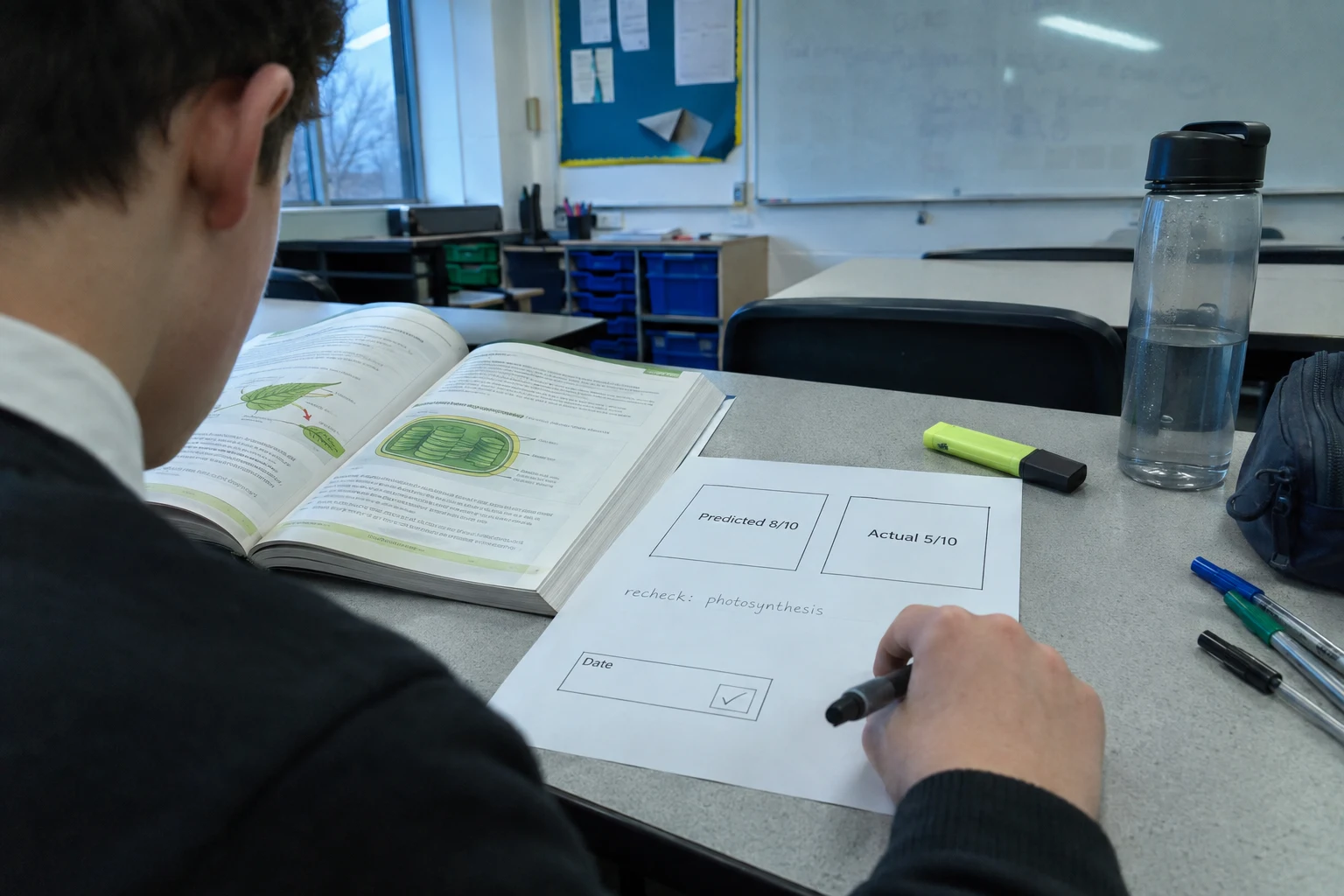
In secondary schools, metacognition means learners knowing why a revision method works, when to switch, and whether they understand or feel fluent. Those who monitor their understanding during revision outperform equally able peers, so compare a predicted mark with the real one after every mock.
Metacognition in secondary schools helps learners plan, monitor and evaluate their thinking in demanding subject content. Flavell (1979) defined metacognition as awareness and regulation of thinking. In KS3 and KS4, this means knowing which strategy fits the task and when to change course.
In a GCSE history lesson, a learner can realise that rereading notes is not helping them explain cause and consequence. The teacher models a better routine: identify the command word, retrieve the relevant evidence, plan the answer and check whether each paragraph answers the question.
For secondary teachers, metacognition is not an extra used to boost motivation. It is part of subject teaching, revision and assessment. Learners need it so they can judge confidence against evidence, manage time and choose strategies under pressure.
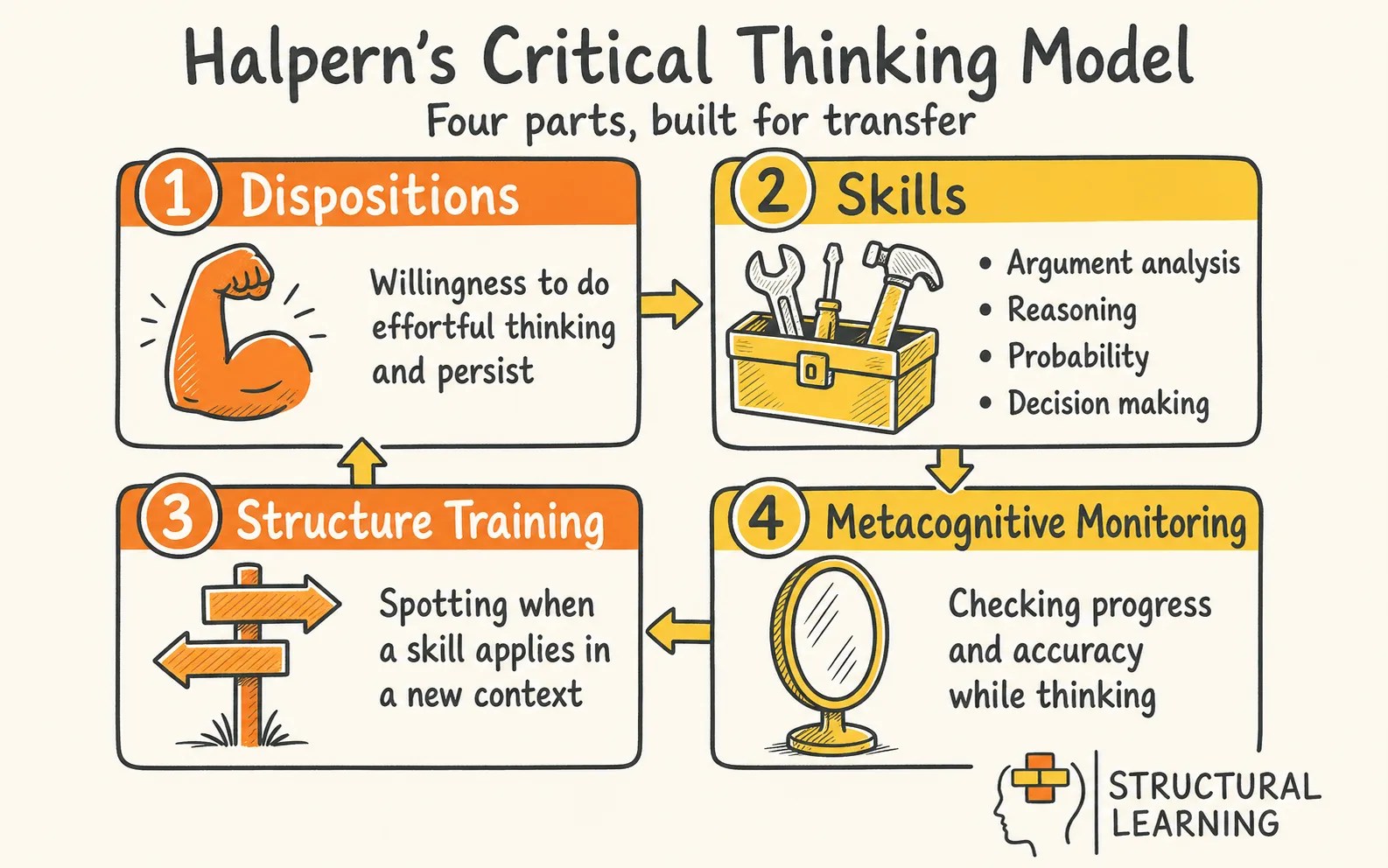
John Flavell (1979) defined metacognition as awareness and regulation of your own thinking processes. In secondary school, this matters a great deal. Learners need to notice how they think and then adjust what they do.
Metacognitive Knowledge: Understanding yourself as a learner. Examples include knowing that you learn best when you work through examples before trying new problems. Or that you need to visualise diagrams to understand 3D shapes. Or that you revise best by making practice questions, not by re-reading notes.
Metacognitive Monitoring: Tracking your understanding in real-time as you work. For example, a learner may notice mid-lesson that they can't explain a concept, even though it felt familiar. They may also recognise that their GCSE revision strategy isn't working. In an exam, they may realise they have misunderstood a question.
Metacognitive Regulation: This means changing your approach after you check how well it is working. For example, you might switch revision methods when the current one is not working. You might also re-read a confusing exam question to clarify what is being asked. Or you might choose worked examples over discovery when learning a new procedure.
All three can be learned and taught. Most secondary learners lack clear metacognitive knowledge and training. That is why they struggle in exams, even when they understand each concept on its own.
Secondary learners face novel demands that primary doesn't prepare them for:
Independent Learning: During homework, no one is standing over them. Learners must check whether their approach is working and change it on their own. Without metacognition, they keep using strategies that fail or give up.
Multiple Subjects Simultaneously: GCSE learners juggle 9+ subjects. Each has its own teaching style, assessment format and content. This is why generic "learning to learn" programmes often disappoint. Willingham argues that thinking is tied to what learners know.
The Education Endowment Foundation stresses that metacognitive strategies work best when taught inside subject content. A history source evaluation, a maths proof and a science practical each need different monitoring questions. So teach the strategy where it will be used.
Exam Pressure: When learners feel anxious and short of time, working memory shrinks. Learners who have developed metacognitive monitoring can manage panic, use time well, and change strategy. Learners without it freeze.
Transfer Demands: Learners must apply knowledge to contexts they haven't seen before. This requires metacognitive awareness: "I understand the procedure, but does this new question fit the same pattern?" Procedural fluency means doing the method. Conceptual understanding means knowing why it works in this context. These are different skills.
Research by Dylan Wiliam (2011) and others shows something important. After prior attainment, metacognitive awareness is the strongest predictor of GCSE results. It predicts them more strongly than IQ does.
Secondary learners need to learn one key metacognitive distinction. Feeling like you understand is not the same as actually understanding. Teachers can help learners test this difference through explanation, practice and feedback.

A Year 10 learner can fluently solve 10 simultaneous equation problems using the elimination method. They feel confident. But when you ask "Explain why we multiply by 3 here," they can't. When you give them a simultaneous equation problem presented differently, they freeze. They were confident but not competent.
This is the "fluency-comprehension gap." Metacognitive learners learn to tell the difference between:
Without this distinction, learners can mistake fluency for understanding. They may then revise in ineffective ways, such as practising what they already know.
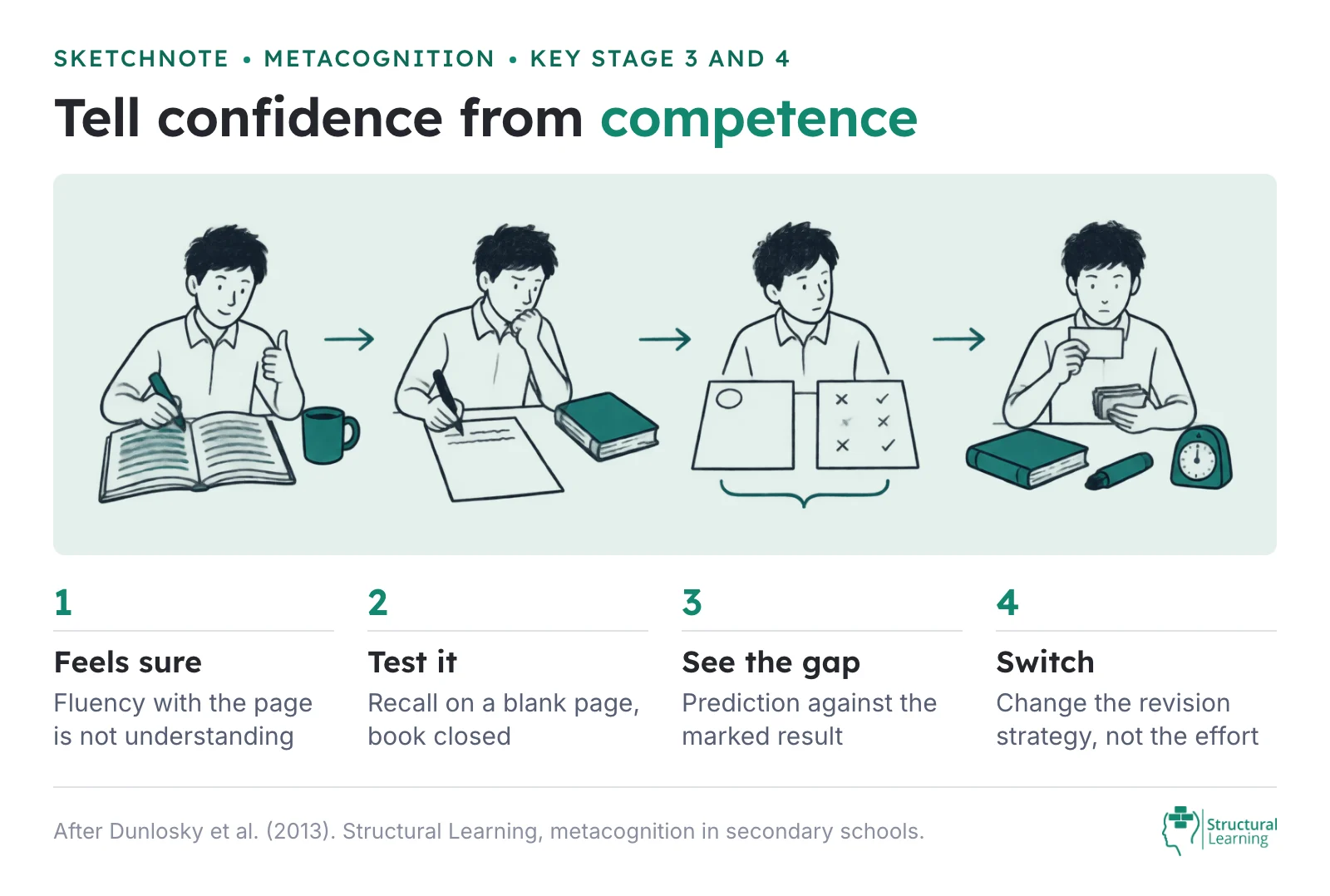
Don't assume secondary learners know *why* a revision strategy works or when to use it. Teach it explicitly.
Example: Retrieval Practice
Don't just say "Do past papers." Explain: "When you do a past paper question without looking at notes, your brain works hard to retrieve the memory. This strengthens the memory much more than re-reading notes. That's why past papers are your best revision tool."
Then: "For the first time you see a topic, use retrieval practice immediately (quiz yourself). For topics you find hard, space your retrieval practice over time (practise, wait a week, practise again). For topics you know well, use mixed problems that force you to discriminate between topics."
Learners now understand not just *what* to do but *why* and when. This is metacognitive knowledge. In 2026, that includes AI-assisted revision. A learner who asks a chatbot for a model answer still has to check something.
They must see whether the output matches the mark scheme, invents evidence, or removes the difficulty that builds recall. Lodge et al. (2023) describe this risk as cognitive offloading, where a tool supports thinking at first but can also replace the monitoring work learners need before an exam.
Have learners compare different revision strategies on the same content. Then have them analyse which works better.
Test Condition: Divide the class into three groups. Group A revises by re-reading notes. Group B makes mind maps.
Group C does practice questions. All revise the same topic. Next lesson, quiz all three groups on the same material.
| Subject | Key Metacognitive Knowledge | How to Teach |
|---|---|---|
| Maths | Understanding (why it works) is different from procedure (how to do it). Novel problems test understanding, not fluency. | Worked examples with explanation. Practice novel problems early (not just variations of practice problems). "Explain why this method works" questions. |
| Science | Memorising facts ≠ understanding mechanisms. You must explain *why* something happens, not just *what* happens. | Constant "Why?" questions. Concept mapping. Explaining mechanisms to peers. Analyzing misconceptions. |
| English Lit | Identifying techniques (fluency) ≠ analysing effect (understanding). Exams test analysis, not identification. | Model analysis. "Identify the technique, then explain its effect." Model essays with annotations. Peer marking with rubrics. |
| History | Memorising facts ≠ understanding causation. Exams test interpretation and evidence use. | Practice source analysis. Model interpretation. "Why did this happen?" vs "What happened?" Structured essay planning. |
| Languages | Knowing vocab ≠ using it in context. Speaking/writing requires integration of grammar, register, and vocabulary. | Speak aloud while writing. Peer dialogue. Model complex sentences with explanation. Analyse authentic texts for patterns. |
Results typically show: Group C (retrieval practice) scores highest. Discuss: "Why did practice questions work better? What happened in your brain? How will you revise differently?" Learners build metacognitive knowledge through direct experience.
Before tasks, label what learners are doing metacognitively.
Task Analysis: "This exam question asks you to 'Analyse the poet's use of metaphor.' That's not 'identify' or 'explain.' It's analyse, meaning you must evaluate *why* the technique is effective. It's high-level thinking. Let me model..."
Learners build metacognitive knowledge about different cognitive demands. Put simply, they learn what kind of thinking a task needs. Over time, they can say, "This question needs analysis, not recall" and change their approach.
Teach learners to tell the difference between overconfidence and real understanding. Use clear measures to show what they know and what they only think they know.
Method: After learning something, have learners:
When this happens across a unit, learners recalibrate. They learn that fluency (doing practised problems) can feel like understanding. But it doesn't guarantee transfer. Genuine understanding feels harder at first (novel problems require thinking).
Learners explain their thinking aloud or in writing before, during, and after problem-solving.
Protocol:
Self-explanation forces monitoring. If a learner can't explain why they chose a method, this tells us something. They understand procedure but lack conceptual knowledge. See also our guide on oracy-driven retrieval practice.
Give learners worked examples that include intentional errors. Ask them to identify the error and explain it.
Chemistry Example: "Here's a balanced equation for combustion of ethane. I made an error. Find it. Explain why it's wrong and how to fix it."
Learners analyse their work in a clear, step-by-step way. This strengthens metacognitive monitoring, so they get better at spotting their own errors.
Eight routines from secondary teachers on social media. This page already defines plan, monitor and evaluate. These rows show the exam-room move.
| Routine, as teachers describe it | What you would notice | What the evidence says |
|---|---|---|
| Walking talking mock Year 11 sit a live paper while the teacher (or six trained learners) talk timings, pitfalls and how to start each question. UK English, maths, science, geography and computer science all posted this in the GCSE run-up.
|
A hall or classroom paper in silence except the spoken start. Pens down until the first question is unpacked. | EEF Toolkit (May 2025): in effective studies, strategies are modelled on a curriculum task, not in a thinking-skills lesson. A walking talking mock is the school's own account, not a trial. |
| Exam wrapper after a mock After mocks or prelims, learners name what they revised, which question types were hard, and what they will do next. Teachers photograph the sheet. US classroom teachers did not post their own wrappers.
|
A filled sheet or form, not a smiley. A next action that names a method. The photographed wrapper is redrawn elsewhere, not copied. | EEF guidance report recommendation 6 names exam wrappers as a way to analyse errors and revision patterns. Carnegie Mellon (Eberly Center): the grade crowds out the strategy. This row is reported, not trialled. |
| Visualiser think-aloud in the subject The teacher writes a response live and names the decisions: why this sentence, this plan, this next step. English unseen poetry, GCSE RE scripture, and a Year 11 paper under the visualiser.
@MsConnellTeach |
I language, not we. A hesitation left on the page. Learners watching a choice, not a finished model answer. | EEF Toolkit: teachers can promote metacognition by modelling their thinking aloud on usual curriculum work. Zoe Enser (@greeborunner), answering a KS4 plea: metacognition should be modelled, not expected. @greeborunner. Not a trial of this lesson. |
| Year 7 revision, not a Year 11 assembly KS3 learners make revision resources inside the subject (Year 7 French: to do, to make, er verbs). Biology homework with a follow-up test, so “I don’t know how to revise” has nowhere to hide.
|
A Year 7 book with a method in it. A short test after the homework, not a tutor-time slogan. | EEF: teach the strategies in the subject, from early years through 16 to 19. The live UK complaint is Year 11 is too late if Year 7 never learned how. Burns writes from his own classroom; Millfield and Reynolds describe their schools' practice. |
| Retrieval that shows overconfidence US high-school psychology: a retrieval task before the test so learners see what they really know. Completing the study guide is named as the weak default. UK variant: boards up, then the paper.
|
A gap between “I know this” and a blank retrieval. Not a highlighted study guide. | Dunlosky et al. (2013): practice testing and spaced practice have high utility. The EEF says monitoring is taught in the task. This classroom scene is reported by Blake Harvard, not a trial of the school. |
| Freshman-seminar brainstorm, then implement In US schools, a period named freshman seminar or advisory. Learners sort effective versus non-effective study strategies on a board. The teacher’s next line was: now train the brain to use them. UK page keeps the subject lesson.
|
A two-column board. Sticky notes. The photograph is redrawn elsewhere, not republished. | EEF: a list of strategies is not the work. The work is using one on a curriculum task. Mrs Schuh already flags the gap. |
| A standalone metacognition lesson objection A KS4 plea for lessons on independent learners and metacognition. The live UK reply: the metacognition lesson is mostly a myth. Domain knowledge predicts transfer better than a learning-to-learn hour.
|
A PowerPoint called metacognition, off the subject. No think-aloud on the paper in front of them. | EEF 2025 update: plan, monitor and evaluate inside the task. Gundimeda’s domain-knowledge claim matches Willingham as cited on this page. |
| Test corrections as grade recovery objection In US schools, an F becomes a C after corrections. A high-school maths teacher asks whether to stop, because learners skip the first test. That is not a reflection routine.
|
Points moving. No named change of method. A paper that never comes back cannot be diagnosed. | Separate the points from the diagnosis, or the wrapper is extra credit. APA TOPSS (US policy sheet, not a classroom post) still uses a wrapper for plan, monitor and evaluate. College wrapper studies are mixed; do not treat them as GCSE evidence. |
Metacognitive knowledge is subject-specific. The question a learner asks while checking a maths answer is not the question that catches a drifting history paragraph. Generic "learning to learn" lessons fail for that reason, and the EEF is clear that the strategies belong inside the subject. Here is the monitoring question that does the work in each of five subjects, and the moment to teach it.
Maths. "Does the answer fit the question?" A negative length, a probability over 1, an answer bigger than the starting number: each is a check a learner can run in five seconds. Teach it on the first problem of every lesson, then ask for it before any hand goes up.
English. "Does this paragraph answer the question I was set?" Learners drift towards what they know about the text. Model it under the visualiser: write a paragraph, stop, reread the question, cross out the sentence that wandered. The hesitation on screen is the lesson.
Science. "Have I answered in the right units and to the command word?" A six-mark evaluate question written as a description scores as a description. Pair every practical with one line on what the variable controls, so the monitoring is about the science, not the worksheet.
History and geography. "Where is my evidence, and does it do the job the question asks?" Source questions reward provenance; explain questions reward cause and consequence. Ask learners to label the job of each sentence in the margin for a fortnight, then stop.
Languages. "Which tense does the task need, and have I used it?" A tick against each tense in a written response is a monitoring routine that takes twenty seconds and catches a common source of lost marks.
None of these is new content. Each is a question you already ask when you mark. The shift is teaching learners to ask it before you do, on the task in front of them, so that by Year 11 the check runs without you.
Exam success is not only about what learners know. It also depends on metacognitive regulation under pressure, which means managing thinking during a demanding task. Teach these strategies clearly.
Use them as a starting point for professional discussion. Identify the learner's current need and record evidence from more than one lesson. Then agree the next classroom adjustment with the SENCO or family.
Learners must monitor time and adjust strategy. Teach this explicitly:
"In a 90-minute exam with 45 marks, you have 2 minutes per mark average. If you spend 10 minutes on a 1-mark question, you're sacrificing other questions. Monitor constantly: 'How many marks remain? How much time?' Adjust pace accordingly."
Before answering, teach learners to analyse what the question actually demands:
| Level | Metacognitive Awareness |
|---|---|
| 4. Metacognitive Expert | Can explain their thinking, identify where they're stuck, choose and switch strategies, and evaluate whether a strategy worked. Transfers learning to new contexts. |
| 3. Metacognitive Aware | Can explain thinking and notice when stuck. Attempts different approaches with prompting. Mostly solves independently. |
| 2. Limited Awareness | Can explain steps taken but not the reasoning. Struggles to notice confusion or adjust strategy. Needs adult support. |
| 1. No Awareness | Can't articulate thinking. Doesn't notice confusion. Repeats same (failing) strategy. Gives up or waits for help. |
Learners do better when they analyse questions metacognitively before they write. They tend to outperform learners who start writing straight away.
Anxiety shrinks working memory. Teach metacognitive strategies for managing it.
"If you panic during an exam, that's metacognitive information: this question is harder than you expected.
Pause. Reread. What part can you do? Start there. Build confidence. Return to hard questions later."
Metacognitive regulation means checking your emotional state as you work. It also means changing your strategy when you need to.
Five classroom examples show a revision process, a stalled learner restarting, a think-aloud, a two-column sort and a timeline.
1 · Process
The same kind of paper learners will face tomorrow.
The teacher talks through how to start the first question.
Notice: decide how to begin before writing the answer.
Learners try the opening independently. This is the intended handover, not an outcome reported in the post.
Ibstock School sat Year 11 in the hall and talked them through the English paper the day before the exam. Pens down until the first question is unpacked.
2 · Cause and effect
rated revision “Very” or “Somewhat Effective”.
Some learners could recall the content but struggled to apply it.
Set exam practice questions alongside or after flashcards.
The 88% is a reported class rating, not an impact estimate. Learner comments exposed a recall-to-application gap, and the teacher planned practice questions alongside or after flashcards.
Devon Research School
The page is Using exam wrappers to encourage Year 11 students to reflect.
3 · Process
What does the teacher decide before writing?
The complete example remains readable without scripting.
Small Heath put a GCSE RE response under the visualiser so the class saw the decision, not the finished answer. The next sentence is theirs.
4 · Before and after
A sticky note names a strategy and the learner tries it on the task.
The learner revisits material without testing what they can do.
Possible teacher move, inferredAsk which strategy learners will use and what their work will show.
A freshman seminar sorted effective versus not effective, then the work was to implement them.
5 · Timeline
The teacher reported this as the strongest response in the task.
The interval alone did not guarantee recall.
Recent exposure can feel familiar.
A retrieval task made overconfidence visible before the test. Learners most often chose last month, the set retrieved three times.
The linked page is An Ah-Ha Moment with Spaced Practice.
An exam wrapper is a short sheet a learner completes when a mock comes back, before the grade has been stared at for long. Teachers on this page describe using one after prelims and mocks, and the EEF guidance names wrappers as a way to analyse errors and revision patterns. Here is a version that fits in ten minutes and does not become a form-filling exercise.
Minutes one and two: predict. Before the paper is handed back, learners write the score they expect, in ink. The gap between that number and the real one is the most useful data in the room, and it is lost the moment the grade is seen.
Minutes three to five: sort the lost marks. Learners go through the paper and label each lost mark with one of three words: did not know, misread, ran out of time. A tally in three columns says more than a percentage. A column of "misread" is a monitoring problem, not a knowledge problem, and it needs a different fix.
Minutes six to eight: name the method. Learners write what they did to revise this topic, in one line, and whether it matched the column that hurt. Re-reading notes is the method teachers on this page name as the weak default. The next line is the change: practice questions, spaced retrieval, a timed section.
Minutes nine and ten: one commitment. One sentence, starting with a verb, naming the topic, the method and the date. "Do ten past-paper questions on moles on Thursday." You collect it, and at the next mock the first question is whether it happened.
Keep the grade off the sheet. Where a wrapper feeds the mark book it becomes extra credit, and the method never changes. Keep the sheet in the subject, not in tutor time, because the sort only works when the person who marked the paper is in the room to answer what each question actually asked.
To develop metacognition, make it visible in learners' work, talk and decisions. Do not treat it as a lesson-observation tick-box. Self-report questionnaires can start a discussion. But they often miss what learners actually do under timed GCSE conditions.
Veenman (2011) and Craig et al. (2020) warn against relying on confidence surveys alone. Metacognitive behaviour is better judged through traces: annotations, answer changes, error logs and live explanations.
So the assessment that counts is a trace: an annotated past paper, a corrected error, a wrapper with a named next step. Teachers who post about this work also post their doubts, and the block below takes the sharpest of those in turn.
Use the questions below to decide how metacognitive routines should sit within subject teaching and revision.
question
“The metacognition lesson is mostly a myth. What the research actually shows is that domain knowledge predicts transfer far better than any "learning to learn" intervention does.”
What the replies and the evidence say. Classroom teachers in that window posted walking talking mocks and visualiser modelling, not a learning-to-learn course. Zoe Enser (@greeborunner) answered a KS4 plea for standalone lessons: be precise, teach them explicitly how to revise, and “Metacogniton should be modelled but not expected”. @greeborunner. The EEF 2025 update takes that side: plan, monitor and evaluate inside the subject task. The page already cites Willingham on thinking being tied to what learners know.
question
“Maybe Year 11 is quite soon enough for children to start taking revision seriously?”
What the replies and the evidence say. He is answering Nathan Burns (@MrMetacognition). Burns posted the same week that revision should be developed from Year 7, not just before GCSEs. Lois hears “I don’t revise / I can’t revise / I just wing it.” Teachers differ on whether revision habits should start in Year 7 or wait until Year 11. The EEF says the strategies work across ages; it does not say start in Year 11. Year 7 French at Millfield was already making revision resources.
question
“When my son was in 8th grade, I asked his social studies teacher how he was teaching students to study/learn. He told me that if they didn’t know when they got to him, he couldn’t do anything.”
What the replies and the evidence say. Forty-five seconds later she replied to that same post: “Executive function skills and study strategies can be taught in schools and should be taught.” @Buffyfanlarson. Blake Harvard, AP Psychology, posted the opposite of “only for AP kids”: they still do not know how to study. The live US objection is too late by 8th grade, not that it is an enrichment extra.
question
“Many times I feel like students do not prepare for the first test knowing retakes and corrections are available. Is next year the year I say no more?”
What the replies and the evidence say. A 6th-grade teacher in the same set of posts has to give corrections on every test: an F becomes a C. That is grade recovery, not a diagnosis. If the wrapper still feeds the gradebook, learners will use it as extra credit. Keep the points off the sheet, or the method will not change.
question
“I had to take avid every single year of hs and ms and Cornell notes hasn’t even scratched my brain in college”
What the replies and the evidence say. US chemistry, middle-school social studies and AVID still post Cornell notes as the taught system. Former learners say the notes never followed them. Pair any organiser with a retrieval step, or it is the display that changed nothing.
Take the next past-paper question you set. Add one line to the instruction: "Before you write, say what the command word asks for and how you will check your answer." Read the answers to that line before you mark the rest. It shows you who is monitoring and who is guessing.
Metacognition IS content. A learner who knows content but can't monitor whether they understand it will fail exams. Integrate metacognitive strategies into regular lessons: explain strategies, have learners compare approaches, model thinking aloud. It's not extra; it's embedded.
Yes. High-attainers often have strong metacognitive knowledge already. They benefit from deepening their conceptual understanding. Struggling learners often lack strategy knowledge, so they benefit most from explicit metacognitive instruction and support.
You can teach time management and question analysis. But learners still underperform if they use these skills without metacognitive monitoring. This means checking whether they understand questions correctly. Metacognition is the foundation.
It's invisible. You can't "teach" it like you teach maths content. But explicit strategy instruction, error analysis, and self-explanation all develop it. The skills are there in good teaching; they're just not always named as metacognition.
Teach metacognition inside the subject, not in a separate lesson. Pick one routine your subject already needs, such as reading the command word before writing or checking a maths answer against the question. Model it under the visualiser in first-person language, with a hesitation left in.
Then have learners do it on the next task while you ask only whether they ran the check. Fade the prompt once they run it unprompted. The EEF guidance describes that sequence as explicit instruction, modelling, guided practice, independent practice and reflection.
Metacognitive strategies for secondary learners are the moves that let them plan, monitor and evaluate their own work. Planning: read the command word, decide the method, set a time. Monitoring: pause mid-task and ask whether the method is working, check a maths answer against the question, notice when a paragraph has drifted from the question. Evaluating: after a mock, name what was revised, which question types went wrong and what changes next. The routines teachers describe on this page, walking talking mocks, exam wrappers and visualiser think-alouds, are all versions of those three moves.
The seven-step model comes from the EEF guidance on metacognition and self-regulated learning. It is a sequence for teaching one strategy explicitly: activate prior knowledge, explain the strategy, model it, memorise it, guided practice, independent practice, then structured reflection. In a secondary classroom that means one strategy per unit, taught in the subject, with the modelling done aloud and the reflection tied to a real piece of work. It is not seven lessons and it is not a scheme. It is the order in which support is offered and then withdrawn.
Metacognition helps in exams because the exam room is where nobody can prompt a learner. A learner who monitors can notice that a question has three parts, that ten minutes have gone on a one-mark question, or that panic is information rather than a verdict. Before the exam it shapes revision: retrieval instead of re-reading, practice questions instead of highlighted notes, and a wrapper after each mock that turns a grade into a next action. Teach the moves on real papers. Exam technique without monitoring produces learners who know the tricks and still misread the question.
Ofsted does not require a metacognition programme, and inspectors do not look for a scheme, a poster or a named lesson. What they look at is whether teaching helps learners remember and apply what they have been taught, which is what a monitoring routine inside a subject does. Treat any staffroom claim that Ofsted wants metacognition as a school-level policy choice, not an inspection rule. If your school adopts it, the evidence worth showing is in learners' work and talk: annotated past papers, corrected errors, and an explanation of why a method was chosen.
In KS3 the job is building the habits before the stakes rise: Year 7 making revision resources inside the subject, short tests after study-skills homework, and the language of plan, check and change used in ordinary lessons. In KS4 the same moves get attached to exam formats: command words, timing per mark, walking talking mocks and exam wrappers. The mistake teachers describe is starting in Year 11. By then a learner who never learned how to revise says they cannot, and one who wings it has two years of evidence that winging it worked.
Craig, K., Hale, D., Grainger, C. and Stewart, M. E. (2020). Evaluating metacognitive self-reports: systematic reviews of the value of self-report in metacognitive research. Metacognition and Learning, 15(2), 155 to 213.
Dunlosky, J., Rawson, K. A., Marsh, E. J., Nathan, M. J. and Willingham, D. T. (2013). Improving students' learning with effective learning techniques: Promising directions from cognitive and educational psychology. Psychological Science in the Public Interest, 14(1), 4 to 58.
Education Endowment Foundation (2025). Metacognition and self-regulation. Teaching and Learning Toolkit. Education Endowment Foundation.
Flavell, J. H. (1979). Metacognition and cognitive monitoring: A new area of cognitive-developmental inquiry. American Psychologist, 34(10), 906 to 911.
Lodge, J. M., Yang, S., Furze, L. and Dawson, P. (2023). It's not like a calculator, so what is the relationship between learners and generative artificial intelligence? Learning: Research and Practice, 9(2), 117 to 124.
Veenman, M. V. J. (2011). Alternative assessment of strategy use with self-report instruments: a discussion. Metacognition and Learning, 6(2), 205 to 211.
Wiliam, D. (2011). Embedded Formative Assessment. Solution Tree Press.