Updated on
September 9, 2026
IB CAS Guide: Projects, Reflections and 7 Outcomes
IB CAS guide for coordinators and teachers: explain the three strands, plan projects, support reflections and evidence all seven learning outcomes.

Updated on
September 9, 2026
IB CAS guide for coordinators and teachers: explain the three strands, plan projects, support reflections and evidence all seven learning outcomes.
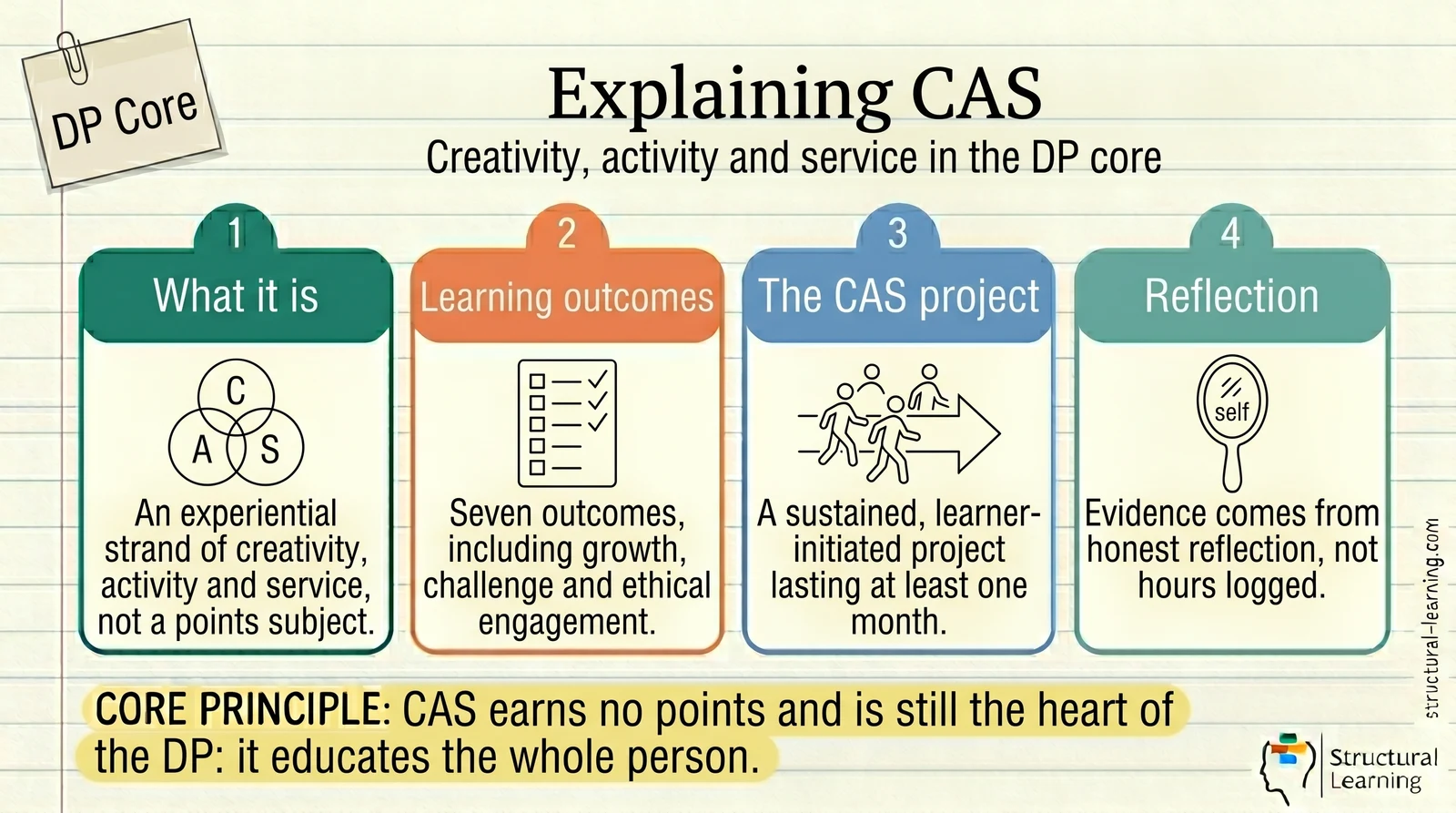
CAS is a required but ungraded part of the IB Diploma Programme core. It means Creativity, Activity, Service. Learners complete experiences across all three strands, at least one CAS project, purposeful reflection and evidence of all seven learning outcomes.
Key Takeaways
CAS stands for Creativity, Activity and Service. It is one of the three required parts of the Diploma Programme core, alongside the Theory of Knowledge guide and the Extended Essay guide. CAS is not formally assessed for points, but learners must complete it to receive the Diploma (International Baccalaureate, 2026).
Learners take part in experiences across creativity, activity and service, complete at least one CAS project, reflect on what changes and provide evidence of all seven learning outcomes. The public IB guidance does not prescribe one universal hours total, reflection count or portfolio platform, so schools should distinguish local routines from programme rules.
This guide explains what CAS involves, how to plan experiences that satisfy the learning outcomes, and what both learners and supervisors need to do to make the programme worthwhile rather than a box-ticking exercise.
CAS sits alongside Theory of Knowledge and the Extended Essay as one of the three core elements of the IB Diploma Programme. TOK now uses the knowledge framework, the core theme of knowledge and the knower, optional themes and five areas of knowledge. CAS connects this intellectual work to action, but it does not add Diploma points.
TOK develops critical thinking through epistemological questions, while the Extended Essay builds independent research skills. CAS connects these intellectual pursuits to real-world action. The three elements are designed to work together. For example, a learner’s CAS project may raise questions explored in TOK (“What ethical obligations do we have to our community?”), while their Extended Essay could draw on experiences gained through CAS service activities.
Schools often see stronger learner engagement when they treat the three core elements as connected rather than separate requirements.
CAS is a structured, learner-led programme requiring steady engagement across the Diploma Programme. It is not meant to be a rush of activity at the end. Current public guidance places CAS throughout the DP and requires meaningful experiences alongside academic study (International Baccalaureate, 2026).
The programme connects experience, action, feedback and reflection. This matters because learners need to explain decisions and changes, not simply show that an activity happened.
CAS is not optional. A learner may complete the six DP subjects, Theory of Knowledge and the Extended Essay, but they will not receive the Diploma if they fail to meet CAS requirements. Six subjects can contribute 42 points, with up to three further points from the TOK and EE matrix. CAS completion is a yes or no requirement, not a mark.
This weight reflects the IB's conviction that intellectual development is incomplete without personal and social development. You will find this principle echoed across the IB's learner profile, especially in its focus on being balanced and principled.
For teachers and coordinators, the practical implication is clear. CAS needs to be introduced early, explained plainly and supported consistently. Learners who understand why CAS exists are more likely to engage seriously than those who treat it as an administrative hurdle.
The IB learner profile can help learners discuss qualities they are developing, but CAS completion is grounded in programme requirements and evidence of the seven learning outcomes. Coordinators should not present learner-profile attributes as a separate project grading rubric.
Each strand has a distinct emphasis, and learners must show sustained engagement with all three strands across the programme. A balanced creativity activity service programme should not let sport crowd out service CAS work, or a single fundraiser stand in for wider CAS learning. The IB does not prescribe a fixed number of hours, but it does require that each strand is pursued with regularity and intention.
Creativity covers arts, design, music, writing, film, performance, and any activity where learners use imagination to make something. The key test is that the learner takes part in the creative process, rather than only consuming it. A learner who attends concerts every week is not meeting the Creativity strand, but a learner who composes music, designs a magazine, or directs a short film is.
Creativity projects can give learners opportunities to plan, revise and respond to difficulty. Growth mindset ideas may offer discussion prompts, but treat any effect on persistence as a local outcome to observe rather than assuming this strand develops productive struggle faster than other CAS experiences.
Activity covers physical exercise and sport. Its aim is not winning competitions, but taking regular care of physical wellbeing. Learners can join a school sports team, start yoga, train for a charity run or build a regular swimming routine.
What matters is that the activity is physically demanding and continues over time. Schools should judge the learner's purpose, engagement and reflection rather than assume that participation alone proves an outcome.
Service asks learners to engage collaboratively with a community in response to an authentic need. Activities such as tutoring, a food-drive project, charity work or digital-skills support may contribute when the learner plans purposefully, works with the community and reflects on the seven outcomes; the activity label alone does not establish completion.
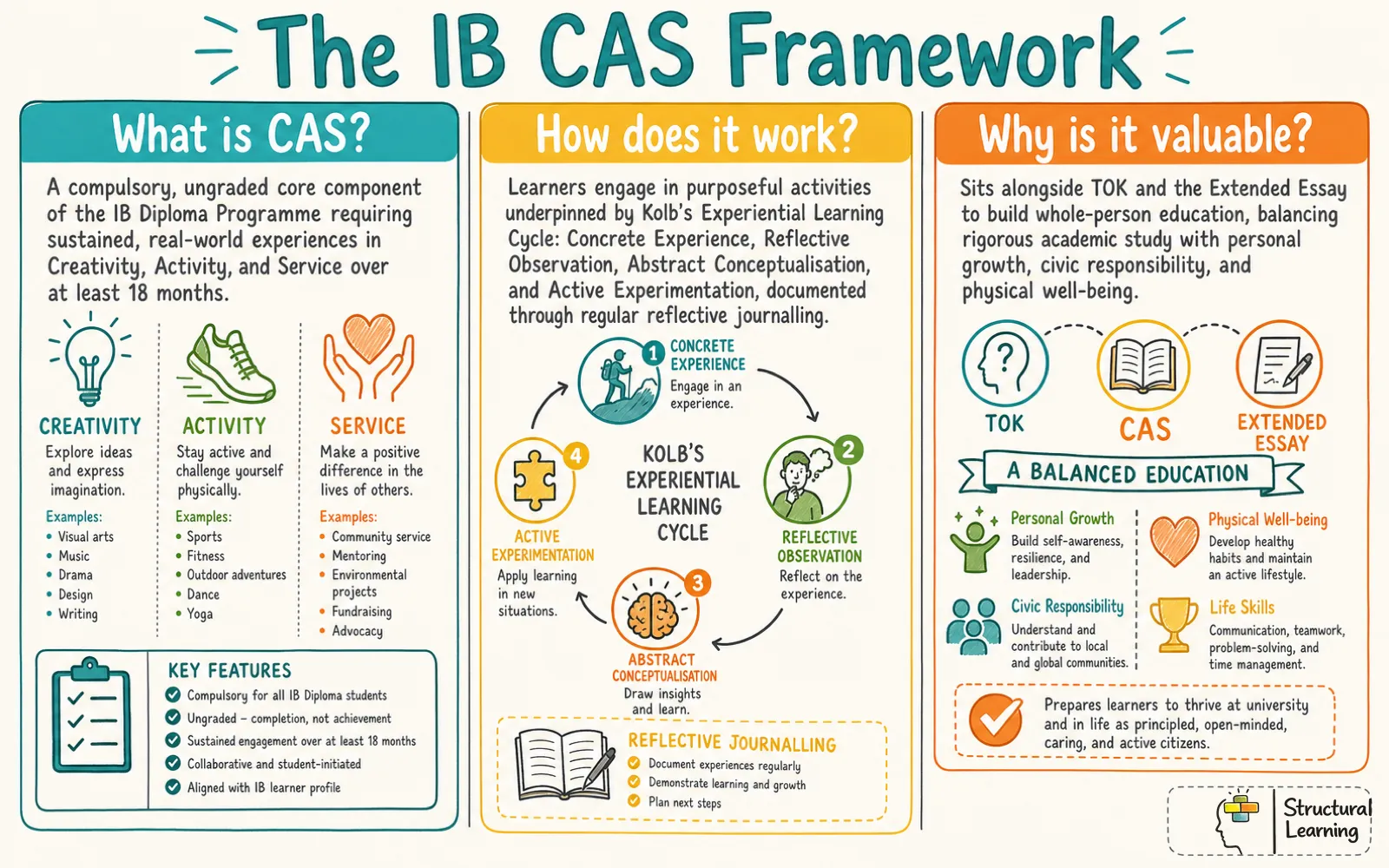
A CAS experience is a purposeful activity within one or more strands. The CAS project is different: it is a sustained, collaborative series of experiences in which learners show initiative, perseverance, planning and shared decision-making. It may address one, two or all three strands, and every learner completes at least one project. The 2017 programme guide recommends at least one month from planning to completion, while schools should confirm the controlled wording they currently use (International Baccalaureate, 2017).
Use the CAS project ideas page for adaptable examples, then keep the approval decision here. Learners should be able to explain the purpose, people affected, risks, roles, evidence and likely learning before a project begins. The meaningful CAS reflections guide supports the separate task of turning experience into evidence.
Good CAS planning starts with genuine interest. Ask learners what they care about outside school, what problems they notice in their community, and what skills they want to develop. The answers will generate better CAS projects than any list you provide. A learner passionate about environmental issues may design and run a school recycling scheme (Service), document it photographically (Creativity), and cycle to community meetings as part of their preparation (Activity).
The IB requires learners to demonstrate achievement in seven learning outcomes CAS coordinators can verify through evidence. These are not boxes to tick once but qualities to develop across the programme:
When learners plan experiences, encourage them to identify which LOs a given project will address before they begin. This is not about gaming the system: it is about designing richer experiences. A learner who plans a tutoring project and asks themselves "how will this develop LO6?" will think more broadly about the communities they serve than one who simply turns up and helps.
Scaffolding in education applies directly here. New Year 12 learners need more structure when planning their first CAS experiences. By Year 13, they should be planning independently. Gradually reducing the level of support you provide mirrors good pedagogy.
Investigation, preparation, action, reflection and demonstration give learners a practical route from an initial need or idea to evidence of learning. Use the stages recursively rather than as a one-pass checklist: new information, feedback or risk can send a team back to its plan.
Reflection helps learners interpret experiences and show what they learned. Schön's reflective-practice work can offer optional professional context, but it should not be described as an explicit IB foundation for CAS.
Learners who reflect well on their CAS activities develop the same capacity for self-directed improvement. Effective teachers use this capacity throughout their careers.
The seven outcomes cover strengths and growth, challenge and skills, initiative and planning, commitment, collaboration, global significance and the ethics of choices and actions. The table paraphrases them for planning. Coordinators and learners should use their current controlled CAS guide for the formal wording.
You can use Kolb's learning cycle as a lesson scaffold in Year 12 introduction sessions. Show learners a worked example of a reflection that moves through all four stages, then ask them to apply the same structure to a low-stakes recent experience such as a school trip or sports fixture. This builds the habit before CAS experiences begin in earnest.
A useful reflection selects one significant moment, explains the learner's response, analyses what changed and names a next action. Description alone records activity; it does not show the decision, evidence or learning that supports an outcome.
| Learning Outcome | What it looks like in practice |
|---|---|
| LO1: Strength and growth | Learner identifies personal strengths and areas for development through structured reflection |
| LO2: Challenge and skills | Learner takes on a new challenge and develops new skills as a result |
| LO3: Initiative and planning | Learner plans and initiates their own experience rather than following a script |
| LO4: Working collaboratively | Learner works with others, navigating different perspectives and responsibilities |
| LO5: Show perseverance | Learner continues through difficulty and documents the process honestly |
| LO6: Global engagement | Learner engages with global issues at a local level |
| LO7: Ethics of choices | Learner considers the ethical implications of their actions |
Reflections do not all need to be written. The IB accepts video diaries, audio recordings, photo essays, creative pieces and blogs; after 2020, teacher support materials made digital and virtual CAS experiences a lasting part of many schools' practice. This is also about access, because neurodivergent and SEN learners may show stronger metacognition through audio logs, images or interviews than through long prose. Encouraging multimodal reflection connects to metacognition in the classroom research: when learners choose the medium that suits them, self-monitoring improves.
CAS is not assessed with a grade or mark. Learners document experiences and reflect on their learning, while the school uses evidence of the seven learning outcomes and its local completion process. A supervisor may confirm participation or provide feedback when the school requires it, but supervision is not a universal assessment rule. The IB assessment guide explains why completion evidence should not be converted into points.
The current official IB CAS page provides a reliable public route to the programme requirements. Schools should use their current controlled CAS guide and local handbook for interview, platform and sign-off procedures rather than relying on an inaccessible older PDF.
The CAS portfolio is a collection of evidence and reflections showing engagement with CAS and achievement of the seven learning outcomes. Schools may use a digital platform or another system and can define suitable local evidence procedures.
In the generative AI era, a polished written journal is weak evidence on its own. Coordinators can triangulate a learner's account with time-stamped artefacts, supervisor comments, brief audio logs and live interviews. The metacognitive reflection guide provides prompts without prescribing one compulsory writing format.
Schools may use a platform such as ManageBac or another portfolio system. The IB does not prescribe a particular platform or a 48-hour reflection deadline; schools should agree a timely routine that supports authentic reflection and manageable evidence.
Good portfolio management depends on good habits built early. Research on self-regulation of learning shows that learners produce much better records when they set regular review dates. They also do better when they treat portfolio maintenance as a planned task, not a last-minute catch-up exercise. A fortnightly 20-minute portfolio session in the diary from September of Year 12 helps prevent panic over incomplete records in the final term.
Formative assessment strategies can be adapted for CAS check-ins. Brief conferences in which learners share one experience they are proud of and one they found difficult generate richer conversations than asking "how is your CAS going?" and often surface documentation gaps early enough to address them.
Research on service learning can inform local reflection and feedback routines, but it should not be presented as proof that one CAS documentation practice causes stronger civic engagement or personal growth.
Schools may appoint adults to confirm participation or provide feedback for particular experiences under local procedures. The CAS coordinator or adviser remains responsible for programme guidance and the school's completion process.
Where a supervisor is used, the school should explain the expected evidence, feedback and safeguarding procedures. Supervisors do not award a CAS grade, and the school should not imply that every experience requires the same sign-off process.
In practice, the supervisor relationship works best when it is clear from the start. Encourage learners to meet their supervisor before an experience begins. They should agree how they will communicate and confirm how feedback will be given. This sets expectations before the work starts.
When a school requires confirmation from a community organisation, learners should agree the process in advance rather than requesting evidence at the end of the programme.
When experiences are based in school, teachers often act as supervisors. This is suitable, but coordinators should watch for the risk of rubber-stamping.
A supervisor adds little value if they only confirm attendance and do not discuss the learner's experience. Give supervisors two or three open questions to ask at each meeting, so real dialogue can happen. Questions such as "What has surprised you about this experience?" or "What would you do differently if you started again?" prompt reflection and strengthen portfolio entries.
Approval is not only a learning-outcome check. Confirm adult responsibility, risk assessment, consent, travel, data protection, image use, financial handling and how the learner will leave or hand over the work safely. Service evidence must not expose personal information or turn community members into props for a portfolio.
Equitable CAS does not depend on overseas travel, expensive equipment or unpaid family transport. Offer school-based and local routes, make disability adjustments, accept suitable evidence formats and review whether timetable, caring or employment responsibilities restrict access. Schools familiar with MYP Service as Action should still teach the distinct DP CAS requirements explicitly.
The largest risk is not poor intent; it is performative CAS. Learners may choose experiences that look impressive rather than meet a real community need. Coordinators should design approval and reflection checks around need, reciprocity, responsible action and evidence of change, not hours or photographs.
Last-minute documentation is the most common problem. Learners can build up months of experience without writing a single reflection. They then try to rebuild everything from memory in the final term.
The result is thin, general entries that do not show genuine learning. The solution is a planned documentation routine from the start of Year 12. Some coordinators use a simple rule: no new experiences may be started if the previous experience has no reflection on file.
Superficial reflection is the second common issue. Learners describe what happened but do not analyse a decision, result or change. Ask for one significant moment, the evidence considered, what the learner now understands and what they will do next.
Strand imbalance occurs when learners pursue Activity at the expense of Service, often because sport is already part of school life. Coordinators should audit strand distribution at the midpoint of Year 12 and flag learners who have no Service evidence at all. Early intervention is far more productive than late-stage scrambling.
Participation without planning, community dialogue or reflection may provide weak evidence for the intended learning outcomes. Help learners move beyond recording attendance by identifying the need, agreeing a role, reviewing the effect of the work and explaining what they learned.

If you are introducing CAS to a new Year 12 cohort, start with a 40-minute session in which learners identify one thing they are already doing outside school that could become a CAS experience. Most learners are already involved in sport, music, volunteering, or creative projects without framing these activities as part of their education. Recognising existing strengths reduces the anxiety many learners feel when CAS first appears on the timetable.
For learners already partway through the programme, use a brief self-audit: ask them to list their experiences in each strand, count the Learning Outcomes they have addressed, and identify any gaps. A visual table works well for this. Learners who can see their own pattern often self-correct without requiring additional instruction.
For supervisors and senior leaders, a 20-minute briefing can explain what you need. This includes specific feedback, honest comments on learner engagement and timely replies to documentation requests. In UK schools, you can map this evidence to Ofsted's Personal Development judgement.
Service, leadership, healthy routines and ethical reflection are already part of CAS. The task is to keep credible evidence without turning the programme into inspection paperwork. Most supervisors are willing to help, but they need to know what good support looks like. Giving them two or three model questions to ask learners will improve feedback across the school.
Use the experiential learning framework to plan your first whole-cohort CAS introduction. Structure the session so learners experience a mini version of the cycle: do a short activity, reflect on it, draw a principle from the reflection, then plan how they would apply that principle in a real CAS context. This models the process learners will use throughout the programme.
Critical thinking develops naturally in a well-run CAS programme. Learners plan, implement, evaluate, and revise their own experiences. In doing so, they practise the iterative reasoning that supports academic work across all Diploma subjects. When teachers make this link clear in conversation, learners are more likely to see CAS as an asset rather than an obligation.
CAS can become performative when visible activity, travel or polished portfolios matter more than community need and learning. Schools should ask who defined the need, whose voice shaped the plan, what changed and whether the relationship was reciprocal. A completed event or attractive portfolio is not evidence of benefit on its own.
The IB-commissioned CAS impact study gathered responses from 7,973 learners, 490 coordinators and 903 alumni. Participants associated successful CAS with meaningful, enjoyable activity and goal-setting, but this is perception evidence rather than proof that every CAS programme causes the same outcomes (Hayden et al., 2017).
Long-term causal evidence remains limited, so schools should not promise that CAS produces the same personal or civic outcome for every learner. Generative AI also makes a polished written journal insufficient evidence on its own. Combine conversations, artefacts, supervisor feedback and multimodal records under proportionate local procedures.
International Baccalaureate. (2026). Creativity, activity, service.
International Baccalaureate. (2017). Creativity, activity, service guide.
Hayden, M., Hemmens, A., McIntosh, S., Sandoval-Hernandez, A., and Thompson, J. (2017). The impact of creativity, action, service on students and communities. International Baccalaureate.