Updated on
March 7, 2026
Speech and Language in Schools: Assessment, Intervention and Classroom Strategies
|
March 7, 2026
Speech, language and communication needs (SLCN) affect approximately one in ten children in the UK. That is two or three pupils in every classroom. Despite being one of the most prevalent forms of special educational needs, SLCN is routinely underidentified. Children who struggle to process verbal instructions may be seen as inattentive. Those who cannot find words for their feelings may be labelled as defiant. Teachers who understand the landscape of SLCN can make a significant difference, often without specialist resources or additional time.
This guide covers the main categories of SLCN, how to spot difficulties at different ages, how to work effectively with speech and language therapists (SaLTs), and the everyday strategies that support language development across every subject.
SLCN is an umbrella term covering a wide range of difficulties with speaking, listening, understanding, and using language. The term is used in the SEND Code of Practice and captures everything from a mild stammer to a severe and complex communication disorder. Not every child with SLCN has the same profile, and two children with the same diagnosis can present very differently in the classroom.
It helps to think in three broad areas. Speech difficulties involve problems with producing sounds clearly, such as substituting one sound for another or leaving sounds off the ends of words. Language difficulties involve problems with understanding or using vocabulary, grammar, and sentence structure. Communication difficulties involve challenges with the social use of language, such as taking turns in conversation, reading non-verbal cues, or adapting speech to different contexts.
These areas overlap. A child with expressive language difficulties may also struggle with speech sounds. A child with autism may have good vocabulary but significant difficulty with communication. Understanding which area is affected guides both referral and classroom support.
| Type of SLCN | Key Features | Age of Concern | Classroom Indicators |
|---|---|---|---|
| Speech sound difficulties | Substitutions, omissions, or distortions of sounds; may be hard to understand | Most sounds in place by age 6–7; persistent errors beyond this warrant referral | Peers and adults struggle to understand; child avoids reading aloud; reluctant to speak in class |
| Receptive language disorder | Difficulty understanding spoken language, following multi-step instructions, or processing verbal information | From pre-school; often missed because children copy peers or follow routine cues | Blank looks after instructions; starts task incorrectly; asks peers what to do; seems 'switched off' |
| Expressive language disorder | Difficulty using vocabulary, forming sentences, organising ideas in speech or writing | Noticeable from nursery; often persists into secondary school | Short, simple sentences; wrong word choices; struggles to retell events in order; avoids verbal contributions |
| Developmental Language Disorder (DLD) | Persistent difficulty with language that is not explained by another condition; affects receptive and/or expressive language | Diagnosis typically from age 5; affects approximately 7% of children | Underperforms on written tasks relative to apparent ability; poor reading comprehension; difficulty with complex instructions |
| Pragmatic language difficulties | Difficulty using language in social contexts: turn-taking, topic maintenance, interpreting figurative language | Often identified in early years; frequently co-occurs with autism | Interrupts conversations; takes idioms literally; misreads social cues; talks at length on preferred topics without checking audience |
SLCN looks different across the age range, which is one reason it is missed. A Reception child who cannot put two words together is obviously concerning. A Year 9 pupil who avoids group discussion, submits short written answers, and appears disengaged is less obviously a child with a language disorder. Yet the root cause may be the same: the pupil cannot process or produce language at the speed the curriculum demands.
In the early years, watch for children who do not follow simple instructions without visual cues, who use very limited vocabulary compared to peers, or whose speech is difficult to understand by age four. Children who find it hard to listen to a short story, answer simple questions about it, or join in songs and rhymes may be showing early signs of SLCN. These are not signs of low ability; they are signs that language development has been disrupted or delayed.
By Key Stage 1, red flags include persistent difficulty blending sounds in phonics, inability to retell a simple sequence of events, very short answers to open questions, and frequent misunderstandings of classroom instructions. A child who consistently starts an activity differently from the rest of the class is worth watching; they may be following visual cues from peers rather than processing the verbal instruction.
At Key Stage 2, the language demands of the curriculum increase sharply. Reading comprehension requires inference and vocabulary knowledge. Maths problems require reading and interpreting multi-step verbal instructions. Science and history require subject-specific vocabulary and the ability to explain reasoning. A child with SLCN who coped in Key Stage 1 may begin to struggle noticeably as these demands mount.
Look for pupils who read fluently but show poor comprehension, who can calculate but cannot explain their method, or who write very little despite having ideas. Children who become avoidant, frustrated, or disruptive during language-heavy tasks may be experiencing cognitive overload from the effort of processing language. Working memory difficulties often co-occur with SLCN and amplify these effects.
Secondary school teachers rarely receive SLCN training, yet they are often the first adults to notice that a pupil is struggling in ways that do not fit a simple explanation. A Year 8 pupil who consistently misinterprets examination questions, who struggles to follow teacher explanations in fast-paced lessons, or who gives monosyllabic answers in discussion may have an unidentified language disorder. Norbury et al. (2016) found that language disorder affects approximately 7.6% of children starting school, many of whom receive no formal identification or support.
If you are concerned about a secondary-age pupil, look at their primary school records. SLCN identified in Year 2 that was 'resolved' often re-emerges under increased academic pressure. Sharing concerns with the SENCO promptly is the right course of action at any key stage.
Speech and language therapists (SaLTs) are the specialists who assess, diagnose, and provide therapy for SLCN. In most schools, SaLT support is commissioned through the local authority or NHS and delivered in blocks. Waiting lists can be long; in many areas, children wait six to twelve months for an initial assessment. This makes it even more important that teachers can provide effective support while a pupil waits.
The most effective school-SaLT relationships are collaborative. When a SaLT works with your school, ask for a short briefing on each child's targets and how to reinforce them in class. SaLTs can provide word banks, visual supports, sentence frames, and communication passports that make classroom support more precise. A communication passport is a one-page document describing how a child communicates, what helps, and what does not. It is particularly useful for pupils with complex needs who work with several adults.
If you refer a pupil to SENCO for SaLT assessment, provide specific observations rather than general concerns. 'Jamie struggles to answer questions in class' is less useful than 'Jamie consistently starts activities differently from the group after verbal-only instructions, gives one-word answers to open questions, and has never volunteered a verbal response in six weeks of Year 5.' Specificity helps the SaLT triage appropriately and supports the referral pathway through the SEND Code of Practice.
After a pupil receives a SaLT report, read the recommendations section carefully. Many reports include classroom strategies that require no specialist equipment: extending wait time, repeating instructions using different words, or checking comprehension by asking the pupil to show rather than tell. These are the adjustments that close the gap between therapy sessions.
Most effective strategies for SLCN pupils do not require additional resources. They require deliberate adjustments to how you communicate and structure learning. The strategies below work across subjects and age groups, and most benefit all pupils in the class, not only those with identified needs.
Children with SLCN typically need longer to process spoken language and formulate a response. Counting silently to ten after asking a question before accepting answers gives these pupils a realistic chance of participating. This is sometimes called 'wait time' and the research on it is consistent: extending wait time improves the quality of responses from all pupils, not just those with SLCN.
In practice, try this: ask a question, count to ten in your head, then take a show of hands or use cold-calling. You will notice that more pupils have something to say. For pupils with significant processing difficulties, tell them the question thirty seconds before you expect an answer. 'Faiza, I am going to ask you about the water cycle in a moment. Think about what happens after evaporation.' This removes the double cognitive demand of processing the question and formulating a response simultaneously.
Long, multi-part verbal instructions place a heavy burden on working memory. A child with SLCN may catch the first instruction and miss everything that follows. Keep instructions short and sequential: say one thing, check it is understood, then say the next thing. Avoid embedding instructions in explanatory talk ('Before you start, and this is important, make sure you have read the passage on page 34, not page 33, which is last week's, and then answer questions one to five'). Separate the instruction from the explanation.
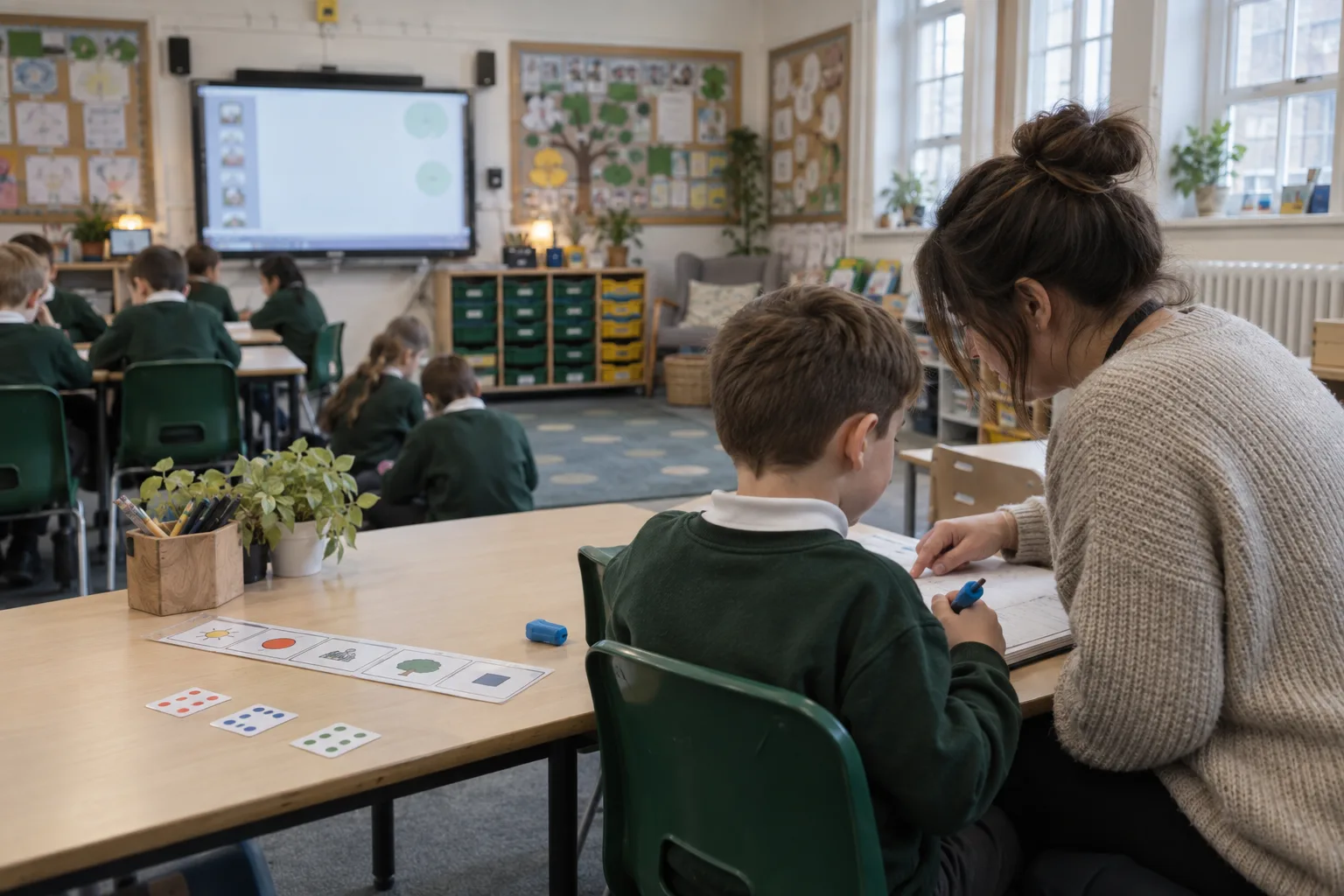
Use visual support alongside verbal instructions wherever possible. Writing the steps on the board, displaying a numbered task list, or showing a physical example reduces the reliance on verbal working memory. This is a form of cognitive load management that benefits pupils with SLCN significantly. After giving instructions verbally, ask a pupil to repeat them back in their own words. This checks comprehension without singling anyone out if you make it a class routine.
Vocabulary is the building block of comprehension. Pupils with SLCN often have smaller vocabularies than their peers, which compounds over time as reading and classroom exposure fail to close the gap. Pre-teaching five to eight key words before a lesson gives these pupils the vocabulary they need to access the content. This does not mean a word list; it means encountering the word in context, hearing it used, seeing it defined, and having an opportunity to use it themselves before the lesson begins.
In a Year 6 science lesson on adaptation, a ten-minute vocabulary warm-up using word cards, images, and a matching activity would pre-teach 'camouflage', 'predator', 'habitat', and 'characteristic' before the main input. The SaLT or teaching assistant can run this warm-up with targeted pupils. Scaffolding at the vocabulary level is one of the highest-leverage adjustments for SLCN pupils.
The type of question you ask has a significant effect on how accessible it is for a pupil with SLCN. Closed questions ('Is this a mammal, yes or no?') are the most accessible; open questions ('Tell me about mammals') are the most demanding. Between these lie forced-choice questions ('Is a whale a mammal or a fish?') and cued questions ('What do mammals do that reptiles don't, think about temperature?'). Using a range of question types, and matching the question type to the pupil's language level, is a form of differentiation that costs nothing.
Avoid 'why' questions with pupils who have expressive language difficulties. 'Why' requires the speaker to formulate a causal explanation, which is linguistically complex. Replace 'Why did the character feel sad?' with 'What happened just before the character felt sad?' This gives the pupil a retrieval task rather than a construction task and is often more revealing of actual comprehension. These questioning strategies can be built into lesson planning as a standard consideration.
A language-rich classroom is one in which talk is structured, purposeful, and supported. This goes beyond displays of vocabulary on walls. It means creating regular, low-stakes opportunities for pupils to use language in varied contexts: pair talk, structured discussion, role play, storytelling, and oral rehearsal before writing. The importance of oracy in this context is well-established; spoken language is the foundation on which reading and writing are built.
Structured talk activities are particularly valuable for SLCN pupils. 'Talk partners' with a clear prompt ('Tell your partner one thing you already know about photosynthesis') gives every pupil a manageable oral task with a defined scope. Sentence frames ('I think... because...', 'One difference between... and... is...') reduce the expressive load by providing a grammatical scaffold. Display these frames on the board during discussion tasks and expect all pupils to use them, so that SLCN pupils are not singled out.
Consider the acoustic environment too. A noisy classroom is significantly harder to process for children with SLCN. Background noise raises the cognitive effort required to parse speech and can make the difference between a pupil following an instruction and missing it entirely. Carpet in the classroom, soft furnishings, and reducing unnecessary ambient noise are adjustments that cost little but make the auditory environment more accessible. For pupils with significant auditory processing difficulties, seating near the front and away from noise sources is a straightforward adjustment.
Labelling routines and transitions also builds language. Consistently naming what is happening ('We are now moving from reading to maths. Put your book away and get out your ruler') supports the language development of pupils who rely on predictable language-action pairings. This supports secure routines that reduce anxiety and free up cognitive capacity for learning.
SLCN is explicitly listed as one of the four broad areas of need in the SEND Code of Practice (2015). Under the Code, schools have a duty to identify, assess, and support pupils with SLCN using a graduated approach: assess, plan, do, review. This cycle applies whether the pupil has an Education, Health and Care (EHC) plan or is receiving SEN support at the school's own level of provision.
In practice, this means that if you identify a pupil you believe has SLCN, you should raise the concern with your SENCO. The SENCO will coordinate an initial assessment, which may involve observation, a checklist such as the Communication Trust's 'What to Look For' resources, or referral to a SaLT for a formal assessment. You do not need a diagnosis to begin in-class support. The Code is clear that schools should not wait for a formal diagnosis before putting adjustments in place.
For pupils with an EHC plan that names speech and language as an area of need, the plan will specify provision, including the type and frequency of SaLT input. Your role is to implement the strategies described in the plan and contribute to the annual review by providing accurate evidence of what is and is not working in the classroom. Formative assessment approaches, adapted for verbal and non-verbal responses, provide the kind of ongoing evidence that is most useful for annual reviews.
Law et al. (2017) found that children from socio-economically disadvantaged backgrounds are disproportionately affected by language delay and disorder, and that early intervention produces the strongest outcomes. This underscores why class teachers, who are the first line of identification, carry such responsibility in the referral process.
Developmental Language Disorder (DLD) is a specific condition within the broader category of SLCN. It is defined as a persistent difficulty with language that is not explained by another condition such as hearing loss, autism, or intellectual disability, and that has a significant impact on everyday life. Approximately 7% of children have DLD, making it more common than autism, yet far less well-known among teachers and the wider public.
The CATALISE project, a major international consensus study led by Bishop et al. (2017), established agreed criteria for DLD and clarified the terminology. The adoption of 'Developmental Language Disorder' as the standard term is relatively recent; older reports may use 'specific language impairment' (SLI) or 'language learning difficulty.' If you see these terms in a pupil's file, they are likely referring to a similar profile.
DLD affects both receptive and expressive language, though the balance varies between individuals. A pupil with DLD may have particular difficulty with complex grammar, narrative organisation, and word retrieval. In secondary school, this manifests as difficulty with extended writing, poor performance on reading comprehension under timed conditions, and struggles with subject-specific vocabulary across all areas. Executive function difficulties, including planning, working memory, and cognitive flexibility, frequently co-occur with DLD and compound the academic impact.
Snowling et al. (2016) followed children with language impairments and found that even those whose language difficulties appeared to resolve in early childhood showed ongoing vulnerabilities in literacy at age eight. This means a pupil whose SLCN was noted in Reception and seemingly resolved should not be assumed to have 'caught up.' Their reading comprehension and writing may still be affected, and they may need continued support through primary school.
DLD is a lifelong condition that does not go away with therapy, though targeted support can significantly improve outcomes and independence. In the classroom, adjustments for DLD overlap substantially with those described above: processing time, simplified instructions, visual supports, structured talk, and vocabulary teaching. What is different is the need for consistency. A pupil with DLD benefits from the same strategies being applied across all lessons and by all staff, rather than receiving good support in one classroom and none in another. Briefing colleagues at transition points is one of the most useful things a SENCO or class teacher can do for a pupil with DLD.
For pupils with autism, the picture is more complex. Some autistic pupils have strong language skills but significant pragmatic difficulties. Others have both DLD and autism. The key is to assess the individual pupil's profile rather than applying assumptions based on a single label. A SaLT report will always be the most reliable guide to which specific language areas need support.

Speech, language and communication needs (SLCN) affect approximately one in ten children in the UK. That is two or three pupils in every classroom. Despite being one of the most prevalent forms of special educational needs, SLCN is routinely underidentified. Children who struggle to process verbal instructions may be seen as inattentive. Those who cannot find words for their feelings may be labelled as defiant. Teachers who understand the landscape of SLCN can make a significant difference, often without specialist resources or additional time.
This guide covers the main categories of SLCN, how to spot difficulties at different ages, how to work effectively with speech and language therapists (SaLTs), and the everyday strategies that support language development across every subject.
SLCN is an umbrella term covering a wide range of difficulties with speaking, listening, understanding, and using language. The term is used in the SEND Code of Practice and captures everything from a mild stammer to a severe and complex communication disorder. Not every child with SLCN has the same profile, and two children with the same diagnosis can present very differently in the classroom.
It helps to think in three broad areas. Speech difficulties involve problems with producing sounds clearly, such as substituting one sound for another or leaving sounds off the ends of words. Language difficulties involve problems with understanding or using vocabulary, grammar, and sentence structure. Communication difficulties involve challenges with the social use of language, such as taking turns in conversation, reading non-verbal cues, or adapting speech to different contexts.
These areas overlap. A child with expressive language difficulties may also struggle with speech sounds. A child with autism may have good vocabulary but significant difficulty with communication. Understanding which area is affected guides both referral and classroom support.
| Type of SLCN | Key Features | Age of Concern | Classroom Indicators |
|---|---|---|---|
| Speech sound difficulties | Substitutions, omissions, or distortions of sounds; may be hard to understand | Most sounds in place by age 6–7; persistent errors beyond this warrant referral | Peers and adults struggle to understand; child avoids reading aloud; reluctant to speak in class |
| Receptive language disorder | Difficulty understanding spoken language, following multi-step instructions, or processing verbal information | From pre-school; often missed because children copy peers or follow routine cues | Blank looks after instructions; starts task incorrectly; asks peers what to do; seems 'switched off' |
| Expressive language disorder | Difficulty using vocabulary, forming sentences, organising ideas in speech or writing | Noticeable from nursery; often persists into secondary school | Short, simple sentences; wrong word choices; struggles to retell events in order; avoids verbal contributions |
| Developmental Language Disorder (DLD) | Persistent difficulty with language that is not explained by another condition; affects receptive and/or expressive language | Diagnosis typically from age 5; affects approximately 7% of children | Underperforms on written tasks relative to apparent ability; poor reading comprehension; difficulty with complex instructions |
| Pragmatic language difficulties | Difficulty using language in social contexts: turn-taking, topic maintenance, interpreting figurative language | Often identified in early years; frequently co-occurs with autism | Interrupts conversations; takes idioms literally; misreads social cues; talks at length on preferred topics without checking audience |
SLCN looks different across the age range, which is one reason it is missed. A Reception child who cannot put two words together is obviously concerning. A Year 9 pupil who avoids group discussion, submits short written answers, and appears disengaged is less obviously a child with a language disorder. Yet the root cause may be the same: the pupil cannot process or produce language at the speed the curriculum demands.
In the early years, watch for children who do not follow simple instructions without visual cues, who use very limited vocabulary compared to peers, or whose speech is difficult to understand by age four. Children who find it hard to listen to a short story, answer simple questions about it, or join in songs and rhymes may be showing early signs of SLCN. These are not signs of low ability; they are signs that language development has been disrupted or delayed.
By Key Stage 1, red flags include persistent difficulty blending sounds in phonics, inability to retell a simple sequence of events, very short answers to open questions, and frequent misunderstandings of classroom instructions. A child who consistently starts an activity differently from the rest of the class is worth watching; they may be following visual cues from peers rather than processing the verbal instruction.
At Key Stage 2, the language demands of the curriculum increase sharply. Reading comprehension requires inference and vocabulary knowledge. Maths problems require reading and interpreting multi-step verbal instructions. Science and history require subject-specific vocabulary and the ability to explain reasoning. A child with SLCN who coped in Key Stage 1 may begin to struggle noticeably as these demands mount.
Look for pupils who read fluently but show poor comprehension, who can calculate but cannot explain their method, or who write very little despite having ideas. Children who become avoidant, frustrated, or disruptive during language-heavy tasks may be experiencing cognitive overload from the effort of processing language. Working memory difficulties often co-occur with SLCN and amplify these effects.
Secondary school teachers rarely receive SLCN training, yet they are often the first adults to notice that a pupil is struggling in ways that do not fit a simple explanation. A Year 8 pupil who consistently misinterprets examination questions, who struggles to follow teacher explanations in fast-paced lessons, or who gives monosyllabic answers in discussion may have an unidentified language disorder. Norbury et al. (2016) found that language disorder affects approximately 7.6% of children starting school, many of whom receive no formal identification or support.
If you are concerned about a secondary-age pupil, look at their primary school records. SLCN identified in Year 2 that was 'resolved' often re-emerges under increased academic pressure. Sharing concerns with the SENCO promptly is the right course of action at any key stage.
Speech and language therapists (SaLTs) are the specialists who assess, diagnose, and provide therapy for SLCN. In most schools, SaLT support is commissioned through the local authority or NHS and delivered in blocks. Waiting lists can be long; in many areas, children wait six to twelve months for an initial assessment. This makes it even more important that teachers can provide effective support while a pupil waits.
The most effective school-SaLT relationships are collaborative. When a SaLT works with your school, ask for a short briefing on each child's targets and how to reinforce them in class. SaLTs can provide word banks, visual supports, sentence frames, and communication passports that make classroom support more precise. A communication passport is a one-page document describing how a child communicates, what helps, and what does not. It is particularly useful for pupils with complex needs who work with several adults.
If you refer a pupil to SENCO for SaLT assessment, provide specific observations rather than general concerns. 'Jamie struggles to answer questions in class' is less useful than 'Jamie consistently starts activities differently from the group after verbal-only instructions, gives one-word answers to open questions, and has never volunteered a verbal response in six weeks of Year 5.' Specificity helps the SaLT triage appropriately and supports the referral pathway through the SEND Code of Practice.
After a pupil receives a SaLT report, read the recommendations section carefully. Many reports include classroom strategies that require no specialist equipment: extending wait time, repeating instructions using different words, or checking comprehension by asking the pupil to show rather than tell. These are the adjustments that close the gap between therapy sessions.
Most effective strategies for SLCN pupils do not require additional resources. They require deliberate adjustments to how you communicate and structure learning. The strategies below work across subjects and age groups, and most benefit all pupils in the class, not only those with identified needs.
Children with SLCN typically need longer to process spoken language and formulate a response. Counting silently to ten after asking a question before accepting answers gives these pupils a realistic chance of participating. This is sometimes called 'wait time' and the research on it is consistent: extending wait time improves the quality of responses from all pupils, not just those with SLCN.
In practice, try this: ask a question, count to ten in your head, then take a show of hands or use cold-calling. You will notice that more pupils have something to say. For pupils with significant processing difficulties, tell them the question thirty seconds before you expect an answer. 'Faiza, I am going to ask you about the water cycle in a moment. Think about what happens after evaporation.' This removes the double cognitive demand of processing the question and formulating a response simultaneously.
Long, multi-part verbal instructions place a heavy burden on working memory. A child with SLCN may catch the first instruction and miss everything that follows. Keep instructions short and sequential: say one thing, check it is understood, then say the next thing. Avoid embedding instructions in explanatory talk ('Before you start, and this is important, make sure you have read the passage on page 34, not page 33, which is last week's, and then answer questions one to five'). Separate the instruction from the explanation.
Use visual support alongside verbal instructions wherever possible. Writing the steps on the board, displaying a numbered task list, or showing a physical example reduces the reliance on verbal working memory. This is a form of cognitive load management that benefits pupils with SLCN significantly. After giving instructions verbally, ask a pupil to repeat them back in their own words. This checks comprehension without singling anyone out if you make it a class routine.
Vocabulary is the building block of comprehension. Pupils with SLCN often have smaller vocabularies than their peers, which compounds over time as reading and classroom exposure fail to close the gap. Pre-teaching five to eight key words before a lesson gives these pupils the vocabulary they need to access the content. This does not mean a word list; it means encountering the word in context, hearing it used, seeing it defined, and having an opportunity to use it themselves before the lesson begins.
In a Year 6 science lesson on adaptation, a ten-minute vocabulary warm-up using word cards, images, and a matching activity would pre-teach 'camouflage', 'predator', 'habitat', and 'characteristic' before the main input. The SaLT or teaching assistant can run this warm-up with targeted pupils. Scaffolding at the vocabulary level is one of the highest-leverage adjustments for SLCN pupils.
The type of question you ask has a significant effect on how accessible it is for a pupil with SLCN. Closed questions ('Is this a mammal, yes or no?') are the most accessible; open questions ('Tell me about mammals') are the most demanding. Between these lie forced-choice questions ('Is a whale a mammal or a fish?') and cued questions ('What do mammals do that reptiles don't, think about temperature?'). Using a range of question types, and matching the question type to the pupil's language level, is a form of differentiation that costs nothing.
Avoid 'why' questions with pupils who have expressive language difficulties. 'Why' requires the speaker to formulate a causal explanation, which is linguistically complex. Replace 'Why did the character feel sad?' with 'What happened just before the character felt sad?' This gives the pupil a retrieval task rather than a construction task and is often more revealing of actual comprehension. These questioning strategies can be built into lesson planning as a standard consideration.
A language-rich classroom is one in which talk is structured, purposeful, and supported. This goes beyond displays of vocabulary on walls. It means creating regular, low-stakes opportunities for pupils to use language in varied contexts: pair talk, structured discussion, role play, storytelling, and oral rehearsal before writing. The importance of oracy in this context is well-established; spoken language is the foundation on which reading and writing are built.
Structured talk activities are particularly valuable for SLCN pupils. 'Talk partners' with a clear prompt ('Tell your partner one thing you already know about photosynthesis') gives every pupil a manageable oral task with a defined scope. Sentence frames ('I think... because...', 'One difference between... and... is...') reduce the expressive load by providing a grammatical scaffold. Display these frames on the board during discussion tasks and expect all pupils to use them, so that SLCN pupils are not singled out.
Consider the acoustic environment too. A noisy classroom is significantly harder to process for children with SLCN. Background noise raises the cognitive effort required to parse speech and can make the difference between a pupil following an instruction and missing it entirely. Carpet in the classroom, soft furnishings, and reducing unnecessary ambient noise are adjustments that cost little but make the auditory environment more accessible. For pupils with significant auditory processing difficulties, seating near the front and away from noise sources is a straightforward adjustment.
Labelling routines and transitions also builds language. Consistently naming what is happening ('We are now moving from reading to maths. Put your book away and get out your ruler') supports the language development of pupils who rely on predictable language-action pairings. This supports secure routines that reduce anxiety and free up cognitive capacity for learning.
SLCN is explicitly listed as one of the four broad areas of need in the SEND Code of Practice (2015). Under the Code, schools have a duty to identify, assess, and support pupils with SLCN using a graduated approach: assess, plan, do, review. This cycle applies whether the pupil has an Education, Health and Care (EHC) plan or is receiving SEN support at the school's own level of provision.
In practice, this means that if you identify a pupil you believe has SLCN, you should raise the concern with your SENCO. The SENCO will coordinate an initial assessment, which may involve observation, a checklist such as the Communication Trust's 'What to Look For' resources, or referral to a SaLT for a formal assessment. You do not need a diagnosis to begin in-class support. The Code is clear that schools should not wait for a formal diagnosis before putting adjustments in place.
For pupils with an EHC plan that names speech and language as an area of need, the plan will specify provision, including the type and frequency of SaLT input. Your role is to implement the strategies described in the plan and contribute to the annual review by providing accurate evidence of what is and is not working in the classroom. Formative assessment approaches, adapted for verbal and non-verbal responses, provide the kind of ongoing evidence that is most useful for annual reviews.
Law et al. (2017) found that children from socio-economically disadvantaged backgrounds are disproportionately affected by language delay and disorder, and that early intervention produces the strongest outcomes. This underscores why class teachers, who are the first line of identification, carry such responsibility in the referral process.
Developmental Language Disorder (DLD) is a specific condition within the broader category of SLCN. It is defined as a persistent difficulty with language that is not explained by another condition such as hearing loss, autism, or intellectual disability, and that has a significant impact on everyday life. Approximately 7% of children have DLD, making it more common than autism, yet far less well-known among teachers and the wider public.
The CATALISE project, a major international consensus study led by Bishop et al. (2017), established agreed criteria for DLD and clarified the terminology. The adoption of 'Developmental Language Disorder' as the standard term is relatively recent; older reports may use 'specific language impairment' (SLI) or 'language learning difficulty.' If you see these terms in a pupil's file, they are likely referring to a similar profile.
DLD affects both receptive and expressive language, though the balance varies between individuals. A pupil with DLD may have particular difficulty with complex grammar, narrative organisation, and word retrieval. In secondary school, this manifests as difficulty with extended writing, poor performance on reading comprehension under timed conditions, and struggles with subject-specific vocabulary across all areas. Executive function difficulties, including planning, working memory, and cognitive flexibility, frequently co-occur with DLD and compound the academic impact.
Snowling et al. (2016) followed children with language impairments and found that even those whose language difficulties appeared to resolve in early childhood showed ongoing vulnerabilities in literacy at age eight. This means a pupil whose SLCN was noted in Reception and seemingly resolved should not be assumed to have 'caught up.' Their reading comprehension and writing may still be affected, and they may need continued support through primary school.
DLD is a lifelong condition that does not go away with therapy, though targeted support can significantly improve outcomes and independence. In the classroom, adjustments for DLD overlap substantially with those described above: processing time, simplified instructions, visual supports, structured talk, and vocabulary teaching. What is different is the need for consistency. A pupil with DLD benefits from the same strategies being applied across all lessons and by all staff, rather than receiving good support in one classroom and none in another. Briefing colleagues at transition points is one of the most useful things a SENCO or class teacher can do for a pupil with DLD.
For pupils with autism, the picture is more complex. Some autistic pupils have strong language skills but significant pragmatic difficulties. Others have both DLD and autism. The key is to assess the individual pupil's profile rather than applying assumptions based on a single label. A SaLT report will always be the most reliable guide to which specific language areas need support.