Teacher burnout prevention requires more than generic self-care. Discover how pedagogical efficiency, modular planning, and visible thinking reduce teacher workload.
Teacher burnout is primarily driven by decision fatigue and unsustainable systems, rather than just physical tiredness.
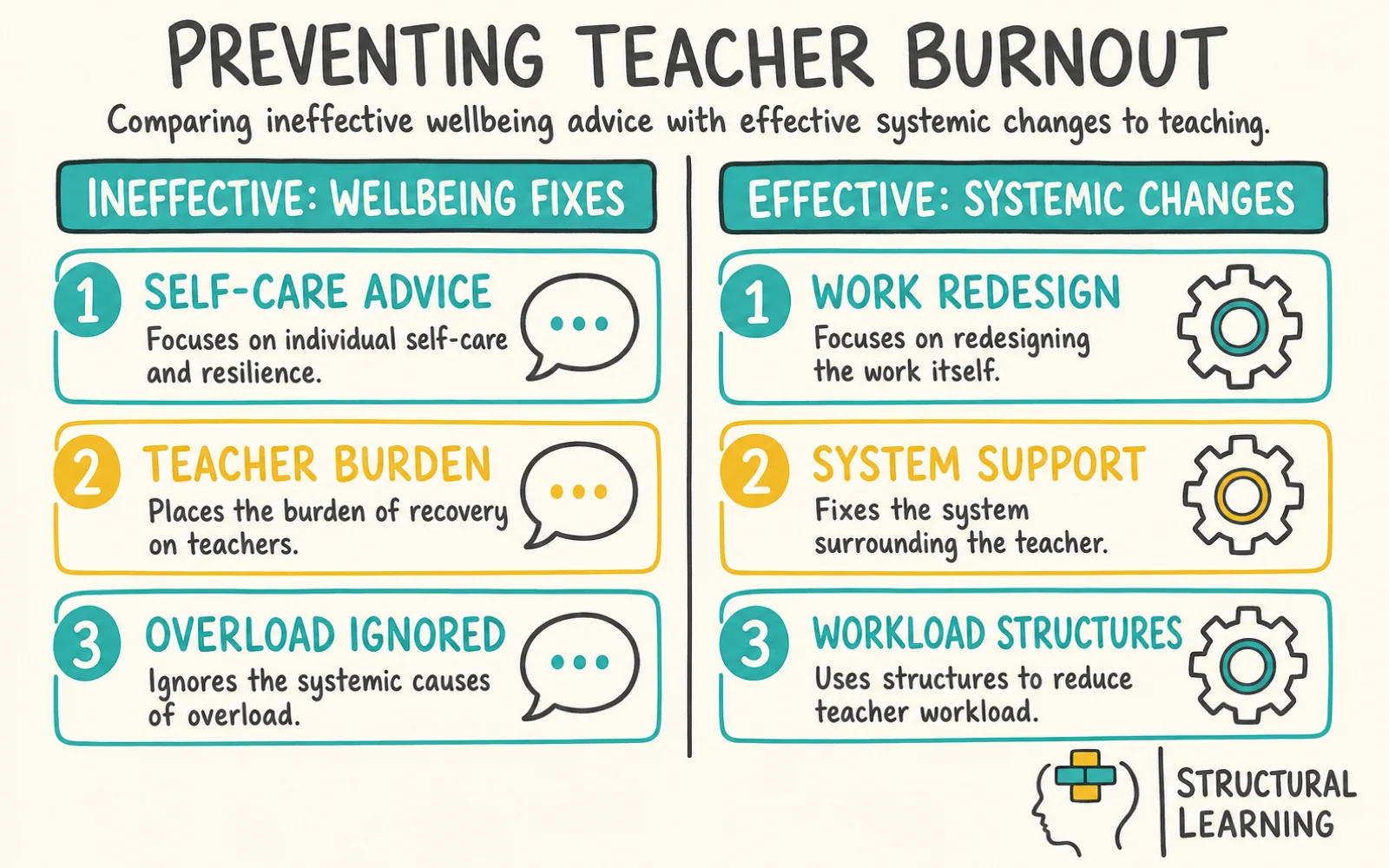
Generic self-care advice fails because it ignores the core mechanics of the classroom and the heavy cognitive load of unstructured lesson planning.
Pedagogical efficiency focuses on shifting the cognitive heavy lifting from the teacher to the learner using predictable instructional frameworks.
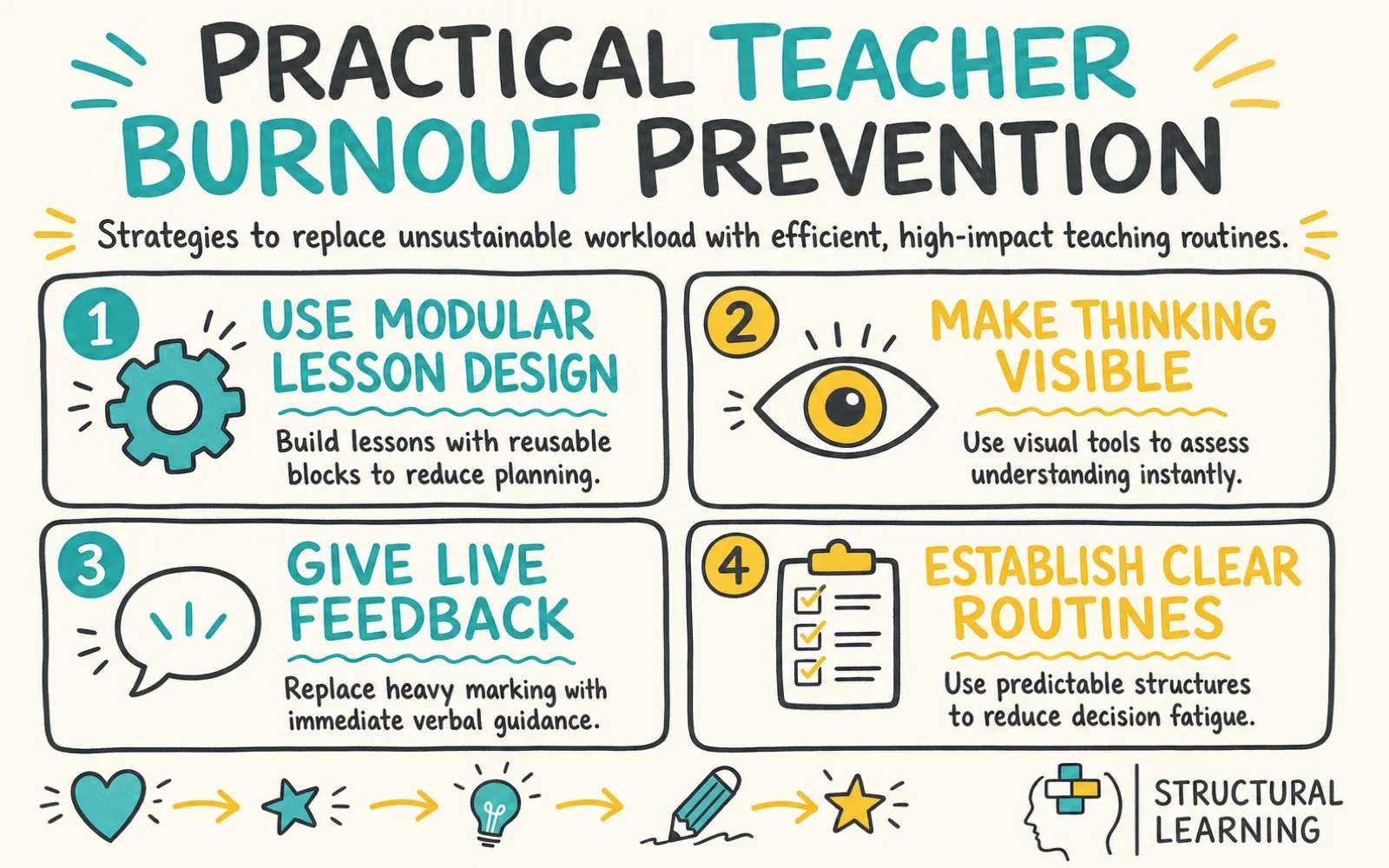
Modular lesson design uses reusable instructional blocks to drastically reduce planning time while maintaining high academic standards.
Making thinking visible allows teachers to assess learner understanding instantly, eliminating the need to take piles of books home for retrospective marking.
Live feedback models replace exhausting written marking with immediate, actionable verbal guidance during the lesson.
Establishing structural boundaries around planning and assessment is more effective than relying on individual willpower to leave work early.
What Is Teacher Burnout Prevention?
Teacher burnout prevention is the systematic reduction of decision fatigue and administrative load through structured instructional frameworks. It moves away from relying on individual resilience and weekend recovery. Instead, it focuses on redesigning the daily mechanics of teaching so that the job itself becomes sustainable. The core principle is achieving pedagogical efficiency by transferring the cognitive heavy lifting from the educator to the learner.
The concept of occupational burnout was defined by Maslach & Jackson (1981), who identified emotional exhaustion and a reduced sense of personal accomplishment as primary markers. In education, this exhaustion rarely comes from interacting with children. It comes from the invisible load of designing bespoke lessons and exhaustive retrospective marking. True burnout prevention addresses these systemic flaws directly rather than offering superficial wellness solutions.
For example, the teacher provides a blank graphic organiser and a complex source text. The learners produce a detailed visual map of the core concepts, doing the analytical thinking themselves. The teacher assesses understanding visually in real time, bypassing after hours marking.
Why Teacher Burnout Prevention Matters for Teachers
Generic wellbeing initiatives that suggest deep breathing place the burden of recovery on the individual. This model fails because it ignores the reality of the classroom. If the structures of planning, teaching, and marking are fundamentally broken, no amount of weekend rest will prevent a collapse. Teachers need systemic changes to their daily workflow, not temporary escapes.
We must apply Cognitive Load Theory directly to the teaching profession. Sweller (1988) demonstrated that working memory is limited for learners, but the same limit applies to teachers. Planning lessons with infinite variables, creating bespoke resources, and managing unpredictable transitions rapidly overwhelms a teacher's working memory. This unstructured cognitive load is the primary driver of decision fatigue and subsequent burnout.
When a teacher is exhausted, their capacity for responsive teaching diminishes. Hattie (2009) highlights that teacher clarity and immediate feedback have massive impacts on learner progress. A burned out teacher cannot monitor the room accurately or provide high quality, immediate feedback. Boundary setting requires robust pedagogical systems, not just a promise to leave the building at a certain time.
Consider the difference in cognitive load during a lesson starter. In a high load scenario, the teacher tries to recall a complex, newly invented activity while managing behaviour. In an efficient scenario, the teacher projects a single inquiry question using a familiar routine. The learners produce draft responses on their mini whiteboards, following an established protocol. The teacher expends zero energy on explaining instructions and focuses entirely on assessing the incoming answers.
Teacher Burnout Prevention in the Classroom
Implementing structural changes to your teaching practice is the most effective way to protect your time and energy. These strategies focus on predictable routines and high impact, low preparation activities.
Strategy 1: Modular Lesson Design
Modular lesson design is the process of building lessons using a restricted set of reusable instructional blocks. Instead of viewing every lesson as a blank canvas requiring unique resources, teachers use the 'Lego Canvas' approach. You select a standard starter block, an information delivery block, and an application block. This reduces the micro decisions required during planning.
The teacher selects a standard 'Say It' block structure to open a new topic, providing a core question and sentence starters. The learners produce structured verbal arguments with their peers, following the framework. The teacher circulates and listens, gathering data on baseline knowledge without preparing a slide or worksheet.
Strategy 2: Making Thinking Visible
Relying on written essays as the only metric of understanding creates an unsustainable marking burden. Making thinking visible involves using spatial and visual tools to externalise learner schemas in real time. When learners use structures like 'Map It' graphic organisers, their comprehension becomes instantly readable.
The teacher distributes a cause and effect graphic organiser alongside a textbook chapter. The learners produce a connected web of historical events, identifying triggers and consequences. The teacher assesses the accuracy of these connections by walking past the desks, intervening where misconceptions are visible.
Strategy 3: Streamlining Assessment With Live Feedback
Exhaustive written marking is the leading cause of teacher burnout, yet it offers a low return on investment for learner progress. Streamlining assessment means shifting the feedback loop into the active lesson time. This involves using targeted questioning, visual checks, and structural prompts to correct errors before they become embedded in written work.
The teacher hands out Starter, Builder, and Challenger role cards during a guided writing phase. The learners produce perfectly framed academic sentences verbally, using the constraints of their assigned cards. The teacher listens, issues verbal corrections, and only then allows the learners to commit the refined sentences to their books.
The Pedagogical Efficiency Pipeline: From Teacher Load to Learner Thinking
Common Misconceptions
The most pervasive misconception is that burnout is simply physical tiredness caused by working long hours. While physical fatigue plays a role, the primary driver is decision fatigue. Making hundreds of micro decisions about planning, behaviour, and differentiation depletes cognitive reserves. The correction is to use standard routines that eliminate unnecessary decisions entirely. For example, the teacher establishes a rigid routine for entering the room. The learners produce immediate silence and begin the standard starter task automatically, saving the teacher from deciding how to settle the class each day.
Another myth is that burnout prevention means lowering standards. In reality, it means teaching with higher structural efficiency. You are not abandoning your learners; you are abandoning the inefficient administrative tasks. The teacher stops designing highly decorative presentation slides. The learners produce high quality analytical work using standard black and white templates, proving that aesthetic preparation does not equal academic rigour.
Many educators believe that providing extensive written feedback is the hallmark of a caring professional. This practice damages teacher wellbeing and delays necessary corrections for the learner. Live feedback is superior. The teacher spots a recurring punctuation error while circulating the room and stops the class for a one minute reteach. The learners produce corrected work immediately on their whiteboards, embedding the right habit.
Finally, there is a misconception that self care programmes are the cure for exhaustion. True prevention happens during the Tuesday morning lesson, not during a weekend yoga class. It requires changing the mechanics of the job. The teacher uses a visible thinking routine to diagnose understanding in five minutes. The learners produce a clear visual map of their knowledge, allowing the teacher to leave the building at a reasonable hour with no marking bag.
Practical Implementation Guide
Transitioning to a highly efficient pedagogical model requires a systematic approach, rather than trying to change everything overnight. Begin by auditing your current workload to identify the single practice that consumes the most planning or marking time. For most teachers, this is either creating bespoke presentation slides or deep marking written assessments.
Choose one specific modular routine to implement across all your classes for the next two weeks. This might be a standard whiteboard starter or a specific 'Map It' graphic organiser for reading comprehension. Refuse to invent new activities during this period. Force yourself to rely on the chosen structure and observe how the learners adapt to the predictability. As they master the routine, you will notice a sharp drop in the time required to explain instructions.
Next, commit to replacing one piece of deep written marking with a live feedback session. Tell the learners that you will be assessing their work over their shoulders as they write. Use a visualiser to show an excellent piece of work in real time, and ask the class to compare their own work against the model. The goal is to close the feedback loop before the lesson ends.
Consider a practical example in a humanities classroom. The teacher provides a raw historical text and a standard, reusable comparison matrix printed on A3 paper. The learners produce a fully populated matrix showing the similarities and differences between two historical figures. The teacher assesses their analytical depth by circulating the room with a highlighter, ticking excellent connections and crossing out factual errors as they happen.
Teacher Burnout Prevention Across Subjects
Pedagogical efficiency is not limited to specific subjects; the underlying principles of cognitive load management and visible thinking apply across the entire curriculum. The key is adapting the modular structures to fit the specific demands of the discipline.
In the Maths classroom, identifying misconceptions quickly is vital. Taking home thirty exercise books to find out that half the class misunderstood dividing fractions is inefficient. The teacher projects a complex equation containing a deliberate procedural error. The learners produce the corrected calculation and a written justification of the mathematical rule on their whiteboards. The teacher scans the raised boards, instantly identifying exactly who needs further intervention without touching a single exercise book.
English literature often generates the highest marking load due to extended essay writing. Teachers can reclaim their weekends by shifting the editing load back to the learners using structured frameworks like the Hockman method. The teacher displays a core, unexpanded sentence under the visualiser. The learners produce expanded, academic paragraphs using specific mandatory conjunctions. The teacher live marks these attempts instantly, forcing the learners to self correct their work before moving on to independent essay drafting.
Science practicals frequently result in heavy administrative burdens when teachers require detailed written reports after every experiment. This load can be drastically reduced by assessing understanding through structured verbal frameworks during the practical itself. The teacher issues 'Say It' role cards to each group at the lab benches. The learners produce rigorous verbal hypotheses and conclusions using the precise scientific vocabulary mandated by the cards. The teacher assesses their scientific reasoning by listening to these structured conversations, entirely replacing the need for a written exit ticket.
Traditional Marking vs. Live Feedback: Time and Energy Impact
Common Questions About Teacher Burnout Prevention
How do I convince senior leadership to accept less written marking?
Focus the conversation on the impact of immediate feedback rather than your own workload. Present evidence showing that live marking and verbal feedback correct misconceptions before they embed, whereas delayed written marking often goes ignored by the learner.
Does modular planning make lessons boring for the learners?
Predictability in structure frees up the learner's working memory to focus on the challenging content. When learners do not have to spend five minutes deciphering a new activity format, they can engage deeply with the academic material immediately.
How can I apply cognitive load theory to my own planning time?
Restrict your choices. Decide that you will only use three types of starter activities and four types of main tasks for the entire term. By removing the need to constantly invent new formats, you preserve your cognitive energy for responsive teaching.
What if my learners resist taking on the cognitive heavy lifting?
Initial resistance is normal when learners are used to being spoon fed information. Stick rigidly to your visible thinking routines and provide heavy scaffolding at first, such as partially completed graphic organisers, slowly removing the support as their independence grows.
How do visible thinking routines reduce my administrative load?
Graphic organisers and concept maps allow you to assess the accuracy of a learner's mental model at a single glance. You can review thirty visual maps in the time it takes to read three traditional essays, allowing all assessment to happen within the lesson time.
Audit your upcoming week of lessons tomorrow morning and replace your most time consuming planning task with a single, reusable 'Map It' graphic organiser.
Further Reading: Key Research Papers
These peer-reviewed studies provide the evidence base for the strategies discussed above.
Why (not) be a music teacher? Exploring pre-service music teachers’ sources of concern regarding their future professionView study ↗ 13 citations
Mateos-Moreno (2022)
This study examines pre-service music teachers' concerns about their future profession, addressing the global shortage of music educators. Understanding these early concerns can help teacher training programmes better prepare new educators and develop targeted support strategies to prevent burnout before it begins.
The research of the possibilities of gamification tools for the development of teacher's emotional intelligenceView study ↗
Soboleva et al. (2023)
Research demonstrates how gamification tools can develop teachers' emotional intelligence, which serves as both burnout prevention and improved social adaptation for new educators. This approach offers practical digital strategies that schools can implement to support teacher wellbeing and professional development.
BREATHE-EASE Goals for Reducing Special Education Teacher BurnoutView study ↗
Ruble et al. (2024)
This study tested a specific burnout intervention called BREATHE-EASE Goals designed for special education teachers, who face particularly high burnout rates. The research provides evidence-based strategies that schools can adopt to address the critical shortage in special education teaching positions.
BURNOUT PREVENTION WITH PSYCHOEDUCATION IN TEACHERSView study ↗
Szigeti (2021)
Research focuses on using psychoeducation as a preventive approach to teacher burnout, emphasising early intervention rather than reactive measures. This approach helps create positive workplace climates whilst promoting mental wellbeing and resilience for both teachers and their students.
Lesson Study for Professional Development of English Language Teachers: Key Takeaways from International PracticesView study ↗ 27 citations
Uştuk et al. (2019)
This study examines Lesson Study as a professional development method for English language teachers, highlighting how active engagement in collaborative learning improves teaching effectiveness. The research offers practical insights into more effective professional development approaches that address real classroom needs.
Free Resource Pack
Teacher Burnout Prevention Guide
Practical strategies and tools to promote well-being and prevent burnout for educators.
Teacher Well-beingBurnout PreventionSelf-Care StrategiesWork-Life BalanceCPD for TeachersChecklist for Well-beingPlanning TemplateStrategy Card
Download your free bundle
Fill in your details below and we'll send the resource pack straight to your inbox.
✅
Your resource pack is ready
We've also sent a copy to your email. Check your inbox.
Teacher burnout is primarily driven by decision fatigue and unsustainable systems, rather than just physical tiredness.
Generic self-care advice fails because it ignores the core mechanics of the classroom and the heavy cognitive load of unstructured lesson planning.
Pedagogical efficiency focuses on shifting the cognitive heavy lifting from the teacher to the learner using predictable instructional frameworks.
Modular lesson design uses reusable instructional blocks to drastically reduce planning time while maintaining high academic standards.
Making thinking visible allows teachers to assess learner understanding instantly, eliminating the need to take piles of books home for retrospective marking.
Live feedback models replace exhausting written marking with immediate, actionable verbal guidance during the lesson.
Establishing structural boundaries around planning and assessment is more effective than relying on individual willpower to leave work early.
What Is Teacher Burnout Prevention?
Teacher burnout prevention is the systematic reduction of decision fatigue and administrative load through structured instructional frameworks. It moves away from relying on individual resilience and weekend recovery. Instead, it focuses on redesigning the daily mechanics of teaching so that the job itself becomes sustainable. The core principle is achieving pedagogical efficiency by transferring the cognitive heavy lifting from the educator to the learner.
The concept of occupational burnout was defined by Maslach & Jackson (1981), who identified emotional exhaustion and a reduced sense of personal accomplishment as primary markers. In education, this exhaustion rarely comes from interacting with children. It comes from the invisible load of designing bespoke lessons and exhaustive retrospective marking. True burnout prevention addresses these systemic flaws directly rather than offering superficial wellness solutions.
For example, the teacher provides a blank graphic organiser and a complex source text. The learners produce a detailed visual map of the core concepts, doing the analytical thinking themselves. The teacher assesses understanding visually in real time, bypassing after hours marking.
Why Teacher Burnout Prevention Matters for Teachers
Generic wellbeing initiatives that suggest deep breathing place the burden of recovery on the individual. This model fails because it ignores the reality of the classroom. If the structures of planning, teaching, and marking are fundamentally broken, no amount of weekend rest will prevent a collapse. Teachers need systemic changes to their daily workflow, not temporary escapes.
We must apply Cognitive Load Theory directly to the teaching profession. Sweller (1988) demonstrated that working memory is limited for learners, but the same limit applies to teachers. Planning lessons with infinite variables, creating bespoke resources, and managing unpredictable transitions rapidly overwhelms a teacher's working memory. This unstructured cognitive load is the primary driver of decision fatigue and subsequent burnout.
When a teacher is exhausted, their capacity for responsive teaching diminishes. Hattie (2009) highlights that teacher clarity and immediate feedback have massive impacts on learner progress. A burned out teacher cannot monitor the room accurately or provide high quality, immediate feedback. Boundary setting requires robust pedagogical systems, not just a promise to leave the building at a certain time.
Consider the difference in cognitive load during a lesson starter. In a high load scenario, the teacher tries to recall a complex, newly invented activity while managing behaviour. In an efficient scenario, the teacher projects a single inquiry question using a familiar routine. The learners produce draft responses on their mini whiteboards, following an established protocol. The teacher expends zero energy on explaining instructions and focuses entirely on assessing the incoming answers.
Teacher Burnout Prevention in the Classroom
Implementing structural changes to your teaching practice is the most effective way to protect your time and energy. These strategies focus on predictable routines and high impact, low preparation activities.
Strategy 1: Modular Lesson Design
Modular lesson design is the process of building lessons using a restricted set of reusable instructional blocks. Instead of viewing every lesson as a blank canvas requiring unique resources, teachers use the 'Lego Canvas' approach. You select a standard starter block, an information delivery block, and an application block. This reduces the micro decisions required during planning.
The teacher selects a standard 'Say It' block structure to open a new topic, providing a core question and sentence starters. The learners produce structured verbal arguments with their peers, following the framework. The teacher circulates and listens, gathering data on baseline knowledge without preparing a slide or worksheet.
Strategy 2: Making Thinking Visible
Relying on written essays as the only metric of understanding creates an unsustainable marking burden. Making thinking visible involves using spatial and visual tools to externalise learner schemas in real time. When learners use structures like 'Map It' graphic organisers, their comprehension becomes instantly readable.
The teacher distributes a cause and effect graphic organiser alongside a textbook chapter. The learners produce a connected web of historical events, identifying triggers and consequences. The teacher assesses the accuracy of these connections by walking past the desks, intervening where misconceptions are visible.
Strategy 3: Streamlining Assessment With Live Feedback
Exhaustive written marking is the leading cause of teacher burnout, yet it offers a low return on investment for learner progress. Streamlining assessment means shifting the feedback loop into the active lesson time. This involves using targeted questioning, visual checks, and structural prompts to correct errors before they become embedded in written work.
The teacher hands out Starter, Builder, and Challenger role cards during a guided writing phase. The learners produce perfectly framed academic sentences verbally, using the constraints of their assigned cards. The teacher listens, issues verbal corrections, and only then allows the learners to commit the refined sentences to their books.
The Pedagogical Efficiency Pipeline: From Teacher Load to Learner Thinking
Common Misconceptions
The most pervasive misconception is that burnout is simply physical tiredness caused by working long hours. While physical fatigue plays a role, the primary driver is decision fatigue. Making hundreds of micro decisions about planning, behaviour, and differentiation depletes cognitive reserves. The correction is to use standard routines that eliminate unnecessary decisions entirely. For example, the teacher establishes a rigid routine for entering the room. The learners produce immediate silence and begin the standard starter task automatically, saving the teacher from deciding how to settle the class each day.
Another myth is that burnout prevention means lowering standards. In reality, it means teaching with higher structural efficiency. You are not abandoning your learners; you are abandoning the inefficient administrative tasks. The teacher stops designing highly decorative presentation slides. The learners produce high quality analytical work using standard black and white templates, proving that aesthetic preparation does not equal academic rigour.
Many educators believe that providing extensive written feedback is the hallmark of a caring professional. This practice damages teacher wellbeing and delays necessary corrections for the learner. Live feedback is superior. The teacher spots a recurring punctuation error while circulating the room and stops the class for a one minute reteach. The learners produce corrected work immediately on their whiteboards, embedding the right habit.
Finally, there is a misconception that self care programmes are the cure for exhaustion. True prevention happens during the Tuesday morning lesson, not during a weekend yoga class. It requires changing the mechanics of the job. The teacher uses a visible thinking routine to diagnose understanding in five minutes. The learners produce a clear visual map of their knowledge, allowing the teacher to leave the building at a reasonable hour with no marking bag.
Practical Implementation Guide
Transitioning to a highly efficient pedagogical model requires a systematic approach, rather than trying to change everything overnight. Begin by auditing your current workload to identify the single practice that consumes the most planning or marking time. For most teachers, this is either creating bespoke presentation slides or deep marking written assessments.
Choose one specific modular routine to implement across all your classes for the next two weeks. This might be a standard whiteboard starter or a specific 'Map It' graphic organiser for reading comprehension. Refuse to invent new activities during this period. Force yourself to rely on the chosen structure and observe how the learners adapt to the predictability. As they master the routine, you will notice a sharp drop in the time required to explain instructions.
Next, commit to replacing one piece of deep written marking with a live feedback session. Tell the learners that you will be assessing their work over their shoulders as they write. Use a visualiser to show an excellent piece of work in real time, and ask the class to compare their own work against the model. The goal is to close the feedback loop before the lesson ends.
Consider a practical example in a humanities classroom. The teacher provides a raw historical text and a standard, reusable comparison matrix printed on A3 paper. The learners produce a fully populated matrix showing the similarities and differences between two historical figures. The teacher assesses their analytical depth by circulating the room with a highlighter, ticking excellent connections and crossing out factual errors as they happen.
Teacher Burnout Prevention Across Subjects
Pedagogical efficiency is not limited to specific subjects; the underlying principles of cognitive load management and visible thinking apply across the entire curriculum. The key is adapting the modular structures to fit the specific demands of the discipline.
In the Maths classroom, identifying misconceptions quickly is vital. Taking home thirty exercise books to find out that half the class misunderstood dividing fractions is inefficient. The teacher projects a complex equation containing a deliberate procedural error. The learners produce the corrected calculation and a written justification of the mathematical rule on their whiteboards. The teacher scans the raised boards, instantly identifying exactly who needs further intervention without touching a single exercise book.
English literature often generates the highest marking load due to extended essay writing. Teachers can reclaim their weekends by shifting the editing load back to the learners using structured frameworks like the Hockman method. The teacher displays a core, unexpanded sentence under the visualiser. The learners produce expanded, academic paragraphs using specific mandatory conjunctions. The teacher live marks these attempts instantly, forcing the learners to self correct their work before moving on to independent essay drafting.
Science practicals frequently result in heavy administrative burdens when teachers require detailed written reports after every experiment. This load can be drastically reduced by assessing understanding through structured verbal frameworks during the practical itself. The teacher issues 'Say It' role cards to each group at the lab benches. The learners produce rigorous verbal hypotheses and conclusions using the precise scientific vocabulary mandated by the cards. The teacher assesses their scientific reasoning by listening to these structured conversations, entirely replacing the need for a written exit ticket.
Traditional Marking vs. Live Feedback: Time and Energy Impact
Common Questions About Teacher Burnout Prevention
How do I convince senior leadership to accept less written marking?
Focus the conversation on the impact of immediate feedback rather than your own workload. Present evidence showing that live marking and verbal feedback correct misconceptions before they embed, whereas delayed written marking often goes ignored by the learner.
Does modular planning make lessons boring for the learners?
Predictability in structure frees up the learner's working memory to focus on the challenging content. When learners do not have to spend five minutes deciphering a new activity format, they can engage deeply with the academic material immediately.
How can I apply cognitive load theory to my own planning time?
Restrict your choices. Decide that you will only use three types of starter activities and four types of main tasks for the entire term. By removing the need to constantly invent new formats, you preserve your cognitive energy for responsive teaching.
What if my learners resist taking on the cognitive heavy lifting?
Initial resistance is normal when learners are used to being spoon fed information. Stick rigidly to your visible thinking routines and provide heavy scaffolding at first, such as partially completed graphic organisers, slowly removing the support as their independence grows.
How do visible thinking routines reduce my administrative load?
Graphic organisers and concept maps allow you to assess the accuracy of a learner's mental model at a single glance. You can review thirty visual maps in the time it takes to read three traditional essays, allowing all assessment to happen within the lesson time.
Audit your upcoming week of lessons tomorrow morning and replace your most time consuming planning task with a single, reusable 'Map It' graphic organiser.
Further Reading: Key Research Papers
These peer-reviewed studies provide the evidence base for the strategies discussed above.
Why (not) be a music teacher? Exploring pre-service music teachers’ sources of concern regarding their future professionView study ↗ 13 citations
Mateos-Moreno (2022)
This study examines pre-service music teachers' concerns about their future profession, addressing the global shortage of music educators. Understanding these early concerns can help teacher training programmes better prepare new educators and develop targeted support strategies to prevent burnout before it begins.
The research of the possibilities of gamification tools for the development of teacher's emotional intelligenceView study ↗
Soboleva et al. (2023)
Research demonstrates how gamification tools can develop teachers' emotional intelligence, which serves as both burnout prevention and improved social adaptation for new educators. This approach offers practical digital strategies that schools can implement to support teacher wellbeing and professional development.
BREATHE-EASE Goals for Reducing Special Education Teacher BurnoutView study ↗
Ruble et al. (2024)
This study tested a specific burnout intervention called BREATHE-EASE Goals designed for special education teachers, who face particularly high burnout rates. The research provides evidence-based strategies that schools can adopt to address the critical shortage in special education teaching positions.
BURNOUT PREVENTION WITH PSYCHOEDUCATION IN TEACHERSView study ↗
Szigeti (2021)
Research focuses on using psychoeducation as a preventive approach to teacher burnout, emphasising early intervention rather than reactive measures. This approach helps create positive workplace climates whilst promoting mental wellbeing and resilience for both teachers and their students.
Lesson Study for Professional Development of English Language Teachers: Key Takeaways from International PracticesView study ↗ 27 citations
Uştuk et al. (2019)
This study examines Lesson Study as a professional development method for English language teachers, highlighting how active engagement in collaborative learning improves teaching effectiveness. The research offers practical insights into more effective professional development approaches that address real classroom needs.
Free Resource Pack
Teacher Burnout Prevention Guide
Practical strategies and tools to promote well-being and prevent burnout for educators.
Teacher Well-beingBurnout PreventionSelf-Care StrategiesWork-Life BalanceCPD for TeachersChecklist for Well-beingPlanning TemplateStrategy Card
Download your free bundle
Fill in your details below and we'll send the resource pack straight to your inbox.
✅
Your resource pack is ready
We've also sent a copy to your email. Check your inbox.