Phonological Awareness Activities: A Teacher's Guide
|
March 19, 2026
Discover evidence-based phonological awareness activities. This teacher's guide for early years covers the continuum, working memory, and classroom strategies.
Phonics: What's the Difference? infographic for teachers" loading="lazy">
Phonological Awareness vs. Phonemic Awareness vs. Phonics: What's the Difference?
Key Takeaways
Phonological awareness is purely auditory; it requires no letters or written symbols.
Development follows a continuum from whole words down to individual phonemes.
Purely auditory tasks can strain a child's working memory capacity.
Physical manipulatives make sounds 'visible' for young learners and those with SEN.
Short daily transitions offer better practice than lengthy isolated lessons.
Diagnostic assessment must identify a child's position on the continuum.
Phonemic awareness is the final, most complex stage of development.
What Is Phonological Awareness?
Phonological awareness is the ability to recognise and manipulate the spoken parts of sentences and words. It operates independently of print. This skill forms the essential auditory foundation before children encounter graphemes or attempt to decode written text.
Many educators confuse phonological awareness with phonemic awareness and phonics. Phonological awareness is the broad term covering all levels of sound manipulation. Phonemic awareness is a specific sub-skill focusing on individual sounds. Phonics is the separate process of mapping spoken sounds to written letters.
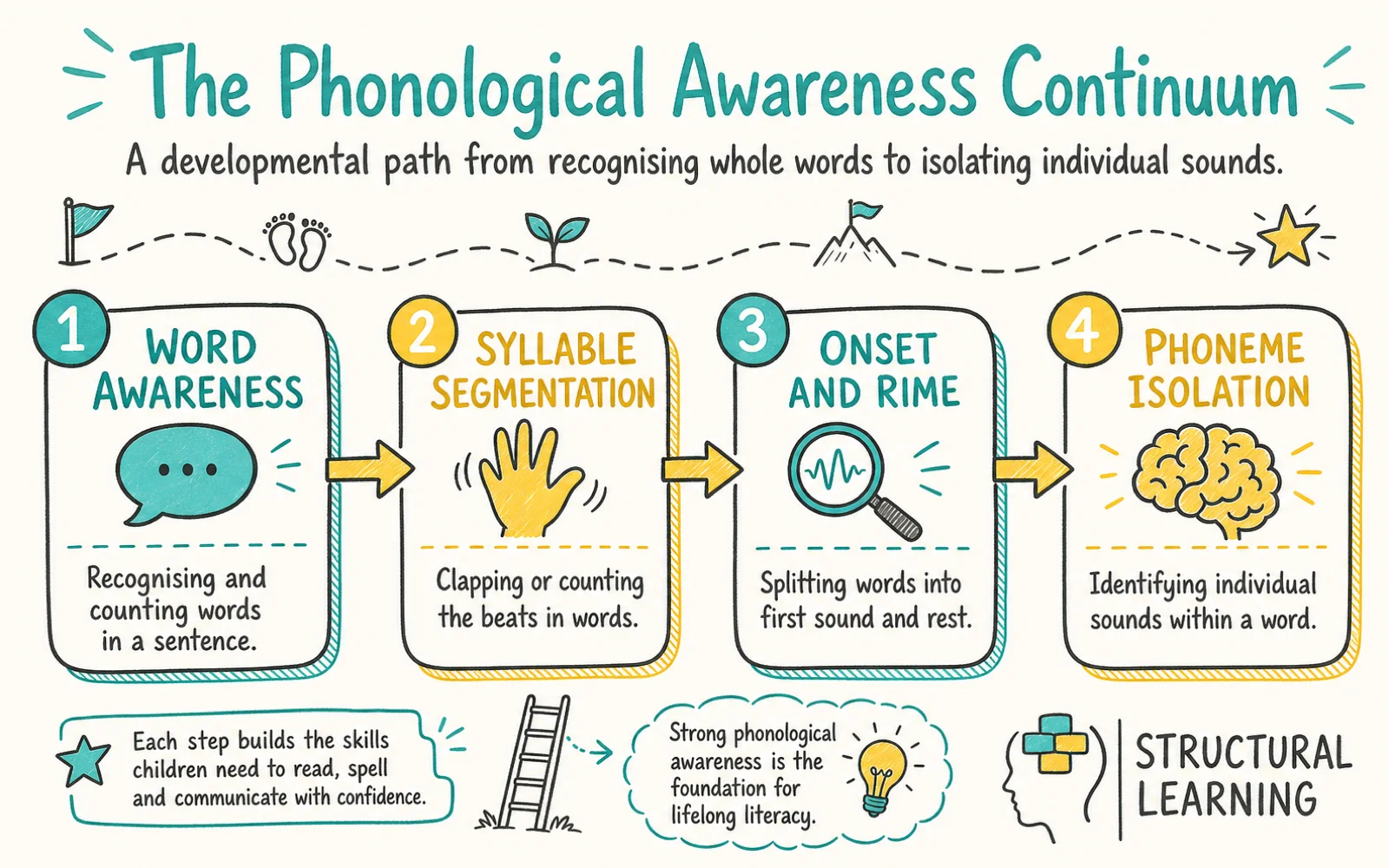
Skills develop along a predictable continuum. Children first identify whole words in sentences. They then break words into syllables, divide syllables into onset and rime, and finally isolate individual phonemes.
Ignoring this continuum hinders instruction. A child cannot blend phonemes if they cannot segment syllables. Teachers must assess a child's position on the continuum to provide appropriate challenges.
For example, a teacher might read a rhyming picture book and ask children to stand when they hear a rhyming pair. The teacher reads aloud, and the pupils actively listen and respond physically. This builds whole-word auditory discrimination without letter knowledge.
Why Phonological Awareness Matters for Teachers
Phonological awareness is a strong predictor of later reading success. Research shows that early sensitivity to sound structure directly affects a child's ability to decode print (Stanovich, 1986). Without a robust internal map of sounds, children struggle to map letters to those sounds.
Working memory is critical in early sound processing. The phonological loop holds and manipulates verbal information (Baddeley, 2000). When blending three sounds, a child must hold the first sound while processing the third.
Purely auditory tasks can strain working memory. If a child has poor working memory, the first sound fades before they hear the last. This explains why some learners fail at oral blending despite understanding the concept. They lose the auditory information.
Teachers can bridge this gap by making sounds visible. Using physical manipulatives reduces the cognitive load of holding abstract sounds. Children offload the memory requirement onto objects, freeing cognitive capacity for blending or segmenting.
Early exposure to rhythm and rhyme accelerates reading acquisition. Children who detect rhyming patterns naturally categorise words by spelling patterns (Goswami, 1990). A teacher might notice a pupil struggling to hear the difference between 'cat' and 'cot'. The teacher provides two coloured blocks, touching one for 'cat' and the other for 'cot', helping the pupil visually anchor the vowel sounds.
Phonological Awareness in the Classroom
Effective instruction embeds sound play into the school day. Continuous provision and transitional moments offer opportunities for practice.
Strategy 1: Robot Talk Transitions
Transitions are ideal for practicing oral blending at the phoneme or syllable level. The teacher uses a mechanical voice to segment instructions, and the pupils blend the sounds to understand. This requires no preparation and turns queuing time into instruction.
The teacher says "Please touch your t-oe-s" or "Line up by the d-oo-r" using distinct, separated sounds. The pupils listen, blend, and perform the action. The physical action provides feedback about who has blended successfully.
If a child struggles, the teacher reduces difficulty by segmenting at the syllable level. For example, the instruction changes to "Touch your shoul-ders". This moves the child back one step on the continuum.
Strategy 2: Lego Syllables
This activity targets syllable segmentation while reducing working memory load. Children use interlocking blocks to separate and blend syllables. The auditory sequence becomes visual and tactile, making it accessible for SEN and EAL learners.
The teacher provides blocks and calls out a word like "di-no-saur". The pupils repeat the word, picking up one block for each syllable. They then snap the blocks together to represent the whole word.
By holding the blocks, the pupils do not have to hold the syllable count in their working memory. The teacher observes the towers to assess accuracy.
Strategy 3: The Sound Box
The Sound Box builds auditory discrimination and syllable awareness. A sealed, opaque box containing a familiar object is passed around. This activity focuses attention on listening.
The teacher passes the box to a pupil and asks them to shake it, asking the group what might be inside based on the sound. The teacher opens the box to reveal the object, such as a 'banana'. The pupils then clap out the syllables of the revealed object together.
This sequence moves children from environmental sound discrimination to linguistic segmentation. The reveal provides a concrete anchor for the word.
Strategy 4: Rhyming Odd-One-Out
This strategy tackles rhyme identification using visual scaffolds. Asking children to hold three spoken words in their head can cause working memory failure. Using objects removes this barrier.
The teacher places three objects or picture cards in a tray, such as a cat, a hat, and a pig. The teacher names each object slowly. The pupils must remove the object that does not sound the same at the end.
Because the objects remain visible, the child can repeatedly point to them and whisper the names. They do not have to rely on their phonological loop.
The Phonological Awareness Continuum: From Words to Phonemes
Common Misconceptions
A misconception is that phonological awareness activities must involve letters. Teachers sometimes show flashcards. This derails the objective, forcing the child to use visual decoding rather than auditory processing.
Another error is treating the continuum as a random menu. Teachers sometimes jump from rhyming games to phoneme blending. Children must secure word and syllable awareness before manipulating phonemes.
Many educators believe that speaking louder and slower will help a failing child. If a child cannot blend 'c-a-t', repeating it louder does not address the issue. The failure is often a working memory deficit, requiring a physical or visual scaffold.
Finally, there is a belief that phonological awareness is only for the early years. Older pupils who struggle with reading often have deficits at the syllable or phoneme level. Diagnostic assessment is necessary for struggling readers in any year group.
Practical Implementation Guide
Implementing a strategy requires systematic planning. You must first identify a child's position on the continuum before planning activities.
Step 1 is conducting a diagnostic assessment. Ask each child to clap a sentence, clap a word into syllables, identify a rhyme, and blend three sounds. Record the point where they hesitate or fail.
Step 2 is grouping children based on their continuum stage. Create flexible groups that target their specific instructional ceiling. Do not force children who cannot segment syllables to sit through phonemic blending.
Step 3 is integrating targeted activities into continuous provision. If a group needs work on onset and rime, hide objects in the water tray that start with the same sound.
For example, you identify four pupils who cannot segment syllables. You set up a playdough station. You instruct the pupils to roll the dough into balls. You call out words from their current topic, and they must smash one ball for every syllable they hear. You provide physical feedback on their auditory processing.
Phonological Awareness Across Subjects
While often viewed as a literacy component, sound manipulation should weave through all early years domains. This repetition solidifies neural pathways.
In early Maths, teachers can connect counting to sound boundaries. When teaching one-to-one correspondence, the teacher provides animal figures. The pupils sort the animals into hoops based on syllable count. The pupils count the syllables and match them to the corresponding numeral card.
In Understanding the World, teachers can focus on environmental auditory discrimination. The teacher takes the class on a listening walk, asking them to close their eyes and identify three sounds. The pupils draw pictures of the sounds they heard. This builds auditory attention.
During Physical Development and PE, teachers can map movements to the continuum. The teacher sets up hoops on the floor. The pupils must jump into one hoop for every word in a sentence, or every syllable in their own name. This physicalises auditory boundaries and reinforces learning through movement.
Classroom Strategies to Support Phonological Awareness Development infographic for teachers" loading="lazy">
5 Classroom Strategies to Support Phonological Awareness Development
Common Questions About Phonological Awareness
What is the difference between phonological and phonemic awareness?
Phonological awareness is the ability to hear and manipulate all parts of spoken language, including words and syllables. Phonemic awareness is the most advanced sub-skill. It deals with manipulating individual sounds, or phonemes.
How long should these teaching sessions last?
Sessions should be brief and focused. Ten minutes of direct instruction is the maximum duration for early years children. It is more effective to do five minutes in the morning and a three-minute transition activity later.
How do I support children with working memory deficits?
Provide a physical object to represent the sound. Use blocks, counters, or tap body parts to anchor the auditory information. This allows the child to focus on manipulating the sound rather than remembering it.
Should I use letters during these activities?
No. Introducing graphemes turns the activity into a phonics lesson. Phonological awareness activities are designed to strengthen auditory processing before visual symbols are introduced.
What if a child cannot hear rhyming words?
Move backwards along the continuum. Check if they can segment and blend syllables first. If they can, begin with exaggerated, physical rhyming activities using objects rather than spoken words.
Is it too late to teach this in Key Stage 1?
It is never too late. Many children mask poor auditory processing by memorising whole words visually. If a pupil in a later year group is struggling to decode, assess their phonological skills and apply these interventions.
Audit your classroom tomorrow morning and identify three transitional moments where you can replace queuing with 'Robot Talk' segmenting.
Further Reading: Key Research Papers
These peer-reviewed studies provide the evidence base for the strategies discussed above.
Explicit phonological awareness instruction in three rural Northern Territory preschoolsView study ↗
Staley et al. (2026)
This research examined a collaborative phonological awareness programme between three rural primary schools and a university. The study provides evidence-based strategies for explicit phonological awareness instruction in preschool settings, offering practical approaches teachers can implement to support early reading development.
Why Did All the Residents Resign? Key Takeaways From the Junior Physicians' Mass Walkout in South Korea.View study ↗ 23 citations
Park et al. (2024)
This paper focuses on healthcare workforce issues in South Korea and is not relevant to classroom teaching or phonological awareness instruction for educators.
Cultivating connectedness and elevating educational experiences for international students in blended learning: reflections from the pandemic era and key takeawaysView study ↗
He et al. (2024)
This study explores videoconferencing technology in blended learning during the pandemic, examining student engagement and satisfaction. Whilst relevant to educational technology, it doesn't directly address phonological awareness activities or early literacy instruction for classroom teachers.
Who Benefits and under What Conditions from Developmental Education Reform? Key Takeaways from Florida’s Statewide InitiativeView study ↗
Mokher et al. (2023)
This research examines developmental education reform outcomes in Florida's higher education system. The study focuses on post-secondary remedial education rather than early literacy or phonological awareness instruction relevant to primary school teachers.
Empowering English Teachers to be Grammar ‘Experts’ and Coursebook Analysts via PerusallView study ↗
Tavares (2023)
This study demonstrates how Perusall, a collaborative reading platform, can enhance English teachers' grammar expertise and coursebook analysis skills. Teachers can apply these digital annotation techniques to develop their professional knowledge and improve language instruction methods.
Free Resource Pack
Phonological Awareness Toolkit
Practical resources for developing essential early literacy skills in young learners.
Phonics: What's the Difference? infographic for teachers" loading="lazy">
Phonological Awareness vs. Phonemic Awareness vs. Phonics: What's the Difference?
Key Takeaways
Phonological awareness is purely auditory; it requires no letters or written symbols.
Development follows a continuum from whole words down to individual phonemes.
Purely auditory tasks can strain a child's working memory capacity.
Physical manipulatives make sounds 'visible' for young learners and those with SEN.
Short daily transitions offer better practice than lengthy isolated lessons.
Diagnostic assessment must identify a child's position on the continuum.
Phonemic awareness is the final, most complex stage of development.
What Is Phonological Awareness?
Phonological awareness is the ability to recognise and manipulate the spoken parts of sentences and words. It operates independently of print. This skill forms the essential auditory foundation before children encounter graphemes or attempt to decode written text.
Many educators confuse phonological awareness with phonemic awareness and phonics. Phonological awareness is the broad term covering all levels of sound manipulation. Phonemic awareness is a specific sub-skill focusing on individual sounds. Phonics is the separate process of mapping spoken sounds to written letters.
Skills develop along a predictable continuum. Children first identify whole words in sentences. They then break words into syllables, divide syllables into onset and rime, and finally isolate individual phonemes.
Ignoring this continuum hinders instruction. A child cannot blend phonemes if they cannot segment syllables. Teachers must assess a child's position on the continuum to provide appropriate challenges.
For example, a teacher might read a rhyming picture book and ask children to stand when they hear a rhyming pair. The teacher reads aloud, and the pupils actively listen and respond physically. This builds whole-word auditory discrimination without letter knowledge.
Why Phonological Awareness Matters for Teachers
Phonological awareness is a strong predictor of later reading success. Research shows that early sensitivity to sound structure directly affects a child's ability to decode print (Stanovich, 1986). Without a robust internal map of sounds, children struggle to map letters to those sounds.
Working memory is critical in early sound processing. The phonological loop holds and manipulates verbal information (Baddeley, 2000). When blending three sounds, a child must hold the first sound while processing the third.
Purely auditory tasks can strain working memory. If a child has poor working memory, the first sound fades before they hear the last. This explains why some learners fail at oral blending despite understanding the concept. They lose the auditory information.
Teachers can bridge this gap by making sounds visible. Using physical manipulatives reduces the cognitive load of holding abstract sounds. Children offload the memory requirement onto objects, freeing cognitive capacity for blending or segmenting.
Early exposure to rhythm and rhyme accelerates reading acquisition. Children who detect rhyming patterns naturally categorise words by spelling patterns (Goswami, 1990). A teacher might notice a pupil struggling to hear the difference between 'cat' and 'cot'. The teacher provides two coloured blocks, touching one for 'cat' and the other for 'cot', helping the pupil visually anchor the vowel sounds.
Phonological Awareness in the Classroom
Effective instruction embeds sound play into the school day. Continuous provision and transitional moments offer opportunities for practice.
Strategy 1: Robot Talk Transitions
Transitions are ideal for practicing oral blending at the phoneme or syllable level. The teacher uses a mechanical voice to segment instructions, and the pupils blend the sounds to understand. This requires no preparation and turns queuing time into instruction.
The teacher says "Please touch your t-oe-s" or "Line up by the d-oo-r" using distinct, separated sounds. The pupils listen, blend, and perform the action. The physical action provides feedback about who has blended successfully.
If a child struggles, the teacher reduces difficulty by segmenting at the syllable level. For example, the instruction changes to "Touch your shoul-ders". This moves the child back one step on the continuum.
Strategy 2: Lego Syllables
This activity targets syllable segmentation while reducing working memory load. Children use interlocking blocks to separate and blend syllables. The auditory sequence becomes visual and tactile, making it accessible for SEN and EAL learners.
The teacher provides blocks and calls out a word like "di-no-saur". The pupils repeat the word, picking up one block for each syllable. They then snap the blocks together to represent the whole word.
By holding the blocks, the pupils do not have to hold the syllable count in their working memory. The teacher observes the towers to assess accuracy.
Strategy 3: The Sound Box
The Sound Box builds auditory discrimination and syllable awareness. A sealed, opaque box containing a familiar object is passed around. This activity focuses attention on listening.
The teacher passes the box to a pupil and asks them to shake it, asking the group what might be inside based on the sound. The teacher opens the box to reveal the object, such as a 'banana'. The pupils then clap out the syllables of the revealed object together.
This sequence moves children from environmental sound discrimination to linguistic segmentation. The reveal provides a concrete anchor for the word.
Strategy 4: Rhyming Odd-One-Out
This strategy tackles rhyme identification using visual scaffolds. Asking children to hold three spoken words in their head can cause working memory failure. Using objects removes this barrier.
The teacher places three objects or picture cards in a tray, such as a cat, a hat, and a pig. The teacher names each object slowly. The pupils must remove the object that does not sound the same at the end.
Because the objects remain visible, the child can repeatedly point to them and whisper the names. They do not have to rely on their phonological loop.
The Phonological Awareness Continuum: From Words to Phonemes
Common Misconceptions
A misconception is that phonological awareness activities must involve letters. Teachers sometimes show flashcards. This derails the objective, forcing the child to use visual decoding rather than auditory processing.
Another error is treating the continuum as a random menu. Teachers sometimes jump from rhyming games to phoneme blending. Children must secure word and syllable awareness before manipulating phonemes.
Many educators believe that speaking louder and slower will help a failing child. If a child cannot blend 'c-a-t', repeating it louder does not address the issue. The failure is often a working memory deficit, requiring a physical or visual scaffold.
Finally, there is a belief that phonological awareness is only for the early years. Older pupils who struggle with reading often have deficits at the syllable or phoneme level. Diagnostic assessment is necessary for struggling readers in any year group.
Practical Implementation Guide
Implementing a strategy requires systematic planning. You must first identify a child's position on the continuum before planning activities.
Step 1 is conducting a diagnostic assessment. Ask each child to clap a sentence, clap a word into syllables, identify a rhyme, and blend three sounds. Record the point where they hesitate or fail.
Step 2 is grouping children based on their continuum stage. Create flexible groups that target their specific instructional ceiling. Do not force children who cannot segment syllables to sit through phonemic blending.
Step 3 is integrating targeted activities into continuous provision. If a group needs work on onset and rime, hide objects in the water tray that start with the same sound.
For example, you identify four pupils who cannot segment syllables. You set up a playdough station. You instruct the pupils to roll the dough into balls. You call out words from their current topic, and they must smash one ball for every syllable they hear. You provide physical feedback on their auditory processing.
Phonological Awareness Across Subjects
While often viewed as a literacy component, sound manipulation should weave through all early years domains. This repetition solidifies neural pathways.
In early Maths, teachers can connect counting to sound boundaries. When teaching one-to-one correspondence, the teacher provides animal figures. The pupils sort the animals into hoops based on syllable count. The pupils count the syllables and match them to the corresponding numeral card.
In Understanding the World, teachers can focus on environmental auditory discrimination. The teacher takes the class on a listening walk, asking them to close their eyes and identify three sounds. The pupils draw pictures of the sounds they heard. This builds auditory attention.
During Physical Development and PE, teachers can map movements to the continuum. The teacher sets up hoops on the floor. The pupils must jump into one hoop for every word in a sentence, or every syllable in their own name. This physicalises auditory boundaries and reinforces learning through movement.
Classroom Strategies to Support Phonological Awareness Development infographic for teachers" loading="lazy">
5 Classroom Strategies to Support Phonological Awareness Development
Common Questions About Phonological Awareness
What is the difference between phonological and phonemic awareness?
Phonological awareness is the ability to hear and manipulate all parts of spoken language, including words and syllables. Phonemic awareness is the most advanced sub-skill. It deals with manipulating individual sounds, or phonemes.
How long should these teaching sessions last?
Sessions should be brief and focused. Ten minutes of direct instruction is the maximum duration for early years children. It is more effective to do five minutes in the morning and a three-minute transition activity later.
How do I support children with working memory deficits?
Provide a physical object to represent the sound. Use blocks, counters, or tap body parts to anchor the auditory information. This allows the child to focus on manipulating the sound rather than remembering it.
Should I use letters during these activities?
No. Introducing graphemes turns the activity into a phonics lesson. Phonological awareness activities are designed to strengthen auditory processing before visual symbols are introduced.
What if a child cannot hear rhyming words?
Move backwards along the continuum. Check if they can segment and blend syllables first. If they can, begin with exaggerated, physical rhyming activities using objects rather than spoken words.
Is it too late to teach this in Key Stage 1?
It is never too late. Many children mask poor auditory processing by memorising whole words visually. If a pupil in a later year group is struggling to decode, assess their phonological skills and apply these interventions.
Audit your classroom tomorrow morning and identify three transitional moments where you can replace queuing with 'Robot Talk' segmenting.
Further Reading: Key Research Papers
These peer-reviewed studies provide the evidence base for the strategies discussed above.
Explicit phonological awareness instruction in three rural Northern Territory preschoolsView study ↗
Staley et al. (2026)
This research examined a collaborative phonological awareness programme between three rural primary schools and a university. The study provides evidence-based strategies for explicit phonological awareness instruction in preschool settings, offering practical approaches teachers can implement to support early reading development.
Why Did All the Residents Resign? Key Takeaways From the Junior Physicians' Mass Walkout in South Korea.View study ↗ 23 citations
Park et al. (2024)
This paper focuses on healthcare workforce issues in South Korea and is not relevant to classroom teaching or phonological awareness instruction for educators.
Cultivating connectedness and elevating educational experiences for international students in blended learning: reflections from the pandemic era and key takeawaysView study ↗
He et al. (2024)
This study explores videoconferencing technology in blended learning during the pandemic, examining student engagement and satisfaction. Whilst relevant to educational technology, it doesn't directly address phonological awareness activities or early literacy instruction for classroom teachers.
Who Benefits and under What Conditions from Developmental Education Reform? Key Takeaways from Florida’s Statewide InitiativeView study ↗
Mokher et al. (2023)
This research examines developmental education reform outcomes in Florida's higher education system. The study focuses on post-secondary remedial education rather than early literacy or phonological awareness instruction relevant to primary school teachers.
Empowering English Teachers to be Grammar ‘Experts’ and Coursebook Analysts via PerusallView study ↗
Tavares (2023)
This study demonstrates how Perusall, a collaborative reading platform, can enhance English teachers' grammar expertise and coursebook analysis skills. Teachers can apply these digital annotation techniques to develop their professional knowledge and improve language instruction methods.
Free Resource Pack
Phonological Awareness Toolkit
Practical resources for developing essential early literacy skills in young learners.
{"@context":"https://schema.org","@graph":[{"@type":"Organization","@id":"https://www.structural-learning.com/#org","name":"Structural Learning","url":"https://www.structural-learning.com/","logo":{"@type":"ImageObject","url":"https://cdn.prod.website-files.com/5b69a01ba2e409501de055d1/5b69a01ba2e40996a5e055f4_structural-learning-logo.png"}},{"@type":"Person","@id":"https://www.structural-learning.com/team/paul-main/#person","name":"Paul Main","url":"https://www.structural-learning.com/team/paul-main","jobTitle":"Founder","affiliation":{"@id":"https://www.structural-learning.com/#org"}},{"@type":"BreadcrumbList","@id":"https://www.structural-learning.com/post/phonological-awareness-activities-teachers#breadcrumb","itemListElement":[{"@type":"ListItem","position":1,"name":"Home","item":"https://www.structural-learning.com/"},{"@type":"ListItem","position":2,"name":"Blog","item":"https://www.structural-learning.com/blog"},{"@type":"ListItem","position":3,"name":"Phonological Awareness Activities: A Teacher's Guide","item":"https://www.structural-learning.com/post/phonological-awareness-activities-teachers"}]},{"@type":"BlogPosting","@id":"https://www.structural-learning.com/post/phonological-awareness-activities-teachers#article","headline":"Phonological Awareness Activities: A Teacher's Guide","description":"Discover evidence-based phonological awareness activities. This teacher's guide for early years covers the continuum, working memory, and classroom strategies.","author":{"@id":"https://www.structural-learning.com/team/paul-main/#person"},"publisher":{"@id":"https://www.structural-learning.com/#org"},"datePublished":"2026-03-19","dateModified":"2026-03-19","inLanguage":"en-GB"}]}