Tactile Metacognition: Making Thinking Physically Visible
|
March 31, 2026
Research-backed strategies for using physical objects, gestures, and movement to teach metacognition. Includes practical classroom activities for KS1-KS2 that connect embodied cognition with self-regulated learning.
In a Year 3 classroom in Bradford, a learner places a red wooden block on the left side of a thinking frame. "This is what I already know," she says. She reaches for a blue block and places it on the right. "This is what I still need to find out." Without writing a single word, she has made her metacognitive monitoring physically visible. Kubik, Joensson, Knopf and Mack (2020) found that enacted retrieval, where learners physically perform actions linked to information, improved long-term retention by 19% compared to covert retrieval alone. That finding carries a direct challenge to every classroom that relies on verbal or written reflection as its only metacognitive tool. Across England, metacognition has become a teaching priority since the Education Endowment Foundation rated it among the highest-impact strategies available. Yet the dominant approach remains talk-based: think-alouds, learning journals, and verbal self-assessment. For the 30% of primary learners who process information best through movement and touch (Mavilidi, Okely, Chandler and Paas, 2025), these methods create an unnecessary barrier between thinking and expressing thought.
Key Takeaways
Enacted retrieval, where learners physically perform recall through gesture or object manipulation, improves long-term retention beyond verbal retrieval alone (Kubik et al., 2020).
Embodied cognition research demonstrates that physical actions reduce extraneous cognitive load by distributing processing across motor and sensory channels (Mavilidi et al., 2025).
Tangible metacognitive tools such as sorting blocks, thinking frames, and gesture-based self-assessment give kinesthetic learners and learners with SEND an accessible route into self-regulation.
Teachers can implement tactile metacognition in 20-minute activities using resources already available in most primary classrooms.
What Is Tactile Metacognition?
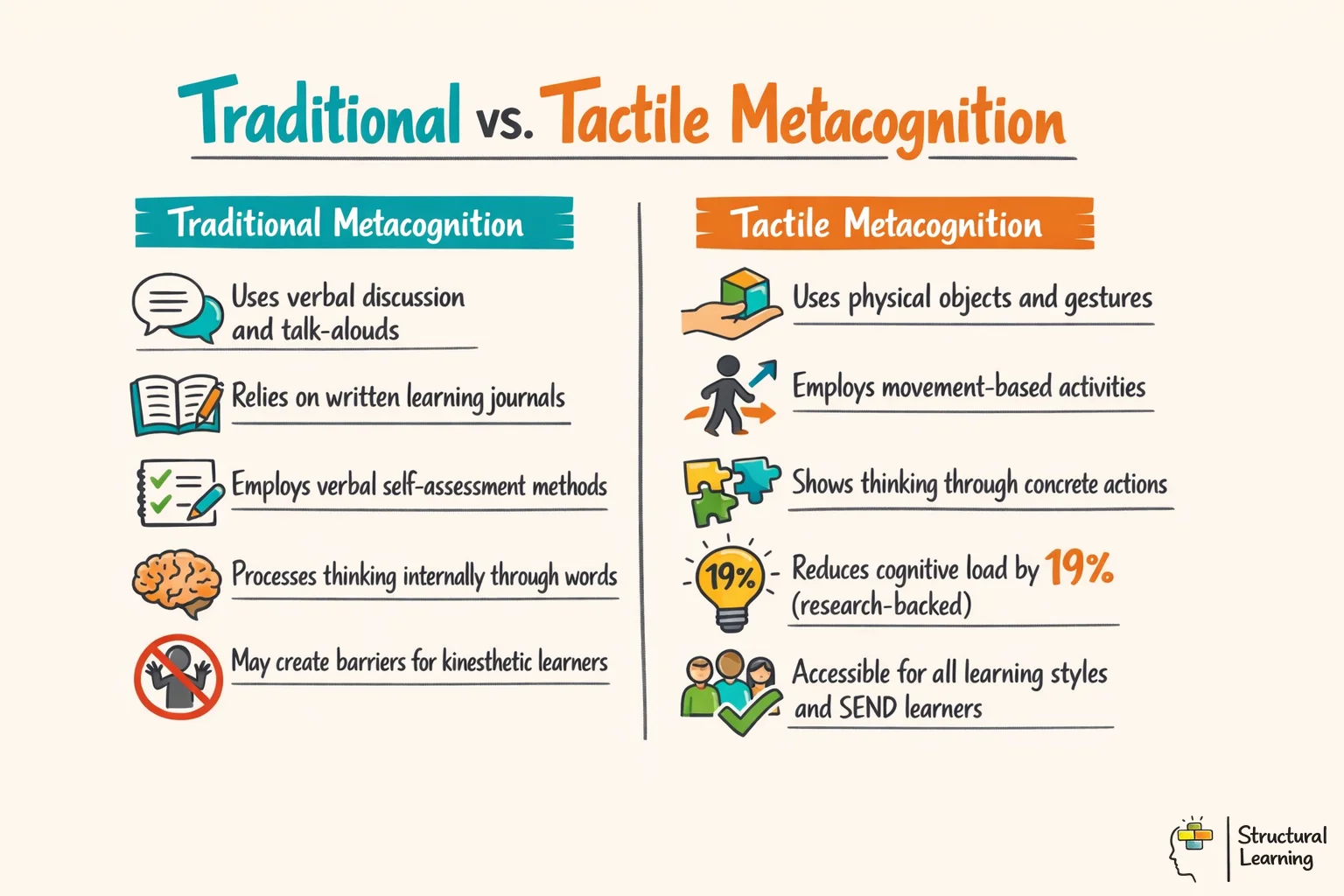
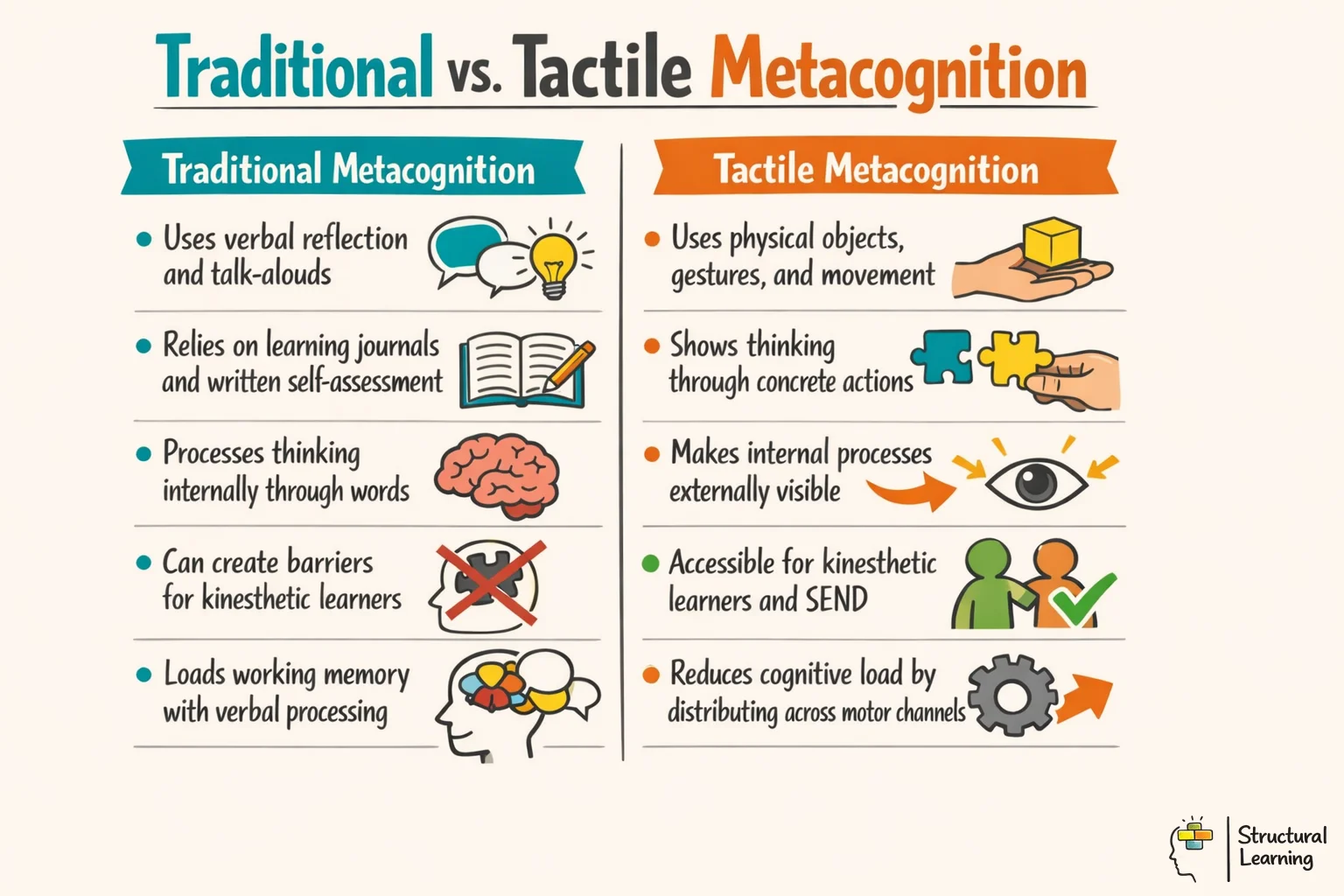
Tactile metacognition is the practice of using physical objects, gestures, and bodily movement to plan, monitor, and evaluate learning. Where traditional metacognition asks learners to think about their thinking through words, tactile metacognition asks them to show their thinking through action.
Traditional vs. Tactile Metacognition
Flavell (1979) first defined metacognition as knowledge about one's own cognitive processes and the ability to regulate them. Brown (1987) expanded this into two components: metacognitive knowledge (what you know about how you learn) and metacognitive regulation (how you control your learning in real time). Both researchers assumed these processes were primarily verbal and internal. The embodied cognition movement challenges that assumption directly.
Traditional vs. Tactile Metacognition
Mavilidi, Okely, Chandler and Paas (2025), writing in Nature Human Behaviour, demonstrated that integrating physical actions with learning content reduces extraneous cognitive load by distributing processing across motor and sensory channels rather than overloading working memory. Their relevance-integration taxonomy shows that the highest learning gains occur when physical actions are both directly related to the content and fully integrated into the task.
Traditional vs. Tactile Metacognition
In a classroom context, this means that a learner who physically sorts concept cards into "understood" and "not yet understood" piles is doing more than a sorting activity. She is engaging her motor system in the act of metacognitive monitoring. The physical action externalises an internal cognitive process that many young learners cannot yet articulate verbally.
Classroom Example: The Thinking Continuum
Place a rope or masking tape line across the floor. Label one end "I understand this completely" and the other "I need more help." After a teaching input, learners physically walk to their position on the line. The teacher then asks learners at different positions to explain why they chose their spot. This transforms abstract self-assessment into a concrete, observable action that the teacher can see, question, and respond to immediately.
The Research Base: Embodied Cognition Meets Metacognition
The theoretical foundation for tactile metacognition sits at the intersection of two well-established research traditions: embodied cognition and metacognitive theory.
Skulmowski and Rey (2018), in their taxonomy of embodied learning published in Cognitive Research: Principles and Implications (cited 225 times), identified two critical dimensions: bodily engagement (how much physical activity is involved) and task integration (whether the physical activity is meaningfully connected to the learning task). Their review of experimental evidence showed that high bodily engagement combined with high task integration produced the strongest learning outcomes.
Kubik, Joensson, Knopf and Mack (2020) applied this principle directly to retrieval practice. In their study, published in the Quarterly Journal of Experimental Psychology, participants who physically enacted recalled information during retrieval practice showed significantly better retention at both one-week and two-week delays compared to those who retrieved silently. The enacted retrieval group outperformed the covert retrieval group even when the final test format was different from the practice format, suggesting that motor enactment creates a qualitatively different and more durable memory trace.
Casasanto and Dijkstra (2021) further demonstrated that the body's position during recall actively shapes memory retrieval. Their work on embodied memories, reviewed in Psychonomic Bulletin and Review, showed that body posture and hand position during retrieval modulated both the speed and accuracy of memory access. When the body was positioned in a way that was incongruent with the original encoding action, retrieval slowed measurably.
For teachers, the practical implication is straightforward: if learners encoded information while moving or manipulating objects, their recall will be stronger when they can move or manipulate objects again during review.
When teaching subject-specific vocabulary, pair each new term with a specific gesture. For "photosynthesis," learners spread their hands wide (sunlight), then bring them together and push down (into the leaf). During retrieval practice, learners perform the gesture before saying the word. This creates a motor cue that supports verbal recall, particularly for learners with weaker verbal working memory.
Why Traditional Metacognition Leaves Learners Behind
The standard metacognitive toolkit in English primary schools relies heavily on language: traffic light self-assessment, thumbs up or down, written learning reflections, and verbal think-alouds. These methods work well for learners with strong verbal processing. They create significant barriers for three groups.
First, learners in Key Stage 1 (ages 5-7) often lack the vocabulary and abstract thinking capacity to describe their own cognitive processes. Asking a five-year-old to write about what they found difficult is asking them to perform two cognitively demanding tasks simultaneously: metacognitive reflection and written composition. The writing task frequently overwhelms the reflection.
Second, learners with speech, language, and communication needs (SLCN) may understand their own learning perfectly well but struggle to express that understanding verbally. The EEF's guidance on metacognition acknowledges that "some pupils may need additional support to develop the language of metacognition." Tactile approaches provide that support without requiring verbal fluency as a prerequisite.
Third, learners with attention difficulties often find static, verbal reflection tasks deeply challenging. The physical movement involved in tactile metacognition provides the sensory input that helps these learners maintain focus on the reflective task itself.
Antle (2011), in a study cited 153 times, demonstrated that tangible interaction systems using embodied metaphors helped children manipulate abstract concepts (in this case, sound properties) through physical actions. Children who could not explain pitch verbally could demonstrate their understanding by physically moving objects. The same principle applies to metacognitive concepts: learners who cannot explain their understanding verbally can demonstrate it physically.
Classroom Example: The Confidence Cube
Give each learner a small wooden cube with faces marked 1-6. After completing a task, learners place their cube on their desk with their confidence number facing up. A 1 means "I could not do this at all" and a 6 means "I could teach this to someone else." The teacher can scan the room in seconds. Crucially, the learner has engaged in calibration (matching their perceived performance to a scale) without writing or speaking. This is pure metacognitive monitoring through physical action.
Tactile Metacognition and Cognitive Load Theory
Sweller's cognitive load theory (1988) provides the strongest theoretical justification for moving metacognition from the verbal channel to the physical channel. Working memory has limited capacity. When a learner is asked to simultaneously hold new content in mind, evaluate their understanding of that content, and then articulate that evaluation in words, the total cognitive load may exceed capacity.
Mavilidi, Okely, Chandler and Paas (2025) demonstrated that task-relevant physical actions redistribute cognitive load across sensory and motor channels, effectively expanding the available processing capacity. Their review in Nature Human Behaviour synthesised evidence showing that when physical actions are meaningfully integrated with learning content, they reduce extraneous load (unnecessary processing) while increasing germane load (processing that builds schemas).
Lennon, Dass, Bott and Vella (2024) extended this work specifically to young children in an Australian Science Discovery Centre. Their co-designed digital exhibit used whole-body actions to teach computational thinking concepts. Children who engaged with the embodied interface demonstrated better understanding of abstract concepts like algorithmic sequencing than children who used screen-based alternatives. The researchers attributed this to the reduction in split-attention effect: rather than dividing attention between a screen and instructions, the children's bodies became the interface itself.
Applied to metacognition, this means that a learner who sorts physical objects into categories of understanding is processing the metacognitive task through her motor system rather than competing for working memory resources with the learning content. The physical action carries part of the cognitive load.
Classroom Example: The Understanding Sort
After a science lesson on forces, give each pair of learners a set of concept cards (gravity, friction, air resistance, magnetism, upthrust). Provide two labelled trays: "We can explain this" and "We need to revisit this." Learners discuss each card and physically place it in a tray. The physical action of placing the card commits the metacognitive judgement to an observable, revisable decision. The teacher photographs each pair's trays for instant formative assessment.
Implementing Tactile Metacognition: A Practical Framework
Teachers can introduce tactile metacognition through three progressive stages, each building on the previous one.
Stage 1: Physical Self-Assessment (Weeks 1-2). Replace verbal or written self-assessment with physical alternatives. Use positioning (stand at the back if confident, front if unsure), object placement (place a counter on a 1-5 scale printed on your desk), or gesture (hold up fingers to show understanding level). The goal is to establish the habit of externalising metacognitive judgements through the body.
Stage 2: Manipulative Monitoring (Weeks 3-4). Introduce physical objects that represent learning progress. Give each learner a set of coloured counters: green for concepts mastered, amber for partially understood, red for not yet learned. After each lesson segment, learners update their counter arrangement on a personal tracking board. This creates a persistent, physical record of metacognitive monitoring that the learner and teacher can review together.
Stage 3: Enacted Regulation (Weeks 5 onwards). Move from monitoring to regulation. When a learner identifies a red counter (not yet learned), they physically select a strategy card from a set of options: "Ask a peer," "Re-read the text," "Draw a diagram," "Use a manipulative." The physical act of selecting the strategy card bridges the gap between knowing that something is difficult and deciding what to do about it. This is metacognitive regulation made tangible.
Kontra, Goldin-Meadow and Beilock (2012) showed that physical experience with scientific phenomena improved both understanding and the ability to reason about those phenomena later. The same principle applies here: physical experience with metacognitive strategies improves the ability to apply those strategies independently.
Classroom Example: The Strategy Toolbox
Create a physical toolbox (a shoe box or tray) for each table group containing laminated strategy cards, mini whiteboards, number lines, vocabulary mats, and worked examples. When a learner identifies a difficulty through their traffic light counters, they physically go to the toolbox, select the resource they think will help, and use it. The teacher observes which strategies learners select, providing direct insight into their metacognitive regulation choices.
Tactile Metacognition for Learners with SEND
For learners with special educational needs and disabilities, tactile metacognition is not merely an alternative pathway to the same outcome. It may be the only accessible pathway to genuine metacognitive engagement.
Learners with autism spectrum conditions often process information through systematic, rule-based physical routines more effectively than through open-ended verbal reflection. A physical sorting system with clear categories and concrete rules (this card goes here if you scored above 7, there if below) provides the structure these learners need to engage in self-assessment.
Learners with dyslexia who struggle with written reflection can demonstrate sophisticated metacognitive awareness through physical object manipulation. The barrier was never their metacognitive capacity; it was the medium through which they were asked to express it.
Kostrubiec, Grechkin and Bhatt (2023) found that young children's embodied interactions with physical and robotic interfaces elicited sustained attention and spontaneous collaborative communication. Children who struggled in traditional verbal learning contexts showed rich multimodal interaction when given physical interfaces. This has direct implications for SEND practice: providing a physical medium for metacognitive expression may unlock capabilities that verbal and written approaches cannot reach.
Classroom Example: The SEND Reflection Board
Create a personal reflection board for each learner using Velcro strips. Provide picture symbols representing different feelings about learning (confident, confused, excited, worried) and different strategies (ask for help, try again, take a break, use a resource). After each activity, the learner selects the relevant symbols and attaches them to their board. The SENCO can photograph boards over time to track metacognitive development without requiring any verbal or written output from the learner.
Connecting Tactile Metacognition to Thinking Frames and the Writer's Block
Structural Learning's Thinking Frames and Writer's Block provide ready-made platforms for tactile metacognition. The Writer's Block, a physical block that learners manipulate to structure their writing, already externalises the planning process through physical manipulation. Each face of the block represents a different aspect of writing composition, requiring the learner to physically turn, read, and respond.
This is metacognitive regulation embedded in a physical object. The learner does not need to remember to plan, because the block sequences the planning for them. As fluency develops, the learner begins to anticipate what comes next before turning the block. At that point, the physical scaffold has been internalised as a cognitive strategy, which is exactly the progression that Brown (1987) described as the goal of metacognitive instruction.
Thinking Frames serve a similar function for broader learning tasks. By providing a physical framework that makes thinking processes visible and sequential, they bridge the gap between implicit cognition and explicit metacognitive awareness. The learner can see where they are in a thinking process, identify what comes next, and evaluate whether each step has been completed adequately, all through physical interaction with the frame rather than through internal verbal monologue.
After completing a piece of writing using the Writer's Block, learners revisit each face of the block and place a green, amber, or red dot sticker next to each element. Green means "I did this well," amber means "I could improve this," and red means "I missed this completely." The block itself becomes a metacognitive review tool, with the physical dot stickers creating a permanent, visible record of self-evaluation.
Measuring the Impact of Tactile Metacognition
Schools implementing tactile metacognition need practical, low-cost methods for tracking its impact. Three approaches work well in combination.
Calibration accuracy tracking. Compare learners' physical self-assessments (their counter placements or position on a confidence line) with their actual performance on related tasks. Track the gap between judgement and performance over half a term. A narrowing gap indicates improving metacognitive accuracy. This directly mirrors the calibration research of Kruger and Dunning (1999), applied in a primary classroom context.
Strategy selection logs. Record which physical strategy cards learners select from their toolbox over time. Look for patterns: are learners selecting increasingly appropriate strategies? Are they moving from always choosing "ask the teacher" to selecting independent strategies? This tracks the development of metacognitive regulation.
Teacher observation protocols. During tactile metacognition activities, photograph or video the physical arrangements learners create. Compare these over time. A learner who begins by placing all counters on "confident" regardless of performance, and later begins differentiating, is developing metacognitive sensitivity.
The research from Hiller, Ihme and Pfeiffer (2020) on enhanced monitoring accuracy showed that when students received specific feedback on their calibration accuracy combined with psychoeducation about metacognition, their overconfidence decreased significantly across subsequent assessments. The same principle applies to tactile metacognition: when teachers show learners the gap between their physical self-assessment and their actual performance, learners recalibrate.
Your Next Lesson
Choose one routine metacognitive moment in your next lesson, the point where you currently ask learners to write or talk about their understanding. Replace it with a physical alternative. Place five numbered spots on the floor and ask learners to stand on their confidence level. Give out sorting cards and two labelled trays. Hand out counters for a desk-based confidence scale. Start with a single physical swap and observe what happens. You will likely see learners who have never meaningfully engaged with self-assessment suddenly participating, because the barrier was never metacognition itself. It was the medium.
Free Resource Pack
Tactile Metacognition Toolkit
4 ready-to-use resources to help students and teachers make thinking physically visible and enhance metacognition.
Fill in your details below and we'll send the resource pack straight to your inbox.
✅
Your resource pack is ready
We've also sent a copy to your email. Check your inbox.
References
Antle, A. N. (2011). Embodied metaphors in tangible interaction design. Personal and Ubiquitous Computing, 15(3), 227-247.
Brown, A. L. (1987). Metacognition, executive control, self-regulation, and other more mysterious mechanisms. In F. E. Weinert and R. H. Kluwe (Eds.), Metacognition, Motivation, and Understanding (pp. 65-116). Lawrence Erlbaum Associates.
Casasanto, D. and Dijkstra, K. (2021). Embodied memories: Reviewing the role of the body in memory processes. Psychonomic Bulletin and Review, 26(6), 1681-1710.
Flavell, J. H. (1979). Metacognition and cognitive monitoring: A new area of cognitive-developmental inquiry. American Psychologist, 34(10), 906-911.
Hiller, S., Ihme, T. A. and Pfeiffer, H. C. (2020). Enhanced monitoring accuracy and test performance: Incremental effects of judgment training over and above repeated testing. Learning and Instruction, 65, 101245.
Kontra, C., Goldin-Meadow, S. and Beilock, S. L. (2012). Embodied learning across the lifespan. Topics in Cognitive Science, 4(4), 731-739.
Kostrubiec, V., Grechkin, T. and Bhatt, S. (2023). Young children's embodied interactions with a social robot. Educational Technology Research and Development, 69, 2269-2293.
Kubik, V., Joensson, F. U., Knopf, M. and Mack, W. (2020). Putting action into testing: Enacted retrieval benefits long-term retention more than covert retrieval. Quarterly Journal of Experimental Psychology, 73(12), 2093-2105.
Lennon, M., Dass, L., Bott, L. and Vella, R. (2024). From conception to fruition: Co-designing a digital exhibit incorporating embodied cognition to encourage young children's computational thinking. The Australian Educational Researcher, 51, 1-24.
Mavilidi, M. F., Okely, A. D., Chandler, P. and Paas, F. (2025). The synergy of embodied cognition and cognitive load theory for optimized learning. Nature Human Behaviour, 9, 1-15.
Skulmowski, A. and Rey, G. D. (2018). Embodied learning: Introducing a taxonomy based on bodily engagement and task integration. Cognitive Research: Principles and Implications, 3(1), 6.
Sweller, J. (1988). Cognitive load during problem solving: Effects on learning. Cognitive Science, 12(2), 257-285.
In a Year 3 classroom in Bradford, a learner places a red wooden block on the left side of a thinking frame. "This is what I already know," she says. She reaches for a blue block and places it on the right. "This is what I still need to find out." Without writing a single word, she has made her metacognitive monitoring physically visible. Kubik, Joensson, Knopf and Mack (2020) found that enacted retrieval, where learners physically perform actions linked to information, improved long-term retention by 19% compared to covert retrieval alone. That finding carries a direct challenge to every classroom that relies on verbal or written reflection as its only metacognitive tool. Across England, metacognition has become a teaching priority since the Education Endowment Foundation rated it among the highest-impact strategies available. Yet the dominant approach remains talk-based: think-alouds, learning journals, and verbal self-assessment. For the 30% of primary learners who process information best through movement and touch (Mavilidi, Okely, Chandler and Paas, 2025), these methods create an unnecessary barrier between thinking and expressing thought.
Key Takeaways
Enacted retrieval, where learners physically perform recall through gesture or object manipulation, improves long-term retention beyond verbal retrieval alone (Kubik et al., 2020).
Embodied cognition research demonstrates that physical actions reduce extraneous cognitive load by distributing processing across motor and sensory channels (Mavilidi et al., 2025).
Tangible metacognitive tools such as sorting blocks, thinking frames, and gesture-based self-assessment give kinesthetic learners and learners with SEND an accessible route into self-regulation.
Teachers can implement tactile metacognition in 20-minute activities using resources already available in most primary classrooms.
What Is Tactile Metacognition?
Tactile metacognition is the practice of using physical objects, gestures, and bodily movement to plan, monitor, and evaluate learning. Where traditional metacognition asks learners to think about their thinking through words, tactile metacognition asks them to show their thinking through action.
Traditional vs. Tactile Metacognition
Flavell (1979) first defined metacognition as knowledge about one's own cognitive processes and the ability to regulate them. Brown (1987) expanded this into two components: metacognitive knowledge (what you know about how you learn) and metacognitive regulation (how you control your learning in real time). Both researchers assumed these processes were primarily verbal and internal. The embodied cognition movement challenges that assumption directly.
Traditional vs. Tactile Metacognition
Mavilidi, Okely, Chandler and Paas (2025), writing in Nature Human Behaviour, demonstrated that integrating physical actions with learning content reduces extraneous cognitive load by distributing processing across motor and sensory channels rather than overloading working memory. Their relevance-integration taxonomy shows that the highest learning gains occur when physical actions are both directly related to the content and fully integrated into the task.
Traditional vs. Tactile Metacognition
In a classroom context, this means that a learner who physically sorts concept cards into "understood" and "not yet understood" piles is doing more than a sorting activity. She is engaging her motor system in the act of metacognitive monitoring. The physical action externalises an internal cognitive process that many young learners cannot yet articulate verbally.
Classroom Example: The Thinking Continuum
Place a rope or masking tape line across the floor. Label one end "I understand this completely" and the other "I need more help." After a teaching input, learners physically walk to their position on the line. The teacher then asks learners at different positions to explain why they chose their spot. This transforms abstract self-assessment into a concrete, observable action that the teacher can see, question, and respond to immediately.
The Research Base: Embodied Cognition Meets Metacognition
The theoretical foundation for tactile metacognition sits at the intersection of two well-established research traditions: embodied cognition and metacognitive theory.
Skulmowski and Rey (2018), in their taxonomy of embodied learning published in Cognitive Research: Principles and Implications (cited 225 times), identified two critical dimensions: bodily engagement (how much physical activity is involved) and task integration (whether the physical activity is meaningfully connected to the learning task). Their review of experimental evidence showed that high bodily engagement combined with high task integration produced the strongest learning outcomes.
Kubik, Joensson, Knopf and Mack (2020) applied this principle directly to retrieval practice. In their study, published in the Quarterly Journal of Experimental Psychology, participants who physically enacted recalled information during retrieval practice showed significantly better retention at both one-week and two-week delays compared to those who retrieved silently. The enacted retrieval group outperformed the covert retrieval group even when the final test format was different from the practice format, suggesting that motor enactment creates a qualitatively different and more durable memory trace.
Casasanto and Dijkstra (2021) further demonstrated that the body's position during recall actively shapes memory retrieval. Their work on embodied memories, reviewed in Psychonomic Bulletin and Review, showed that body posture and hand position during retrieval modulated both the speed and accuracy of memory access. When the body was positioned in a way that was incongruent with the original encoding action, retrieval slowed measurably.
For teachers, the practical implication is straightforward: if learners encoded information while moving or manipulating objects, their recall will be stronger when they can move or manipulate objects again during review.
When teaching subject-specific vocabulary, pair each new term with a specific gesture. For "photosynthesis," learners spread their hands wide (sunlight), then bring them together and push down (into the leaf). During retrieval practice, learners perform the gesture before saying the word. This creates a motor cue that supports verbal recall, particularly for learners with weaker verbal working memory.
Why Traditional Metacognition Leaves Learners Behind
The standard metacognitive toolkit in English primary schools relies heavily on language: traffic light self-assessment, thumbs up or down, written learning reflections, and verbal think-alouds. These methods work well for learners with strong verbal processing. They create significant barriers for three groups.
First, learners in Key Stage 1 (ages 5-7) often lack the vocabulary and abstract thinking capacity to describe their own cognitive processes. Asking a five-year-old to write about what they found difficult is asking them to perform two cognitively demanding tasks simultaneously: metacognitive reflection and written composition. The writing task frequently overwhelms the reflection.
Second, learners with speech, language, and communication needs (SLCN) may understand their own learning perfectly well but struggle to express that understanding verbally. The EEF's guidance on metacognition acknowledges that "some pupils may need additional support to develop the language of metacognition." Tactile approaches provide that support without requiring verbal fluency as a prerequisite.
Third, learners with attention difficulties often find static, verbal reflection tasks deeply challenging. The physical movement involved in tactile metacognition provides the sensory input that helps these learners maintain focus on the reflective task itself.
Antle (2011), in a study cited 153 times, demonstrated that tangible interaction systems using embodied metaphors helped children manipulate abstract concepts (in this case, sound properties) through physical actions. Children who could not explain pitch verbally could demonstrate their understanding by physically moving objects. The same principle applies to metacognitive concepts: learners who cannot explain their understanding verbally can demonstrate it physically.
Classroom Example: The Confidence Cube
Give each learner a small wooden cube with faces marked 1-6. After completing a task, learners place their cube on their desk with their confidence number facing up. A 1 means "I could not do this at all" and a 6 means "I could teach this to someone else." The teacher can scan the room in seconds. Crucially, the learner has engaged in calibration (matching their perceived performance to a scale) without writing or speaking. This is pure metacognitive monitoring through physical action.
Tactile Metacognition and Cognitive Load Theory
Sweller's cognitive load theory (1988) provides the strongest theoretical justification for moving metacognition from the verbal channel to the physical channel. Working memory has limited capacity. When a learner is asked to simultaneously hold new content in mind, evaluate their understanding of that content, and then articulate that evaluation in words, the total cognitive load may exceed capacity.
Mavilidi, Okely, Chandler and Paas (2025) demonstrated that task-relevant physical actions redistribute cognitive load across sensory and motor channels, effectively expanding the available processing capacity. Their review in Nature Human Behaviour synthesised evidence showing that when physical actions are meaningfully integrated with learning content, they reduce extraneous load (unnecessary processing) while increasing germane load (processing that builds schemas).
Lennon, Dass, Bott and Vella (2024) extended this work specifically to young children in an Australian Science Discovery Centre. Their co-designed digital exhibit used whole-body actions to teach computational thinking concepts. Children who engaged with the embodied interface demonstrated better understanding of abstract concepts like algorithmic sequencing than children who used screen-based alternatives. The researchers attributed this to the reduction in split-attention effect: rather than dividing attention between a screen and instructions, the children's bodies became the interface itself.
Applied to metacognition, this means that a learner who sorts physical objects into categories of understanding is processing the metacognitive task through her motor system rather than competing for working memory resources with the learning content. The physical action carries part of the cognitive load.
Classroom Example: The Understanding Sort
After a science lesson on forces, give each pair of learners a set of concept cards (gravity, friction, air resistance, magnetism, upthrust). Provide two labelled trays: "We can explain this" and "We need to revisit this." Learners discuss each card and physically place it in a tray. The physical action of placing the card commits the metacognitive judgement to an observable, revisable decision. The teacher photographs each pair's trays for instant formative assessment.
Implementing Tactile Metacognition: A Practical Framework
Teachers can introduce tactile metacognition through three progressive stages, each building on the previous one.
Stage 1: Physical Self-Assessment (Weeks 1-2). Replace verbal or written self-assessment with physical alternatives. Use positioning (stand at the back if confident, front if unsure), object placement (place a counter on a 1-5 scale printed on your desk), or gesture (hold up fingers to show understanding level). The goal is to establish the habit of externalising metacognitive judgements through the body.
Stage 2: Manipulative Monitoring (Weeks 3-4). Introduce physical objects that represent learning progress. Give each learner a set of coloured counters: green for concepts mastered, amber for partially understood, red for not yet learned. After each lesson segment, learners update their counter arrangement on a personal tracking board. This creates a persistent, physical record of metacognitive monitoring that the learner and teacher can review together.
Stage 3: Enacted Regulation (Weeks 5 onwards). Move from monitoring to regulation. When a learner identifies a red counter (not yet learned), they physically select a strategy card from a set of options: "Ask a peer," "Re-read the text," "Draw a diagram," "Use a manipulative." The physical act of selecting the strategy card bridges the gap between knowing that something is difficult and deciding what to do about it. This is metacognitive regulation made tangible.
Kontra, Goldin-Meadow and Beilock (2012) showed that physical experience with scientific phenomena improved both understanding and the ability to reason about those phenomena later. The same principle applies here: physical experience with metacognitive strategies improves the ability to apply those strategies independently.
Classroom Example: The Strategy Toolbox
Create a physical toolbox (a shoe box or tray) for each table group containing laminated strategy cards, mini whiteboards, number lines, vocabulary mats, and worked examples. When a learner identifies a difficulty through their traffic light counters, they physically go to the toolbox, select the resource they think will help, and use it. The teacher observes which strategies learners select, providing direct insight into their metacognitive regulation choices.
Tactile Metacognition for Learners with SEND
For learners with special educational needs and disabilities, tactile metacognition is not merely an alternative pathway to the same outcome. It may be the only accessible pathway to genuine metacognitive engagement.
Learners with autism spectrum conditions often process information through systematic, rule-based physical routines more effectively than through open-ended verbal reflection. A physical sorting system with clear categories and concrete rules (this card goes here if you scored above 7, there if below) provides the structure these learners need to engage in self-assessment.
Learners with dyslexia who struggle with written reflection can demonstrate sophisticated metacognitive awareness through physical object manipulation. The barrier was never their metacognitive capacity; it was the medium through which they were asked to express it.
Kostrubiec, Grechkin and Bhatt (2023) found that young children's embodied interactions with physical and robotic interfaces elicited sustained attention and spontaneous collaborative communication. Children who struggled in traditional verbal learning contexts showed rich multimodal interaction when given physical interfaces. This has direct implications for SEND practice: providing a physical medium for metacognitive expression may unlock capabilities that verbal and written approaches cannot reach.
Classroom Example: The SEND Reflection Board
Create a personal reflection board for each learner using Velcro strips. Provide picture symbols representing different feelings about learning (confident, confused, excited, worried) and different strategies (ask for help, try again, take a break, use a resource). After each activity, the learner selects the relevant symbols and attaches them to their board. The SENCO can photograph boards over time to track metacognitive development without requiring any verbal or written output from the learner.
Connecting Tactile Metacognition to Thinking Frames and the Writer's Block
Structural Learning's Thinking Frames and Writer's Block provide ready-made platforms for tactile metacognition. The Writer's Block, a physical block that learners manipulate to structure their writing, already externalises the planning process through physical manipulation. Each face of the block represents a different aspect of writing composition, requiring the learner to physically turn, read, and respond.
This is metacognitive regulation embedded in a physical object. The learner does not need to remember to plan, because the block sequences the planning for them. As fluency develops, the learner begins to anticipate what comes next before turning the block. At that point, the physical scaffold has been internalised as a cognitive strategy, which is exactly the progression that Brown (1987) described as the goal of metacognitive instruction.
Thinking Frames serve a similar function for broader learning tasks. By providing a physical framework that makes thinking processes visible and sequential, they bridge the gap between implicit cognition and explicit metacognitive awareness. The learner can see where they are in a thinking process, identify what comes next, and evaluate whether each step has been completed adequately, all through physical interaction with the frame rather than through internal verbal monologue.
After completing a piece of writing using the Writer's Block, learners revisit each face of the block and place a green, amber, or red dot sticker next to each element. Green means "I did this well," amber means "I could improve this," and red means "I missed this completely." The block itself becomes a metacognitive review tool, with the physical dot stickers creating a permanent, visible record of self-evaluation.
Measuring the Impact of Tactile Metacognition
Schools implementing tactile metacognition need practical, low-cost methods for tracking its impact. Three approaches work well in combination.
Calibration accuracy tracking. Compare learners' physical self-assessments (their counter placements or position on a confidence line) with their actual performance on related tasks. Track the gap between judgement and performance over half a term. A narrowing gap indicates improving metacognitive accuracy. This directly mirrors the calibration research of Kruger and Dunning (1999), applied in a primary classroom context.
Strategy selection logs. Record which physical strategy cards learners select from their toolbox over time. Look for patterns: are learners selecting increasingly appropriate strategies? Are they moving from always choosing "ask the teacher" to selecting independent strategies? This tracks the development of metacognitive regulation.
Teacher observation protocols. During tactile metacognition activities, photograph or video the physical arrangements learners create. Compare these over time. A learner who begins by placing all counters on "confident" regardless of performance, and later begins differentiating, is developing metacognitive sensitivity.
The research from Hiller, Ihme and Pfeiffer (2020) on enhanced monitoring accuracy showed that when students received specific feedback on their calibration accuracy combined with psychoeducation about metacognition, their overconfidence decreased significantly across subsequent assessments. The same principle applies to tactile metacognition: when teachers show learners the gap between their physical self-assessment and their actual performance, learners recalibrate.
Your Next Lesson
Choose one routine metacognitive moment in your next lesson, the point where you currently ask learners to write or talk about their understanding. Replace it with a physical alternative. Place five numbered spots on the floor and ask learners to stand on their confidence level. Give out sorting cards and two labelled trays. Hand out counters for a desk-based confidence scale. Start with a single physical swap and observe what happens. You will likely see learners who have never meaningfully engaged with self-assessment suddenly participating, because the barrier was never metacognition itself. It was the medium.
Free Resource Pack
Tactile Metacognition Toolkit
4 ready-to-use resources to help students and teachers make thinking physically visible and enhance metacognition.
Fill in your details below and we'll send the resource pack straight to your inbox.
✅
Your resource pack is ready
We've also sent a copy to your email. Check your inbox.
References
Antle, A. N. (2011). Embodied metaphors in tangible interaction design. Personal and Ubiquitous Computing, 15(3), 227-247.
Brown, A. L. (1987). Metacognition, executive control, self-regulation, and other more mysterious mechanisms. In F. E. Weinert and R. H. Kluwe (Eds.), Metacognition, Motivation, and Understanding (pp. 65-116). Lawrence Erlbaum Associates.
Casasanto, D. and Dijkstra, K. (2021). Embodied memories: Reviewing the role of the body in memory processes. Psychonomic Bulletin and Review, 26(6), 1681-1710.
Flavell, J. H. (1979). Metacognition and cognitive monitoring: A new area of cognitive-developmental inquiry. American Psychologist, 34(10), 906-911.
Hiller, S., Ihme, T. A. and Pfeiffer, H. C. (2020). Enhanced monitoring accuracy and test performance: Incremental effects of judgment training over and above repeated testing. Learning and Instruction, 65, 101245.
Kontra, C., Goldin-Meadow, S. and Beilock, S. L. (2012). Embodied learning across the lifespan. Topics in Cognitive Science, 4(4), 731-739.
Kostrubiec, V., Grechkin, T. and Bhatt, S. (2023). Young children's embodied interactions with a social robot. Educational Technology Research and Development, 69, 2269-2293.
Kubik, V., Joensson, F. U., Knopf, M. and Mack, W. (2020). Putting action into testing: Enacted retrieval benefits long-term retention more than covert retrieval. Quarterly Journal of Experimental Psychology, 73(12), 2093-2105.
Lennon, M., Dass, L., Bott, L. and Vella, R. (2024). From conception to fruition: Co-designing a digital exhibit incorporating embodied cognition to encourage young children's computational thinking. The Australian Educational Researcher, 51, 1-24.
Mavilidi, M. F., Okely, A. D., Chandler, P. and Paas, F. (2025). The synergy of embodied cognition and cognitive load theory for optimized learning. Nature Human Behaviour, 9, 1-15.
Skulmowski, A. and Rey, G. D. (2018). Embodied learning: Introducing a taxonomy based on bodily engagement and task integration. Cognitive Research: Principles and Implications, 3(1), 6.
Sweller, J. (1988). Cognitive load during problem solving: Effects on learning. Cognitive Science, 12(2), 257-285.