Updated on
March 20, 2026
Ausubel's Meaningful Learning Theory: A Teacher's Guide to Advance Organisers
|
March 20, 2026


Updated on
March 20, 2026
|
March 20, 2026
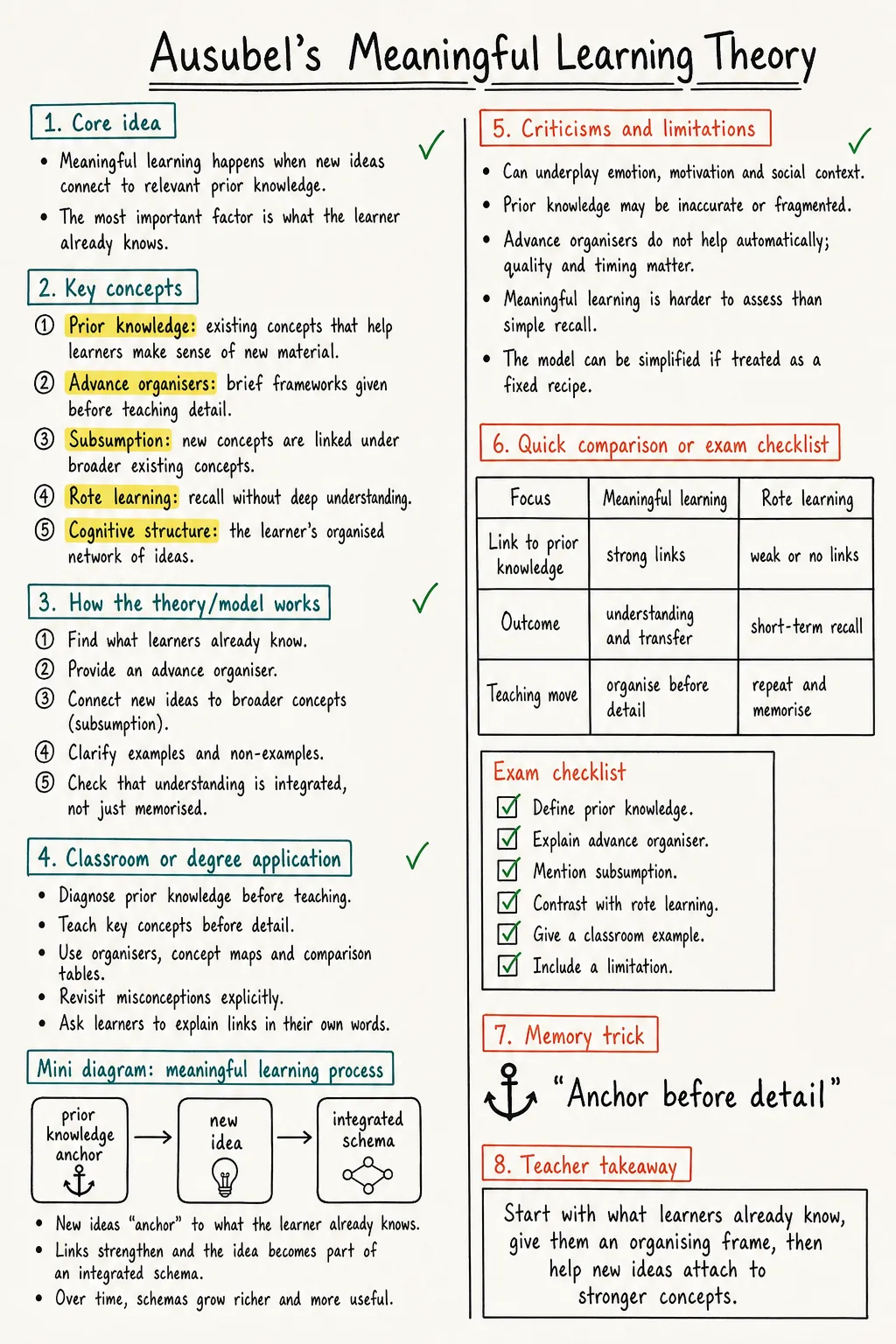
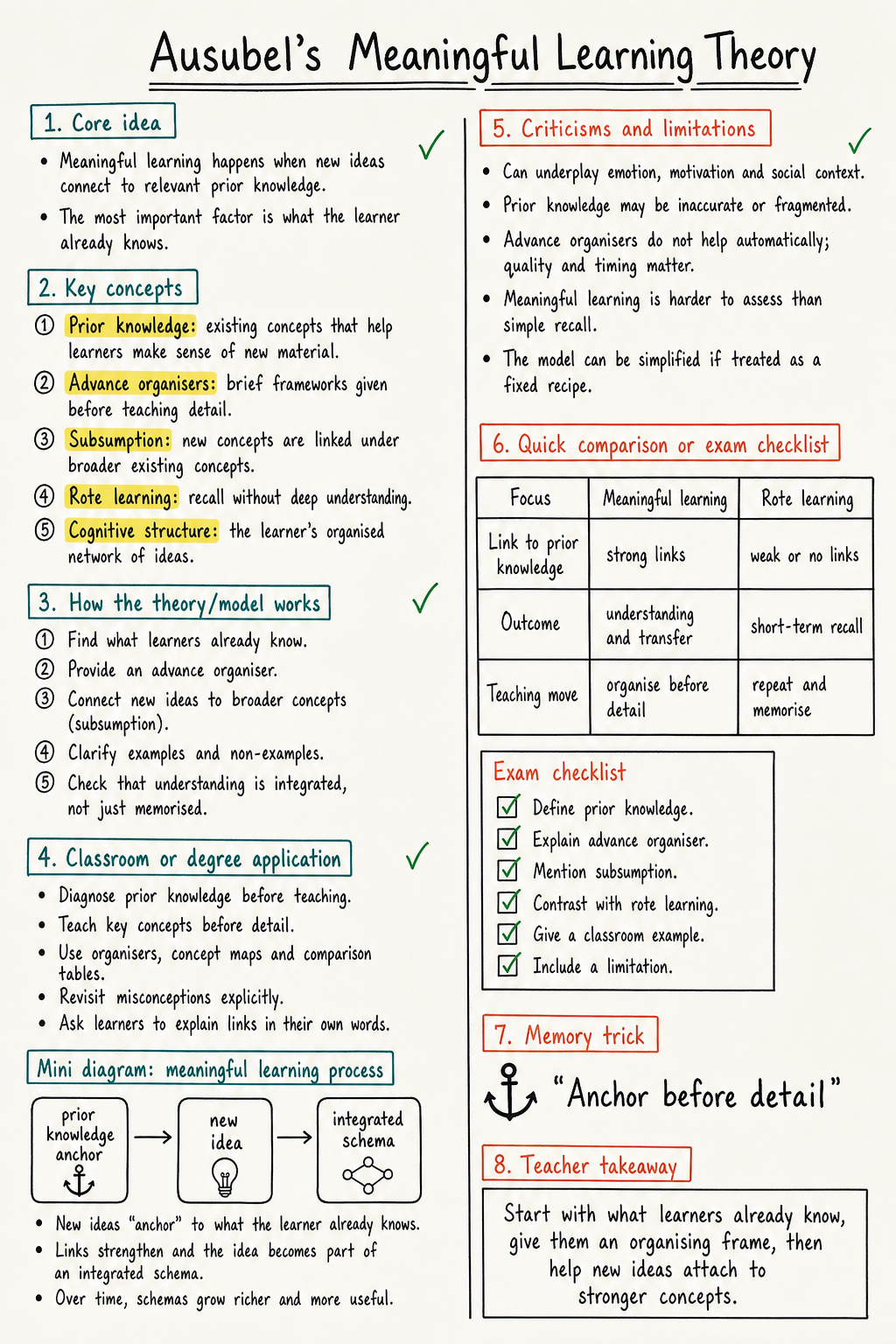
David Ausubel argued that learning only sticks when new knowledge connects to something a learner already knows. His theory of meaningful learning, developed through the 1960s, proposes that teachers should explicitly activate existing knowledge before introducing new concepts. The practical tool he designed to do this, the advance organiser, remains one of the most evidence-supported instructional strategies available to classroom teachers today.

David Paul Ausubel (1918-2008) was an American educational psychologist whose career spanned psychiatry, cognitive development, and classroom learning. Trained as a physician at Middlesex Medical School and later earning a doctorate in developmental psychology from Columbia University, Ausubel brought a clinical rigour to questions about how students actually learn in school settings.
His 1963 book, The Psychology of Meaningful Verbal Learning, laid out a systematic account of how verbal instruction works in classrooms. He followed this with the landmark 1968 volume Educational Psychology: A Cognitive View, which remains a foundational reference in teacher education programmes. Ausubel was preoccupied with a deceptively simple question: why do some students retain what they are taught while others forget almost immediately?
His answer was equally simple and profound. Students retain material when it anchors to what they already know. Learning that fails to make this connection is rote at best and transient at worst.
Ausubel drew a sharp distinction between two types of learning. Rote learning involves memorising material without connecting it to existing knowledge. The learner stores information in isolation, where it remains fragile and inaccessible when retrieval demands change. Meaningful learning, by contrast, occurs when new information is deliberately related to relevant concepts already held in the learner's cognitive structure (Ausubel, 1968).
The distinction matters enormously in classrooms. A pupil who memorises that the mitochondria produces ATP has acquired a fact. A pupil who understands why cells need energy, and how ATP functions as a portable store of that energy, has engaged in meaningful learning. The second pupil can transfer this understanding to new problems; the first cannot.
Ausubel's framework treats the learner's existing knowledge, what he called their cognitive structure, as the most critical variable in instruction. His most frequently quoted line captures this directly: "If I had to reduce all of educational psychology to just one principle, I would say this: The most important single factor influencing learning is what the learner already knows. Ascertain this and teach him accordingly" (Ausubel, 1968, p. vi).
This insight predates and anticipates much of what cognitive load theory would later formalise, particularly the role of working memory as a bottleneck when prior knowledge is absent. It also connects directly to schema theory, where existing knowledge structures (schemas) provide the hooks on which new learning is organised.
An advance organiser is introductory material presented before a lesson at a higher level of abstraction than the lesson content itself (Ausubel, 1960). It is not a summary, a preview, or a list of objectives. It is a conceptual bridge that connects what pupils already know to what they are about to learn.
Ausubel (1960) first demonstrated the effect in a study where students who received an advance organiser before reading a passage on metallurgy scored significantly higher on recall and transfer tests than students who read introductory material of equivalent length but without the bridging function. This finding has been replicated and extended in numerous subsequent studies, most notably through Mayer's (1979) meta-analysis, which found consistent positive effects of advance organisers on learning outcomes across science and social studies content.
There are two types of advance organiser, and they serve different instructional purposes.
Expository organisers introduce content that is entirely new to the learner. They present the key concepts at a general level before the lesson introduces the specifics. For example, before teaching a unit on the water cycle, a teacher might open with a short explanation of energy transfer as the underlying concept that drives all weather patterns. This gives pupils a conceptual anchor before they encounter the terminology of evaporation, condensation, and precipitation.
In secondary science, an expository organiser for a lesson on oxidation might begin by establishing that many chemical reactions involve atoms gaining or losing electrons, and that this transfer drives both rusting and fire. The organiser does not teach the lesson; it creates the cognitive space into which the lesson can settle.
Comparative organisers are used when pupils already have some relevant knowledge but are at risk of confusing two related concepts. They activate prior knowledge explicitly, then map out the distinctions. A teacher introducing negative reinforcement, for instance, might use a comparative organiser that draws out what pupils already know about positive reinforcement, then sets up the conceptual distinction between adding something and removing something.
This type is particularly valuable in subjects such as history, where pupils frequently conflate causes and consequences, or in mathematics, where similar procedures (such as finding area and finding perimeter) are routinely confused. Scaffolding in education often incorporates comparative organisers as a way of making distinctions visible before a pupil attempts independent work.
Behind the practical advance organiser lies a more detailed theoretical account of how knowledge is structured in the mind. Ausubel described this as subsumption theory. His claim was that new concepts are learned by being incorporated, or subsumed, into broader, more general concepts already held by the learner. Knowledge is not stored randomly; it is hierarchically organised, with more inclusive concepts at the top and specific instances nested beneath them.
Ausubel identified four subsumption processes.
Derivative subsumption occurs when new material is a specific example of a concept the learner already holds. A pupil who understands the concept of democracy as rule by elected representatives will find derivative subsumption straightforward when introduced to the Westminster system.
Correlative subsumption occurs when new material extends, modifies, or qualifies an existing concept. Learning that some democracies use proportional representation rather than first-past-the-post requires the pupil to revise their cognitive structure, not simply add a new example.
Superordinate learning works in reverse. Here, the pupil already knows several specific instances and then acquires the overarching concept that encompasses them. A pupil who knows robins, sparrows, and thrushes as specific birds acquires superordinate learning when they grasp the broader concept of passerine birds.
Combinatorial learning occurs when new material cannot be subsumed under existing concepts but relates to them in other ways. This is the most demanding form and requires the learner to form new connections across existing knowledge rather than integrating material vertically into an existing hierarchy.
Understanding which type of subsumption is involved in a lesson helps teachers select the right type of organiser and anticipate where pupils are likely to struggle. Graphic organiser templates can be designed specifically to mirror each type: hierarchical diagrams for derivative and superordinate subsumption, comparison tables for correlative subsumption, and concept maps for combinatorial learning.
Ausubel's theory was developed in direct tension with the discovery learning tradition championed by Jerome Bruner. Bruner argued that pupils learn most effectively when they discover concepts themselves through guided exploration. Ausubel disagreed forcefully.
His counterargument was that reception learning, where content is presented explicitly by the teacher, is not inherently passive or inferior to discovery learning. The quality of learning depends not on whether the learner discovered the content but on whether the new material was meaningfully integrated with prior knowledge (Ausubel, 1961). He was particularly critical of the assumption that meaningful learning requires independent discovery, calling this a conflation of the how of learning with the what.
From Ausubel's perspective, well-designed expository teaching, supported by advance organisers, could produce deeper and more durable learning than undirected discovery. He pointed to the implausibility of expecting pupils to independently reinvent the conceptual frameworks of centuries of accumulated knowledge.
This debate has practical implications for classroom design. Direct instruction research has subsequently accumulated substantial evidence in line with Ausubel's position: explicit teaching with careful sequencing and scaffolded progression produces strong outcomes, particularly for novice learners. Discovery-based approaches tend to work better once learners have acquired enough prior knowledge to make productive use of exploration.
The debate also illustrates a broader point about theory in teaching. Both Ausubel and Bruner were right in different contexts. Advance organisers and expository teaching are most valuable when pupils lack prior knowledge. Discovery approaches have a place once foundational knowledge is secured.

Primary teachers can apply Ausubel's theory in straightforward and immediate ways without needing to redesign their entire practice.
Before any new topic, spend two to three minutes asking pupils what they already know. This is not revision for its own sake; it activates the cognitive structures to which new material will attach. A Year 4 teacher beginning a geography unit on rivers might ask pupils to describe where they have seen water flowing in their own experience, from taps and gutters to streams and canals. This activates relevant prior knowledge before the technical vocabulary of tributaries and watersheds appears.
Visual advance organisers are particularly effective with younger pupils. A simple diagram showing that all rivers share three features, source, channel, and mouth, gives pupils a conceptual frame they can use to sort the detail that follows. This is precisely how concept mapping functions as a teaching tool: it makes the hierarchical structure of knowledge visible before pupils are asked to populate it with specific content.
Comparative organisers help primary pupils avoid the persistent confusions that impede progress. Before teaching subtraction as the inverse of addition, a brief comparative organiser that maps what pupils already know about addition against what they will learn about subtraction prevents the conflation that causes computational errors throughout Key Stage 2.
Differentiation strategies for the primary classroom often reduce to this single question: do all pupils have the prior knowledge they need to make sense of today's lesson? Ausubel's framework makes the answer to that question instructionally consequential.
Secondary teachers work in a context where the knowledge gaps between pupils are wider and prior misconceptions more entrenched. Ausubel's framework is particularly useful for handling both.
Before introducing new concepts in any subject, a brief diagnostic exercise reveals what pupils already hold in their cognitive structures. In chemistry, before teaching redox reactions, ask pupils to describe what happens when iron rusts. This activates prior knowledge while surfacing misconceptions (such as the belief that rust is a surface coating rather than a chemical transformation) that an expository organiser can address before they take root.
In English literature, before studying an unfamiliar text, a comparative organiser that connects the text's themes to a more familiar cultural reference point gives pupils a conceptual bridge. Before teaching Animal Farm, an organiser that draws on what pupils already know about satire and power structures creates the cognitive scaffolding into which Orwell's allegory can be meaningfully absorbed.
History teachers can use comparative organisers to help pupils distinguish between concepts they habitually conflate: revolution and reform, primary and secondary causes, ideology and policy. These distinctions are not naturally obvious; they require explicit conceptual preparation.
Ausubel's framework also supports retrieval practice. Retrieval is most effective when the material retrieved is meaningfully organised, not isolated facts. When prior lessons have used advance organisers to build hierarchical knowledge structures, retrieval practice activates those structures rather than isolated fragments.
The connection between Ausubel's theory and graphic organisers is direct and foundational. Graphic organiser templates are, in essence, the visible expression of the cognitive structures Ausubel described. They make the hierarchy of knowledge explicit so that pupils can see where new information fits.
A hierarchical graphic organiser models derivative and superordinate subsumption directly. When a pupil fills in a tree diagram that starts with the overarching concept and branches into specific instances, they are performing exactly the cognitive operation Ausubel described as the mechanism of meaningful learning. The visual structure externalises the internal cognitive process.
Comparative organisers translate directly into comparison frames and Venn diagrams. When pupils map similarities and differences between two concepts using a graphic organiser, they are engaging in correlative subsumption, revising and extending their existing conceptual structures rather than simply adding new facts.
Concept mapping, which Novak (2002) developed explicitly as an applied form of Ausubel's theory, goes further still. Novak worked directly with Ausubel and translated subsumption theory into a visual tool that pupils could use to represent their own knowledge structures. A well-constructed concept map shows not just which concepts a pupil knows but how those concepts relate to each other, revealing the depth of meaningful learning rather than the surface of recall.
For teachers using graphic organisers in the classroom, Ausubel's theory provides the theoretical grounding for why these tools work. They are not simply organisational aids. They are instruments for creating the conditions under which meaningful learning, as opposed to rote memorisation, becomes possible.
Ausubel's framework and cognitive load theory developed independently but arrive at complementary conclusions. Both theories identify the limits of working memory and the critical importance of prior knowledge as the central variables in learning.
Cognitive load theory (Sweller, 1988) proposes that working memory has a limited capacity and that instruction should be designed to manage this constraint. Material that cannot be connected to existing schemas places a heavy burden on working memory because every element must be held separately. Material that connects to existing knowledge can be handled as larger chunks, dramatically reducing the cognitive load.
Ausubel's meaningful learning is, in cognitive load terms, the process by which new information becomes integrated into existing schemas so that it can subsequently be processed as a unit rather than as isolated elements. The advance organiser reduces extraneous load by providing the schema into which new material will fit, before the detail arrives.
This connection is visible in the effect of expertise on learning. Expert learners, who have rich and well-organised prior knowledge, can learn from minimally guided instruction because they have the cognitive structures needed to assimilate new information meaningfully. Novice learners need explicit instruction and organisational scaffolding precisely because they lack those structures (Kirschner, Sweller, and Clark, 2006).
Working memory research supports Ausubel's practical recommendations. Activating prior knowledge before instruction is not merely motivational; it is a means of preparing the cognitive architecture that makes meaningful learning possible. Concrete, pictorial, and abstract approaches in mathematics education apply this principle by building conceptual understanding progressively rather than presenting abstract notation before pupils have the prior knowledge to make sense of it.

Ausubel's theory has several well-documented limitations that teachers should keep in mind when applying it.
The most persistent criticism concerns the difficulty of defining advance organisers with sufficient precision. Mayer (1979) noted in his meta-analysis that the effect sizes for advance organisers vary considerably across studies, partly because researchers define and operationalise them differently. An advance organiser that is too abstract provides no usable bridge; one that is too close in content to the lesson itself simply previews the lesson without providing genuine conceptual scaffolding.
The theory also assumes that pupils have prior knowledge that can be activated. For genuinely novel domains where no relevant prior knowledge exists, the advance organiser has nothing to connect to and the mechanism breaks down. Ausubel himself acknowledged this limitation, noting that superordinate learning, where the pupil lacks an existing concept that subsumes the new material, is the most challenging instructional problem.
A further limitation is that Ausubel's framework is primarily descriptive rather than prescriptive. It tells teachers that meaningful learning requires connection to prior knowledge without providing a detailed method for identifying exactly what prior knowledge pupils hold, or for diagnosing which misconceptions are present. Teachers must combine Ausubel's framework with diagnostic assessment practices to operationalise it fully in the classroom.
Finally, the theory focuses on declarative and conceptual knowledge. It has less to say about procedural knowledge, such as the learning of mathematical algorithms or physical skills, where the role of prior conceptual understanding is less direct.
These peer-reviewed studies provide the evidence base for the strategies discussed above.
The meaning of meaningful learning in mathematics in upper-primary education View study ↗
61 citations
Polman et al. (2020)
This study examines how meaningful learning in mathematics can be defined and implemented in upper-primary classrooms. Teachers can benefit from understanding the various interpretations of meaningful learning to better engage students and improve motivation in mathematics lessons.
Research Methods in Teacher Education: Meaningful Engagement Through Service-Learning View study ↗
14 citations
Froehlich et al. (2021)
This research demonstrates how service-learning and design-based research can create meaningful learning experiences in teacher education programmes. The Teaching Clinic approach offers practical methods for teacher educators to enhance research competencies whilst providing authentic learning opportunities.
Playful and Meaningful Learning of Programming. What does it Take to Integrate an App-Based Game Promoting Digital Mathematics into Early Childhood Education? View study ↗
Barman et al. (2022)
This study explores integrating app-based mathematical games in early childhood education through playful learning approaches. Teachers can learn how digital tools can be effectively incorporated into early years mathematics teaching to create engaging and meaningful learning experiences.
Exploring what makes learning meaningful for postgraduate business students in higher education View study ↗
Zeivots et al. (2024)
This research reveals that 'meaningful learning' is often interpreted differently by teachers and students in higher education contexts. The findings highlight the importance of understanding students' perspectives on meaningfulness to improve teaching effectiveness and engagement.
Empowering Science Education: Unveiling the Potential of Advance Organisers in Fostering Science Process Skills within Cooperative Learning Environments View study ↗
Apeadido et al. (2024)
This study demonstrates how advance organisers combined with cooperative learning can enhance science process skills development. Teachers can apply these findings to structure science lessons more effectively, using advance organisers to improve student understanding and skill acquisition.
David Ausubel argued that learning only sticks when new knowledge connects to something a learner already knows. His theory of meaningful learning, developed through the 1960s, proposes that teachers should explicitly activate existing knowledge before introducing new concepts. The practical tool he designed to do this, the advance organiser, remains one of the most evidence-supported instructional strategies available to classroom teachers today.

David Paul Ausubel (1918-2008) was an American educational psychologist whose career spanned psychiatry, cognitive development, and classroom learning. Trained as a physician at Middlesex Medical School and later earning a doctorate in developmental psychology from Columbia University, Ausubel brought a clinical rigour to questions about how students actually learn in school settings.
His 1963 book, The Psychology of Meaningful Verbal Learning, laid out a systematic account of how verbal instruction works in classrooms. He followed this with the landmark 1968 volume Educational Psychology: A Cognitive View, which remains a foundational reference in teacher education programmes. Ausubel was preoccupied with a deceptively simple question: why do some students retain what they are taught while others forget almost immediately?
His answer was equally simple and profound. Students retain material when it anchors to what they already know. Learning that fails to make this connection is rote at best and transient at worst.
Ausubel drew a sharp distinction between two types of learning. Rote learning involves memorising material without connecting it to existing knowledge. The learner stores information in isolation, where it remains fragile and inaccessible when retrieval demands change. Meaningful learning, by contrast, occurs when new information is deliberately related to relevant concepts already held in the learner's cognitive structure (Ausubel, 1968).
The distinction matters enormously in classrooms. A pupil who memorises that the mitochondria produces ATP has acquired a fact. A pupil who understands why cells need energy, and how ATP functions as a portable store of that energy, has engaged in meaningful learning. The second pupil can transfer this understanding to new problems; the first cannot.
Ausubel's framework treats the learner's existing knowledge, what he called their cognitive structure, as the most critical variable in instruction. His most frequently quoted line captures this directly: "If I had to reduce all of educational psychology to just one principle, I would say this: The most important single factor influencing learning is what the learner already knows. Ascertain this and teach him accordingly" (Ausubel, 1968, p. vi).
This insight predates and anticipates much of what cognitive load theory would later formalise, particularly the role of working memory as a bottleneck when prior knowledge is absent. It also connects directly to schema theory, where existing knowledge structures (schemas) provide the hooks on which new learning is organised.
An advance organiser is introductory material presented before a lesson at a higher level of abstraction than the lesson content itself (Ausubel, 1960). It is not a summary, a preview, or a list of objectives. It is a conceptual bridge that connects what pupils already know to what they are about to learn.
Ausubel (1960) first demonstrated the effect in a study where students who received an advance organiser before reading a passage on metallurgy scored significantly higher on recall and transfer tests than students who read introductory material of equivalent length but without the bridging function. This finding has been replicated and extended in numerous subsequent studies, most notably through Mayer's (1979) meta-analysis, which found consistent positive effects of advance organisers on learning outcomes across science and social studies content.
There are two types of advance organiser, and they serve different instructional purposes.
Expository organisers introduce content that is entirely new to the learner. They present the key concepts at a general level before the lesson introduces the specifics. For example, before teaching a unit on the water cycle, a teacher might open with a short explanation of energy transfer as the underlying concept that drives all weather patterns. This gives pupils a conceptual anchor before they encounter the terminology of evaporation, condensation, and precipitation.
In secondary science, an expository organiser for a lesson on oxidation might begin by establishing that many chemical reactions involve atoms gaining or losing electrons, and that this transfer drives both rusting and fire. The organiser does not teach the lesson; it creates the cognitive space into which the lesson can settle.
Comparative organisers are used when pupils already have some relevant knowledge but are at risk of confusing two related concepts. They activate prior knowledge explicitly, then map out the distinctions. A teacher introducing negative reinforcement, for instance, might use a comparative organiser that draws out what pupils already know about positive reinforcement, then sets up the conceptual distinction between adding something and removing something.
This type is particularly valuable in subjects such as history, where pupils frequently conflate causes and consequences, or in mathematics, where similar procedures (such as finding area and finding perimeter) are routinely confused. Scaffolding in education often incorporates comparative organisers as a way of making distinctions visible before a pupil attempts independent work.
Behind the practical advance organiser lies a more detailed theoretical account of how knowledge is structured in the mind. Ausubel described this as subsumption theory. His claim was that new concepts are learned by being incorporated, or subsumed, into broader, more general concepts already held by the learner. Knowledge is not stored randomly; it is hierarchically organised, with more inclusive concepts at the top and specific instances nested beneath them.
Ausubel identified four subsumption processes.
Derivative subsumption occurs when new material is a specific example of a concept the learner already holds. A pupil who understands the concept of democracy as rule by elected representatives will find derivative subsumption straightforward when introduced to the Westminster system.
Correlative subsumption occurs when new material extends, modifies, or qualifies an existing concept. Learning that some democracies use proportional representation rather than first-past-the-post requires the pupil to revise their cognitive structure, not simply add a new example.
Superordinate learning works in reverse. Here, the pupil already knows several specific instances and then acquires the overarching concept that encompasses them. A pupil who knows robins, sparrows, and thrushes as specific birds acquires superordinate learning when they grasp the broader concept of passerine birds.
Combinatorial learning occurs when new material cannot be subsumed under existing concepts but relates to them in other ways. This is the most demanding form and requires the learner to form new connections across existing knowledge rather than integrating material vertically into an existing hierarchy.
Understanding which type of subsumption is involved in a lesson helps teachers select the right type of organiser and anticipate where pupils are likely to struggle. Graphic organiser templates can be designed specifically to mirror each type: hierarchical diagrams for derivative and superordinate subsumption, comparison tables for correlative subsumption, and concept maps for combinatorial learning.
Ausubel's theory was developed in direct tension with the discovery learning tradition championed by Jerome Bruner. Bruner argued that pupils learn most effectively when they discover concepts themselves through guided exploration. Ausubel disagreed forcefully.
His counterargument was that reception learning, where content is presented explicitly by the teacher, is not inherently passive or inferior to discovery learning. The quality of learning depends not on whether the learner discovered the content but on whether the new material was meaningfully integrated with prior knowledge (Ausubel, 1961). He was particularly critical of the assumption that meaningful learning requires independent discovery, calling this a conflation of the how of learning with the what.
From Ausubel's perspective, well-designed expository teaching, supported by advance organisers, could produce deeper and more durable learning than undirected discovery. He pointed to the implausibility of expecting pupils to independently reinvent the conceptual frameworks of centuries of accumulated knowledge.
This debate has practical implications for classroom design. Direct instruction research has subsequently accumulated substantial evidence in line with Ausubel's position: explicit teaching with careful sequencing and scaffolded progression produces strong outcomes, particularly for novice learners. Discovery-based approaches tend to work better once learners have acquired enough prior knowledge to make productive use of exploration.
The debate also illustrates a broader point about theory in teaching. Both Ausubel and Bruner were right in different contexts. Advance organisers and expository teaching are most valuable when pupils lack prior knowledge. Discovery approaches have a place once foundational knowledge is secured.

Primary teachers can apply Ausubel's theory in straightforward and immediate ways without needing to redesign their entire practice.
Before any new topic, spend two to three minutes asking pupils what they already know. This is not revision for its own sake; it activates the cognitive structures to which new material will attach. A Year 4 teacher beginning a geography unit on rivers might ask pupils to describe where they have seen water flowing in their own experience, from taps and gutters to streams and canals. This activates relevant prior knowledge before the technical vocabulary of tributaries and watersheds appears.
Visual advance organisers are particularly effective with younger pupils. A simple diagram showing that all rivers share three features, source, channel, and mouth, gives pupils a conceptual frame they can use to sort the detail that follows. This is precisely how concept mapping functions as a teaching tool: it makes the hierarchical structure of knowledge visible before pupils are asked to populate it with specific content.
Comparative organisers help primary pupils avoid the persistent confusions that impede progress. Before teaching subtraction as the inverse of addition, a brief comparative organiser that maps what pupils already know about addition against what they will learn about subtraction prevents the conflation that causes computational errors throughout Key Stage 2.
Differentiation strategies for the primary classroom often reduce to this single question: do all pupils have the prior knowledge they need to make sense of today's lesson? Ausubel's framework makes the answer to that question instructionally consequential.
Secondary teachers work in a context where the knowledge gaps between pupils are wider and prior misconceptions more entrenched. Ausubel's framework is particularly useful for handling both.
Before introducing new concepts in any subject, a brief diagnostic exercise reveals what pupils already hold in their cognitive structures. In chemistry, before teaching redox reactions, ask pupils to describe what happens when iron rusts. This activates prior knowledge while surfacing misconceptions (such as the belief that rust is a surface coating rather than a chemical transformation) that an expository organiser can address before they take root.
In English literature, before studying an unfamiliar text, a comparative organiser that connects the text's themes to a more familiar cultural reference point gives pupils a conceptual bridge. Before teaching Animal Farm, an organiser that draws on what pupils already know about satire and power structures creates the cognitive scaffolding into which Orwell's allegory can be meaningfully absorbed.
History teachers can use comparative organisers to help pupils distinguish between concepts they habitually conflate: revolution and reform, primary and secondary causes, ideology and policy. These distinctions are not naturally obvious; they require explicit conceptual preparation.
Ausubel's framework also supports retrieval practice. Retrieval is most effective when the material retrieved is meaningfully organised, not isolated facts. When prior lessons have used advance organisers to build hierarchical knowledge structures, retrieval practice activates those structures rather than isolated fragments.
The connection between Ausubel's theory and graphic organisers is direct and foundational. Graphic organiser templates are, in essence, the visible expression of the cognitive structures Ausubel described. They make the hierarchy of knowledge explicit so that pupils can see where new information fits.
A hierarchical graphic organiser models derivative and superordinate subsumption directly. When a pupil fills in a tree diagram that starts with the overarching concept and branches into specific instances, they are performing exactly the cognitive operation Ausubel described as the mechanism of meaningful learning. The visual structure externalises the internal cognitive process.
Comparative organisers translate directly into comparison frames and Venn diagrams. When pupils map similarities and differences between two concepts using a graphic organiser, they are engaging in correlative subsumption, revising and extending their existing conceptual structures rather than simply adding new facts.
Concept mapping, which Novak (2002) developed explicitly as an applied form of Ausubel's theory, goes further still. Novak worked directly with Ausubel and translated subsumption theory into a visual tool that pupils could use to represent their own knowledge structures. A well-constructed concept map shows not just which concepts a pupil knows but how those concepts relate to each other, revealing the depth of meaningful learning rather than the surface of recall.
For teachers using graphic organisers in the classroom, Ausubel's theory provides the theoretical grounding for why these tools work. They are not simply organisational aids. They are instruments for creating the conditions under which meaningful learning, as opposed to rote memorisation, becomes possible.
Ausubel's framework and cognitive load theory developed independently but arrive at complementary conclusions. Both theories identify the limits of working memory and the critical importance of prior knowledge as the central variables in learning.
Cognitive load theory (Sweller, 1988) proposes that working memory has a limited capacity and that instruction should be designed to manage this constraint. Material that cannot be connected to existing schemas places a heavy burden on working memory because every element must be held separately. Material that connects to existing knowledge can be handled as larger chunks, dramatically reducing the cognitive load.
Ausubel's meaningful learning is, in cognitive load terms, the process by which new information becomes integrated into existing schemas so that it can subsequently be processed as a unit rather than as isolated elements. The advance organiser reduces extraneous load by providing the schema into which new material will fit, before the detail arrives.
This connection is visible in the effect of expertise on learning. Expert learners, who have rich and well-organised prior knowledge, can learn from minimally guided instruction because they have the cognitive structures needed to assimilate new information meaningfully. Novice learners need explicit instruction and organisational scaffolding precisely because they lack those structures (Kirschner, Sweller, and Clark, 2006).
Working memory research supports Ausubel's practical recommendations. Activating prior knowledge before instruction is not merely motivational; it is a means of preparing the cognitive architecture that makes meaningful learning possible. Concrete, pictorial, and abstract approaches in mathematics education apply this principle by building conceptual understanding progressively rather than presenting abstract notation before pupils have the prior knowledge to make sense of it.

Ausubel's theory has several well-documented limitations that teachers should keep in mind when applying it.
The most persistent criticism concerns the difficulty of defining advance organisers with sufficient precision. Mayer (1979) noted in his meta-analysis that the effect sizes for advance organisers vary considerably across studies, partly because researchers define and operationalise them differently. An advance organiser that is too abstract provides no usable bridge; one that is too close in content to the lesson itself simply previews the lesson without providing genuine conceptual scaffolding.
The theory also assumes that pupils have prior knowledge that can be activated. For genuinely novel domains where no relevant prior knowledge exists, the advance organiser has nothing to connect to and the mechanism breaks down. Ausubel himself acknowledged this limitation, noting that superordinate learning, where the pupil lacks an existing concept that subsumes the new material, is the most challenging instructional problem.
A further limitation is that Ausubel's framework is primarily descriptive rather than prescriptive. It tells teachers that meaningful learning requires connection to prior knowledge without providing a detailed method for identifying exactly what prior knowledge pupils hold, or for diagnosing which misconceptions are present. Teachers must combine Ausubel's framework with diagnostic assessment practices to operationalise it fully in the classroom.
Finally, the theory focuses on declarative and conceptual knowledge. It has less to say about procedural knowledge, such as the learning of mathematical algorithms or physical skills, where the role of prior conceptual understanding is less direct.
These peer-reviewed studies provide the evidence base for the strategies discussed above.
The meaning of meaningful learning in mathematics in upper-primary education View study ↗
61 citations
Polman et al. (2020)
This study examines how meaningful learning in mathematics can be defined and implemented in upper-primary classrooms. Teachers can benefit from understanding the various interpretations of meaningful learning to better engage students and improve motivation in mathematics lessons.
Research Methods in Teacher Education: Meaningful Engagement Through Service-Learning View study ↗
14 citations
Froehlich et al. (2021)
This research demonstrates how service-learning and design-based research can create meaningful learning experiences in teacher education programmes. The Teaching Clinic approach offers practical methods for teacher educators to enhance research competencies whilst providing authentic learning opportunities.
Playful and Meaningful Learning of Programming. What does it Take to Integrate an App-Based Game Promoting Digital Mathematics into Early Childhood Education? View study ↗
Barman et al. (2022)
This study explores integrating app-based mathematical games in early childhood education through playful learning approaches. Teachers can learn how digital tools can be effectively incorporated into early years mathematics teaching to create engaging and meaningful learning experiences.
Exploring what makes learning meaningful for postgraduate business students in higher education View study ↗
Zeivots et al. (2024)
This research reveals that 'meaningful learning' is often interpreted differently by teachers and students in higher education contexts. The findings highlight the importance of understanding students' perspectives on meaningfulness to improve teaching effectiveness and engagement.
Empowering Science Education: Unveiling the Potential of Advance Organisers in Fostering Science Process Skills within Cooperative Learning Environments View study ↗
Apeadido et al. (2024)
This study demonstrates how advance organisers combined with cooperative learning can enhance science process skills development. Teachers can apply these findings to structure science lessons more effectively, using advance organisers to improve student understanding and skill acquisition.
{"@context":"https://schema.org","@graph":[{"@type":"Organization","@id":"https://www.structural-learning.com/#org","name":"Structural Learning","url":"https://www.structural-learning.com/","logo":{"@type":"ImageObject","url":"https://cdn.prod.website-files.com/5b69a01ba2e409501de055d1/5b69a01ba2e40996a5e055f4_structural-learning-logo.png"}},{"@type":"Person","@id":"https://www.structural-learning.com/team/paul-main/#person","name":"Paul Main","url":"https://www.structural-learning.com/team/paul-main","jobTitle":"Founder","affiliation":{"@id":"https://www.structural-learning.com/#org"}},{"@type":"BreadcrumbList","@id":"https://www.structural-learning.com/post/ausubels-meaningful-learning-theory-teachers#breadcrumb","itemListElement":[{"@type":"ListItem","position":1,"name":"Home","item":"https://www.structural-learning.com/"},{"@type":"ListItem","position":2,"name":"Blog","item":"https://www.structural-learning.com/blog"},{"@type":"ListItem","position":3,"name":"Ausubel's Meaningful Learning Theory: A Teacher's Guide to Advance Organisers","item":"https://www.structural-learning.com/post/ausubels-meaningful-learning-theory-teachers"}]},{"@type":"BlogPosting","@id":"https://www.structural-learning.com/post/ausubels-meaningful-learning-theory-teachers#article","headline":"Ausubel's Meaningful Learning Theory: A Teacher's Guide to Advance Organisers","description":"","author":{"@id":"https://www.structural-learning.com/team/paul-main/#person"},"publisher":{"@id":"https://www.structural-learning.com/#org"},"datePublished":"2026-03-20","dateModified":"2026-03-20","inLanguage":"en-GB"}]}