Updated on
September 24, 2026
Science Pedagogy: Practical Methods for Science Teachers
Choose evidence-based science teaching methods, from practical work and argumentation to modelling, with guidance for primary and secondary classrooms.

Updated on
September 24, 2026
Choose evidence-based science teaching methods, from practical work and argumentation to modelling, with guidance for primary and secondary classrooms.
Science teaching helps learners understand concepts and reason scientifically. Good lessons focus on sense-making, not just following steps. Learners should predict and explain observations using models (Osborne, 2007; Hodson, 1998; Millar, 2004).
EEF (2020) found low science outcomes when learners copy more and do less practical work. Ofsted (2023) said many schools teach science as isolated facts. Learners then struggle to apply their knowledge in new situations.
These elements improve scientific understanding if used together. Abrahams & Millar (2008) say success needs planning and teacher knowledge. Hodson (1998) and Osborne (2010) stress linking tasks to science concepts. Gilbert (2004) says teachers make abstract ideas accessible for each learner. Zimmerman (2007) finds explicit instruction on reasoning is key.
Inquiry means guiding learners to question, predict, test, and interpret (Rosenshine, 2012). Kirschner et al. (2006) found unstructured exploration ineffective for new science concepts. They suggest that highly structured inquiry, with teacher support, works better.
Practical work matters, but not all practicals are equal. Abrahams and Millar (2008) found that learners learn more when practicals are designed to test learners' predictions than when they're designed merely to confirm textbook knowledge. A practical that asks "Does the mass of an object affect how fast it falls?" is more powerful than one that says "Here's how to measure the time for different objects falling, write down the data." The first develops reasoning; the second develops procedure.
Conceptual models help learners explain observations, which supports scientific reasoning. KS3 learners commonly think of heat as a substance (Driver, 1989). Teachers should explicitly contrast this naive model with particle vibration, then ask learners to use the scientific model to explain what they observed (Posner, 1982).
The 5E cycle is a widely-used sequence that mirrors scientific thinking. A Year 7 energy unit might follow this pattern:
Engage: Show learners a video of ice melting in a cup of warm water. Ask: "Where does the heat go? What happens to the heat?" Learners commit to a prediction or sketch what they think is happening inside the water.
Learners heat water and add ice. They measure temperature change over time and record results. The practical task lets them observe without needing explanations (Piaget, 1936).
Teachers present the particle model of heat as vibrating particle kinetic energy. Learners then explain observations. "Warm water particles move faster," they say. "They hit ice particles, making them vibrate faster. This melts the ice".
Elaborate: Learners apply this model to new contexts: "Why does a spoon in a hot cup become hot?" "How does insulation slow cooling?" They explain using the particle model, not memory.
Learners check their first idea by asking, "Was I right? What did I learn?" This metacognitive step helps learners compare their prediction with the evidence (Flavell, 1979; Dunlosky & Rawson, 2012). Reflection strengthens the connection between the observation and the scientific model (Nelson & Narens, 1990).
Learners build meaning, instead of just receiving facts. The 5E model sparks interest, connecting what learners know already (Bybee et al., 2006). Learners explore ideas, creating a base for explanations (Trowbridge & Bybee, 1990). Learners assess their knowledge, which strengthens learning (BSCS, 2005).
POE is a simpler, more focused approach used when introducing a new concept. A Year 5 forces lesson might use POE for floating and sinking:
Predict: "Will this lump of playdough sink or float?" Learners write down their prediction and why.
Observe: Learners drop the playdough into water. It sinks. The teacher then shows what happens when the same playdough is shaped into a boat. It floats.
Explain: Learners now explain the apparent contradiction: "The amount of material didn't change, but the shape did. The boat shape spreads the weight over a larger area, so the water pushes up harder." They draw a diagram showing forces to explain their reasoning.
POE helps learners because prediction errors cause thinking conflicts. (Posner et al., 1982). The brain works to fix these conflicts by finding better answers. This process replaces old misconceptions with correct science knowledge (Hewson et al., 1998).
Science involves more than experiments; learners build and defend explanations. Good science teaching lets learners make claims based on evidence. They can also challenge flawed thinking (Osborne, 2010; Berland & Reiser, 2009; McNeill & Krajcik, 2008).
In a Year 8 photosynthesis lesson, learners might analyse competing claims: "My friend says plants get their energy from soil because they have roots in soil. A scientist says plants get energy from sunlight. Which is correct and why?" Learners must cite evidence (plants can grow without soil but with light; plants stop growing in darkness even with rich soil) and construct a logical argument.
Argumentation scaffolds include:
Learners eventually internalise this reasoning, building scientific explanations independently. Driver et al. (1994) showed that learners arguing their reasoning gain deeper science understanding. They learn more than those taught only facts.
Abstract science concepts, atoms, energy, forces, fields, exist at scales learners cannot see. Modelling bridges this gap. A model is a simplification that captures key features of a phenomenon and allows prediction.
For photosynthesis, learners might start with a word model: "Plants take in carbon dioxide and water, use sunlight, and make sugar and oxygen." This is true but vague. A visual model shows inputs and outputs: sunlight → plant → sugar + oxygen. A more sophisticated model shows where these processes happen (leaf structure: stomata, mesophyll cells, chloroplasts). The most sophisticated model shows the chemical equations and energy transfer.
Effective modelling involves:
Without explicit modelling, learners build their own basic ideas. They may think heat is a fluid, electricity is used up or atoms are tiny uniform balls. Explicit teaching of models, analogies and their limits helps replace these misconceptions with more scientific explanations (Gilbert, 2004; Clement, 2000).
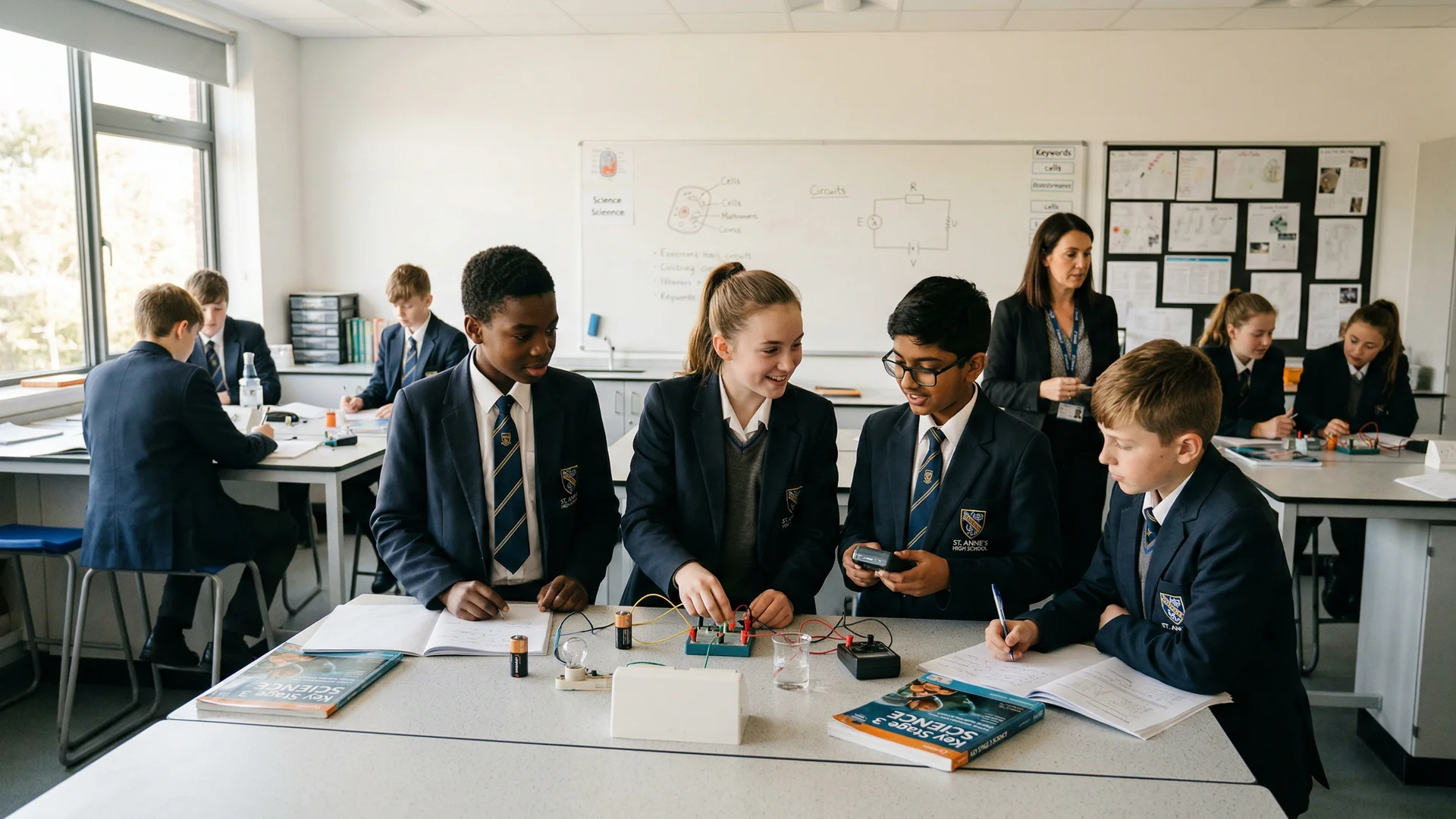
Abrahams and Millar (2008) showed not all practicals are equal. They identified key features that make practical work effective for learners. These features help learners connect actions with science concepts (Abrahams & Millar, 2008).
Purpose clarity: Learners must know why they're doing the practical. "We're testing whether sugar dissolves faster in hot or cold water" is clearer than "Do this experiment." Learners with clear purpose engage more deeply.
Research shows prediction engages learners' minds (Engelmann et al., 2023). Testing predictions, like car speed versus distance, builds reasoning skills. Simply measuring lacks the same cognitive benefit (Engelmann et al., 2023).
Clear instructions and targeted questioning aid learner understanding (Vygotsky, 1978). Scaffolding, according to Wood et al (1976), bridges the gap between current and desired learner skills. This approach fosters deeper learning (Hmelo-Silver et al, 2007).
Time for analysis: Learners often spend 90% of practical time collecting data and 10% analysing it. This is backwards. Once data is collected (quickly), most time should be spent explaining patterns, identifying anomalies, and refining predictions. A practical that takes 20 minutes to set up and 30 minutes to analyse is more effective than one that takes 40 minutes to set up and 10 minutes to analyse.
(Harlen, 2010) suggested primary science builds early curiosity. Learners gain skills and basic science ideas. Key Stage 1 and 2 science needs emphasis on:
Science enquiry skills include questioning and planning tests. Learners measure, observe, and draw conclusions (National Curriculum). Year 2 learners grow cress with different conditions for "What do plants need?" They record what they observe, then decide what the plants need. This builds models of variables and testing, key for Key Stage 3.
In Year 3, learners explore materials and their properties through concrete examples: hard, soft, stretchy and waterproof. Year 5 develops this towards reversible and irreversible change. Key Stage 3 then introduces particles, bonding and structure-property explanations.
Bruner (1966) said learners grasp concrete examples first. Start electricity lessons with real circuits for Year 4 learners. Let learners observe changes by breaking circuits (Bruner, 1966). They can also add bulbs or change the battery. Circuit symbols and models can wait until KS3. Building from concrete to abstract helps learning (Bruner, 1966).
Phenomena engage learners when they point towards an explanation. Instead of lifecycle worksheets, try a playground walk: find insects with learners, observe habitats and ask, "Why are beetles under logs, not butterflies?" This keeps curiosity tied to a scientific question (Windschitl et al., 2008).
Science teachers guide learners through complex GCSE concepts. Adey and Shayer's (1994) research proves cognitive acceleration is effective. Osborne and Dillon (2008) stress good argumentation skills. Millar (2004) says balance understanding and practical skills.
Learners first handle materials, then name and classify them. Next, they identify observable properties, building on earlier experiences. Finally, learners connect properties to particle and atomic models so later explanations have a concrete base.
Each step builds on the previous one. Learners who skip early steps often develop misconceptions by KS4, they memorise reactions without understanding why they occur.
Learners often memorise GCSE facts, like photosynthesis equations. They struggle to apply this knowledge to new situations. Effective preparation builds understanding in KS3 and KS4. Revision then focuses on applying that deep understanding.
GCSEs include practical work; learners must show competence in 16 practicals. Good teachers plan this into KS3 and KS4, not just Year 11. A Year 9 forces lesson uses practical skills, relevant in Year 11 (Abrahams & Millar, 2008).
Misconceptions are persistent false beliefs about how the world works. They're not careless errors, they're coherent mental models that make sense to learners based on their experience. Addressing misconceptions is the core work of science pedagogy.
Common misconceptions by topic:
How to address misconceptions:
Simply stating the correct idea doesn't change minds. Learners need to confront their misconception, engage with evidence against it, and construct a better model. The Predict-Observe-Explain approach does this well: when learners predict that a heavier ball falls faster, then observe that it falls at the same rate (ignoring air resistance), they experience cognitive conflict that motivates a search for better explanation.
Diagnostic questions, questions designed to reveal misconceptions, are powerful tools. "A brick and a marble drop from a height. Which hits the ground first?" Those who say "the brick" reveal the misconception that weight affects fall speed. This reveals where teaching is needed.
Once a misconception is revealed, teaching should explicitly contrast the naive model with the scientific one: "Many people think heavier objects fall faster because they're heavier. But watch this: two objects of different masses, dropped at the same time, they hit the ground together. What does this tell us?" This explicit contrast replaces misconceptions more effectively than simply teaching the right answer.
Science depends on disciplinary literacy, mathematical reasoning and careful use of models. Learners benefit when teachers explicitly teach these connections rather than assuming they will transfer from English or maths. The EEF secondary science guidance supports this planning.
Science uses maths such as graphs in physics and equations in chemistry. Year 10 physics, such as terminal velocity, uses equations and graphs to show how gravity and air resistance change over time. Teach the mathematical representation alongside the science concept so learners can explain what the graph means.
Scientific writing uses causal language; for example, "A increases B because...". This differs from narrative, which says "A then B." Teaching scientific writing improves learners’ literacy and science (Year 8). Writing like "Heating sugar makes particles vibrate faster, dissolving it quicker" builds vocabulary, reasoning and knowledge.
STEM and cross-curricular work should protect subject depth. Designing insulation can connect science, design and mathematics, but the science goal must stay explicit. Good cross-curricular work needs genuine connections and secure subject teaching (Honey, 2014; Bybee, 2010; Sanders, 2009).
Several evidence syntheses guide effective science teaching:
The EEF Improving Secondary Science guidance report recommends using models, supporting scientific reasoning, teaching vocabulary explicitly, using structured feedback and making practical work purposeful. It is guidance for improving teaching decisions, not a claim that one set of methods automatically raises GCSE results.
Ofsted's 2023 science subject report found that stronger science curricula build concepts over time, use practical work to deepen understanding and address misconceptions directly. It also warns against teaching disconnected facts without enough attention to the organising ideas of the subject.
Sweller's (1988) cognitive load theory helps with science lessons. Present new information clearly, avoiding unnecessary distractions. Worked examples support learners' problem-solving skills (Sweller, 1988). Spaced retrieval practice boosts long-term learning (Sweller, 1988).
Despite strong evidence for effective practice, several barriers persist:
Primary teachers often feel unsure about science due to lacking qualifications. This can result in copying resources instead of fostering learner reasoning. Research shows investment in science CPD boosts teaching practice.
Some schools lack labs or equipment, limiting practical work. However, useful practical work can still be simple: plant growth observations, dissolving substances, building circuits or observing forces. The important point is whether the task helps learners connect action with scientific explanation (Hodson, 1998; Abrahams & Millar, 2008).
Curriculum time can put science under pressure when schools prioritise English and maths intervention. Protecting science time matters because later GCSE understanding depends on secure foundations in concepts, vocabulary, models and enquiry. Leaders should solve timetabling pressure without creating avoidable science knowledge gaps.
GCSE pressure can pull teaching towards rehearsal of exam routines. That may help short-term performance, but science teaching still needs conceptual understanding, retrieval, vocabulary and purposeful practical work. The strongest approach is to prepare learners for exams by building the knowledge and reasoning the exams are intended to sample.
1. Abrahams, I., & Millar, R. (2008). Does practical work really work? A study of the effectiveness of practical work as a teaching and learning method in school science. International Journal of Science Education, 30(14), 1945-1969.
This study analysed why some practicals develop reasoning while others merely confirm facts. The key finding: practicals work when learners predict outcomes first, then test their predictions.
Driver et al. (1994) detail common science misconceptions in "Making Sense of Secondary Science". They provide strategies to address these ideas. The book helps teachers understand learners' existing beliefs.
Kirschner, Sweller, and Clark (2006) showed minimal guidance in learning does not work. Their paper explains why constructivist methods often fail. Effective inquiry needs strong teacher support, they argued.
Education Endowment Foundation (2020) offers five science teaching recommendations. This guidance improves learner GCSE results by 0.4 grades, research shows. Find practical strategies in their "Improving Secondary Science" report.
Ofsted (2023) reviewed science in 41 schools. They found conceptual coherence improved outcomes. Practical work with purpose and addressing misconceptions helped learners (Ofsted, 2023).