Reciprocal Reading: The Complete Teacher's Guide to the Fab Four Strategies
|
January 16, 2026
Implement Reciprocal Reading effectively with the Fab Four strategies: Predict, Clarify, Question, and Summarise. Access role cards and session structures.
Main, P. (2026, January 20). Reciprocal Reading: The Complete Teacher's Guide to Collaborative Comprehension. Retrieved from https://www.structural-learning.com/post/reciprocal-reading-complete-teachers-guide
Ready to transform your students into confident, engaged readers? This complete guide to reciprocal reading will show you exactly how to implement the powerful "Fab Four" strategies in your classroom, with step-by-step instructions that make even reluctant readers active participants in their learning. You'll discover practical techniques for teaching students to predict, clarify, question, and summarise whilst leading their own reading discussions. Whether you're new to reciprocal reading or looking to refine your approach, these proven methods will help you create a collaborative reading environment where every student develops stronger comprehension skills.
Essential Reciprocal Reading Benefits
Strategy Purpose Student Action Key Skill Developed
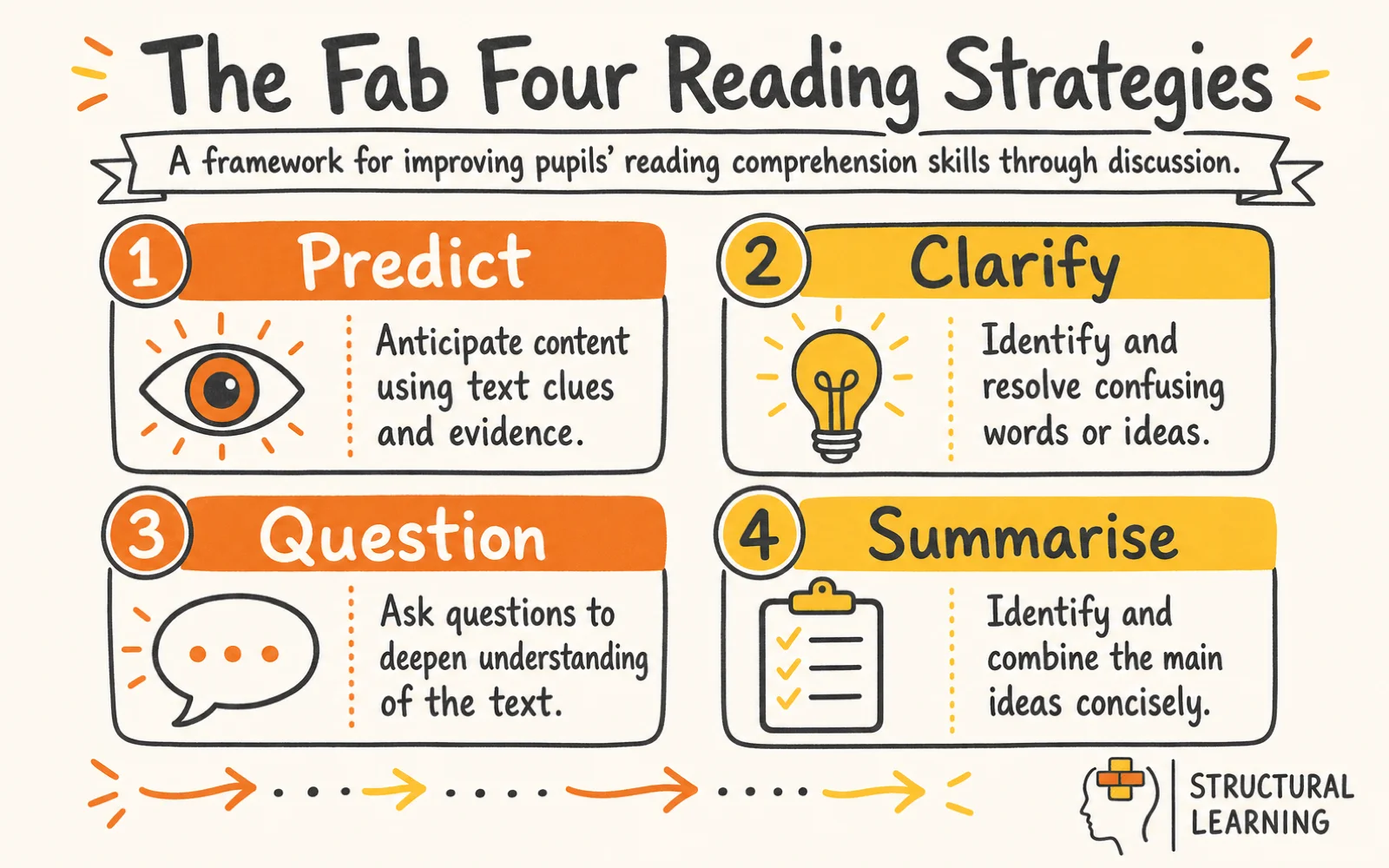
Predict Use clues from text to anticipate what will happen next Make evidence-based predictions about upcoming content Forwards-thinking and text analysis
Clarify Identify and resolve confusing or difficult concepts Explain unclear words, phrases, or ideas Problem-solving and vocabulary development
Question Generate meaningful questions to deepen understanding Create questions that promote discussion and thinking Critical thinking and inquiry skills
Summarise Identify and synthesize main ideas and key information Create concise summaries of text content Information synthesis and main idea identification
The Fab Four: Reciprocal Reading Strategies at a Glance
Key Takeaways
The Fab Four Strategies: Predict, Clarify, Question, and Summarise work together to develop metacognitive reading skills. Students learn not just to read, but to think about their reading
Role-Based Discussion: Students take turns being the "teacher" for each strategy, building confidence and ownership of their learning. The teacher gradually releases responsibility to the group
Research-Proven Results: Studies show reading comprehension improvements from 30% to 70% after just 15-20 days of consistent practise. Effect sizes of 0.74 make this one of the most effective reading interventions available
Explicit Instruction First: The approach works best when teachers explicitly model each strategy before expecting students to use them independently. Never assume students know how to predict, clarify, question, or summarise
What is Reciprocal Reading?
Reciprocal Reading is an instructional approach where students learn four comprehension strategies through structured group discussions. The method involves students taking turns as 'teacher' whilst using Predict, Clarify, Question, and Summarise strategies. Research demonstrates reading comprehension improvements of 30-70% after consistent practise.
The Fab Four Strategies Framework
Reciprocal Reading (also called Reciprocal Teaching) is an instructional approach where students learn four comprehension strategies through structured group discussions. The term "reciprocal" refers to the back-and-forth dialogue between teacher and students, and eventually between students themselves.
Palincsar and Brown developed this approach based on research showing that proficient readers naturally use strategies like predicting and summarising, while struggling readers often read passively without engaging with the text. By explicitly teaching these strategies and providing structured practise, all students can develop the comprehension skills that good readers use automatically.
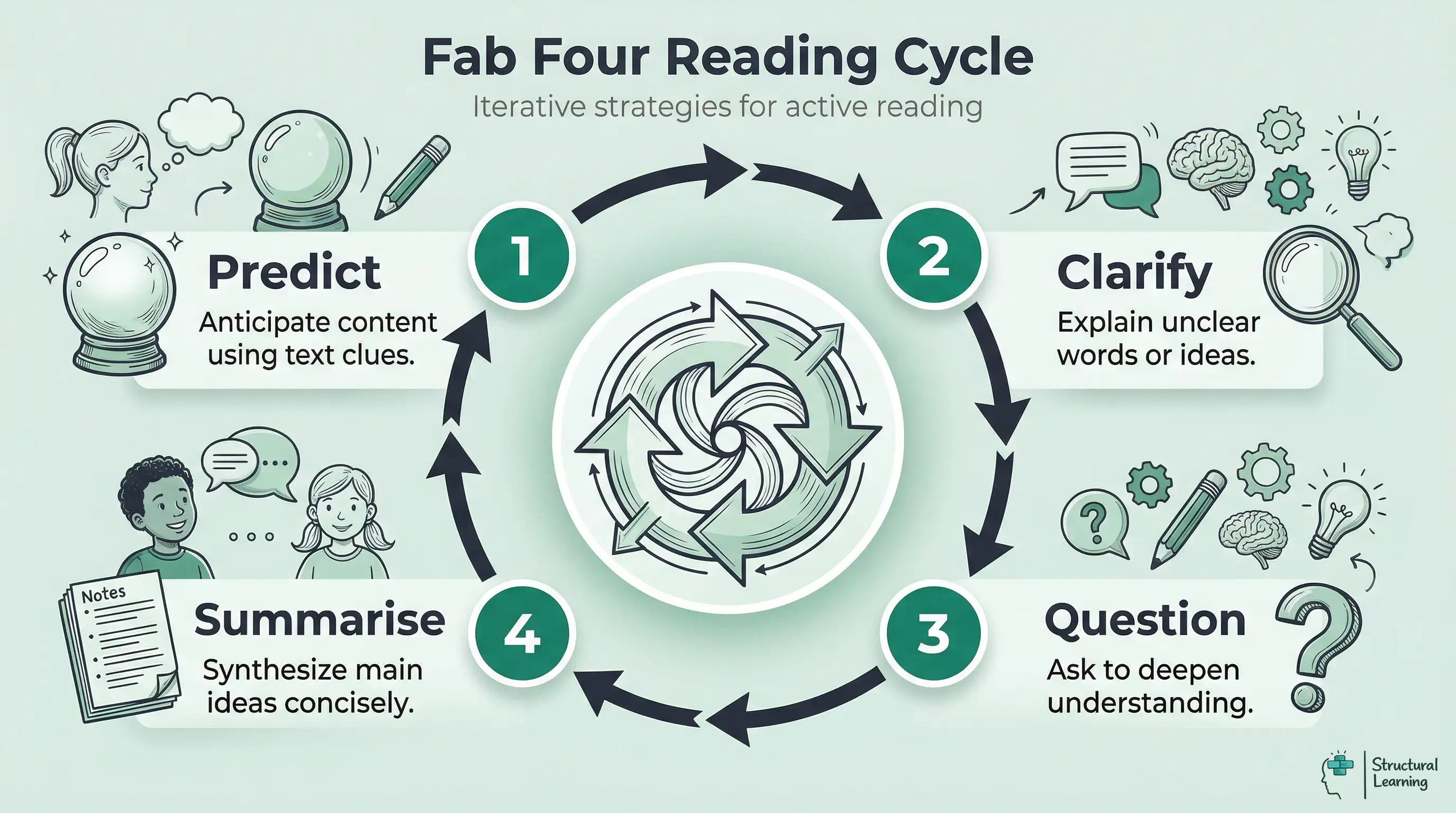
The Fab Four strategies are Predict, Clarify, Question, and Summarise, four comprehension techniques that transform passive reading into active engagement. These strategies work together to develop metacognitive reading skills. Students use evidence-based predicting, clarify difficult concepts, generate meaningful questions, and create concise summaries.
Strategy 1: Predict
Predicting involves using clues from the text to anticipate what will happen next or what information will be covered. Good predictions are based on evidence, not random guesses.
What students do when predicting:
Teaching prompts for predicting:
Sentence stems for students:
Strategy 2: Clarify
Clarifying involves identifying and resolving confusion in the text. Students learn to recognise when they do not understand something and use strategies to fix comprehension breakdowns.
| Right There | Answer is directly stated in the text | "What colour was the dragon?" |
| Think and Search | Answer requires combining information from different parts | "How did the character change throughout the story?" |
| Author and Me | Answer requires inference using text plus prior knowledge | "Why do you think the character made that choice?" |
| On My Own | Answer draws on prior knowledge and opinion | "What would you do in this situation?" |
Teaching prompts for questioning:
Sentence stems for students:
Strategy 4: Summarise
Summarising involves identifying and restating the main ideas in your own words. This strategy helps students distinguish between important information and supporting details.
What makes a good summary:
Teaching prompts for summarising:
Sentence stems for students:
How to Implement Reciprocal Reading
Phase 1: Teacher Modelling (Weeks 1-2)
The teacher demonstrates each strategy explicitly using think-alouds:
Read a short section of text aloud
Stop and verbalise your thinking for each strategy
Make your thought process visible: "I am predicting that... because I noticed..."
Show what happens when comprehension breaks down and how to fix it
Summarise in your own words, explaining what you included and excluded
Repeat this process daily with different texts until students can identify when and why you use each strategy.
Phase 2: Guided Practise (Weeks 3-4)
Gradually involve students in the process:
Read text together
Teacher leads each strategy but invites student contributions
Use prompts like "What do you predict? Can anyone add to that?"
Teacher circulates, supports, and provides feedback
Phase 4: Independent Application (Ongoing)
Students internalise strategies and use them automatically:
Groups function independently
Teacher observes and assesses
Students apply strategies to independent reading
Strategies become automatic reading habits
Continue practise across different text types
Classroom Setup and Group Organisation
Reciprocal Reading groups work best with 4-6 students of mixed abilities, allowing peer support and diverse perspectives. Teachers assign rotating roles for each strategy, ensuring every student experiences leading discussions. Groups require clear expectations, established routines, and structured discussion protocols to function effectively.
Group Composition
Role Cards
Create cards for each role with the strategy name, key questions, and sentence stems:
Predictor Card:
Clarifier Card:
Questioner Card:
Summariser Card:
Session Structure
A typical 20-30 minute session:
| Time | Activity |
|------|----------|
| 2 min | Introduce text, activate prior knowledge |
| 3 min | Predictor leads predictions based on title/pictures |
| 5 min | Read section together (or independently) |
| 3 min | Clarifier identifies and resolves confusion |
| 5 min | Questioner leads question generation and discussion |
| 3 min | Summariser restates main ideas |
| 2 min | Rotate roles, repeat with next section |
From Teacher-Led to Student-Led: The Reciprocal Reading Process
Common Reciprocal Reading Challenges
Common Reciprocal Reading challenges include students making weak predictions, avoiding difficult vocabulary, asking superficial questions, and creating incomplete summaries. Teachers overcome these issues through explicit modelling, providing sentence starters, using graphic organisers, and offering targeted feedback during group discussions.
Challenge: Students Won't Participate
Possible causes:
Solutions:
Challenge: Superficial Discussion Quality
Possible causes:
Solutions:
Challenge: Over-reliance on Teacher Support
Possible causes:
Solutions:
Challenge: Student Domination in Groups
Possible causes:
Solutions:
Assessing Progress in Reciprocal Reading
Live Assessment During Reading Sessions
Observe and note:
Formal Comprehension Testing Methods
Compare pre and post:
Self-Assessment
Students reflect on:
Supporting SEND Students with Reciprocal Reading
SEND students benefit from Reciprocal Reading through additional scaffolding-in-education-a-teachers-guide">scaffolding, visual supports, and modified expectations. Teachers provide strategy cards, reduce text complexity, offer extended thinking time, and use peer partnerships. The structured approach particularly supports students with reading difficulties and autism spectrum conditions.
Helping Struggling Readers Succeed
Adapting Strategies for EAL Learners
Challenging High-ability Reader Extensions
Reciprocal Reading Research Evidence
Reciprocal Teaching has one of the strongest evidence bases of any reading intervention:
The research consistently shows that explicit instruction in the four strategies, followed by guided practise in small groups, leads to significant gains in reading comprehension that transfer to independent reading.
What is Reciprocal Teaching? Understanding the Fab Four Strategies
Reciprocal teaching transforms reading from a passive activity into an interactive dialogue between students and text. Developed by Palincsar and Brown in 1984, this structured approach teaches students to lead their own reading comprehension discussions using four interconnected strategies: predicting, clarifying, questioning, and summarising.
Unlike traditional reading lessons where teachers ask all the questions, reciprocal teaching puts students in charge of their learning. Groups of four to six students work together, with each member taking responsibility for one of the "Fab Four" strategies. The predictor anticipates what might happen next, the clarifier identifies confusing parts, the questioner generates discussion points, and the summariser captures key ideas. These roles rotate, ensuring every student practises each skill.
In practise, this might look like Year 5 students reading a chapter from The Lion, the Witch and the Wardrobe. The predictor says, "I think Lucy will find something magical in the wardrobe because the professor seems mysterious." The clarifier explains that "spare room" means an unused bedroom, whilst the questioner asks, "Why do you think the author describes the house as feeling empty?" The summariser then captures the main events: "Four children arrive at a large house during the war to stay with an old professor."
Research consistently shows that reciprocal teaching improves reading comprehension more effectively than traditional methods. The approach works because it makes thinking visible; students must articulate their understanding rather than simply answering comprehension questions. By teaching students how expert readers think, reciprocal teaching provides a framework they can use independently with any text, from science textbooks to historical documents.
Why Use Reciprocal Teaching in Your Classroom?
Reciprocal teaching transforms passive readers into active thinkers, giving you a structured framework that works across all ability levels. When students learn to predict, clarify, question, and summarise, they're not just reading; they're developing the same mental processes that skilled readers use automatically. This approach is particularly powerful because it makes invisible thinking visible, allowing you to spot and address comprehension gaps immediately.
The collaborative nature of reciprocal teaching addresses several classroom challenges simultaneously. Students who typically remain silent during whole-class discussions often flourish in small group settings where they have specific roles and responsibilities. For example, a Year 5 student who struggles with confidence might excel as the 'Clarifier', helping peers understand difficult vocabulary whilst building their own self-esteem. Similarly, more able readers develop deeper analytical skills when they must explain their thinking process to others.
Research consistently demonstrates reciprocal teaching's impact on reading comprehension, with studies showing it benefits both struggling readers and those performing at expected levels. The National Literacy Trust highlights how dialogue-based learning approaches significantly improve comprehension, particularly for disadvantaged pupils. In practise, this means a Year 7 class studying 'The Boy in the Striped Pyjamas' might see comprehension test scores improve by 40% after just six weeks of regular reciprocal reading sessions.
Perhaps most importantly, reciprocal teaching equips students with transferable skills they'll use beyond your classroom. When students learn to question texts critically, clarify their understanding independently, and summarise key information, they're developing essential study skills for GCSEs and beyond. These strategies work equally well with fiction, non-fiction, and even mathematical word problems, making them invaluable tools for lifelong learning.
How to Implement Reciprocal Teaching: A Step-by-Step Guide
Successful reciprocal teaching follows a structured progression that gradually transfers responsibility from teacher to students. Begin by selecting appropriate texts; choose materials slightly above students' independent reading level but within their instructional range. Short, content-rich passages of 300-500 words work best initially.
Start with explicit modelling over several sessions. Demonstrate each strategy separately, thinking aloud as you predict, clarify, question, and summarise. For instance, when teaching prediction, show students how you use text features, prior knowledge, and context clues to anticipate content. Display your thought process visibly, perhaps noting predictions on the board with supporting evidence.
Next, move to guided practise where you scaffold student attempts. Assign one strategy per student in groups of four, providing prompt cards initially. A clarifier might receive prompts like "I wasn't sure what this word meant..." or "This part confused me because..." Circulate amongst groups, offering feedback and gradually reducing support as competence grows.
The transition to independent group work typically takes 10-15 sessions. By this stage, students should rotate roles naturally, with minimal teacher intervention. Monitor for quality discussions; effective groups spend equal time on each strategy and reference the text specifically. One Year 5 teacher reported her groups progressing from five-minute superficial discussions to twenty-minute analytical conversations within six weeks.
Assessment happens through observation and student self-reflection. Create simple rubrics focusing on strategy use rather than comprehension accuracy. Students might rate their performance: "I made three predictions using text evidence" or "I asked one 'why' question and one 'what if' question." This metacognitive awareness strengthens the approach's effectiveness, as Palincsar and Brown's original research demonstrated.
Reciprocal Reading FAQs
How often should we do Reciprocal Reading?
Daily or near-daily practise during the learning phase (first 4-6 weeks) yields best results. After strategies are established, 2-3 times weekly maintains skills.
What age/year group is this suitable for?
Reciprocal Reading works from Year 2 upwards. Younger children can learn simplified versions of the strategies with more scaffolding.
Can I use this with whole class teaching?
Yes, but it is most effective in small groups where all students actively participate. Use whole-class modelling, then small group practise.
How long until we see improvement?
Research shows significant gains after 15-20 sessions. Consistent practise over 6-8 weeks typically shows measurable progress.
Do students need to read the text themselves?
For struggling readers, the teacher or a peer can read aloud while students focus on strategy practise. As fluency improves, students read independently.
That Work infographic for teachers" loading="lazy">
Power Up Your Predictions: Teaching Prompts That Work
Frequently Asked Questions
How long should each reciprocal reading session last?
Reciprocal reading sessions work best when they last 20-30 minutes for primary students and 30-45 minutes for secondary students. This allows enough time for each student to practise their assigned strategy role whilst maintaining engagement. Start with shorter sessions and gradually increase duration as students become more comfortable with the process.
What text types work best for reciprocal reading activities?
Fiction and non-fiction texts at students' instructional reading level work equally well for reciprocal reading. Choose texts with rich content that naturally lend themselves to prediction, questioning, and discussion. Avoid texts that are too easy or too difficult, as this can limit the effectiveness of the clarifying and questioning strategies.
How do you assess student progress in reciprocal reading?
Assess reciprocal reading progress through observation checklists, recording the quality of student-generated questions, predictions, and summaries. Listen for evidence of deeper thinking during discussions and note improvements in students' ability to lead their strategy roles independently. Regular comprehension checks and reading assessments will show measurable gains over time.
Can reciprocal reading work with struggling readers?
Yes, reciprocal reading is particularly effective for struggling readers when properly scaffolded. Provide additional modelling, use texts at appropriate levels, and consider pairing weaker readers with stronger peers initially. The collaborative nature and explicit strategy instruction help build confidence whilst improving comprehension skills for all ability levels.
How often should students rotate between the four strategy roles?
Students should rotate through all four roles regularly, typically every few days or weekly depending on your reading schedule. This ensures all students experience being the 'teacher' for each strategy and develop competence across all four areas. Avoid rotating too frequently within single sessions as this can disrupt the flow of discussion.
Further Reading: Key Research Papers
These peer-reviewed studies provide deeper insights into the research behind this topic:
Kristen L. McMaster et al. (2006)
This research examines peer-assisted learning strategies where students help teach each other, showing both promising outcomes and important limitations. Teachers can use these findings to implement structured peer tutoring programmes whilst being aware of potential challenges in classroom management and ensuring quality instruction.
Wendy R. Locke & L. Fuchs (1995)
This study demonstrates that peer-mediated reading instruction significantly improves both academic engagement and social behaviour in children with behavioural disorders. Teachers working with challenging students can implement peer reading partnerships to simultaneously address reading skills and classroom behaviour management.
Silvia Najemi et al. (2024)
Research shows that using Google Sites for differentiated instruction significantly increases student motivation and reading comprehension in English narrative texts. Teachers can use this accessible digital platform to create personalised learning experiences that cater to diverse student needs and learning styles. [Read the full study]
I. Made et al. (2025)
This study reveals that digital storybooks incorporating local Balinese culture effectively enhance students' cultural awareness and civic education outcomes. Teachers can apply this approach by integrating culturally relevant digital content to make learning more meaningful and connected to students' heritage. [Read the full study]
Samsudin Samsudin et al. (2024)
Research demonstrates that Contextual Teaching and Learning (CTL) approaches make reading instruction more meaningful by connecting texts to real-world situations. Teachers can implement CTL strategies to help students better understand and engage with reading materials through practical, relevant contexts. [Read the full study]
Reciprocal Reading Implementation Summary
Reciprocal Reading transforms reading comprehension instruction by teaching students the four strategies that skilled readers use automatically: Predict, Clarify, Question, and Summarise. Through explicit instruction, guided practise, and collaborative discussion, students develop metacognitive awareness of their reading and learn to actively engage with texts.
The approach works because it makes thinking visible, gives students ownership of their learning, and provides structured practise in essential comprehension skills. With consistent implementation over 6-8 weeks, teachers can expect significant improvements in reading comprehension that transfer to independent reading across the curriculum.
Ready to transform your students into confident, engaged readers? This complete guide to reciprocal reading will show you exactly how to implement the powerful "Fab Four" strategies in your classroom, with step-by-step instructions that make even reluctant readers active participants in their learning. You'll discover practical techniques for teaching students to predict, clarify, question, and summarise whilst leading their own reading discussions. Whether you're new to reciprocal reading or looking to refine your approach, these proven methods will help you create a collaborative reading environment where every student develops stronger comprehension skills.
Essential Reciprocal Reading Benefits
Strategy Purpose Student Action Key Skill Developed
Predict Use clues from text to anticipate what will happen next Make evidence-based predictions about upcoming content Forwards-thinking and text analysis
Clarify Identify and resolve confusing or difficult concepts Explain unclear words, phrases, or ideas Problem-solving and vocabulary development
Question Generate meaningful questions to deepen understanding Create questions that promote discussion and thinking Critical thinking and inquiry skills
Summarise Identify and synthesize main ideas and key information Create concise summaries of text content Information synthesis and main idea identification
The Fab Four: Reciprocal Reading Strategies at a Glance
Key Takeaways
The Fab Four Strategies: Predict, Clarify, Question, and Summarise work together to develop metacognitive reading skills. Students learn not just to read, but to think about their reading
Role-Based Discussion: Students take turns being the "teacher" for each strategy, building confidence and ownership of their learning. The teacher gradually releases responsibility to the group
Research-Proven Results: Studies show reading comprehension improvements from 30% to 70% after just 15-20 days of consistent practise. Effect sizes of 0.74 make this one of the most effective reading interventions available
Explicit Instruction First: The approach works best when teachers explicitly model each strategy before expecting students to use them independently. Never assume students know how to predict, clarify, question, or summarise
What is Reciprocal Reading?
Reciprocal Reading is an instructional approach where students learn four comprehension strategies through structured group discussions. The method involves students taking turns as 'teacher' whilst using Predict, Clarify, Question, and Summarise strategies. Research demonstrates reading comprehension improvements of 30-70% after consistent practise.
The Fab Four Strategies Framework
Reciprocal Reading (also called Reciprocal Teaching) is an instructional approach where students learn four comprehension strategies through structured group discussions. The term "reciprocal" refers to the back-and-forth dialogue between teacher and students, and eventually between students themselves.
Palincsar and Brown developed this approach based on research showing that proficient readers naturally use strategies like predicting and summarising, while struggling readers often read passively without engaging with the text. By explicitly teaching these strategies and providing structured practise, all students can develop the comprehension skills that good readers use automatically.
The Fab Four strategies are Predict, Clarify, Question, and Summarise, four comprehension techniques that transform passive reading into active engagement. These strategies work together to develop metacognitive reading skills. Students use evidence-based predicting, clarify difficult concepts, generate meaningful questions, and create concise summaries.
Strategy 1: Predict
Predicting involves using clues from the text to anticipate what will happen next or what information will be covered. Good predictions are based on evidence, not random guesses.
What students do when predicting:
Teaching prompts for predicting:
Sentence stems for students:
Strategy 2: Clarify
Clarifying involves identifying and resolving confusion in the text. Students learn to recognise when they do not understand something and use strategies to fix comprehension breakdowns.
| Right There | Answer is directly stated in the text | "What colour was the dragon?" |
| Think and Search | Answer requires combining information from different parts | "How did the character change throughout the story?" |
| Author and Me | Answer requires inference using text plus prior knowledge | "Why do you think the character made that choice?" |
| On My Own | Answer draws on prior knowledge and opinion | "What would you do in this situation?" |
Teaching prompts for questioning:
Sentence stems for students:
Strategy 4: Summarise
Summarising involves identifying and restating the main ideas in your own words. This strategy helps students distinguish between important information and supporting details.
What makes a good summary:
Teaching prompts for summarising:
Sentence stems for students:
How to Implement Reciprocal Reading
Phase 1: Teacher Modelling (Weeks 1-2)
The teacher demonstrates each strategy explicitly using think-alouds:
Read a short section of text aloud
Stop and verbalise your thinking for each strategy
Make your thought process visible: "I am predicting that... because I noticed..."
Show what happens when comprehension breaks down and how to fix it
Summarise in your own words, explaining what you included and excluded
Repeat this process daily with different texts until students can identify when and why you use each strategy.
Phase 2: Guided Practise (Weeks 3-4)
Gradually involve students in the process:
Read text together
Teacher leads each strategy but invites student contributions
Use prompts like "What do you predict? Can anyone add to that?"
Teacher circulates, supports, and provides feedback
Phase 4: Independent Application (Ongoing)
Students internalise strategies and use them automatically:
Groups function independently
Teacher observes and assesses
Students apply strategies to independent reading
Strategies become automatic reading habits
Continue practise across different text types
Classroom Setup and Group Organisation
Reciprocal Reading groups work best with 4-6 students of mixed abilities, allowing peer support and diverse perspectives. Teachers assign rotating roles for each strategy, ensuring every student experiences leading discussions. Groups require clear expectations, established routines, and structured discussion protocols to function effectively.
Group Composition
Role Cards
Create cards for each role with the strategy name, key questions, and sentence stems:
Predictor Card:
Clarifier Card:
Questioner Card:
Summariser Card:
Session Structure
A typical 20-30 minute session:
| Time | Activity |
|------|----------|
| 2 min | Introduce text, activate prior knowledge |
| 3 min | Predictor leads predictions based on title/pictures |
| 5 min | Read section together (or independently) |
| 3 min | Clarifier identifies and resolves confusion |
| 5 min | Questioner leads question generation and discussion |
| 3 min | Summariser restates main ideas |
| 2 min | Rotate roles, repeat with next section |
From Teacher-Led to Student-Led: The Reciprocal Reading Process
Common Reciprocal Reading Challenges
Common Reciprocal Reading challenges include students making weak predictions, avoiding difficult vocabulary, asking superficial questions, and creating incomplete summaries. Teachers overcome these issues through explicit modelling, providing sentence starters, using graphic organisers, and offering targeted feedback during group discussions.
Challenge: Students Won't Participate
Possible causes:
Solutions:
Challenge: Superficial Discussion Quality
Possible causes:
Solutions:
Challenge: Over-reliance on Teacher Support
Possible causes:
Solutions:
Challenge: Student Domination in Groups
Possible causes:
Solutions:
Assessing Progress in Reciprocal Reading
Live Assessment During Reading Sessions
Observe and note:
Formal Comprehension Testing Methods
Compare pre and post:
Self-Assessment
Students reflect on:
Supporting SEND Students with Reciprocal Reading
SEND students benefit from Reciprocal Reading through additional scaffolding-in-education-a-teachers-guide">scaffolding, visual supports, and modified expectations. Teachers provide strategy cards, reduce text complexity, offer extended thinking time, and use peer partnerships. The structured approach particularly supports students with reading difficulties and autism spectrum conditions.
Helping Struggling Readers Succeed
Adapting Strategies for EAL Learners
Challenging High-ability Reader Extensions
Reciprocal Reading Research Evidence
Reciprocal Teaching has one of the strongest evidence bases of any reading intervention:
The research consistently shows that explicit instruction in the four strategies, followed by guided practise in small groups, leads to significant gains in reading comprehension that transfer to independent reading.
What is Reciprocal Teaching? Understanding the Fab Four Strategies
Reciprocal teaching transforms reading from a passive activity into an interactive dialogue between students and text. Developed by Palincsar and Brown in 1984, this structured approach teaches students to lead their own reading comprehension discussions using four interconnected strategies: predicting, clarifying, questioning, and summarising.
Unlike traditional reading lessons where teachers ask all the questions, reciprocal teaching puts students in charge of their learning. Groups of four to six students work together, with each member taking responsibility for one of the "Fab Four" strategies. The predictor anticipates what might happen next, the clarifier identifies confusing parts, the questioner generates discussion points, and the summariser captures key ideas. These roles rotate, ensuring every student practises each skill.
In practise, this might look like Year 5 students reading a chapter from The Lion, the Witch and the Wardrobe. The predictor says, "I think Lucy will find something magical in the wardrobe because the professor seems mysterious." The clarifier explains that "spare room" means an unused bedroom, whilst the questioner asks, "Why do you think the author describes the house as feeling empty?" The summariser then captures the main events: "Four children arrive at a large house during the war to stay with an old professor."
Research consistently shows that reciprocal teaching improves reading comprehension more effectively than traditional methods. The approach works because it makes thinking visible; students must articulate their understanding rather than simply answering comprehension questions. By teaching students how expert readers think, reciprocal teaching provides a framework they can use independently with any text, from science textbooks to historical documents.
Why Use Reciprocal Teaching in Your Classroom?
Reciprocal teaching transforms passive readers into active thinkers, giving you a structured framework that works across all ability levels. When students learn to predict, clarify, question, and summarise, they're not just reading; they're developing the same mental processes that skilled readers use automatically. This approach is particularly powerful because it makes invisible thinking visible, allowing you to spot and address comprehension gaps immediately.
The collaborative nature of reciprocal teaching addresses several classroom challenges simultaneously. Students who typically remain silent during whole-class discussions often flourish in small group settings where they have specific roles and responsibilities. For example, a Year 5 student who struggles with confidence might excel as the 'Clarifier', helping peers understand difficult vocabulary whilst building their own self-esteem. Similarly, more able readers develop deeper analytical skills when they must explain their thinking process to others.
Research consistently demonstrates reciprocal teaching's impact on reading comprehension, with studies showing it benefits both struggling readers and those performing at expected levels. The National Literacy Trust highlights how dialogue-based learning approaches significantly improve comprehension, particularly for disadvantaged pupils. In practise, this means a Year 7 class studying 'The Boy in the Striped Pyjamas' might see comprehension test scores improve by 40% after just six weeks of regular reciprocal reading sessions.
Perhaps most importantly, reciprocal teaching equips students with transferable skills they'll use beyond your classroom. When students learn to question texts critically, clarify their understanding independently, and summarise key information, they're developing essential study skills for GCSEs and beyond. These strategies work equally well with fiction, non-fiction, and even mathematical word problems, making them invaluable tools for lifelong learning.
How to Implement Reciprocal Teaching: A Step-by-Step Guide
Successful reciprocal teaching follows a structured progression that gradually transfers responsibility from teacher to students. Begin by selecting appropriate texts; choose materials slightly above students' independent reading level but within their instructional range. Short, content-rich passages of 300-500 words work best initially.
Start with explicit modelling over several sessions. Demonstrate each strategy separately, thinking aloud as you predict, clarify, question, and summarise. For instance, when teaching prediction, show students how you use text features, prior knowledge, and context clues to anticipate content. Display your thought process visibly, perhaps noting predictions on the board with supporting evidence.
Next, move to guided practise where you scaffold student attempts. Assign one strategy per student in groups of four, providing prompt cards initially. A clarifier might receive prompts like "I wasn't sure what this word meant..." or "This part confused me because..." Circulate amongst groups, offering feedback and gradually reducing support as competence grows.
The transition to independent group work typically takes 10-15 sessions. By this stage, students should rotate roles naturally, with minimal teacher intervention. Monitor for quality discussions; effective groups spend equal time on each strategy and reference the text specifically. One Year 5 teacher reported her groups progressing from five-minute superficial discussions to twenty-minute analytical conversations within six weeks.
Assessment happens through observation and student self-reflection. Create simple rubrics focusing on strategy use rather than comprehension accuracy. Students might rate their performance: "I made three predictions using text evidence" or "I asked one 'why' question and one 'what if' question." This metacognitive awareness strengthens the approach's effectiveness, as Palincsar and Brown's original research demonstrated.
Reciprocal Reading FAQs
How often should we do Reciprocal Reading?
Daily or near-daily practise during the learning phase (first 4-6 weeks) yields best results. After strategies are established, 2-3 times weekly maintains skills.
What age/year group is this suitable for?
Reciprocal Reading works from Year 2 upwards. Younger children can learn simplified versions of the strategies with more scaffolding.
Can I use this with whole class teaching?
Yes, but it is most effective in small groups where all students actively participate. Use whole-class modelling, then small group practise.
How long until we see improvement?
Research shows significant gains after 15-20 sessions. Consistent practise over 6-8 weeks typically shows measurable progress.
Do students need to read the text themselves?
For struggling readers, the teacher or a peer can read aloud while students focus on strategy practise. As fluency improves, students read independently.
That Work infographic for teachers" loading="lazy">
Power Up Your Predictions: Teaching Prompts That Work
Frequently Asked Questions
How long should each reciprocal reading session last?
Reciprocal reading sessions work best when they last 20-30 minutes for primary students and 30-45 minutes for secondary students. This allows enough time for each student to practise their assigned strategy role whilst maintaining engagement. Start with shorter sessions and gradually increase duration as students become more comfortable with the process.
What text types work best for reciprocal reading activities?
Fiction and non-fiction texts at students' instructional reading level work equally well for reciprocal reading. Choose texts with rich content that naturally lend themselves to prediction, questioning, and discussion. Avoid texts that are too easy or too difficult, as this can limit the effectiveness of the clarifying and questioning strategies.
How do you assess student progress in reciprocal reading?
Assess reciprocal reading progress through observation checklists, recording the quality of student-generated questions, predictions, and summaries. Listen for evidence of deeper thinking during discussions and note improvements in students' ability to lead their strategy roles independently. Regular comprehension checks and reading assessments will show measurable gains over time.
Can reciprocal reading work with struggling readers?
Yes, reciprocal reading is particularly effective for struggling readers when properly scaffolded. Provide additional modelling, use texts at appropriate levels, and consider pairing weaker readers with stronger peers initially. The collaborative nature and explicit strategy instruction help build confidence whilst improving comprehension skills for all ability levels.
How often should students rotate between the four strategy roles?
Students should rotate through all four roles regularly, typically every few days or weekly depending on your reading schedule. This ensures all students experience being the 'teacher' for each strategy and develop competence across all four areas. Avoid rotating too frequently within single sessions as this can disrupt the flow of discussion.
Further Reading: Key Research Papers
These peer-reviewed studies provide deeper insights into the research behind this topic:
Kristen L. McMaster et al. (2006)
This research examines peer-assisted learning strategies where students help teach each other, showing both promising outcomes and important limitations. Teachers can use these findings to implement structured peer tutoring programmes whilst being aware of potential challenges in classroom management and ensuring quality instruction.
Wendy R. Locke & L. Fuchs (1995)
This study demonstrates that peer-mediated reading instruction significantly improves both academic engagement and social behaviour in children with behavioural disorders. Teachers working with challenging students can implement peer reading partnerships to simultaneously address reading skills and classroom behaviour management.
Silvia Najemi et al. (2024)
Research shows that using Google Sites for differentiated instruction significantly increases student motivation and reading comprehension in English narrative texts. Teachers can use this accessible digital platform to create personalised learning experiences that cater to diverse student needs and learning styles. [Read the full study]
I. Made et al. (2025)
This study reveals that digital storybooks incorporating local Balinese culture effectively enhance students' cultural awareness and civic education outcomes. Teachers can apply this approach by integrating culturally relevant digital content to make learning more meaningful and connected to students' heritage. [Read the full study]
Samsudin Samsudin et al. (2024)
Research demonstrates that Contextual Teaching and Learning (CTL) approaches make reading instruction more meaningful by connecting texts to real-world situations. Teachers can implement CTL strategies to help students better understand and engage with reading materials through practical, relevant contexts. [Read the full study]
Reciprocal Reading Implementation Summary
Reciprocal Reading transforms reading comprehension instruction by teaching students the four strategies that skilled readers use automatically: Predict, Clarify, Question, and Summarise. Through explicit instruction, guided practise, and collaborative discussion, students develop metacognitive awareness of their reading and learn to actively engage with texts.
The approach works because it makes thinking visible, gives students ownership of their learning, and provides structured practise in essential comprehension skills. With consistent implementation over 6-8 weeks, teachers can expect significant improvements in reading comprehension that transfer to independent reading across the curriculum.