Reflective Practice for Teachers: Models and StrategiesReflective Practice for Teachers: Models and Strategies: practical strategies for teachers

Updated on  

March 17, 2026

Reflective Practice for Teachers: Models and Strategies

|

March 17, 2026

Reflective practice for teachers explained through Schon, Gibbs, Kolb, and Brookfield. Practical strategies, ECT guidance, and AI-assisted reflection tools.

Reflective practice is one of those terms that appears constantly in teacher training, appraisal documentation, and CPD frameworks, yet rarely receives the careful, structured attention it deserves. It is not simply thinking about a lesson afterwards. It is a disciplined process of examining your own teaching, challenging your assumptions, and using what you find to teach more effectively.

This guide walks through the major models, explains what the research says, and gives you practical strategies you can apply this week, whether you are an ECT in your first term or a subject lead reviewing your department's practice.

Key Takeaways

    • Reflection requires structure: Unguided thinking about lessons rarely produces change. Models such as Gibbs (1988) and Schon (1983) give you a framework that moves from description to action.
    • Schon's two types matter: Reflection-in-action happens during the lesson; reflection-on-action happens afterwards. Both are necessary and serve different purposes.
    • Brookfield's four lenses challenge blind spots: Viewing your practice through autobiography, students' eyes, peer perspectives, and research literature catches assumptions that single-lens reflection misses.
    • Reflective journals work best with prompts: Open-ended journalling produces description. Question-driven prompts produce analysis. Spend at least two minutes per entry on "what would I do differently".
    • AI tools can structure and deepen reflection: Using ChatGPT or Claude to generate reflection questions from a lesson description produces more searching prompts than most practitioners generate alone.

Reflection-In-Action vs. Reflection-On-Action: When & How They Work infographic for teachers
Reflection-In-Action vs. Reflection-On-Action: When & How They Work

What Is Reflective Practice?

Reflective practice is the habit of deliberately examining your own professional actions, beliefs, and outcomes, with the aim of improving future performance. The roots lie in John Dewey's (1933) argument that experience alone does not produce learning. Learning requires reflection on that experience. A teacher who has taught for 20 years without examining their assumptions has, in Dewey's terms, simply repeated one year of experience 20 times.

Donald Schon (1983) gave the concept its most influential framing in 'The Reflective Practitioner'. He described the skilled professional not as someone who applies technical rules but as someone who draws on a body of embodied knowledge, recognises when something is not working, and adjusts in real time. For teachers, this means the ability to read a classroom, respond to unexpected student confusion, and adapt a lesson mid-flow.

Jenny Moon (1999) extended this by distinguishing between surface reflection, which describes what happened, and deep reflection, which challenges the underlying values and beliefs that shaped the actions. Most teachers default to surface reflection because it is quicker. Deep reflection is more demanding but produces more durable change.

Why Reflective Practice Matters for Teachers

The argument for reflective practice is not just philosophical. There is a body of evidence connecting structured teacher reflection to improved student outcomes.

Hattie (2009) found that teachers who use evidence about their impact and adjust their practice accordingly have some of the highest effect sizes in educational research. The key phrase is "adjust their practice". That adjustment requires reflection.

The Early Career Framework (DfE, 2019) places reflective practice at the centre of teacher development, requiring ECTs and their mentors to engage in structured observation, feedback, and professional dialogue. The framework's emphasis on "understanding what pupils are learning, not just what they are doing" is, at its core, a call for analytical reflection.

Timperley et al. (2007), in a major synthesis of teacher professional learning, found that professional development which included structured reflection on student data produced significantly stronger effects than training that did not. The mechanism matters: reflection must be connected to evidence about students, not just to the teacher's own feelings about how a lesson went.

Schon's Reflection-in-Action and Reflection-on-Action

Schon (1983) made a distinction that is still the clearest framework for understanding how professional reflection actually works.

Reflection-in-action happens while you are teaching. A question falls flat; you rephrase it without consciously deciding to. A student looks confused; you stop and re-explain. You notice three hands go up and change your seating for the next activity. This is expert practice in motion. It draws on tacit knowledge, the things you know how to do without being able to fully articulate why.

Reflection-on-action happens after the lesson. You sit with your notes, your memory, or a colleague's observation, and you examine what happened with some analytical distance. This is where models like Gibbs and Brookfield become useful. They give structure to what could otherwise be rumination.

Schon argued that novice teachers rely heavily on reflection-on-action because they do not yet have the tacit knowledge to reflect effectively in real time. As expertise develops, more reflection moves into the action itself. This is a useful frame for mentoring ECTs: the goal is not to give them more to do after the lesson but to help them develop the in-lesson awareness that characterises expert teaching.

Key Reflective Practice Models

Several models have been developed to give structured shape to reflective practice. The table below summarises the four most widely used in UK teacher education.

| Model | Origin | Stages | Best Used For |

|-------|--------|--------|--------------|
| Gibbs Reflective Cycle | Gibbs (1988) | 6: Description, Feelings, Evaluation, Analysis, Conclusion, Action Plan | Post-lesson analysis; ITT portfolio evidence |

| Kolb Experiential Learning | Kolb (1984) | 4: Concrete Experience, Reflective Observation, Abstract Conceptualisation, Active Experimentation | CPD planning; trying new approaches |

| Driscoll's What? | Driscoll (1994) | 3: What?, So what?, Now what? | Quick daily reflection; ECT journal prompts |

| Brookfield's Four Lenses | Brookfield (1995) | 4 lenses: Autobiography, Students, Peers, Literature | Tackling assumptions; appraisal and review |

Each model asks you to move beyond describing what happened towards explaining why it happened and what you will do differently. The choice of model should depend on purpose. Gibbs suits detailed post-lesson analysis. Driscoll suits a quick five-minute end-of-day journal entry.

Gibbs Reflective Cycle in the Classroom

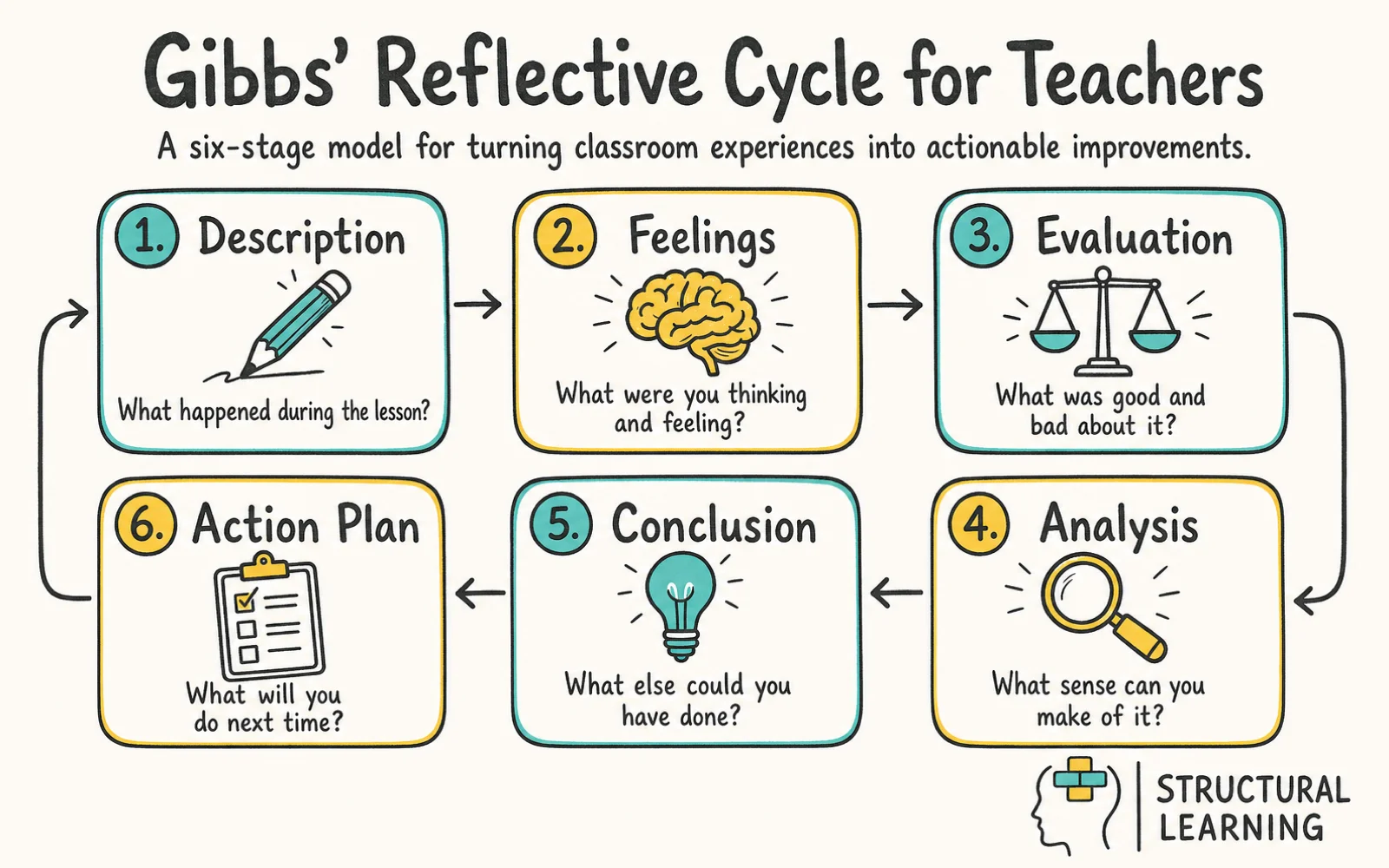
The Gibbs Reflective Cycle (1988) is the most commonly used model in UK initial teacher education. Its six stages provide a scaffold that prevents reflection collapsing into description.

You can read the full guide to applying the Gibbs Reflective Cycle in the classroom, but here is a practical overview of each stage with a worked example using a Year 8 science lesson on density.

Stage 1: Description. What happened? Keep this brief. "Students struggled to calculate density from the formula. Most completed fewer than three of the six questions."

Stage 2: Feelings. What were you thinking and feeling? "I felt frustrated that I had explained the formula twice but they still didn't seem to understand it."

Stage 3: Evaluation. What was good and bad about the experience? "The demonstration with the oil and water was effective. The worked example on the board was too fast."

Stage 4: Analysis. What sense can you make of the situation? "Students who could recall prior knowledge of fractions applied the formula correctly. Those without that knowledge were stuck at the calculation step, not the conceptual step."

Stage 5: Conclusion. What else could you have done? "I could have checked fraction fluency before the lesson. I could have modelled the calculation step by step, using a think-aloud."

Stage 6: Action Plan. If it arose again, what would you do? "Check prior knowledge of fractions in the lesson starter. Use a partially completed worked example for the first two questions."

This is reflection with teeth. The action plan is specific, observable, and tied directly to the analysis rather than to general good intentions.

Brookfield's Four Lenses: See Your Teaching Through Multiple Perspectives infographic for teachers
Brookfield's Four Lenses: See Your Teaching Through Multiple Perspectives

Brookfield's Four Lenses

Stephen Brookfield (1995) argued that all teachers operate with assumptions that are invisible to themselves. These assumptions shape every decision, from whom you call on in discussion, to which topics you linger on, to how you interpret student silence.

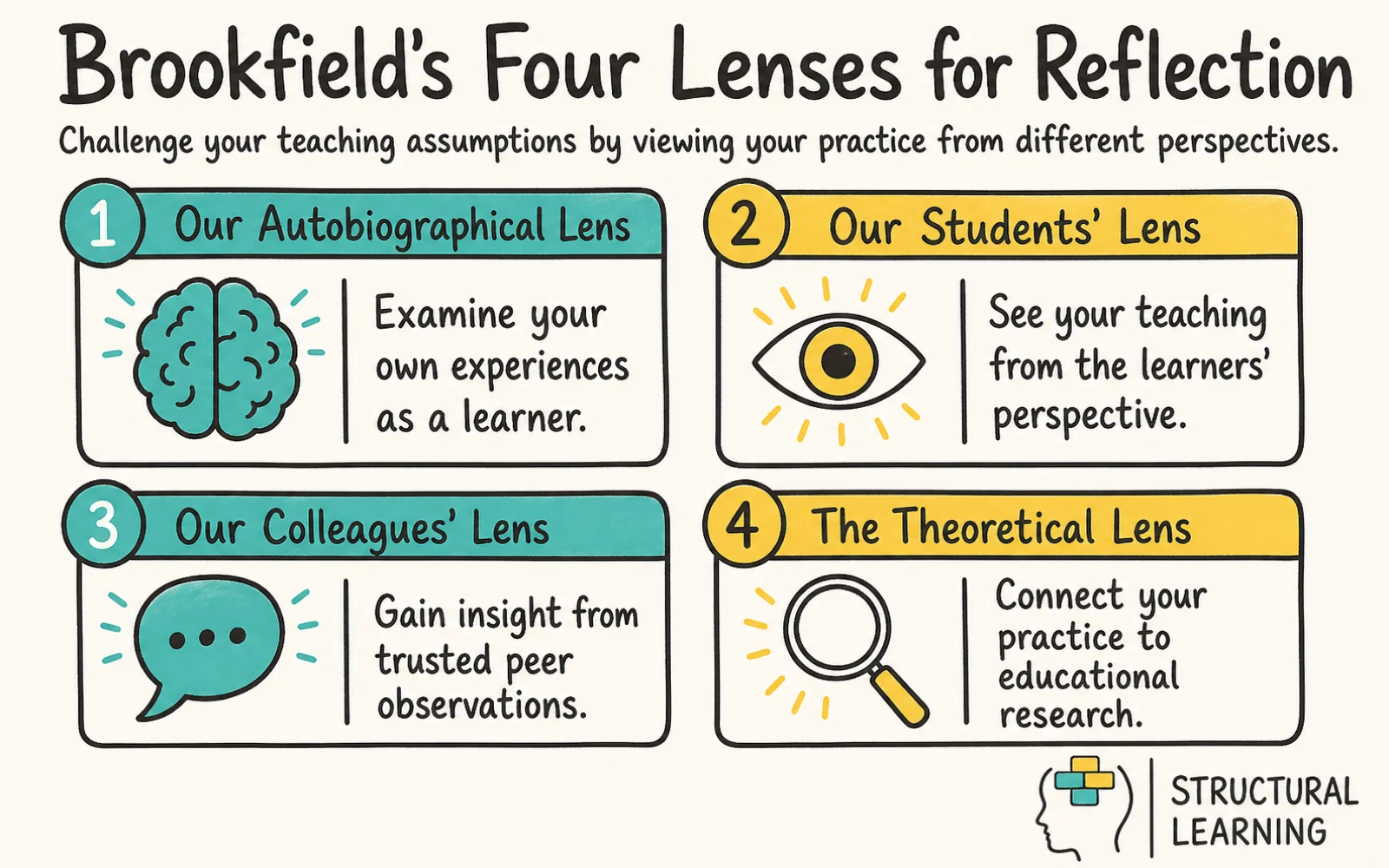
Single-source reflection, looking at a lesson only from your own perspective, cannot surface these assumptions. Brookfield proposed four lenses that triangulate your view.

Lens 1: Autobiography. What is your own history as a learner? Which teachers shaped your practice, and why? Teachers who found school easy may design for students who share their cognitive profile. Those who struggled may design for a different type of learner. Your autobiography is always present in your classroom.

Lens 2: Students' eyes. What would your students say is happening in your lessons? Anonymous feedback, exit slips, or structured student voice conversations give you data you cannot generate yourself. Brookfield recommended asking students specifically what helps their learning, what confuses them, and what they wish you would do differently.

Lens 3: Peers. What do colleagues see when they observe you? This lens requires genuine reciprocal observation, not a formal inspection. A colleague watching for a specific agreed focus, such as questioning patterns or wait time, will notice things that the teacher delivering the lesson cannot.

Lens 4: Literature. What does research say about the practices you are using? Connecting your lesson reflection to a paper on cognitive load theory or retrieval practice places your individual experience within a wider evidence base and surfaces alternative explanations for what you observed.

Using all four lenses at once is not necessary for every reflection. But returning to all four periodically, perhaps once per term, is likely to challenge assumptions that narrower reflection leaves intact.

Practical Strategies for Reflective Practice

Theory without implementation is of little use. The following strategies are practical, low-burden, and suitable for different career stages.

Reflective Journals

A reflective journal is the most accessible tool. The risk is that it becomes a list of what happened rather than an analysis of why. Use a prompt framework to prevent this.

Driscoll's three questions (What? So what? Now what?) take under five minutes and produce far more usable analysis than a narrative account. Write the entry the same day, while the lesson is still clear in memory. Review a set of entries monthly to look for patterns: recurring student misconceptions, activities that consistently engage or disengage, moments of genuine learning.

Lesson Study

Lesson study, developed in Japan and adapted widely in UK schools, involves a small group of teachers co-planning a lesson, observing it together, and analysing what they find. The focus is always on a specific group of "case pupils", not on evaluating the teacher.

This approach shifts the frame from "how well did the teacher perform?" to "what did these three students learn?" The distinction matters. Lesson study tends to produce more specific, transferable insights than individual observation and debrief because the analysis is grounded in observable student responses.

Peer Observation with an Agreed Focus

The most common weakness of peer observation is a lack of focus. A colleague watching an entire lesson and then offering general feedback produces broad, often unhelpful commentary. Agree a specific question before the observation: "How much thinking time am I giving before taking answers?" or "Which students am I not calling on?" The observer collects evidence on that specific question. The debrief is then targeted.

This approach links directly to action research in the classroom, a structured cycle of inquiry that uses lesson observation as one source of data alongside student work and assessment.

Reflective Practice in ITT and ECT Years

Initial teacher training and the early career years are when reflective habits are formed. The habits formed in the first three years of teaching tend to persist. Getting the structure right early matters.

The Early Career Framework (DfE, 2019) requires ECTs to engage in structured professional dialogue with their mentor, analyse student work, observe experienced colleagues, and review their own practice against the Teachers' Standards. This is a reflective practice framework in all but name.

For ECTs, the most common difficulty is finding time. Reflection gets crowded out by marking, planning, and administrative demands. The solution is not to find more time but to embed reflection into existing routines. A two-minute entry after last lesson, a brief note on a lesson plan about what to change next time, or a monthly conversation with a mentor specifically about patterns noticed across lessons are all low-cost and sustainable.

Mentors working with ECTs should use Schon's distinction actively. During formal observation feedback, focus on reflection-on-action: what happened, why, and what might change. In informal professional conversations, encourage reflection-in-action awareness: what did you notice during the lesson that shifted your approach?

Using AI for Teacher Reflection

No competitor has written about this. Yet it may be one of the most practical developments in teacher professional development in the past two years.

Large language models such as ChatGPT and Claude can serve as structured reflection partners. They do not replace peer conversation or mentor feedback. They supplement it, particularly for teachers working in isolation or between scheduled observations.

Here are four specific ways to use AI tools for reflection.

1. Generating reflection questions from a lesson description.

Paste a brief description of what happened in a lesson, including what you planned, what students did, and any points of confusion or unexpected success. Ask the AI to generate ten reflection questions based on that description. The questions it produces will often be more searching than those you generate yourself, because it is not subject to the same blind spots.

A useful prompt: "Here is a description of a lesson I taught today: [description]. Generate 10 reflection questions that move beyond description towards analysis and evaluation. Include at least two questions that challenge my assumptions about what students understood."

2. Challenging your interpretation.

Write a brief account of a lesson event and your interpretation of why it happened. Ask the AI to offer three alternative explanations. This replicates one function of a skilled peer: the "have you considered that..." response that surfaces other explanations.

A useful prompt: "I think [this happened] because [my interpretation]. Give me three alternative explanations that I should consider before deciding what to do next."

3. Tracking patterns across entries.

Copy five weekly journal entries into a conversation and ask the AI to identify recurring themes, persistent questions, or patterns in what you are noticing. This produces the kind of meta-analysis that is difficult to do manually when you are close to the material.

4. Connecting to research.

Describe a classroom challenge and ask the AI to identify relevant research frameworks that might help you analyse it. This replicates Brookfield's fourth lens, connecting personal experience to literature, without requiring you to search databases or read full papers before acting.

A practical note on accuracy: AI tools can misattribute research or generate plausible-sounding but fictitious citations. Use the frameworks they surface as prompts to search rather than as confirmed references. The reflective questions they generate are reliable; the citations they offer should be verified.

From Description to Action: The Gibbs Reflection Cycle for Teachers infographic for teachers
From Description to Action: The Gibbs Reflection Cycle for Teachers

Common Mistakes in Reflective Practice

Understanding what reflective practice is not, as well as what it is, prevents the most common errors.

Describing rather than analysing. The most frequent mistake is spending the bulk of a reflection on what happened rather than why. Description is a necessary starting point, not an end in itself. If your entry reads like a lesson narrative, you have not yet reflected.

Reflecting on everything. Teachers who try to reflect systematically on every lesson quickly give up. Focus on lessons or moments that produced unexpected results, either better or worse than anticipated. These are the richest sources of learning.

Ignoring student evidence. Reflection that is entirely self-referential misses the most important data. What students produced, said, or demonstrated in the lesson is more reliable evidence than your memory of how engaged they appeared.

Treating reflection as a performance task. Particularly in ITT, reflective journals and assignments can become documents written for an assessor rather than genuine tools for learning. If your reflection is crafted rather than honest, it will not produce change.

Reflection without action. Moon (1999) distinguishes between reflective writing that is exploratory and writing that connects to changed practice. Both have value, but only the latter closes the loop. Every period of substantive reflection should end with at least one specific intended change, however small.

Further Reading: Key Research Papers

These peer-reviewed studies provide the evidence base for the strategies discussed in this guide.

The Reflective Practitioner: How Professionals Think in Action View study ↗

Schon, D. A. (1983)

The foundational text for reflective practice in professional education. Schon's distinction between reflection-in-action and reflection-on-action remains the most widely cited framework in teacher education. The book draws on case studies from architecture, psychotherapy, and engineering to show how practitioners develop and use tacit knowledge.

Teacher Professional Learning and Development: Best Evidence Synthesis Iteration View study ↗

Timperley, H., Wilson, A., Barrar, H., & Fung, I. (2007)

This major synthesis reviewed 97 studies of teacher professional learning and identified which conditions produce lasting change in teacher practice and student outcomes. The review consistently found that effective professional development includes structured reflection on evidence about student learning, not just training in new techniques.

Becoming a Critically Reflective Teacher View study ↗

Brookfield, S. D. (1995)

Brookfield's four-lens framework gives teachers a structured method for examining assumptions that single-source reflection cannot surface. The book includes practical protocols for using student feedback, peer observation, and the research literature as mirrors on practice, with worked examples from higher education and schools.

A Handbook of Reflective and Experiential Learning: Theory and Practice View study ↗

Moon, J. A. (1999)

Moon's distinction between surface and deep reflection is essential reading for teacher educators. The book provides a learning map showing how reflection moves from description through integration to transformative action. The practical frameworks are directly applicable to reflective journal design and mentor conversation protocols in both ITT and CPD contexts.

Lesson Study: Professional Learning for Our Time View study ↗

Cajkler, W., & Wood, P. (2015)

This systematic review of lesson study research in UK schools found consistent positive effects on teacher professional learning when the model included structured observation of named case pupils and collaborative analysis of student evidence. The review provides a practical implementation guide applicable to primary, secondary, and special school settings.

Free Resource Pack

Reflective Practice for Teachers

3 ready-to-use resources designed to deepen teachers' understanding and application of reflective practice models and strategies.

Reflective Practice for Teachers — 3 resources
Reflective Practice CPD Briefing Visual Teaching Strategies Professional Development Teacher Wellbeing Self-Evaluation Gibbs' Reflective Cycle Schon's Reflection Planning Template Quick Reference Card

Download your free bundle

Fill in your details below and we'll send the resource pack straight to your inbox.

Quick survey (helps us create better resources)

How confident are you in applying different models and strategies of reflective practice in your teaching?

Not at all confident
Slightly confident
Moderately confident
Very confident
Extremely confident

To what extent does your school or colleagues actively encourage and support reflective practice among teachers?

Not at all
To a small extent
To some extent
To a great extent
To a very great extent

How regularly do you engage in structured reflective practice to evaluate and improve your teaching?

Never
Rarely
Occasionally
Regularly
Consistently

Your resource pack is ready

We've also sent a copy to your email. Check your inbox.

Loading audit...

Reflective practice is one of those terms that appears constantly in teacher training, appraisal documentation, and CPD frameworks, yet rarely receives the careful, structured attention it deserves. It is not simply thinking about a lesson afterwards. It is a disciplined process of examining your own teaching, challenging your assumptions, and using what you find to teach more effectively.

This guide walks through the major models, explains what the research says, and gives you practical strategies you can apply this week, whether you are an ECT in your first term or a subject lead reviewing your department's practice.

Key Takeaways

    • Reflection requires structure: Unguided thinking about lessons rarely produces change. Models such as Gibbs (1988) and Schon (1983) give you a framework that moves from description to action.
    • Schon's two types matter: Reflection-in-action happens during the lesson; reflection-on-action happens afterwards. Both are necessary and serve different purposes.
    • Brookfield's four lenses challenge blind spots: Viewing your practice through autobiography, students' eyes, peer perspectives, and research literature catches assumptions that single-lens reflection misses.
    • Reflective journals work best with prompts: Open-ended journalling produces description. Question-driven prompts produce analysis. Spend at least two minutes per entry on "what would I do differently".
    • AI tools can structure and deepen reflection: Using ChatGPT or Claude to generate reflection questions from a lesson description produces more searching prompts than most practitioners generate alone.

Reflection-In-Action vs. Reflection-On-Action: When & How They Work infographic for teachers
Reflection-In-Action vs. Reflection-On-Action: When & How They Work

What Is Reflective Practice?

Reflective practice is the habit of deliberately examining your own professional actions, beliefs, and outcomes, with the aim of improving future performance. The roots lie in John Dewey's (1933) argument that experience alone does not produce learning. Learning requires reflection on that experience. A teacher who has taught for 20 years without examining their assumptions has, in Dewey's terms, simply repeated one year of experience 20 times.

Donald Schon (1983) gave the concept its most influential framing in 'The Reflective Practitioner'. He described the skilled professional not as someone who applies technical rules but as someone who draws on a body of embodied knowledge, recognises when something is not working, and adjusts in real time. For teachers, this means the ability to read a classroom, respond to unexpected student confusion, and adapt a lesson mid-flow.

Jenny Moon (1999) extended this by distinguishing between surface reflection, which describes what happened, and deep reflection, which challenges the underlying values and beliefs that shaped the actions. Most teachers default to surface reflection because it is quicker. Deep reflection is more demanding but produces more durable change.

Why Reflective Practice Matters for Teachers

The argument for reflective practice is not just philosophical. There is a body of evidence connecting structured teacher reflection to improved student outcomes.

Hattie (2009) found that teachers who use evidence about their impact and adjust their practice accordingly have some of the highest effect sizes in educational research. The key phrase is "adjust their practice". That adjustment requires reflection.

The Early Career Framework (DfE, 2019) places reflective practice at the centre of teacher development, requiring ECTs and their mentors to engage in structured observation, feedback, and professional dialogue. The framework's emphasis on "understanding what pupils are learning, not just what they are doing" is, at its core, a call for analytical reflection.

Timperley et al. (2007), in a major synthesis of teacher professional learning, found that professional development which included structured reflection on student data produced significantly stronger effects than training that did not. The mechanism matters: reflection must be connected to evidence about students, not just to the teacher's own feelings about how a lesson went.

Schon's Reflection-in-Action and Reflection-on-Action

Schon (1983) made a distinction that is still the clearest framework for understanding how professional reflection actually works.

Reflection-in-action happens while you are teaching. A question falls flat; you rephrase it without consciously deciding to. A student looks confused; you stop and re-explain. You notice three hands go up and change your seating for the next activity. This is expert practice in motion. It draws on tacit knowledge, the things you know how to do without being able to fully articulate why.

Reflection-on-action happens after the lesson. You sit with your notes, your memory, or a colleague's observation, and you examine what happened with some analytical distance. This is where models like Gibbs and Brookfield become useful. They give structure to what could otherwise be rumination.

Schon argued that novice teachers rely heavily on reflection-on-action because they do not yet have the tacit knowledge to reflect effectively in real time. As expertise develops, more reflection moves into the action itself. This is a useful frame for mentoring ECTs: the goal is not to give them more to do after the lesson but to help them develop the in-lesson awareness that characterises expert teaching.

Key Reflective Practice Models

Several models have been developed to give structured shape to reflective practice. The table below summarises the four most widely used in UK teacher education.

| Model | Origin | Stages | Best Used For |

|-------|--------|--------|--------------|

| Gibbs Reflective Cycle | Gibbs (1988) | 6: Description, Feelings, Evaluation, Analysis, Conclusion, Action Plan | Post-lesson analysis; ITT portfolio evidence |

| Kolb Experiential Learning | Kolb (1984) | 4: Concrete Experience, Reflective Observation, Abstract Conceptualisation, Active Experimentation | CPD planning; trying new approaches |

| Driscoll's What? | Driscoll (1994) | 3: What?, So what?, Now what? | Quick daily reflection; ECT journal prompts |

| Brookfield's Four Lenses | Brookfield (1995) | 4 lenses: Autobiography, Students, Peers, Literature | Tackling assumptions; appraisal and review |

Each model asks you to move beyond describing what happened towards explaining why it happened and what you will do differently. The choice of model should depend on purpose. Gibbs suits detailed post-lesson analysis. Driscoll suits a quick five-minute end-of-day journal entry.

Gibbs Reflective Cycle in the Classroom

The Gibbs Reflective Cycle (1988) is the most commonly used model in UK initial teacher education. Its six stages provide a scaffold that prevents reflection collapsing into description.

You can read the full guide to applying the Gibbs Reflective Cycle in the classroom, but here is a practical overview of each stage with a worked example using a Year 8 science lesson on density.

Stage 1: Description. What happened? Keep this brief. "Students struggled to calculate density from the formula. Most completed fewer than three of the six questions."

Stage 2: Feelings. What were you thinking and feeling? "I felt frustrated that I had explained the formula twice but they still didn't seem to understand it."

Stage 3: Evaluation. What was good and bad about the experience? "The demonstration with the oil and water was effective. The worked example on the board was too fast."

Stage 4: Analysis. What sense can you make of the situation? "Students who could recall prior knowledge of fractions applied the formula correctly. Those without that knowledge were stuck at the calculation step, not the conceptual step."

Stage 5: Conclusion. What else could you have done? "I could have checked fraction fluency before the lesson. I could have modelled the calculation step by step, using a think-aloud."

Stage 6: Action Plan. If it arose again, what would you do? "Check prior knowledge of fractions in the lesson starter. Use a partially completed worked example for the first two questions."

This is reflection with teeth. The action plan is specific, observable, and tied directly to the analysis rather than to general good intentions.

Brookfield's Four Lenses: See Your Teaching Through Multiple Perspectives infographic for teachers
Brookfield's Four Lenses: See Your Teaching Through Multiple Perspectives

Brookfield's Four Lenses

Stephen Brookfield (1995) argued that all teachers operate with assumptions that are invisible to themselves. These assumptions shape every decision, from whom you call on in discussion, to which topics you linger on, to how you interpret student silence.

Single-source reflection, looking at a lesson only from your own perspective, cannot surface these assumptions. Brookfield proposed four lenses that triangulate your view.

Lens 1: Autobiography. What is your own history as a learner? Which teachers shaped your practice, and why? Teachers who found school easy may design for students who share their cognitive profile. Those who struggled may design for a different type of learner. Your autobiography is always present in your classroom.

Lens 2: Students' eyes. What would your students say is happening in your lessons? Anonymous feedback, exit slips, or structured student voice conversations give you data you cannot generate yourself. Brookfield recommended asking students specifically what helps their learning, what confuses them, and what they wish you would do differently.

Lens 3: Peers. What do colleagues see when they observe you? This lens requires genuine reciprocal observation, not a formal inspection. A colleague watching for a specific agreed focus, such as questioning patterns or wait time, will notice things that the teacher delivering the lesson cannot.

Lens 4: Literature. What does research say about the practices you are using? Connecting your lesson reflection to a paper on cognitive load theory or retrieval practice places your individual experience within a wider evidence base and surfaces alternative explanations for what you observed.

Using all four lenses at once is not necessary for every reflection. But returning to all four periodically, perhaps once per term, is likely to challenge assumptions that narrower reflection leaves intact.

Practical Strategies for Reflective Practice

Theory without implementation is of little use. The following strategies are practical, low-burden, and suitable for different career stages.

Reflective Journals

A reflective journal is the most accessible tool. The risk is that it becomes a list of what happened rather than an analysis of why. Use a prompt framework to prevent this.

Driscoll's three questions (What? So what? Now what?) take under five minutes and produce far more usable analysis than a narrative account. Write the entry the same day, while the lesson is still clear in memory. Review a set of entries monthly to look for patterns: recurring student misconceptions, activities that consistently engage or disengage, moments of genuine learning.

Lesson Study

Lesson study, developed in Japan and adapted widely in UK schools, involves a small group of teachers co-planning a lesson, observing it together, and analysing what they find. The focus is always on a specific group of "case pupils", not on evaluating the teacher.

This approach shifts the frame from "how well did the teacher perform?" to "what did these three students learn?" The distinction matters. Lesson study tends to produce more specific, transferable insights than individual observation and debrief because the analysis is grounded in observable student responses.

Peer Observation with an Agreed Focus

The most common weakness of peer observation is a lack of focus. A colleague watching an entire lesson and then offering general feedback produces broad, often unhelpful commentary. Agree a specific question before the observation: "How much thinking time am I giving before taking answers?" or "Which students am I not calling on?" The observer collects evidence on that specific question. The debrief is then targeted.

This approach links directly to action research in the classroom, a structured cycle of inquiry that uses lesson observation as one source of data alongside student work and assessment.

Reflective Practice in ITT and ECT Years

Initial teacher training and the early career years are when reflective habits are formed. The habits formed in the first three years of teaching tend to persist. Getting the structure right early matters.

The Early Career Framework (DfE, 2019) requires ECTs to engage in structured professional dialogue with their mentor, analyse student work, observe experienced colleagues, and review their own practice against the Teachers' Standards. This is a reflective practice framework in all but name.

For ECTs, the most common difficulty is finding time. Reflection gets crowded out by marking, planning, and administrative demands. The solution is not to find more time but to embed reflection into existing routines. A two-minute entry after last lesson, a brief note on a lesson plan about what to change next time, or a monthly conversation with a mentor specifically about patterns noticed across lessons are all low-cost and sustainable.

Mentors working with ECTs should use Schon's distinction actively. During formal observation feedback, focus on reflection-on-action: what happened, why, and what might change. In informal professional conversations, encourage reflection-in-action awareness: what did you notice during the lesson that shifted your approach?

Using AI for Teacher Reflection

No competitor has written about this. Yet it may be one of the most practical developments in teacher professional development in the past two years.

Large language models such as ChatGPT and Claude can serve as structured reflection partners. They do not replace peer conversation or mentor feedback. They supplement it, particularly for teachers working in isolation or between scheduled observations.

Here are four specific ways to use AI tools for reflection.

1. Generating reflection questions from a lesson description.

Paste a brief description of what happened in a lesson, including what you planned, what students did, and any points of confusion or unexpected success. Ask the AI to generate ten reflection questions based on that description. The questions it produces will often be more searching than those you generate yourself, because it is not subject to the same blind spots.

A useful prompt: "Here is a description of a lesson I taught today: [description]. Generate 10 reflection questions that move beyond description towards analysis and evaluation. Include at least two questions that challenge my assumptions about what students understood."

2. Challenging your interpretation.

Write a brief account of a lesson event and your interpretation of why it happened. Ask the AI to offer three alternative explanations. This replicates one function of a skilled peer: the "have you considered that..." response that surfaces other explanations.

A useful prompt: "I think [this happened] because [my interpretation]. Give me three alternative explanations that I should consider before deciding what to do next."

3. Tracking patterns across entries.

Copy five weekly journal entries into a conversation and ask the AI to identify recurring themes, persistent questions, or patterns in what you are noticing. This produces the kind of meta-analysis that is difficult to do manually when you are close to the material.

4. Connecting to research.

Describe a classroom challenge and ask the AI to identify relevant research frameworks that might help you analyse it. This replicates Brookfield's fourth lens, connecting personal experience to literature, without requiring you to search databases or read full papers before acting.

A practical note on accuracy: AI tools can misattribute research or generate plausible-sounding but fictitious citations. Use the frameworks they surface as prompts to search rather than as confirmed references. The reflective questions they generate are reliable; the citations they offer should be verified.

From Description to Action: The Gibbs Reflection Cycle for Teachers infographic for teachers
From Description to Action: The Gibbs Reflection Cycle for Teachers

Common Mistakes in Reflective Practice

Understanding what reflective practice is not, as well as what it is, prevents the most common errors.

Describing rather than analysing. The most frequent mistake is spending the bulk of a reflection on what happened rather than why. Description is a necessary starting point, not an end in itself. If your entry reads like a lesson narrative, you have not yet reflected.

Reflecting on everything. Teachers who try to reflect systematically on every lesson quickly give up. Focus on lessons or moments that produced unexpected results, either better or worse than anticipated. These are the richest sources of learning.

Ignoring student evidence. Reflection that is entirely self-referential misses the most important data. What students produced, said, or demonstrated in the lesson is more reliable evidence than your memory of how engaged they appeared.

Treating reflection as a performance task. Particularly in ITT, reflective journals and assignments can become documents written for an assessor rather than genuine tools for learning. If your reflection is crafted rather than honest, it will not produce change.

Reflection without action. Moon (1999) distinguishes between reflective writing that is exploratory and writing that connects to changed practice. Both have value, but only the latter closes the loop. Every period of substantive reflection should end with at least one specific intended change, however small.

Further Reading: Key Research Papers

These peer-reviewed studies provide the evidence base for the strategies discussed in this guide.

The Reflective Practitioner: How Professionals Think in Action View study ↗

Schon, D. A. (1983)

The foundational text for reflective practice in professional education. Schon's distinction between reflection-in-action and reflection-on-action remains the most widely cited framework in teacher education. The book draws on case studies from architecture, psychotherapy, and engineering to show how practitioners develop and use tacit knowledge.

Teacher Professional Learning and Development: Best Evidence Synthesis Iteration View study ↗

Timperley, H., Wilson, A., Barrar, H., & Fung, I. (2007)

This major synthesis reviewed 97 studies of teacher professional learning and identified which conditions produce lasting change in teacher practice and student outcomes. The review consistently found that effective professional development includes structured reflection on evidence about student learning, not just training in new techniques.

Becoming a Critically Reflective Teacher View study ↗

Brookfield, S. D. (1995)

Brookfield's four-lens framework gives teachers a structured method for examining assumptions that single-source reflection cannot surface. The book includes practical protocols for using student feedback, peer observation, and the research literature as mirrors on practice, with worked examples from higher education and schools.

A Handbook of Reflective and Experiential Learning: Theory and Practice View study ↗

Moon, J. A. (1999)

Moon's distinction between surface and deep reflection is essential reading for teacher educators. The book provides a learning map showing how reflection moves from description through integration to transformative action. The practical frameworks are directly applicable to reflective journal design and mentor conversation protocols in both ITT and CPD contexts.

Lesson Study: Professional Learning for Our Time View study ↗

Cajkler, W., & Wood, P. (2015)

This systematic review of lesson study research in UK schools found consistent positive effects on teacher professional learning when the model included structured observation of named case pupils and collaborative analysis of student evidence. The review provides a practical implementation guide applicable to primary, secondary, and special school settings.

Free Resource Pack

Reflective Practice for Teachers

3 ready-to-use resources designed to deepen teachers' understanding and application of reflective practice models and strategies.

Reflective Practice for Teachers — 3 resources
Reflective Practice CPD Briefing Visual Teaching Strategies Professional Development Teacher Wellbeing Self-Evaluation Gibbs' Reflective Cycle Schon's Reflection Planning Template Quick Reference Card

Download your free bundle

Fill in your details below and we'll send the resource pack straight to your inbox.

Quick survey (helps us create better resources)

How confident are you in applying different models and strategies of reflective practice in your teaching?

Not at all confident
Slightly confident
Moderately confident
Very confident
Extremely confident

To what extent does your school or colleagues actively encourage and support reflective practice among teachers?

Not at all
To a small extent
To some extent
To a great extent
To a very great extent

How regularly do you engage in structured reflective practice to evaluate and improve your teaching?

Never
Rarely
Occasionally
Regularly
Consistently

Your resource pack is ready

We've also sent a copy to your email. Check your inbox.

Educational Technology

Back to Blog

{"@context":"https://schema.org","@graph":[{"@type":"Organization","@id":"https://www.structural-learning.com/#org","name":"Structural Learning","url":"https://www.structural-learning.com/","logo":{"@type":"ImageObject","url":"https://cdn.prod.website-files.com/5b69a01ba2e409501de055d1/5b69a01ba2e40996a5e055f4_structural-learning-logo.png"}},{"@type":"Person","@id":"https://www.structural-learning.com/team/paul-main/#person","name":"Paul Main","url":"https://www.structural-learning.com/team/paul-main","jobTitle":"Founder","affiliation":{"@id":"https://www.structural-learning.com/#org"}},{"@type":"BreadcrumbList","@id":"https://www.structural-learning.com/post/reflective-practice-teachers-models#breadcrumb","itemListElement":[{"@type":"ListItem","position":1,"name":"Home","item":"https://www.structural-learning.com/"},{"@type":"ListItem","position":2,"name":"Blog","item":"https://www.structural-learning.com/blog"},{"@type":"ListItem","position":3,"name":"Reflective Practice for Teachers: Models and Strategies","item":"https://www.structural-learning.com/post/reflective-practice-teachers-models"}]},{"@type":"BlogPosting","@id":"https://www.structural-learning.com/post/reflective-practice-teachers-models#article","headline":"Reflective Practice for Teachers: Models and Strategies","description":"Reflective practice for teachers explained through Schon, Gibbs, Kolb, and Brookfield. Practical strategies, ECT guidance, and AI-assisted reflection tools.","author":{"@id":"https://www.structural-learning.com/team/paul-main/#person"},"publisher":{"@id":"https://www.structural-learning.com/#org"},"datePublished":"2026-03-17","dateModified":"2026-03-17","inLanguage":"en-GB"}]}