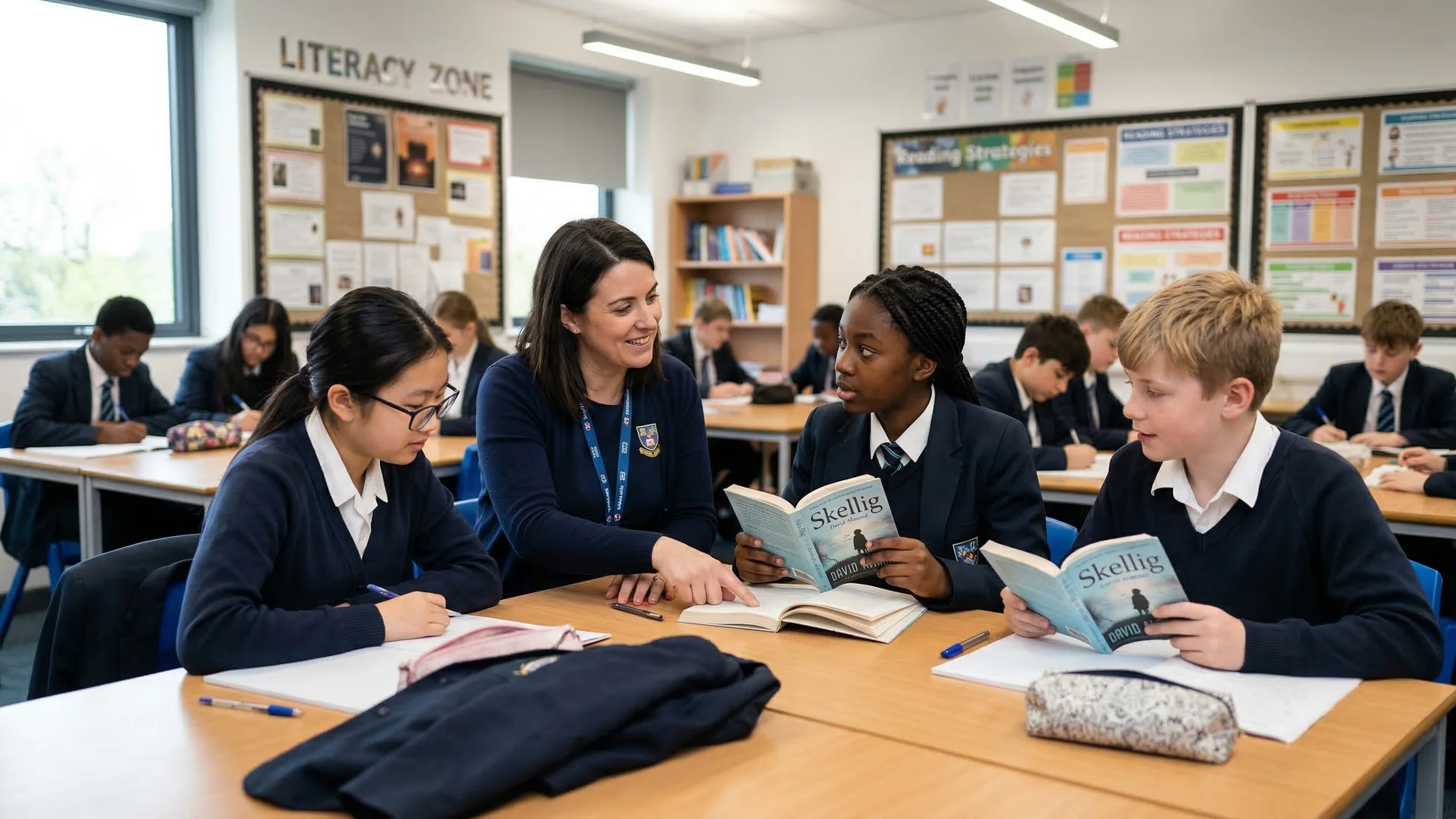
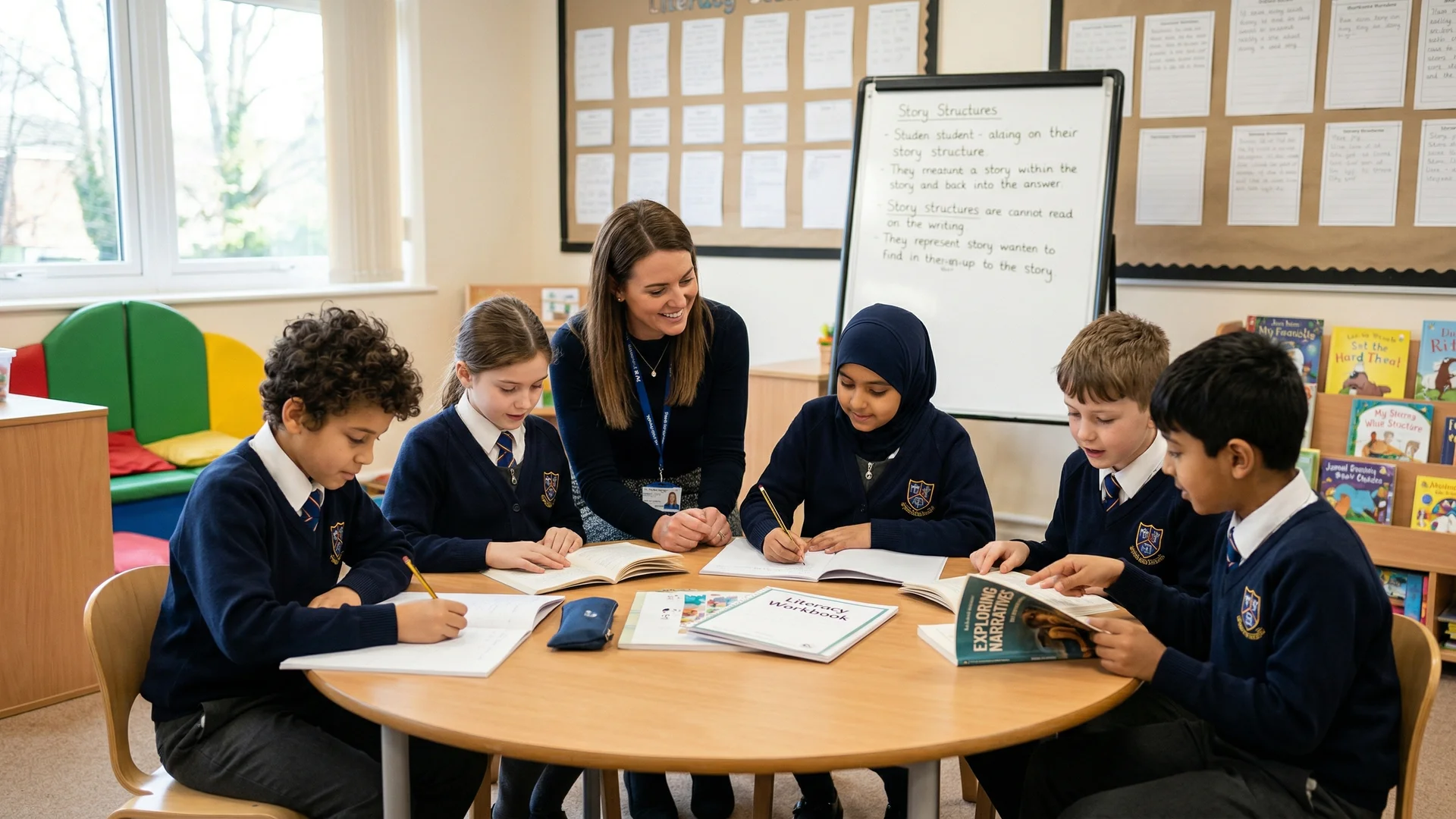
The Simple View of Reading: A Teacher's GuideThe Simple View of Reading: A Teacher's Guide: practical strategies for teachers

Updated on  

March 19, 2026

The Simple View of Reading: A Teacher's Guide

|

March 19, 2026

Master the simple view of reading gough tunmer model teachers guide. Learn how to diagnose reader profiles and apply evidence-based classroom strategies today.

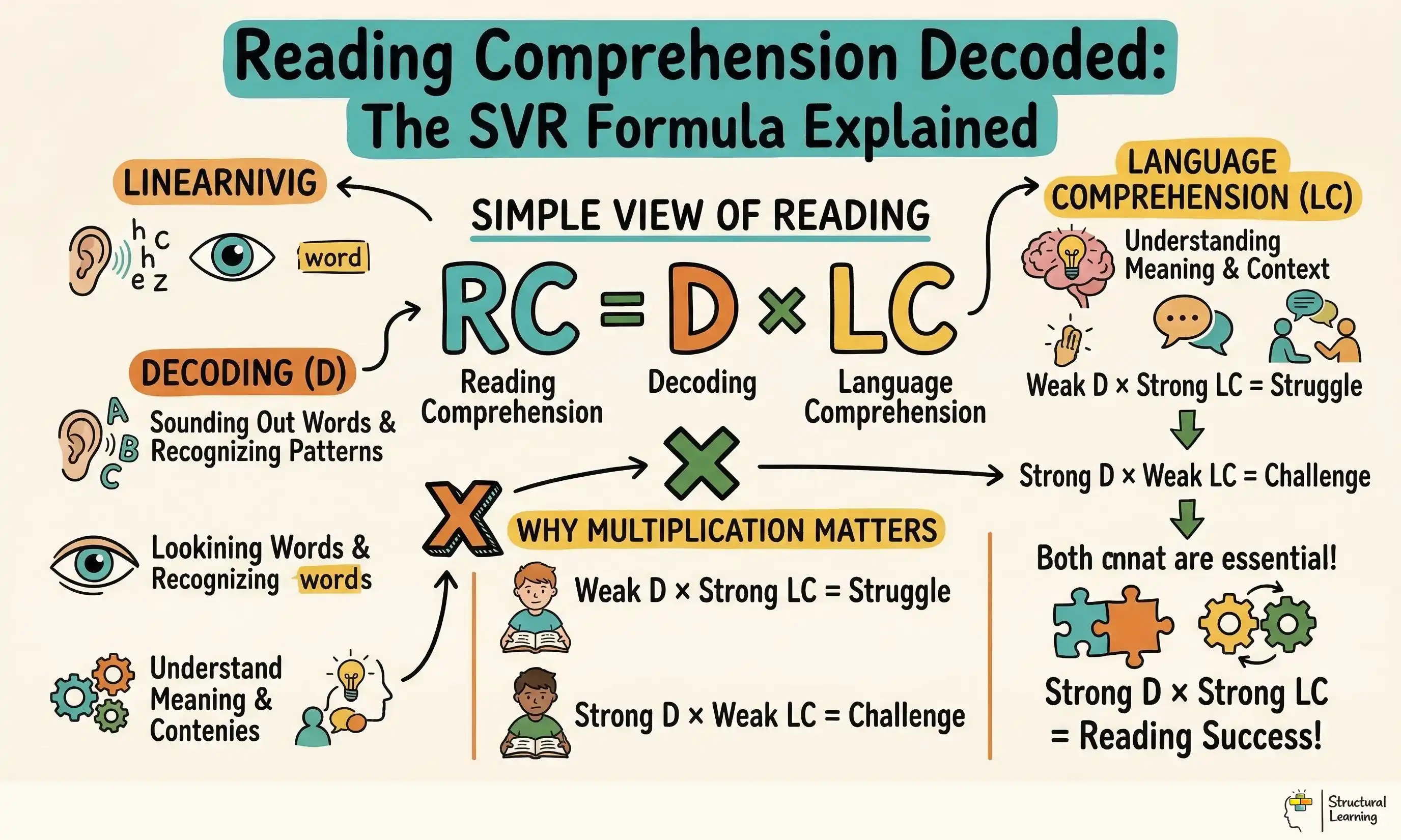
<a href=Reading Comprehension Decoded: The SVR Formula Explained infographic for teachers" loading="lazy">
Reading Comprehension Decoded: The SVR Formula Explained

Key Takeaways

  • The Simple View of Reading (SVR) defines reading comprehension as the product of decoding and language comprehension (RC = D × LC).
  • The formula uses multiplication, meaning a zero score in either decoding or language comprehension results in zero reading comprehension.
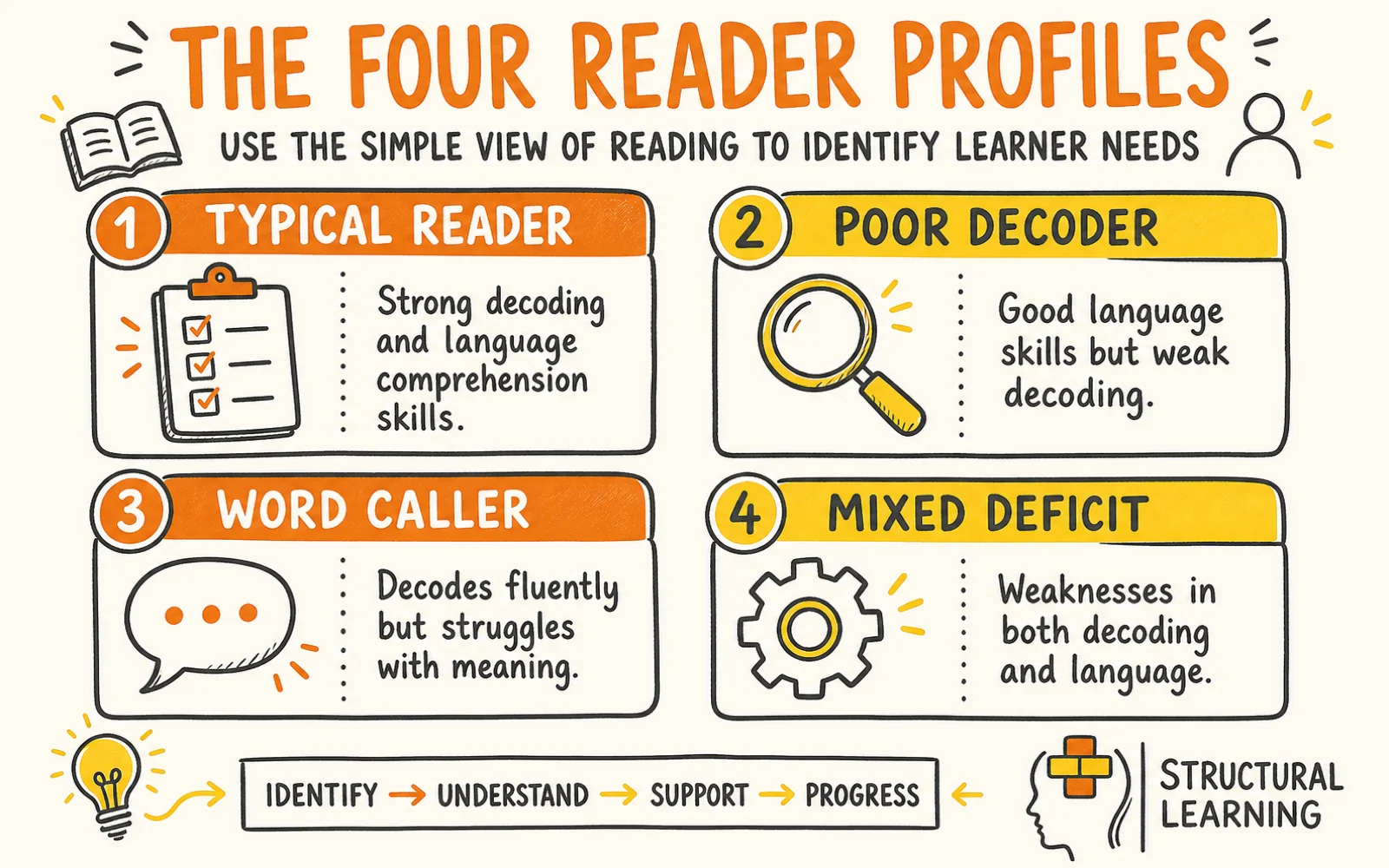
  • Teachers can categorise pupils into four distinct reader profiles: Typical Reader, Poor Decoder, Word Caller, and Mixed Deficit.
  • Word Callers decode fluently but lack the vocabulary or background knowledge to understand the text.
  • Diagnostic assessment must isolate decoding skills from language comprehension skills to pinpoint the source of a pupil's reading difficulty.
  • Structured interventions, such as graphic organisers and dual coding, address specific deficits.
  • The framework supports pupils with SEND and EAL by breaking down reading into manageable, assessable components.

What Is the Simple View?

The Simple View of Reading (SVR) is a framework defining reading comprehension as the product of decoding and language comprehension. Proposed by Gough & Tunmer (1986), the model simplifies literacy instruction to a mathematical equation: Reading Comprehension (RC) = Decoding (D) × Language Comprehension (LC).

Decoding is the ability to recognise words. It includes phonological awareness, cipher knowledge, and letter-sound correspondence. Language comprehension is the ability to derive meaning from spoken language, encompassing vocabulary, syntax, semantics, and background knowledge.

The multiplication sign is crucial. If a pupil has perfect language comprehension (value of 1) but cannot decode (value of 0), their reading comprehension is zero (1 × 0 = 0). Similarly, fluent decoding (1) is useless without language comprehension (0).

This shifts the focus. Instead of seeing a "struggling reader," teachers identify breakdowns in decoding or language comprehension (Scarborough, 2001).

What the teacher does / What pupils produce: A Year 3 teacher notices a pupil struggling with a reading comprehension test. The teacher gives a listening comprehension test. The pupil answers correctly, showing the deficit lies in decoding, not language comprehension.

Why the Model Matters

The SVR offers a diagnostic tool, preventing ineffective interventions. It demands teachers isolate the specific cause of reading failure (Hoover & Gough, 1990).

The multiplier effect helps teachers identify four reader profiles: Typical Reader (strong D, strong LC), Poor Decoder (weak D, strong LC), Word Caller (strong D, weak LC), and Mixed Deficit (weak D, weak LC).

These profiles link to cognitive load theory. Working memory is limited. If a pupil uses all their cognitive resources to sound out words, they have none left to process meaning.

This is critical for SEND and EAL learners. An EAL pupil might excel in phonics but fail to understand a text due to vocabulary gaps. Phonics intervention would be ineffective.
What the teacher does / What pupils produce: A Year 4 teacher has a Word Caller who reads about the water cycle fluently but cannot summarise it. The teacher provides a graphic organiser, asking the pupil to visually map key vocabulary before rereading.

The Model in Class

Applying the simple view of reading gough tunmer model teachers requires splitting classroom instruction to target both decoding and language comprehension.

Isolating Decoding Deficits

Pupils with decoding deficits need structured practice with phoneme-grapheme correspondences. Dual coding helps secure these skills.

What the teacher does / What pupils produce: The teacher introduces a new digraph and places sound buttons under the letters. The class produces the sounds. Pupils use structural blocks to build words, moving a block for each phoneme. They write the graphemes on whiteboards.

Tackling the Word Caller

Word Callers require interventions that force them to process meaning actively.

What the teacher does / What pupils produce: The teacher gives a pupil a short historical source and instructs them to pause at the end of each sentence. The teacher asks, "Who is doing what in this sentence?" The pupil summarises each sentence verbally and produces a bulleted list of facts.

Building Language Comprehension

Language comprehension relies on background knowledge and vocabulary. Teachers must build this knowledge before pupils encounter a text.

What the teacher does / What pupils produce: Before reading about deforestation, the teacher displays a concept map, explicitly teaching three tier 2 words and placing them on the map. Pupils discuss connections and draw their own concept maps, creating a visual glossary for use during reading.

Supporting Mixed Deficits

Pupils with mixed deficits need systematic synthetic phonics and rich oral language environments.
What the teacher does / What pupils produce: In the morning, the teacher provides rapid phonics drills. In the afternoon, the teacher reads a complex story aloud and asks inferential questions. Pupils answer verbally, engaging in semantic analysis without the burden of reading.

Four Reader Profiles: Find Your Students' Strengths & Gaps infographic for teachers
Four Reader Profiles: Find Your Students' Strengths & Gaps

Common Misconceptions

A misconception is that the SVR equation implies reading is simply adding phonics to vocabulary. The multiplication demonstrates that neither skill alone is sufficient.

Another misunderstanding is that phonics is only for young children. Both decoding and comprehension must be developed simultaneously (Castles, Rastle, & Nation, 2018).

Some believe the SVR conflicts with Scarborough's Reading Rope. The Reading Rope expands on the SVR, with decoding and language comprehension as its core strands.

Finally, some think the SVR is outdated. The Active View of Reading builds upon the SVR by including executive function (Duke & Cartwright, 2021).

What the teacher does / What pupils produce: In a staff meeting, a teacher suggests a Year 6 pupil just needs to read more. The literacy lead uses the SVR to explain the pupil has a cipher knowledge gap and that assigning more independent reading reinforces poor habits.

Practical Implementation Guide

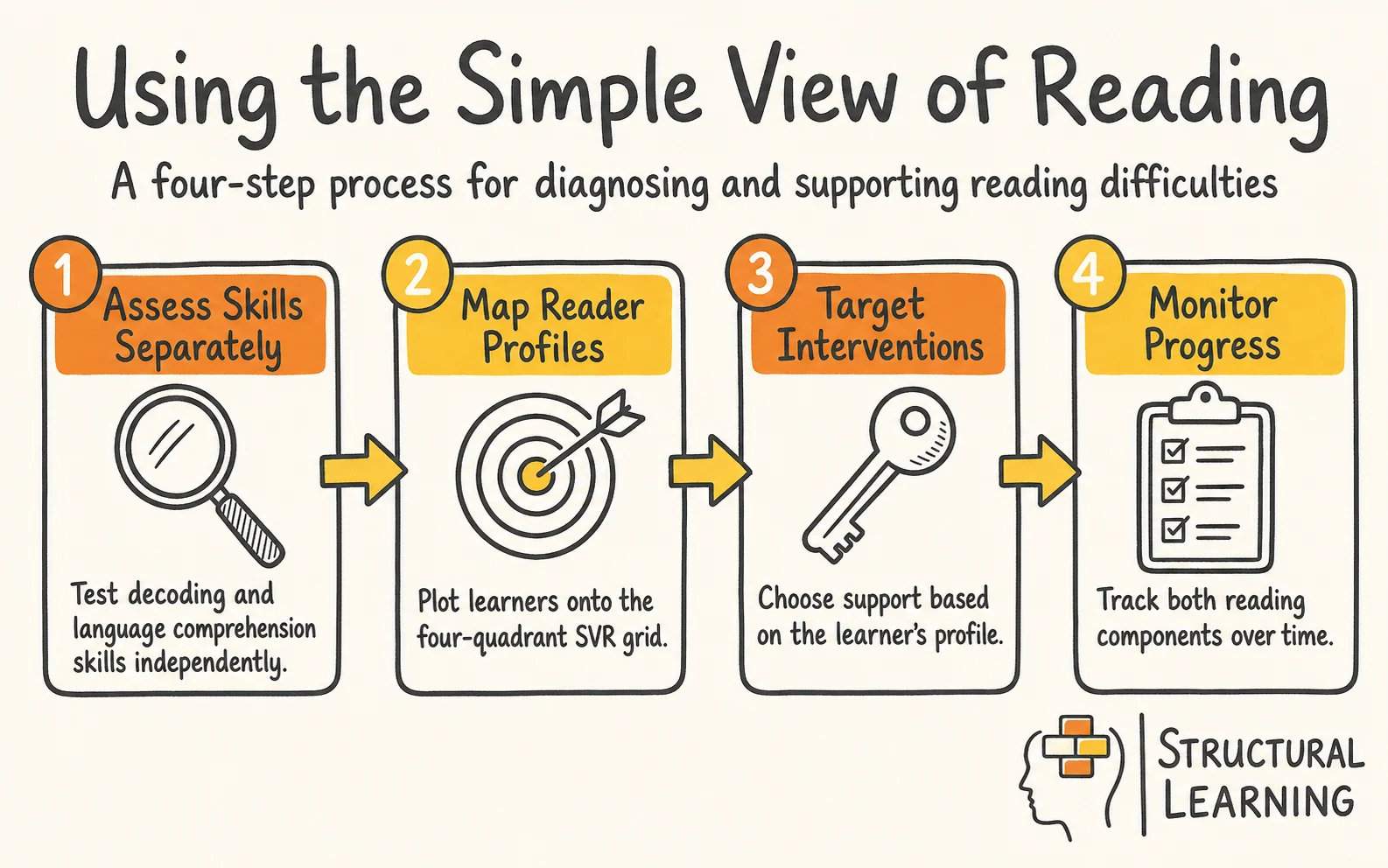
Implementing the simple view of reading gough tunmer model teachers requires a shift to diagnostic teaching. Assess and treat the two variables separately.

Step 1: Separate assessments. Use a nonsense word reading test for decoding and a listening comprehension test for language comprehension.

Step 2: Map profiles. Create a four-quadrant grid for your class: Typical Reader, Poor Decoder, Word Caller, or Mixed Deficit.

Step 3: Allocate interventions. Assign Poor Decoders to phonics catch-up groups and Word Callers to vocabulary and reciprocal reading sessions.

Step 4: Monitor progress independently. Track decoding fluency and comprehension scores separately.
What the teacher does / What pupils produce: A Year 2 teacher assesses a pupil who gives brilliant oral answers but struggles to read simple sentences. The teacher plots the pupil in the Poor Decoder quadrant and pairs them with decodable texts that match their phonics knowledge. The pupil reads the text aloud, blending sounds without guessing.

The Model Across Subjects

The SVR applies across all subjects.

In Maths, pupils face word problems. A pupil might decode the words but fail to understand the syntax. The teacher models translating the language into a mathematical operation. Pupils underline relational vocabulary and produce a matching number sentence.

In Science, the vocabulary load is high. The teacher breaks down multisyllabic words into morphological components. Pupils write definitions based on these components.

In History, pupils must comprehend archaic syntax and background knowledge. The teacher pre-teaches historical context before exposing pupils to a primary source. Pupils write a summary of the context before reading the source.

Why SVR Works: Evidence-Based Interventions That Transform Classrooms infographic for teachers
Why SVR Works: Evidence-Based Interventions That Transform Classrooms

Common Questions About the SVR

Is the simple view of reading still relevant?

Yes, it is the foundational framework.

How does the formula explain dyslexia?

Dyslexia is a specific deficit in decoding.

What causes a pupil to become a word caller?

Word calling occurs when a pupil has strong phonics but lacks vocabulary or background knowledge.

Can language comprehension be taught?

Yes, through vocabulary instruction, exposure to complex syntax, and building background knowledge.

How do I assess decoding without language comprehension interfering?

Use nonsense word reading assessments.

Does the model apply to older secondary pupils?

Yes. Determine if a textbook struggle is due to poor decoding or a lack of subject-specific language comprehension.

Audit your class reading data tomorrow and identify your hidden Word Callers using a standalone listening comprehension test.

Reading Strategy Selector

Find the best reading strategy for your classroom context

1 Select your Key Stage

2 Select your focus area

3 Select your main challenge

Recommended Strategies

Further Reading: Key Research Papers

These peer-reviewed studies provide the evidence base for the strategies discussed above.

Why Did All the Residents Resign? Key Takeaways From the Junior Physicians' Mass Walkout in South Korea. View study ↗
23 citations

Park et al. (2024)

This paper examines the mass resignation of junior doctors in South Korea, but appears unrelated to reading instruction or classroom teaching. Without an available abstract, its relevance to educators implementing the Simple View of Reading is unclear.

Cultivating connectedness and elevating educational experiences for international students in blended learning: reflections from the pandemic era and key takeaways View study ↗

He et al. (2024)

This study explores how videoconferencing enhances blended learning for international students during the pandemic. Teachers can apply these findings to improve engagement and satisfaction when using technology to support reading instruction in diverse classrooms.

Who Benefits and under What Conditions from Developmental Education Reform? Key Takeaways from Florida’s Statewide Initiative View study ↗

Mokher et al. (2023)

This research analyses Florida's developmental education reforms to identify which students benefit most from remedial programmes. Teachers working with struggling readers can use these insights to better understand effective intervention strategies and conditions.

Why are some students “not into” computational thinking activities embedded within high school science units? Key takeaways from a microethnographic discourse analysis study View study ↗

Aslan et al. (2024)

This study examines why some secondary students resist computational thinking activities in science lessons through detailed discourse analysis. Teachers can apply these findings to understand student engagement patterns when integrating cross-curricular approaches to reading comprehension.

Conceptual models of forest dynamics in environmental education and management: keep it as simple as possible, but no simpler View study ↗
24 citations

Kuuluvainen (2016)

This paper discusses how conceptual models in forest education should balance simplicity with accuracy. Teachers can apply this principle when designing reading comprehension activities, ensuring explanations of the Simple View of Reading remain accessible yet complete.

Free Resource Pack

The Simple View of Reading: Teacher's Guide

Essential resources for understanding, applying, and teaching with the Simple View of Reading.

The Simple View of Reading: Teacher's Guide — 4 resources
Simple View of Reading Reading Instruction Reading Comprehension Decoding Language Comprehension CPD Visual Quick Reference Planning Template Staff Room Poster

Download your free bundle

Fill in your details below and we'll send the resource pack straight to your inbox.

Quick survey (helps us create better resources)

How confident are you in explaining the components and implications of the Simple View of Reading?

Not at all confident
Slightly confident
Moderately confident
Very confident
Extremely confident

To what extent do your colleagues and school leadership integrate the principles of the Simple View of Reading into reading instruction?

Not at all
Minimally
Somewhat
Mostly
Fully

How effectively do you currently diagnose student reading difficulties by considering both decoding and language comprehension, as suggested by the SVR?

Not at all effectively
Slightly effectively
Moderately effectively
Very effectively
Extremely effectively

Your resource pack is ready

We've also sent a copy to your email. Check your inbox.

Loading audit...

<a href=Reading Comprehension Decoded: The SVR Formula Explained infographic for teachers" loading="lazy">
Reading Comprehension Decoded: The SVR Formula Explained

Key Takeaways

  • The Simple View of Reading (SVR) defines reading comprehension as the product of decoding and language comprehension (RC = D × LC).
  • The formula uses multiplication, meaning a zero score in either decoding or language comprehension results in zero reading comprehension.
  • Teachers can categorise pupils into four distinct reader profiles: Typical Reader, Poor Decoder, Word Caller, and Mixed Deficit.
  • Word Callers decode fluently but lack the vocabulary or background knowledge to understand the text.
  • Diagnostic assessment must isolate decoding skills from language comprehension skills to pinpoint the source of a pupil's reading difficulty.
  • Structured interventions, such as graphic organisers and dual coding, address specific deficits.
  • The framework supports pupils with SEND and EAL by breaking down reading into manageable, assessable components.

What Is the Simple View?

The Simple View of Reading (SVR) is a framework defining reading comprehension as the product of decoding and language comprehension. Proposed by Gough & Tunmer (1986), the model simplifies literacy instruction to a mathematical equation: Reading Comprehension (RC) = Decoding (D) × Language Comprehension (LC).

Decoding is the ability to recognise words. It includes phonological awareness, cipher knowledge, and letter-sound correspondence. Language comprehension is the ability to derive meaning from spoken language, encompassing vocabulary, syntax, semantics, and background knowledge.

The multiplication sign is crucial. If a pupil has perfect language comprehension (value of 1) but cannot decode (value of 0), their reading comprehension is zero (1 × 0 = 0). Similarly, fluent decoding (1) is useless without language comprehension (0).

This shifts the focus. Instead of seeing a "struggling reader," teachers identify breakdowns in decoding or language comprehension (Scarborough, 2001).

What the teacher does / What pupils produce: A Year 3 teacher notices a pupil struggling with a reading comprehension test. The teacher gives a listening comprehension test. The pupil answers correctly, showing the deficit lies in decoding, not language comprehension.

Why the Model Matters

The SVR offers a diagnostic tool, preventing ineffective interventions. It demands teachers isolate the specific cause of reading failure (Hoover & Gough, 1990).

The multiplier effect helps teachers identify four reader profiles: Typical Reader (strong D, strong LC), Poor Decoder (weak D, strong LC), Word Caller (strong D, weak LC), and Mixed Deficit (weak D, weak LC).

These profiles link to cognitive load theory. Working memory is limited. If a pupil uses all their cognitive resources to sound out words, they have none left to process meaning.

This is critical for SEND and EAL learners. An EAL pupil might excel in phonics but fail to understand a text due to vocabulary gaps. Phonics intervention would be ineffective.

What the teacher does / What pupils produce: A Year 4 teacher has a Word Caller who reads about the water cycle fluently but cannot summarise it. The teacher provides a graphic organiser, asking the pupil to visually map key vocabulary before rereading.

The Model in Class

Applying the simple view of reading gough tunmer model teachers requires splitting classroom instruction to target both decoding and language comprehension.

Isolating Decoding Deficits

Pupils with decoding deficits need structured practice with phoneme-grapheme correspondences. Dual coding helps secure these skills.

What the teacher does / What pupils produce: The teacher introduces a new digraph and places sound buttons under the letters. The class produces the sounds. Pupils use structural blocks to build words, moving a block for each phoneme. They write the graphemes on whiteboards.

Tackling the Word Caller

Word Callers require interventions that force them to process meaning actively.

What the teacher does / What pupils produce: The teacher gives a pupil a short historical source and instructs them to pause at the end of each sentence. The teacher asks, "Who is doing what in this sentence?" The pupil summarises each sentence verbally and produces a bulleted list of facts.

Building Language Comprehension

Language comprehension relies on background knowledge and vocabulary. Teachers must build this knowledge before pupils encounter a text.

What the teacher does / What pupils produce: Before reading about deforestation, the teacher displays a concept map, explicitly teaching three tier 2 words and placing them on the map. Pupils discuss connections and draw their own concept maps, creating a visual glossary for use during reading.

Supporting Mixed Deficits

Pupils with mixed deficits need systematic synthetic phonics and rich oral language environments.

What the teacher does / What pupils produce: In the morning, the teacher provides rapid phonics drills. In the afternoon, the teacher reads a complex story aloud and asks inferential questions. Pupils answer verbally, engaging in semantic analysis without the burden of reading.

Four Reader Profiles: Find Your Students' Strengths & Gaps infographic for teachers
Four Reader Profiles: Find Your Students' Strengths & Gaps

Common Misconceptions

A misconception is that the SVR equation implies reading is simply adding phonics to vocabulary. The multiplication demonstrates that neither skill alone is sufficient.

Another misunderstanding is that phonics is only for young children. Both decoding and comprehension must be developed simultaneously (Castles, Rastle, & Nation, 2018).

Some believe the SVR conflicts with Scarborough's Reading Rope. The Reading Rope expands on the SVR, with decoding and language comprehension as its core strands.

Finally, some think the SVR is outdated. The Active View of Reading builds upon the SVR by including executive function (Duke & Cartwright, 2021).

What the teacher does / What pupils produce: In a staff meeting, a teacher suggests a Year 6 pupil just needs to read more. The literacy lead uses the SVR to explain the pupil has a cipher knowledge gap and that assigning more independent reading reinforces poor habits.

Practical Implementation Guide

Implementing the simple view of reading gough tunmer model teachers requires a shift to diagnostic teaching. Assess and treat the two variables separately.

Step 1: Separate assessments. Use a nonsense word reading test for decoding and a listening comprehension test for language comprehension.

Step 2: Map profiles. Create a four-quadrant grid for your class: Typical Reader, Poor Decoder, Word Caller, or Mixed Deficit.

Step 3: Allocate interventions. Assign Poor Decoders to phonics catch-up groups and Word Callers to vocabulary and reciprocal reading sessions.

Step 4: Monitor progress independently. Track decoding fluency and comprehension scores separately.

What the teacher does / What pupils produce: A Year 2 teacher assesses a pupil who gives brilliant oral answers but struggles to read simple sentences. The teacher plots the pupil in the Poor Decoder quadrant and pairs them with decodable texts that match their phonics knowledge. The pupil reads the text aloud, blending sounds without guessing.

The Model Across Subjects

The SVR applies across all subjects.

In Maths, pupils face word problems. A pupil might decode the words but fail to understand the syntax. The teacher models translating the language into a mathematical operation. Pupils underline relational vocabulary and produce a matching number sentence.

In Science, the vocabulary load is high. The teacher breaks down multisyllabic words into morphological components. Pupils write definitions based on these components.

In History, pupils must comprehend archaic syntax and background knowledge. The teacher pre-teaches historical context before exposing pupils to a primary source. Pupils write a summary of the context before reading the source.

Why SVR Works: Evidence-Based Interventions That Transform Classrooms infographic for teachers
Why SVR Works: Evidence-Based Interventions That Transform Classrooms

Common Questions About the SVR

Is the simple view of reading still relevant?

Yes, it is the foundational framework.

How does the formula explain dyslexia?

Dyslexia is a specific deficit in decoding.

What causes a pupil to become a word caller?

Word calling occurs when a pupil has strong phonics but lacks vocabulary or background knowledge.

Can language comprehension be taught?

Yes, through vocabulary instruction, exposure to complex syntax, and building background knowledge.

How do I assess decoding without language comprehension interfering?

Use nonsense word reading assessments.

Does the model apply to older secondary pupils?

Yes. Determine if a textbook struggle is due to poor decoding or a lack of subject-specific language comprehension.

Audit your class reading data tomorrow and identify your hidden Word Callers using a standalone listening comprehension test.

Reading Strategy Selector

Find the best reading strategy for your classroom context

1 Select your Key Stage

2 Select your focus area

3 Select your main challenge

Recommended Strategies

Further Reading: Key Research Papers

These peer-reviewed studies provide the evidence base for the strategies discussed above.

Why Did All the Residents Resign? Key Takeaways From the Junior Physicians' Mass Walkout in South Korea. View study ↗
23 citations

Park et al. (2024)

This paper examines the mass resignation of junior doctors in South Korea, but appears unrelated to reading instruction or classroom teaching. Without an available abstract, its relevance to educators implementing the Simple View of Reading is unclear.

Cultivating connectedness and elevating educational experiences for international students in blended learning: reflections from the pandemic era and key takeaways View study ↗

He et al. (2024)

This study explores how videoconferencing enhances blended learning for international students during the pandemic. Teachers can apply these findings to improve engagement and satisfaction when using technology to support reading instruction in diverse classrooms.

Who Benefits and under What Conditions from Developmental Education Reform? Key Takeaways from Florida’s Statewide Initiative View study ↗

Mokher et al. (2023)

This research analyses Florida's developmental education reforms to identify which students benefit most from remedial programmes. Teachers working with struggling readers can use these insights to better understand effective intervention strategies and conditions.

Why are some students “not into” computational thinking activities embedded within high school science units? Key takeaways from a microethnographic discourse analysis study View study ↗

Aslan et al. (2024)

This study examines why some secondary students resist computational thinking activities in science lessons through detailed discourse analysis. Teachers can apply these findings to understand student engagement patterns when integrating cross-curricular approaches to reading comprehension.

Conceptual models of forest dynamics in environmental education and management: keep it as simple as possible, but no simpler View study ↗
24 citations

Kuuluvainen (2016)

This paper discusses how conceptual models in forest education should balance simplicity with accuracy. Teachers can apply this principle when designing reading comprehension activities, ensuring explanations of the Simple View of Reading remain accessible yet complete.

Free Resource Pack

The Simple View of Reading: Teacher's Guide

Essential resources for understanding, applying, and teaching with the Simple View of Reading.

The Simple View of Reading: Teacher's Guide — 4 resources
Simple View of Reading Reading Instruction Reading Comprehension Decoding Language Comprehension CPD Visual Quick Reference Planning Template Staff Room Poster

Download your free bundle

Fill in your details below and we'll send the resource pack straight to your inbox.

Quick survey (helps us create better resources)

How confident are you in explaining the components and implications of the Simple View of Reading?

Not at all confident
Slightly confident
Moderately confident
Very confident
Extremely confident

To what extent do your colleagues and school leadership integrate the principles of the Simple View of Reading into reading instruction?

Not at all
Minimally
Somewhat
Mostly
Fully

How effectively do you currently diagnose student reading difficulties by considering both decoding and language comprehension, as suggested by the SVR?

Not at all effectively
Slightly effectively
Moderately effectively
Very effectively
Extremely effectively

Your resource pack is ready

We've also sent a copy to your email. Check your inbox.

Educational Technology

Back to Blog

{"@context":"https://schema.org","@graph":[{"@type":"Organization","@id":"https://www.structural-learning.com/#org","name":"Structural Learning","url":"https://www.structural-learning.com/","logo":{"@type":"ImageObject","url":"https://cdn.prod.website-files.com/5b69a01ba2e409501de055d1/5b69a01ba2e40996a5e055f4_structural-learning-logo.png"}},{"@type":"Person","@id":"https://www.structural-learning.com/team/paul-main/#person","name":"Paul Main","url":"https://www.structural-learning.com/team/paul-main","jobTitle":"Founder","affiliation":{"@id":"https://www.structural-learning.com/#org"}},{"@type":"BreadcrumbList","@id":"https://www.structural-learning.com/post/simple-view-reading-teachers-guide#breadcrumb","itemListElement":[{"@type":"ListItem","position":1,"name":"Home","item":"https://www.structural-learning.com/"},{"@type":"ListItem","position":2,"name":"Blog","item":"https://www.structural-learning.com/blog"},{"@type":"ListItem","position":3,"name":"The Simple View of Reading: A Teacher's Guide","item":"https://www.structural-learning.com/post/simple-view-reading-teachers-guide"}]},{"@type":"BlogPosting","@id":"https://www.structural-learning.com/post/simple-view-reading-teachers-guide#article","headline":"The Simple View of Reading: A Teacher's Guide","description":"Master the simple view of reading gough tunmer model teachers guide. Learn how to diagnose reader profiles and apply evidence-based classroom strategies today.","author":{"@id":"https://www.structural-learning.com/team/paul-main/#person"},"publisher":{"@id":"https://www.structural-learning.com/#org"},"datePublished":"2026-03-19","dateModified":"2026-03-19","inLanguage":"en-GB"}]}