Gagné's Nine Events of Instruction: A Teacher's Guide to Effective Lesson Design
|
March 20, 2026
Gagné's Nine Events of Instruction give teachers a research-backed sequence for lesson design. This guide explains each event with practical classroom examples.
A sequence, not a checklist: Gagné's nine events describe a psychological sequence that mirrors how the human brain acquires and retains new knowledge. Skipping events does not save time; it reduces learning.
Rooted in cognitive science: Each event corresponds to an internal cognitive process, from gaining attention to long-term retention. The framework draws on information-processing theory, not intuition.
Modular by design: The nine events are discrete, purposeful building blocks. Teachers can combine, reorder, and adapt them to suit different subjects, age groups, and lesson contexts, much like assembling components from a kit.
Still relevant after sixty years: Gagné published the framework in 1965. Subsequent research into working memory, cognitive load theory, and retrieval has repeatedly validated his core sequence.
Who Was Robert Gagné?
Robert Mills Gagné (1916–2002) was an American educational psychologist whose career spanned military training research, university teaching, and curriculum design. He worked with the US Air Force in the 1940s on training programme effectiveness, and this early exposure to real-world skill acquisition shaped everything he later wrote. Where other psychologists studied learning in laboratory conditions, Gagné studied it where it mattered most: in classrooms and training centres where failure had consequences.
His landmark text, 'The Conditions of Learning', first published in 1965, argued that not all learning is the same. Memorising a fact requires different conditions from learning a procedure, and learning a procedure requires different conditions from developing an attitude. This taxonomy of learning outcomes was radical because it told teachers that one-size-fits-all instruction was never going to work.
Gagné collaborated with Leslie Briggs and Walter Wager to develop what became the nine events of instruction, a sequence of instructional activities that support each of the internal cognitive processes required for new learning. His later work with Briggs and Wager, 'Principles of Instructional Design' (Gagné, Briggs and Wager, 1992), remains a standard reference in teacher education programmes worldwide.
The Nine Events of Instruction
Gagné's nine events map directly onto what cognitive science tells us about how new information is processed, encoded, and retrieved. Each event activates a specific internal process. Together they form a coherent instructional sequence that supports both short-term comprehension and long-term retention.
Event 1: Gain Attention
Before any learning can happen, pupils must be attending. Gagné called this 'reception', the cognitive process of registering incoming sensory information. If a pupil's working memory is occupied elsewhere, instruction is noise.
In practice this might be a surprising fact, a short video clip, a provocative question, or a physical demonstration. A Year 9 science teacher might begin a lesson on Newton's laws by dropping a heavy and a light ball simultaneously and asking which will hit the floor first. The counter-intuitive result gets attention. The lesson has begun.
The mistake many teachers make is treating this event as entertainment rather than as a cognitive primer. The attention-gaining stimulus should connect directly to the lesson's content, not simply generate noise.
Event 2: Inform Learners of the Objective
Once pupils are attending, they need to know what they are about to learn and why it matters. Gagné called this 'expectancy': learners who understand the goal of a lesson process information differently from learners who do not. They filter incoming information through the lens of the objective, which improves encoding.
A clear learning objective does more than satisfy an observation checklist. It activates relevant prior knowledge (see Event 3), reduces extraneous cognitive load, and gives pupils a self-monitoring tool. When a Year 6 pupil knows they are learning to identify the features of a persuasive text, they will pay different attention to the mentor text the teacher shares than if they think they are simply reading.
Avoid vague objectives like 'understand forces'. Concrete, observable objectives, such as 'explain why objects in free fall accelerate at the same rate regardless of mass', give learners a precise target.
Event 3: Stimulate Recall of Prior Learning
New knowledge is constructed on the foundation of existing knowledge. Gagné called this activation of 'retrieval from long-term memory'. Cognitive science now confirms what Gagné intuited: information that connects to existing schema is processed more efficiently and retained more durably (Ausubel, 1968).
This event overlaps directly with retrieval practice. A brief low-stakes quiz on last lesson's content does three things simultaneously: it retrieves prior knowledge into working memory, it strengthens memory traces through the testing effect, and it exposes gaps that the teacher can address before introducing new material. For a deeper treatment of this mechanism, see the guide to retrieval practice.
The event need not be formal. A teacher might simply ask: 'Last lesson we looked at fractions. What do you remember about finding a common denominator?' The key is that prior knowledge is active in working memory before new learning begins.
Event 4: Present the Content
This is the most visible part of teaching, but Gagné's framework places it fourth, not first. By the time content is presented, pupils are attending, they know what they are learning, and their relevant prior knowledge is active. The content lands on prepared ground.
Good content presentation follows the principles of direct instruction: clear worked examples, explicit modelling, concrete-to-abstract sequencing. Sweller's (1988) work on cognitive load is relevant here: content should be chunked to avoid overloading working memory. Presenting too much at once, without the prior structure that Events 1–3 build, is the most common reason new content fails to stick.
Dual-coding principles apply here too. Pairing verbal explanation with a diagram or graphic organiser reduces split-attention effects and supports learners who process information differently.
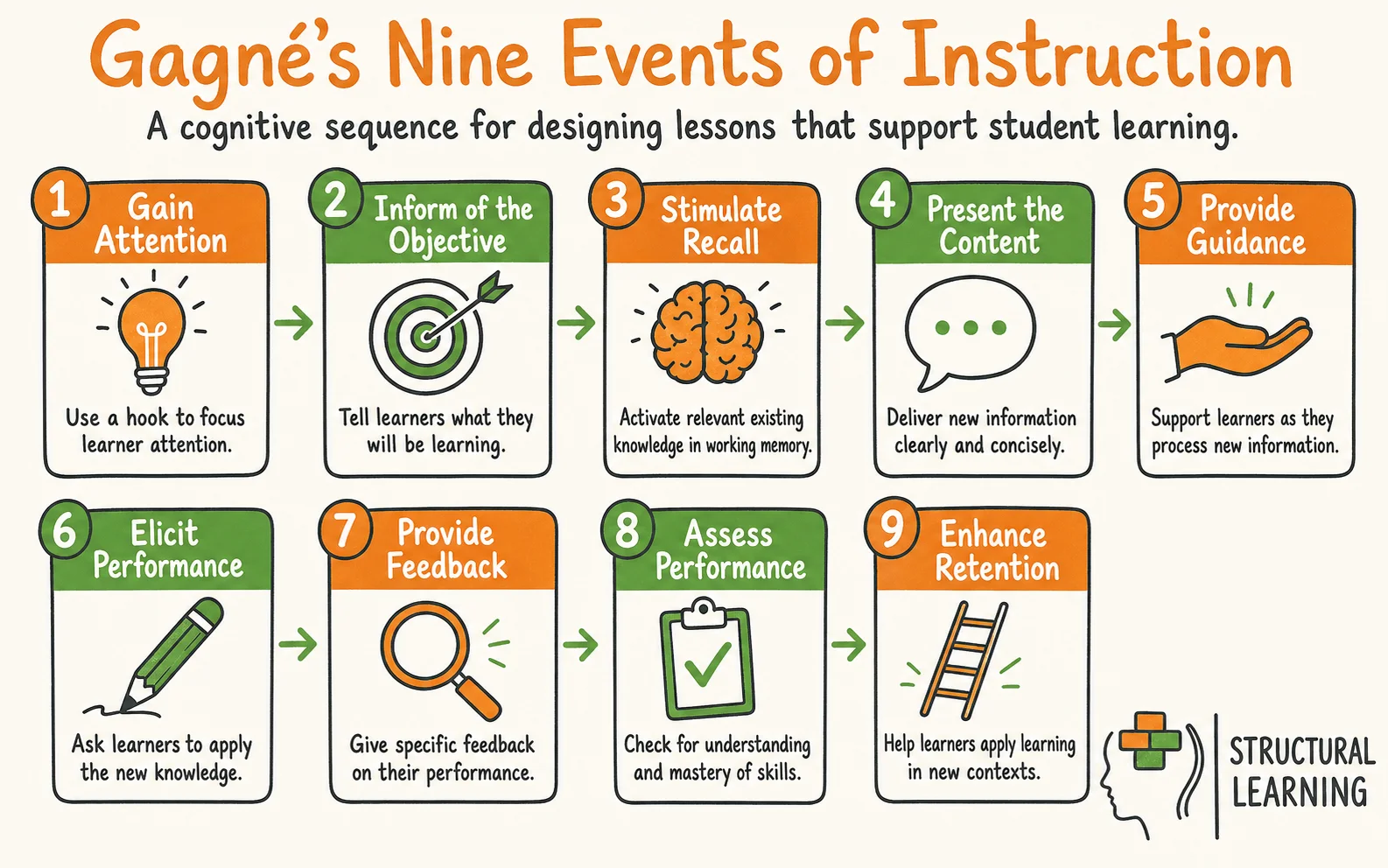
Event 5: Provide Learning Guidance
Presenting content is not the same as teaching it. Guidance helps learners encode new information meaningfully rather than mechanically. Gagné described this as 'semantic encoding': the process of connecting new information to existing knowledge structures.
Guidance takes many forms: analogies that link new concepts to familiar ones, scaffolding that supports novice learners without doing the thinking for them, think-alouds that make expert reasoning visible, and questioning strategies that prompt pupils to elaborate on their understanding.
The key distinction Gagné drew was between guidance and telling. Telling pupils the answer encodes little. Guiding them to construct the answer themselves encodes deeply. A mathematics teacher demonstrating long division should not simply execute the algorithm: they should verbalise each decision, highlight where errors commonly occur, and invite pupils to predict the next step.
Event 6: Elicit Performance
At this point, pupils must do something with the new learning. Gagné called this 'responding', and it serves two functions: it gives pupils practice at the target skill, and it gives the teacher information about what has been understood.
This event corresponds to guided practice in Rosenshine's Principles: the moment when pupils attempt the skill with support available. The task should be achievable but not trivial. Too easy and no learning occurs; too hard and cognitive load overwhelms the attempt.
A useful structure is the worked-example to completion-problem sequence (Paas and van Merriënboer, 1994): begin with fully worked examples, then completion problems where part of the solution is provided, then full problems. This gradient of challenge reduces load while building competence.
Event 7: Provide Feedback
Feedback is only useful if it is specific, timely, and acted upon. Gagné described this as 'reinforcement', though his conception was broader than the behaviourist version: effective feedback in his framework tells learners not just whether they are right or wrong, but why, and what to do next.
Formative assessment is the vehicle for this event. Hinge questions, mini-whiteboards, exit tickets, and targeted questioning all generate the information a teacher needs to give meaningful feedback at the lesson level. Wiliam's (2011) evidence on feedback confirms what Gagné described decades earlier: feedback that is acted upon in the moment has a far greater effect on learning than feedback returned the following week.
Feedback should address misconceptions directly. If several pupils make the same error, that is not a marking problem; it is a teaching problem. Event 7 is where teachers decide whether to proceed or reteach.
Event 8: Assess Performance
Assessing performance is distinct from eliciting it. Event 6 was guided practice; Event 8 is independent performance. Pupils now demonstrate what they have learned without scaffolding. This corresponds to what Rosenshine called independent practice.
The purpose of this assessment is to confirm that learning has occurred, not simply that pupils can perform under guidance. A pupil who completes a task correctly when the teacher is beside them, but fails on the same task the following day, has not yet learned. Event 8 reveals this gap.
Differentiation strategies matter here. The assessment task should be calibrated to the learning objective, not to the average pupil. A single task cannot reveal what all learners know. Consider multiple entry points: some pupils may demonstrate understanding through writing, others through diagram completion, others through oral explanation.
Event 9: Enhance Retention and Transfer
The final event addresses the hardest problem in teaching: getting learning to last and to transfer to new contexts. Gagné called this 'retrieval and generalisation'. Without explicit attention to this event, much of what happens in Events 1–8 fades within days.
Spaced practice is the most evidence-backed tool for Event 9. Returning to content across multiple lessons, with increasing gaps between reviews, produces far more durable retention than massed practice (Ebbinghaus, 1885; Cepeda et al., 2006). The implications for lesson planning are significant: a single lesson cannot achieve Event 9. It requires a medium-term planning view.
Transfer is harder still. Near transfer (applying a skill in a similar context) is achievable with varied practice. Far transfer (applying a skill in a genuinely novel context) requires pupils to understand the deep structure of what they have learned, not just the surface features. This is where Ausubel's work on meaningful learning connects: knowledge that is meaningfully encoded, rather than rotely memorised, transfers more readily.
Gagné's Conditions of Learning
The nine events sit within a broader theoretical framework. Gagné argued that different types of learning require different conditions. He identified five categories of learning outcomes, each with its own instructional requirements.
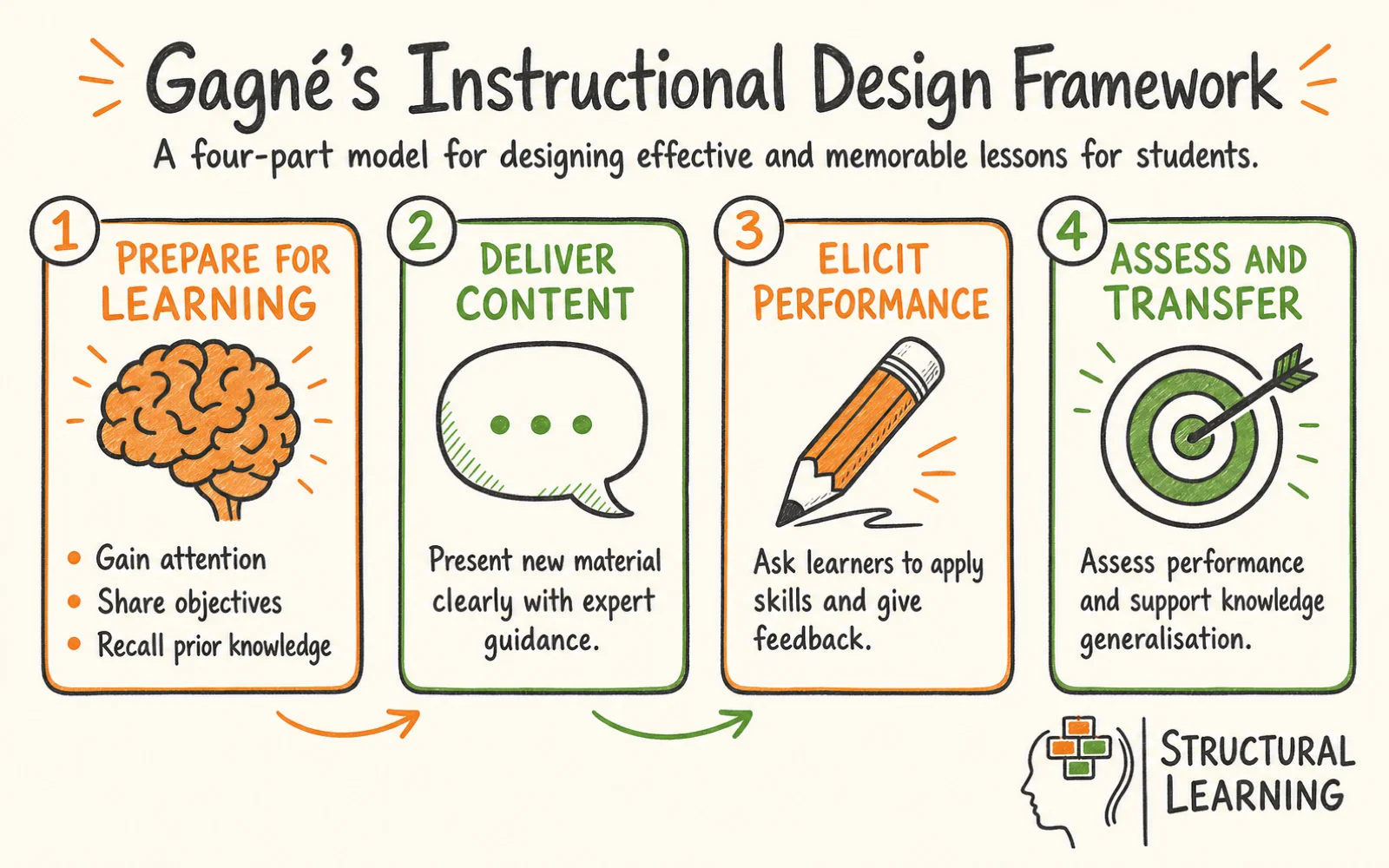
Verbal information covers facts, names, and declarative knowledge. Pupils need this organised into meaningful categories and connected to prior knowledge. A student learning the dates of historical events needs those dates embedded in a causal narrative, not isolated on a list.
Intellectual skills are the procedural competencies that allow pupils to interact with symbols and rules: reading, writing, calculating, classifying. Gagné subdivided these into discriminations, concepts, rules, and higher-order rules. Each builds on the one below. You cannot apply a rule about fractions until you understand the concept of a fraction.
Cognitive strategies are the internal control processes that learners use to manage their own learning: planning, monitoring, and evaluating. These correspond closely to what Flavell (1979) called metacognitive skills. Teaching cognitive strategies explicitly is one of the highest-leverage interventions available to teachers, with consistent effect sizes across the research base.
Motor skills involve physical performance, from handwriting in primary school to pipette technique in A-level chemistry. These require practice guided by feedback, with attention to the constituent sub-skills before integration into the whole.
Attitudes are the affective dimensions of learning: a pupil's disposition towards reading, their confidence in mathematics, their willingness to attempt challenging work. Gagné recognised that attitudes are learned and that instruction can shape them, through modelling, through reinforcement, and through the design of conditions that allow pupils to experience success.
Understanding which category a learning objective belongs to helps teachers design instruction that actually addresses it. A lesson aimed at changing a pupil's attitude towards reading requires very different conditions from a lesson aimed at teaching the concept of a subordinate clause.
Gagné's Taxonomy vs Bloom's Taxonomy
Both frameworks describe learning in hierarchical terms, and both are used in lesson planning. They are not the same thing, and confusing them leads to weaker teaching.
Bloom's Taxonomy (Bloom et al., 1956; revised Anderson and Krathwohl, 2001) is a taxonomy of cognitive processes arranged from lower-order to higher-order thinking: remember, understand, apply, analyse, evaluate, create. It describes the complexity of the thinking demanded by a task.
Gagné's five learning outcomes describe the type of learning that is occurring, not the complexity of the thinking. A pupil can exercise higher-order thinking (Bloom's evaluate) while working within any of Gagné's five categories. A pupil can also perform a motor skill (Gagné's category) at a very simple or very complex level.
The practical difference: Bloom's helps you write learning objectives that target the right level of cognitive demand. Gagné's helps you design the instructional conditions that will make that learning possible. They are complementary tools. Using Bloom's alone, without Gagné's framework, is like knowing where you want to go without knowing how to get there.
Many teachers familiar with Bloom's taxonomy find that adding Gagné's conditions framework to their planning significantly improves lesson coherence.
Building Blocks of Instruction: How to Assemble Your Lesson
The 9-Step Learning Journey: Gagné's Events in Action
Lesson Planning with the Nine Events
The nine events do not prescribe a rigid timing. A one-hour lesson might move through all nine; a short activity might address only three or four. What matters is that the events used are sequenced correctly and that none are omitted without a pedagogical reason.
A practical planning approach is to map each event to a lesson segment. For a Year 10 history lesson on the causes of the First World War, the mapping might look like this.
Event 1 is a short clip of news coverage framing a current geopolitical crisis, which the teacher links to the question of how wars start. Event 2 states the objective: pupils will be able to rank the causes of the First World War by significance and justify their ranking. Event 3 is a five-minute retrieval quiz on the previous lesson's content about alliances. Event 4 is a teacher-led explanation of the key causal factors, using a timeline and a visual representation of the alliance system. Event 5 involves a class discussion using the questioning strategies approach where the teacher probes understanding through elaborative questions. Event 6 asks pairs to rank the causes on cards. Event 7 is class feedback where the teacher addresses common misconceptions. Event 8 is an individual written justification of one ranking decision. Event 9 is the teacher's note to return to this ranking at the start of next lesson and again in three weeks.
This kind of structured mapping takes practice. Over time it becomes automatic, and teachers begin to notice which events they habitually skip and what effect that has on pupil learning.
Digital Tools and Gagné's Framework
The nine events translate directly into digital learning environments, and understanding Gagné helps teachers evaluate whether an edtech tool is actually supporting learning or simply digitising activity.
A tool that presents content beautifully but provides no mechanism for Events 3, 5, or 7 is a presentation tool, not a learning tool. Conversely, a well-designed platform that sequences retrieval, explanation, guided practice, feedback, and retention activities reflects Gagné's framework in its architecture.
Adaptive learning platforms, when well-designed, support Events 6, 7, and 8 efficiently. The teacher's role shifts towards Events 2, 3, 4, and 5: the human elements of learning that technology cannot replicate. Setting objectives, activating prior knowledge, providing expert guidance, and modelling cognitive strategies are inherently relational acts. Gagné's framework helps teachers understand where their time is irreplaceable.
For asynchronous learning (homework, flipped classroom), the challenge is Events 5 and 7. Without the teacher present, guidance and feedback are limited. Designing good asynchronous tasks means building the guidance into the task itself: structured note-taking, self-checking templates, and embedded worked examples that pupils use as reference points.
How Modular Lesson Design Connects to Gagné
The most significant insight in Gagné's framework for contemporary lesson design is that the nine events are modular. They are not a script. They are discrete, purposeful building blocks that can be combined in different sequences, at different scales, and with different materials.
This modular logic is what makes Gagné's framework so compatible with structured lesson-planning approaches. Consider what modular lesson design means in practice: a teacher selects from a set of purposeful components, sequences them appropriately for the learning goal, and assembles them into a coherent instructional unit. Each component has a clear cognitive purpose. No component is filler.
The connection to Gagné is explicit. When a teacher selects a retrieval component (Event 3), an explanation component (Event 4), a guided practice component (Event 6), and a feedback component (Event 7), they are not following a rigid template: they are making purposeful instructional decisions grounded in six decades of learning science research.
Gagné's framework gives the pedagogical rationale for this kind of modular thinking. The components are not arbitrary; they correspond to the cognitive processes that research identifies as necessary for durable learning. A lesson built from well-chosen components, sequenced correctly, is not just efficient: it is scientifically grounded.
This is why Gagné's work has experienced a resurgence of interest among teachers who are moving away from lesson-plan templates and towards genuine instructional design. The question shifts from 'what am I covering?' to 'what cognitive processes am I supporting, and how?'
Limitations and Criticisms
Gagné's framework is influential, but it has attracted substantive criticism from researchers and practitioners.
David Merrill (2002) proposed 'First Principles of Instruction' partly as a response to frameworks like Gagné's that he felt under-specified the conditions of effective learning. Merrill argued that problem-centred learning, where instruction is organised around real-world tasks rather than event sequences, produces more transferable learning. His critique has merit, particularly for complex performance goals where the nine events can feel artificially linear.
Constructivist researchers have challenged the information-processing assumptions underlying the framework (Wilson, 1997). The nine events assume that knowledge is transmitted from teacher to learner and then stored. Constructivist accounts suggest instead that knowledge is actively built by learners through experience, dialogue, and reflection. In this view, Events 4 and 5 are less about transmitting content and more about creating conditions for construction.
The framework has also been criticised for its teacher-centredness. In a nine-event sequence, the teacher controls Events 1 through 6 almost entirely. Learner agency is limited to Events 6, 8, and, arguably, 9. Critics argue that this positions pupils as passive recipients rather than active agents in their own learning.
These criticisms do not invalidate the framework. They contextualise it. Gagné's nine events are most powerful for structured content learning and skill acquisition. They are less well-suited to open-ended inquiry, project-based learning, or contexts where learner autonomy is the primary goal. The skilled teacher uses the framework as a starting point, not a straitjacket.
Gagné vs. The Checklist: Why Sequence Matters More Than Speed
Gagné in the Age of AI-Assisted Teaching
AI tools are now available for several of the cognitive tasks that the nine events describe, and understanding Gagné helps teachers use these tools intelligently rather than indiscriminately.
Event 3, stimulating recall of prior learning, can be supported by AI-generated retrieval quiz questions calibrated to prior lesson content. Event 4, presenting content, can be supported by AI-generated explanations, worked examples, and summary notes. Event 7, providing feedback, is where AI tools are developing fastest: automated feedback on writing, mathematics, and structured responses is now available at scale.
What AI cannot yet do well is Events 2, 5, and 9 in their fullest sense. Informing learners of the objective requires a teacher who understands the pupil's prior knowledge, misconceptions, and motivational state. Providing learning guidance requires expert judgement about when to prompt, when to tell, and when to let a pupil struggle productively. Enhancing transfer requires knowing the learner well enough to design tasks that stretch precisely the right dimensions of understanding.
Gagné's framework, read in the light of AI capabilities, is a map of where human teaching remains indispensable. The events that AI can support free up teacher time for the events that demand human expertise. That is not a threat to teaching; it is an opportunity to focus professional effort where it has the greatest impact.
Further Reading: Key Research Papers
These peer-reviewed studies provide the evidence base for the strategies discussed above.
Why Did All the Residents Resign? Key Takeaways From the Junior Physicians' Mass Walkout in South Korea.View study ↗ 23 citations
Park et al. (2024)
This paper examines the mass resignation of medical residents in South Korea. Whilst not directly related to classroom instruction, it may offer insights into systemic educational pressures and institutional communication that teachers could apply when considering student engagement and retention strategies.
Cultivating connectedness and elevating educational experiences for international students in blended learning: reflections from the pandemic era and key takeawaysView study ↗
He et al. (2024)
This study explores how videoconferencing technology enhances blended learning for international students during the pandemic. Teachers can learn from the findings about using technology to foster student connection, engagement, and satisfaction in mixed online-offline learning environments.
Who Benefits and under What Conditions from Developmental Education Reform? Key Takeaways from Florida’s Statewide InitiativeView study ↗
Mokher et al. (2023)
This research evaluates Florida's developmental education reforms to identify which students benefit most from policy changes. Teachers working with struggling students can gain insights into effective support strategies and conditions that promote academic success in remedial programmes.
Why are some students “not into” computational thinking activities embedded within high school science units? Key takeaways from a microethnographic discourse analysis studyView study ↗
Aslan et al. (2024)
This microethnographic study investigates why some students disengage from computational thinking activities in science classes. Teachers can use these findings to better understand student resistance and develop more engaging approaches to integrating computational thinking into their curricula.
Establishing a distance PharmD program: An overview and key takeaways.View study ↗
Rao et al. (2025)
This paper outlines the establishment of a distance pharmacy programme, drawing lessons from pandemic-era online education. Teachers can apply insights about remote programme design, student support systems, and maintaining educational quality in distance learning environments.
Free Resource Pack
Gagné's 9 Events: Teacher's Planning Toolkit
A collection of 4 ready-to-use resources for teachers to design effective, evidence-informed lessons.
A sequence, not a checklist: Gagné's nine events describe a psychological sequence that mirrors how the human brain acquires and retains new knowledge. Skipping events does not save time; it reduces learning.
Rooted in cognitive science: Each event corresponds to an internal cognitive process, from gaining attention to long-term retention. The framework draws on information-processing theory, not intuition.
Modular by design: The nine events are discrete, purposeful building blocks. Teachers can combine, reorder, and adapt them to suit different subjects, age groups, and lesson contexts, much like assembling components from a kit.
Still relevant after sixty years: Gagné published the framework in 1965. Subsequent research into working memory, cognitive load theory, and retrieval has repeatedly validated his core sequence.
Who Was Robert Gagné?
Robert Mills Gagné (1916–2002) was an American educational psychologist whose career spanned military training research, university teaching, and curriculum design. He worked with the US Air Force in the 1940s on training programme effectiveness, and this early exposure to real-world skill acquisition shaped everything he later wrote. Where other psychologists studied learning in laboratory conditions, Gagné studied it where it mattered most: in classrooms and training centres where failure had consequences.
His landmark text, 'The Conditions of Learning', first published in 1965, argued that not all learning is the same. Memorising a fact requires different conditions from learning a procedure, and learning a procedure requires different conditions from developing an attitude. This taxonomy of learning outcomes was radical because it told teachers that one-size-fits-all instruction was never going to work.
Gagné collaborated with Leslie Briggs and Walter Wager to develop what became the nine events of instruction, a sequence of instructional activities that support each of the internal cognitive processes required for new learning. His later work with Briggs and Wager, 'Principles of Instructional Design' (Gagné, Briggs and Wager, 1992), remains a standard reference in teacher education programmes worldwide.
The Nine Events of Instruction
Gagné's nine events map directly onto what cognitive science tells us about how new information is processed, encoded, and retrieved. Each event activates a specific internal process. Together they form a coherent instructional sequence that supports both short-term comprehension and long-term retention.
Event 1: Gain Attention
Before any learning can happen, pupils must be attending. Gagné called this 'reception', the cognitive process of registering incoming sensory information. If a pupil's working memory is occupied elsewhere, instruction is noise.
In practice this might be a surprising fact, a short video clip, a provocative question, or a physical demonstration. A Year 9 science teacher might begin a lesson on Newton's laws by dropping a heavy and a light ball simultaneously and asking which will hit the floor first. The counter-intuitive result gets attention. The lesson has begun.
The mistake many teachers make is treating this event as entertainment rather than as a cognitive primer. The attention-gaining stimulus should connect directly to the lesson's content, not simply generate noise.
Event 2: Inform Learners of the Objective
Once pupils are attending, they need to know what they are about to learn and why it matters. Gagné called this 'expectancy': learners who understand the goal of a lesson process information differently from learners who do not. They filter incoming information through the lens of the objective, which improves encoding.
A clear learning objective does more than satisfy an observation checklist. It activates relevant prior knowledge (see Event 3), reduces extraneous cognitive load, and gives pupils a self-monitoring tool. When a Year 6 pupil knows they are learning to identify the features of a persuasive text, they will pay different attention to the mentor text the teacher shares than if they think they are simply reading.
Avoid vague objectives like 'understand forces'. Concrete, observable objectives, such as 'explain why objects in free fall accelerate at the same rate regardless of mass', give learners a precise target.
Event 3: Stimulate Recall of Prior Learning
New knowledge is constructed on the foundation of existing knowledge. Gagné called this activation of 'retrieval from long-term memory'. Cognitive science now confirms what Gagné intuited: information that connects to existing schema is processed more efficiently and retained more durably (Ausubel, 1968).
This event overlaps directly with retrieval practice. A brief low-stakes quiz on last lesson's content does three things simultaneously: it retrieves prior knowledge into working memory, it strengthens memory traces through the testing effect, and it exposes gaps that the teacher can address before introducing new material. For a deeper treatment of this mechanism, see the guide to retrieval practice.
The event need not be formal. A teacher might simply ask: 'Last lesson we looked at fractions. What do you remember about finding a common denominator?' The key is that prior knowledge is active in working memory before new learning begins.
Event 4: Present the Content
This is the most visible part of teaching, but Gagné's framework places it fourth, not first. By the time content is presented, pupils are attending, they know what they are learning, and their relevant prior knowledge is active. The content lands on prepared ground.
Good content presentation follows the principles of direct instruction: clear worked examples, explicit modelling, concrete-to-abstract sequencing. Sweller's (1988) work on cognitive load is relevant here: content should be chunked to avoid overloading working memory. Presenting too much at once, without the prior structure that Events 1–3 build, is the most common reason new content fails to stick.
Dual-coding principles apply here too. Pairing verbal explanation with a diagram or graphic organiser reduces split-attention effects and supports learners who process information differently.
Event 5: Provide Learning Guidance
Presenting content is not the same as teaching it. Guidance helps learners encode new information meaningfully rather than mechanically. Gagné described this as 'semantic encoding': the process of connecting new information to existing knowledge structures.
Guidance takes many forms: analogies that link new concepts to familiar ones, scaffolding that supports novice learners without doing the thinking for them, think-alouds that make expert reasoning visible, and questioning strategies that prompt pupils to elaborate on their understanding.
The key distinction Gagné drew was between guidance and telling. Telling pupils the answer encodes little. Guiding them to construct the answer themselves encodes deeply. A mathematics teacher demonstrating long division should not simply execute the algorithm: they should verbalise each decision, highlight where errors commonly occur, and invite pupils to predict the next step.
Event 6: Elicit Performance
At this point, pupils must do something with the new learning. Gagné called this 'responding', and it serves two functions: it gives pupils practice at the target skill, and it gives the teacher information about what has been understood.
This event corresponds to guided practice in Rosenshine's Principles: the moment when pupils attempt the skill with support available. The task should be achievable but not trivial. Too easy and no learning occurs; too hard and cognitive load overwhelms the attempt.
A useful structure is the worked-example to completion-problem sequence (Paas and van Merriënboer, 1994): begin with fully worked examples, then completion problems where part of the solution is provided, then full problems. This gradient of challenge reduces load while building competence.
Event 7: Provide Feedback
Feedback is only useful if it is specific, timely, and acted upon. Gagné described this as 'reinforcement', though his conception was broader than the behaviourist version: effective feedback in his framework tells learners not just whether they are right or wrong, but why, and what to do next.
Formative assessment is the vehicle for this event. Hinge questions, mini-whiteboards, exit tickets, and targeted questioning all generate the information a teacher needs to give meaningful feedback at the lesson level. Wiliam's (2011) evidence on feedback confirms what Gagné described decades earlier: feedback that is acted upon in the moment has a far greater effect on learning than feedback returned the following week.
Feedback should address misconceptions directly. If several pupils make the same error, that is not a marking problem; it is a teaching problem. Event 7 is where teachers decide whether to proceed or reteach.
Event 8: Assess Performance
Assessing performance is distinct from eliciting it. Event 6 was guided practice; Event 8 is independent performance. Pupils now demonstrate what they have learned without scaffolding. This corresponds to what Rosenshine called independent practice.
The purpose of this assessment is to confirm that learning has occurred, not simply that pupils can perform under guidance. A pupil who completes a task correctly when the teacher is beside them, but fails on the same task the following day, has not yet learned. Event 8 reveals this gap.
Differentiation strategies matter here. The assessment task should be calibrated to the learning objective, not to the average pupil. A single task cannot reveal what all learners know. Consider multiple entry points: some pupils may demonstrate understanding through writing, others through diagram completion, others through oral explanation.
Event 9: Enhance Retention and Transfer
The final event addresses the hardest problem in teaching: getting learning to last and to transfer to new contexts. Gagné called this 'retrieval and generalisation'. Without explicit attention to this event, much of what happens in Events 1–8 fades within days.
Spaced practice is the most evidence-backed tool for Event 9. Returning to content across multiple lessons, with increasing gaps between reviews, produces far more durable retention than massed practice (Ebbinghaus, 1885; Cepeda et al., 2006). The implications for lesson planning are significant: a single lesson cannot achieve Event 9. It requires a medium-term planning view.
Transfer is harder still. Near transfer (applying a skill in a similar context) is achievable with varied practice. Far transfer (applying a skill in a genuinely novel context) requires pupils to understand the deep structure of what they have learned, not just the surface features. This is where Ausubel's work on meaningful learning connects: knowledge that is meaningfully encoded, rather than rotely memorised, transfers more readily.
Gagné's Conditions of Learning
The nine events sit within a broader theoretical framework. Gagné argued that different types of learning require different conditions. He identified five categories of learning outcomes, each with its own instructional requirements.
Verbal information covers facts, names, and declarative knowledge. Pupils need this organised into meaningful categories and connected to prior knowledge. A student learning the dates of historical events needs those dates embedded in a causal narrative, not isolated on a list.
Intellectual skills are the procedural competencies that allow pupils to interact with symbols and rules: reading, writing, calculating, classifying. Gagné subdivided these into discriminations, concepts, rules, and higher-order rules. Each builds on the one below. You cannot apply a rule about fractions until you understand the concept of a fraction.
Cognitive strategies are the internal control processes that learners use to manage their own learning: planning, monitoring, and evaluating. These correspond closely to what Flavell (1979) called metacognitive skills. Teaching cognitive strategies explicitly is one of the highest-leverage interventions available to teachers, with consistent effect sizes across the research base.
Motor skills involve physical performance, from handwriting in primary school to pipette technique in A-level chemistry. These require practice guided by feedback, with attention to the constituent sub-skills before integration into the whole.
Attitudes are the affective dimensions of learning: a pupil's disposition towards reading, their confidence in mathematics, their willingness to attempt challenging work. Gagné recognised that attitudes are learned and that instruction can shape them, through modelling, through reinforcement, and through the design of conditions that allow pupils to experience success.
Understanding which category a learning objective belongs to helps teachers design instruction that actually addresses it. A lesson aimed at changing a pupil's attitude towards reading requires very different conditions from a lesson aimed at teaching the concept of a subordinate clause.
Gagné's Taxonomy vs Bloom's Taxonomy
Both frameworks describe learning in hierarchical terms, and both are used in lesson planning. They are not the same thing, and confusing them leads to weaker teaching.
Bloom's Taxonomy (Bloom et al., 1956; revised Anderson and Krathwohl, 2001) is a taxonomy of cognitive processes arranged from lower-order to higher-order thinking: remember, understand, apply, analyse, evaluate, create. It describes the complexity of the thinking demanded by a task.
Gagné's five learning outcomes describe the type of learning that is occurring, not the complexity of the thinking. A pupil can exercise higher-order thinking (Bloom's evaluate) while working within any of Gagné's five categories. A pupil can also perform a motor skill (Gagné's category) at a very simple or very complex level.
The practical difference: Bloom's helps you write learning objectives that target the right level of cognitive demand. Gagné's helps you design the instructional conditions that will make that learning possible. They are complementary tools. Using Bloom's alone, without Gagné's framework, is like knowing where you want to go without knowing how to get there.
Many teachers familiar with Bloom's taxonomy find that adding Gagné's conditions framework to their planning significantly improves lesson coherence.
Building Blocks of Instruction: How to Assemble Your Lesson
The 9-Step Learning Journey: Gagné's Events in Action
Lesson Planning with the Nine Events
The nine events do not prescribe a rigid timing. A one-hour lesson might move through all nine; a short activity might address only three or four. What matters is that the events used are sequenced correctly and that none are omitted without a pedagogical reason.
A practical planning approach is to map each event to a lesson segment. For a Year 10 history lesson on the causes of the First World War, the mapping might look like this.
Event 1 is a short clip of news coverage framing a current geopolitical crisis, which the teacher links to the question of how wars start. Event 2 states the objective: pupils will be able to rank the causes of the First World War by significance and justify their ranking. Event 3 is a five-minute retrieval quiz on the previous lesson's content about alliances. Event 4 is a teacher-led explanation of the key causal factors, using a timeline and a visual representation of the alliance system. Event 5 involves a class discussion using the questioning strategies approach where the teacher probes understanding through elaborative questions. Event 6 asks pairs to rank the causes on cards. Event 7 is class feedback where the teacher addresses common misconceptions. Event 8 is an individual written justification of one ranking decision. Event 9 is the teacher's note to return to this ranking at the start of next lesson and again in three weeks.
This kind of structured mapping takes practice. Over time it becomes automatic, and teachers begin to notice which events they habitually skip and what effect that has on pupil learning.
Digital Tools and Gagné's Framework
The nine events translate directly into digital learning environments, and understanding Gagné helps teachers evaluate whether an edtech tool is actually supporting learning or simply digitising activity.
A tool that presents content beautifully but provides no mechanism for Events 3, 5, or 7 is a presentation tool, not a learning tool. Conversely, a well-designed platform that sequences retrieval, explanation, guided practice, feedback, and retention activities reflects Gagné's framework in its architecture.
Adaptive learning platforms, when well-designed, support Events 6, 7, and 8 efficiently. The teacher's role shifts towards Events 2, 3, 4, and 5: the human elements of learning that technology cannot replicate. Setting objectives, activating prior knowledge, providing expert guidance, and modelling cognitive strategies are inherently relational acts. Gagné's framework helps teachers understand where their time is irreplaceable.
For asynchronous learning (homework, flipped classroom), the challenge is Events 5 and 7. Without the teacher present, guidance and feedback are limited. Designing good asynchronous tasks means building the guidance into the task itself: structured note-taking, self-checking templates, and embedded worked examples that pupils use as reference points.
How Modular Lesson Design Connects to Gagné
The most significant insight in Gagné's framework for contemporary lesson design is that the nine events are modular. They are not a script. They are discrete, purposeful building blocks that can be combined in different sequences, at different scales, and with different materials.
This modular logic is what makes Gagné's framework so compatible with structured lesson-planning approaches. Consider what modular lesson design means in practice: a teacher selects from a set of purposeful components, sequences them appropriately for the learning goal, and assembles them into a coherent instructional unit. Each component has a clear cognitive purpose. No component is filler.
The connection to Gagné is explicit. When a teacher selects a retrieval component (Event 3), an explanation component (Event 4), a guided practice component (Event 6), and a feedback component (Event 7), they are not following a rigid template: they are making purposeful instructional decisions grounded in six decades of learning science research.
Gagné's framework gives the pedagogical rationale for this kind of modular thinking. The components are not arbitrary; they correspond to the cognitive processes that research identifies as necessary for durable learning. A lesson built from well-chosen components, sequenced correctly, is not just efficient: it is scientifically grounded.
This is why Gagné's work has experienced a resurgence of interest among teachers who are moving away from lesson-plan templates and towards genuine instructional design. The question shifts from 'what am I covering?' to 'what cognitive processes am I supporting, and how?'
Limitations and Criticisms
Gagné's framework is influential, but it has attracted substantive criticism from researchers and practitioners.
David Merrill (2002) proposed 'First Principles of Instruction' partly as a response to frameworks like Gagné's that he felt under-specified the conditions of effective learning. Merrill argued that problem-centred learning, where instruction is organised around real-world tasks rather than event sequences, produces more transferable learning. His critique has merit, particularly for complex performance goals where the nine events can feel artificially linear.
Constructivist researchers have challenged the information-processing assumptions underlying the framework (Wilson, 1997). The nine events assume that knowledge is transmitted from teacher to learner and then stored. Constructivist accounts suggest instead that knowledge is actively built by learners through experience, dialogue, and reflection. In this view, Events 4 and 5 are less about transmitting content and more about creating conditions for construction.
The framework has also been criticised for its teacher-centredness. In a nine-event sequence, the teacher controls Events 1 through 6 almost entirely. Learner agency is limited to Events 6, 8, and, arguably, 9. Critics argue that this positions pupils as passive recipients rather than active agents in their own learning.
These criticisms do not invalidate the framework. They contextualise it. Gagné's nine events are most powerful for structured content learning and skill acquisition. They are less well-suited to open-ended inquiry, project-based learning, or contexts where learner autonomy is the primary goal. The skilled teacher uses the framework as a starting point, not a straitjacket.
Gagné vs. The Checklist: Why Sequence Matters More Than Speed
Gagné in the Age of AI-Assisted Teaching
AI tools are now available for several of the cognitive tasks that the nine events describe, and understanding Gagné helps teachers use these tools intelligently rather than indiscriminately.
Event 3, stimulating recall of prior learning, can be supported by AI-generated retrieval quiz questions calibrated to prior lesson content. Event 4, presenting content, can be supported by AI-generated explanations, worked examples, and summary notes. Event 7, providing feedback, is where AI tools are developing fastest: automated feedback on writing, mathematics, and structured responses is now available at scale.
What AI cannot yet do well is Events 2, 5, and 9 in their fullest sense. Informing learners of the objective requires a teacher who understands the pupil's prior knowledge, misconceptions, and motivational state. Providing learning guidance requires expert judgement about when to prompt, when to tell, and when to let a pupil struggle productively. Enhancing transfer requires knowing the learner well enough to design tasks that stretch precisely the right dimensions of understanding.
Gagné's framework, read in the light of AI capabilities, is a map of where human teaching remains indispensable. The events that AI can support free up teacher time for the events that demand human expertise. That is not a threat to teaching; it is an opportunity to focus professional effort where it has the greatest impact.
Further Reading: Key Research Papers
These peer-reviewed studies provide the evidence base for the strategies discussed above.
Why Did All the Residents Resign? Key Takeaways From the Junior Physicians' Mass Walkout in South Korea.View study ↗ 23 citations
Park et al. (2024)
This paper examines the mass resignation of medical residents in South Korea. Whilst not directly related to classroom instruction, it may offer insights into systemic educational pressures and institutional communication that teachers could apply when considering student engagement and retention strategies.
Cultivating connectedness and elevating educational experiences for international students in blended learning: reflections from the pandemic era and key takeawaysView study ↗
He et al. (2024)
This study explores how videoconferencing technology enhances blended learning for international students during the pandemic. Teachers can learn from the findings about using technology to foster student connection, engagement, and satisfaction in mixed online-offline learning environments.
Who Benefits and under What Conditions from Developmental Education Reform? Key Takeaways from Florida’s Statewide InitiativeView study ↗
Mokher et al. (2023)
This research evaluates Florida's developmental education reforms to identify which students benefit most from policy changes. Teachers working with struggling students can gain insights into effective support strategies and conditions that promote academic success in remedial programmes.
Why are some students “not into” computational thinking activities embedded within high school science units? Key takeaways from a microethnographic discourse analysis studyView study ↗
Aslan et al. (2024)
This microethnographic study investigates why some students disengage from computational thinking activities in science classes. Teachers can use these findings to better understand student resistance and develop more engaging approaches to integrating computational thinking into their curricula.
Establishing a distance PharmD program: An overview and key takeaways.View study ↗
Rao et al. (2025)
This paper outlines the establishment of a distance pharmacy programme, drawing lessons from pandemic-era online education. Teachers can apply insights about remote programme design, student support systems, and maintaining educational quality in distance learning environments.
Free Resource Pack
Gagné's 9 Events: Teacher's Planning Toolkit
A collection of 4 ready-to-use resources for teachers to design effective, evidence-informed lessons.
{"@context":"https://schema.org","@graph":[{"@type":"Organization","@id":"https://www.structural-learning.com/#org","name":"Structural Learning","url":"https://www.structural-learning.com/","logo":{"@type":"ImageObject","url":"https://cdn.prod.website-files.com/5b69a01ba2e409501de055d1/5b69a01ba2e40996a5e055f4_structural-learning-logo.png"}},{"@type":"Person","@id":"https://www.structural-learning.com/team/paul-main/#person","name":"Paul Main","url":"https://www.structural-learning.com/team/paul-main","jobTitle":"Founder","affiliation":{"@id":"https://www.structural-learning.com/#org"}},{"@type":"BreadcrumbList","@id":"https://www.structural-learning.com/post/gagns-nine-events-instruction-teachers-guide#breadcrumb","itemListElement":[{"@type":"ListItem","position":1,"name":"Home","item":"https://www.structural-learning.com/"},{"@type":"ListItem","position":2,"name":"Blog","item":"https://www.structural-learning.com/blog"},{"@type":"ListItem","position":3,"name":"Gagné's Nine Events of Instruction: A Teacher's Guide to Effective Lesson Design","item":"https://www.structural-learning.com/post/gagns-nine-events-instruction-teachers-guide"}]},{"@type":"BlogPosting","@id":"https://www.structural-learning.com/post/gagns-nine-events-instruction-teachers-guide#article","headline":"Gagné's Nine Events of Instruction: A Teacher's Guide to Effective Lesson Design","description":"Gagné's Nine Events of Instruction give teachers a research-backed sequence for lesson design. This guide explains each event with practical classroom examples.","author":{"@id":"https://www.structural-learning.com/team/paul-main/#person"},"publisher":{"@id":"https://www.structural-learning.com/#org"},"datePublished":"2026-03-20","dateModified":"2026-03-20","inLanguage":"en-GB"}]}