Updated on
September 9, 2026
Literacy Pedagogy: Frameworks for Reading and Writing
Explore effective literacy pedagogy teaching reading and writing. Discover evidence-based frameworks, classroom strategies, and cognitive load solutions.

Updated on
September 9, 2026
Explore effective literacy pedagogy teaching reading and writing. Discover evidence-based frameworks, classroom strategies, and cognitive load solutions.
Literacy pedagogy teaches learners to systematically encode and decode text. This builds cognitive skills, so learners understand text and share ideas. Research in cognitive psychology and neuroscience supports this (Seidenberg, 2005; Wolf, 2007). More on science pedagogy can be found elsewhere.
For a more explicit narrative scaffold, our guide to Story Grammar Marker shows how teachers can make character, setting, problem and resolution visible during reading and writing.
Gough & Tunmer (1986) introduced the Simple View of Reading. This model shows that reading comprehension is the product of word recognition and language comprehension. If a learner cannot decode the words, their comprehension is zero, regardless of their verbal intelligence.
Scarborough (2001) presented the Reading Rope framework. The model shows word recognition links with language skills. Fluent reading develops as learners practice these strands. Teachers can plan lessons targeting learners' specific weaknesses (Scarborough, 2001).
Sedita introduced the Writing Rope to help learners express ideas. The framework (Sedita, n.d.) breaks writing into thinking, syntax, structure, and transcription. Good teaching merges reading and writing (Shanahan, 2016) as one process. See our article on talk for writing (Mercer & Dawes, 2008) for support.
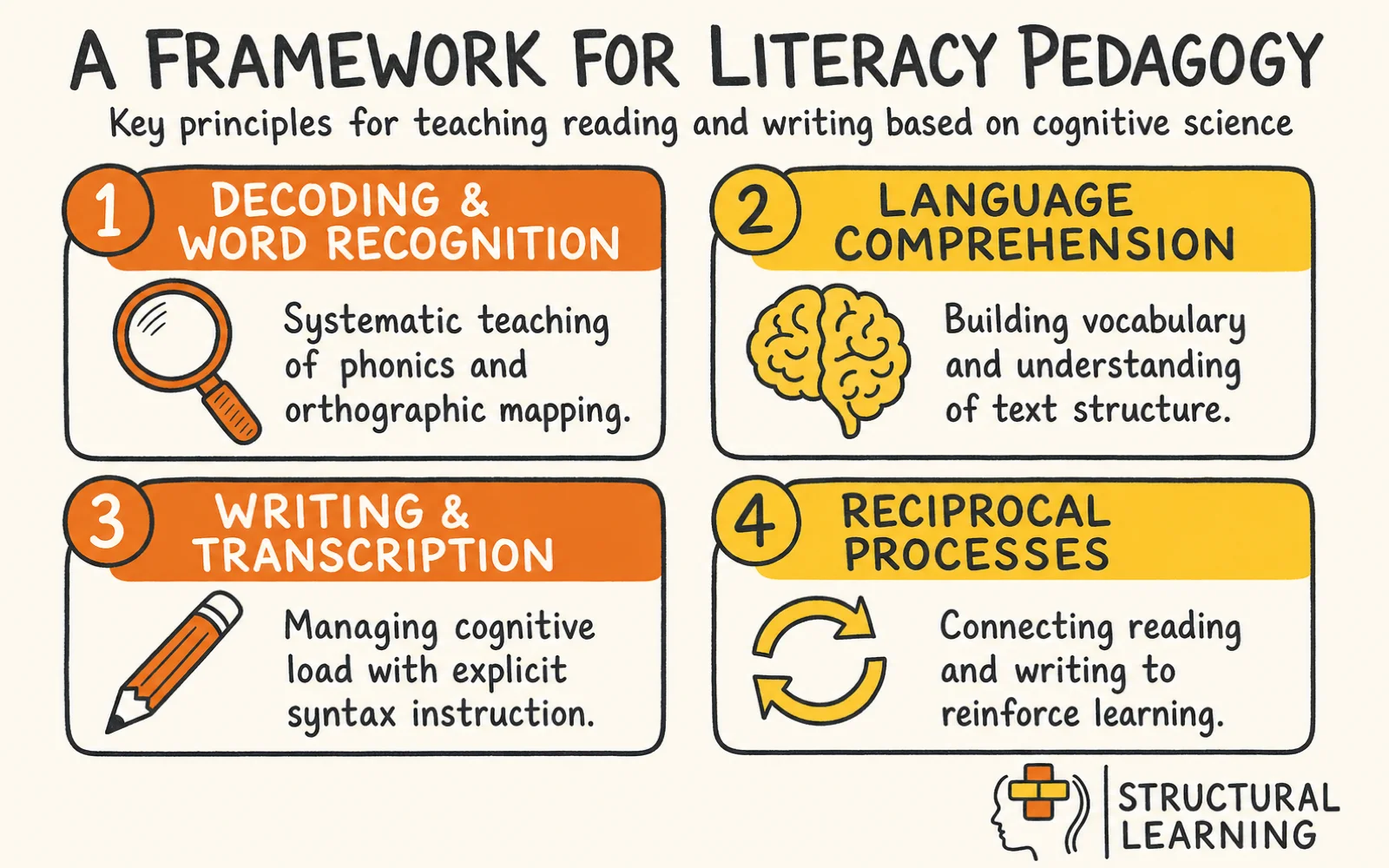
Written language isn't natural; brains are wired for speech (Dehaene, 2009). Learners need clear, systematic reading and writing teaching (Seidenberg, 2017). Without it, some learners will struggle to access the curriculum (Snowling & Hulme, 2011).
Sweller (1988) showed Cognitive Load Theory affects literacy. Writing can quickly overwhelm a learner's working memory. Learners manage handwriting, spelling, grammar, and concepts at once. Support is helpful; overload lowers writing and reading skills.
Treating reading and writing as separate subjects wastes time and limits cognitive transfer. Connecting orthographic mapping with expressive writing helps learners link print and meaning. Ehri (2014) highlights orthographic mapping as the process that builds sight word memory.
When learners write the words they are learning to read, this encoding strengthens their neural connections, making future decoding faster. A teacher applying this will ask learners to write down the phonemes they are learning to read, cementing the knowledge through action.
With 'Writer's Block', teachers show learners abstract grammar concepts. Teachers model sentence construction by connecting subject, verb, predicate blocks. This makes grammar rules understandable for learners (McNeill, 1992).
Learners arrange the blocks to build sentences. They swap a verb block to see how it changes the meaning. They move an adverb block to the front to understand how sentence emphasis shifts.
During a science lesson, the teacher asks the class to describe a process. Learners use the blocks to build the core sentence. They then use additional blocks to add subordinate clauses, ensuring the scientific concept is structured correctly before writing it down.
The teacher models choral reading with a short text. They then assign cognitive roles to small groups. These roles include the Clarifier, the Summariser, and the Questioner. This encourages active engagement with the text structure and vocabulary.
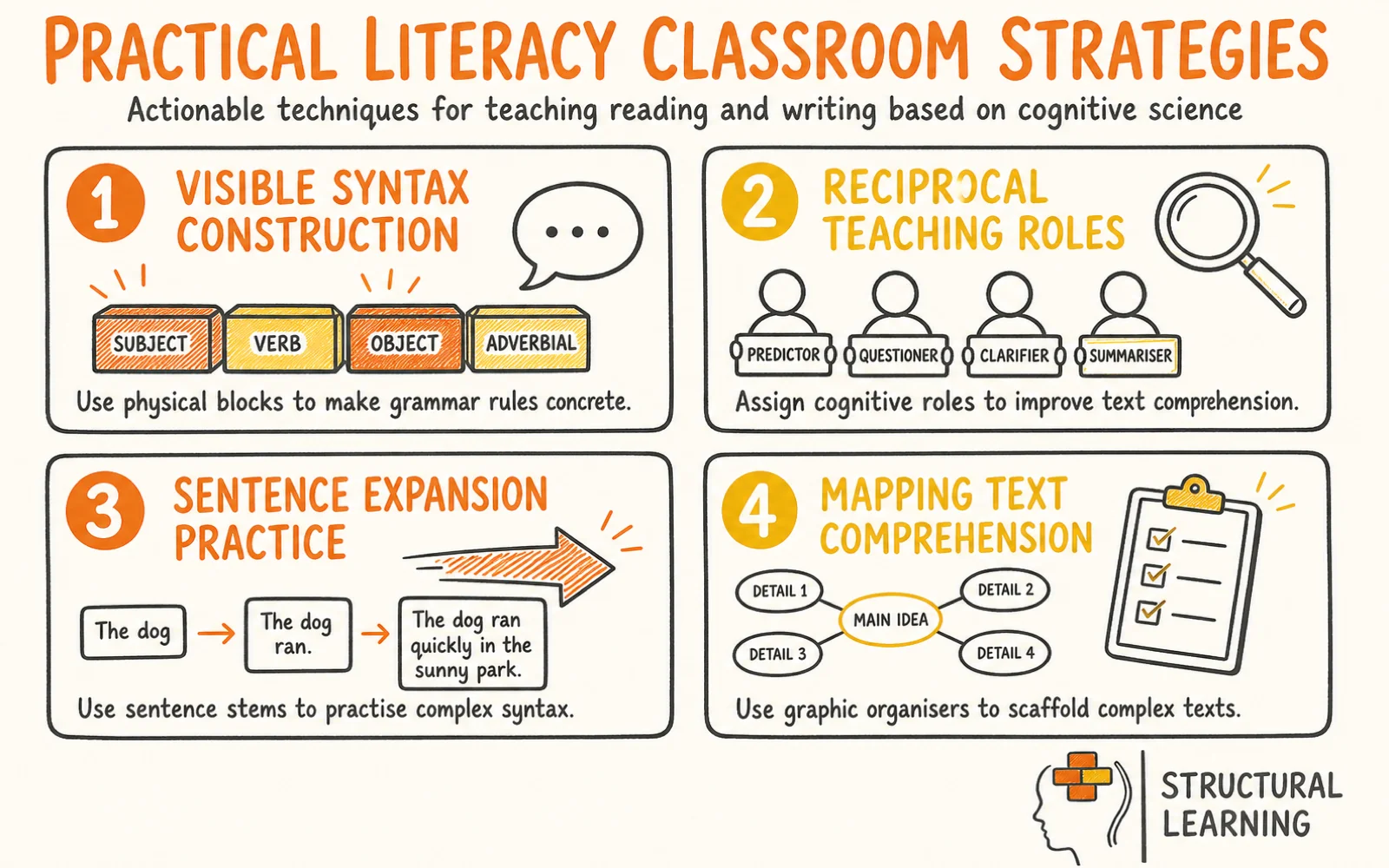
The Predictor forecasts what comes next (Palincsar & Brown, 1984). These strategies support comprehension (Rosenshine & Meister, 1994). Each learner takes on a role to improve understanding (Slavin, 2011). The teacher guides learners in applying these techniques (Fisher & Frey, 2010).
During a history lesson on the Romans, the teacher pauses the reading. The Questioner asks why the Romans built straight roads. The Summariser uses their notes to write a sentence explaining that Romans built straight roads to move armies quickly.
The teacher provides a basic sentence stem related to the text. They introduce a framework to practice complex syntax (Hochman & Wexler, 2017). This provides boundaries for learners to demonstrate their comprehension.
Learners complete the sentence stem three ways to demonstrate comprehension. They must use the conjunctions 'because', 'but', and 'so'. This forces them to think critically about cause, contrast, and effect.
The teacher provides the stem "Photosynthesis is important". Learners write three variations: it is important because it creates oxygen, important but it requires sunlight, and important so plants need access to light.
The teacher provides a structural graphic organiser before reading a complex text. This maps out the core concepts and text structure, serving as a visual scaffold to reduce the working memory demands of reading a dense passage.
Learners complete graphic organisers while reading. They spot causes, effects, sequences, or similarities (Armbruster et al., 1989). This map helps them structure their summary paragraphs (Vacca & Vacca, 2005).
Before reading about animal habitats, the teacher hands out a Venn diagram. Learners plot the characteristics of a desert and a rainforest as they read. They then use the completed map to write a comparative paragraph with accurate syntax.
A major misconception is that reading and writing are separate subjects. Many schools teach reading in the morning and writing in the afternoon. Evidence shows they are reciprocal processes that develop best when taught together. Reading a text should inform the syntax and vocabulary used in the writing task.
Teachers may think phonics is just for younger learners. They stop teaching phonics after basic reading skills develop. However, orthographic mapping needs morphology and etymology teaching (Ehri, 2014; Kilpatrick, 2015). Learners need to know prefixes, suffixes, and roots to decode words (Bowers & Kirby, 2010; Deacon & Kirby, 2015).
Some think writing just records speech, but it's more. Teachers might believe clear speaking equals clear writing. However, this ignores transcription's load (Kellogg, 1996) and text structure. Explicit sentence syntax helps learners write coherent text (Christie & Derewianka, 2008; Myhill, 2012).
Schools often teach generic reading skills. Learners find main ideas using single reading strategies. Research by Hirsch (2003) and Willingham (2006) shows prior knowledge helps. Content-rich lessons improve learner reading comprehension, studies suggest.
Next, consider scaffolding strategies like pre-teaching key terms. This approach boosts learner comprehension, as research by Beck, McKeown & Kucan (2013) shows. Graff (2011) and Shanahan & Shanahan (2008) suggest modelling expert reading practices. These methods help learners grasp complex ideas.
Step 2: Identify the specific syntax challenge within that text. Select one complex sentence structure the author uses, such as a subordinate clause or passive voice.
Step 3: Introduce this structure explicitly. Write the target sentence on the board. Break it down using physical manipulatives or visual boundaries to show how it is constructed.
Step 4: Practise via sentence expansion. Give learners a sentence stem related to the text. Ask them to complete it using the conjunctions you have modelled.
Step 5: Apply this skill to independent writing. Ask learners to write a short summary of the text. Mandate that they must use the specific syntax structure they just practised in their final paragraph.
For example, a geography teacher selects a text on tectonic plates. They identify the phrase "Due to convection currents, the plates shift." The teacher models this structure. Learners practise completing stems starting with "Due to high temperatures" before writing a full explanation of earthquakes using the target syntax.
Maths contains a high density of concepts per word. The teacher uses structural graphic organisers to help learners decode complex word problems. This prevents learners from guessing the operation based on isolated numbers.
Learners first map known values and unknown targets, before calculating. They highlight vocabulary that shows the maths operation needed. This focus encourages reading for structure, not just skimming (Boaler, 2016).
Learners read a problem asking them to calculate the perimeter of a shape. They highlight the word perimeter and write the definition next to it. They extract the numerical data and map it onto a diagram of the shape before completing the addition.
English lessons must connect the science of reading with the science of writing. The teacher uses reciprocal teaching roles during a novel study. This ensures all learners engage with the complex sentence structures of the author.
Learners clarify difficult Dickens words. They record definitions for later use. Next, they expand sentences and analyse character motives. (Fisher, Frey, & Hattie, 2016).
Fisher and Frey (2014) suggest using sentence stems about Pip's motivation. Learners complete these stems, using clear vocabulary. This links reading comprehension and expressive writing, Hattie (2009) noted.
Science needs exact words and clear structure. Teachers use objects so learners can form good guesses. This helps learners make science predictions, easing mental effort (Johnson, 2020; Smith, 2021).
Learners use blocks to build sentences. This shows the required structure before experiments. They include all needed variables for written accuracy. This prepares them for practical tasks.
Learners use the blocks to build the sentence "If the temperature increases, then the rate of reaction will increase." They copy this syntax into their lab books. This reduces errors and allows them to focus on observing the scientific reaction.
Gough and Tunmer (1986) said reading comprehension is decoding multiplied by language comprehension. Without one, a learner's comprehension is zero. Hoover and Gough (1990) built on this idea.
Writing asks learners to manage spelling, handwriting, grammar, and content. Automatic skills prevent overwhelming their working memory. Overload impairs a learner's written expression (Berninger et al., 1998).
It is the mental process we use to store words for immediate retrieval. It connects the sounds of a word to its letter sequence and meaning, allowing for fluent reading.
Grammar and syntax are abstract concepts for young learners. Using physical blocks to represent word classes makes these rules visible.
Hirsch (2003) and Beck, McKeown & Kucan (2013) state background knowledge and vocab aid learner understanding. Palincsar & Brown (1984) and Duke & Pearson (2002) found text structure teaching and reciprocal teaching assist learners too.

Target your next lesson plan. Replace one writing task with sentence expansion to build syntax and understanding. Research by Saddler (2005), Graham and Perin (2007), and Olinghouse and Graham (2009) supports this. They found sentence combining can really help any learner improve.
Palincsar & Brown (1984) created reciprocal teaching to boost reading comprehension. This uses four strategies: predicting, questioning, clarifying, and summarising. The model makes expert reading skills clear and easy to learn. Learners become teachers, which makes them more involved with texts.
In a guided reading session, the teacher opens with a short passage on volcanoes. The Predictor reads the title and subheadings aloud, then offers a prediction about the content. The Questioner asks a comprehension question about the first paragraph. The Clarifier identifies the word "pyroclastic" and uses context clues and a quick dictionary check to explain it to the group. The Summariser then condenses the paragraph into a single sentence the group agrees on before the class moves to the next passage.
Reciprocal teaching improves struggling learners' outcomes (Education Endowment Foundation, 2021). Learners practise strategies by rotating roles weekly. The reciprocal reading guide provides session plans. This framework helps learners understand clear support structures.
Flower and Hayes (1981) found writing is recursive, not linear. It involves planning, translating, and reviewing. Planning generates and organises ideas. Translating turns plans into writing, using grammar. Reviewing evaluates and revises the plan and text.
Graham et al. (2012) found planning helps learners write longer, better texts. Teachers can model thinking aloud when writing (Bereiter & Scardamalia, 1987). Sadler (2006) showed peer editing focuses revision and avoids overwhelming the learner.
Graphic organisers aid teachers in planning persuasive letters with learners. Model the first paragraph after ten minutes planning. Learners then draft letters independently, separating planning and writing stages. Writing frames use Flower and Hayes' (1981) model, giving structural support.
Beck, McKeown & Kucan (2002) proposed a three-tier model that gives teachers a principled basis for deciding which words to teach explicitly. Tier 1 words are common, everyday words that most learners acquire through oral language, such as "happy" or "run". Tier 2 words are high-frequency academic words that appear across many subjects, such as "analyse", "justify", or "contrast". Tier 3 words are domain-specific technical terms, such as "photosynthesis" or "numerator", that are rare outside their subject area.
This helps teachers focus on Tier 2 words, boosting academic success. Learners struggle on tests if they miss key vocabulary like "contrast". Explicit teaching of Tier 2 words reduces vocabulary gaps in reading (Beck et al., 2002).
Before the Ancient Egyptians lesson, the teacher chose Tier 2 words (Beck et al., 2002). These were "preserve", "significant" and "hierarchy". The teacher defined each word, used it in a sentence and had learners answer a question. Learners added words to journals, then used them in next week's task. This spaced practice (Cepeda et al., 2008) improves understanding and writing.
Clay (1993) created running records; these assess learners' reading. Teachers mark errors as learners read aloud (Clay, 1993). The record highlights patterns, showing gaps in phonics or comprehension.
Miscue analysis builds on running records by checking error types. A learner saying "house" instead of "home" uses word knowledge (Goodman, 1969). They show they understand (Weber, 1968). If they say "horse" for "house", they use visual cues but miss meaning (Yopp, 1988). Interventions should differ for each learner (Clay, 2000). A test score cannot show this.
The Flesch Reading Ease score quickly checks if texts suit learners. Cloze procedures (Wilson, 1953), where learners fill in missing words, assess vocabulary. Using these with running records (Clay, 2000) helps track progress. Miscue analysis (Goodman, 1969) also supports targeted interventions.
Shanahan and Shanahan (2008) found learners need subject-specific literacy skills. Historians read sources and check the author and context. Scientists confirm experiments by carefully reading the methods (Shanahan & Shanahan, 2008). Mathematicians read for logic, statements, and definitions.
Generic reading skills aren't enough at secondary school. "Finding the main idea" won't help learners with specialist texts. Subject teachers know how their subject makes meaning (Shanahan & Shanahan, 2012). They are best placed to teach subject-specific literacy (Fang & Schleppegrell, 2010).
Shanahan and Shanahan (2012) say science teachers should introduce abstract reading before summaries. History teachers can show learners how to annotate sources. This helps them judge reliability before analysing texts. Teams then gain shared literacy vocabulary.
Literacy can improve without overhauling lesson plans. Researchers Daniels and Zemelman (2004) found text introductions impact learner understanding. Beck and McKeown (2001) showed this also helps learners' writing. Short, focused changes offer good results, according to Fisher and Frey (2012).
Choose one text your class reads this week. Before learners open it, spend three minutes activating prior knowledge with a concept map on the board. Write the topic in the centre, ask learners to share what they already know, and connect related ideas with lines. This takes less preparation than a starter activity, costs no planning time, and does exactly what the evidence demands: it activates the background knowledge that Gough and Tunmer's model shows is essential for language comprehension. When learners then read the text, their comprehension is stronger because the relevant schemas are already primed.
The following week, identify one Tier 2 word from the same text and build a short routine around it. Define it, use it in context, and ask learners to use it in a sentence before the lesson ends. Returning to that word across the next three lessons consolidates it into long-term memory. Two small habits, two weeks, and the quality of learner writing will begin to shift.
The evidence base for this article is anchored on the foundational literacy and cognitive-science sources already cited in the main text. The five most useful starting points for SENCOs, English leads and CPD leads are:
Ending the Reading Wars: A Scientist's Guide to Mindful Reading Instruction.
Castles, A., Rastle, K. & Nation, K. (2018)
A widely cited review setting out the evidence for systematic phonics within a broader reading-science framework, written for teachers and policy-makers rather than for specialists.
Writing Next: Effective Strategies to Improve Writing of Adolescents in Middle and High Schools.
Graham, S. & Perin, D. (2007)
A meta-analysis of writing instruction strategies that consistently improve secondary learners' writing, including strategy instruction, summarisation, collaborative writing, sentence combining and process writing.
Bringing Words to Life: Robust Vocabulary Instruction.
Beck, I. L., McKeown, M. G. & Kucan, L. (2013)
The seminal text on the three-tier model of vocabulary instruction, with classroom-tested routines for teaching Tier 2 words alongside disciplinary Tier 3 terminology.
Improving Literacy in Key Stage 2: Guidance Report.
Education Endowment Foundation (2021)
The EEF's synthesised recommendations for KS2 reading and writing, used by most English schools to structure literacy CPD and intervention provision.
Language at the Speed of Sight: How We Read, Why So Many Can't, and What Can Be Done About It.
Seidenberg, M. S. (2017)
A research-led overview of the science of reading, useful background reading for SENCOs and English leads who want to understand why some learners struggle and what works to support them.