Updated on
August 27, 2026
Screen Time and Child Development
Screen time and development: evidence-based guidance. Covers digital media effects, age limits, and strategies for teaching healthy tech habits.

Updated on
August 27, 2026
Screen time and development: evidence-based guidance. Covers digital media effects, age limits, and strategies for teaching healthy tech habits.
Children use screens to communicate, learn, create, play and gain access to the curriculum. That range makes a simple total of minutes a poor description of what happened. It also makes confident claims about “screen effects” difficult to defend. Teachers need age-aware guidance, a clear reading of the evidence and a way to review each classroom use without blaming a child or family.
Screen time is associated with child development, but there is no single screen-time effect. Outcomes vary with age, content, purpose, timing, adult involvement and what the activity replaces. Many studies are observational, use parent or child reports and find small average associations, so they cannot explain an individual child’s difficulty. Teachers should follow age-specific guidance and judge classroom screen use by its learning purpose, participation, opportunity cost and follow-up.
Both benefits and risks can be real. A video call can sustain a relationship. An accessible digital text can let a learner take part. A short animation can show a hidden process.
Background television can interrupt talk. A long solo activity can displace sleep, movement, play or conversation. The useful question is not “Are screens good or bad?” It is “What is this screen use doing here, for this child, at this time?”
Mallawaarachchi and colleagues (2024) reviewed 100 studies involving 176,742 children under six. Their results show why context matters, but most included studies were weak observational studies and the average links were small.
This guide brings together current England guidance and research for teachers, SENCOs and school leaders. It separates advice for parents of under-fives, guidance for early-years providers and the less settled evidence for children aged 5 to 16.
Screen time usually means the duration of exposure to a television, tablet, phone, computer, games console or another device with a display. That measure can be useful, especially when sedentary viewing competes with sleep or movement. It does not tell us what the child watched, why the device was used, whether another person took part or what happened afterwards.
Screen use is the broader idea. It includes the content, purpose, context, pace, timing and level of participation. Twenty minutes of video calling with a relative, twenty minutes of independent phonics practice and twenty minutes of rapidly changing entertainment have the same duration. They do not offer the same experience.
Child development is broad too. It includes language, cognition, attention, self-regulation, movement, sleep, relationships, emotional wellbeing and the knowledge and skills used in school. A study about sleep in adolescents cannot answer a question about language in toddlers. A study of television viewing cannot automatically answer a question about an interactive communication aid.
The language used in this field needs care. “Associated with” means two things vary together. It does not show that one caused the other.
“Mediated by” means a path fits the data model. It is not proof of the path in one child. A fair test can support a stronger claim, but only for the task, group and result that were tested.
Working definition for schools: screen use is one feature of a learning environment. Review what the device enables, how learners take part and what it displaces. Do not use classroom behaviour to estimate home screen time or to explain a child’s development.
This evidence boundary sits alongside good child development theory and the wider fundamental theories of learning. Development grows from linked biological, social, cultural and environmental conditions. A daily-minute total cannot represent that system.
The best recent syntheses do not support a simple story of screens damaging or improving development. They show a varied evidence base, mostly made up of observational studies, with results that change by age, device, activity and outcome.
Mallawaarachchi and colleagues (2024) reviewed 100 studies involving 176,742 children younger than six. Sixty-four observational studies entered meta-analyses. Programme viewing and background television had small negative links with cognitive outcomes.
Age-inappropriate content and caregiver screen use during routines had small negative links with social and emotional outcomes. Co-use had a small positive link with cognitive outcomes.
The details restrain the headline. Sixty-five of the 100 studies were rated weak, 27 moderate and eight strong. Most pooled effects were small, and some analyses had high heterogeneity. The study supports looking beyond minutes, but it does not show that an adult’s presence reverses every risk or turns any content into effective teaching.
Taylor and colleagues (2024) focused on adult-child co-use and learning from birth to age six. Their analysis included 17 studies, 100 effect sizes and 1,288 children. It found a small positive link, with a standardised effect of 0.198.
That is useful evidence for active adult input. It is not a promise of benefit. The review also notes the narrow range of samples and study designs.
The Norwegian Institute of Public Health reached an even more cautious conclusion. Its 2024 umbrella review included 19 systematic reviews across ages zero to 19. Most primary studies were cross-sectional, and few designs could support causal inference. The reviewers found a considerable lack of good-quality evidence and could not draw firm conclusions for many emotional, cognitive and motor outcomes.
A larger umbrella review by Hancock and colleagues brought together 102 meta-analyses, 2,451 primary studies and almost 1.94 million people. Most links were small. Education results were mixed, and some changed with content or parent input.
A large sample can give a more exact estimate of a small average link. It cannot make that average a diagnosis for one child.
These findings support both concern and restraint. They justify clear lesson design, protection of sleep, movement and interaction, and avoidance of age-inappropriate content. They do not justify statements such as “screen time weakens executive function” or “this learner’s attention shows excessive device use at home”.
A useful review considers six linked parts: duration, content, context, participation, timing and displacement. Each part can change what the child does and what the activity replaces. None can turn a weak task into a good one on its own, so teachers should review the whole experience.
Displacement is plausible and sometimes directly studied. Putnick and colleagues followed 3,894 children from 12 to 36 months using parent reports. More screen time was linked with less peer play but not with less adult reading.
Adjusted models found no direct link with developmental delay. They did find an indirect path. More screen time was linked with less peer play, and peer play was linked with lower odds of delay.
That result is more precise than the slogan “screens displace development”. It identifies one pathway in one age group and data set. It also reminds schools to protect peer interaction without claiming to know why a particular child finds group play difficult.
Co-use needs similar care. An adult can add language, attention and explanation, but only when they take part. An adult who sits nearby while answering messages does not add the same support.
Some learners also need independent digital practice. The question is whether that practice serves a clear learning or access goal. An adult does not need to remain beside every screen.
Age limits and rules come from several bodies. Each source answers a different question. Parent advice, early-years guidance, health advice and school phone rules are not one rule. Use the source that fits the child, setting and task.
On a small screen, swipe the table to compare all columns.
| Age or setting | Current source and status | What it says | Safe school translation |
|---|---|---|---|
| Children under five at home | EYSTAG report and Best Start in Life parent advice for England | Avoid solo use under two, apart from shared use for bonding and talk. From two to five, aim for no more than one hour a day and less where possible. Also check content, sleep, play and adult input. | Call this parent advice based on an expert report. It is not a law or a score for a child. |
| Nursery, childminder and pre-school settings | DfE guidance for early-years providers in England; may also help Reception | Avoid screens under two apart from rare shared use. From two to five, limit use to one hour a day. Use a screen with care for a clear learning aim and take part with the child. | Use this as the main setting source. Prefer direct talk and play. Record why a screen is the right tool. |
| Children aged two to four | WHO 24-hour movement guideline | Seated screen time should be no more than one hour, and less is better. This sits with advice on sleep and active play. | Use it as health advice for under-fives. It does not rate a lesson or set a rule for older learners. |
| Ages 5 to 16 in England | New government advice was announced in June 2026; evidence is still being gathered | Final parent advice is still in progress. It will cover sleep, learning, first phones and screen use in schools. | Do not invent a daily cap. Use current school rules and review the purpose and what the task replaces. |
| Learner mobile phones during the school day | DfE legal guidance to be followed from September 2026 | Schools should stop learner phone use through the school day, with suitable exceptions and a clear plan. | Keep personal phone rules apart from planned use of class screens, laptops, tablets and access tools. |
| Assistive and access technology | DfE guidance, EYSTAG and SEND duties | General time limits do not apply in the same way to vital screen-based access tools. | Start with voice, access and wellbeing. Agree a personal plan with the learner, family and staff who support them. |
The EYSTAG report is expert advice and a review of the evidence. It says that it is not guidance. It also left early-years settings out of scope. The later DfE page is the right practice source for those settings in England.
Schools should link screen choices with online safety and safeguarding. Those duties cover content, contact, conduct, privacy and risk. They do not prove an effect on learning or growth.
Screen use may relate to language, focus, sleep, movement and social learning through several paths. It can shape the content a child meets, add or reduce adult talk, and take time from other tasks. Most studies show group-level links, so teachers should support the observed need without assigning a screen-based cause.
Young children build language through talk that goes back and forth. Brushe and colleagues followed 220 Australian families from 12 to 36 months. They used sound records from the home.
More screen time was linked with fewer adult words, child sounds and turns in talk. The study does not show that screens caused any child’s language needs.
Adult input can change what happens. Pause, name, predict and link the content to real events. The useful part is the talk and the fit with the child, not the label “co-viewing”. Teachers can use the same idea for classroom oracy around a short clip.
Adult phone use during routines is another case. In Corkin and colleagues’ study, more sound alerts were linked with a lower word score. A more direct style of adult talk formed part of that data model. This was an observed link, not a test that made alerts harm words or control parents.
Attention is not one fixed skill. Executive functions also cover several skills. Studies use different tests, ages and types of screen use.
Some find negative links, while others find no clear link. The NIPH review could not reach firm answers for much of this work.
A teacher can still protect sustained attention. Reduce irrelevant alerts, avoid background video and split a digital demo into short parts. Ask learners to recall or use information away from the display.
These are sound teaching choices. They do not depend on a claim that a skill was depleted at home.
Screen use can take time from sleep and movement. Light, exciting content and night messages can also matter. Protect sleep and look at timing.
In school, break up long seated screen tasks with movement and other ways to take part. Use health advice for the home rather than guess from daytime tiredness.
Sleep difficulty, fatigue and low attention have many possible causes. Record the observation, support the learner and follow the school’s pastoral, SEND or health route when needed. Do not attribute it to screen use without evidence.
Young children need hands-on play, movement and shared talk. A screen can prompt a real task, but it can also replace one. Compare the screen task with the best practical choice, not with an empty slot.
A tablet photo can help children look again at a block model and say how they made it. Filming the whole build may distract from the work and talk. Value comes from the task and follow-up, not the device alone.
Ask four questions before a screen task: purpose, participation, replacement and follow-up. They test whether the device has a clear job, whether learners think and act, whether a better task is lost, and how the teacher will check learning away from the screen.
1. Purpose
What exact learning or access job does the screen do? Name what it helps the learner know, practise, show or say.
2. Participation
What will learners say, make, retrieve, practise, compare or decide? Watching is an action, but it is not evidence of learning.
3. Replacement
What would happen without the screen? Check if it replaces better talk, models, reading, writing, hands-on work, movement or teacher time.
4. Follow-up
How will learning move past the device? Plan a question, short answer, worked example, hands-on use or later recall check.
The four questions improve ordinary learning objectives. “Use the tablet” is not an objective. “Compare two habitats and justify which feature supports survival” names the thinking. The device is one possible route.
A screen can pass the check when used alone. A learner may use text-to-speech to access a source. They may use a simulation to test a variable or a camera to record evidence.
An activity can also fail while looking interactive. Repeated tapping for points may create movement on screen without useful thought.
On a small screen, swipe the table to compare all columns.
| Evidence signal | What it supports | Teacher action | Boundary |
|---|---|---|---|
| Background television has a small negative link with thinking skills in under-sixes | Protect talk and remove media that has no job | Turn off unused displays and avoid background video during talk or independent work | Does not prove a cause for one child |
| Co-use has a small positive link with early learning | Active adult talk can add value to suitable media use | Pause, question, explain and connect content to experience | Does not guarantee benefit or apply equally to all ages and content |
| Screen use can replace peer play | Check what the screen task takes away | Protect group, physical and hands-on tasks | Do not infer a cause for one child from a class event |
| School plans have a small average effect on screen minutes | School routines can make a small change | Name the target and check both time and the learning or wellbeing goal | Fewer minutes do not prove better growth or learning |
Early years: watching a minibeast clip. A practitioner wants children to notice how a woodlouse moves before looking outdoors. The purpose is to show movement that is hard to see. Children predict, watch a 30-second clip with the adult and say what they saw.
The clip does not replace outdoor exploration. Children then search, observe without harm, draw and talk. For an under-two group, the adult should prefer direct experience and follow current provider guidance.
Primary: practising multiplication facts. A class uses a digital practice tool for eight minutes. The purpose is spaced recall with quick feedback. Every learner recalls answers rather than watches a demo.
The activity replaces a paper drill of similar value, not maths talk or objects. Learners then explain one fact family to a partner. The teacher checks transfer without the tool and gives other input or response routes where needed.
Secondary: investigating climate data. Learners use an interactive data set to compare changes in temperature. The purpose is to inspect a scale and time series that would be hard to use on paper. Pairs choose evidence and justify a claim.
The screen aids data access but does not replace talk or writing. Devices close before learners write a short explanation. Alerts and unrelated tabs are off.
These examples share a structure, not a time formula. They identify the learning job, require participation, protect a valuable alternative and move knowledge beyond the screen. The exact duration depends on age, task, accessibility and current guidance.
School programmes that aim to cut screen time also need modest goals. Lai and colleagues reviewed 39 randomised or cluster-randomised school studies with 95,033 people. The average reduction was small. Results varied widely, and most evidence had low certainty.
Schools should measure the exact problem they aim to solve. Fewer minutes do not prove that learning has improved.
Access tools are not a form of optional fun. AAC can give a learner a voice. Eye gaze, captions, text-to-speech, zoom, symbols and a stable digital routine may be vital for access and wellbeing.
Current under-five advice says that general time limits do not apply in the same way to screen-based access tools. In school, use the learner’s needs, fair changes and the graduated SEND process.
The four questions still help, but purpose starts with access. Does the device give the learner a voice, clear text, a calm route or a way to show what they know? Check tiredness, position, movement and sight. Keep shared work with peers where it helps.
A general “screen-free” plan can exclude learners if it removes their way to communicate or gain access. A device should not isolate a learner by default. Plan peer talk, adult response and off-screen tasks around the tool where possible.
EAL is a separate need. Translation, images, audio and rehearsal can help a learner join subject talk. They should support rich talk and direct language teaching, not replace them. The same rule guides inclusive education: change the barrier before you judge the learner.
Safeguarding boundary: low focus, tiredness, language needs, distress, peer needs or fine-motor needs cannot show too much home screen use. Record what you see. Give support, speak with the child and family where apt, and use normal SEND, pastoral, health and safety routes.
Screen-use conversations can quickly sound like a judgement about parenting. Start with the child’s learning and with an observation the school can support. Invite information rather than supplying a cause.
A neutral opening might be:
“We have noticed that Sam is very tired during the first lesson and finds it hard to join the opening discussion. We are adjusting the start of the day and checking when this happens. Have you noticed anything that might help us understand the pattern, such as sleep, health, travel, medication or routines? We can agree one small step and review it together.”
This wording does not mention screen time unless the family raises it or there is direct, relevant information. If screen use becomes part of the discussion, use an official source that fits the child’s age. For an under-five child, share the DfE parent or provider guidance. For an older child, be clear that England’s 5-16 advice is still developing and focus on sleep, routines, content, online safety and the family’s own goals.
Schools should also account for unequal circumstances. Devices can provide childcare support during work, language connection with relatives, homework access or the only available leisure in an unsafe neighbourhood. Advice should be practical and non-judgemental. “Add a shared conversation” may be more achievable than “remove all screens”.
If a concern involves harmful content, coercion, contact, exploitation or risk, use the school’s safeguarding and digital literacy routes. Do not reduce a safety concern to a daily-minute target.
A school review should record the lesson choice, not rate the child or family. Start with one task or routine. State the learning or access aim. Note who takes part, what the screen replaces and how staff check learning later.
Collect evidence from real use:
Review more than engagement. A colourful app can hold attention without producing lasting learning. Compare the task with a practical option.
If a short teacher demo and paired practice lead to better answers with less setup, the screen has not earned its place. If a simulation lets learners test a system that cannot be built safely, it may be the stronger choice.
Caballero-Julia and colleagues’ 2024 review finds both risks and gains. It calls for staff training and digital skills. That is a better school response than one broad time count.
Screen research has clear limits. Many studies take one snapshot, so screen use and the result are measured at the same time. Cause could run the other way. A family may use a screen more because a child already has sleep, distress or speech needs.
Time counts are often rough. Reports from adults and children can miss the true length. “Screen time” may mix TV, school work, games, calls, social media and access tools. Studies also use many tests and cut-off points.
Average links are often small. A small link can matter across a large group, but children vary a great deal. Money, stress, sleep, health, school, close ties and past growth can affect both screen use and the result.
Tools change faster than research. Work on TV or early tablets may not fit short video, AI, virtual worlds or a new access tool. EYSTAG urged care with AI for under-fives because there was not firm proof on its safety or effects.
Much of the research covers children under six. Do not extend it unchanged to older learners. England is still writing 5-16 advice.
Until then, use current school rules and safety duties. Make clear teaching choices and review them.
The one-page evidence note keeps the age boundaries and four lesson questions together. The printable record turns them into a two-page plan, observation log and decision. Both tools review the screen task, protect AAC and access needs, and prevent staff from inferring home screen use from classroom behaviour.
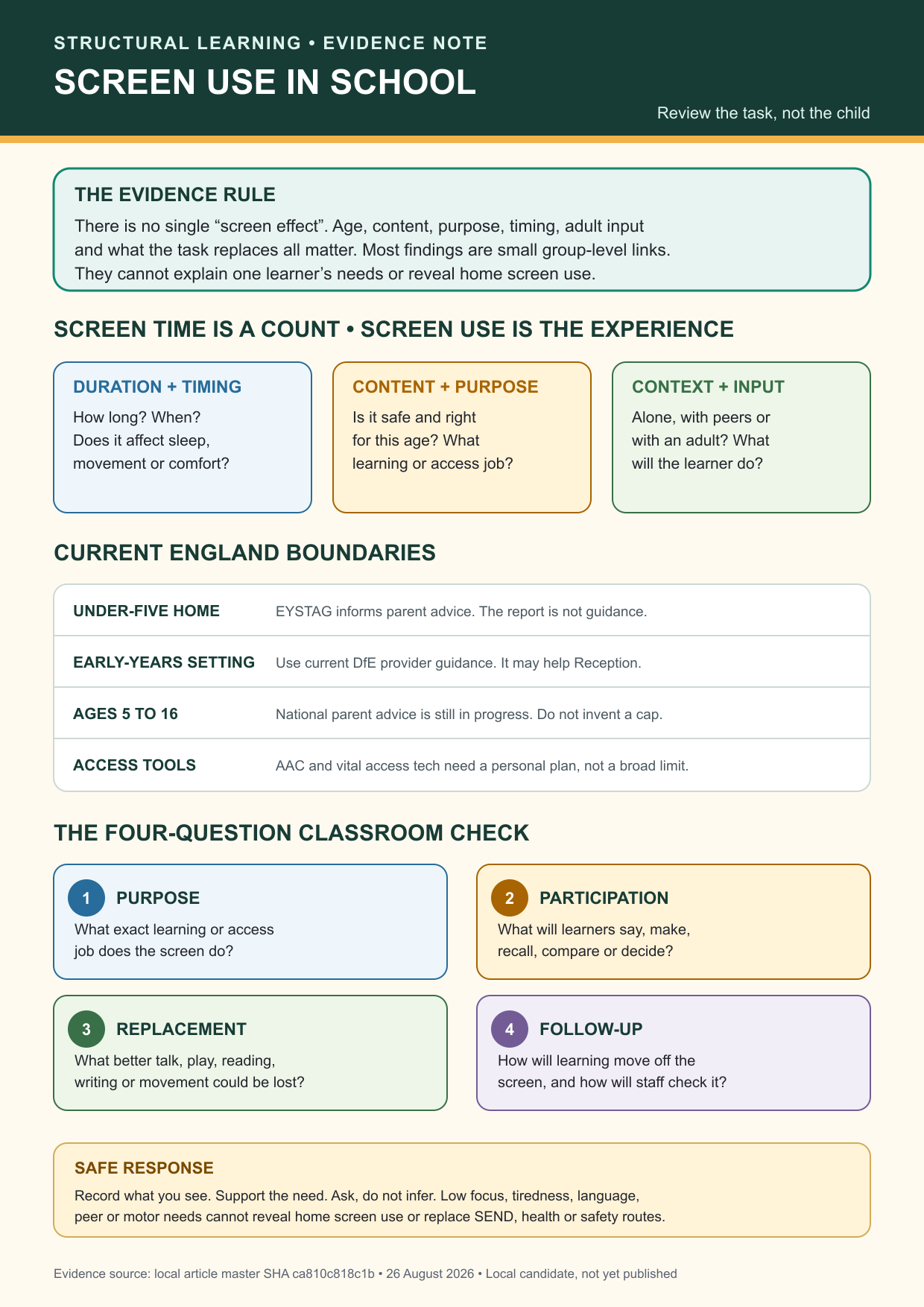
Evidence rule: there is no single screen effect. Age, content, purpose, timing, adult input and what the task replaces all matter. Most results are small group-level links and cannot explain one learner’s needs.
Current England boundaries: EYSTAG informs parent advice for under-fives but is not guidance. Use current DfE provider guidance in early-years settings. Advice for ages 5 to 16 is still in progress. AAC and vital access technology need a personal plan.
Classroom check: name the screen’s learning or access purpose; state what learners will say, make, recall, compare or decide; check what better task may be replaced; and plan how learning will move off the screen.
Safe response: record what you see, support the need and ask rather than infer. Low focus, tiredness, language, peer or motor needs cannot reveal home screen use or replace SEND, health or safeguarding routes.
Printable school screen-use review record
Plan the guidance check, learning purpose, participation, replacement, follow-up and access route. Use page two to record learning away from the screen, learner and staff views, the family conversation boundary and the next decision.
Useful answers depend on age, setting and purpose. Under-five limits do not form a rule for every school learner, co-use does not ensure benefit, and classroom behaviour cannot reveal home screen use. Access tools need an individual plan, while other screen tasks should earn their place through clear learning value.
No. “Educational” does not describe what a learner gains. Check the purpose, thought, access, other option and follow-up. Content can be correct and still lead to passive use or displace a better talk task.
There is no settled England daily limit for all children aged 5 to 16. Government guidance for this age group is being developed. Schools should distinguish personal phones, planned curriculum use, homework, leisure and assistive technology, then follow current policy and review purpose, timing and displacement.
No. Co-use has a small positive association with early learning in meta-analysis, but it does not make every activity beneficial. Content, age, duration, adult behaviour, participation and what the activity replaces still matter.
No. Attention, fatigue, language, motor, interaction and regulation difficulties have many possible causes. Record the classroom observation, support the learner and use ordinary family, SEND, pastoral, health or safeguarding routes. Do not infer a home cause.
Not in the same way. Communication and access come first. Plan from the individual child’s needs and reasonable adjustments, while also considering positioning, fatigue, interaction and opportunities to participate with peers.
The evidence does not support one answer for every activity. Personal-phone policy is different from planned teaching and assistive use. A school should remove screen use that has no clear purpose or displaces a better activity, and retain use that provides a justified learning, communication or access benefit.