Updated on
September 16, 2026
Using AI to Reduce Cognitive Load: A Teacher's Guide
How AI can cut extraneous cognitive load in your lessons: faded worked examples, reduced split attention, and scaffolds that protect working memory.

Updated on
September 16, 2026
How AI can cut extraneous cognitive load in your lessons: faded worked examples, reduced split attention, and scaffolds that protect working memory.
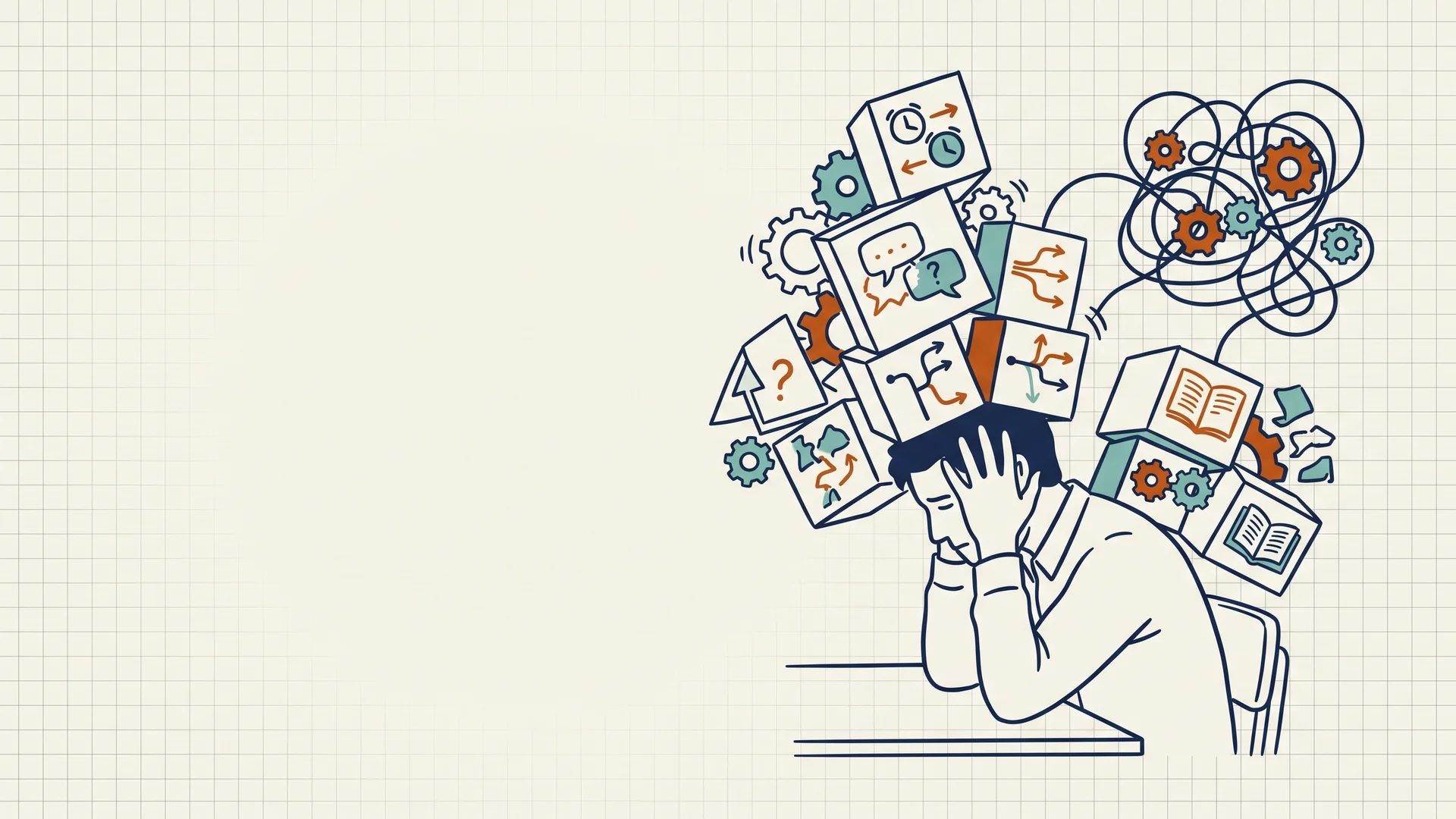
Classrooms have a bottleneck: working memory limits. Lessons often strain this, not behaviour. Sweller (1988) argued that conventional problem solving can overload limited working memory; separate capacity estimates include Miller's (1956) seven-plus-or-minus-two and Cowan's (2001) about four chunks. Bad lessons waste capacity on the wrong things. This reduces actual learning.
Sweller (1988) introduced cognitive load theory; the commonly cited intrinsic, extraneous and germane load distinction was developed in later CLT work, including Sweller, van Merrienboer and Paas (1998). Intrinsic load is the content's inherent difficulty; photosynthesis is harder than counting. Extraneous load comes from bad instruction, like cluttered worksheets. Germane load involves learners actively building schemas and linking new with prior knowledge (Paas, Renkl & Sweller, 2003).
Researchers propose strategies to reduce all three types of cognitive load. Intrinsic load and germane load also benefit from clever AI tool use. Extraneous load is the most easily reduced via AI (Sweller, 1988; Mayer, 2005; Moreno, 2010).
For a practical overview of how these ideas apply in lessons, see our guide to working memory in the classroom.
Intrinsic load exists due to subject complexity. Teachers can sequence content instead of removing it. AI can order content for learners (Sweller, element interactivity). AI lessons can introduce one concept each session. This limits interacting elements learners process (Sweller, element interactivity).
Building germane load with AI. Germane load is the productive effort of constructing and automating schemas. Teachers should not try to reduce this. It IS the learning. AI can increase germane load by generating tasks that require learners to connect new information to existing knowledge: "Create 5 questions that ask learners to link today's lesson on fractions to what they already know about sharing equally." The Thinking Framework's Analogy operation is particularly effective here: "What is this new concept LIKE something we already understand?"
Means-ends analysis requires learners to compare their situation with the goal (Sweller, 1988). This process uses much working memory needed for schema building. AI can ease this load by giving the goal: "The answer is 42, show how." This worked example stops means-ends processing and helps learners understand methods.
Instructional design aims to reduce unnecessary load, freeing working memory for relevant learning. Teachers often simplify language, chunk tasks and use visuals. However, preparing effective lessons for every learner requires significant time. AI (Artificial Intelligence) can assist with this challenge.
Research consistently shows that extraneous load is the most tractable type. You cannot make photosynthesis simpler than it is, but you can present it in a way that stops learners wasting cognitive resources on decoding instructions, integrating separated information sources, or searching a cluttered slide for the relevant content. Working memory is the bottleneck; AI can widen the pipe by eliminating the friction that should never have been there.
The mechanism is straightforward. AI handles the reformatting so the teacher's cognitive effort stays on pedagogy. A teacher who would have spent forty minutes simplifying a dense Year 9 science text into three reading levels can now do it in three minutes. The time saved is not the main benefit: the main benefit is that the simplified version actually gets made, gets used, and reduces extraneous load for the learners who needed it. See also: Ai metacognition teachers need know.
Rewriting instructions into steps helps learners (Sweller, 2010). Chunking tasks reduces overload (Paas & van Merriënboer, 2020). Audio generation aids struggling readers (Mayer, 2009). Visuals replace dense text (Clark & Mayer, 2016), addressing cognitive load.
The key principle for teachers is to be explicit in the prompt about what you want the AI to do and why. "Simplify this" is too vague. "Rewrite this for a reading age of nine, keeping the key vocabulary but using sentences of no more than twelve words and numbered steps of no more than one action each" produces something useful. The prompt is the instructional design decision; the AI is the execution.
Mayer (2009) said learners process words and visuals separately. AI quickly makes dual-channel resources. These include text with visuals, or analogies for diagrams. This lowers load by spreading information across channels.
Sweller and Cooper (1985) found worked examples helped novice learners more than problem-solving. Problem-solving adds extra load via means-ends analysis. Worked examples focus attention on the solution (Sweller & Cooper, 1985). Renkl (2014) reviews evidence that worked examples can be faded as learners gain competence.
AI makes faded worked example sequences fast enough to be practical for classroom use. A teacher preparing a maths lesson can generate a complete four-step sequence in under two minutes. The prompt template below works across subjects and age groups:
Prompt: "Create 4 versions of this problem at decreasing levels of scaffolding: (1) fully worked with every step shown and annotated, (2) steps 1 and 2 shown but steps 3 and 4 blank with prompts, (3) only the first step shown with a brief prompt for each subsequent step, (4) the problem statement only with no scaffolding. Keep the mathematical notation consistent across all four versions."
This sequence exploits the expertise reversal effect identified by Kalyuga et al. (2003): scaffolding that helps novices becomes redundant noise for more experienced learners, and can actually increase cognitive load. By having all four versions available, teachers can match the level of scaffolding to where each learner is in their learning, rather than guessing at a single version that will overload some and bore others.
This approach works for English, history, science, and languages. Provide learners with a worked example, then a partially done one, then a plan. AI can generate these three versions quickly from one master example. It saves teacher time while also improving support for learners.
Chandler and Sweller (1991) found the split-attention effect uses learner working memory. Learners integrate separate sources like diagrams and text. This integration process, not source understanding, causes cognitive load.
Research on split attention shows that learners often benefit when related words, labels and visuals are physically integrated rather than separated. Chandler and Sweller (1991) are the core source for this instructional-design point, and Mayer and Moreno (2003) connect the same principle to multimedia learning. AI can reduce the time needed to create labelled diagrams, annotated visuals and integrated explanations.
Prompt template for split-attention reduction: "Combine this explanation with the description of this diagram. All labels and explanatory text should appear directly on or immediately adjacent to the relevant part of the visual. Describe the integrated result in enough detail for me to create it, noting exactly where each label should sit."
For teachers working with maps, scientific diagrams, flowcharts, or annotated source documents, this is immediately practical. The AI output describes an integrated layout that the teacher can produce in a slide tool or simply have students draw while the teacher narrates. Either way, the split-attention burden is removed. Where differentiation is required, AI can produce integrated versions at different complexity levels from the same source material.
Traditional differentiation can overload teachers when it means preparing multiple separate resources for every lesson. Teachers may avoid it, do it inconsistently, or adapt on the spot. A better use of AI is to produce carefully constrained variations from one strong explanation, while the teacher checks accuracy and keeps the core instruction coherent.
AI changes the economics of differentiation. A single source text can be transformed into three reading levels in three minutes. The teacher makes the pedagogical decisions (which vocabulary to preserve at each level, what scaffolding to add, which challenge questions to append) and the AI does the textual work. This is a clean division of labour.
Prompt template: "Take this Year 9 science passage and produce three versions. Version 1: age-appropriate as written. Version 2: simplified to a reading age of nine, keeping all key scientific terms but using shorter sentences and replacing complex connectives with simple ones. Version 3: an extended version for learners who have already encountered this content, with two additional challenge questions requiring them to apply the concept to an unfamiliar example. Format all three clearly."
The cognitive load benefit for learners is direct. A learner reading at age nine who is given the age-appropriate Year 9 text is spending most of their working memory on decoding, leaving almost none for understanding the science. The same learner given the simplified version can actually engage with the concept. Cognitive load theory predicts this; AI makes the solution feasible.
It is worth noting that differentiation by text level is only one application. AI can also generate task versions with different levels of working memory demand: a version with sentence starters and vocabulary banks for learners who need them, and a version with no supports for learners who do not. The key is that the teacher specifies the cognitive design, not just the difficulty.
SEND learners often struggle with cognitive overload, which standard resources may worsen. Gathercole and Alloway (2008) describe working-memory difficulties as common among children who struggle with classroom learning, including some learners with special educational needs. Alloway and Alloway (2010), in 'Investigating the predictive roles of working memory and IQ in academic attainment,' reported that working memory predicted later academic attainment better than IQ. So, accessible resources are vital for SEND learners (Gathercole & Alloway, 2008).
AI tackles SEND cognitive load through tailored support. Sentence starters reduce writing retrieval for learners with working memory issues; AI makes these fast. Chunked instructions help learners with slow processing speed handle verbal directions. AI simplifies text and suggests audio for learners with dyslexia. Visual schedules from lesson plans ease transitions for autistic learners.
The PDA (pathological demand avoidance) application deserves specific mention. PDA-aware teaching reframes demands as choices. AI can rewrite a directive task into an autonomous one: "Complete questions 1-5" becomes "Choose any four of these five questions and complete them in any order." This is a single textual transformation that meaningfully changes the cognitive and emotional experience for a PDA learner. AI makes it fast enough to do routinely rather than occasionally.
SENCOs can use AI tools to draft resources, summarise planning notes and reduce repetitive administration. These outputs still need professional checking, but well-bounded prompts can free more time for direct support, teacher consultation and learner-focused provision planning.
Open-ended thinking tasks carry the highest intrinsic cognitive load because the learner must generate both the content and the structure simultaneously. "Write about the causes of the First World War" requires a learner to decide what counts as a cause, how to order them, what detail to include, and how to structure a written response, all while managing their existing knowledge. The cognitive demand is unbounded.
The Thinking Framework solves this by providing the cognitive structure in advance. When a teacher says "Compare the causes of the First World War using the Compare operation," the learner knows they need to identify attributes, find similarities and differences, and draw a conclusion. The structure is given; only the content is open. This is a principled reduction in cognitive demand.
AI combined with the Thinking Framework produces bounded cognitive tasks at scale. A teacher can prompt: "Create five Compare tasks on the causes of the First World War at different complexity levels. Each task should specify what is being compared and what attributes to consider. Use the Compare thinking operation structure: identify attributes, find similarities and differences, draw a conclusion." The result is a set of tasks that are cognitively well-designed, not just superficially differentiated.
Compare, Classify and other Thinking Framework operations can guide learners through complex material. The operations reduce cognitive demand by making the required thinking move explicit. AI can quickly produce these tasks on different topics, but the teacher still decides which operation best fits the learning goal.
Metacognitive framing suits AI tasks,. Learners monitor thinking better when they grasp the cognitive operation (Flavell, 1979). The Thinking Framework offers the language; AI can consistently embed it into task instructions (Lai, 2011).
Chandler and Sweller (1991) identified redundancy and split-attention problems in instructional materials; these principles can be applied cautiously when reviewing AI-generated resources. Presenting information in multiple ways overloads learners' minds. Teachers using AI text with verbal explanation can hinder learning. Both sources compete for space in working memory.
The practical rule is: use AI to replace a less effective format, not to add to it. If the teacher is explaining verbally, the slide should show a diagram, not the same explanation in text. If the AI has generated a simplified text version, the teacher does not also need to read it aloud word for word. This sounds obvious, but the temptation to use AI-generated content as a supplement to existing resources, rather than as a replacement, is strong, and it produces redundant presentations.
Mayer's coherence principle (2009) warns against lengthy outputs. AI's comprehensive answers can hinder learning. Long explanations, like 600 words on osmosis, add extra load. Brevity helps learners understand; 150 words might work better. Prompt AI for short answers: "Explain osmosis in 100 words" (Year 8 learner).
A third failure mode is complexity mismatch. AI generates at the level you specify, but if you do not specify, it defaults to a generic middle level that may be too complex for struggling learners and too simple for strong ones, while feeling appropriate to neither. The expertise reversal effect means that the same AI-generated scaffold that helps a novice can actively impede a more experienced learner. Prompt specifically, or generate multiple versions and select the appropriate one. Barriers to learning are often design problems rather than learner problems, and AI can introduce new design problems if the teacher is not deliberate about the prompt.
Rosenshine (2012) fits with cognitive load theory, giving you ways AI can help. Small steps cut how much learners face at once. Models (worked examples) drop extra demands. Check learners understand before you move on. This stops extra problems building up.
AI can support each of these. Small steps can be generated from a larger learning objective by asking AI to sequence the component knowledge elements. Models can be generated as worked examples with the fading approach described above. Rosenshine's emphasis on high success rate also has a cognitive load interpretation: tasks that are pitched correctly do not impose unnecessary extraneous load from confusion, and AI can generate formative checkpoints that help teachers pitch tasks accurately.
The connection to retrieval practice is also worth making explicit. Retrieval practice works partly by strengthening schema in long-term memory, which in turn reduces future cognitive load when related content is encountered. AI can generate retrieval practice questions quickly: low-stakes, frequent, and varied. A teacher who uses AI to produce five retrieval questions at the start of each lesson is investing in reducing the cognitive load of future lessons, not just the current one.
Take the most complex written instruction you give learners this week. It might be a task brief, a set of exam questions, or a multi-step investigation protocol. Paste it into an AI tool with this prompt:
"Simplify this instruction for a learner with a reading age of nine. Keep all the key subject vocabulary but use sentences of no more than twelve words. Present each action as a separate numbered step. Where there are more than five steps, break them into two labelled sections."
Compare the original and the AI output. The simplified version is almost certainly clearer for your whole class, not just your struggling learners. Use it for everyone. The learners who would have found the original easy will not be disadvantaged by clearer instructions; the learners who would have been confused by the original will now be able to engage with the actual content. That is the extraneous load reduction in practice.
The second thing to try is a faded worked example. Take one problem or task you plan to set this week. Ask AI to generate a fully worked version with annotations, then a partially worked version with the final two steps removed, then a planning frame only. Use all three in the same lesson, matching each to the appropriate group of learners. Notice whether the learners who receive the fully worked example engage more successfully with the independent practice than usual, and whether the planning-frame group are stretched without being overwhelmed.
If you want to go further, look at your most complex resource from this term, whether a reading, a diagram, or a data table, and ask AI to integrate the text with the visual so that labels appear directly on the relevant part of the image rather than in a separate key. The cognitive cost of reducing split-attention in that one resource is minutes. The benefit to your learners' comprehension is measurable. That is the cognitive load case for AI in teaching: not a transformation, but a removal of friction that should never have been there. See our guide to AI for teachers and AI in lesson planning for the broader toolkit.
Research by Sweller (1988) and Mayer and Moreno (2003) informs AI instruction. Cognitive load theory guides effective learning design, as shown by Paas et al (2003). Chandler and Sweller (1991) explore reducing extraneous load.
Cognitive Load Theory guides instruction using information and thinking. Sweller (1988) showed working memory is limited. Complex tasks overwhelm learners (Chandler & Sweller, 1991). Mayer's (2009) research suggests manage load to boost learning.
Sweller, J., Ayres, P., & Kalyuga, S. (2011)
Cognitive load theory, including intrinsic, extraneous and germane load, is discussed at length. Teachers can use this for AI material design. Understand AI prompting with Sweller (1988) and use the theory to look beyond basic AI uses.
The Worked Example Effect and Human Cognition
850+ citations
Sweller, J. (2006)
Sweller's work on cognitive load and worked examples supports using clear examples before asking novices to solve complex problems independently. AI can help teachers draft faded example sequences, but the teacher should check that each step is accurate, sequenced and matched to learner expertise.
Principles for Reducing Extraneous Processing in Multimedia Learning
Mayer, R. E. (2009)
Mayer, R. E. (2009)
Mayer's multimedia learning work presents principles such as coherence, signalling, redundancy and spatial or temporal contiguity. Teachers who understand these principles can avoid common AI misuse, including overloading slides with decorative visuals or duplicating spoken and written explanations without purpose.
Working Memory Capacity and Implications for Learning
1,400+ citations
Gathercole, S. E., & Alloway, T. P. (2008)
Gathercole and Alloway (2008) linked working memory issues to weaker learning. This research shows many learners struggle with working memory. Reducing extra demands helps SEND learners succeed (Gathercole & Alloway, 2008).
Cognitive Architecture and Instructional Design: 20 Years Later
900+ citations
Sweller, J., van Merriënboer, J., & Paas, F. (2019)
Sweller, van Merriënboer and Paas (2019) review twenty years of cognitive load theory research. The paper discusses theoretical developments, element interactivity, expertise reversal and implications for instructional design. This is the appropriate review source for the further-reading entry, rather than a fabricated newer review.
The paper uses cognitive load theory and AI for learning support. (Sweller, 1988; Paas, Renkl & Sweller, 2003; Chandler & Sweller, 1991.) Educational psychology research also informs this. (Renkl, 2014; Mayer, 2009; Gathercole & Alloway, 2008.)
For the wider picture, explore our AI and EdTech tools hub, our home for evidence-based AI guidance across policy, lesson planning, and classroom practice.