Updated on
September 9, 2026
Scarborough's Reading Rope: The Strands Explained
Scarborough's Reading Rope explained: the word recognition strands, the language comprehension strands, and how they intertwine into skilled reading.

Updated on
September 9, 2026
Scarborough's Reading Rope explained: the word recognition strands, the language comprehension strands, and how they intertwine into skilled reading.
John Hattie's (2009) research on Visible Learning demonstrates the profound impact of teachers understanding the underlying processes of learning. Similarly, understanding reading comprehension requires dissecting its component parts. For more on this topic, see Comprehension in reading. Scarborough's Reading Rope (Scarborough, 2001) is a widely recognised model that visually represents the complex and interwoven skills that contribute to proficient reading.
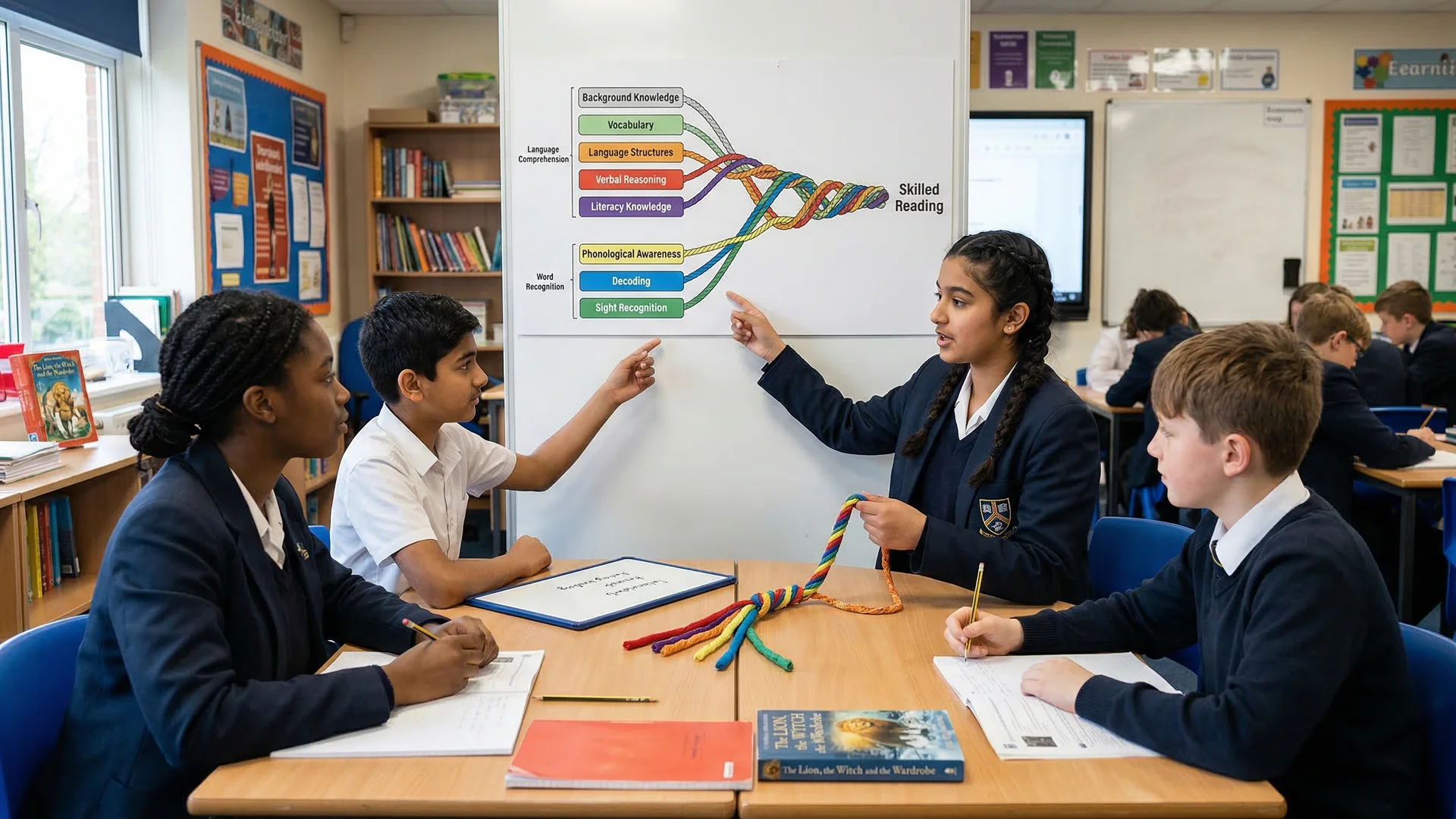
It presents reading as not a single skill, but the product of two broad categories: word recognition and language comprehension. These two categories, in turn, are made up of multiple strands that develop and become increasingly intertwined, ultimately forming the "rope" of skilled reading.
Classroom Application: Introduce the Reading Rope to your staff during a professional development session. Use a physical rope to illustrate how individual strands (e.g., phonological awareness, vocabulary) intertwine to create a strong, unified rope representing skilled reading. This visual aid can help teachers conceptualise the interconnectedness of reading skills.
These ideas sit within a broader toolkit covered in our guide to reading comprehension strategies.
The word recognition strands focus on the reader's ability to decode and recognise written words accurately and fluently. These strands become increasingly automatic with practice.
The three key strands within word recognition are: phonological awareness (understanding and manipulating the sounds in words), decoding (the ability to sound out words using phonics knowledge), and sight recognition (instantaneously recognising familiar words).
Strong phonological awareness is fundamental. It involves the ability to hear, identify, and manipulate individual sounds (phonemes) within words. This includes skills such as rhyming, segmenting words into sounds, and blending sounds together (National Reading Panel, 2000). See also: Simple view reading.
Decoding relies on phonics knowledge, the understanding of the relationship between letters and sounds. Students must be able to apply this knowledge to sound out unfamiliar words. As readers become more proficient, they develop a store of sight words, words they recognise instantly without needing to decode.
Classroom Application: Integrate activities that explicitly target phonological awareness, such as phoneme blending and segmenting exercises. Use decodable texts that allow students to practice their phonics skills in context. Regularly assess students' sight word recognition to identify areas for targeted intervention. Provide games, e.g., phonics hopscotch, to improve fluency.
The language comprehension strands encompass the skills needed to understand the meaning of spoken and written language. These strands draw upon a reader's background knowledge, vocabulary, and understanding of language structures.
The language comprehension strands include: background knowledge (understanding of the world and various topics), vocabulary (knowledge of word meanings), language structures (understanding grammar and syntax), verbal reasoning (inferencing and critical thinking), and literacy knowledge (understanding text features and genres).
Background knowledge provides a foundation for understanding new information. The more a reader knows about a topic, the easier it will be to comprehend a text on that topic (Hirsch, 2003).
Vocabulary knowledge is directly related to reading comprehension. Readers need to understand the meanings of words to make sense of the text (Beck, McKeown, & Kucan, 2013).
Understanding language structures (syntax and semantics) is crucial for interpreting sentences and paragraphs. Verbal reasoning skills enable readers to make inferences, draw conclusions, and think critically about the text. Finally, literacy knowledge, including an understanding of different text genres and features, helps readers navigate and comprehend various types of texts.
Classroom Application: Pre-teach key vocabulary and concepts before reading a new text. Engage students in discussions to activate their background knowledge and make connections to the topic. Model strategies for making inferences and drawing conclusions. Use graphic organisers to help students analyse text structure and identify key information.
The beauty of Scarborough's Reading Rope lies in its depiction of how these strands intertwine. Word recognition and language comprehension are not separate entities but rather work together to create skilled reading. As the strands develop and become more automatic, they become increasingly interwoven.
For example, a student with strong decoding skills but limited vocabulary may be able to sound out the words in a text but struggle to understand its meaning. Conversely, a student with rich background knowledge but weak decoding skills may struggle to access the text in the first place. Effective reading instruction addresses all strands of the rope, ensuring that students develop a balanced skillset.
Classroom Application: Design integrated reading lessons that address both word recognition and language comprehension. For example, after reading a passage aloud, focus on specific vocabulary words and their meanings. Then, engage students in activities that require them to apply their phonics skills to decode unfamiliar words from the text.
The Reading Rope can be a valuable tool for assessing and diagnosing reading difficulties. By identifying which strands are weak or underdeveloped, teachers can target their instruction accordingly (Kilpatrick, 2015). For example, a student who struggles with phonological awareness may benefit from targeted interventions focusing on segmenting and blending sounds.
Similarly, a student with weak vocabulary skills may need explicit instruction in word meanings and strategies for learning new words. Observing students' reading behaviours and using diagnostic assessments can help pinpoint specific areas of need.
Classroom Application: Use formative assessments to monitor students' progress in each of the strands of the Reading Rope. Observe students during reading activities and note any difficulties they encounter. Use standardised reading assessments to identify students who may be struggling and to pinpoint their specific areas of weakness. Use running records to analyze word recognition skills. Adjust teaching approach based on insights gained from assessment.
Understanding the Reading Rope can inform curriculum design by ensuring that all strands are explicitly addressed. A comprehensive reading curriculum should include activities that develop phonological awareness, decoding skills, sight word recognition, vocabulary, background knowledge, language structures, verbal reasoning, and literacy knowledge.
The curriculum should also provide opportunities for students to practice integrating these skills through reading and writing activities. Furthermore, it is important to sequence instruction in a way that builds upon foundational skills, gradually introducing more complex concepts and strategies (Shanahan, 2020).
Classroom Application: Review your school's reading curriculum to ensure that all strands of the Reading Rope are adequately addressed. Integrate a variety of instructional strategies and activities to cater to diverse learning needs. Sequence instruction in a logical and progressive manner, building upon foundational skills.
The Reading Rope highlights the cumulative nature of reading development. Foundational skills, such as phonological awareness and decoding, provide the basis for more complex skills, such as reading comprehension. As students develop these foundational skills, they become more automatic and allow readers to focus on higher-level comprehension processes.
This cumulative nature means that gaps in foundational skills can have a significant impact on later reading development. It is therefore crucial to address any weaknesses in these areas as early as possible to prevent reading difficulties from escalating (Moats, 2020).
Classroom Application: Regularly review and reinforce foundational reading skills, even with older students. Provide targeted interventions for students who are struggling with specific foundational skills. Differentiate instruction to meet the diverse needs of learners in your classroom.
While Scarborough's Reading Rope is a valuable model for understanding reading development, it is not without its limitations. One critique is that the model is somewhat static and does not fully capture the dynamic and interactive nature of reading (Ehri, 2005). Reading is a complex process that involves continuous feedback and adaptation.
Another limitation is that the model primarily focuses on individual skills and may not adequately address the role of motivation, engagement, and social-emotional factors in reading development. These factors can significantly impact a student's reading success.
Furthermore, some argue that the model oversimplifies the complexities of language comprehension. The language comprehension strands are broad categories that encompass a wide range of cognitive processes. Nevertheless, the Reading Rope remains a useful framework for understanding the components of skilled reading and for informing instructional practices.
Classroom Application: Acknowledge the limitations of the Reading Rope model and consider other factors that may influence reading development, such as student motivation and engagement. Incorporate activities that promote a love of reading and foster a positive reading identity. Create a classroom environment that is supportive and inclusive, where all students feel valued as readers.
References Beck, I. L., McKeown, M. G., & Kucan, L. (2013). Bringing words to life: Robust vocabulary instruction. Guilford Press. Ehri, L. C. (2005). Development of sight word reading: Phases and model. In M. J. Snowling & C. Hulme (Eds.), The science of reading: A handbook (pp. 135-154). Blackwell Publishing. Hattie, J. (2009). Visible learning: A synthesis of over 800 meta-analyses relating to achievement. Routledge. Hirsch, E. D., Jr. (2003). *Reading comprehension requires knowledge of words and the world: Scientific insights into the fourth-grade slump. American Educator, 27*(1), 10-29. Kilpatrick, D. A. (2015). *Equipped for reading success: A comprehensive, step-by-step program for developing phonemic awareness and fluent word reading*. Casey & Kirsch Publishers. Moats, L. C. (2020). Speech to print: Language essentials for teachers. Brookes Publishing. National Reading Panel. (2000). Report of the National Reading Panel: Teaching children to read. National Institute of Child Health and Human Development. Scarborough, H. S. (2001). Connecting early language and literacy to later reading (dis)abilities: Evidence, theory, and practice. In S. Neuman & D. Dickinson (Eds.), Handbook of early literacy research (pp. 97-110). Guilford Press. Shanahan, T. (2020). The elements of reading instruction. International Literacy Association.
These peer-reviewed studies provide the research foundation for the strategies discussed in this article:
Dongyang Liu (2024)
This study investigates how breaking down multimedia learning materials into smaller segments affects how much mental effort learners expend, how well they learn and remember vocabulary, and their reading comprehension. Understanding the impact of segmentation can help teachers design more effective digital learning resources, optimising cognitive load and improving learning outcomes for students.
Khaled Ahmed Abdel-Al Ibrahim et al. (2023)
This study examines the effects of collaborative learning, scaffolding, and self-assessment on reading comprehension, motivation, and anxiety in English as a Foreign Language (EFL) learners. The results highlight the potential of these strategies to improve reading skills, increase student motivation, and reduce anxiety, offering practical approaches for teachers working with EFL students.