Updated on
September 9, 2026
IB Assessment: Criteria, Best Fit and Standardisation
Use IB assessment criteria accurately across PYP, MYP, DP and CP, with a best-fit workflow, standardisation routine and free teacher checklist.


Updated on
September 9, 2026
Use IB assessment criteria accurately across PYP, MYP, DP and CP, with a best-fit workflow, standardisation routine and free teacher checklist.
IB Assessment describes how the International Baccalaureate gathers, judges and reports evidence of what learners can do. It uses published criteria across the Primary Years Programme, Middle Years Programme, Diploma Programme and Career-related Programme. This matters because a teacher's mark is not a running average of effort, neatness or early mistakes. It should be a defensible judgement against criteria, backed by recent and consistent evidence (IBO, 2019; Black, 1998).
In a Year 10 MYP science class, this helps a teacher separate strong data analysis from weaker evaluation. The teacher can record the evidence against Criterion B and C, then explain the final level without comparing the learner with the rest of the class. In the Diploma Programme, the same logic shapes Internal Assessment, External Assessment and the Core. Final grades still depend on IB grade boundaries and moderation.
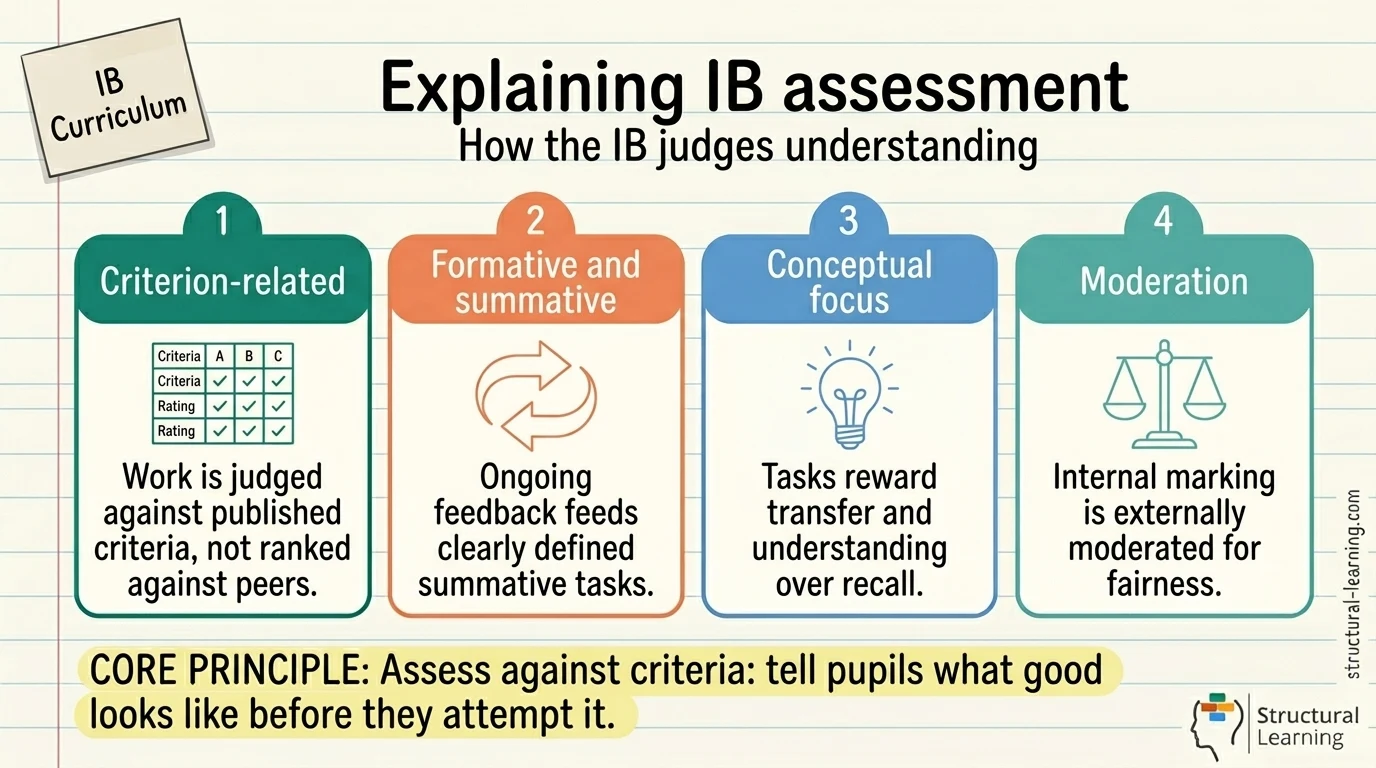
IB assessment is criterion-related, not norm-referenced. Teachers and examiners judge work against stated criteria, markbands or mark schemes rather than rank learners against one another. Session grade boundaries help convert marks into reported grades, but that does not turn the system into norm-referenced assessment (International Baccalaureate, 2026).
3 things to try in your classroom this week
Rubrics with clear command terms and descriptors support this work. However, each programme has a different scoring route. In the Middle Years Programme, most subject groups use four criteria: A, B, C and D. Each criterion is scored out of 8, giving a maximum of 32 before conversion to the 1-7 grade scale.
In the Diploma Programme, six subjects can contribute up to 42 points. The DP Core is Theory of Knowledge (TOK), the Extended Essay (EE) and Creativity, Activity, Service (CAS). TOK and EE can add up to 3 bonus points through the matrix, while CAS earns no points because it is a completion requirement. This makes 45 the maximum International Baccalaureate Diploma score, with 24 points the usual minimum subject to passing conditions.
Hattie (2009) and Hattie and Timperley (2007) are useful when feedback links current work to visible success criteria. Even so, their effect sizes should not be treated as exact forecasts for IB grades.
Rubrics should guide learning before they assess work. In an International Baccalaureate classroom, criteria help learners see what counts as stronger evidence, not just what score they received. Wiliam (2011) argued that learners need to understand success criteria if feedback is to change what they do next. The shift is from chasing marks to improving the quality of the response.
A Geography teacher starts a Diploma Programme global politics essay by projecting the International Baccalaureate rubric. The teacher asks the class to define the command terms 'describe' and 'evaluate'. The class then checks these definitions against two short exemplar paragraphs.
Learners write their own definitions in draft planners. What the teacher does: Projects the rubric and leads a criteria discussion. What learners produce: Written command-term definitions and one annotated exemplar.
The four programmes do not use one common assessment route. The PYP has no formal IB assessment. MYP, DP and CP combine school-led work and external checking in different ways. Always start with the current programme and subject guide.
| Programme | Main assessment route | External checking | Teacher's immediate action |
|---|---|---|---|
| PYP | School-led assessment for feedback, self-assessment and reflection | No formal IB assessment | Plan evidence and feedback within the school's programme of inquiry |
| MYP | Subject criteria applied by teachers, usually across four criteria | Optional eAssessment; ePortfolios are externally moderated | Use the current subject criteria and standardise judgements internally |
| DP | Programme-specific internal and external components | Examinations and other external marking; internal work is moderated | Check the current subject guide, component weighting and submission rules |
| CP | DP courses plus the CP core and career-related study | Depends on the component and DP courses selected | Map who assesses each component and which rules apply |
The official overview confirms that MYP, DP and CP offer summative assessment, while the PYP does not offer formal IB assessment (International Baccalaureate, 2026). This distinction prevents teachers from importing DP grading language into primary classrooms.
IB rubrics ask learners to move between recall, explanation, analysis and evaluation. Webb (1997) gives teachers a useful alignment check: the thinking demand in the teaching task should match the demand in the assessment criterion. A short factual quiz may prepare learners for DoK 1 or 2 work. However, a Diploma Programme global politics essay or an environmental systems and societies evaluation needs sustained reasoning closer to DoK 3 or 4.
IB rubrics can place too much strain on working memory. Sweller (1988) showed that learners can only process a limited amount at one time. So teachers should separate the real subject demand from language that makes the task harder than it needs to be. This matters for EAL, neurodivergent and working-class learners, because dense command terms such as 'synthesise' and 'evaluate' can reward cultural capital as well as subject understanding (Bourdieu, 1986).
SEND learners can struggle with unclear assessment criteria. Abstract rubrics may hide a learner's understanding (Wiggins, 1998). Teachers can use visible thinking routines and concrete examples to make criteria clearer, then provide structured scaffolds that show what a successful response needs to include.
A Mathematics teacher maps an IB investigation rubric against Webb's DoK levels on a wall chart. The teacher points to the DoK Level 2 section and asks learners to complete a calculation exercise. Learners work on mini whiteboards and hold them up for checking.
What the teacher does: Creates a DoK-aligned wall chart and leads a short practice exercise. What learners produce: Completed calculation exercises on mini whiteboards.

Strong assessment practice starts when teachers connect IB policy to the evidence they collect each week. Learners need clear criteria, explicit modelling and chances to act on feedback before final submission. In the Diploma Programme, this also means knowing the balance between Internal Assessment, where classroom teachers may mark work before IB moderation, and External Assessment, where scripts are marked by IB examiners. The practical test is simple: can the department explain which evidence supports the grade without creating a shadow spreadsheet that doubles workload?
Best-fit means teachers judge which achievement band best represents the overall quality of a learner's work. That judgement is useful in education, but it is not bias-free. Complex rubrics can leave room for halo effects, prior knowledge of the learner and departmental habit to shape decisions. This is why assessment reliability depends on moderation, annotated exemplars and recorded rationales (Baird et al., 2017; Sadler, 1989; Torrance & Pryor, 1998).
Best fit is applied within the criterion being judged. Read the whole response, match evidence to its strands or aspects, then choose the descriptor that fits most fairly. Judge every separate criterion on its own evidence.
The teacher reviews an English literature essay alongside the Criterion A rubric. The teacher highlights strong critical analysis, a band 7 descriptor, in green. The teacher also highlights weak textual referencing, a band 4 descriptor, in yellow. They decide that the overall quality sits in the 5-6 band and record a justification.
What the teacher does: Highlights strengths and weaknesses in an essay using colour-coding. What learners produce: Learners review their own highlighted essays and explain why their work fits a specific band.
Assessment clarity is not the same as handing out a dense rubric. Wiggins (1998), Sadler (1989) and Andrade (2000) point to a stronger routine: show the standard, compare work against it, then help learners close the gap. Hattie and Timperley (2007) frame feedback around where the learner is going, how they are going and where they should go next, but Simpson (2017) and Slavin (2018) warn against treating a single feedback effect size as a direct prediction for complex International Baccalaureate tasks.
The teacher designs visual checkpoints based on the MYP Design cycle criteria. The teacher places cards for each criteria strand on the learners' desks. The teacher asks the class to move a token onto a card once they have completed that requirement.
What the teacher does: Creates physical cards representing each stage of the design cycle. What learners produce: Learners move tokens to indicate progress and explain their reasoning.
IB policy language is written to keep standards consistent across programmes. It is not written as classroom-facing guidance for learners. Teachers should reword rubrics in accessible language, then check that the new wording still preserves the original assessment standard. Clearer wording can reduce anxiety and help learners understand the task (Sadler, 1989; Boud, 1995).
The teacher projects the official DP History rubric beside a simpler version. The teacher shows how "synthesises complex information" means "combines facts from three sources to make a new point". The teacher then hands out copies of the translated rubric.
What the teacher does: Creates and distributes a simplified version of the rubric. What learners produce: Learners use the translated rubric to check their work against the criteria.
A learner does not need to meet every descriptor in a lower band before reaching a higher band. Best-fit grading asks the teacher to identify the centre of gravity in the work: a learner may show strong evaluation while still making minor structural errors. The recorded grade should reflect the prevailing quality, with a short rationale linked to descriptors.
Teachers often think rubrics are just for end-of-term grades. Actually, criteria should guide ongoing assessment. Waiting until the end means learners lose valuable feedback chances. Formative tasks must focus on rubric strands (Brookhart, 2018; Andrade, 2005).
Another error is assuming that the rubric dictates the sequence of teaching. Criteria define the end point, not the lesson sequence. Teachers can build retrieval, modelling, inquiry and discussion before asking learners to produce final evidence.
Averaging is the more damaging misconception. In the Middle Years Programme, adding every score across a term can create a 'zombie grade' that represents neither early struggle nor current ability. Best-fit grading should draw on recent, consistent evidence and cite descriptors, not calculate a mean.
IB continuum language also needs updating. The International Baccalaureate now describes four programmes. These are the Primary Years Programme for ages 3-12, the Middle Years Programme for ages 11-16, the Diploma Programme for ages 16-19, and the Career-related Programme for ages 16-19.
In the PYP, the current specified concepts are seven: form, function, causation, change, connection, perspective and responsibility. Reflection was once listed as an eighth key concept. However, the Enhanced PYP (2018) moved it into continuous practice across inquiry, assessment and action. Many school websites and teacher resources still say '8 lenses' in 2026; this article follows the current seven.
For the DP Core, the current Theory of Knowledge course is not the old Ways of Knowing model. TOK now uses the knowledge framework, scope, perspectives, methods and tools, and ethics, alongside a core theme, optional themes and five areas of knowledge. Its assessments are the TOK exhibition, based on three objects, and the TOK essay on prescribed titles.
The same logic applies to MYP eAssessment. Optional on-screen examinations and ePortfolios add an external check to school-based judgement. For example, ePortfolios in areas such as design, physical and health education, arts music and language acquisition are marked by classroom teachers, with samples moderated by IB examiners. When a department understands this process, it can explain why one spelling error does not block a high science level, while weak reasoning or missing evaluation can still hold the grade down.
Implementation starts as a leadership issue, before it becomes a marking issue. Heads of department need a simple evidence model that meets IB expectations and supports Ofsted conversations about progress. It should also avoid a separate grade book that teachers have to update after every lesson.
Step 1: Examine the Subject Guide. Read the specific IB guide for your subject and programme. Identify the core assessment criteria and highlight the command terms.
Step 2: Translate descriptors into learner-friendly language. Use 'I can' statements, worked examples and non-examples, but keep the translated wording anchored to the official descriptor so the standard does not drift (Brookhart, 2013; Andrade, 2000).
Step 3: Design formative scaffolds. Link short activities to the exact strand in the current subject guide. Rehearse one part of the thinking before the larger task, then fade the scaffold before assessed evidence is produced (Wiliam, 2011).
Step 4: Conduct Internal Standardisation. Gather your department to review a sample of learner work before assigning final grades. Discuss the work against the criteria and agree on the best-fit band.
A History department meets to standardise a recent MYP Year 3 assessment. The lead teacher gives the group three unmarked essays. Each teacher marks the first essay in silence, using the translated rubric. They then share their awarded bands and discuss any differences until they reach a consensus.
What the teacher does: Provides sample essays and leads a standardisation meeting. What learners produce: N/A (This is a teacher-focussed activity).

Criterion-related assessment varies by subject, but it always needs clear standards and sound evidence. In Diploma Programme language literature, learners may need to interpret texts and write with control. In global politics, evidence may come from case analysis and argument, while in business management it often comes from applied evaluation.
Mathematics analysis and approaches and mathematics applications and interpretation have different emphases, while environmental systems and societies links the sciences with individuals and societies. Arts music tasks add a further layer because teachers judge performance, process and reflection against descriptors, not personal taste (Guskey, 1996; Brookhart, 2013; McMillan, 2007).
MYP teachers often find Criterion A difficult when literacy is weak. Because each criterion can be scored out of 8, small language barriers can have large consequences when the total is mapped from 32 onto the 1-7 scale. A Map It organiser can let learners show causal links before writing: in global politics they can connect power, sovereignty and human rights; in environmental systems and societies they can map pollution sources, feedback loops and stakeholder interests.
When judging learner text production, especially in language literature, teachers can confuse fluent writing with subject understanding. Sentence blocks can support analysis without writing the answer for the learner. For example, a learner can use 'the evidence suggests' or 'this implies' in a first draft, then remove the scaffold once the analytical habit is secure. The same approach helps business management and environmental systems and societies learners explain evidence without turning the task into a formula.
SEND learners can find complex science rubrics hard to use. Teachers can adapt the assessment with a Learning Design Canvas (LDC), which helps them break the rubric into one clear step at a time. Each step has a visible checkpoint: for example, learners first get a card for the hypothesis, then one for the methodology (Gibbons, 2002). This support helps them complete lab reports (Laurillard, 2012).
The one-page workflow keeps criteria, scaffolding, best fit and standardisation in the right order. Use it when planning a task or discussing two or three anonymised samples with a department.
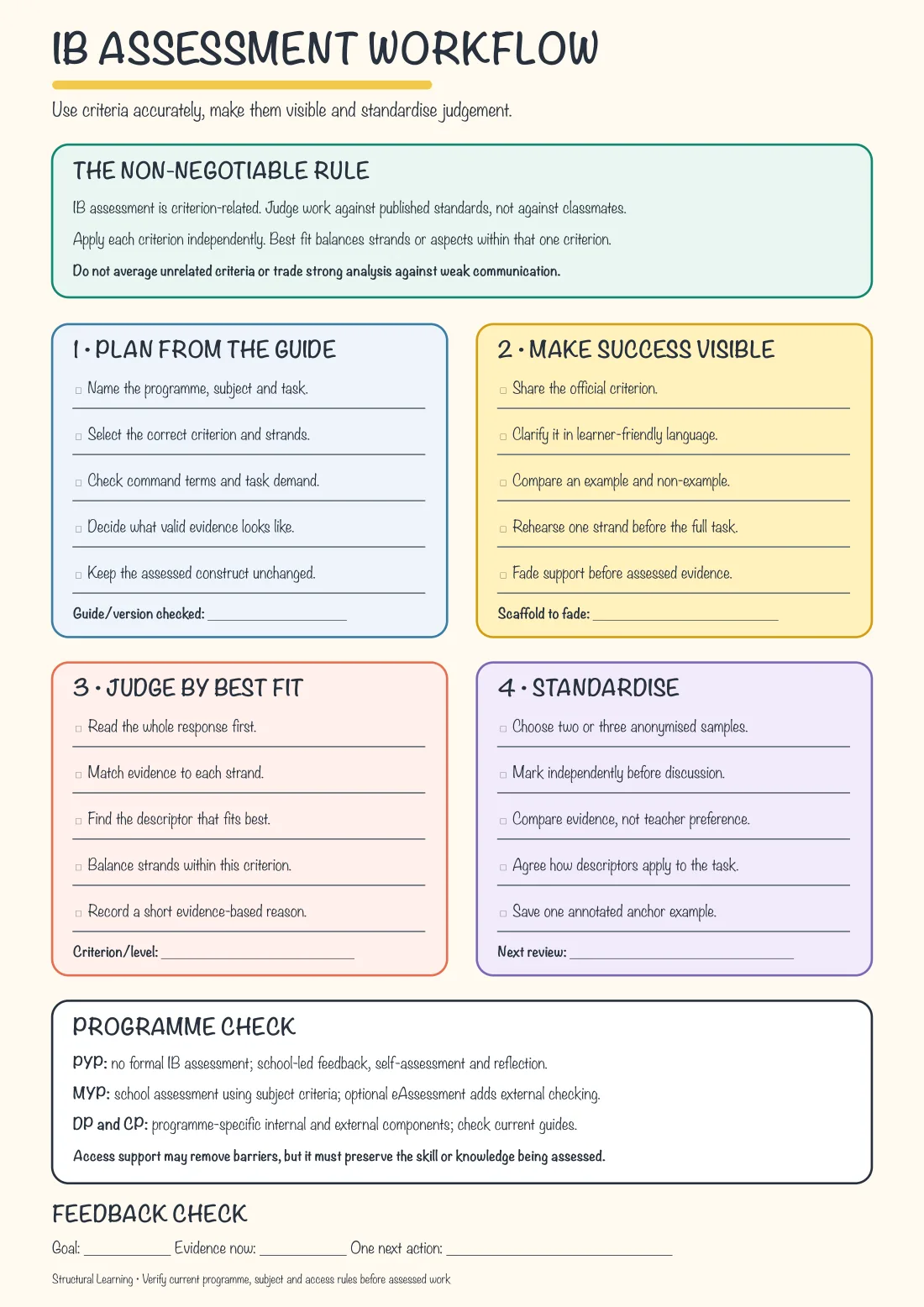
Use the four-step sheet to plan a task, clarify criteria, record a best-fit judgement and run a short department standardisation meeting.
Check the current IB assessment overview, the IB's explanation of criterion-related assessment, the official MYP best-fit guidance and the current access and inclusion guidance before adapting assessed work.
IB Assessment can look more objective than it is. Criterion descriptors reduce crude ranking, but best-fit judgement still depends on teacher interpretation. Baird et al. (2017) warn that classroom assessment reliability is not the same as large-scale test reliability; moderation, exemplars and shared rationales are needed because two well-informed teachers may still read the same evidence differently.
There are also cultural and linguistic limits. Bourdieu (1986) helps explain why command terms such as 'evaluate' and 'synthesise' can reward cultural capital, academic English and prior exposure to essay conventions. This can affect EAL, working-class and neurodivergent learners, especially in language literature, global politics and environmental systems and societies, where subject understanding is often filtered through dense written performance.
The evidence base needs care. Hattie (2009) is often quoted as if feedback effect sizes transfer cleanly to every rubric, but Simpson (2017) and Slavin (2018) question the comparability of aggregated effect sizes across contexts. Karpicke's retrieval work (Karpicke, 2008) and Vygotsky's account of guided support (Vygotsky, 1978) are useful, yet both require adaptation for multilingual, high-stakes International Baccalaureate settings.
Generative AI adds a new validity problem: coursework may show polished output without secure authorship or understanding (Dawson et al., 2024). Despite these limits, IB Assessment remains valuable when schools treat criteria as public standards, moderate judgement carefully and design tasks that let learners explain their thinking.
Formative assessment happens during learning and gives feedback on specific strands of the criteria. Summative assessment judges the final performance against the relevant rubric or examination mark scheme. In the Diploma Programme, this summative picture usually combines Internal Assessment, External Assessment and, for the Core, Theory of Knowledge and the Extended Essay. CAS must be completed, but it does not add points.
When a learner's work sits on the border between two bands, revisit the command terms. Look for the prevailing quality of the work and determine if it leans towards the higher or lower cognitive demand. Document your rationale.
Apply each criterion independently. If one criterion contains several strands, use best fit to decide which descriptor most fairly reflects the balance of evidence within that criterion. Do not use strength in one criterion, such as analysis, to compensate for weak performance in another, such as communication. Record a short reason when the evidence spans two levels.
During learning, reduce avoidable reading load by chunking the rubric, explaining command terms and using examples. Keep the complete success criteria available so that the standard is not hidden. For assessed work, any access arrangement or scaffold must preserve the knowledge or skill being assessed and follow the current programme, subject and access rules (International Baccalaureate, 2026).
For example, a teacher can enlarge text, improve layout or let a learner rehearse how to navigate a rubric. The teacher must not remove a strand, supply the content of the answer or change the assessed construct. Seek the coordinator's advice where a classroom support may affect submitted work.
Sadler (2009) and Bloxham (2009) show why standardisation protects teacher judgement. Before each major assessment, departments should standardise marking with two or three anonymised samples. They should also write brief reasons for each mark, which reduces drift between teachers and makes borderline choices easier to defend.
Use percentages with care. Classroom assessment should refer to criteria. However, DP components still produce raw marks that are weighted, added together and converted into 1-7 grades through session grade boundaries.
In the MYP, criterion scores are totalled out of 32 and then mapped to the 1-7 scale. In the UK, the phrase 'IB exam' usually refers to Diploma Programme final written examinations, although the qualification also includes coursework, Internal Assessment and the Core. Comparisons with GCSE or four IB and A-level comparison are too blunt, because the International Baccalaureate Diploma spreads assessment across six subjects plus the Core. This means workload and breadth differ from A level specialisation, rather than sitting on a simple harder or easier scale.
Academic integrity now needs to be designed into the assessment, not added as a warning on the cover sheet. The IB does not ban generative AI, but any AI-generated text, image or data must be credited and cannot be presented as the learner's own work. For Internal Assessment, this pushes teachers towards process evidence, supervised drafting, short viva voce checks and oral defences where learners explain why a method, source or model was chosen (IBO, 2023; Dawson et al., 2024).
Draft the translated rubric for your next unit. Then add one authenticity checkpoint. This could be a five-minute oral explanation, a live data annotation, or a short comparison between an early plan and the final submission.
Black, P. (1998). Inside the black box.
Hattie, J. (2009). Visible learning.
Karpicke, J. (2008). The critical importance of retrieval for learning.
Vygotsky, L. (1978). Mind in society: The development of higher psychological processes.
Webb, N. (1997). Criteria for alignment of expectations and assessments.
Wiliam, D. (2011). Embedded formative assessment.
These sources focus on assessment validity, feedback, formative assessment and cognitive demand.
Assessment and Classroom Learning
Black and Wiliam (1998) provide the foundational review behind much classroom formative assessment practice. Use it to ground feedback, questioning and evidence-responsive teaching.
Hattie and Timperley (2007) clarify how feedback should answer where learners are going, how they are going and where they should go next.
Formative Assessment and the Design of Instructional Systems
Sadler (1989) is central for understanding standards, criteria and learner action in formative assessment.
Cognitive Load During Problem Solving
Sweller (1988) supports the article's point that assessment scaffolds should reduce unnecessary load while preserving the intended cognitive challenge.
A Generative AI model for Assessment in Higher Education
Dawson et al. (2024) is a relevant source for the article's AI assessment section because it frames validity as a more important design problem than cheating prevention alone.