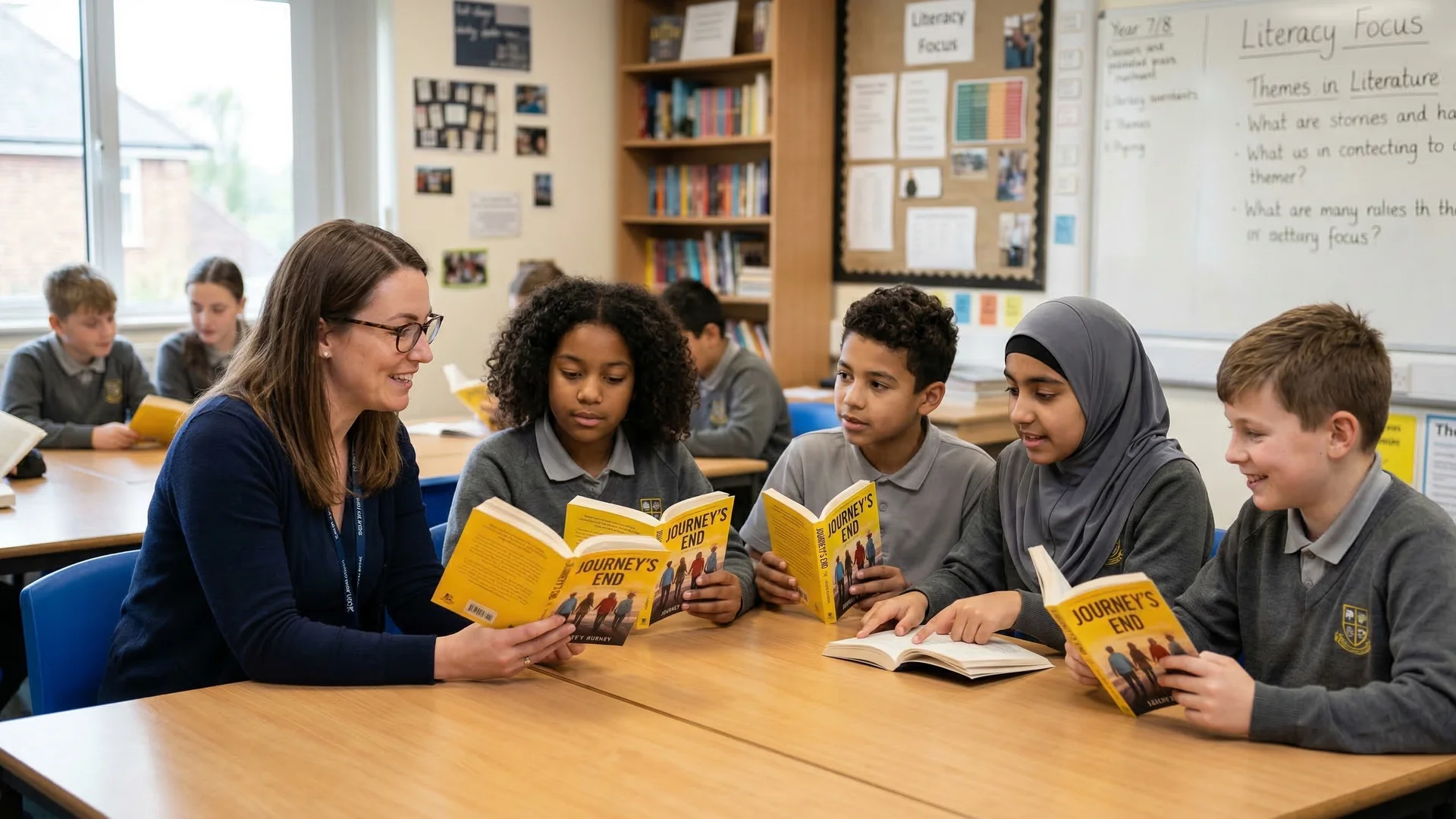
Guided Reading: A Teacher's GuideGuided Reading: A Teacher's Guide: practical strategies for teachers

Updated on  

March 20, 2026

Guided Reading: A Teacher's Guide

|

March 19, 2026

This guided reading teachers guide primary school strategies resource provides actionable frameworks, cognitive science insights, and SEND scaffolds for your class.

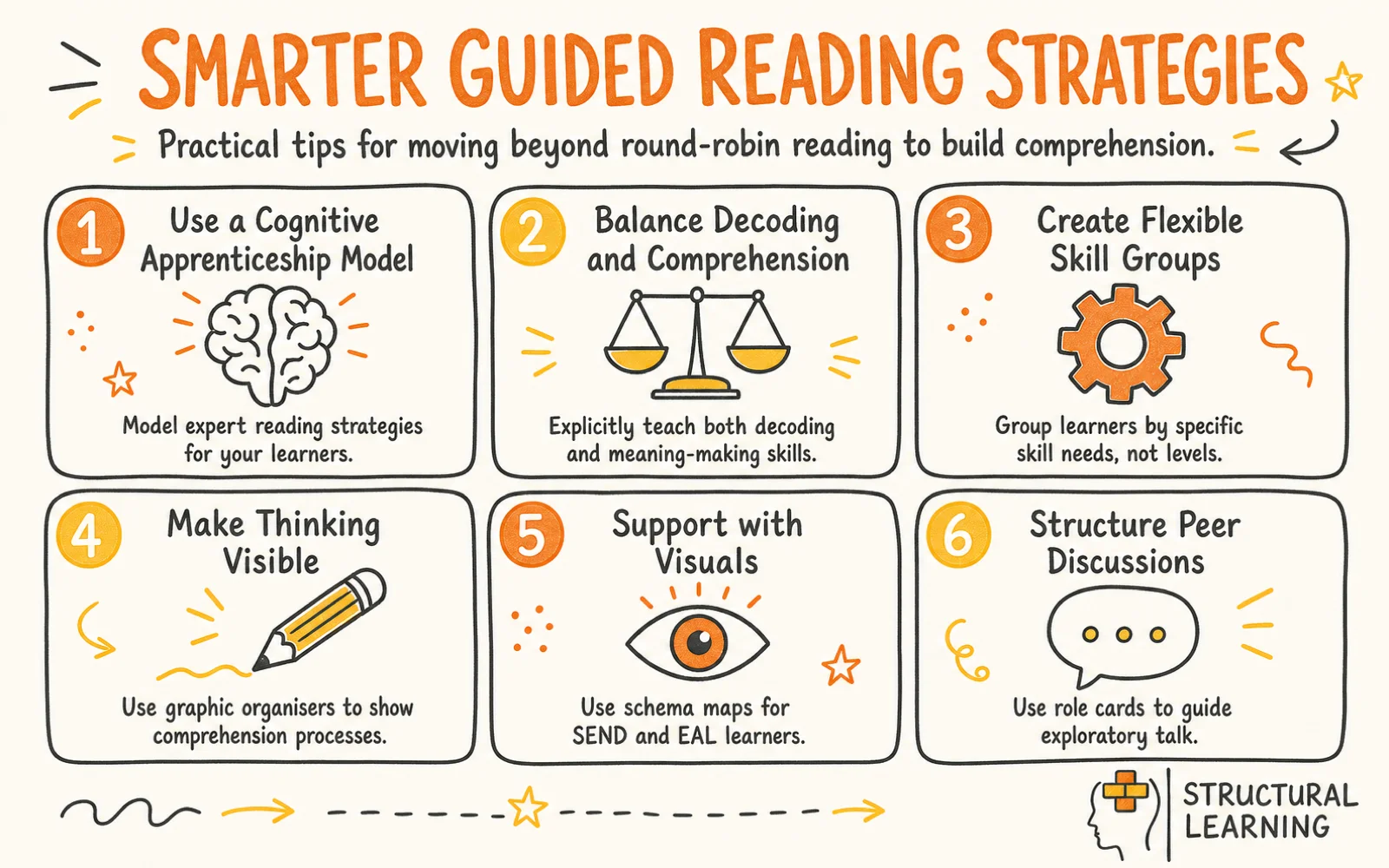
Guided Reading: From Round-Robin to Cognitive Apprenticeship infographic for teachers
Guided Reading: From Round-Robin to Cognitive Apprenticeship

Key Takeaways

  • Reframe guided reading from round-robin reading to a cognitive apprenticeship.
  • Balance decoding practice with explicit comprehension strategy instruction.
  • Replace rigid ability bands with dynamic, skill-focused grouping.
  • Use graphic organisers to make reading comprehension visible and reduce cognitive load.
  • Design meaningful independent learning tasks for the rest of the class.
  • Provide SEND and EAL learners with visual schema maps before reading.
  • Use structured role cards to facilitate peer-led exploratory talk.

What Is Guided Reading?

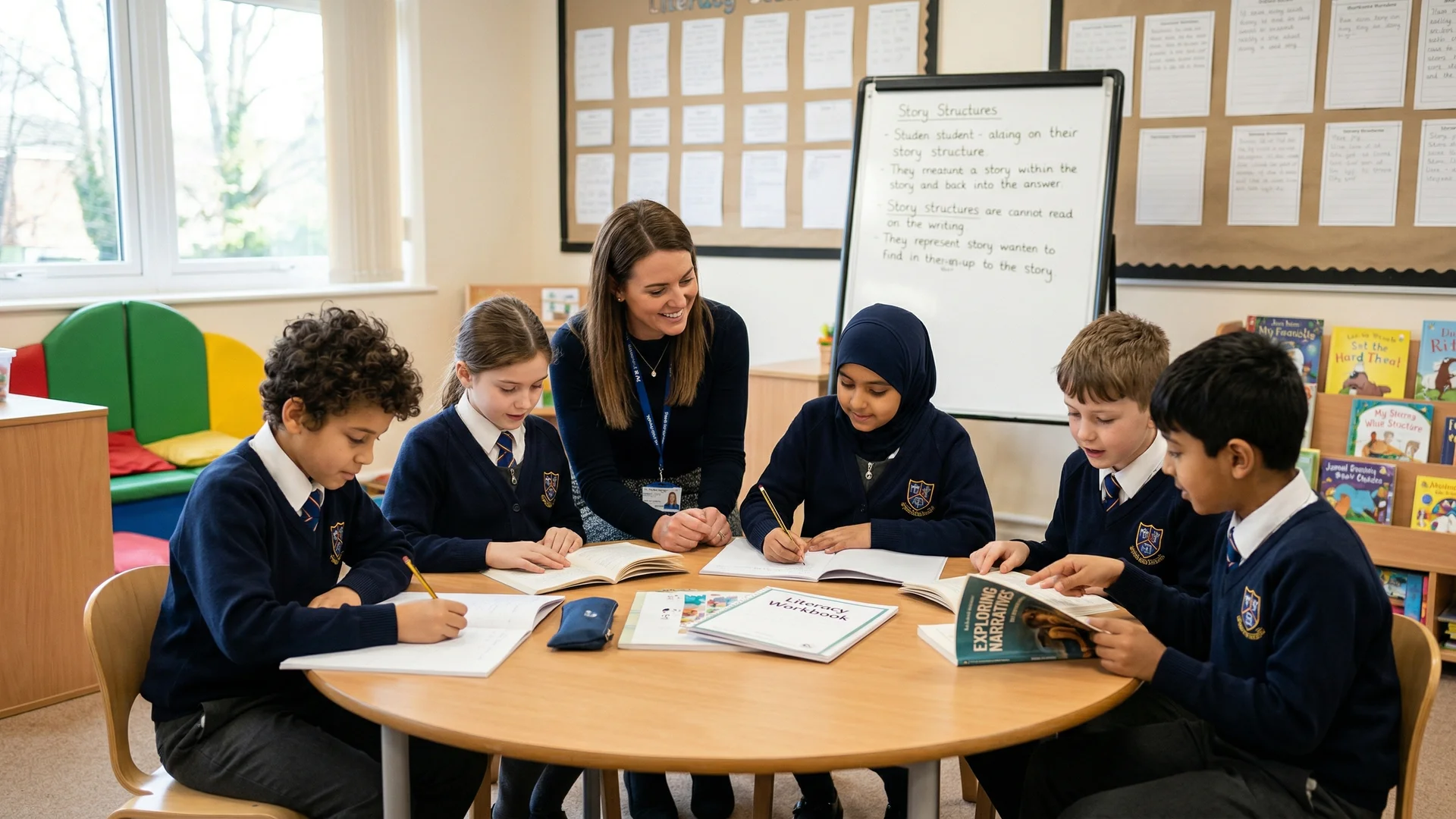
Guided reading is a small-group instructional practice where teachers support a targeted group of pupils as they read a text. The core purpose is to help children develop independent reading strategies that they can apply to any text they encounter. Teachers select a text that offers a specific level of challenge and carefully scaffold the reading process to build both fluency and deep comprehension. The practice originated as a structured way to differentiate reading instruction within the primary classroom (Fountas and Pinnell, 1996).

Modern classrooms are moving away from traditional models of guided reading that rely on passive turn-taking. We now frame this time as a cognitive apprenticeship. Teachers do not just listen to children read words. Instead, teachers make their own internal reading processes visible, showing pupils how an expert reader navigates confusing sentences, uncovers hidden meanings, and connects new information to existing knowledge.

The goal is to push learners from simple recall to strategic thinking. When teachers explicitly model how to monitor comprehension, pupils learn to identify when they have lost the thread of a story. They learn to stop, apply a fix-up strategy, and re-read with purpose. This transforms reading from a mechanical decoding task into an active process of meaning-making.

In a Year 4 classroom, the teacher introduces a historical narrative. Instead of asking the pupils to take turns reading aloud, the teacher reads the first paragraph and thinks aloud. The teacher says, "I am confused by this character's reaction, so I am going to re-read the previous sentence to look for clues." The pupils then whisper-read the next section independently, placing a small sticky note next to any sentence that breaks their understanding. The pupils produce annotated texts showing evidence of active comprehension monitoring.

Why Guided Reading Matters

Decoding text is only the first step in the reading process. The cognitive science of reading demonstrates that deep comprehension requires the active integration of decoding skills, vocabulary knowledge, and working memory. Pupils must hold multiple pieces of information in their minds while simultaneously predicting what will happen next. Explicitly teaching these strategies is essential because comprehension monitoring does not develop automatically for all children (Oakhill, Cain, and Elbro, 2014).

Background knowledge plays a significant role in a child's ability to understand a text. Reading comprehension is not a generic, transferable skill that works equally well across all subjects. A child's ability to comprehend a text is heavily dependent on how much they already know about the topic (Willingham, 2017). Guided reading matters because it gives teachers the dedicated time to build this necessary background knowledge before the pupils attempt to read the text.

Managing cognitive load is particularly crucial for SEND and EAL learners during reading tasks. When a text contains unfamiliar Tier 2 vocabulary alongside complex sentence structures, a pupil's working memory quickly becomes overwhelmed. Guided reading allows the teacher to pre-teach these potential barriers. By removing the obstacles before the reading begins, pupils have the cognitive capacity available to engage with the actual meaning of the text.

Consider a Year 5 teacher introducing a text about the water cycle. Before looking at the book, the teacher displays a visual diagram of condensation and evaporation. The teacher defines these two terms explicitly and asks the pupils to explain the diagram to a partner. When the pupils finally open the book, they do not stumble over the core concepts. The pupils produce a written summary of the text that shows accurate scientific understanding because their cognitive load was managed from the start.

Guided Reading Classroom Strategies

Effective guided reading sessions follow a structured progression. The framework is divided into Before Reading, During Reading, and After Reading phases. This structure ensures that cognitive support is provided at the moment the pupil needs it.

Strategy 1: The Before Phase

The Before Reading phase is about preparation and schema activation. Teachers must prime the pupils' brains to receive new information. This is the moment to establish the purpose of the reading and introduce critical Tier 2 vocabulary words that will appear in the text (Beck, McKeown, and Kucan, 2002). Teachers should not reveal the entire plot, but they must provide enough context to anchor the pupils' understanding.

To support SEND and EAL learners, teachers provide visual scaffolding during this phase. This reduces the cognitive burden of trying to picture unfamiliar concepts while decoding difficult words. Pre-teaching vocabulary using kid-friendly definitions and concrete examples ensures that pupils do not hit a comprehension wall in the first paragraph.

In a Year 3 group, the teacher introduces a text about a mountain rescue. The teacher says, "Today we will see the word 'perilous', which means very dangerous. Walking on an icy cliff is perilous." The teacher hands a visual Schema Map to an autistic learner in the group, showing a simple drawing of a mountain, a rescue helicopter, and the weather conditions. The pupils write the word 'perilous' on their whiteboards and draw a quick symbol next to it before opening their books. The pupils produce whiteboards showing the target vocabulary word and a relevant visual cue.
Strategy 2: The During Phase

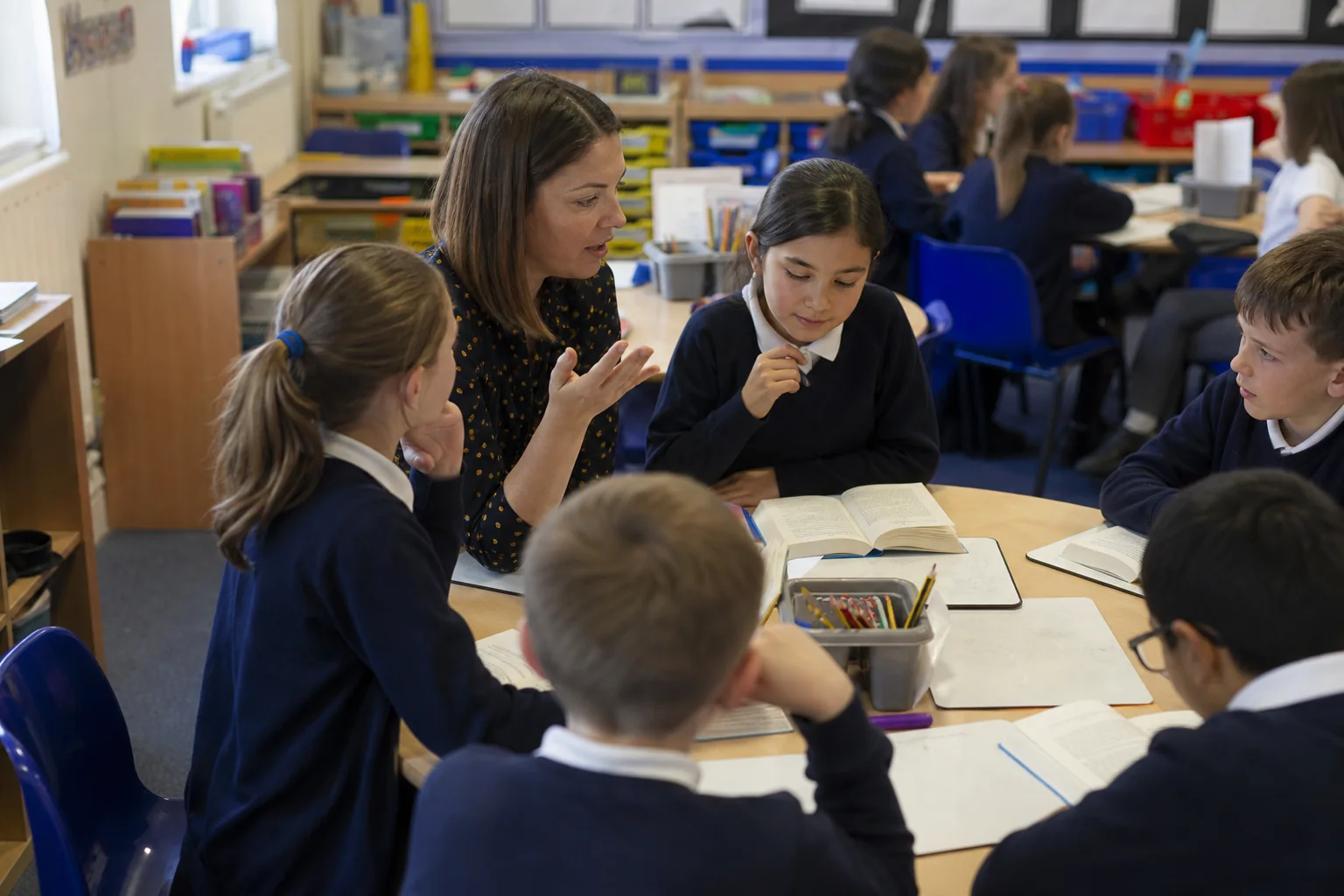
The During Reading phase requires pupils to actively engage with the text. Round-robin reading is abandoned completely. Instead, pupils engage in independent whisper-reading or silent reading at their own pace. The teacher acts as an observer and facilitator, listening to individual pupils and offering targeted prompts when a child struggles.

This phase is about making thinking visible. Pupils use tools to track their comprehension as they navigate the paragraphs. Teachers prompt pupils to apply specific strategies rather than simply feeding them the correct word. If a pupil is stuck on a word, the teacher prompts them to look at the root of the word or read the rest of the sentence for context clues.

In a Year 4 fiction session, pupils are given a 'Thinking Tracker' graphic organiser. The teacher instructs them to read the next two pages independently. The pupils whisper-read the text. Every time the main character makes a difficult choice, the pupils pause and mark the emotion on their tracker graph. The teacher listens to one pupil read, notices they skipped a critical conjunction, and asks them to re-read the sentence to see how the word 'although' changes the meaning. The pupils produce completed 'Thinking Tracker' graphs showing fluctuations in the main character's emotions.

Strategy 3: The After Phase

The After Reading phase is where deep consolidation occurs. The teacher guides the pupils to synthesise what they have read and construct complex responses. This is not a simple quiz of recall questions. The focus shifts to Webb's Depth of Knowledge Level 3, demanding strategic thinking, inference, and evidence-backed arguments.

Teachers use structured talk to reduce their own speaking time and increase pupil participation. Following the reading, pupils must articulate their understanding before they are asked to write about it. Structured sentence stems and specific writing methodologies are used to ensure the final output reflects deep comprehension.

In a Year 6 non-fiction session, the teacher applies the Hockman Method to consolidate learning about the Victorians. The teacher provides the stem "Children worked in factories..." and asks the pupils to complete it three ways using "because, but, so". The pupils discuss their ideas using Role Cards. The 'Starter' proposes an idea, the 'Builder' adds evidence from the text, and the 'Challenger' questions the logic. The pupils then independently write: "Children worked in factories because their families needed money, but the machines were dangerous, so many suffered severe injuries." The pupils produce extended sentences demonstrating causal reasoning about the Victorian era.

Strategy 4: Dynamic Grouping

Rigid ability banding restricts pupil progress. Dynamic grouping strategies organise pupils based on specific instructional needs rather than a general reading age. Formative assessment data drives the formation of these groups, and the groups change frequently as skills are mastered.

Teachers analyse recent reading tasks to identify patterns of need. One group might be formed to work on decoding multi-syllabic words. Another group, featuring a mix of reading fluencies, might be formed specifically to practice drawing inferences from dialogue. This ensures teaching time is highly targeted.

A Year 5 teacher reviews the previous week's comprehension tasks and notes that five pupils struggled to identify the author's bias. The teacher pulls these five pupils, who usually sit at different tables, into a guided group for twenty minutes. The teacher models how to spot emotive language. The pupils work together to highlight biased adjectives in a short newspaper article, successfully completing a task they previously failed. The group is then disbanded for the next session. The pupils produce an annotated newspaper article with biased language highlighted.

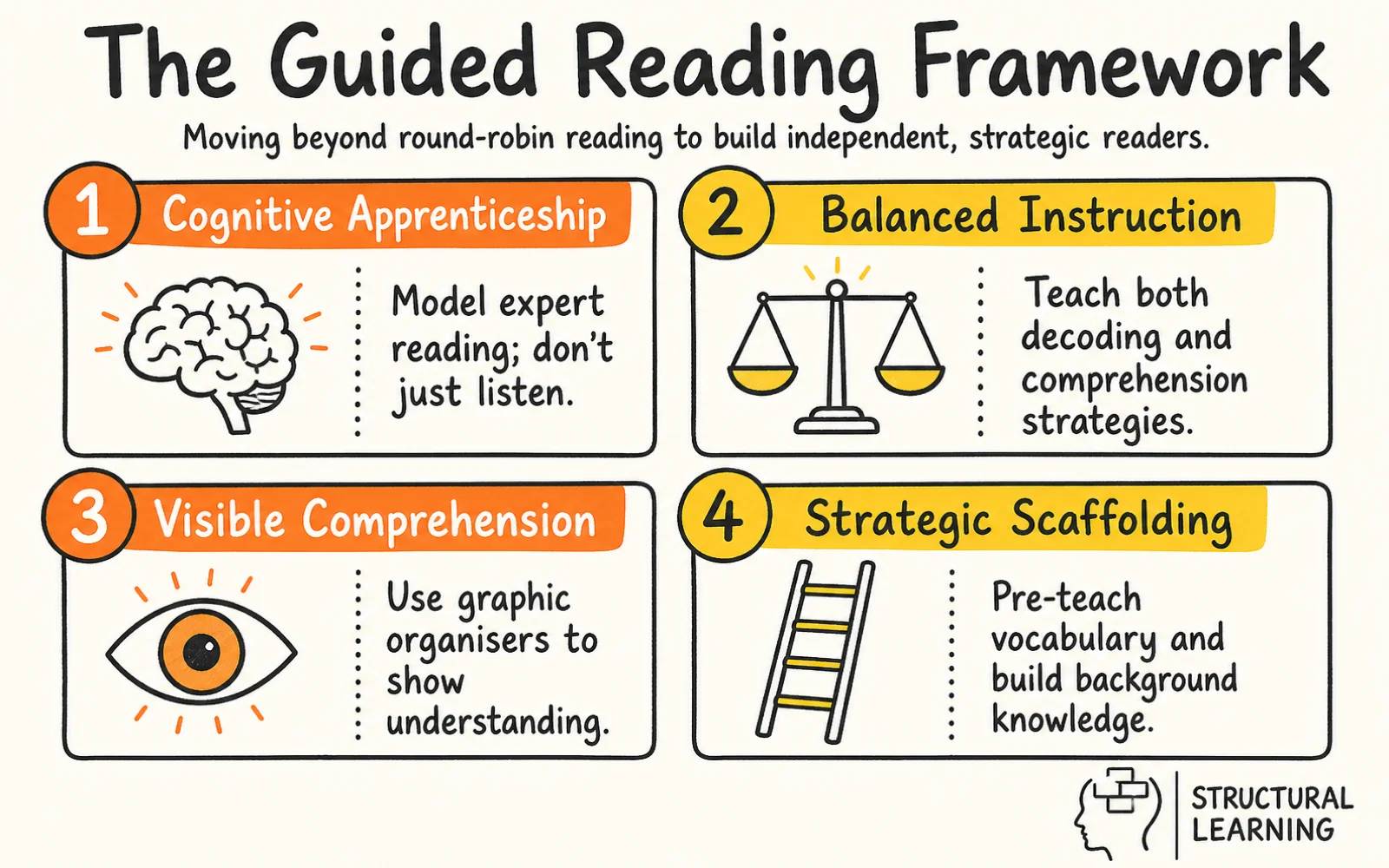
The Guided Reading Scaffold: 4 Pillars of Strategic Reading infographic for teachers
The Guided Reading Scaffold: 4 Pillars of Strategic Reading

Common Reading Misconceptions

A prevalent misconception is that reading aloud around the circle improves fluency. In reality, round-robin reading causes anxiety for struggling readers and boredom for advanced readers. It breaks the flow of the text and actively damages comprehension because pupils focus solely on rehearsing their upcoming paragraph instead of listening to the story. Whisper-reading allows all pupils to read the entire text simultaneously while the teacher listens in.

Another misconception is that SEND learners simply need easier books to succeed in guided reading. Lowering the text complexity often removes the rich vocabulary and interesting plots that drive engagement. The solution is not to dilute the content but to increase the scaffolding. Providing visual organisers, pre-teaching vocabulary, and reducing the volume of text to be read in one sitting are more effective strategies for supporting cognitive load.

Many teachers believe that the 'rest of the class' should engage in quiet, sustained reading while the teacher works with a group. Without accountability, this often devolves into fake reading. Independent tasks must be directly linked to the reading curriculum and require a tangible output. If the independent work is not meaningful, behaviour management issues will interrupt the guided reading group.

In practice, a teacher working with a guided group cannot monitor thirty silent readers effectively. To solve this, the teacher assigns the rest of the class a 'Map It' graphic organiser. The pupils must map the timeline of the chapter they read yesterday. This provides a structured, accountable task that requires deep thought, keeping the class focused and allowing the teacher to concentrate on the guided group. The pupils produce completed timeline maps of the previous day's reading.

Practical Implementation Guide

Transitioning to this model of guided reading requires clear routines. Step one is text selection. You must choose a text that is slightly above the pupils' independent reading level to provide the necessary friction for learning. If the text is too easy, there is no need for guided instruction. If it is too hard, cognitive overload will prevent any strategy application.

Step two is identifying a single, specific learning goal for the twenty-minute session. Do not try to teach vocabulary, fluency, inference, and summarising all at once. Pick one strategic focus, such as identifying the cause and effect within a historical recount. Every prompt and question during the session must align with this single goal to maintain clarity.

Step three involves answering the golden question: what is the rest of the class doing? Before you call your group to the table, ensure the independent stations are fully resourced and understood. Establish a strict rule that the teacher cannot be interrupted during guided reading unless it is an absolute emergency. Train the pupils to rely on peer support or move on to a secondary task if they get stuck.

Step four is the execution of the session. You spend four minutes on the Before phase, explicitly teaching two vocabulary words and activating schema. You spend ten minutes on the During phase, observing as pupils whisper-read and applying targeted prompts. You spend six minutes on the After phase, using structured talk and a short writing task to consolidate the learning.

On a Tuesday morning, a teacher implements this structure. The teacher calls a group of six pupils to the table. The rest of the class begins a paired vocabulary activity that was modeled the previous day. At the table, the teacher spends four minutes showing pictures of 'famine' and 'drought'. The pupils whisper-read for ten minutes while the teacher takes brief anecdotal notes on a clipboard. Finally, the teacher spends six minutes facilitating a debate about the text using sentence stems. The entire class remains productive. The teacher produces anecdotal notes that will inform future lesson planning.

Guided Reading Across Subjects

Guided reading strategies are not confined to the English block. Mathematical word problems are fundamentally reading comprehension tasks. Pupils frequently fail to solve maths problems not because they cannot do the arithmetic, but because they do not comprehend the structure of the text. Applying guided reading principles to maths lessons changes how pupils interact with problem-solving.

In a maths lesson, the teacher pulls a small group to read a complex, multi-step word problem. Instead of rushing to the numbers, the teacher guides the group to read the text strictly for meaning. The pupils highlight the action words that indicate mathematical operations. They draw a bar model to represent the story happening in the text before they are allowed to write any equations. The pupils produce a visual representation of the text, ensuring they understand the underlying logic.

Science texts carry a massive cognitive load due to the density of Tier 3 technical vocabulary and complex informational structures. Guided reading in science focuses on teaching pupils how to navigate diagrams, glossaries, and subheadings. It is about reading for information extraction and mapping relationships between difficult concepts.

During a science lesson on ecosystems, the teacher leads a guided reading group using a cause-and-effect graphic organiser. The teacher models how to pause at the end of a dense paragraph about deforestation. The pupils read the next section independently. They then map the primary action (cutting trees) to the secondary effects (soil erosion, habitat loss) on their organisers. The pupils build a clear, structured map of the scientific process directly from the text. The pupils produce cause-and-effect maps linking deforestation to its environmental consequences.

Reading historical primary sources requires pupils to understand context, bias, and perspective. Guided reading in history teaches pupils to interrogate the text rather than accept it as absolute fact. Teachers guide pupils to ask questions about the author's intent and the audience the text was written for.

In a history lesson, the teacher presents a short diary entry from a Victorian mill owner. The teacher uses a questioning matrix to guide the group. The teacher asks, "Why might this author describe the factory conditions as 'acceptable'?" The pupils read the text looking specifically for clues about the author's financial motivations. The pupils produce a short written paragraph comparing the mill owner's perspective with the reality of the workers, demonstrating high-level critical analysis.

Inclusive Guided Reading: Strategies for SEND & EAL Learners infographic for teachers
Inclusive Guided Reading: Strategies for SEND & EAL Learners

Common Questions About Guided Reading

How long should a session last?

A focused guided reading session should last twenty minutes. Anything longer results in cognitive fatigue and reduces time to see other groups. Keep the pace brisk, limit the vocabulary introduction, and dedicate the bulk of the time to active reading and structured talk.

How do I assess without disrupting the flow?

Use a clipboard with a simple tracking grid for the pupils in your group. Take quick, anecdotal notes while the pupils are whisper-reading. You only need to record specific observations, such as a pupil successfully using a context clue or struggling with a specific vowel digraph. This formative assessment informs your planning for the next session.

What if a pupil finishes reading early?

Never let early finishers sit idle or disrupt the group. Before the reading phase begins, provide a structured re-reading task. Instruct pupils that if they reach the end of the assigned section, they must immediately go back and underline three words that create a specific mood, or they must begin filling out their graphic organiser.

How often should I see each group?

Frequency depends on the instructional needs of the pupils. Pupils who are struggling with basic decoding or comprehension monitoring should be seen every day. Pupils who are reading fluently and comprehending well may only need a guided session once or twice a week, spending the rest of their time engaged in independent literature studies.

How do I manage the noise of whisper-reading?

Whisper-reading requires explicit modeling and practice at the start of the academic year. Teach the pupils what a 'table whisper' sounds like compared to a normal speaking voice. If the noise level rises, gently tap the table and use a non-verbal hand signal to remind the group to lower their volume. It quickly becomes an established, productive routine.

Tomorrow, audit your current guided reading groups and shift one static ability band into a dynamic, skill-focused cluster.

Reading Strategy Selector

Find the best reading strategy for your classroom context

1 Select your Key Stage

2 Select your focus area

3 Select your main challenge

Recommended Strategies

Further Reading: Key Research Papers

These peer-reviewed studies provide the evidence base for the strategies discussed above.

How preservice teachers use learner knowledge for planning and in-the-moment teaching decisions during guided reading View study ↗

Davis et al. (2019)

This study examines how trainee teachers make decisions during guided reading lessons, focusing on how they use knowledge about students' abilities and needs. For classroom teachers, it highlights the importance of understanding individual learners to make effective planning and real-time instructional decisions during guided reading sessions.

KAJIAN ETIKA KRISTEN TERKAIT PERAN GURU DALAM MENERAPKAN PENDIDIKAN KARAKTER UNTUK MENGATASI KEMEROSOTAN KARAKTER SISWA DI ERA DIGITAL [A STUDY OF CHRISTIAN ETHICS RELATED TO THE TEACHER'S ROLE IN IMPLEMENTING CHARACTER EDUCATION TO OVERCOME CHARACTER DECLINE IN THE DIGITAL ERA] View study ↗

Bora et al. (2022)

This research explores how teachers can implement character education to address declining student values in the digital age from a Christian ethics perspective. It emphasises teachers' crucial role in balancing technology use with moral guidance, providing practical insights for educators seeking to develop students' character alongside digital literacy.

Adopting Literature Circle to Guide Work Undergraduate Students in Extensive Reading Program: Lessons Learned from Initial Teacher Education View study ↗

Anggrarini et al. (2022)

This study investigates using literature circles within extensive reading programmes for undergraduate students learning English as a foreign language. Teachers can learn how structured discussion groups enhance student engagement with reading materials, offering a collaborative approach to developing reading skills and literary appreciation.

Why Did All the Residents Resign? Key Takeaways From the Junior Physicians' Mass Walkout in South Korea. View study ↗
23 citations

Park et al. (2024)

This paper analyses the mass resignation of medical residents in South Korea's healthcare system. While not directly education-focused, it offers insights into workplace conditions and professional development that may be relevant for understanding teacher retention and educational leadership challenges.

Cultivating connectedness and elevating educational experiences for international students in blended learning: reflections from the pandemic era and key takeaways View study ↗

He et al. (2024)

This research examines how videoconferencing technology supports international students in blended learning environments during the pandemic. Teachers can apply these findings to improve online engagement strategies, enhance student satisfaction, and create more inclusive learning experiences for diverse student populations.

Free Resource Pack

Guided Reading: A Teacher's Guide

Practical resources to support effective planning and delivery of engaging guided reading sessions.

Guided Reading: A Teacher's Guide , 3 resources
CPD Visual Planning Template Quick Reference Guide Reading Strategies Literacy Instruction Reading Comprehension

Download your free bundle

Fill in your details below and we'll send the resource pack straight to your inbox.

Quick survey (helps us create better resources)

How confident do you feel in planning and delivering effective guided reading sessions?

Not at all confident
Slightly confident
Moderately confident
Quite confident
Extremely confident

To what extent do you feel your school provides adequate resources and support for guided reading?

Not at all
Slightly
Moderately
Well
Extensively

How consistently do you implement structured guided reading sessions in your classroom?

Rarely/Never
Sometimes
About half the time
Most of the time
Consistently

Your resource pack is ready

We've also sent a copy to your email. Check your inbox.

Loading audit...

Guided Reading: From Round-Robin to Cognitive Apprenticeship infographic for teachers
Guided Reading: From Round-Robin to Cognitive Apprenticeship

Key Takeaways

  • Reframe guided reading from round-robin reading to a cognitive apprenticeship.
  • Balance decoding practice with explicit comprehension strategy instruction.
  • Replace rigid ability bands with dynamic, skill-focused grouping.
  • Use graphic organisers to make reading comprehension visible and reduce cognitive load.
  • Design meaningful independent learning tasks for the rest of the class.
  • Provide SEND and EAL learners with visual schema maps before reading.
  • Use structured role cards to facilitate peer-led exploratory talk.

What Is Guided Reading?

Guided reading is a small-group instructional practice where teachers support a targeted group of pupils as they read a text. The core purpose is to help children develop independent reading strategies that they can apply to any text they encounter. Teachers select a text that offers a specific level of challenge and carefully scaffold the reading process to build both fluency and deep comprehension. The practice originated as a structured way to differentiate reading instruction within the primary classroom (Fountas and Pinnell, 1996).

Modern classrooms are moving away from traditional models of guided reading that rely on passive turn-taking. We now frame this time as a cognitive apprenticeship. Teachers do not just listen to children read words. Instead, teachers make their own internal reading processes visible, showing pupils how an expert reader navigates confusing sentences, uncovers hidden meanings, and connects new information to existing knowledge.

The goal is to push learners from simple recall to strategic thinking. When teachers explicitly model how to monitor comprehension, pupils learn to identify when they have lost the thread of a story. They learn to stop, apply a fix-up strategy, and re-read with purpose. This transforms reading from a mechanical decoding task into an active process of meaning-making.

In a Year 4 classroom, the teacher introduces a historical narrative. Instead of asking the pupils to take turns reading aloud, the teacher reads the first paragraph and thinks aloud. The teacher says, "I am confused by this character's reaction, so I am going to re-read the previous sentence to look for clues." The pupils then whisper-read the next section independently, placing a small sticky note next to any sentence that breaks their understanding. The pupils produce annotated texts showing evidence of active comprehension monitoring.

Why Guided Reading Matters

Decoding text is only the first step in the reading process. The cognitive science of reading demonstrates that deep comprehension requires the active integration of decoding skills, vocabulary knowledge, and working memory. Pupils must hold multiple pieces of information in their minds while simultaneously predicting what will happen next. Explicitly teaching these strategies is essential because comprehension monitoring does not develop automatically for all children (Oakhill, Cain, and Elbro, 2014).

Background knowledge plays a significant role in a child's ability to understand a text. Reading comprehension is not a generic, transferable skill that works equally well across all subjects. A child's ability to comprehend a text is heavily dependent on how much they already know about the topic (Willingham, 2017). Guided reading matters because it gives teachers the dedicated time to build this necessary background knowledge before the pupils attempt to read the text.

Managing cognitive load is particularly crucial for SEND and EAL learners during reading tasks. When a text contains unfamiliar Tier 2 vocabulary alongside complex sentence structures, a pupil's working memory quickly becomes overwhelmed. Guided reading allows the teacher to pre-teach these potential barriers. By removing the obstacles before the reading begins, pupils have the cognitive capacity available to engage with the actual meaning of the text.

Consider a Year 5 teacher introducing a text about the water cycle. Before looking at the book, the teacher displays a visual diagram of condensation and evaporation. The teacher defines these two terms explicitly and asks the pupils to explain the diagram to a partner. When the pupils finally open the book, they do not stumble over the core concepts. The pupils produce a written summary of the text that shows accurate scientific understanding because their cognitive load was managed from the start.

Guided Reading Classroom Strategies

Effective guided reading sessions follow a structured progression. The framework is divided into Before Reading, During Reading, and After Reading phases. This structure ensures that cognitive support is provided at the moment the pupil needs it.

Strategy 1: The Before Phase

The Before Reading phase is about preparation and schema activation. Teachers must prime the pupils' brains to receive new information. This is the moment to establish the purpose of the reading and introduce critical Tier 2 vocabulary words that will appear in the text (Beck, McKeown, and Kucan, 2002). Teachers should not reveal the entire plot, but they must provide enough context to anchor the pupils' understanding.

To support SEND and EAL learners, teachers provide visual scaffolding during this phase. This reduces the cognitive burden of trying to picture unfamiliar concepts while decoding difficult words. Pre-teaching vocabulary using kid-friendly definitions and concrete examples ensures that pupils do not hit a comprehension wall in the first paragraph.

In a Year 3 group, the teacher introduces a text about a mountain rescue. The teacher says, "Today we will see the word 'perilous', which means very dangerous. Walking on an icy cliff is perilous." The teacher hands a visual Schema Map to an autistic learner in the group, showing a simple drawing of a mountain, a rescue helicopter, and the weather conditions. The pupils write the word 'perilous' on their whiteboards and draw a quick symbol next to it before opening their books. The pupils produce whiteboards showing the target vocabulary word and a relevant visual cue.

Strategy 2: The During Phase

The During Reading phase requires pupils to actively engage with the text. Round-robin reading is abandoned completely. Instead, pupils engage in independent whisper-reading or silent reading at their own pace. The teacher acts as an observer and facilitator, listening to individual pupils and offering targeted prompts when a child struggles.

This phase is about making thinking visible. Pupils use tools to track their comprehension as they navigate the paragraphs. Teachers prompt pupils to apply specific strategies rather than simply feeding them the correct word. If a pupil is stuck on a word, the teacher prompts them to look at the root of the word or read the rest of the sentence for context clues.

In a Year 4 fiction session, pupils are given a 'Thinking Tracker' graphic organiser. The teacher instructs them to read the next two pages independently. The pupils whisper-read the text. Every time the main character makes a difficult choice, the pupils pause and mark the emotion on their tracker graph. The teacher listens to one pupil read, notices they skipped a critical conjunction, and asks them to re-read the sentence to see how the word 'although' changes the meaning. The pupils produce completed 'Thinking Tracker' graphs showing fluctuations in the main character's emotions.

Strategy 3: The After Phase

The After Reading phase is where deep consolidation occurs. The teacher guides the pupils to synthesise what they have read and construct complex responses. This is not a simple quiz of recall questions. The focus shifts to Webb's Depth of Knowledge Level 3, demanding strategic thinking, inference, and evidence-backed arguments.

Teachers use structured talk to reduce their own speaking time and increase pupil participation. Following the reading, pupils must articulate their understanding before they are asked to write about it. Structured sentence stems and specific writing methodologies are used to ensure the final output reflects deep comprehension.

In a Year 6 non-fiction session, the teacher applies the Hockman Method to consolidate learning about the Victorians. The teacher provides the stem "Children worked in factories..." and asks the pupils to complete it three ways using "because, but, so". The pupils discuss their ideas using Role Cards. The 'Starter' proposes an idea, the 'Builder' adds evidence from the text, and the 'Challenger' questions the logic. The pupils then independently write: "Children worked in factories because their families needed money, but the machines were dangerous, so many suffered severe injuries." The pupils produce extended sentences demonstrating causal reasoning about the Victorian era.

Strategy 4: Dynamic Grouping

Rigid ability banding restricts pupil progress. Dynamic grouping strategies organise pupils based on specific instructional needs rather than a general reading age. Formative assessment data drives the formation of these groups, and the groups change frequently as skills are mastered.

Teachers analyse recent reading tasks to identify patterns of need. One group might be formed to work on decoding multi-syllabic words. Another group, featuring a mix of reading fluencies, might be formed specifically to practice drawing inferences from dialogue. This ensures teaching time is highly targeted.

A Year 5 teacher reviews the previous week's comprehension tasks and notes that five pupils struggled to identify the author's bias. The teacher pulls these five pupils, who usually sit at different tables, into a guided group for twenty minutes. The teacher models how to spot emotive language. The pupils work together to highlight biased adjectives in a short newspaper article, successfully completing a task they previously failed. The group is then disbanded for the next session. The pupils produce an annotated newspaper article with biased language highlighted.

The Guided Reading Scaffold: 4 Pillars of Strategic Reading infographic for teachers
The Guided Reading Scaffold: 4 Pillars of Strategic Reading

Common Reading Misconceptions

A prevalent misconception is that reading aloud around the circle improves fluency. In reality, round-robin reading causes anxiety for struggling readers and boredom for advanced readers. It breaks the flow of the text and actively damages comprehension because pupils focus solely on rehearsing their upcoming paragraph instead of listening to the story. Whisper-reading allows all pupils to read the entire text simultaneously while the teacher listens in.

Another misconception is that SEND learners simply need easier books to succeed in guided reading. Lowering the text complexity often removes the rich vocabulary and interesting plots that drive engagement. The solution is not to dilute the content but to increase the scaffolding. Providing visual organisers, pre-teaching vocabulary, and reducing the volume of text to be read in one sitting are more effective strategies for supporting cognitive load.

Many teachers believe that the 'rest of the class' should engage in quiet, sustained reading while the teacher works with a group. Without accountability, this often devolves into fake reading. Independent tasks must be directly linked to the reading curriculum and require a tangible output. If the independent work is not meaningful, behaviour management issues will interrupt the guided reading group.

In practice, a teacher working with a guided group cannot monitor thirty silent readers effectively. To solve this, the teacher assigns the rest of the class a 'Map It' graphic organiser. The pupils must map the timeline of the chapter they read yesterday. This provides a structured, accountable task that requires deep thought, keeping the class focused and allowing the teacher to concentrate on the guided group. The pupils produce completed timeline maps of the previous day's reading.

Practical Implementation Guide

Transitioning to this model of guided reading requires clear routines. Step one is text selection. You must choose a text that is slightly above the pupils' independent reading level to provide the necessary friction for learning. If the text is too easy, there is no need for guided instruction. If it is too hard, cognitive overload will prevent any strategy application.

Step two is identifying a single, specific learning goal for the twenty-minute session. Do not try to teach vocabulary, fluency, inference, and summarising all at once. Pick one strategic focus, such as identifying the cause and effect within a historical recount. Every prompt and question during the session must align with this single goal to maintain clarity.

Step three involves answering the golden question: what is the rest of the class doing? Before you call your group to the table, ensure the independent stations are fully resourced and understood. Establish a strict rule that the teacher cannot be interrupted during guided reading unless it is an absolute emergency. Train the pupils to rely on peer support or move on to a secondary task if they get stuck.

Step four is the execution of the session. You spend four minutes on the Before phase, explicitly teaching two vocabulary words and activating schema. You spend ten minutes on the During phase, observing as pupils whisper-read and applying targeted prompts. You spend six minutes on the After phase, using structured talk and a short writing task to consolidate the learning.

On a Tuesday morning, a teacher implements this structure. The teacher calls a group of six pupils to the table. The rest of the class begins a paired vocabulary activity that was modeled the previous day. At the table, the teacher spends four minutes showing pictures of 'famine' and 'drought'. The pupils whisper-read for ten minutes while the teacher takes brief anecdotal notes on a clipboard. Finally, the teacher spends six minutes facilitating a debate about the text using sentence stems. The entire class remains productive. The teacher produces anecdotal notes that will inform future lesson planning.

Guided Reading Across Subjects

Guided reading strategies are not confined to the English block. Mathematical word problems are fundamentally reading comprehension tasks. Pupils frequently fail to solve maths problems not because they cannot do the arithmetic, but because they do not comprehend the structure of the text. Applying guided reading principles to maths lessons changes how pupils interact with problem-solving.

In a maths lesson, the teacher pulls a small group to read a complex, multi-step word problem. Instead of rushing to the numbers, the teacher guides the group to read the text strictly for meaning. The pupils highlight the action words that indicate mathematical operations. They draw a bar model to represent the story happening in the text before they are allowed to write any equations. The pupils produce a visual representation of the text, ensuring they understand the underlying logic.

Science texts carry a massive cognitive load due to the density of Tier 3 technical vocabulary and complex informational structures. Guided reading in science focuses on teaching pupils how to navigate diagrams, glossaries, and subheadings. It is about reading for information extraction and mapping relationships between difficult concepts.

During a science lesson on ecosystems, the teacher leads a guided reading group using a cause-and-effect graphic organiser. The teacher models how to pause at the end of a dense paragraph about deforestation. The pupils read the next section independently. They then map the primary action (cutting trees) to the secondary effects (soil erosion, habitat loss) on their organisers. The pupils build a clear, structured map of the scientific process directly from the text. The pupils produce cause-and-effect maps linking deforestation to its environmental consequences.

Reading historical primary sources requires pupils to understand context, bias, and perspective. Guided reading in history teaches pupils to interrogate the text rather than accept it as absolute fact. Teachers guide pupils to ask questions about the author's intent and the audience the text was written for.

In a history lesson, the teacher presents a short diary entry from a Victorian mill owner. The teacher uses a questioning matrix to guide the group. The teacher asks, "Why might this author describe the factory conditions as 'acceptable'?" The pupils read the text looking specifically for clues about the author's financial motivations. The pupils produce a short written paragraph comparing the mill owner's perspective with the reality of the workers, demonstrating high-level critical analysis.

Inclusive Guided Reading: Strategies for SEND & EAL Learners infographic for teachers
Inclusive Guided Reading: Strategies for SEND & EAL Learners

Common Questions About Guided Reading

How long should a session last?

A focused guided reading session should last twenty minutes. Anything longer results in cognitive fatigue and reduces time to see other groups. Keep the pace brisk, limit the vocabulary introduction, and dedicate the bulk of the time to active reading and structured talk.

How do I assess without disrupting the flow?

Use a clipboard with a simple tracking grid for the pupils in your group. Take quick, anecdotal notes while the pupils are whisper-reading. You only need to record specific observations, such as a pupil successfully using a context clue or struggling with a specific vowel digraph. This formative assessment informs your planning for the next session.

What if a pupil finishes reading early?

Never let early finishers sit idle or disrupt the group. Before the reading phase begins, provide a structured re-reading task. Instruct pupils that if they reach the end of the assigned section, they must immediately go back and underline three words that create a specific mood, or they must begin filling out their graphic organiser.

How often should I see each group?

Frequency depends on the instructional needs of the pupils. Pupils who are struggling with basic decoding or comprehension monitoring should be seen every day. Pupils who are reading fluently and comprehending well may only need a guided session once or twice a week, spending the rest of their time engaged in independent literature studies.

How do I manage the noise of whisper-reading?

Whisper-reading requires explicit modeling and practice at the start of the academic year. Teach the pupils what a 'table whisper' sounds like compared to a normal speaking voice. If the noise level rises, gently tap the table and use a non-verbal hand signal to remind the group to lower their volume. It quickly becomes an established, productive routine.

Tomorrow, audit your current guided reading groups and shift one static ability band into a dynamic, skill-focused cluster.

Reading Strategy Selector

Find the best reading strategy for your classroom context

1 Select your Key Stage

2 Select your focus area

3 Select your main challenge

Recommended Strategies

Further Reading: Key Research Papers

These peer-reviewed studies provide the evidence base for the strategies discussed above.

How preservice teachers use learner knowledge for planning and in-the-moment teaching decisions during guided reading View study ↗

Davis et al. (2019)

This study examines how trainee teachers make decisions during guided reading lessons, focusing on how they use knowledge about students' abilities and needs. For classroom teachers, it highlights the importance of understanding individual learners to make effective planning and real-time instructional decisions during guided reading sessions.

KAJIAN ETIKA KRISTEN TERKAIT PERAN GURU DALAM MENERAPKAN PENDIDIKAN KARAKTER UNTUK MENGATASI KEMEROSOTAN KARAKTER SISWA DI ERA DIGITAL [A STUDY OF CHRISTIAN ETHICS RELATED TO THE TEACHER'S ROLE IN IMPLEMENTING CHARACTER EDUCATION TO OVERCOME CHARACTER DECLINE IN THE DIGITAL ERA] View study ↗

Bora et al. (2022)

This research explores how teachers can implement character education to address declining student values in the digital age from a Christian ethics perspective. It emphasises teachers' crucial role in balancing technology use with moral guidance, providing practical insights for educators seeking to develop students' character alongside digital literacy.

Adopting Literature Circle to Guide Work Undergraduate Students in Extensive Reading Program: Lessons Learned from Initial Teacher Education View study ↗

Anggrarini et al. (2022)

This study investigates using literature circles within extensive reading programmes for undergraduate students learning English as a foreign language. Teachers can learn how structured discussion groups enhance student engagement with reading materials, offering a collaborative approach to developing reading skills and literary appreciation.

Why Did All the Residents Resign? Key Takeaways From the Junior Physicians' Mass Walkout in South Korea. View study ↗
23 citations

Park et al. (2024)

This paper analyses the mass resignation of medical residents in South Korea's healthcare system. While not directly education-focused, it offers insights into workplace conditions and professional development that may be relevant for understanding teacher retention and educational leadership challenges.

Cultivating connectedness and elevating educational experiences for international students in blended learning: reflections from the pandemic era and key takeaways View study ↗

He et al. (2024)

This research examines how videoconferencing technology supports international students in blended learning environments during the pandemic. Teachers can apply these findings to improve online engagement strategies, enhance student satisfaction, and create more inclusive learning experiences for diverse student populations.

Free Resource Pack

Guided Reading: A Teacher's Guide

Practical resources to support effective planning and delivery of engaging guided reading sessions.

Guided Reading: A Teacher's Guide , 3 resources
CPD Visual Planning Template Quick Reference Guide Reading Strategies Literacy Instruction Reading Comprehension

Download your free bundle

Fill in your details below and we'll send the resource pack straight to your inbox.

Quick survey (helps us create better resources)

How confident do you feel in planning and delivering effective guided reading sessions?

Not at all confident
Slightly confident
Moderately confident
Quite confident
Extremely confident

To what extent do you feel your school provides adequate resources and support for guided reading?

Not at all
Slightly
Moderately
Well
Extensively

How consistently do you implement structured guided reading sessions in your classroom?

Rarely/Never
Sometimes
About half the time
Most of the time
Consistently

Your resource pack is ready

We've also sent a copy to your email. Check your inbox.

Educational Technology

Back to Blog

{"@context":"https://schema.org","@graph":[{"@type":"Organization","@id":"https://www.structural-learning.com/#org","name":"Structural Learning","url":"https://www.structural-learning.com/","logo":{"@type":"ImageObject","url":"https://cdn.prod.website-files.com/5b69a01ba2e409501de055d1/5b69a01ba2e40996a5e055f4_structural-learning-logo.png"}},{"@type":"Person","@id":"https://www.structural-learning.com/team/paul-main/#person","name":"Paul Main","url":"https://www.structural-learning.com/team/paul-main","jobTitle":"Founder","affiliation":{"@id":"https://www.structural-learning.com/#org"}},{"@type":"BreadcrumbList","@id":"https://www.structural-learning.com/post/guided-reading-teachers-guide#breadcrumb","itemListElement":[{"@type":"ListItem","position":1,"name":"Home","item":"https://www.structural-learning.com/"},{"@type":"ListItem","position":2,"name":"Blog","item":"https://www.structural-learning.com/blog"},{"@type":"ListItem","position":3,"name":"Guided Reading: A Teacher's Guide","item":"https://www.structural-learning.com/post/guided-reading-teachers-guide"}]},{"@type":"BlogPosting","@id":"https://www.structural-learning.com/post/guided-reading-teachers-guide#article","headline":"Guided Reading: A Teacher's Guide","description":"This guided reading teachers guide primary school strategies resource provides actionable frameworks, cognitive science insights, and SEND scaffolds for your class.","author":{"@id":"https://www.structural-learning.com/team/paul-main/#person"},"publisher":{"@id":"https://www.structural-learning.com/#org"},"datePublished":"2026-03-19","dateModified":"2026-03-19","inLanguage":"en-GB"}]}