Disciplinary Literacy Across Curriculum: Guide for Secondary TeachersDisciplinary Literacy Across Curriculum: Guide for Secondary Teachers: practical strategies for teachers

Updated on  

March 19, 2026

Disciplinary Literacy Across Curriculum: Guide for Secondary Teachers

|

March 19, 2026

Master disciplinary literacy across curriculum for secondary teachers. Discover subject-specific reading, writing, and oracy strategies to support all pupils.

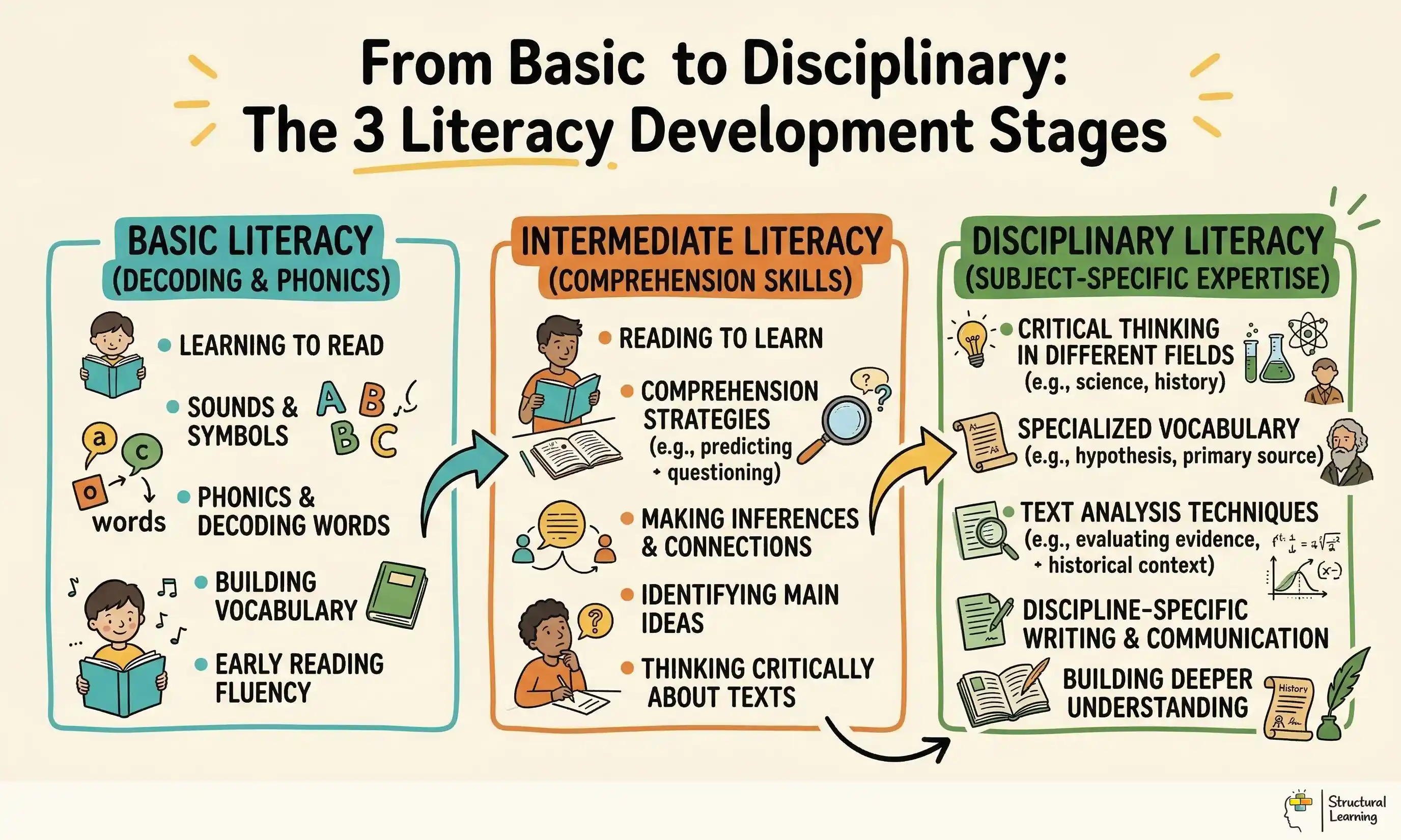
From Basic to Disciplinary: The 3 Literacy Development Stages infographic for teachers
From Basic to Disciplinary: The 3 Literacy Development Stages

Key Takeaways

  • Disciplinary literacy moves beyond generic reading strategies to teach the specific ways experts in a subject read, write, and communicate.
  • The Education Endowment Foundation identifies disciplinary literacy as a crucial step for improving secondary school literacy outcomes.
  • Explicitly teaching Tier 2 and Tier 3 vocabulary through morphology helps pupils decode complex subject-specific language independently.
  • Graphic organisers reduce cognitive load by making abstract disciplinary thinking visible for all learners.
  • Structured exploratory talk provides a vital bridge between reading complex academic texts and writing formal subject responses.
  • Consistent routines scaffold the reading and writing process for pupils with Special Educational Needs and Disabilities (SEND) and English as an Additional Language (EAL) across different curriculum areas.
  • Every teacher is responsible for teaching the specific communication rules and text structures of their own domain.

What Is Disciplinary Literacy?

Disciplinary literacy is a tailored approach to teaching reading, writing, and communication skills specific to an academic subject. It moves away from generic reading comprehension tools and asks how an expert in a specific field approaches text. Historians read with a focus on bias and sourcing. Scientists read to extract objective facts and processes.

Shanahan & Shanahan (2008) established that literacy development occurs in distinct stages. Basic literacy begins in the early primary years with decoding and phonics. Intermediate literacy covers general comprehension skills like summarising and predicting. Disciplinary literacy is the specialised skill set required to access secondary education effectively.

Pupils cannot automatically transfer reading skills from an English lesson to a Physics lesson. The cognitive demands and structural rules of the texts are different. Moje (2015) argues that teaching these subject-specific practices is fundamentally an issue of equity and access. When we do not explicitly teach how to read a subject, we leave pupils to guess the rules.

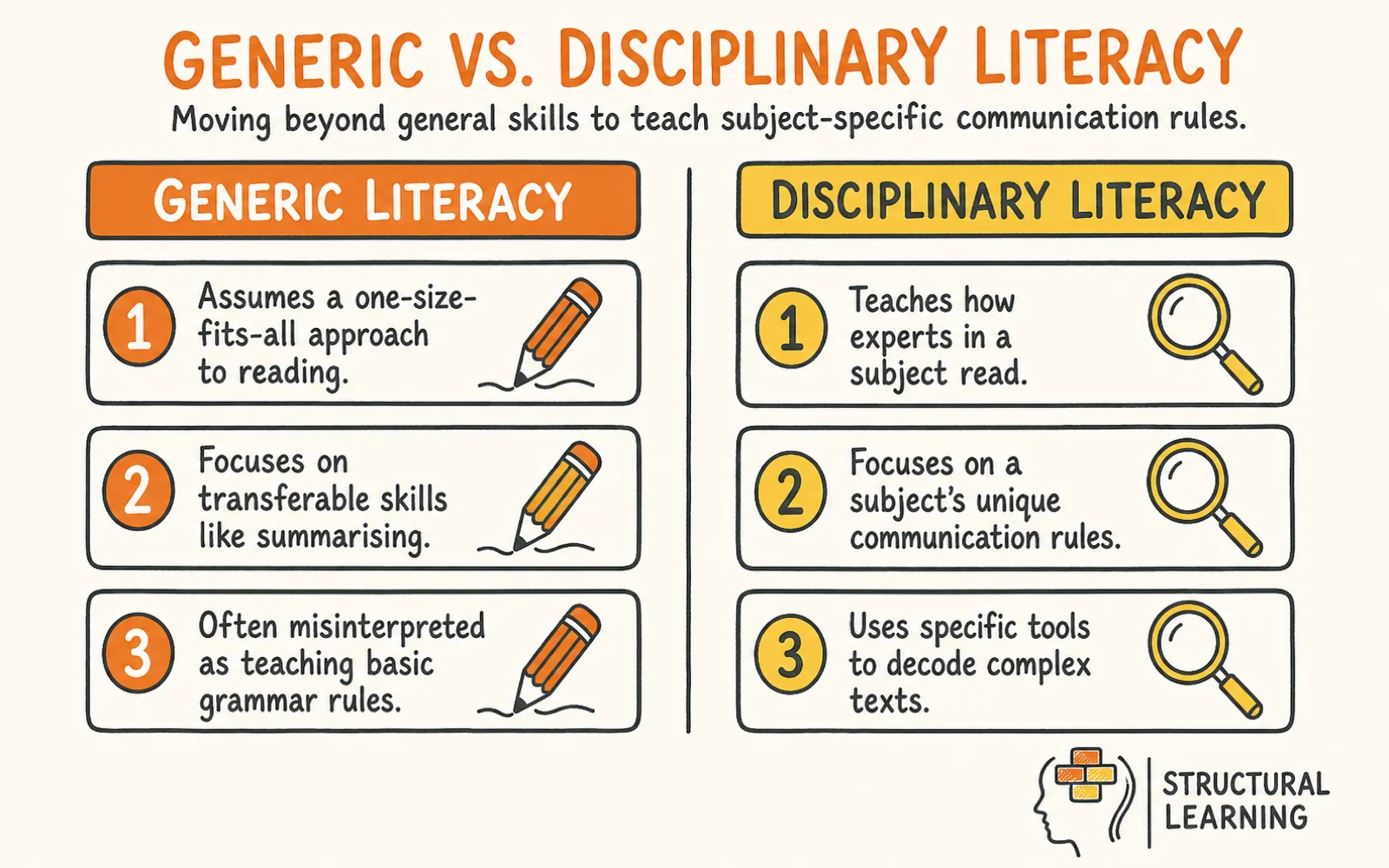
Generic strategies assume reading is an identical process everywhere. Disciplinary literacy recognises that reading a historical source requires different cognitive processes than reading a scientific flowchart. We must stop assuming pupils will absorb the unspoken rules of academic disciplines. Explicit instruction demystifies the subject.

The teacher displays a complex historical source on the board and models their internal monologue. They highlight the author and date, questioning the author's motives before reading the text. The pupils then receive a different source and produce a written list of questions evaluating the new author's potential bias.

Why Disciplinary Literacy Matters

The Education Endowment Foundation (EEF, 2019) places disciplinary literacy as a top recommendation for improving secondary literacy. General literacy interventions often fail to impact subject grades significantly. Pupils need to know how to decode the language of the GCSE paper. The ability to read academic text remains a gatekeeper to academic success.

Reading dense academic text places a strain on working memory. Cognitive load theory (Sweller, 1988) shows that when pupils encounter unfamiliar vocabulary and complex sentence structures, their working memory overloads. They stop processing the subject content and spend mental energy decoding words.

This cognitive overload disproportionately affects pupils with SEND and those with English as an Additional Language. These learners often rely on surface-level comprehension. They need teachers to break down the implicit rules of the text systematically. By explicitly teaching disciplinary reading, we reduce extraneous cognitive load and allow pupils to focus on core concepts.

High expectations require support structures. When we teach pupils how to navigate a dense textbook page, we build their academic independence. They learn to tackle difficult texts rather than waiting for a summary.
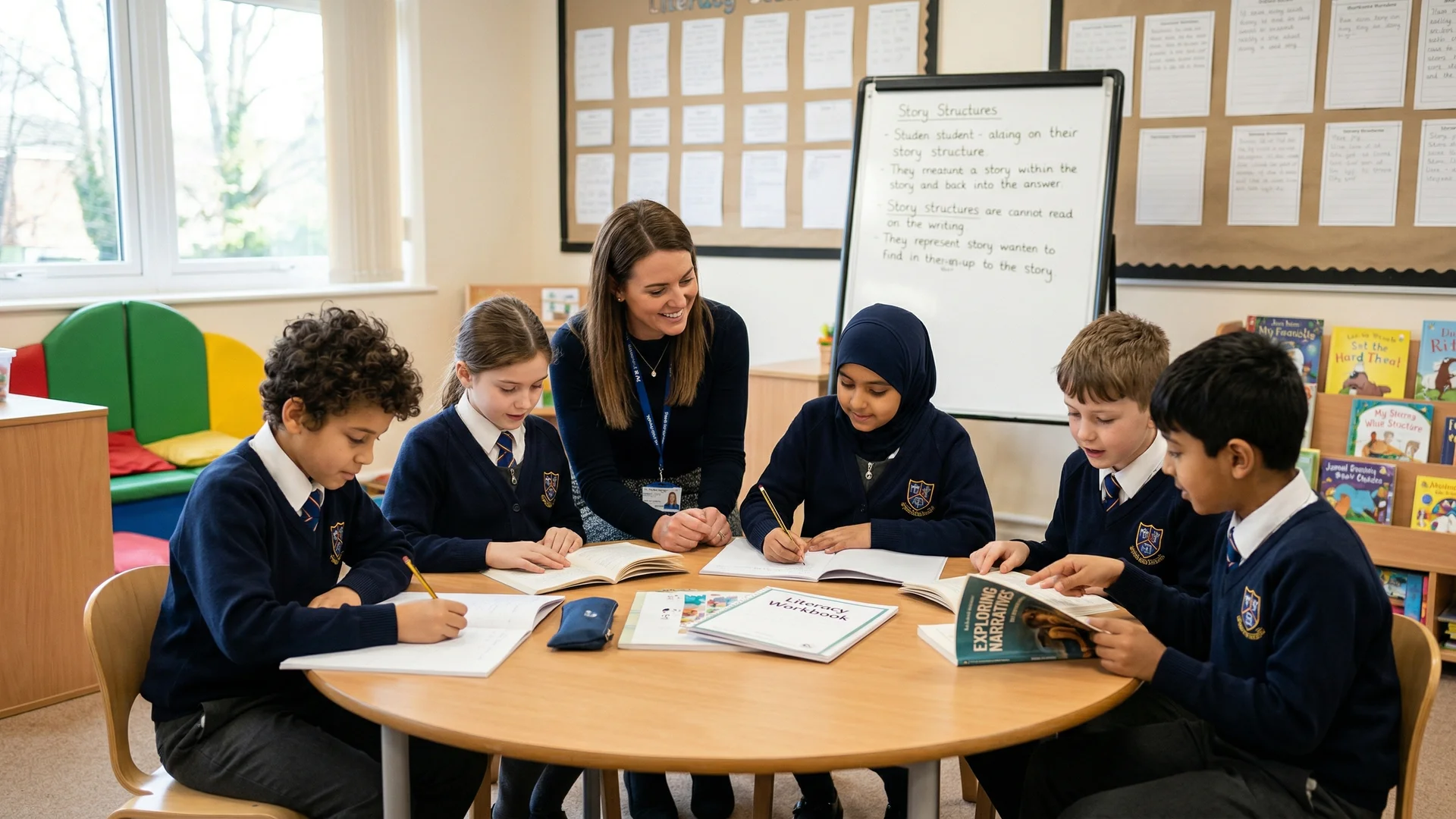
The teacher identifies a dense paragraph in a geography textbook containing three new Tier 3 terms. They pre-teach these words using images and definitions before the class reads the text. The pupils produce a visual glossary in their books connecting the new terms to the core geographical concept.

Disciplinary Literacy in Classrooms

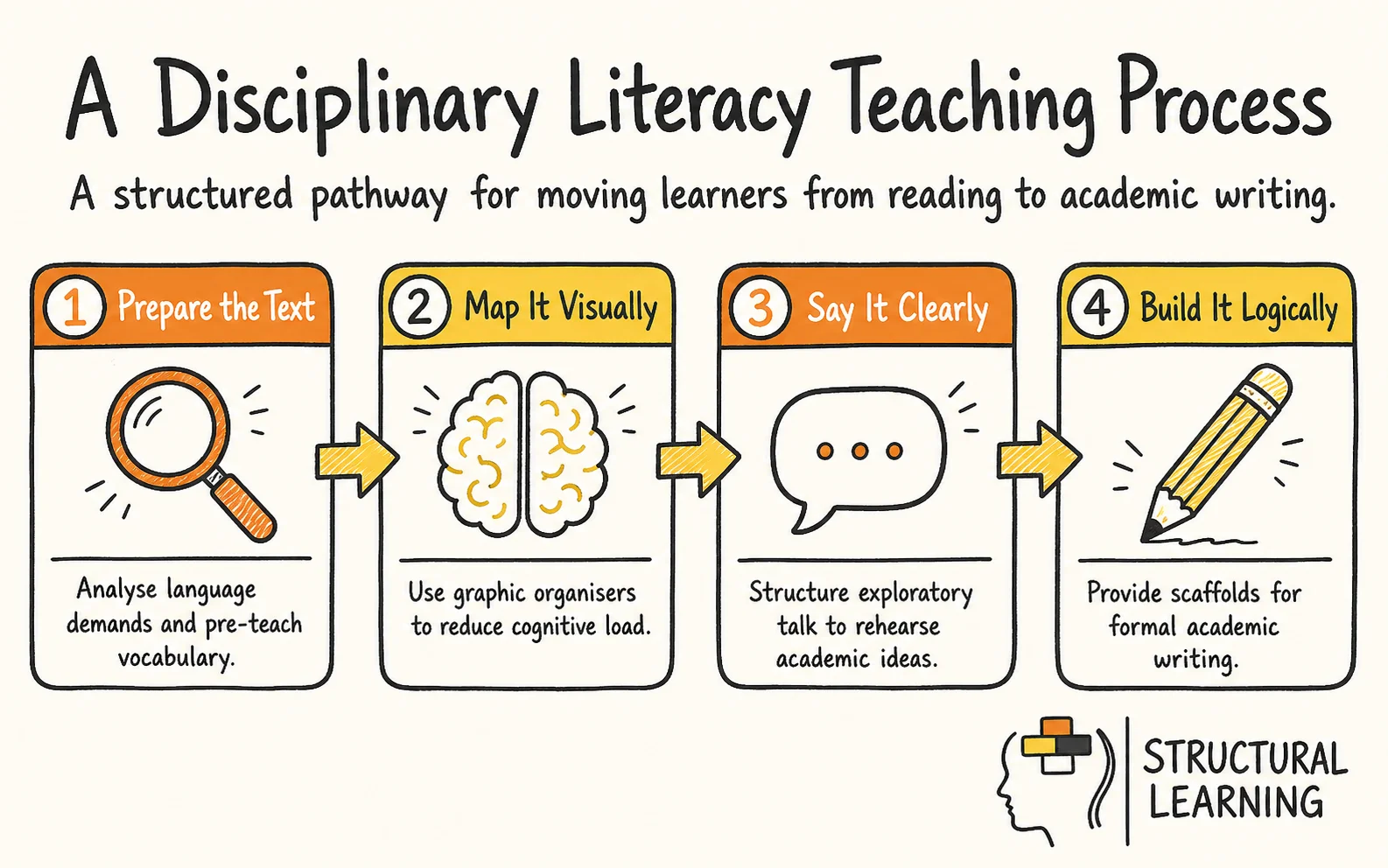
To embed these practices, teachers need structured routines. The 'Map It, Say It, Build It' framework provides a pathway from decoding text to producing academic writing. This routine ensures that pupils process information deeply.

Strategy 1: Map It Visually

Experts visualise abstract concepts when reading complex material. Novices do not possess this ability. We must encourage visualisation using graphic organisers to support working memory. A graphic organiser is a visual representation of specific disciplinary thinking.

In history, this might be a timeline or a cause-and-effect map. In science, it might be a cyclical process diagram. When pupils map out the text visually, they reduce the cognitive burden of holding multiple facts in their heads. They can see the relationships between ideas.

The teacher introduces a text describing the water cycle and provides an empty cyclical graphic organiser. As the teacher reads the text aloud, they model where to place the first concept. The pupils produce a diagram by extracting key terms and placing them in the correct sequential boxes.

Strategy 2: Say It Clearly

Reading and writing are connected by structured talk. Exploratory talk allows pupils to trial their academic ideas before committing them to paper. Casual classroom chat does not develop disciplinary literacy. Pupils need specific roles and academic sentence stems to engage in rigorous conversations.

When we structure oracy, we provide a bridge between reading complex texts and writing formal responses. Pupils need to hear themselves using Tier 3 vocabulary. They need to practice forming arguments verbally before writing them down.

The teacher assigns role cards to small groups reading a text on climate change. One pupil is the 'Starter', another the 'Builder', and another the 'Challenger'. The pupils produce a recorded audio summary of their debate, using sentence stems like "The evidence suggests that..." and "I challenge that conclusion because...".

Strategy 3: Build It Logically

Once pupils have mapped their thinking and verbalised their ideas, they are ready to write. Writing is the test of disciplinary understanding. Blank pages cause anxiety and lead to poor outcomes. Teachers must provide sentence-level scaffolds that enforce the grammatical rules of the subject.
We need to teach pupils how sentences connect to form logical arguments. Using structured writing frames helps pupils understand the mechanics of academic writing.

The teacher explains that scientific conclusions require cause and effect structures. They provide the stems "Because...", "But...", and "So..." on the whiteboard. The pupils produce three sentences summarising a science experiment, using objective language and causal links without copying from the textbook.

How Experts Read Differently: Subject-Specific Reading Strategies infographic for teachers
How Experts Read Differently: Subject-Specific Reading Strategies

Common Literacy Misconceptions

The phrase "every teacher is a teacher of literacy" is misunderstood in secondary schools. It often leads teachers to believe they must teach basic spelling or grammar rules. This is false. You are responsible for the communication rules of your domain.

A science teacher is a teacher of scientific literacy. An art teacher is a teacher of visual and critical literacy. Another misconception is that generic reading strategies work across all subjects. Techniques like skimming and scanning are excellent for finding a quote in an English novel but are disastrous when applied to a mathematical word problem.

Maths problems require slow, precise reading where every word and symbol changes the operation. Finally, many teachers view vocabulary instruction as handing out glossaries. Glossaries are passive tools that pupils rarely consult. True vocabulary instruction requires active morphological analysis and retrieval practice.

The science teacher stops asking pupils to highlight the main idea of a physics text. Instead, the teacher models how to identify the independent and dependent variables. The pupils produce a table separating the text into these categories, demonstrating disciplinary reading.

Practical Implementation Guide

Implementing disciplinary literacy requires planning. Start by auditing the linguistic demands of your texts. Identify the Tier 2 words, which are academic words used across subjects like 'evaluate' or 'contrast'. Then identify the Tier 3 words, which are subject terms like 'mitochondria'.

Next, explicitly teach the morphology of these words. Break complex words down into prefixes, roots, and suffixes. This strategy is powerful for pupils with SEND. When a pupil learns that 'poly' means many, they can decode 'polygon', 'polymer', and 'polytheism' across subjects.

This morphological approach builds a connected schema of vocabulary rather than isolated definitions. Ensure your lesson plans include time for reading complex texts live in the classroom. Do not set complex reading solely as homework. Model your expert thinking, pausing to show pupils how you navigate confusing sentences or reference a diagram.

The teacher introduces the word 'democracy'. They write the word on the board and split it into 'demos' (people) and 'kratos' (power). The pupils produce a spider diagram linking this root to other words they know, writing a definition for each based on the shared root meaning.

Literacy Across Core Subjects

Reading and writing demands shift as pupils move between classrooms. Understanding these shifts is vital for secondary teachers. We must make the rules of our subjects visible.

Strategy 1: History Literacy

History relies on interpretation, bias, and context. A historical text is never neutral. Reading like a historian means engaging in sourcing, contextualisation, and corroboration. Writing in history requires balancing conflicting evidence to build an argument.

The teacher displays a propaganda poster and a private diary entry from the same era. They provide a sourcing checklist focusing on authorship and motive. The pupils produce an analytical paragraph comparing the reliability of the two documents, using phrases like "Written with the benefit of hindsight...".

Strategy 2: Science Literacy

Scientific text is dense, authoritative, and objective. It relies on the passive voice and nominalisation. Scientific reading requires pupils to move their eyes between written prose, data tables, and diagrams.

The teacher provides a text describing a chemical reaction alongside a blank graph. The teacher reads the text aloud and pauses at key numerical data points. The pupils produce a plotted line graph, translating the written prose into a visual data format.

Strategy 3: Maths Literacy

Mathematics possesses a high density of meaning per word. A misplaced word changes the calculation and outcome. Everyday words often have dual meanings. Reading in Maths requires precision and a slow pace.

The teacher projects a word problem about ratios on the interactive whiteboard. They read the problem aloud, circling the operational verbs and quantities. The pupils produce a bar model representing the ratio before writing any numbers or equations.

The Disciplinary Literacy Teaching Framework: 5 Key Strategies infographic for teachers
The Disciplinary Literacy Teaching Framework: 5 Key Strategies

Questions About Disciplinary Literacy

Question: How is this different from content-area literacy?

Content-area literacy relies on generic reading strategies applied across all subjects. Disciplinary literacy focuses on the subject-specific practices used by experts. It treats reading a poem and reading a lab report as two distinct tasks.

Question: How do I find time to teach reading?

Teaching pupils how to read your subject texts is not an add-on. Teaching how to read the text is teaching the subject content. If pupils cannot read the material, they cannot access the curriculum.

Question: How does this support SEND pupils?

Disciplinary literacy makes the rules of expert thinking explicit. It reduces cognitive load by providing structures, visual organisers, and sentence scaffolds. This allows pupils with SEND to focus on understanding concepts rather than struggling with text mechanics.

Question: Should I stop using general reading strategies?

Basic comprehension strategies remain necessary for foundational understanding and decoding. However, secondary teachers must transition pupils from these skills toward subject-specific analysis. Generic strategies are the starting point, not the final destination.

Question: How do we assess disciplinary literacy?

You assess it through the quality of the pupils' subject-specific writing and their verbal reasoning. If a pupil can corroborate two historical sources in an essay, they have demonstrated historical literacy. Assessment is embedded within your normal subject tasks.

Identify one complex textbook passage you plan to use next week and map out how a subject expert would read it.

Further Reading: Key Research Papers

These peer-reviewed studies provide the evidence base for the strategies discussed above.

Legitimising disciplinary literacy: rewriting the rules of the literacy game and enhancing secondary teachers’ professional habitus View study ↗

Davies et al. (2022)

This study examines how disciplinary literacy knowledge intersects with subject teachers' professional identities using Bourdieu's framework. It explores how secondary teachers can legitimise literacy practices within their specific disciplines, enhancing their professional expertise whilst integrating reading and writing skills into subject-area teaching.

Editorial: From Policy to Pedagogy – Building Human-Centered AI Literacy Across Educational Contexts View study ↗

Hsu et al. (2025)

This editorial presents a human-centred framework for AI literacy education in schools, emphasising ethical AI understanding across four key domains. It provides guidance for teachers on integrating AI literacy into curriculum whilst maintaining focus on human values and critical thinking skills.

Human Capital Management for Improving Teachers’ Digital Competency at Secondary Vocational Schools, Chongzuo City, China View study ↗

Liang et al. (2026)

This mixed-methods study investigates how human capital management strategies can improve teachers' digital competencies in Chinese vocational schools. The research offers insights for educational leaders on developing systematic approaches to enhance teachers' technology skills through targeted professional development programmes.

Financial literacy and family communication patterns View study ↗
75 citations

Hanson et al. (2018)

This research explores the relationship between family communication patterns and financial literacy development. Whilst not directly education-focused, it provides teachers with understanding of how home communication styles affect students' financial knowledge, informing classroom approaches to financial education.

Why Did All the Residents Resign? Key Takeaways From the Junior Physicians' Mass Walkout in South Korea. View study ↗
23 citations

Park et al. (2024)

This paper analyses the mass resignation of junior physicians in South Korea. Though medical-focused, it may offer insights for educators about workplace conditions, professional development, and factors that influence career satisfaction in educational settings.

Free Resource Pack

Disciplinary Literacy: Secondary Teacher Guide

Essential resources for secondary teachers to embed disciplinary literacy across all subjects.

Disciplinary Literacy: Secondary Teacher Guide — 4 resources
Disciplinary Literacy Secondary Education Curriculum Integration CPD Teacher Planning Student Strategies Reading Strategies Writing Strategies Subject Specific

Download your free bundle

Fill in your details below and we'll send the resource pack straight to your inbox.

Quick survey (helps us create better resources)

How confident do you feel integrating disciplinary literacy strategies into your subject teaching?

Not at all confident
Slightly confident
Moderately confident
Quite confident
Very confident

To what extent is disciplinary literacy a common focus or discussion point among staff at your school?

Not at all
Rarely
Sometimes
Often
Consistently

How often do you explicitly teach reading and writing strategies specific to your subject's discipline?

Never
Rarely
Sometimes
Often
Always

Your resource pack is ready

We've also sent a copy to your email. Check your inbox.

Loading audit...

From Basic to Disciplinary: The 3 Literacy Development Stages infographic for teachers
From Basic to Disciplinary: The 3 Literacy Development Stages

Key Takeaways

  • Disciplinary literacy moves beyond generic reading strategies to teach the specific ways experts in a subject read, write, and communicate.
  • The Education Endowment Foundation identifies disciplinary literacy as a crucial step for improving secondary school literacy outcomes.
  • Explicitly teaching Tier 2 and Tier 3 vocabulary through morphology helps pupils decode complex subject-specific language independently.
  • Graphic organisers reduce cognitive load by making abstract disciplinary thinking visible for all learners.
  • Structured exploratory talk provides a vital bridge between reading complex academic texts and writing formal subject responses.
  • Consistent routines scaffold the reading and writing process for pupils with Special Educational Needs and Disabilities (SEND) and English as an Additional Language (EAL) across different curriculum areas.
  • Every teacher is responsible for teaching the specific communication rules and text structures of their own domain.

What Is Disciplinary Literacy?

Disciplinary literacy is a tailored approach to teaching reading, writing, and communication skills specific to an academic subject. It moves away from generic reading comprehension tools and asks how an expert in a specific field approaches text. Historians read with a focus on bias and sourcing. Scientists read to extract objective facts and processes.

Shanahan & Shanahan (2008) established that literacy development occurs in distinct stages. Basic literacy begins in the early primary years with decoding and phonics. Intermediate literacy covers general comprehension skills like summarising and predicting. Disciplinary literacy is the specialised skill set required to access secondary education effectively.

Pupils cannot automatically transfer reading skills from an English lesson to a Physics lesson. The cognitive demands and structural rules of the texts are different. Moje (2015) argues that teaching these subject-specific practices is fundamentally an issue of equity and access. When we do not explicitly teach how to read a subject, we leave pupils to guess the rules.

Generic strategies assume reading is an identical process everywhere. Disciplinary literacy recognises that reading a historical source requires different cognitive processes than reading a scientific flowchart. We must stop assuming pupils will absorb the unspoken rules of academic disciplines. Explicit instruction demystifies the subject.

The teacher displays a complex historical source on the board and models their internal monologue. They highlight the author and date, questioning the author's motives before reading the text. The pupils then receive a different source and produce a written list of questions evaluating the new author's potential bias.

Why Disciplinary Literacy Matters

The Education Endowment Foundation (EEF, 2019) places disciplinary literacy as a top recommendation for improving secondary literacy. General literacy interventions often fail to impact subject grades significantly. Pupils need to know how to decode the language of the GCSE paper. The ability to read academic text remains a gatekeeper to academic success.

Reading dense academic text places a strain on working memory. Cognitive load theory (Sweller, 1988) shows that when pupils encounter unfamiliar vocabulary and complex sentence structures, their working memory overloads. They stop processing the subject content and spend mental energy decoding words.

This cognitive overload disproportionately affects pupils with SEND and those with English as an Additional Language. These learners often rely on surface-level comprehension. They need teachers to break down the implicit rules of the text systematically. By explicitly teaching disciplinary reading, we reduce extraneous cognitive load and allow pupils to focus on core concepts.

High expectations require support structures. When we teach pupils how to navigate a dense textbook page, we build their academic independence. They learn to tackle difficult texts rather than waiting for a summary.

The teacher identifies a dense paragraph in a geography textbook containing three new Tier 3 terms. They pre-teach these words using images and definitions before the class reads the text. The pupils produce a visual glossary in their books connecting the new terms to the core geographical concept.

Disciplinary Literacy in Classrooms

To embed these practices, teachers need structured routines. The 'Map It, Say It, Build It' framework provides a pathway from decoding text to producing academic writing. This routine ensures that pupils process information deeply.

Strategy 1: Map It Visually

Experts visualise abstract concepts when reading complex material. Novices do not possess this ability. We must encourage visualisation using graphic organisers to support working memory. A graphic organiser is a visual representation of specific disciplinary thinking.

In history, this might be a timeline or a cause-and-effect map. In science, it might be a cyclical process diagram. When pupils map out the text visually, they reduce the cognitive burden of holding multiple facts in their heads. They can see the relationships between ideas.

The teacher introduces a text describing the water cycle and provides an empty cyclical graphic organiser. As the teacher reads the text aloud, they model where to place the first concept. The pupils produce a diagram by extracting key terms and placing them in the correct sequential boxes.

Strategy 2: Say It Clearly

Reading and writing are connected by structured talk. Exploratory talk allows pupils to trial their academic ideas before committing them to paper. Casual classroom chat does not develop disciplinary literacy. Pupils need specific roles and academic sentence stems to engage in rigorous conversations.

When we structure oracy, we provide a bridge between reading complex texts and writing formal responses. Pupils need to hear themselves using Tier 3 vocabulary. They need to practice forming arguments verbally before writing them down.

The teacher assigns role cards to small groups reading a text on climate change. One pupil is the 'Starter', another the 'Builder', and another the 'Challenger'. The pupils produce a recorded audio summary of their debate, using sentence stems like "The evidence suggests that..." and "I challenge that conclusion because...".

Strategy 3: Build It Logically

Once pupils have mapped their thinking and verbalised their ideas, they are ready to write. Writing is the test of disciplinary understanding. Blank pages cause anxiety and lead to poor outcomes. Teachers must provide sentence-level scaffolds that enforce the grammatical rules of the subject.

We need to teach pupils how sentences connect to form logical arguments. Using structured writing frames helps pupils understand the mechanics of academic writing.

The teacher explains that scientific conclusions require cause and effect structures. They provide the stems "Because...", "But...", and "So..." on the whiteboard. The pupils produce three sentences summarising a science experiment, using objective language and causal links without copying from the textbook.

How Experts Read Differently: Subject-Specific Reading Strategies infographic for teachers
How Experts Read Differently: Subject-Specific Reading Strategies

Common Literacy Misconceptions

The phrase "every teacher is a teacher of literacy" is misunderstood in secondary schools. It often leads teachers to believe they must teach basic spelling or grammar rules. This is false. You are responsible for the communication rules of your domain.

A science teacher is a teacher of scientific literacy. An art teacher is a teacher of visual and critical literacy. Another misconception is that generic reading strategies work across all subjects. Techniques like skimming and scanning are excellent for finding a quote in an English novel but are disastrous when applied to a mathematical word problem.

Maths problems require slow, precise reading where every word and symbol changes the operation. Finally, many teachers view vocabulary instruction as handing out glossaries. Glossaries are passive tools that pupils rarely consult. True vocabulary instruction requires active morphological analysis and retrieval practice.

The science teacher stops asking pupils to highlight the main idea of a physics text. Instead, the teacher models how to identify the independent and dependent variables. The pupils produce a table separating the text into these categories, demonstrating disciplinary reading.

Practical Implementation Guide

Implementing disciplinary literacy requires planning. Start by auditing the linguistic demands of your texts. Identify the Tier 2 words, which are academic words used across subjects like 'evaluate' or 'contrast'. Then identify the Tier 3 words, which are subject terms like 'mitochondria'.

Next, explicitly teach the morphology of these words. Break complex words down into prefixes, roots, and suffixes. This strategy is powerful for pupils with SEND. When a pupil learns that 'poly' means many, they can decode 'polygon', 'polymer', and 'polytheism' across subjects.

This morphological approach builds a connected schema of vocabulary rather than isolated definitions. Ensure your lesson plans include time for reading complex texts live in the classroom. Do not set complex reading solely as homework. Model your expert thinking, pausing to show pupils how you navigate confusing sentences or reference a diagram.

The teacher introduces the word 'democracy'. They write the word on the board and split it into 'demos' (people) and 'kratos' (power). The pupils produce a spider diagram linking this root to other words they know, writing a definition for each based on the shared root meaning.

Literacy Across Core Subjects

Reading and writing demands shift as pupils move between classrooms. Understanding these shifts is vital for secondary teachers. We must make the rules of our subjects visible.

Strategy 1: History Literacy

History relies on interpretation, bias, and context. A historical text is never neutral. Reading like a historian means engaging in sourcing, contextualisation, and corroboration. Writing in history requires balancing conflicting evidence to build an argument.

The teacher displays a propaganda poster and a private diary entry from the same era. They provide a sourcing checklist focusing on authorship and motive. The pupils produce an analytical paragraph comparing the reliability of the two documents, using phrases like "Written with the benefit of hindsight...".

Strategy 2: Science Literacy

Scientific text is dense, authoritative, and objective. It relies on the passive voice and nominalisation. Scientific reading requires pupils to move their eyes between written prose, data tables, and diagrams.

The teacher provides a text describing a chemical reaction alongside a blank graph. The teacher reads the text aloud and pauses at key numerical data points. The pupils produce a plotted line graph, translating the written prose into a visual data format.

Strategy 3: Maths Literacy

Mathematics possesses a high density of meaning per word. A misplaced word changes the calculation and outcome. Everyday words often have dual meanings. Reading in Maths requires precision and a slow pace.

The teacher projects a word problem about ratios on the interactive whiteboard. They read the problem aloud, circling the operational verbs and quantities. The pupils produce a bar model representing the ratio before writing any numbers or equations.

The Disciplinary Literacy Teaching Framework: 5 Key Strategies infographic for teachers
The Disciplinary Literacy Teaching Framework: 5 Key Strategies

Questions About Disciplinary Literacy

Question: How is this different from content-area literacy?

Content-area literacy relies on generic reading strategies applied across all subjects. Disciplinary literacy focuses on the subject-specific practices used by experts. It treats reading a poem and reading a lab report as two distinct tasks.

Question: How do I find time to teach reading?

Teaching pupils how to read your subject texts is not an add-on. Teaching how to read the text is teaching the subject content. If pupils cannot read the material, they cannot access the curriculum.

Question: How does this support SEND pupils?

Disciplinary literacy makes the rules of expert thinking explicit. It reduces cognitive load by providing structures, visual organisers, and sentence scaffolds. This allows pupils with SEND to focus on understanding concepts rather than struggling with text mechanics.

Question: Should I stop using general reading strategies?

Basic comprehension strategies remain necessary for foundational understanding and decoding. However, secondary teachers must transition pupils from these skills toward subject-specific analysis. Generic strategies are the starting point, not the final destination.

Question: How do we assess disciplinary literacy?

You assess it through the quality of the pupils' subject-specific writing and their verbal reasoning. If a pupil can corroborate two historical sources in an essay, they have demonstrated historical literacy. Assessment is embedded within your normal subject tasks.

Identify one complex textbook passage you plan to use next week and map out how a subject expert would read it.

Further Reading: Key Research Papers

These peer-reviewed studies provide the evidence base for the strategies discussed above.

Legitimising disciplinary literacy: rewriting the rules of the literacy game and enhancing secondary teachers’ professional habitus View study ↗

Davies et al. (2022)

This study examines how disciplinary literacy knowledge intersects with subject teachers' professional identities using Bourdieu's framework. It explores how secondary teachers can legitimise literacy practices within their specific disciplines, enhancing their professional expertise whilst integrating reading and writing skills into subject-area teaching.

Editorial: From Policy to Pedagogy – Building Human-Centered AI Literacy Across Educational Contexts View study ↗

Hsu et al. (2025)

This editorial presents a human-centred framework for AI literacy education in schools, emphasising ethical AI understanding across four key domains. It provides guidance for teachers on integrating AI literacy into curriculum whilst maintaining focus on human values and critical thinking skills.

Human Capital Management for Improving Teachers’ Digital Competency at Secondary Vocational Schools, Chongzuo City, China View study ↗

Liang et al. (2026)

This mixed-methods study investigates how human capital management strategies can improve teachers' digital competencies in Chinese vocational schools. The research offers insights for educational leaders on developing systematic approaches to enhance teachers' technology skills through targeted professional development programmes.

Financial literacy and family communication patterns View study ↗
75 citations

Hanson et al. (2018)

This research explores the relationship between family communication patterns and financial literacy development. Whilst not directly education-focused, it provides teachers with understanding of how home communication styles affect students' financial knowledge, informing classroom approaches to financial education.

Why Did All the Residents Resign? Key Takeaways From the Junior Physicians' Mass Walkout in South Korea. View study ↗
23 citations

Park et al. (2024)

This paper analyses the mass resignation of junior physicians in South Korea. Though medical-focused, it may offer insights for educators about workplace conditions, professional development, and factors that influence career satisfaction in educational settings.

Free Resource Pack

Disciplinary Literacy: Secondary Teacher Guide

Essential resources for secondary teachers to embed disciplinary literacy across all subjects.

Disciplinary Literacy: Secondary Teacher Guide — 4 resources
Disciplinary Literacy Secondary Education Curriculum Integration CPD Teacher Planning Student Strategies Reading Strategies Writing Strategies Subject Specific

Download your free bundle

Fill in your details below and we'll send the resource pack straight to your inbox.

Quick survey (helps us create better resources)

How confident do you feel integrating disciplinary literacy strategies into your subject teaching?

Not at all confident
Slightly confident
Moderately confident
Quite confident
Very confident

To what extent is disciplinary literacy a common focus or discussion point among staff at your school?

Not at all
Rarely
Sometimes
Often
Consistently

How often do you explicitly teach reading and writing strategies specific to your subject's discipline?

Never
Rarely
Sometimes
Often
Always

Your resource pack is ready

We've also sent a copy to your email. Check your inbox.

Educational Technology

Back to Blog

{"@context":"https://schema.org","@graph":[{"@type":"Organization","@id":"https://www.structural-learning.com/#org","name":"Structural Learning","url":"https://www.structural-learning.com/","logo":{"@type":"ImageObject","url":"https://cdn.prod.website-files.com/5b69a01ba2e409501de055d1/5b69a01ba2e40996a5e055f4_structural-learning-logo.png"}},{"@type":"Person","@id":"https://www.structural-learning.com/team/paul-main/#person","name":"Paul Main","url":"https://www.structural-learning.com/team/paul-main","jobTitle":"Founder","affiliation":{"@id":"https://www.structural-learning.com/#org"}},{"@type":"BreadcrumbList","@id":"https://www.structural-learning.com/post/disciplinary-literacy-across-curriculum#breadcrumb","itemListElement":[{"@type":"ListItem","position":1,"name":"Home","item":"https://www.structural-learning.com/"},{"@type":"ListItem","position":2,"name":"Blog","item":"https://www.structural-learning.com/blog"},{"@type":"ListItem","position":3,"name":"Disciplinary Literacy Across Curriculum: Guide for Secondary Teachers","item":"https://www.structural-learning.com/post/disciplinary-literacy-across-curriculum"}]},{"@type":"BlogPosting","@id":"https://www.structural-learning.com/post/disciplinary-literacy-across-curriculum#article","headline":"Disciplinary Literacy Across Curriculum: Guide for Secondary Teachers","description":"Master disciplinary literacy across curriculum for secondary teachers. Discover subject-specific reading, writing, and oracy strategies to support all pupils.","author":{"@id":"https://www.structural-learning.com/team/paul-main/#person"},"publisher":{"@id":"https://www.structural-learning.com/#org"},"datePublished":"2026-03-19","dateModified":"2026-03-19","inLanguage":"en-GB"}]}