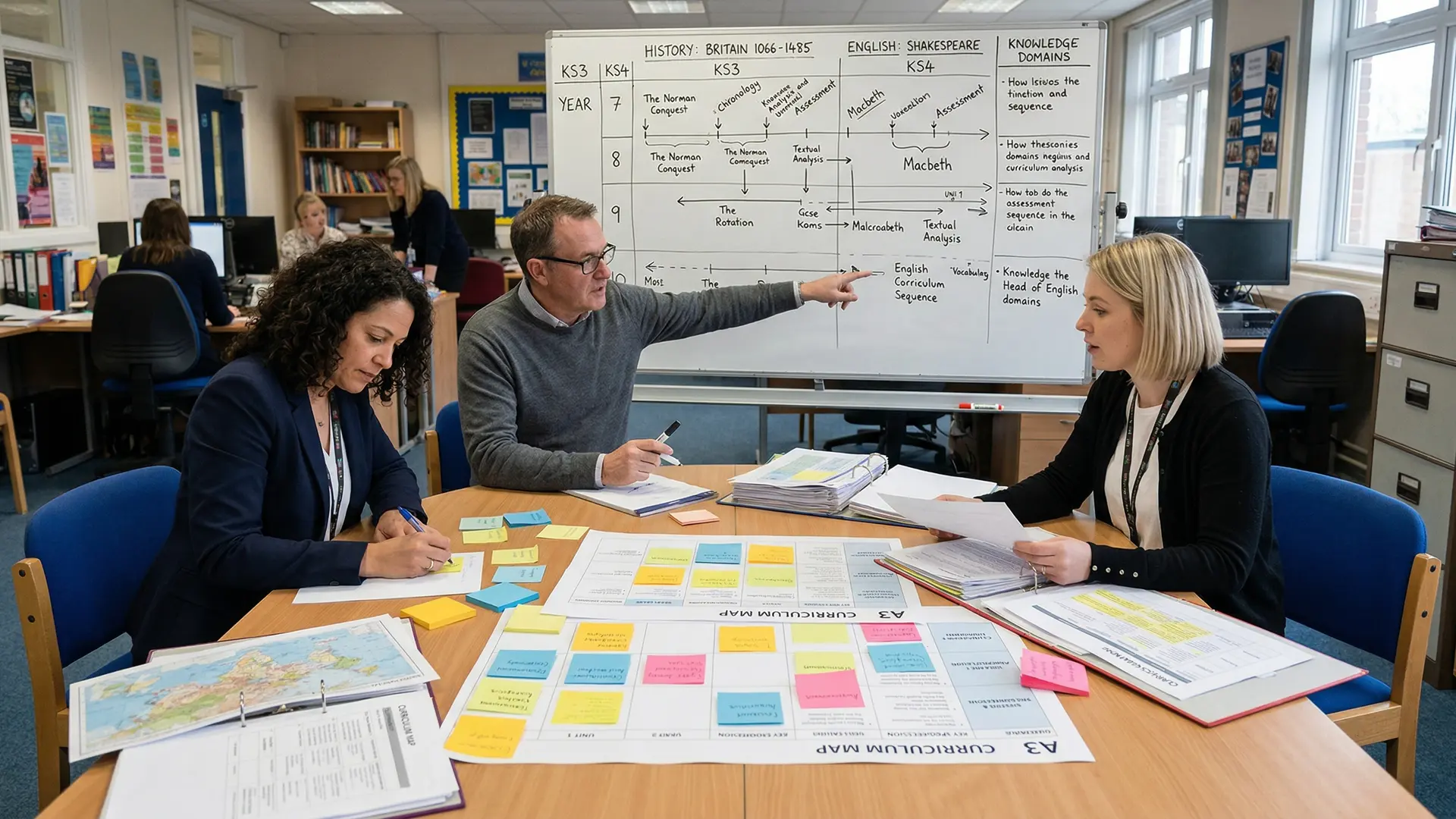
Knowledge-rich curriculum design, sequencing, interleaving, and subject-specific pedagogy. From spiral curriculum to Ofsted's quality of education judgement. Updated for 2026.
Curriculum is the planned sequence of what learners learn, not simply a list of topics to cover. Hirsch (1987) argued that background knowledge is the great equaliser: learners who arrive at school with rich domain knowledge are systematically better able to read, reason, and learn new content, because comprehension depends on what you already know. A knowledge-rich curriculum is not about rote memorisation. It is about giving learners the conceptual frameworks and vocabulary they need to think with. Willingham (2009) put it plainly: memory is the residue of thought, and you cannot think about nothing.
Curriculum sequencing is one of the most consequential decisions school leaders and subject teachers make. Bruner (1960) proposed that any subject can be taught in intellectually honest form at any stage, providing you revisit it with greater sophistication over time: the spiral curriculum. Sweller (1988) showed that the order in which content is introduced affects cognitive load: presenting closely related material together causes interference, while spacing and interleaving can dramatically improve long-term retention. Rosenshine (2012) identified that the most effective teachers check prior knowledge before introducing new content, build on it systematically, and review it frequently. These findings together constitute a coherent theory of curriculum design.
Start with Curriculum Design for the overview, then follow the pathway below.
| Framework | Core Principle | Best Application | Classroom Implication |
|---|---|---|---|
| Knowledge-Rich Curriculum | Systematic, sequenced acquisition of domain knowledge gives all learners the cultural capital to participate in academic and civic life. | Schools serving disadvantaged communities where knowledge gaps are greatest. All phases from EYFS upwards. | Sequence content carefully. Teach vocabulary explicitly. Do not assume prior knowledge: build it deliberately. |
| Spiral Curriculum | Return to core concepts at increasing levels of complexity and abstraction across years and key stages (Bruner, 1960). | Subject curriculum mapping across key stages. Particularly powerful in mathematics, science, and history. | Plan for revisitation, not just coverage. Connect new learning explicitly to earlier encounters with the same concept. |
| Interleaving | Mixing different topics or problem types within a study session improves discrimination and long-term retention more than blocked practice (Rohrer, 2012). | Revision and practice phases in mathematics and science. Works best once content has been initially understood. | Mix problem types in practice sets. Do not teach one topic to mastery before moving on: return and mix. |
| Concept-Based Learning | Organise curriculum around transferable concepts (cause, system, transformation) rather than only facts and skills (Erickson, 2002). | Secondary humanities, IB programmes, and subjects where transfer across contexts is a core learning goal. | Teach facts and skills through a conceptual lens. Ask "what big idea does this example illustrate?" |
The essential overview. Intent, implementation, and impact. What a knowledge-rich curriculum looks like in practice, with examples from multiple subjects.
Two principles that transform how you sequence content: revisiting core ideas in a spiral and mixing rather than blocking practice.
Map your curriculum across year groups and manage cognitive load in individual lessons so learners can actually learn what you intend.
The Structural Learning platform has CPD courses, curriculum planning tools, and a growing library of resources built on the research above. Open a free account to browse.
No credit card required.
About this hub. Articles are written by practising educators and reviewed against peer-reviewed research. Citations follow author-date format. New content added regularly. Get in touch if you cannot find what you need.
Start with the most-comprehensive guide in the list below. Look for titles that say A Teachers Guide those are flagship deep-dives. They link out to all the related concepts.
Every article cites peer-reviewed research and translates findings into classroom practice. Where research is contested, we say so. Where the evidence is strong, we explain why and what to do.
Each guide ends with practical next-lesson actions. You can also use our AI lesson planning tools which generate full lesson plans grounded in these methods.