Updated on
September 9, 2026
PYP Unit of Inquiry Planning: A Teacher's Guide
Plan PYP units of inquiry step-by-step. Covers central ideas, lines of inquiry, transdisciplinary themes, and practical assessment integration.

Updated on
September 9, 2026
Plan PYP units of inquiry step-by-step. Covers central ideas, lines of inquiry, transdisciplinary themes, and practical assessment integration.
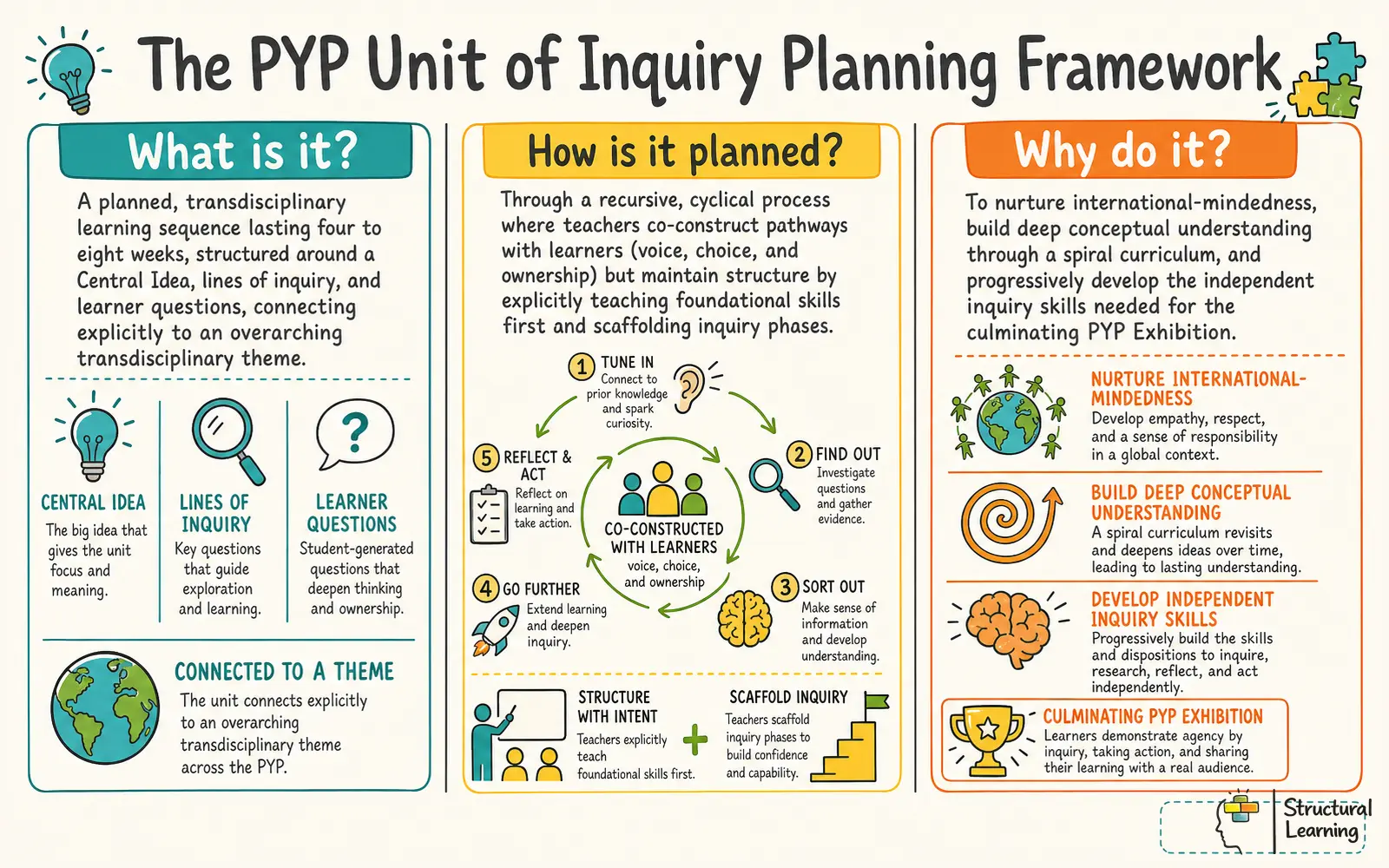
A PYP unit of inquiry is a collaboratively planned, transdisciplinary sequence organised around a central idea, lines of inquiry, subject knowledge, learner questions and evidence of conceptual understanding. It connects learning to one of the six PYP transdisciplinary themes while allowing learners' questions to influence the route.
Plan the knowledge, concepts, Approaches to Learning and assessment evidence first, then decide where voice, choice and action can deepen the inquiry. Learner agency sits inside a coherent curriculum and does not replace explicit teaching or careful assessment (International Baccalaureate Organisation, 2019; Furtak et al., 2012).
In a Year 5 water unit, the teacher may first teach evaporation explicitly and model a research protocol. Learners can then test whether their own questions about scarcity, rights and responsibility can be answered with evidence. Planning PYP unit work is therefore recursive, which means teachers return to it as learning develops. They revisit the central idea, assessment evidence and questions throughout the unit, not only at the start.
A Unit of Inquiry is a flexible PYP unit built around a Central Idea, lines of inquiry and planned learning experiences. Schools set a time frame that gives learners enough depth and remains responsive to their context; there is no universal four-to-eight-week rule.
Teachers link each unit to one of six transdisciplinary themes and co-construct parts of the inquiry through voice, choice and ownership. Learner questions can shape the route, but they do not replace the curriculum map, explicit teaching or assessment plan (Wiggins & McTighe, 2005; Furtak et al., 2012).
Dewey (1938) argued learning through questions and experience builds better understanding. Bruner (1960) suggested revisiting core concepts in a spiral curriculum. PYP units use this principle, linking ideas across years. Learners explore ideas again with more complexity as they grow.
The International Baccalaureate PYP curriculum framework presents units of inquiry as part of a transdisciplinary programme that develops knowledge, conceptual understanding, skills and learner-profile attributes through inquiry, reflection and action.
PYP learners usually work through at least six units each year across the transdisciplinary themes. The PYP Exhibition takes place in the final year of the PYP programme, depending on the school's structure. It is typically for learners aged 10 to 12, rather than being fixed to Year 6 or Year 7.
PYP teachers need to see a Unit of Inquiry as collaborative learning, not just a set of topic lessons. In inquiry-based teaching, teachers investigate alongside learners rather than only deliver pre-set lessons. This matches the PYP's Approaches to Teaching (IB Organisation, 2018). Genuine inquiry helps learners deepen their grasp of the topic (Murdoch, 2015).
Murdoch (2015) presents inquiry as a recursive process rather than a set of fixed stages. Learners tune in through prior knowledge and questions, find out by gathering information, sort and test what they have found, go further to deepen understanding, then draw conclusions and consider action.
The inquiry cycle is recursive, not linear. In simple terms, learners may move back to an earlier point when their thinking changes.
A learner researching water scarcity may find that their first question is too broad. They then loop back to frame a better one.
A class discussion in the sorting-out phase may show a gap in understanding and send learners back to sources. This is not a failure of the planning process, but inquiry learning working as intended.
Teachers who understand that inquiry often loops back can plan flexibly without leaving learning to chance. They do not need to script each day's activity.
Instead, effective PYP teachers identify the knowledge, vocabulary and approaches to learning learners should practise in each phase of the unit. They then prepare several possible learning experiences for each phase. This requires questioning strategies that help teachers judge where learners are in the planning process and what move would be most useful next.
Claxton (2002) says flexible teaching builds 'learning power' through resourcefulness and reflectiveness. Learners also develop resilience and reciprocity when teachers respond well to their needs. Units of Inquiry can build these capacities in ways that tightly scripted lessons do not.
One practical tool for managing the inquiry cycle is a class question board, where learners post questions as they arise. The teacher categorises them, draws attention to the most productive questions and helps learners recognise when a question has been answered or requires further investigation. This makes metacognition visible and shared.
The six PYP transdisciplinary themes provide the organising framework for all Units of Inquiry. They are: Who We Are, Where We Are in Place and Time, How We Express Ourselves, How the World Works, How We Organise Ourselves, and Sharing the Planet. Each theme is broad enough to encompass genuine complexity while focussed enough to give units direction.
When planning a unit, the first decision is which theme it sits within. This is not always obvious. A unit on migration might fit within Where We Are in Place and Time (historical and geographical), How We Organise Ourselves (social and political systems), or Sharing the Planet (human impact and shared responsibility). The choice shapes the Central Idea and the Lines of Inquiry that follow, so it warrants careful discussion within the planning team.
The International Baccalaureate's current PYP learning and teaching guidance describes transdisciplinary learning as relevant between, across and beyond subjects. Topic work keeps subject boundaries and adds activities that are only loosely linked; transdisciplinary learning uses subject knowledge when the inquiry needs it.
For UK schools, teachers still need to map the central idea and lines of inquiry against National Curriculum, Ofsted or ISI expectations. Maths, science, geography and economics can work together, but schools must be able to show coverage clearly rather than assume it.
Transdisciplinary units need teamwork. Teachers often struggle to plan across several subjects on their own. PYP schools schedule joint planning with specialists, so single-subject teachers can contribute to the transdisciplinary unit, in line with the PYP's published planning model (IB Organisation, 2018). Without this team planning, units risk becoming mere topic work.
The Central Idea is key when planning. It's a statement showing transferable understanding. A strong Central Idea is relevant for learners and age appropriate. Learners can reasonably debate its meaning (Wiggins and McTighe, 2005).
Weak Central Ideas list facts, not concepts. For example, "Rainforests have many species" is not a Central Idea. A conceptual idea, such as "Biodiversity depends on connected systems," works better because learners can use it in new situations. This fits the transfer-of-learning logic in backward design (Wiggins & McTighe, 2005).
Lines of Inquiry break the Central Idea into focused threads learners can investigate. The current seven PYP specified concepts, form, function, causation, change, connection, perspective and responsibility, can help teams decide which relationships each line should expose.
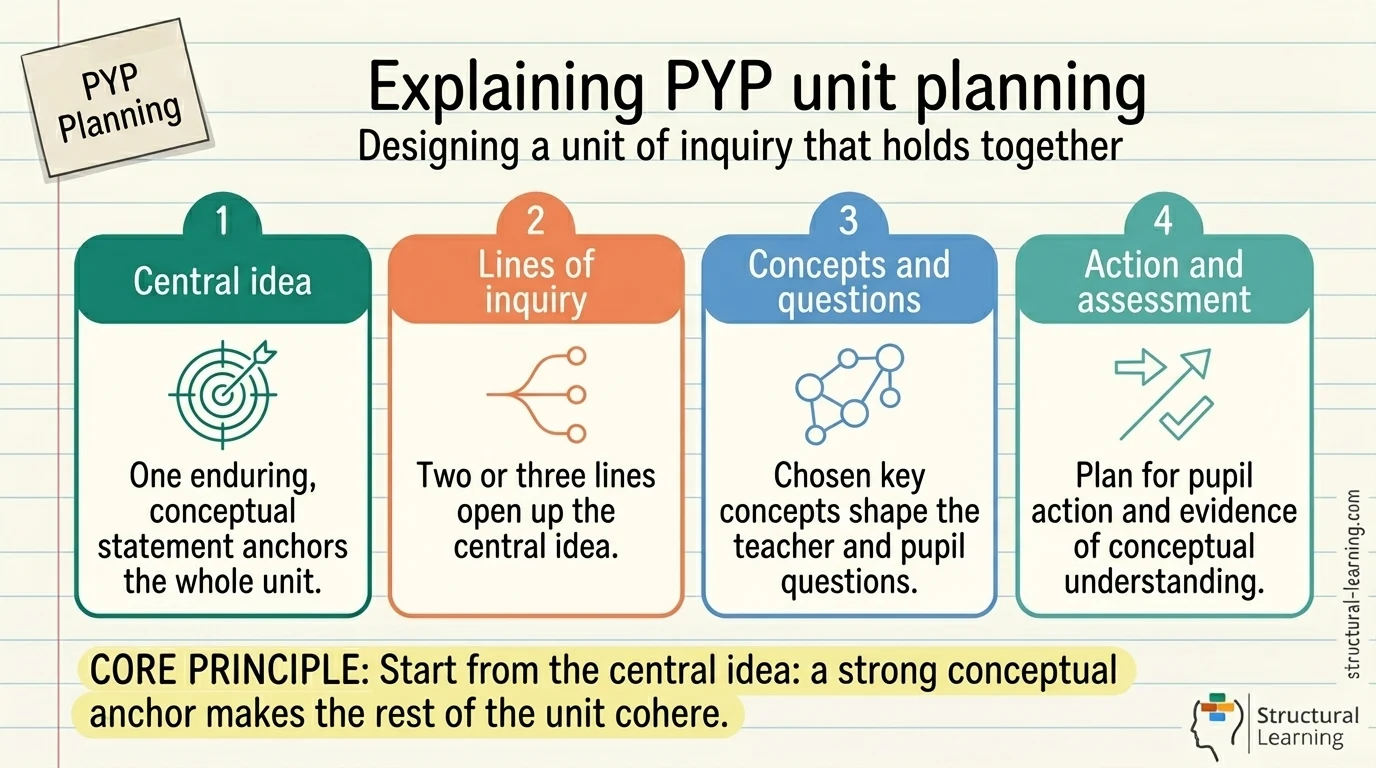
Older PYP resources listed eight key concepts because Reflection used to be a separate lens. In the Enhanced PYP, reflection runs through inquiry, assessment and action, so many school websites and teacher resources that still say "8 lenses" are out of date in 2026. A unit on economic systems might use form, function and responsibility to examine markets, value and social priorities.
Good Lines of Inquiry need clear thinking, much like learning objectives. Use Bruner's (1960) spiral curriculum principle to check this.
Does each Line of Inquiry revisit simpler concepts before moving on? Does it then open up more complex ideas later? This approach brings coherence and builds learner confidence.
Vygotsky (1978) helps explain why scaffolding inquiry learning is hard to judge. Learners need support inside the zone of proximal development, where work is just beyond what they can do alone. Yet too much help can remove the intellectual demand. Hmelo-Silver et al. (2007) and Tabak (2004) support varied help around a shared task, not separate low-level tasks.
In PYP unit planning, SEND, EAL and neurodivergent learners need clear vocabulary, visual structure, limited choices and time to rehearse talk before open investigation.
PYP differentiation focuses on the complexity of resources, the structure of research and the final form of communication. Learners who need support can use templates and simpler texts. More advanced learners can critique sources, spot gaps and explore counterarguments (Tomlinson, 2001). All learners still explore the same central idea.
Scaffolding is the key mechanism here. Effective scaffolds in inquiry learning are temporary and fading: they give learners access to the inquiry without doing the intellectual work for them. A graphic organiser that prompts learners to record what they know, what they want to find out, what evidence says and what still needs checking is a scaffold. A worksheet that tells learners what to look for and where to find it is a substitute for inquiry, not a support for it.
Cognitive load theory makes the issue of teacher control clear. Learners with less prior knowledge often find open investigation harder. Their working memory can quickly fill up with searching, reading and choosing a method.
Kirschner, Sweller and Clark (2006) and Sweller (2020) warn that minimally guided inquiry can overload novices. To reduce this load, simplify the first investigation, teach foundational vocabulary directly and fade support as learners gain control. This manages challenge, not expectations.
Collaborative learning helps teachers differentiate in PYP. Mixed-ability groups work best when each learner has a clear role and the task creates real interdependence. This means learners need one another to complete the investigation (Vygotsky, 1978).
One learner may catalogue evidence, while another builds arguments (Johnson & Johnson, 2009). Both still contribute to the same inquiry, but they work at different cognitive levels (Piaget, 1936).
| Transdisciplinary Theme | Example Central Idea | Key Subject Connections |
|---|---|---|
| Who We Are | Identity is shaped by personal history, culture, and the choices we make | PSHE, History, Language |
| Where We Are in Place and Time | Migration shapes the identities of people and places | Geography, History, Language, Art |
| How We Express Ourselves | The arts communicate ideas that words alone cannot convey | Art, Music, Drama, Language |
| How the World Works | Natural systems maintain balance through interdependence | Science, Geography, Mathematics |
| How We Organise Ourselves | Economic systems reflect the values and priorities of societies | Economics, Mathematics, History |
| Sharing the Planet | Human choices have consequences for future generations | Science, Geography, Ethics |
The International Baccalaureate Organisation (2019) sees assessment as information that guides the next teaching decision, not just as evidence for reports. Teachers collect observation notes, conference records, retrieval checks and draft products, then adjust lessons. This formative feedback loop is more useful than marking alone when it changes the next learning experience (Black & Wiliam, 1998; Hattie, 2009).
PYP assessment can include observation, performance tasks, portfolios and conferencing. The PYP key concepts guide explains how to look for conceptual transfer rather than recall alone. Learners can select work that shows growth and explain why each piece demonstrates understanding.
Conferencing lets teachers check what learners understand. Teachers meet learners one to one or in small groups (Vygotsky, 1978).
This helps teachers assess concepts, not just recall. A learner who links the Central Idea to real examples shows deeper knowledge (Bruner, 1966). Simply stating research findings shows less (Piaget, 1936).
Bloom's taxonomy can help teachers plan assessment tasks with a better spread of demand (Bloom, 1956). Early in the planning process, assess recall and understanding so learners have the knowledge needed for inquiry. Later, ask learners to analyse, evaluate and create. A unit that never moves beyond collection and display misses the conceptual purpose of inquiry.
Kath Murdoch (2015) says inquiry teachers research, plan, model, guide and reflect. This is not softer than direct teaching. It often requires more invisible control: selecting sources, narrowing choices, modelling methods and deciding when to intervene. The myth of pure learner agency is damaging because unguided discovery can widen gaps between confident learners and those with less prior knowledge (Furtak et al., 2012; Kirschner, Sweller & Clark, 2006).
Teachers adjust their role during units. At the start, they build safe spaces for questions, as suggested by Rosenshine (2012). Teachers activate prior knowledge and find learner misconceptions. Activating existing knowledge, even in inquiry, is vital (Hmelo-Silver et al., 2007).
During the investigation phase, the teacher's role is to ask questions that deepen thinking rather than confirm it. The move from "what did you find out?" to "why does that matter?" and then "what would have to be different for that not to be true?" shifts learners from reporting to reasoning. Carol Dweck (2006) argues that learners take on harder intellectual work when uncertainty is treated as part of learning rather than as a sign of failure.
Modelling the inquiry process is a specific and underused teacher strategy. When a teacher says, out loud, "I don't know the answer to that question. Here is how I would go about finding out," they demonstrate the intellectual behaviour the programme is trying to develop. This connects to the IB's learner profile attribute of being inquirers: learners who approach unfamiliar problems with curiosity, method and evidence rather than anxiety or avoidance.
After the unit, the teacher reviews the Central Idea, the lines of inquiry, assessment tasks and the level of learner agency, sometimes labelled learner agency in school planning documents. A short reflective log kept during the unit gives evidence for this judgement. Units improve when teams revise them using evidence of learner understanding, not only teacher preference.
If you are planning a new unit, start by writing three possible Central Ideas and testing each against this question: could a learner disagree with this, or is it simply true? Discard any that are merely descriptive or factual. The idea that provokes the most genuine debate is usually the strongest.
If you are currently teaching a unit, spend ten minutes before your next session listing the questions learners have generated so far. Sort them into two groups: questions that research can answer, and questions that require judgement, values or interpretation. In 2026, add a third check: if an AI tool gives an instant answer, what claim, source or assumption should learners test? This moves digital research from answer-finding to epistemic critique (Molenaar, 2022).
For your assessment practice, try one structured conference with three or four learners this week. Ask each learner to explain the Central Idea in their own words and give you an example from outside the unit that illustrates it. The quality of these responses will tell you more about conceptual understanding than any written task.
When you plan, review the previous unit's lines of inquiry. Ask whether each line led to real investigation, or whether it narrowed the answers too soon. Use classroom evidence to revise the lines of inquiry; this fits backward-design planning (Wiggins & McTighe, 2005) and Hattie's case for using assessment evidence to revise practice (Hattie, 2009). This responsive replanning keeps learner inquiry purposeful (Murdoch, 2015).
Use inquiry-based learning in your team's professional learning. Share a surprising learner reflection and talk about what it shows about the Central Idea. Then consider what you would change in your unit planning, following Vygotsky (1978). This kind of shared reflection helps your school run stronger inquiry units.
PYP inquiry planning is sometimes presented as if learner choice alone guarantees depth. The evidence is less simple. Kirschner, Sweller and Clark (2006) argued that discovery with little guidance places heavy demands on working memory, especially for novices. Furtak et al. (2012) reached a more balanced conclusion: inquiry is strongest when teachers guide questioning, evidence use and explanation.
A second critique concerns culture and access. Delpit (1988) warned that progressive pedagogies can hide the rules of academic success from learners who do not already possess the language, confidence or cultural capital expected by school. This matters for SEND, EAL and working-class learners in PYP classrooms. Agency has to be taught through models, sentence frames, role rehearsal and explicit knowledge, not simply offered as choice.
The PYP evidence base also has limits in its methods. Wright and Lee (2023) found a relatively small research field. It often draws on case studies, international-school contexts and implementation reports rather than large causal trials.
Because of this, findings may not transfer neatly to UK schools facing National Curriculum, Ofsted or ISI accountability. Dweck's mindset work and Hattie's synthesis also need careful use, as effect sizes and interventions vary by context (Dweck, 2006; Hattie, 2009).
These limits do not make the PYP Unit of Inquiry weak. They make the teacher's planning process more important: explicit knowledge, guided inquiry and genuine learner action need to work together.
Bruner, J. S. (1960). The process of education. Harvard University Press.
Claxton, G. (2002). Building learning power: Helping young people become better learners. TLO.
Dewey, J. (1938). Experience and education. Kappa Delta Pi.
International Baccalaureate Organisation. (2018). Learning and teaching in the IB. IBO.
Inquiry supports learners; Murdoch (2015) explores teaching with curiosity. This approach uses creativity and purpose in classrooms today. It helps learners thrive.
These peer-reviewed studies provide the evidence base for the strategies discussed above.
Teachers' Practices, Values and Beliefs for Successful Inquiry-Based Teaching in the International Baccalaureate Primary Years Programme
48 citations
Twigg (2010)
This foundational paper highlights how teachers must shift from didactic instruction to student-led inquiry. It helps educators align their beliefs with PYP unit planning to support successful classroom inquiry.
International Baccalaureate Primary Years Programme: A Systematic Review
Bores-García et al. (2023)
This systematic review synthesises research on PYP implementation and intercultural education. For teachers, it outlines how to balance transdisciplinary units of inquiry with local national curriculum demands.
Perceived Difficulties Between Early Years and Primary Teachers in International Baccalaureate Primary Years Programme Implementation
Bakieva (2018)
This study identifies specific friction points in PYP implementation across age groups. It helps teachers co-ordinate planning by anticipating challenges with key concepts and transdisciplinary themes.
IB-PYP Curriculum and Teachers' Roles Within IB-PYP
Cemaloglu (2024)
This study contrasts the PYP with traditional curricula to show how a teacher's role shifts. It helps teachers transition from a product-oriented model to sharing scoping and assessment decisions with learners.
The International Baccalaureate Primary Years Programme (PYP) in Victorian Government Primary Schools, Australia
Gough et al. (2014)
This empirical study demonstrates that mainstream state schools using the PYP achieved above-average literacy and numeracy outcomes. It provides evidence that inquiry-based planning successfully raises academic standards for all learners.
Meta-Analysis of Inquiry-Based Learning: Effects of Guidance
Lazonder, A. W. & Harmsen, R. (2016), Review of Educational Research. A 72-study synthesis showing inquiry-based approaches succeed when learners receive adequate guidance, the evidence base behind the IB's scaffolded-inquiry model.