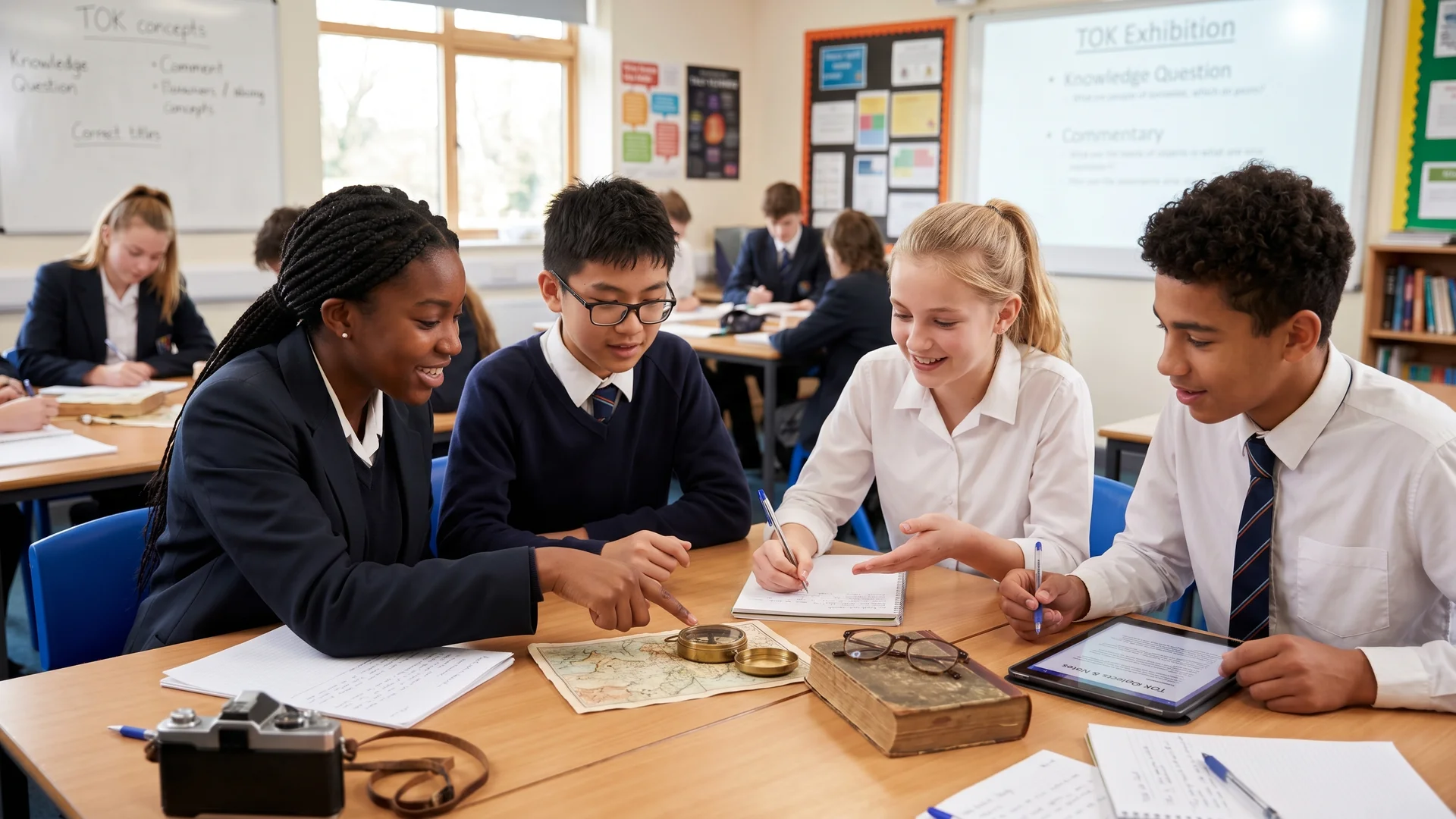
TOK Exhibition: How to Choose Objects & Write Commentary That Actually Scores
|
April 22, 2026
Demystify the TOK Exhibition. Choose objects using the knowledge question, write commentary that scores marks, avoid 3 common traps. IBO prompt guide included.
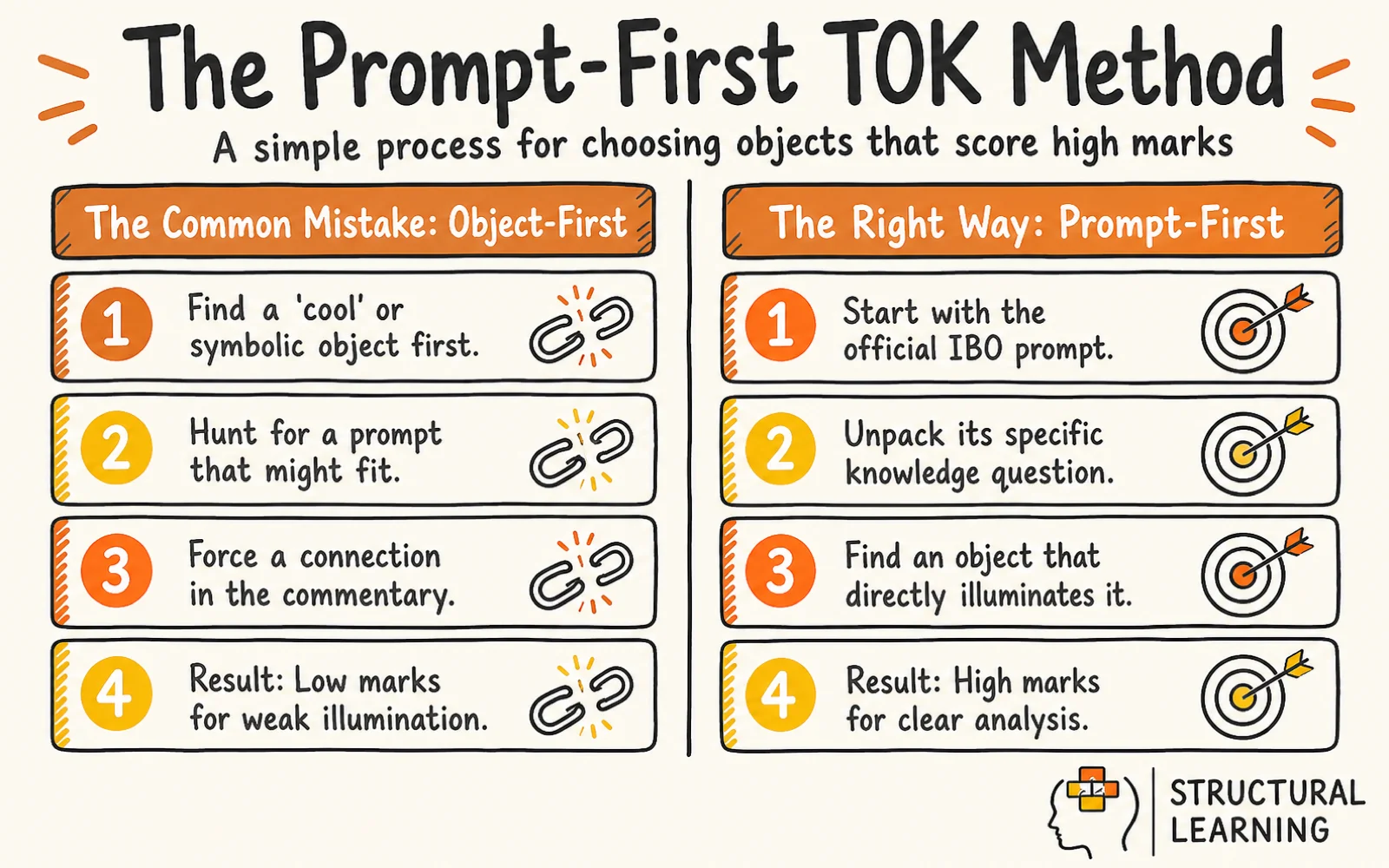
The Prompt-First Selection Method: Object → Knowledge Question → Commentary
Key Takeaways
Start with the prompt, not the object: Choose an object that directly illuminates the knowledge question, not one that symbolically "fits." Most low-scoring exhibitions reverse this order.
The 2022 format totals 20 marks across three criteria: Criterion A (knowledge and thinking, 0-8), Criterion B (perspectives and limitations, 0-8), Criterion C (quality of exhibition, 0-4).
Band 7+ exhibitions share three features: a specific named object, explicit reference to at least one way of knowing, and an acknowledged limitation or counter-perspective.
Use the Five-Move Commentary Structure: prompt plus knowledge question, object description, illumination, limitation, conclusion. Each move has a target word budget within the 950-word cap.
Specificity Beats Clever Symbolism
A student walks into the examination room with a broken clock. Her commentary talks about how "time is subjective" and how the clock "represents the relativity of knowledge." Examiner feedback arrives weeks later: "Limited engagement with the specific prompt's knowledge question. Missing explicit reference to ways of knowing. Commentary reads as generic philosophical musing. Band 3/8 on Criterion A."
Another student brings a photograph from a news archive. Her prompt asks: "To what extent is bias inevitable in the production of knowledge?" She explains that the same photograph had different captions in 1987 and 2015. She shows how the framing changed. She demonstrates how the same visual "evidence" tells different stories depending on source language, editorial choice, and historical context. Mark: Band 7/8.
The difference isn't that one student picked a rare object and the other picked a common one. The difference is specificity. The first student chose an object, then hunted for a matching prompt. The second student started with the prompt's knowledge question, then chose an object that directly illuminates it.
This article walks you through the prompt-first framework, shows you what examiners actually reward, and gives you the mark-band logic so you can self-assess as you write. If you're a TOK teacher, you can use the exemplars and checklists with your learners tomorrow. If you're a student writing your Exhibition, the five-move structure and common traps section will save you from the mistakes that cost 2, 3 marks.
The 2022 TOK Exhibition Structure: What's Actually Being Assessed
The TOK Exhibition launched in 2022 and replaced the older Internal Assessment format. Many teachers and learners still carry misconceptions about how it's marked, so let's be clear about the structure first.
You write one commentary of maximum 950 words in response to one of 35 official IBO prompts. Your commentary must engage with one real, concrete object, something you can photograph, describe, and analyse. The object isn't decorative; it's evidence.
The exhibition is assessed across three criteria, each worth a specific number of marks. Criterion A (Knowledge, Understanding, Thinking) asks whether you've explained how your object illuminates the prompt's knowledge question. This is worth 0, 8 marks and is the heaviest weighting because it's the hardest to do well. Criterion B (Perspectives and Limitations) awards 0, 8 marks for acknowledging alternative views and the boundaries of your own analysis. Criterion C (Quality of Exhibition) is worth 0, 4 marks and assesses whether your commentary is clear, well-structured, and free of significant writing errors.
Total: 20 marks. A mark of 12 or above typically places your work in the "proficient" range. Marks of 15, 20 are rare because they require sophisticated thinking and flawless execution.
This matters because many teachers still teach to the old rubric, where the weighting was different and the emphasis on "context" and "bias awareness" was explicit in the criteria. The 2022 version is tighter. Examiners want you to answer the knowledge question, not to construct a historical or philosophical essay that happens to mention your object.
The Fatal Error: Choosing Your Object First
Most learners get this backwards. They think: "I'll use my phone because it's relevant to the modern world" or "I'll bring my grandmother's photograph because it has sentimental meaning." Then they hunt through the 35 prompts looking for one that might fit.
This approach almost always results in a Band 3, 4 commentary because you end up forcing the object-prompt connection instead of showing genuine illumination.
Here's a real example of what this looks like. A learner chooses an iPhone. She scrolls through the prompts and finds "Can intuition be a reliable source of knowledge?" She decides to argue that intuition guided her to choose the iPhone, and the iPhone's touchscreen interface responds to her intuitive touch. There's no coherent link between the prompt's knowledge question (What counts as reliable intuition?) and the object (a phone). The examiner notes: Band 2, 3. "The object does not illuminate the prompt."
Now reverse the process. Start with the prompt: "Can intuition be a reliable source of knowledge?" Ask yourself: What object directly tests intuition's reliability? A chess game works brilliantly. You play, you intuit a move, and sometimes it wins, sometimes it loses. You can analyse when intuition succeeds (familiar patterns, trained unconscious thinking) and when it fails (novel situations, emotional influence). The object is the evidence. Your commentary traces through it. Mark: Band 6, 7 (if the commentary is clear).
The prompt-first process forces you to think logically. You're not decorating an object with philosophy; you're using an object to answer a knowledge question.
Use this checklist before you commit to an object:
[ ] I have read the prompt's exact wording.
[ ] I can articulate the knowledge question in my own words.
[ ] I know which way(s) of knowing it touches (Reason, Perception, Language, Emotion, Intuition, Memory, Imagination).
[ ] I have chosen an object that directly illuminates that question, not metaphorically, but evidentially.
[ ] I can explain in one sentence why this object matters to this question.
If any box stays unchecked, you're not ready. Restart with a different object or a different prompt.
The 35 Prompts Decoded: Sample Reference
The IBO publishes 35 mandatory prompts each examination session. These prompts cluster around the Ways of Knowing and Areas of Knowledge, which are the conceptual scaffolding of TOK. Rather than list all 35 here (which would bloat the article), I've provided a sample of 12 decoded prompts below, three from each major Way of Knowing grouping. Use this as a model for how to think about the prompts you're assigned.
Each decoded prompt shows: the exact wording, the underlying knowledge question, and one strong exemplar object with one sentence explaining why it works.
Prompt Number
Prompt Text
Knowledge Question (Decoded)
Strong Exemplar Object
Why It Works
3
"Does the internet have a positive or negative effect on knowledge?"
What does "positive" and "negative" mean when applied to knowledge systems? Does scale matter?
A social media algorithm's code (or documentation of how it ranks posts)
Shows how knowledge is filtered and curated by invisible rules; directly tests whether systems amplify or distort human understanding
7
"Can intuition be a reliable source of knowledge?"
Under what conditions is intuition correct? When does it fail? What's the difference between intuition and trained pattern recognition?
A chess game where the player intuits moves vs. a beginner game where intuition fails repeatedly
Demonstrates intuition's successes (trained recognition) and failures (unfamiliar patterns); directly answers the reliability question
12
"To what extent is bias inevitable in the production of knowledge?"
Is objectivity possible? Who decides what counts as bias?
A historical photograph with captions from 1987 and 2024
Same object, different interpretations; shows how knowledge is shaped by framing and context, proving bias is structural, not just individual
15
"Can imagination be a substitute for knowledge?"
What does "substitute" mean here? Can we imagine facts that turn out to be true?
A design sketch by an engineer (Brunelleschi's dome design, for example) that was imagined centuries before the mathematics to build it was available
Shows imagination preceding knowledge in some domains, but requiring empirical testing to become reliable, not a pure substitute
18
"Is mathematics a discovery or an invention?"
What's the difference? Could math be different?
A Euclidean proof (e.g., Pythagoras' theorem) alongside a non-Euclidean geometry proof
Both are "true" within their systems; shows math emerges from invented axioms, but relationships within those systems are discovered, resolves the tension
21
"Are some types of knowledge more valuable than others?"
Valuable to whom? For what purpose? By what metric?
Two textbooks: a medieval herbalist's guide (valued for healing then) and a modern pharmacology textbook (valued for precision now)
Directly shows how value is context-dependent; same knowledge question, different answers across time
24
"What is the value of uncertainty in knowledge?"
Is certainty always desirable? Can uncertainty create knowledge?
A medical diagnosis rule-out process (a doctor's notes showing "This could be X, Y, or Z") where uncertainty drives further investigation
Uncertainty doesn't block knowledge; it structures the process of generating more reliable knowledge
28
"Is certainty possible in the human sciences?"
What would certainty look like? Why are human sciences harder than natural sciences?
Patient medical records from 1950 vs. 2024 showing how the same condition is diagnosed completely differently now
Shows that "certainty" in human sciences is provisional, method-dependent, and evolves, nothing certain about it
31
"Does the production of knowledge require taking risks?"
What kind of risks? Financial? Intellectual? Physical?
A scientific researcher's lab notebook showing failed experiments (wasted resources, time) that led to a breakthrough
Directly shows that knowledge production requires trying things that might fail; certainty-seeking alone blocks discovery
34
"Knowledge is power. Discuss."
What kind of power? Over what? For whom?
A literacy primer from colonial India (or any colonized context) showing how standardized education was a tool of control
Shows knowledge as a power relationship, not a neutral asset; the object is the evidence
35
"To what extent is doubt essential in the production of knowledge?"
Can doubt block knowledge? Is it always productive?
A scientist's grant proposal that was rejected, then accepted years later when doubt about the original theory had grown
"What is the purpose of education in a global society?"
Purpose according to whom? By what metrics?
A university curriculum from 1950 vs. a modern one (or a school brochure showing how "global citizenship" is now marketed)
Shows education's stated purpose changes with social values; reveals that purpose is not fixed but negotiated
The full table of all 35 prompts is available as a downloadable resource (PDF or spreadsheet). These 12 above are enough to show the pattern: every prompt has a tension or limitation built in. Your job is to pick an object that exposes that tension.
Weak vs Strong: The Same Prompt, Two Objects
This is where the mark difference becomes visible. Let me show you the exact same prompt answered two ways.
Prompt: "Is mathematics a discovery or an invention?"
Weak Exhibition
Object chosen: A mathematics textbook
Commentary excerpt: "This textbook shows that mathematics can be both discovered and invented. The textbook was invented by humans, but the mathematics inside was discovered. For example, the Pythagorean theorem was discovered by Pythagoras, but the textbook was invented by the author. This proves that mathematics is both a discovery and an invention."
Why this scores Band 3, 4:
- The commentary never engages with what "discovery" and "invention" mean. What's the actual difference? The student asserts they're both true without exploring the tension.
- No explicit reference to ways of knowing. Is this about Reason? Intuition? Language? The commentary is silent.
- No engagement with the knowledge question's logical problem. If math is discovered, what exactly is being discovered? Are we discovering truth that exists independently, or patterns we've created?
- No limitation acknowledged. The student doesn't ask: "But wait, if Pythagoras discovered the theorem, why didn't someone in ancient Egypt or Babylon discover it first?" This is a crack in the argument the examiner expects you to address.
- Safe and vague. Any student with a textbook could write this.
Strong Exhibition
Object chosen: A Euclidean proof (Pythagoras' theorem) and a non-Euclidean geometry proof (a hyperbolic plane proof)
Commentary excerpt: "Both proofs are logically valid within their systems. In Euclidean geometry, the Pythagorean theorem is true. In hyperbolic geometry, the Pythagorean theorem fails—distances work differently. This shows that mathematical truth is discovered within a framework, but the framework itself is invented. Euclid invented the axiom that parallel lines never meet. Once you accept that axiom, the Pythagorean theorem follows necessarily—it's discovered. But Lobachevsky invented a different axiom (parallel lines can meet in hyperbolic space) and discovered completely different theorems. So mathematics is a discovery of the invented. However, this still assumes that proofs are language constructs, symbols manipulated according to rules we created. So the question 'discovery or invention' might be false. Maybe there's no fact of the matter independent of the system we choose to build."
Why this scores Band 7, 8:
- The commentary directly engages the knowledge question. It doesn't just assert both answers are true; it resolves the tension by showing they're true at different levels (framework-level invention, theorem-level discovery).
- Names ways of knowing explicitly. Reason (logic systems), Language (the role of axioms and symbols).
- Uses the object as specific evidence. The two proofs are not decorative; they're the evidence that forces the argument.
- Acknowledges a limitation. The conclusion doesn't claim victory; it opens a further question: "Maybe the whole 'discovery vs invention' frame is a language problem." This is Criterion B (Perspectives & Limitations).
- Shows sophisticated thinking. A Band 7, 8 student sees that the prompt contains a hidden assumption (that discovery and invention are mutually exclusive) and unpicks it.
The difference in marks? 4, 5 points. And it's not because the strong student is a better writer. It's because they thought about the prompt before choosing the object.
The Commentary Structure That Scores Marks
You don't need to be a brilliant philosopher to score Band 7. You need to follow a structure. Here's the five-move framework that examiners recognize and reward.
Move 1: The Prompt & Knowledge Question (~100, 150 words)
State the prompt exactly. Then rephrase the knowledge question in your own words. This isn't padding; examiners need to see you understand what you're answering. Many Band 3, 4 commentaries drift because the student never nails down what they're actually supposed to address.
Example: "My prompt is 'To what extent is bias inevitable in the production of knowledge?' This asks: Can anyone produce knowledge without filtering it through their own perspective? Or is bias a structural feature of how knowledge gets made?"
Move 2: The Object Description (~150, 200 words)
Describe your object clearly. Say what it is, where it comes from, why it matters in its original context. Avoid flowery language. Be concrete. Examiners assess whether you understand your object, not whether you're a poet. A Band 3 commentary often describes the object vaguely ("It's a historical document") while a Band 7 commentary specifies ("It's a photograph of the 1963 Birmingham civil rights march, captioned differently in the Birmingham Post (racist framing) and in the Life Magazine international edition (humanising framing)").
Move 3: The Illumination (~350, 400 words)
This is where you earn Band 6+. Explain how the object directly addresses the knowledge question. Name the way(s) of knowing it engages. Use specific examples from the object to show the link. Don't say "This object shows bias is inevitable." Say: "This object shows bias is inevitable because even when two photographers aimed the same event, same place, same time, their captions contradicted each other. The image stayed constant, but the knowledge produced from that image changed depending on who was framing it. The photographer has no control over the caption; a language user does. This proves bias isn't just individual belief, it's structural."
Move 4: The Limitation (~100, 150 words)
This is Criterion B. Acknowledge what your object doesn't explain. Name an alternative perspective or a counterexample. "However, this object only shows bias in visual knowledge. It doesn't address bias in mathematics or logic, where language is more controlled. So while the object proves bias is inevitable in historical knowledge production, I can't claim it's inevitable everywhere."
Move 5: The Conclusion (~50, 100 words)
Restate how the object illuminates the prompt. Do not introduce new ideas. Don't say "In conclusion, I've shown that bias is inevitable, and by extension, we should teach media literacy in schools." Stick to your argument. "This object demonstrates that bias is inevitable in knowledge production because framing, through language and editorial choice, is unavoidable. Even when the 'facts' (the photograph) are identical, the knowledge produced (the meaning readers extract) varies. There is no unbiased account."
Critical Do-Nots:
- Don't write as if the object is a symbol. Avoid "represents," "signifies," "embodies."
- Don't assert claims without linking them to the object.
- Don't assume the reader knows your prompt. Restate it.
- Don't exceed 950 words. Rambling signals unclear thinking.
Common Traps & How to Avoid Them
These are the five mistakes that cost learners 2, 4 marks. If you recognize one in your draft, fix it before submitting.
Trap
What It Looks Like
Why It Fails
How to Fix
The Metaphor Trap
"Art is like knowledge, it evolves and changes. Both adapt to the context."
Comparing is not explaining. You're stating a similarity, not showing why the object illuminates the prompt. Examiners read this as philosophical waffle, not analysis.
Replace "is like" with "demonstrates." Use your object as evidence, not analogy. "The photograph demonstrates how knowledge is reframed because the caption changed." Not: "The photograph is like knowledge."
The Generic Object Trap
"I chose a smartphone because technology shows how knowledge changes."
One in three students choose a phone or computer. Examiners see it as lazy. More importantly, you're using a category (technology) not a specific object.
Name the specific object: your phone's GPS malfunction (which happened on a particular route); the autocorrect failure that teaches you about language; a specific app's algorithm. Not just "a smartphone."
The Missing Prompt Trap
"This object shows how bias is everywhere in knowledge."
Doesn't connect to your specific prompt. A different prompt might ask the same question. Examiners need to see you're answering this one.
Write the prompt sentence. Repeat it. Use its exact language in your commentary. Point-by-point, show how your object answers that question.
The Symbol-Overload Trap
"This painting represents the tension between reality and perception because colours mean emotions and perspective means truth."
You've left the object and entered pure philosophy. Examiners ask: "Where's the evidence? Why does red mean emotion?"
Ground every claim in the specific object. "This painting uses warm colours in the foreground (representing the painter's perspective) and cool colours in the background (representing the actual landscape photographed from the same vantage point)—showing how perception diverges from objective reality."
The No-Limitation Trap
"This object proves that intuition is a reliable source of knowledge."
Overconfident. You're making an absolute claim. Criterion B penalises this.
Add a "however" clause. "This object shows intuition can guide correct decisions, but only when combined with prior experience. For untrained intuition, it often fails."
Real Exemplar Walk-Through: A Band 7 Exhibition
This is a complete, anonymised student example with examiner feedback and mark justification. Read this carefully, it shows what Band 7 actually looks like.
Student's Prompt: "Knowledge is power. Discuss with reference to your chosen object."
Student's Object: A literacy primer from colonial India (early 20th century)
Student's Full Commentary:
The prompt asks whether knowledge confers power over others. My object is a literacy primer produced by British administrators in colonial India, designed to teach English literacy to Indian students.
This object directly illuminates the prompt: the primer was a tool of cultural and political power. By standardising English literacy, colonial administrators could enforce compliance, limit access to government jobs for non-English speakers, and position English as "civilised" versus local languages as "primitive." The knowledge (English language plus British cultural values embedded in the primer's content) became a mechanism of power. It granted power to English speakers and withheld opportunity from those who didn't speak it. The primer wasn't neutral education; it was policy.
But here's the limitation: the prompt assumes knowledge always creates power for the knower. However, the primer also became a tool of resistance. Some Indian students learned English specifically to read colonial law and articulate anti-colonial arguments. Their knowledge became their power against the very system that introduced it. So knowledge can serve opposing forces, it's not inherently powerful for one side.
Additionally, the primer shows that the production of knowledge (who decides what's "true" to teach) is itself a power relationship. The British decided what constituted "legitimate knowledge." This means knowledge and power aren't separate, they're entangled. You can't produce knowledge without exercising power.
Examiner Mark & Feedback:
Criterion
Band
Mark
Rationale
A: Knowledge, Understanding, Thinking
7
7
Student clearly connects object to prompt's knowledge question (knowledge = power). Engages explicitly with the relationship (primers as tools of power). Goes beyond surface description to show why and how.
B: Perspectives & Limitations
7
7
Acknowledges that the primer served opposing interests (British power and Indian resistance). Shows that knowledge's relationship to power is more complex than the prompt implies.
C: Quality of Exhibition
4
4
Clear structure, coherent argument, well-supported. No significant writing errors.
Total
—
18/20
Strong exhibition. Would rank top 15% of submissions.
Why Band 7, Not Band 5?
Uses the object as specific evidence, not vague symbolism.
Engages with the knowledge question's tension (power for whom? in what direction?).
Names limitations and alternative views.
Shows reasoning about the relationship between knowledge and power, not just asserting it.
Why Not Band 8?
A Band 8 would likely explore a second object or dimension, for example, how the primer's existence as an artefact has now become a tool for post-colonial scholarship, giving Indian historians power to reclaim their own narrative. But the student worked with one object and did it thoroughly, which is Band 7 territory.
Five Questions to Ask Before You Submit
Run through this checklist before you hand in your Exhibition. If you answer "no" to any question, rewrite that section.
Can I state my prompt and knowledge question without looking at my paper?
If no: you haven't internalised what you're answering. Rewrite the opening section until it's clear.
Does my commentary mention my object by name or clear description at least three times?
If no: you've drifted into abstract philosophy. Anchor every claim back to the object.
Have I named at least one way of knowing (Reason, Perception, Language, Emotion, Intuition, Memory, Imagination)?
If no: Criterion A penalises this. Add it explicitly. "This engages Reason because..." or "This is a matter of Perception because..."
Have I acknowledged a limitation, counterexample, or alternative view?
If no: Criterion B is weak. Add a sentence: "However..." or "But this assumes..." or "One might object that..."
Could someone else understand my argument without knowing my object in advance?
If no: your commentary is too insider-focused. Rewrite the object description to be clearer and more specific.
Objects That Work: A Quick Reference
If you're stuck on object selection, here are 10 objects that consistently lead to strong exhibitions, paired with the prompts they illuminate best.
Object
Best For These Prompts
Why It Works
Common Pitfall
A chess game (played by the learner)
"Can intuition be a reliable source of knowledge?"
Directly tests intuition's success and failure. You have evidence: your wins and losses.
Don't just say "intuition helped me win." Analyse when intuition works (pattern recognition in familiar positions) and when it fails (novel situations).
A historical photograph with captions from two different eras
"To what extent is bias inevitable in the production of knowledge?"
Same object, different interpretations. Proves bias is structural, not just individual opinion.
Don't stop at saying captions differ. Explain why they differ (editorial choice, language, historical moment) to show bias is inevitable.
A GPS malfunction (or the learner's experience with one)
"Does technology reveal or conceal the natural world?"
Demonstrates how technology mediates understanding. When it fails, you see dependence on the tool.
Stay focused on the epistemological question, not just the technology. What does the malfunction teach us about how we know the world?
Medical records from two time periods showing different diagnoses for the same condition
"Is certainty possible in the human sciences?"
Shows certainty is provisional and method-dependent.
Don't just say "medicine changed." Explain why it changed (new knowledge methods, new understanding of biology) to engage the knowledge question.
A design sketch by an engineer that preceded the mathematics to build it
"Can imagination be a substitute for knowledge?"
Shows imagination preceding reliable knowledge, but requiring empirical testing.
Avoid saying imagination equals knowledge. Instead, show imagination starting the process, but knowledge completing it.
A recipe in two languages
"To what extent is language a barrier to knowledge?" or "Does language shape the way we think?"
Same instructions, different semantic choices reveal how language influences action and thought.
Don't just list translation differences. Show why a speaker of language B might cook differently based on the semantic choices in their language version.
A social media algorithm's ranking rule (or a learner's analysis of how Instagram prioritizes posts)
"Does the internet have a positive or negative effect on knowledge?"
Shows knowledge is filtered by invisible systems. Questions what counts as knowledge in a digital age.
Don't treat this as a complaint about social media. Analyse why the algorithm shapes knowledge the way it does.
A student's marked exam paper from 10 years ago vs. a current one, same subject
"To what extent has knowledge changed?" or "Is certainty possible in the human sciences?"
Concrete evidence that what's correct (marked right) changes over time.
Explain why the change happened, new research, revised understanding, not just that it happened.
A music score and its two different performances
"Is beauty objective or subjective?" or "Can we know the composer's intention?"
Two interpretations of the same "text" (score) challenge objectivity.
Go beyond saying "people interpret differently." Analyse how performance choices reveal what aspects of the work are fixed (notes) vs. interpretive (tempo, expression).
A archaeological artefact with conflicting scholarly interpretations
"How is knowledge produced in different ways of knowing?"
Different scholars using the same object reach different conclusions. Shows knowledge production is method-dependent.
Don't just list the interpretations. Analyse why scholars disagree, different methodologies, assumptions, evidence weighting.
Further Reading: IBO Guidance and Reflective Practice Research
The sources below combine the IBO's own curriculum documents with the reflective-practice research that underpins the Exhibition's assessment criteria.
Theory of Knowledge Guide: First Assessment 2022View source ↗
The official TOK curriculum. It sets the 35 prescribed prompts, defines the three assessment criteria (A, B, C totalling 20 marks), and explains how examiners weigh object-prompt alignment against symbolic interpretation. Every exhibition draft should be checked against this document before submission.
IBO-commissioned research mapping ATL skills (thinking, communication, self-management, research, social) to the Exhibition. Gillet shows that strong exhibitions reveal explicit metacognitive reasoning, not just finished commentary. Useful for coordinators planning ATL scaffolding across Year 12 and Year 13.
Transnational spaces of education: the growth of the international school sectorView study ↗
Hayden (2011), Globalisation, Societies and Education
Peer-reviewed analysis of the IB's pedagogical identity. Hayden argues that TOK functions as the epistemic glue of the DP, training learners to interrogate how knowledge claims are built rather than simply to reproduce them. The paper helps teachers defend TOK's rigour to sceptical governors and parents.
A Handbook of Reflective and Experiential LearningView source ↗
Moon (2004), Routledge
Foundational framework for judging depth in reflective writing. Moon's levels map neatly onto the band 3 to band 8 progression in Criterion A: surface description, reasoned analysis, critical synthesis. Use her questions to diagnose why a draft is stuck at band 4 and what would push it to band 7.
Perspectives on a Curious Subject: What is IB Theory of Knowledge All About?View source ↗
IB Research (2015)
IBO-commissioned examination of how TOK is taught and assessed across regions. The report surfaces common delivery patterns that either enable or inhibit the kind of object-prompt analysis the Exhibition rewards. Informative for heads of school reviewing departmental TOK provision.
Free Resource Pack
TOK Exhibition Success Kit
4 essential resources for students and teachers to master the TOK Exhibition and achieve high scores.
TOKIB DiplomaExhibitionAssessment GuidanceStudent SupportTeacher CPDPlanning ToolDesk CardClassroom ResourceTheory of Knowledge
Download your free bundle
Fill in your details below and we'll send the resource pack straight to your inbox.
✅
Your resource pack is ready
We've also sent a copy to your email. Check your inbox.
{
"@context": "https://schema.org",
"@type": "FAQPage",
"mainEntity": [
{
"@type": "Question",
"name": "How do you choose an object for the TOK Exhibition?",
"acceptedAnswer": {
"@type": "Answer",
"text": "Start with your prompt's knowledge question, not with an object. Choose an object that directly illuminates that question, not one that symbolically 'fits.' Use the Prompt-First Checklist: I have read the prompt exactly, I can articulate the knowledge question, I know which ways of knowing it touches, I've chosen an object that directly illuminates it, and I can explain in one sentence why it matters."
}
},
{
"@type": "Question",
"name": "What makes a strong TOK Exhibition commentary?",
"acceptedAnswer": {
"@type": "Answer",
"text": "A strong commentary (Band 6+) explicitly connects the object to the prompt's knowledge question, names at least one way of knowing, uses the object as specific evidence (not metaphor), and acknowledges a limitation or alternative view. It follows the five-move structure: prompt & knowledge question, object description, illumination, limitation, conclusion."
}
},
{
"@type": "Question",
"name": "How many words should a TOK Exhibition be?",
"acceptedAnswer": {
"@type": "Answer",
"text": "Maximum 950 words. Rambling commentary signals unclear thinking to examiners. Aim for: Prompt paragraph ~100, 150 words, Object description ~150, 200 words, Illumination ~350, 400 words, Limitation ~100, 150 words, Conclusion ~50, 100 words."
}
},
{
"@type": "Question",
"name": "What are the TOK Exhibition assessment criteria?",
"acceptedAnswer": {
"@type": "Answer",
"text": "Three criteria: Criterion A (Knowledge, Understanding, Thinking; 0, 8 marks) assesses whether you explain how the object illuminates the prompt's knowledge question. Criterion B (Perspectives & Limitations; 0, 8) rewards acknowledging alternative views and limitations. Criterion C (Quality of Exhibition; 0, 4) assesses clarity and structure. Total: 20 marks."
}
},
{
"@type": "Question",
"name": "Can you use a smartphone for the TOK Exhibition?",
"acceptedAnswer": {
"@type": "Answer",
"text": "Yes, but many students choose smartphones as generic objects. The risk: your commentary becomes superficial. Only choose a smartphone if you can explain a *specific* feature (GPS malfunction, algorithm, autocorrect failure) that directly illuminates your prompt's knowledge question. The more specific your object, the stronger your commentary."
}
},
{
"@type": "Question",
"name": "What's the most common mistake in TOK Exhibition commentaries?",
"acceptedAnswer": {
"@type": "Answer",
"text": "Choosing an object first, then hunting for a matching prompt. This almost always results in forced, vague connections. Instead, start with the prompt's knowledge question, then choose an object that directly illuminates it. This reversal forces clearer thinking and earns 2, 4 more marks on average."
}
},
{
"@type": "Question",
"name": "What does 'directly illuminates' mean?",
"acceptedAnswer": {
"@type": "Answer",
"text": "It means the object is *evidence* for answering the knowledge question, not a metaphor or symbol. The object should work because of what it *is*, not because of what it 'represents.' For example, a chess game directly illuminates 'Can intuition be reliable?' because playing chess either succeeds or fails. But a chess set doesn't, it's just an object that exists."
}
},
{
"@type": "Question",
"name": "How do examiners mark Band 3 vs. Band 7?",
"acceptedAnswer": {
"@type": "Answer",
"text": "Band 3 (Developing): Vague object description, missing prompt reference, generic philosophical claims, no engagement with alternative views. Band 7 (Sophisticated): Clear object-prompt connection, specific object as evidence, explicit reference to ways of knowing, acknowledged limitations, coherent reasoning. The difference is specificity and intellectual honesty about what the object does and doesn't explain."
}
}
]
}
About the Author
Paul Main
Founder, Structural Learning · Fellow of the RSA · Fellow of the Chartered College of Teaching
Paul translates cognitive science research into classroom-ready tools used by 400+ schools. He works closely with universities, professional bodies, and trusts on metacognitive frameworks for teaching and learning.
{"@context":"https://schema.org","@graph":[{"@type":"Organization","@id":"https://www.structural-learning.com/#org","name":"Structural Learning","url":"https://www.structural-learning.com/","logo":{"@type":"ImageObject","url":"https://cdn.prod.website-files.com/5b69a01ba2e409501de055d1/5b69a01ba2e40996a5e055f4_structural-learning-logo.png"}},{"@type":"Person","@id":"https://www.structural-learning.com/team/paul-main/#person","name":"Paul Main","url":"https://www.structural-learning.com/team/paul-main","jobTitle":"Founder","affiliation":{"@id":"https://www.structural-learning.com/#org"}},{"@type":"BreadcrumbList","@id":"https://www.structural-learning.com/post/tok-exhibition-choose-objects-write#breadcrumb","itemListElement":[{"@type":"ListItem","position":1,"name":"Home","item":"https://www.structural-learning.com/"},{"@type":"ListItem","position":2,"name":"Blog","item":"https://www.structural-learning.com/blog"},{"@type":"ListItem","position":3,"name":"TOK Exhibition: How to Choose Objects & Write Commentary That Actually Scores","item":"https://www.structural-learning.com/post/tok-exhibition-choose-objects-write"}]},{"@type":"BlogPosting","@id":"https://www.structural-learning.com/post/tok-exhibition-choose-objects-write#article","headline":"TOK Exhibition: How to Choose Objects & Write Commentary That Actually Scores","description":"Demystify the TOK Exhibition. Choose objects using the knowledge question, write commentary that scores marks, avoid 3 common traps. IBO prompt guide included.","author":{"@id":"https://www.structural-learning.com/team/paul-main/#person"},"publisher":{"@id":"https://www.structural-learning.com/#org"},"datePublished":"2026-04-22","dateModified":"2026-04-22","inLanguage":"en-GB"}]}