Rudolf Steiner and Waldorf Education: A Teacher's Guide

Updated on  

March 7, 2026

Rudolf Steiner and Waldorf Education: A Teacher's Guide

|

March 7, 2026

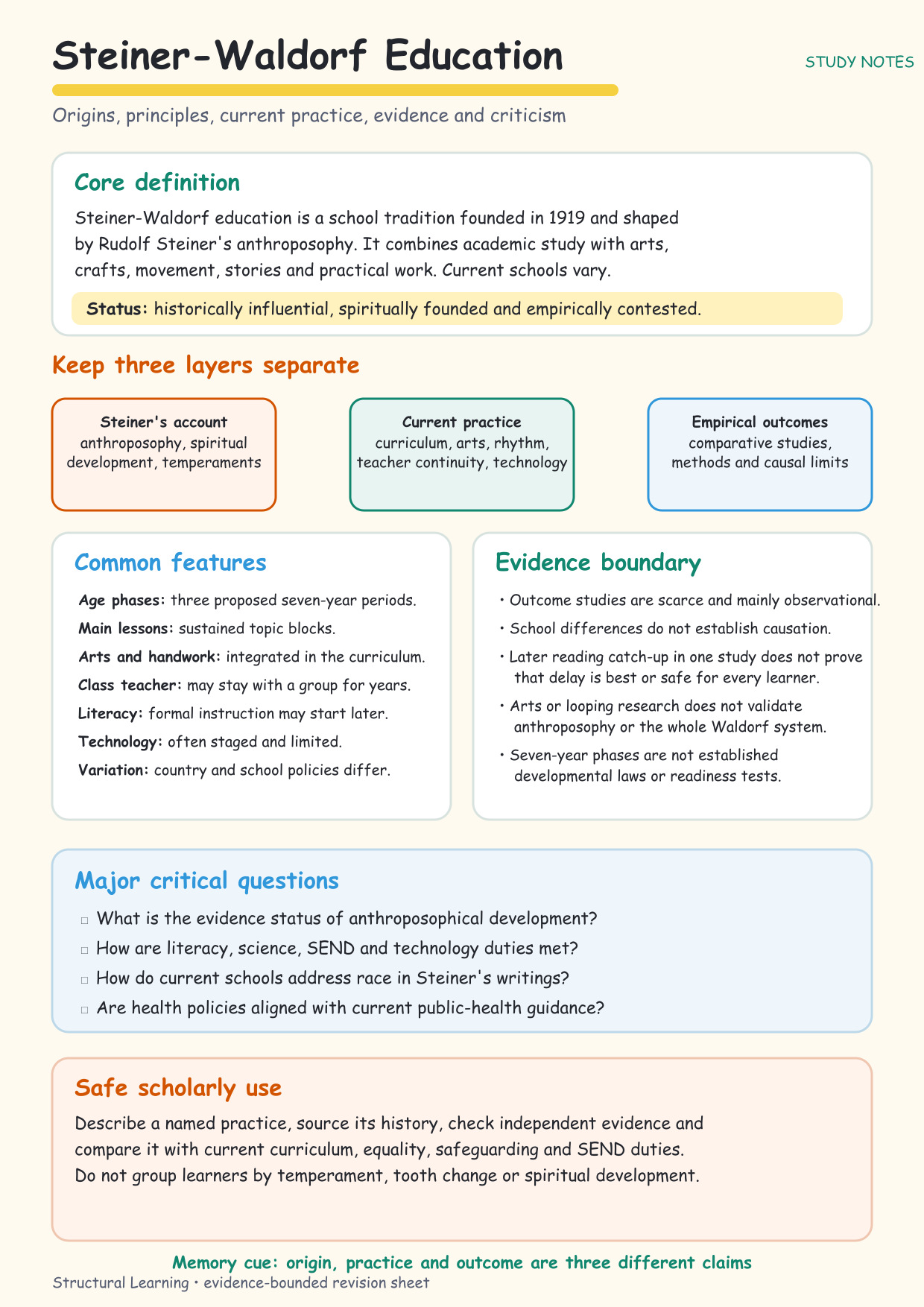
Rudolf Steiner remains one of the most debated figures in education. His Waldorf approach, developed in Stuttgart in 1919, now operates in more than 1,100 schools across 60 countries, yet many classroom teachers encounter his ideas without any clear account of what he actually argued or why. This guide sets out Steiner's core developmental theory, explains how Waldorf schools translate it into curriculum, and draws out the findings most relevant to teachers working in mainstream settings.

Key Takeaways

  1. Three developmental stages: Steiner proposed that children develop through three seven-year cycles, each with distinct learning needs: will (0-7), feeling (7-14), and thinking (14-21).
  2. Arts integrate across the curriculum: Waldorf education uses painting, music, movement (eurythmy), and storytelling not as extras but as core learning methods that engage the whole child.
  3. Delayed formal academics: Steiner argued against early reading and writing instruction, advocating play-based learning until age seven. This remains controversial but aligns with some early years research.
  4. Rhythm and routine matter: Waldorf classrooms follow predictable daily and seasonal rhythms. Research on executive function supports the value of structured routines for young learners.

Who Was Rudolf Steiner?

Rudolf Steiner (1861-1925) was an Austrian philosopher and social reformer whose ideas spanned architecture, agriculture, medicine, and education. He studied mathematics and natural science at the Vienna Institute of Technology before developing his philosophical system, which he called anthroposophy: a structured account of the spiritual dimensions of human experience and development. His educational ideas grew directly from this framework, making Waldorf pedagogy inseparable from its philosophical roots.

In 1919, Steiner was invited by Emil Molt, director of the Waldorf-Astoria cigarette factory in Stuttgart, to establish a school for factory workers' children. The resulting school, the first Waldorf school, was unusual from the start. It was co-educational, accepted children of all social backgrounds, and structured its curriculum around Steiner's developmental theory rather than state examination requirements. By the time Steiner died in 1925, twelve Waldorf schools were operating across Europe.

Steiner's legacy in mainstream education is genuinely mixed. His philosophy generated one of the most coherent alternative school movements in history. It also contained beliefs, including a spiritual account of child development tied to reincarnation and a racial hierarchy in some of his lectures, that are incompatible with contemporary educational values. A balanced assessment of Waldorf education requires holding both the pedagogical insights and the problematic foundations in view. Oberski (2011) provides a careful examination of Steiner's philosophy of freedom and its limits as a basis for educational practice.

Core Principles of Waldorf Education

Waldorf education rests on the view that children are not simply smaller adults waiting to acquire adult knowledge, but are passing through qualitatively distinct phases of development, each with its own appropriate mode of learning. Steiner opposed what he saw as the intellectualisation of early childhood, by which he meant the imposition of abstract, symbol-based learning on children who were not yet developmentally ready for it. His classroom prescription followed directly from this diagnosis: match the teaching method to the developmental stage of the child.

The relationship between teacher and class is central to the Waldorf model. In most Waldorf schools, the class teacher stays with the same group from Class 1 through Class 8 (roughly ages 6 to 14), a structure known as the "looping" model. The rationale is that deep knowledge of individual children's development allows the teacher to respond appropriately across multiple years of growth. Rawson and Richter (2000) describe the Waldorf curriculum as designed not around subject knowledge alone but around the developmental needs that each subject can meet at each stage.

Rhythm structures the Waldorf school day at every level. The morning begins with a "main lesson," a 90-to-120-minute block in which the class works intensively on a single subject (history, mathematics, science) for three or four weeks before rotating to another. The afternoon covers arts, crafts, foreign languages, and movement. The week, the school year, and the multi-year curriculum all follow seasonal and developmental rhythms. A practical consequence of this structure is that pupils encounter the same topics repeatedly across years, each time at a greater level of complexity, a pattern that maps closely onto what cognitive scientists now call spaced retrieval practice.

Waldorf schools avoid formal textbooks in the early and middle years. Instead, pupils create their own "main lesson books," hand-written and illustrated records of what they have learned in each block. This practice serves multiple functions: it requires pupils to synthesise and represent information, it demands genuine engagement with the material, and it produces a personalised record that reflects the individual child's understanding rather than a standardised version of it. The parallel with graphic organisers as a tool for structuring and externalising knowledge is worth noting.

Steiner's Three Stages of Development

Steiner's developmental model divides childhood and adolescence into three seven-year phases. Each phase is governed by a different human capacity: will in the first phase, feeling in the second, and thinking in the third. These are not arbitrary divisions; Steiner grounded them in his anthroposophical account of human development, though contemporary developmental psychologists would frame similar observations in different terms. The table below compares Steiner's stages with Piaget's cognitive stages and Erikson's psychosocial stages, three frameworks that address overlapping territory from different angles.

Age Range Steiner's Stage Piaget's Stage Erikson's Stage
0-7 Will: learning through imitation, movement, and sensory experience; play-based, no formal instruction Sensorimotor (0-2) and Preoperational (2-7): learning through action and symbolic play, limited logical reasoning Trust vs Mistrust (0-1), Autonomy vs Shame (1-3), Initiative vs Guilt (3-6): building trust, independence, and purposeful action
7-14 Feeling: learning through imagination, narrative, and artistic expression; teacher as authority figure Concrete Operational (7-11) and early Formal Operational: logical thinking with concrete objects, growing abstract capacity Industry vs Inferiority (6-12): developing competence and a sense of achievement through school and social tasks
14-21 Thinking: learning through independent reasoning, abstract concepts, and critical inquiry; teacher as guide Formal Operational (12+): hypothetical reasoning, systematic problem-solving, abstract thought Identity vs Role Confusion (12-18): forming a stable sense of self, values, and direction

The first stage (0-7) is the period of will. Steiner believed young children learn primarily through imitation and physical activity. The appropriate educational environment is one rich in sensory experience, purposeful movement, and rhythmic activity. Formal reading and writing instruction are deliberately withheld; the concern is that early symbol-based learning places cognitive demands on children before the neurological foundations for abstract representation are mature. In a Waldorf kindergarten classroom, you will find children cooking, gardening, painting, and hearing stories, not sitting at desks completing worksheets. This connects to broader early years debates explored in the child development theories literature.

The second stage (7-14) is the period of feeling. Steiner believed the child's relationship to the world now moves through the emotions and imagination rather than through direct physical imitation. The curriculum becomes narrative-led: history is taught through biography and story, science is introduced through observation and description before analysis, mathematics is embedded in pattern and rhythm. The class teacher's authority is important in this phase. Steiner argued that the child in the feeling stage needs an admired adult to provide emotional and moral orientation, making the looping relationship between teacher and class particularly significant here.

The third stage (14-21) is the period of thinking. Abstract reasoning, independent judgement, and conceptual analysis become appropriate and central. The teacher's role shifts from authority figure to intellectual guide. Pupils in this phase engage with primary sources, debate competing interpretations, and are expected to form their own considered positions. In the classroom, a teacher might present two conflicting historical accounts of the same event and ask pupils to weigh the evidence, model their own reasoning aloud, and identify where certainty ends and interpretation begins. The alignment with metacognitive development is clear: Steiner's third stage is precisely the phase in which thinking about one's own thinking becomes both possible and educationally central.

The Waldorf Curriculum in Practice

The Waldorf curriculum is organised in multi-week "main lesson blocks" rather than daily subject periods. A Class 4 block on Norse mythology, for instance, might run for four weeks: the teacher narrates a myth at the opening of each morning session, pupils illustrate and write about it in their main lesson books, the narrative connects to history, geography, and language work, and the block closes with pupils recounting the mythology sequence from memory. This is not incidental to the learning; the block structure is designed to allow deep immersion in a topic rather than the superficial coverage associated with timetabled subject rotation.

Foreign languages begin from Class 1 in most Waldorf schools, taught initially through song, verse, and conversation rather than grammar instruction. Steiner believed that young children absorb language through imitation and repetition in the same way they absorb their mother tongue, making grammatical analysis unnecessary and potentially counterproductive in the early years. Two foreign languages are typically taught simultaneously throughout the primary phase. A Waldorf Class 2 lesson in French might involve the class repeating a French poem with movement, learning vocabulary through a game, and dramatising a short scene, with no written grammar exercise in sight.

Mathematics in Waldorf classrooms is introduced through rhythm and the body. Before children write numerals, they clap, stamp, and move to number sequences. Multiplication tables are learned as chanting patterns with physical gestures, embedding the arithmetic in motor memory before it is abstracted to paper. This approach has resonance with the concrete-pictorial-abstract sequence familiar to primary teachers: Waldorf mathematics moves deliberately from embodied, concrete experience toward abstraction, rarely rushing the transition. Research on the use of physical movement in early mathematics learning supports the value of this sequencing.

Science education in Waldorf schools follows what Steiner called a "phenomenological" approach. Before pupils are offered explanations or theories, they are asked to observe phenomena carefully and describe what they see. A Class 6 physics block on optics might begin with pupils simply observing how light behaves when it passes through water, noting colours, shadows, and angles without any explanation of refraction. The theoretical account comes later, after the phenomenon itself has been thoroughly experienced. This parallels the scaffolding principle of building from concrete observation toward abstract model, though Steiner arrived at it from a different theoretical direction.

Arts, Movement, and Imagination

In Waldorf education, arts are not peripheral enrichment activities but central to how all learning is structured. Steiner's argument was that intellectual and artistic development are not separate domains but aspects of a single unified process of human development. A pupil who paints a scene from a history lesson is not decorating their notebook; they are processing and integrating the content through a different cognitive register. The same principle applies to modelling in beeswax, woodworking, knitting, and weaving, all of which appear in the Waldorf curriculum as vehicles for developing spatial reasoning, fine motor control, patience, and planning.

Eurythmy is the movement practice specific to Waldorf schools. Developed by Steiner himself, it involves translating music and speech into bodily movement. Pupils move through space in patterns that correspond to the sounds and rhythms of language and music, using gestures that Steiner associated with specific phonemes and musical intervals. For outsiders, eurythmy is often the most puzzling element of Waldorf practice. Waldorf educators argue that it integrates the will, feeling, and thinking capacities simultaneously, making it a whole-child learning activity. Whether or not one accepts this framing, the emphasis on purposeful, rhythmic physical movement as part of the school day has general resonance with research on the relationship between physical activity and cognitive performance.

Storytelling is the primary instructional medium in Waldorf schools through the early and middle years. Before the age of nine or ten, Steiner argued, children live in a naturally mythological relationship with the world: they do not yet experience a clear boundary between themselves and nature, between the animate and inanimate. The Waldorf curriculum responds by sequencing stories according to this developmental arc: fairy tales and fables in Classes 1-2, legends and mythology in Classes 3-4, ancient history narrated as biography in Classes 5-6. A Class 3 teacher in a Waldorf school might spend twenty minutes narrating the story of Moses with full dramatic expression before asking the class to draw a scene from memory and then discuss what they noticed. The narrative frame is not a pedagogical trick; it is the primary vehicle for content delivery in this phase.

Imagination as a pedagogical tool in this phase connects directly to what Vygotsky described as the zone of proximal development: the teacher uses narrative and imagery to lead children just beyond their current understanding, providing the scaffolding of story so that the child can reach what they could not access through direct instruction alone. The two theoretical frameworks arrive at a similar conclusion from different starting points.

Criticisms and Limitations

The delayed introduction of formal literacy and numeracy is the most contested aspect of Waldorf education. Steiner argued that formal reading instruction before age seven places inappropriate cognitive demands on children and may produce short-term results at the cost of long-term engagement. A widely cited study by Suggate, Schaughency, and Reese (2013) in Early Childhood Research Quarterly found that children who began formal reading instruction later caught up with those who began earlier by age ten, and showed no measurable disadvantage thereafter. This is frequently cited in support of Waldorf's delayed start. However, the study examined children in a specific New Zealand context and does not address all the variables relevant to early reading instruction, particularly for children from low-literacy home environments, where early intervention carries well-established long-term benefits.

The anthroposophical foundations of Waldorf education create genuine difficulties. Steiner's account of human development was not scientific in any contemporary sense; it was derived from his spiritual philosophy and included claims about karma, reincarnation, and what he termed "racial root races" in some lectures. Several researchers and former Waldorf teachers have documented how anthroposophical beliefs can influence curriculum decisions and teacher training in ways that are not transparent to parents. Woods, Ashley, and Woods (2005), in their study of Steiner schools in England for the Department for Education and Skills, found significant variation in the degree to which individual schools made their anthroposophical commitments visible to parents.

The looping model, while beneficial for relational continuity, creates structural risks. If a child's relationship with their class teacher is poor, there is no natural break point for eight years. The model also places extraordinary demands on teachers, who must be competent to teach every curriculum subject across the primary phase. In practice, this means that the quality of Waldorf education varies significantly between teachers and between schools, making generalisations about outcomes difficult. Dahlin (2017) notes that Waldorf education's evidence base is substantially thinner than its philosophical confidence would suggest, with most outcome studies relying on self-selected samples and parental satisfaction measures rather than controlled comparisons.

Assessment in Waldorf schools is deliberately qualitative throughout the primary phase. Written narrative reports replace grades and test scores. This approach reflects Steiner's view that standardised assessment imposes an external measuring frame on development that is inherently individual and non-linear. The practical consequence is that Waldorf pupils transitioning to mainstream secondary schools sometimes find the shift to examination-based assessment significant. This does not necessarily indicate poorer learning, but it does mean that attainment data comparing Waldorf and mainstream outcomes must be interpreted with care. The nature versus nurture debate in education is relevant here: outcomes in Waldorf schools are influenced by both the pedagogy and the self-selecting population of families who choose the approach.

What Mainstream Teachers Can Learn

Even teachers with no intention of applying Waldorf pedagogy wholesale can draw useful insights from Steiner's approach. The most transferable finding is the value of extended, immersive topic work. The research on scaffolding and deep learning consistently supports the argument that superficial coverage of many topics produces weaker retention than sustained engagement with fewer topics. A mainstream primary teacher who dedicates three weeks to a single historical period, allowing connections to accumulate across literacy, art, and discussion, is applying a version of this principle regardless of its Waldorf origins.

The looping relationship between teacher and class, even if applied in modified form, has well-supported benefits for pupils whose development is non-linear. Research on executive function in early childhood consistently finds that stable, predictable relational environments support the development of self-regulation. A teacher who knows a pupil across multiple years has access to longitudinal understanding of that pupil's development that a new teacher, however skilled, cannot replicate. Secondary schools have explored versions of this through extended form tutor periods and personalised learning mentors.

Steiner's insistence on arts integration across the curriculum anticipates what is now described as multimodal learning: the finding that engaging multiple sensory and representational channels in a single learning activity strengthens encoding and retrieval. A science teacher who asks pupils to sketch and annotate a diagram immediately after a demonstration, rather than reading a pre-prepared diagram in a textbook, is applying this principle. An English teacher who asks pupils to create a visual timeline of a novel's plot structure before writing an analytical essay is using the same underlying mechanism. The Waldorf version of this insight is embedded in a spiritual philosophy, but the educational practice translates cleanly.

The phenomenological approach to science instruction, observing carefully before explaining, has direct application in mainstream classrooms. Beginning a lesson on plant cells by asking pupils to look at a real leaf under a hand lens and describe what they see, before introducing the concept of cell structure, uses curiosity and observation as the cognitive hook on which the subsequent explanation hangs. This is consistent with what Piaget described as the role of concrete experience in cognitive development, and with the constructivist tradition more broadly. Teachers working within the Froebel tradition will recognise a similar emphasis on careful observation of the natural world as the starting point for understanding.

Rhythm and routine, the most organisationally distinctive features of Waldorf classrooms, have the strongest evidence base among Steiner's pedagogical commitments. Predictable daily structures reduce the cognitive overhead of navigating a school day, freeing pupils' attention for the learning itself. The morning circle in a Waldorf kindergarten, in which the class moves through the same sequence of verse, song, and movement every day, provides the kind of structured routine that research on executive function identifies as particularly beneficial for young children and for pupils with attention difficulties. A mainstream Reception or Year 1 teacher who builds a consistent morning routine, even a simple one, is drawing on the same developmental insight. The child development evidence base on the role of predictable routines in self-regulation is substantial.

Finally, Steiner's emphasis on the teacher's relationship to the material matters. Waldorf teachers are expected to know their content deeply enough to narrate it without notes, to animate it through storytelling, and to respond to children's questions from genuine understanding rather than scripted exposition. This is a demanding standard, but it reflects something important about what makes teaching powerful. A teacher who has internalised material well enough to improvise around it, to follow a pupil's unexpected question into productive territory, to reframe an explanation when the first attempt does not land, is a more effective teacher than one who delivers a fixed script, regardless of how well that script was designed. The Deweyan tradition makes a similar argument from a different starting point: learning requires genuine inquiry from the teacher as well as the pupil.

Further Reading: Key Papers on Waldorf Education

Further Reading: Key Papers on Waldorf Education

The following studies provide the strongest evidence base for understanding Waldorf education's principles, outcomes, and limitations.

Rudolf Steiner: The Relevance of Waldorf Education View study ↗
Dahlin, B. (2017). Springer.

Dahlin's volume provides the most rigorous academic assessment of Waldorf education's evidence base, examining what is genuinely supported by research and what rests on anthroposophical assumptions. He identifies the gap between Waldorf's philosophical confidence and the thinness of its comparative outcome data, making this essential reading for any teacher evaluating Steiner's claims critically.

Children learning to read later catch up to children reading earlier View study ↗
Suggate, S.P., Schaughency, E.A. & Reese, E. (2013). Early Childhood Research Quarterly, 28(1).

This New Zealand study found no measurable disadvantage for children who began formal reading instruction at age seven compared with those who began at five, once both groups reached age ten. The finding is frequently cited in defence of Waldorf's delayed literacy approach, though readers should note its specific context and the wider evidence on early intervention for at-risk readers.

Rudolf Steiner's philosophy of freedom as a basis for spiritual education? View study ↗
Oberski, I. (2011). International Journal of Children's Spirituality, 16(1).

Oberski examines the philosophical coherence and practical limits of Steiner's philosophy of freedom as a foundation for educational practice. The paper is particularly useful for understanding where Steiner's spiritual premises create tensions with contemporary educational values, offering a balanced rather than polemical account of these difficulties.

Steiner Schools in England View study ↗
Woods, P., Ashley, M. & Woods, G. (2005). University of the West of England.

This government-commissioned study remains the most detailed empirical account of how Waldorf education operates in English schools, covering curriculum practices, teacher experiences, pupil and parent perspectives, and the degree to which anthroposophical commitments are made transparent. It identifies significant variation between schools, an important caveat for any generalisation about Waldorf outcomes.

The Educational Tasks and Content of the Steiner Waldorf Curriculum View study ↗
Rawson, M. & Richter, T. (2000). Steiner Waldorf Schools Fellowship.

This is the primary curriculum document for Waldorf schools in the UK, setting out the developmental rationale for each subject at each stage. Reading it alongside the Dahlin and Woods studies gives a complete picture of both the intended design and the empirical reality of Waldorf education in practice.

Loading audit...

Rudolf Steiner remains one of the most debated figures in education. His Waldorf approach, developed in Stuttgart in 1919, now operates in more than 1,100 schools across 60 countries, yet many classroom teachers encounter his ideas without any clear account of what he actually argued or why. This guide sets out Steiner's core developmental theory, explains how Waldorf schools translate it into curriculum, and draws out the findings most relevant to teachers working in mainstream settings.

Key Takeaways

  1. Three developmental stages: Steiner proposed that children develop through three seven-year cycles, each with distinct learning needs: will (0-7), feeling (7-14), and thinking (14-21).
  2. Arts integrate across the curriculum: Waldorf education uses painting, music, movement (eurythmy), and storytelling not as extras but as core learning methods that engage the whole child.
  3. Delayed formal academics: Steiner argued against early reading and writing instruction, advocating play-based learning until age seven. This remains controversial but aligns with some early years research.
  4. Rhythm and routine matter: Waldorf classrooms follow predictable daily and seasonal rhythms. Research on executive function supports the value of structured routines for young learners.

Who Was Rudolf Steiner?

Rudolf Steiner (1861-1925) was an Austrian philosopher and social reformer whose ideas spanned architecture, agriculture, medicine, and education. He studied mathematics and natural science at the Vienna Institute of Technology before developing his philosophical system, which he called anthroposophy: a structured account of the spiritual dimensions of human experience and development. His educational ideas grew directly from this framework, making Waldorf pedagogy inseparable from its philosophical roots.

In 1919, Steiner was invited by Emil Molt, director of the Waldorf-Astoria cigarette factory in Stuttgart, to establish a school for factory workers' children. The resulting school, the first Waldorf school, was unusual from the start. It was co-educational, accepted children of all social backgrounds, and structured its curriculum around Steiner's developmental theory rather than state examination requirements. By the time Steiner died in 1925, twelve Waldorf schools were operating across Europe.

Steiner's legacy in mainstream education is genuinely mixed. His philosophy generated one of the most coherent alternative school movements in history. It also contained beliefs, including a spiritual account of child development tied to reincarnation and a racial hierarchy in some of his lectures, that are incompatible with contemporary educational values. A balanced assessment of Waldorf education requires holding both the pedagogical insights and the problematic foundations in view. Oberski (2011) provides a careful examination of Steiner's philosophy of freedom and its limits as a basis for educational practice.

Core Principles of Waldorf Education

Waldorf education rests on the view that children are not simply smaller adults waiting to acquire adult knowledge, but are passing through qualitatively distinct phases of development, each with its own appropriate mode of learning. Steiner opposed what he saw as the intellectualisation of early childhood, by which he meant the imposition of abstract, symbol-based learning on children who were not yet developmentally ready for it. His classroom prescription followed directly from this diagnosis: match the teaching method to the developmental stage of the child.

The relationship between teacher and class is central to the Waldorf model. In most Waldorf schools, the class teacher stays with the same group from Class 1 through Class 8 (roughly ages 6 to 14), a structure known as the "looping" model. The rationale is that deep knowledge of individual children's development allows the teacher to respond appropriately across multiple years of growth. Rawson and Richter (2000) describe the Waldorf curriculum as designed not around subject knowledge alone but around the developmental needs that each subject can meet at each stage.

Rhythm structures the Waldorf school day at every level. The morning begins with a "main lesson," a 90-to-120-minute block in which the class works intensively on a single subject (history, mathematics, science) for three or four weeks before rotating to another. The afternoon covers arts, crafts, foreign languages, and movement. The week, the school year, and the multi-year curriculum all follow seasonal and developmental rhythms. A practical consequence of this structure is that pupils encounter the same topics repeatedly across years, each time at a greater level of complexity, a pattern that maps closely onto what cognitive scientists now call spaced retrieval practice.

Waldorf schools avoid formal textbooks in the early and middle years. Instead, pupils create their own "main lesson books," hand-written and illustrated records of what they have learned in each block. This practice serves multiple functions: it requires pupils to synthesise and represent information, it demands genuine engagement with the material, and it produces a personalised record that reflects the individual child's understanding rather than a standardised version of it. The parallel with graphic organisers as a tool for structuring and externalising knowledge is worth noting.

Steiner's Three Stages of Development

Steiner's developmental model divides childhood and adolescence into three seven-year phases. Each phase is governed by a different human capacity: will in the first phase, feeling in the second, and thinking in the third. These are not arbitrary divisions; Steiner grounded them in his anthroposophical account of human development, though contemporary developmental psychologists would frame similar observations in different terms. The table below compares Steiner's stages with Piaget's cognitive stages and Erikson's psychosocial stages, three frameworks that address overlapping territory from different angles.

Age Range Steiner's Stage Piaget's Stage Erikson's Stage
0-7 Will: learning through imitation, movement, and sensory experience; play-based, no formal instruction Sensorimotor (0-2) and Preoperational (2-7): learning through action and symbolic play, limited logical reasoning Trust vs Mistrust (0-1), Autonomy vs Shame (1-3), Initiative vs Guilt (3-6): building trust, independence, and purposeful action
7-14 Feeling: learning through imagination, narrative, and artistic expression; teacher as authority figure Concrete Operational (7-11) and early Formal Operational: logical thinking with concrete objects, growing abstract capacity Industry vs Inferiority (6-12): developing competence and a sense of achievement through school and social tasks
14-21 Thinking: learning through independent reasoning, abstract concepts, and critical inquiry; teacher as guide Formal Operational (12+): hypothetical reasoning, systematic problem-solving, abstract thought Identity vs Role Confusion (12-18): forming a stable sense of self, values, and direction

The first stage (0-7) is the period of will. Steiner believed young children learn primarily through imitation and physical activity. The appropriate educational environment is one rich in sensory experience, purposeful movement, and rhythmic activity. Formal reading and writing instruction are deliberately withheld; the concern is that early symbol-based learning places cognitive demands on children before the neurological foundations for abstract representation are mature. In a Waldorf kindergarten classroom, you will find children cooking, gardening, painting, and hearing stories, not sitting at desks completing worksheets. This connects to broader early years debates explored in the child development theories literature.

The second stage (7-14) is the period of feeling. Steiner believed the child's relationship to the world now moves through the emotions and imagination rather than through direct physical imitation. The curriculum becomes narrative-led: history is taught through biography and story, science is introduced through observation and description before analysis, mathematics is embedded in pattern and rhythm. The class teacher's authority is important in this phase. Steiner argued that the child in the feeling stage needs an admired adult to provide emotional and moral orientation, making the looping relationship between teacher and class particularly significant here.

The third stage (14-21) is the period of thinking. Abstract reasoning, independent judgement, and conceptual analysis become appropriate and central. The teacher's role shifts from authority figure to intellectual guide. Pupils in this phase engage with primary sources, debate competing interpretations, and are expected to form their own considered positions. In the classroom, a teacher might present two conflicting historical accounts of the same event and ask pupils to weigh the evidence, model their own reasoning aloud, and identify where certainty ends and interpretation begins. The alignment with metacognitive development is clear: Steiner's third stage is precisely the phase in which thinking about one's own thinking becomes both possible and educationally central.

The Waldorf Curriculum in Practice

The Waldorf curriculum is organised in multi-week "main lesson blocks" rather than daily subject periods. A Class 4 block on Norse mythology, for instance, might run for four weeks: the teacher narrates a myth at the opening of each morning session, pupils illustrate and write about it in their main lesson books, the narrative connects to history, geography, and language work, and the block closes with pupils recounting the mythology sequence from memory. This is not incidental to the learning; the block structure is designed to allow deep immersion in a topic rather than the superficial coverage associated with timetabled subject rotation.

Foreign languages begin from Class 1 in most Waldorf schools, taught initially through song, verse, and conversation rather than grammar instruction. Steiner believed that young children absorb language through imitation and repetition in the same way they absorb their mother tongue, making grammatical analysis unnecessary and potentially counterproductive in the early years. Two foreign languages are typically taught simultaneously throughout the primary phase. A Waldorf Class 2 lesson in French might involve the class repeating a French poem with movement, learning vocabulary through a game, and dramatising a short scene, with no written grammar exercise in sight.

Mathematics in Waldorf classrooms is introduced through rhythm and the body. Before children write numerals, they clap, stamp, and move to number sequences. Multiplication tables are learned as chanting patterns with physical gestures, embedding the arithmetic in motor memory before it is abstracted to paper. This approach has resonance with the concrete-pictorial-abstract sequence familiar to primary teachers: Waldorf mathematics moves deliberately from embodied, concrete experience toward abstraction, rarely rushing the transition. Research on the use of physical movement in early mathematics learning supports the value of this sequencing.

Science education in Waldorf schools follows what Steiner called a "phenomenological" approach. Before pupils are offered explanations or theories, they are asked to observe phenomena carefully and describe what they see. A Class 6 physics block on optics might begin with pupils simply observing how light behaves when it passes through water, noting colours, shadows, and angles without any explanation of refraction. The theoretical account comes later, after the phenomenon itself has been thoroughly experienced. This parallels the scaffolding principle of building from concrete observation toward abstract model, though Steiner arrived at it from a different theoretical direction.

Arts, Movement, and Imagination

In Waldorf education, arts are not peripheral enrichment activities but central to how all learning is structured. Steiner's argument was that intellectual and artistic development are not separate domains but aspects of a single unified process of human development. A pupil who paints a scene from a history lesson is not decorating their notebook; they are processing and integrating the content through a different cognitive register. The same principle applies to modelling in beeswax, woodworking, knitting, and weaving, all of which appear in the Waldorf curriculum as vehicles for developing spatial reasoning, fine motor control, patience, and planning.

Eurythmy is the movement practice specific to Waldorf schools. Developed by Steiner himself, it involves translating music and speech into bodily movement. Pupils move through space in patterns that correspond to the sounds and rhythms of language and music, using gestures that Steiner associated with specific phonemes and musical intervals. For outsiders, eurythmy is often the most puzzling element of Waldorf practice. Waldorf educators argue that it integrates the will, feeling, and thinking capacities simultaneously, making it a whole-child learning activity. Whether or not one accepts this framing, the emphasis on purposeful, rhythmic physical movement as part of the school day has general resonance with research on the relationship between physical activity and cognitive performance.

Storytelling is the primary instructional medium in Waldorf schools through the early and middle years. Before the age of nine or ten, Steiner argued, children live in a naturally mythological relationship with the world: they do not yet experience a clear boundary between themselves and nature, between the animate and inanimate. The Waldorf curriculum responds by sequencing stories according to this developmental arc: fairy tales and fables in Classes 1-2, legends and mythology in Classes 3-4, ancient history narrated as biography in Classes 5-6. A Class 3 teacher in a Waldorf school might spend twenty minutes narrating the story of Moses with full dramatic expression before asking the class to draw a scene from memory and then discuss what they noticed. The narrative frame is not a pedagogical trick; it is the primary vehicle for content delivery in this phase.

Imagination as a pedagogical tool in this phase connects directly to what Vygotsky described as the zone of proximal development: the teacher uses narrative and imagery to lead children just beyond their current understanding, providing the scaffolding of story so that the child can reach what they could not access through direct instruction alone. The two theoretical frameworks arrive at a similar conclusion from different starting points.

Criticisms and Limitations

The delayed introduction of formal literacy and numeracy is the most contested aspect of Waldorf education. Steiner argued that formal reading instruction before age seven places inappropriate cognitive demands on children and may produce short-term results at the cost of long-term engagement. A widely cited study by Suggate, Schaughency, and Reese (2013) in Early Childhood Research Quarterly found that children who began formal reading instruction later caught up with those who began earlier by age ten, and showed no measurable disadvantage thereafter. This is frequently cited in support of Waldorf's delayed start. However, the study examined children in a specific New Zealand context and does not address all the variables relevant to early reading instruction, particularly for children from low-literacy home environments, where early intervention carries well-established long-term benefits.

The anthroposophical foundations of Waldorf education create genuine difficulties. Steiner's account of human development was not scientific in any contemporary sense; it was derived from his spiritual philosophy and included claims about karma, reincarnation, and what he termed "racial root races" in some lectures. Several researchers and former Waldorf teachers have documented how anthroposophical beliefs can influence curriculum decisions and teacher training in ways that are not transparent to parents. Woods, Ashley, and Woods (2005), in their study of Steiner schools in England for the Department for Education and Skills, found significant variation in the degree to which individual schools made their anthroposophical commitments visible to parents.

The looping model, while beneficial for relational continuity, creates structural risks. If a child's relationship with their class teacher is poor, there is no natural break point for eight years. The model also places extraordinary demands on teachers, who must be competent to teach every curriculum subject across the primary phase. In practice, this means that the quality of Waldorf education varies significantly between teachers and between schools, making generalisations about outcomes difficult. Dahlin (2017) notes that Waldorf education's evidence base is substantially thinner than its philosophical confidence would suggest, with most outcome studies relying on self-selected samples and parental satisfaction measures rather than controlled comparisons.

Assessment in Waldorf schools is deliberately qualitative throughout the primary phase. Written narrative reports replace grades and test scores. This approach reflects Steiner's view that standardised assessment imposes an external measuring frame on development that is inherently individual and non-linear. The practical consequence is that Waldorf pupils transitioning to mainstream secondary schools sometimes find the shift to examination-based assessment significant. This does not necessarily indicate poorer learning, but it does mean that attainment data comparing Waldorf and mainstream outcomes must be interpreted with care. The nature versus nurture debate in education is relevant here: outcomes in Waldorf schools are influenced by both the pedagogy and the self-selecting population of families who choose the approach.

What Mainstream Teachers Can Learn

Even teachers with no intention of applying Waldorf pedagogy wholesale can draw useful insights from Steiner's approach. The most transferable finding is the value of extended, immersive topic work. The research on scaffolding and deep learning consistently supports the argument that superficial coverage of many topics produces weaker retention than sustained engagement with fewer topics. A mainstream primary teacher who dedicates three weeks to a single historical period, allowing connections to accumulate across literacy, art, and discussion, is applying a version of this principle regardless of its Waldorf origins.

The looping relationship between teacher and class, even if applied in modified form, has well-supported benefits for pupils whose development is non-linear. Research on executive function in early childhood consistently finds that stable, predictable relational environments support the development of self-regulation. A teacher who knows a pupil across multiple years has access to longitudinal understanding of that pupil's development that a new teacher, however skilled, cannot replicate. Secondary schools have explored versions of this through extended form tutor periods and personalised learning mentors.

Steiner's insistence on arts integration across the curriculum anticipates what is now described as multimodal learning: the finding that engaging multiple sensory and representational channels in a single learning activity strengthens encoding and retrieval. A science teacher who asks pupils to sketch and annotate a diagram immediately after a demonstration, rather than reading a pre-prepared diagram in a textbook, is applying this principle. An English teacher who asks pupils to create a visual timeline of a novel's plot structure before writing an analytical essay is using the same underlying mechanism. The Waldorf version of this insight is embedded in a spiritual philosophy, but the educational practice translates cleanly.

The phenomenological approach to science instruction, observing carefully before explaining, has direct application in mainstream classrooms. Beginning a lesson on plant cells by asking pupils to look at a real leaf under a hand lens and describe what they see, before introducing the concept of cell structure, uses curiosity and observation as the cognitive hook on which the subsequent explanation hangs. This is consistent with what Piaget described as the role of concrete experience in cognitive development, and with the constructivist tradition more broadly. Teachers working within the Froebel tradition will recognise a similar emphasis on careful observation of the natural world as the starting point for understanding.

Rhythm and routine, the most organisationally distinctive features of Waldorf classrooms, have the strongest evidence base among Steiner's pedagogical commitments. Predictable daily structures reduce the cognitive overhead of navigating a school day, freeing pupils' attention for the learning itself. The morning circle in a Waldorf kindergarten, in which the class moves through the same sequence of verse, song, and movement every day, provides the kind of structured routine that research on executive function identifies as particularly beneficial for young children and for pupils with attention difficulties. A mainstream Reception or Year 1 teacher who builds a consistent morning routine, even a simple one, is drawing on the same developmental insight. The child development evidence base on the role of predictable routines in self-regulation is substantial.

Finally, Steiner's emphasis on the teacher's relationship to the material matters. Waldorf teachers are expected to know their content deeply enough to narrate it without notes, to animate it through storytelling, and to respond to children's questions from genuine understanding rather than scripted exposition. This is a demanding standard, but it reflects something important about what makes teaching powerful. A teacher who has internalised material well enough to improvise around it, to follow a pupil's unexpected question into productive territory, to reframe an explanation when the first attempt does not land, is a more effective teacher than one who delivers a fixed script, regardless of how well that script was designed. The Deweyan tradition makes a similar argument from a different starting point: learning requires genuine inquiry from the teacher as well as the pupil.

Further Reading: Key Papers on Waldorf Education

Further Reading: Key Papers on Waldorf Education

The following studies provide the strongest evidence base for understanding Waldorf education's principles, outcomes, and limitations.

Rudolf Steiner: The Relevance of Waldorf Education View study ↗
Dahlin, B. (2017). Springer.

Dahlin's volume provides the most rigorous academic assessment of Waldorf education's evidence base, examining what is genuinely supported by research and what rests on anthroposophical assumptions. He identifies the gap between Waldorf's philosophical confidence and the thinness of its comparative outcome data, making this essential reading for any teacher evaluating Steiner's claims critically.

Children learning to read later catch up to children reading earlier View study ↗
Suggate, S.P., Schaughency, E.A. & Reese, E. (2013). Early Childhood Research Quarterly, 28(1).

This New Zealand study found no measurable disadvantage for children who began formal reading instruction at age seven compared with those who began at five, once both groups reached age ten. The finding is frequently cited in defence of Waldorf's delayed literacy approach, though readers should note its specific context and the wider evidence on early intervention for at-risk readers.

Rudolf Steiner's philosophy of freedom as a basis for spiritual education? View study ↗
Oberski, I. (2011). International Journal of Children's Spirituality, 16(1).

Oberski examines the philosophical coherence and practical limits of Steiner's philosophy of freedom as a foundation for educational practice. The paper is particularly useful for understanding where Steiner's spiritual premises create tensions with contemporary educational values, offering a balanced rather than polemical account of these difficulties.

Steiner Schools in England View study ↗
Woods, P., Ashley, M. & Woods, G. (2005). University of the West of England.

This government-commissioned study remains the most detailed empirical account of how Waldorf education operates in English schools, covering curriculum practices, teacher experiences, pupil and parent perspectives, and the degree to which anthroposophical commitments are made transparent. It identifies significant variation between schools, an important caveat for any generalisation about Waldorf outcomes.

The Educational Tasks and Content of the Steiner Waldorf Curriculum View study ↗
Rawson, M. & Richter, T. (2000). Steiner Waldorf Schools Fellowship.

This is the primary curriculum document for Waldorf schools in the UK, setting out the developmental rationale for each subject at each stage. Reading it alongside the Dahlin and Woods studies gives a complete picture of both the intended design and the empirical reality of Waldorf education in practice.

No Posts found.
Back to Blog