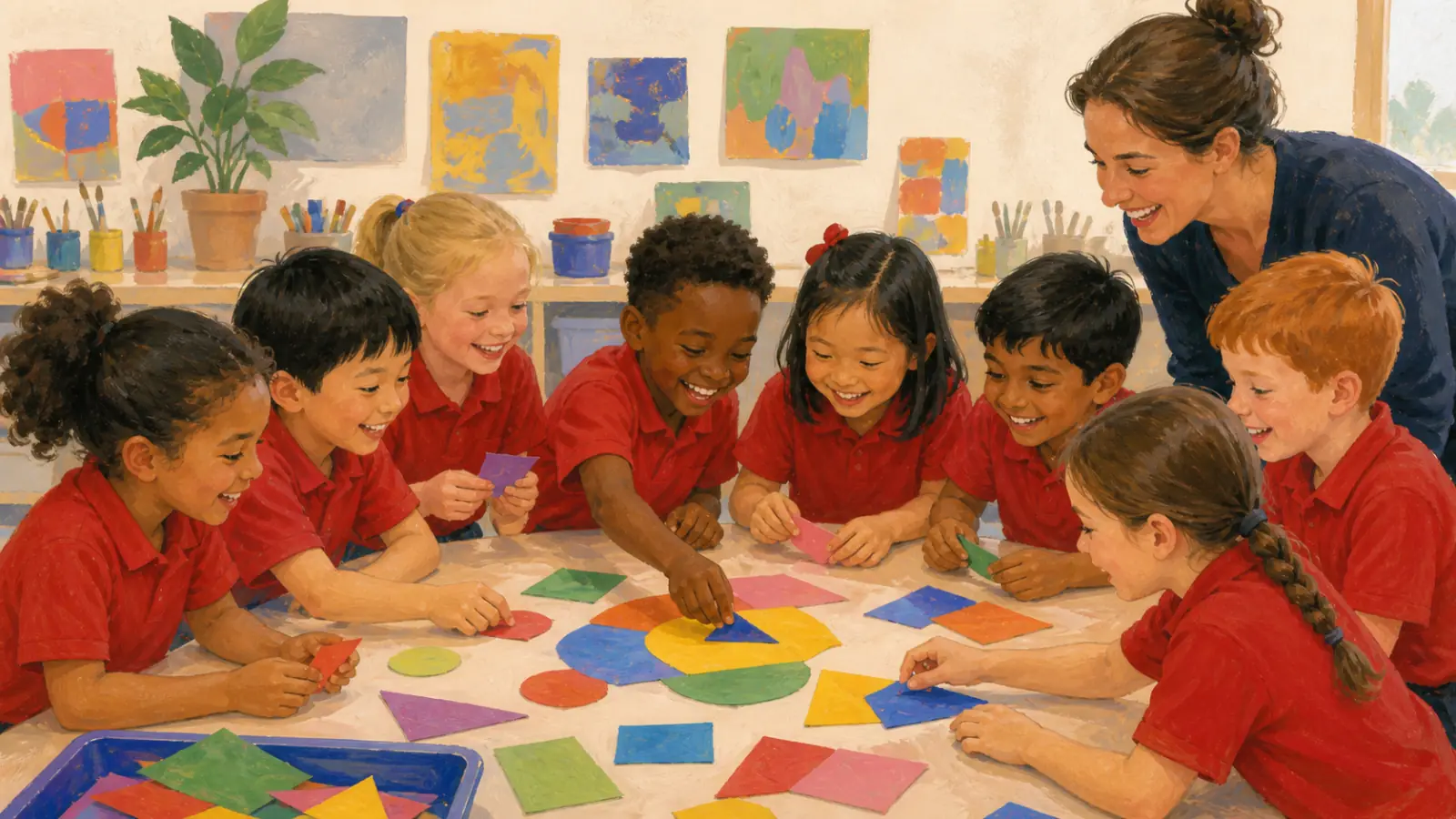
Oracy in the classroom: a teacher's guide

Updated on  

January 3, 2026

Oracy in the classroom: a teacher's guide

|

May 13, 2021

Discover the vital role of oracy in language development and how enhancing speaking skills in the classroom can boost students' learning and confidence.

Course Enquiry
Copy citation

Main, P (2021, May 13). Oracy in the classroom: a teacher's guide. Retrieved from https://www.structural-learning.com/post/the-importance-of-oracy-in-language-development

What is Oracy?

In this article, we explore ways of developing a strong culture of language use in the classroom. The importance of oracy in language development cannot be emphasised enough. Discussion is central to all aspects of the curriculum including areas such as grammar development. If the conditions are set up correctly with the right sort of tools, children can have purposeful discussions about the possibilities, effects and meaning of the curriculum.

Key Takeaways

  1. Beyond Basic Classroom Talk: Discover why oracy is the missing foundation of literacy and how mastering it transforms struggling readers into confident learners
  2. The Post-Lockdown Language Crisis: Learn why disadvantaged pupils face a hidden communication gap and the specific classroom techniques that rapidly rebuild lost oracy skills
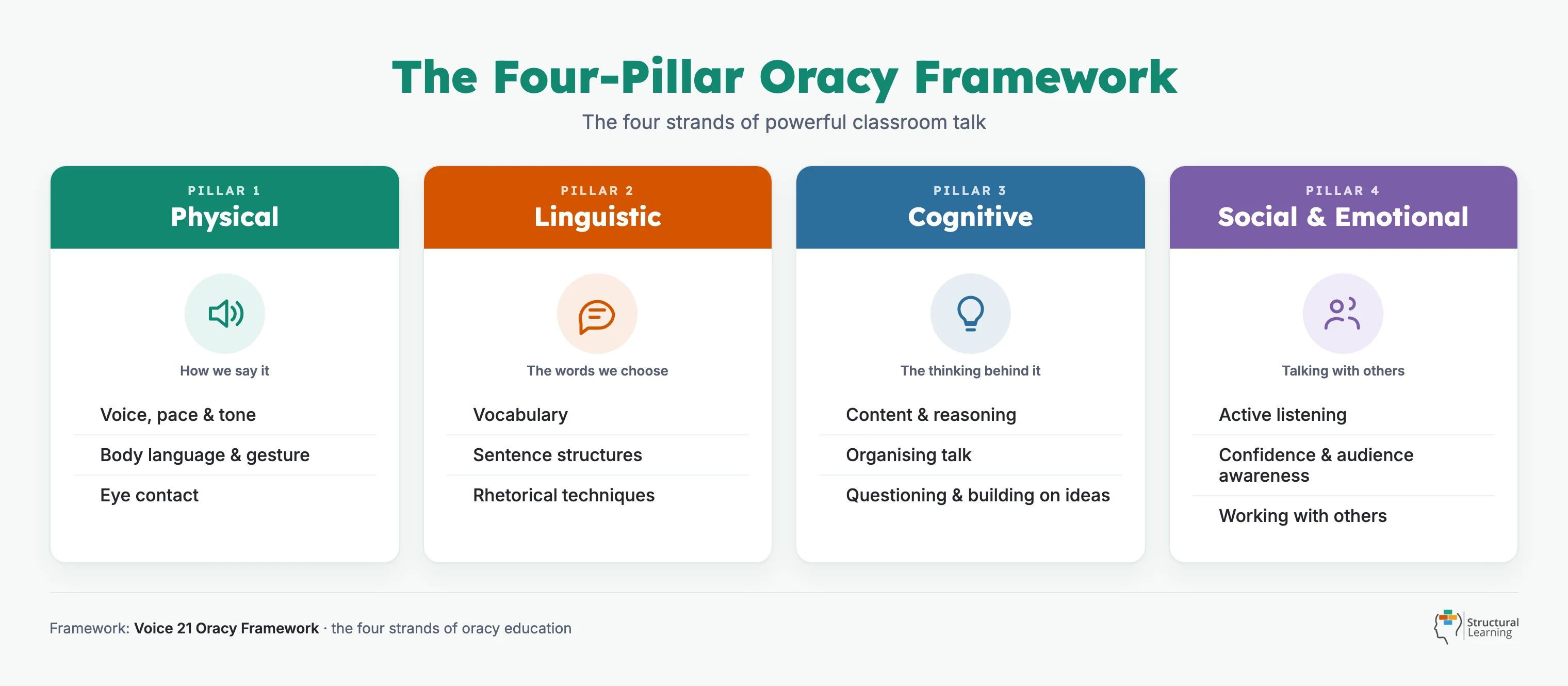
  3. Your Four-Pillar Oracy Framework: Master the evidence-based framework that turns everyday classroom conversations into powerful tools for deep learning and curriculum understanding
  4. The Elaboration Advantage: Uncover the verbal rehearsal technique that separates idea creation from writing complexity, helping pupils articulate thoughts and practice sentence building before they write

Oracy can be described as learning to talk and learning through talk. This article focuses on the latter, we are particularly interested in how using active discussions can form the foundation for pupils understanding of curriculum content.

Enabling children to understand the different types of discussion roles available to them broadens their repertoire of classroom talk. As well as being a tool of communication, effective oracy skills enable pupils to participate in deep learning activities where they can exchange ideas, engage in exploratory talk, and challenge assumptions.

This area of pedagogy has particular significance for disadvantaged or low-attaining pupils. Within this article and the rest of the website you will find examples of how classroom talk can be used for knowledge acquisition and the development spoken language skills. Oracy is the art of speaking eloquently and persuasively. When someone speaks in a persuasive manner, they try to convince others of their point of view. While this type of communication is common in everyday life, it's also a fundamental part of the curriculum.

Speaking is one of the most basic skills that humans possess. We learn to talk early in life, and our ability to communicate continues to develop throughout adulthood. Regardless of whether someone speaks fluently or struggles to express themselves, learning to speak is the foundational building block of literacy. Learning to read and write is much easier when you understand the basics of spoken communication.

For example, knowing how to pronounce certain letters and sounds allows children to recognize letter patterns and build vocabulary. When kids grow into adults, they continue to rely on their knowledge of pronunciation to decode written text. It's no surprise then that mastering the art of speech is a critical part of developing literacy. People who lack proficiency in speaking tend to fall behind academically, especially when it comes to reading comprehension. Organisations such as Voice 21 I've been promoting effective oracy skills across schools in the UK, it is clear that providing children with the tool of communication sets them up for a lifetime of success.


Oracy is to communicate what literacy is to reading and writing; and numeracy to mathematics. The term ‘oracy’ was first used by Andrew Wilkinson in the 1960s. Andrew believed that oracy, one's ability to express themself with fluency in speech, must get equal status to math performance and literacy in school curriculums.

In its simplest form, oracy is to be able to express oneself well. It relates to having a broad range of vocabulary to say what one needs to say and the proficiency to structure thoughts so that the person makes sense to others.

More recently, oracy has become even more important. This is because, education in schools is predominantly provided in English (in the UK), but many children lack spoken communication skills because they speak another language at home. Once schools begun reopening after the initial pandemic lockdown, many educators reported a dip in oracy skills particularly in children from disadvantaged backgrounds.

How do you measure Oracy Skills?

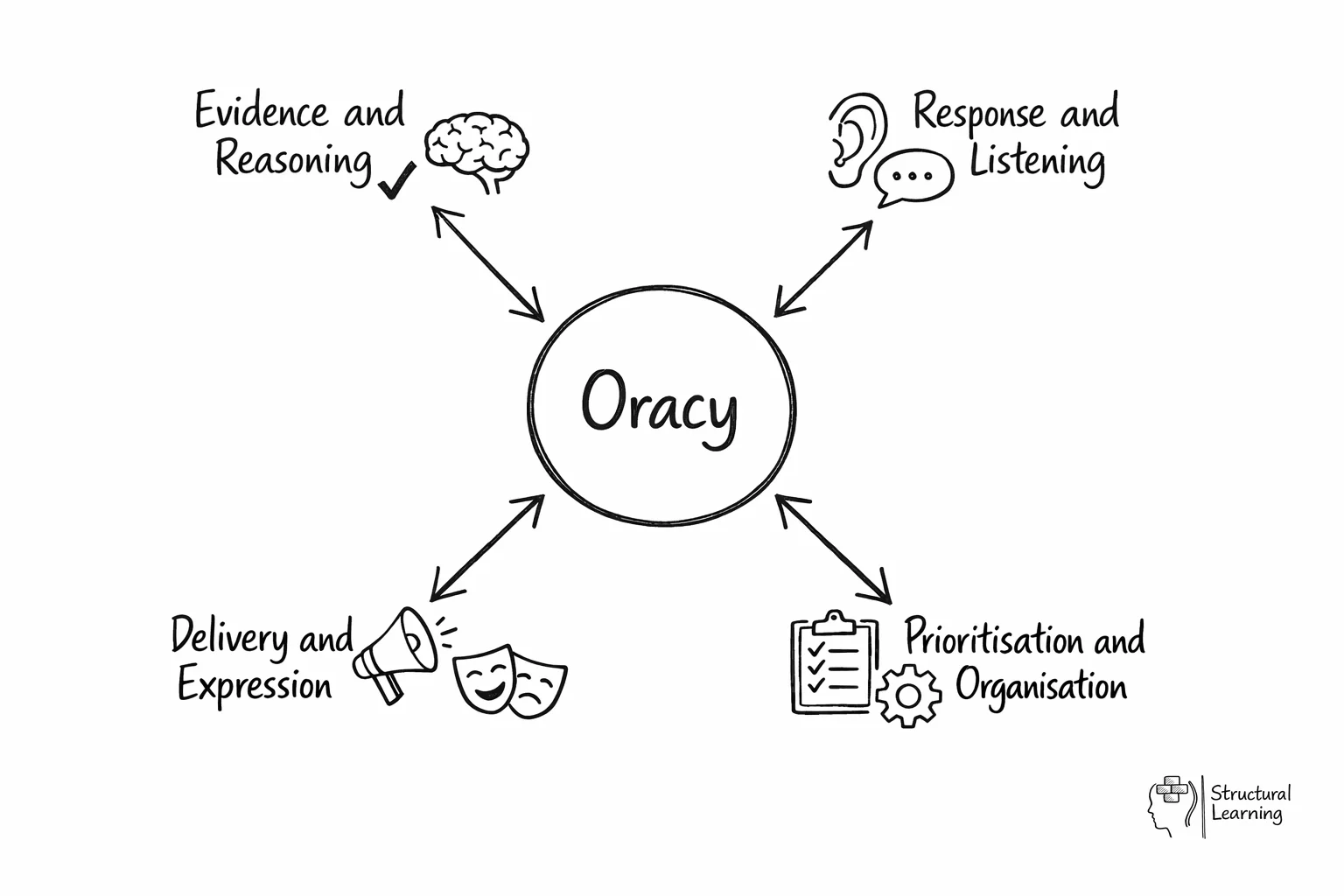
Many studies have discussed the potential role of teachers and schools in building Oracy skills in students. In recent times, online learning has made serious negative impacts on students such as social isolation, and poor communication skills. After opening, the majority of schools can reduce the negative impact of online education through different competitions, programmes and resources based upon 4 key oracy skillsets: evidence and reasoning; response and listening; delivery and expression; and prioritisation and organisation. Schools must teach and develop students' proficiency in these skillsets just like literacy and numeracy.

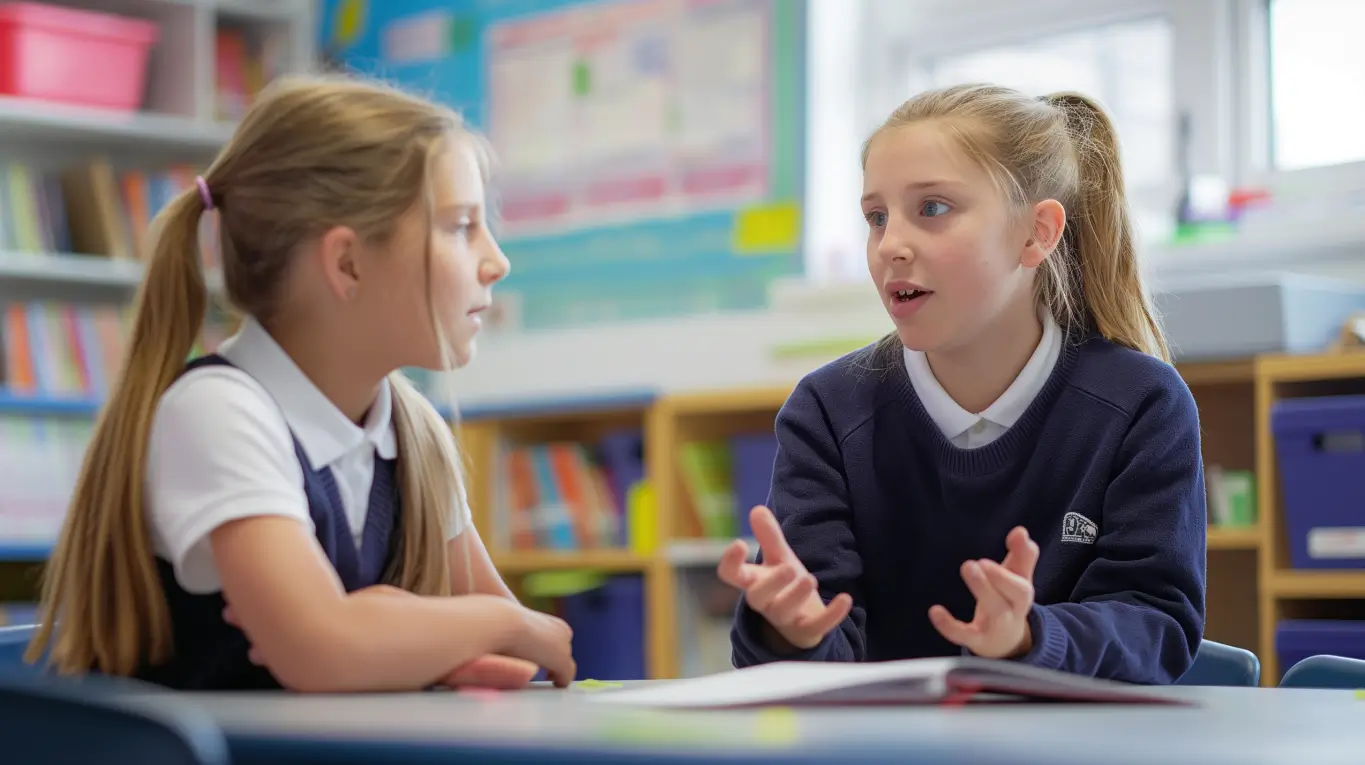
Monitoring how well pupils articulate their ideas to each other
Oracy Framework for Speaking Skills


How Can Teachers Improve Oracy Skills in the Classroom?

Teachers can improve oracy skills by creating structured opportunities for purposeful classroom discussions and establishing clear dialogue frameworks. The most effective approach involves teaching pupils different discussion roles and providing explicit instruction in verbal rehearsal techniques. Regular practice with feedback helps students develop confidence and articulation skills that support both speaking and writing development.


Schools can take the following steps to build strong foundations of oracy skills for the students in a classroom:


1. Allocating Extra Classroom Time for Oracy Techniques: More than anything else, classroom time is needed for building correct language speaking skills in the students. Although each class has a fixed timetable to follow, the teachers must try to engage students in oracy explicit activities within the classroom time. Also, teachers must not be hesitant to make oracy an objective or focus for a lesson. Learning through Oracy must be practised in every classroom.


2. Promoting Oracy in the Classroom: The most effective teachers take the responsibility for the language development of children very seriously. They make sure to commemorate oracy in their classroom environment. Following are some of the ways to promote oracy in the classroom.
a. Children’s verbal comments must be gathered and displayed in the classroom.
b. Teachers must frequently read aloud and tell stories to the students.
c. Children must be invited to perform the poetry and plays.
d. Displaying unusual objects in the classroom and encouraging children to talk about them.
e. Making a ‘talking corner’ in the classroom and inviting guests to talk about an interesting topic with the class.
All the above activities will build students' confidence and enhance their oracy skills.


3. Explicitly Teaching Oracy: Teachers must use direct vocabulary instruction especially with the students having any other native language. They must teach oracy related topics in the classroom. It is suggested to start by teaching a language structure or speaking frame each week. But unfortunately, teachers cannot give everything they know to the students. Children have to grab things and make them their own. Hence, teachers must support children to reflect and analyze their language skills, not only after they've completed their written tasks but also while they're writing their ideas and vocabulary.

Oracy in the classroom


4. Providing Opportunities to Practise Oracy: To make children confident speakers, teachers must provide them with a lot of opportunities to use their oracy skills in the classroom. Teachers must try different ways to talk about different topics and the structures they use in the classroom. Teachers can ask questions about students' major achievements in education or, prompt or comment about any topic. Teachers need to build upon students' comments. It is a must to think about how frequently children get the opportunity to report verbally, both planned and unplanned. It is also recommended to allocate some of the classroom time for children with poor communication skills and design additional language-related activities for them. Teachers can build a ‘conversation station’ with some rules to facilitate conversations between children.


5. Practice to Elaborate: An element of communication that's extremely powerful is 'elaboration.' Elaboration means to explain one's idea to someone else and add details to it. This method acts as a verbal rehearsal before writing ideas on paper. For young learners, oral practice separates the process of the creation of ideas from the more complex task of writing them. Older children can practice elaborating which help them in trying out different ways to write sentences and to listen to their writing aloud.


6. Expect Oracy from each student: For teachers, it is crucial to teach students about the fundamentals of classroom talk and model what good communication sounds like. A teacher's thinking voice plays an important role in building children’s metacognitive skills in both oracy and writing. To think about the most useful ways to phrase speech and to verbalise oracy choices are keys to supporting the development of oracy skills. It is an effective way to give feedback about Oracy. A teacher must not highlight if a child says something incorrectly, it might be more effective to repeat what they said incorrectly using the right words.


7. Make Oracy a fun-filled Activity: It is necessary to enjoy oracy explicit activities in the class with children such as games, role play, performances and debates. Teachers can design a thorough curriculum for oracy including many oracy related activities to improve oracy in children.


A child first acquires language to build upon natural fluency. Each student must get the opportunity to improve their content vocabulary through oral presentations and discussion rather than learning new vocabulary to be used in writing. Improvements in a student’s spoken English are usually followed by developments in their writing skills. However, incorporating tier 2 direct vocabulary instruction into the curriculum has been shown to have positive outcomes for pupils.


What are the benefits of Oracy Skills for the pupils?


High-quality language development activities in primary classrooms can greatly improve educational attainment, from improving science and SAT results in maths to enhancing reasoning, reading and writing skills.
There is an extensive body of evidence that suggests that students with better communication skills are 4 times more likely to achieve five A* at GCSE.

When teachers engage students in cognitively challenging classroom talk students do not only improve their language skills but also gain additional progress in subjects like science and mathematics. High-quality oracy education improves different techniques of writing in students; mainly including extended writing and collective writing skills. Oracy also has a positive impact on children's spelling and reading comprehension. The spoken language supports children's cognitive development, helping them to understand the world around them.


More recently, teachers and employers think that life skills such as communication, confidence, resilience and motivation are equally or even more important than educational qualifications. Oracy improves a child's academic and cognitive outcomes, his mental-wellbeing, self-esteem, employability, social mobility, and civic engagement. With companies now rating effective speaking as the most desirable skill, having superior public speaking and communication skills and a strong ability to express ideas through discussion are more needed in life beyond school.


There are hundreds of schools all across the country where teachers have understood the importance of building strong Oracy skills within the students. But, despite having all the above advantages and teachers' realisation of its importance we don't see the oracy curriculum receiving as much attention as literacy and numeracy in the school curriculum.

According to academic evidence, pupils' average contribution in each class remains limited to just four words per lesson. Therefore, it is suggested that just as literacy and numeracy, oracy framework and key oracy skillset must be taught and, essentially practised for developing communication proficiency in students.

Cognitive activities for promoting talk

What Are Learning Conversations and How Do You Build Them?

Learning conversations are structured dialogues where pupils exchange ideas, explore curriculum content, and challenge assumptions through talk. Teachers build these by establishing clear discussion protocols and teaching students specific conversational roles and techniques. These conversations form the foundation for deeper understanding by allowing pupils to rehearse ideas verbally before writing.

As a teacher you can't give them what you know. Learners have to take it and make it their own, and it's the discussion that really helps to do that. You can really support this by giving children tasks that require them to create several versions of something and then discuss which is best.

Using the ‘Writer’s block’, we have seen children make changes and then reason their ideas to someone else. So you might say, ‘write several opening sentences and discuss which one is the best’. The children can then use the Structural Learning blocks to move and change the parts of the sentence without any fear of ‘getting it wrong’. As learners make changes, they always justify their thinking to their peers, a gateway to critical thinking.

There are many different types of communication skills, including speaking, listening, asking questions, giving feedback, and presenting ideas. Each type of skill requires a specific set of techniques to master. Speaking is the most fundamental form of communication to learn.

When facilitating classroom talking exercises, focus on your learners practicing their voice inflections and pronunciation. Once they feel comfortable with their speaking abilities, try practicing public speaking. Listening is another key component of effective communication.

While you might be able to read someone's body language, you still need to pay attention to their tone and volume level. Try to practice active listening by actively participating in conversations.

Questions are another useful technique for communicating effectively. Asking open-ended questions allows others to share their opinions and feelings. Avoid leading questions, however, which can lead to answers that aren't entirely honest. Instead, ask questions that allow others to answer honestly.

Giving feedback is yet another way to communicate effectively. Giving constructive criticism in the classroom is helpful for improving relationships and encouraging academic growth. As with any performance, avoid faulting students directly; instead, offer suggestions for improvement.

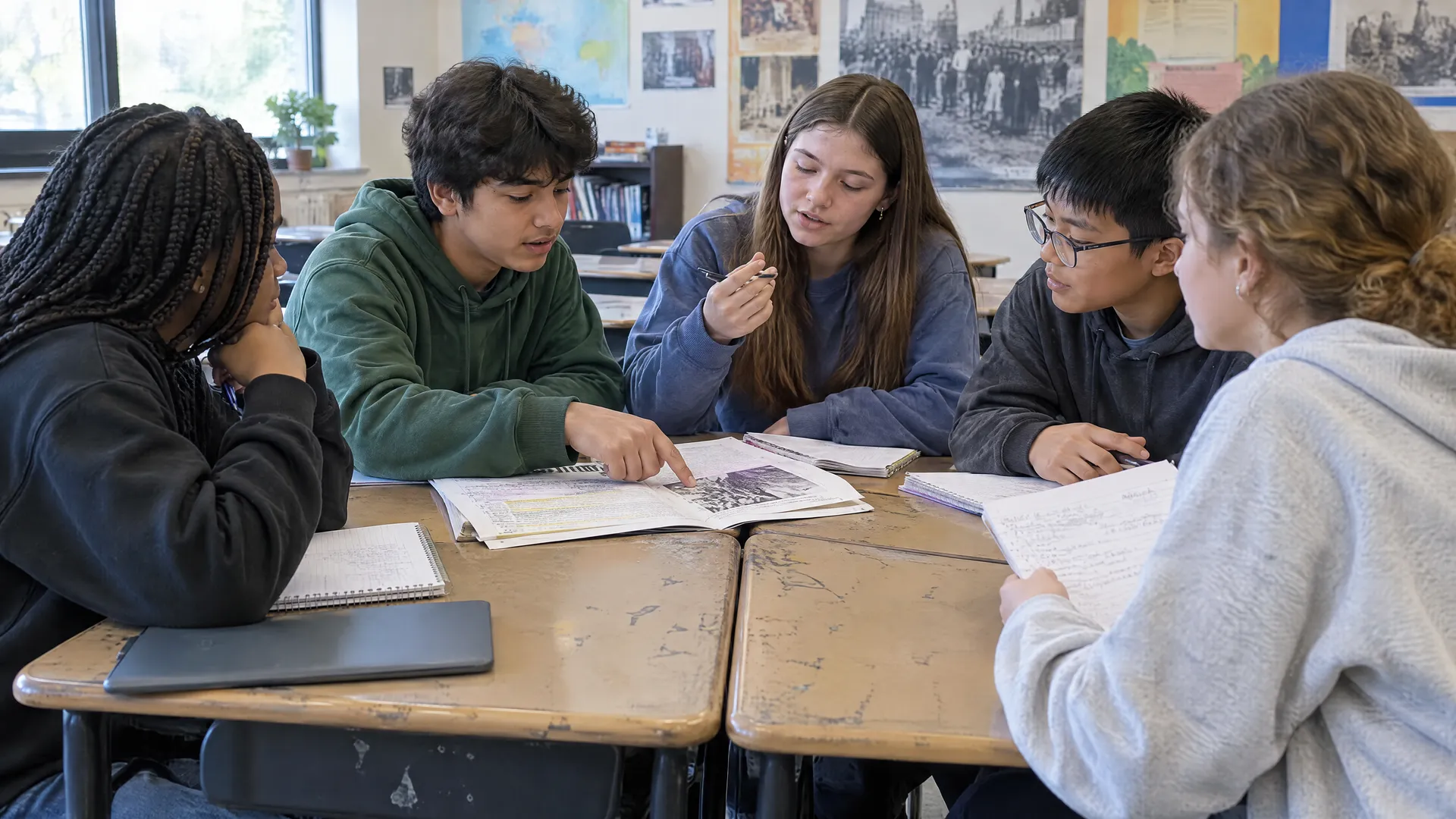
promoting the development of oracy skills

How Can Classroom Talk Help Students Generate Ideas?

Classroom talk helps students generate ideas by separating the creative thinking process from the complexity of writing tasks. Through verbal rehearsal and discussion, pupils can explore possibilities and articulate thoughts in a low-pressure environment. This collaborative approach allows students to build on each other's contributions and develop more sophisticated thinking.

Another important role for talk in writing is the kind of talk that helps children to generate the ideas.

You can't write if you haven't got anything to say and the talking to generate ideas helps you to work through your ideas in a logical way. One element of talk that's particularly powerful is elaboration. This is the idea of explaining your ideas back to someone else and adding details along the way. This approach acts as an oral rehearsal before pen is committed to paper. For very young children, oral rehearsal separates the formulating of a sentence from the very difficult demand of writing it.

With older children it helps them try out different possibilities for sentences and to hear their writing aloud. And finally, talk is important for reflection and evaluation. We all know how hard it is to get children revising their work. Support children to reflect and evaluate on their writing, not just after they've written but also as they're developing their ideas and vocabulary. The block structures can easily be manipulated into different combinations, it’s a lot less daunting than putting a line through it. Focus their revision with key evaluative questions tied to the learning focus.

Remember, talk is the foundation of all learning.

Oracy Talking Prompts

What Are the Key Principles for Promoting Classroom Dialogue?

The key principles include establishing clear structures and expectations for classroom talk, teaching pupils specific dialogue roles, and creating purposeful discussion opportunities across all curriculum areas. Teachers must model effective dialogue techniques and provide scaffolding to support all learners. Regular practice with constructive feedback helps embed these principles into classroom culture.

1. Differences in Home Backgrounds: There might be significant disparities in the experiences of students from disadvantaged backgrounds, including those who receive pupil premium funding, compared to their peers. These disparities often stem from differences in home environments, particularly in terms of the amount and quality of dialogue students are exposed to.

Implication: It is crucial for educators to be aware of these disparities and strive to create an inclusive classroom environment where all students feel valued and capable. Additional support and resources should be provided to students who may come from less dialogue-rich environments or who may feel overwhelmed or underprepared. This could include additional opportunities for these students to engage in meaningful dialogue in the classroom, as well as targeted support to help them develop their language and communication skills.

2. The Role of Language in Learning: Language plays a crucial role in the teaching and learning processes. It shapes ways of thinking and expressing ideas.

Implication: Educators should incorporate language-focused activities into their lesson plans. This could include vocabulary building exercises, reading comprehension activities, and opportunities for students to practice expressing their ideas verbally.

3. Ground Rules in Discussions: The concept of "ground rules" in discussions is crucial. These are the implicit norms that guide how people interact in a conversation. Students often use unproductive ground rules in group discussions, such as only speaking when they know a lot about a subject or only agreeing with their friends.

Implication: Educators should explicitly teach and reinforce productive ground rules for discussions. This could include norms like everyone participating, listening attentively to others, providing reasons for their views, and respectfully challenging others' ideas.

4. The Role of Lectures in Demonstrating Academic Discourse: Lectures offer an opportunity to witness how academic argument works in real time. The value of lectures is not in covering the ground but in demonstrating the discourse.

Implication: Educators should model academic discourse in their teaching. This could involve demonstrating how to construct an argument, how to use evidence to support claims, and how to engage in respectful academic debate.

Practical Classroom Activities:

  1. Role-Playing Activities: To help students understand the experiences of their peers from different backgrounds, teachers could organize role-playing activities. This could help students develop empathy and understanding for their peers.
  2. Language-Focused Activities: Teachers could incorporate activities that focus on vocabulary building, reading comprehension, and verbal expression. This could include word games, reading circles, and debate clubs.
  3. Group Discussion Norms: Teachers could establish and reinforce productive ground rules for group discussions. This could involve creating a poster of discussion norms and referring to it during group activities.
  4. Modeling Academic Discourse: Teachers could model academic discourse in their teaching. This could involve demonstrating how to construct an argument, how to use evidence to support claims, and how to engage in respectful academic debate.
Oracy for Attainment

How Can Teachers Support Reluctant Speakers in the Classroom?

Teachers can support reluctant speakers by providing structured frameworks that reduce anxiety and offer clear guidance for participation. Techniques include pair work before whole-class discussion, giving thinking time, and teaching specific sentence starters or discussion roles. Building confidence requires creating a safe environment where all contributions are valued and mistakes are treated as learning opportunities.

Every classroom has children who hesitate to voice their opinions, whether through shyness, language barriers, or fear of making mistakes. These reluctant speakers often have valuable contributions locked away behind a wall of anxiety. The Learning Behaviours Framework identifies ten specific communication behaviours that teachers can systematically develop, starting with the most accessible: explaining ideas using full sentences.

For these learners, physical manipulation of ideas through Writer's Block provides a crucial bridge. When children can move, arrange, and rearrange their thoughts using coloured blocks before speaking, they gain confidence through rehearsal. A Year 3 teacher in Birmingham reported that her most anxious speaker transformed when given blocks to physically build her sentences first: "She could change her mind without crossing out, test different word orders without judgement, and then read her final construction aloud with pride."

Practical Strategies for Reluctant Speakers:

1. Start with non-verbal agreement signals, Provide thumbs up/down cards or traffic light cups that children can use to show understanding without speaking initially

2. Use Think-Write-Pair-Share progression, Allow silent thinking time, then written preparation using graphic organisers, before paired discussion

3. Implement "Talk Partners" rotation, Change partners weekly so reluctant speakers practice with different peers, building comfort gradually

4. Create low-stakes speaking opportunities, Begin with reading pre-written sentences from Writer's Block constructions, progressing to explaining their choices

5. Scaffold with Thinking Framework question stems, Provide Yellow cards (validate, explain, verify) as sentence starters to structure responses

6. Establish "wait time" protocols, Count to seven after asking questions; this processing time particularly benefits EAL learners and those with slower processing speeds

Senior leaders should monitor these pupils' progress through the structured observation scales that track communication development across the ten behaviours. When schools adopt this systematic approach, even the quietest voices find their strength.

Promoting cognitive development with Oracy activities

How Should Teachers Develop Oracy in Early Years Settings?

Early years teachers should develop oracy through play-based conversations, storytelling, and structured talk activities that build vocabulary and communication skills. The focus should be on creating rich language environments where children hear and practice varied vocabulary in meaningful contexts. Regular opportunities for speaking and listening through games, role-play, and guided discussions support foundation language development.

The foundation years represent a critical window for language development, where children's vocabulary can triple and their sentence structures evolve from simple two-word combinations to complex narratives. In EYFS settings, oracy isn't an add-on; it's the vehicle through which all seven areas of learning travel. The Map It visual tools prove particularly powerful here, as young learners naturally think in pictures before words.

Reception teachers using the Structural Learning approach report that combining physical block building with exploratory talk creates what one practitioner called "thinking you can see and touch." When four-year-olds categorise farm animals using coloured blocks (Green skill), they simultaneously develop mathematical sorting skills, expand vocabulary, and practice turn-taking in discussion. The blocks become thinking made tangible.

Oracy Skills Framework

EYFS-Specific Oracy Activities:

Story Building with Blocks, Children use Writer's Block to sequence story events (Blue skill), physically moving blocks to show beginning, middle, and end whilst narrating their choices

Pattern Talk, Using blocks in repeating colour patterns whilst children describe what comes next, embedding mathematical language naturally through sustained dialogue

Feelings Fishbone, A simplified fishbone diagram helps children connect emotions to causes (Yellow skill), supporting emotional literacy alongside language development

Daily Question Ritual, Display one Thinking Framework card each day; children generate questions about their play or learning using that skill

Vocabulary Collections, Children physically sort new words using blocks: "loud words" on yellow blocks, "quiet words" on white blocks, making abstract concepts concrete

For EYFS leaders, implementing these approaches requires thoughtful environmental design. Position Say It oracy prompts at child height in continuous provision areas. Create "thinking stations" where blocks and visual organisers live alongside traditional resources. Most importantly, model the language of thinking yourself: "I'm going to rank these fruits from smallest to biggest. Can you help me explain my thinking?"

The evidence from early years settings using this integrated approach shows accelerated progress not just in Communication and Language, but across all prime areas. When metacognitive awareness begins this early, children enter Key Stage 1 already understanding how their own thinking works, ready to articulate ideas with confidence and precision.

Effective talk at Key Stage 2

What Are the Best Oracy Tips for Teachers?

The best oracy tips include establishing clear talk protocols, teaching pupils sentence starters and discussion roles, and building in regular verbal rehearsal before writing tasks. Teachers should model good listening skills, provide adequate thinking time, and create opportunities for collaborative discussion across all subjects. Consistent practice and positive reinforcement help embed strong oracy habits in classroom culture.

Communication is one of the most important aspects of learning. Children learn best when they are actively involved in the learning process. They learn best when they are engaged in meaningful tasks. Children who are able to express themselves clearly and effectively are much more successful learners. This means that teachers need to pay attention to the communication skills of students.

1. Be Aware of What Students Say

It's important for teachers to listen carefully to what students say. Teachers should ask questions to find out what students think and understand. Teachers should also encourage students to explain things to each other. For example, if a student has an idea for a project, he/she may want to discuss it with another child.

This helps students develop their understanding of others' opinions and encourages them to talk about their ideas.

2. Encourage Students to Talk About Their Ideas

Encouraging students to talk about their ideas is a great way to improve their ability to communicate. If students don't have any ideas, they won't be able to talk about them. However, encouraging students to talk about their thoughts and feelings is a great way to promote self-expression.

When students feel comfortable talking about their ideas, they are more likely to participate in class discussions and projects.

3. Help Students Develop Their Writing Skills

Writing is a skill that develops over time. Educators can encourage students to write down notes and then elaborate on their ideas which helps them join their points together. This type of practice helps children create logical arguments that fit together.

4. Provide Opportunities for Students to Practice Speaking

Speaking is another area where students often lack confidence. To help students overcome this problem, teachers should provide speaking opportunities. These opportunities could include giving presentations, participating in debates, or presenting information orally.

Providing these opportunities gives students the chance to practice speaking in front of groups of people.

5. Give Students Time to Think Before Responding

Sometimes, students respond without thinking. This can make them appear rude and abrupt. Giving students time to think before responding is a great way to avoid such problems. Teachers should allow students to pause after asking a question before answering. This allows students to reflect on their answer before replying.

By doing this, students are more likely to come up with thoughtful responses. Asking students to pause before responding is a simple way to teach students to think before they speak.

Why Oracy Matters
Why Oracy Matters

What Does Research Say About Oracy in Education?

Research shows that oracy is fundamental to literacy development and academic achievement, with structured classroom talk significantly improving learning outcomes. Studies demonstrate that verbal rehearsal helps pupils organize thoughts before writing and that discussion-based learning supports deeper curriculum understanding. Evidence particularly highlights the benefits for disadvantaged pupils who gain access to academic language through planned talk activities.

Research highlights the significance of teaching oracy to enhance students' cognitive, social, and listening skills across a range of contexts. Key figures, like Neil Mercer, emphasize the importance of dialogic teaching and talk-based activities, which align with a whole-school approach to fostering oracy as a fundamental aspect of education. The following five studies explore diverse aspects of oracy education and its transformative role in teaching and learning practices.

1. Mercer et al. (2017), Cambridge Oracy Assessment Toolkit

This study introduces the Cambridge Oracy Assessment Toolkit, a practical resource for assessing oracy skills in students aged 11-12. The toolkit evaluates cognitive, social, and linguistic dimensions of spoken communication across a range of contexts, emphasizing the role of oracy in academic success. It aligns with a whole-school approach, supporting teachers in embedding oracy practices into classroom and wider school life.

The study emphasizes oral language interventions as integral to effective pedagogy, advocating for structured methods to assess and develop listening skills and dialogic teaching strategies. Mercer and colleagues argue that prioritizing oracy in education is essential for equipping students with the skills needed for active participation in society. Their findings underscore the critical role of talk-based activities in fostering collaborative learning environments, promoting the teaching of oracy as a key pedagogical approach.

2. Boyd & Markarian (2015), Dialogic Teaching and Classroom Discourse

Boyd and Markarian explore dialogic teaching, focusing on its function rather than its form. Their study highlights how teachers adopting a dialogic instructional stance use classroom talk to model cognitive and social inquiry, enriching students' learning progress. Through narrative analysis, they illustrate how oracy practices in talk-based activities enable students to voice their perspectives while engaging with diverse ideas.

The study also highlights listening skills as a core aspect of dialogic teaching. The authors emphasize the importance of dialogic teaching as a pedagogical approach that transforms classroom discourse, nurturing the role of oracy in fostering critical thinking and collaborative learning.

3. Nichol & Andrews (2018), Oracy-Dialogics and Whole-School Philosophy

This research focuses on implementing "Oracy-Dialogics" in a Cambridge Primary Review flagship school. It explores how a whole-school approach to oracy can shape teaching and learning practices, particularly through dialogic teaching and structured oral language interventions.

The study evaluates oracy practices within a series of lessons, emphasizing the role of talk-based activities in fostering engagement, critical dialogue, and peer collaboration. It also examines how listening skills are developed within this pedagogical approach. The findings underline the need for oracy education to be embedded across various school contexts, encouraging teachers to adopt innovative methods for teaching oracy.

4. Sedova et al. (2016), Teacher Professional Development

This study investigates the impact of professional development programs on teachers' ability to foster dialogic teaching and oracy practices. Focusing on Czech lower-secondary schools, the researchers found that teacher training improved the quality of classroom discourse, increasing students’ participation in reasoning and collaborative discussions.

The study highlights oracy's role in enhancing students' ability to engage critically with ideas and arguments, a skill integral to wider school life. It also underscores the importance of listening skills and structured pedagogical approaches in oracy education, advocating for sustained teacher training as a key aspect of developing oracy-focused classrooms.

5. Santiago-Garabieta et al. (2022), Dialogic Literary Gatherings

This study examines the development of oracy skills among secondary students engaged in dialogic literary gatherings. Using the Cambridge Oracy Assessment Toolkit, the researchers analyzed the cognitive and socio-emotional benefits of these talk-based activities, especially in second-language (L2) contexts.

The study reinforces the value of dialogic teaching as a pedagogical approach that enhances communication and listening skills. It also emphasizes the need for whole-school strategies to incorporate structured oracy education as a foundation for academic and social development.

Frequently Asked Questions

What exactly is oracy and how does it differ from basic classroom discussion?

Oracy is both learning to talk and learning through talk, focusing on developing eloquent and persuasive communication skills. It goes beyond basic classroom discussion by providing structured opportunities for pupils to engage in exploratory talk, exchange ideas, and challenge assumptions using evidence-based frameworks. Oracy serves as the foundational building block for literacy, helping children understand pronunciation, letter patterns, and vocabulary development.

How can teachers implement the four-pillar oracy framework in their daily lessons?

The four key oracy skillsets are evidence and reasoning, response and listening, delivery and expression, and prioritisation and organisation. Teachers should explicitly teach these skills through structured discussion roles, verbal rehearsal techniques, and regular practice with feedback. Schools must allocate dedicated classroom time for oracy activities and make oracy an explicit learning objective, just like literacy and numeracy.

Why are disadvantaged pupils particularly affected by poor oracy skills, especially post-lockdown?

Many disadvantaged children face a hidden communication gap because they may speak different languages at home whilst education is predominantly delivered in English. The pandemic lockdown significantly worsened this issue, with educators reporting notable dips in oracy skills among disadvantaged pupils due to social isolation and reduced face-to-face interaction. These pupils particularly benefit from structured oracy interventions as effective communication skills set them up for lifelong academic and personal success.

What practical classroom activities can teachers use to promote oracy skills?

Teachers can create a 'talking corner' for guest speakers, display unusual objects to encourage discussion, and invite children to perform poetry and plays. Other effective strategies include gathering and displaying children's verbal comments, reading aloud regularly, teaching language structures or speaking frames weekly, and using direct vocabulary instruction. These activities build confidence whilst providing structured opportunities for purposeful classroom discussions.

How does developing oracy skills specifically help with reading and writing development?

Oracy provides the foundation for literacy by helping children understand pronunciation, recognise letter patterns, and build vocabulary before they attempt reading and writing. The verbal rehearsal technique separates idea creation from writing complexity, allowing pupils to articulate thoughts and practice sentence building orally first. People who lack proficiency in speaking tend to fall behind academically, particularly in reading comprehension, making oracy essential for overall literacy development.

How can schools measure and assess pupils' oracy skills effectively?

Schools can assess oracy skills using the four key skillsets framework: evidence and reasoning, response and listening, delivery and expression, and prioritisation and organisation. Teachers should provide regular feedback during structured discussion activities and monitor pupils' ability to take on different discussion roles. Assessment should focus on pupils' growing confidence, articulation skills, and their ability to engage in exploratory talk and challenge assumptions effectively.

Loading audit...

What is Oracy?

In this article, we explore ways of developing a strong culture of language use in the classroom. The importance of oracy in language development cannot be emphasised enough. Discussion is central to all aspects of the curriculum including areas such as grammar development. If the conditions are set up correctly with the right sort of tools, children can have purposeful discussions about the possibilities, effects and meaning of the curriculum.

Key Takeaways

  1. Beyond Basic Classroom Talk: Discover why oracy is the missing foundation of literacy and how mastering it transforms struggling readers into confident learners
  2. The Post-Lockdown Language Crisis: Learn why disadvantaged pupils face a hidden communication gap and the specific classroom techniques that rapidly rebuild lost oracy skills
  3. Your Four-Pillar Oracy Framework: Master the evidence-based framework that turns everyday classroom conversations into powerful tools for deep learning and curriculum understanding
  4. The Elaboration Advantage: Uncover the verbal rehearsal technique that separates idea creation from writing complexity, helping pupils articulate thoughts and practice sentence building before they write

Oracy can be described as learning to talk and learning through talk. This article focuses on the latter, we are particularly interested in how using active discussions can form the foundation for pupils understanding of curriculum content.

Enabling children to understand the different types of discussion roles available to them broadens their repertoire of classroom talk. As well as being a tool of communication, effective oracy skills enable pupils to participate in deep learning activities where they can exchange ideas, engage in exploratory talk, and challenge assumptions.

This area of pedagogy has particular significance for disadvantaged or low-attaining pupils. Within this article and the rest of the website you will find examples of how classroom talk can be used for knowledge acquisition and the development spoken language skills. Oracy is the art of speaking eloquently and persuasively. When someone speaks in a persuasive manner, they try to convince others of their point of view. While this type of communication is common in everyday life, it's also a fundamental part of the curriculum.

Speaking is one of the most basic skills that humans possess. We learn to talk early in life, and our ability to communicate continues to develop throughout adulthood. Regardless of whether someone speaks fluently or struggles to express themselves, learning to speak is the foundational building block of literacy. Learning to read and write is much easier when you understand the basics of spoken communication.

For example, knowing how to pronounce certain letters and sounds allows children to recognize letter patterns and build vocabulary. When kids grow into adults, they continue to rely on their knowledge of pronunciation to decode written text. It's no surprise then that mastering the art of speech is a critical part of developing literacy. People who lack proficiency in speaking tend to fall behind academically, especially when it comes to reading comprehension. Organisations such as Voice 21 I've been promoting effective oracy skills across schools in the UK, it is clear that providing children with the tool of communication sets them up for a lifetime of success.


Oracy is to communicate what literacy is to reading and writing; and numeracy to mathematics. The term ‘oracy’ was first used by Andrew Wilkinson in the 1960s. Andrew believed that oracy, one's ability to express themself with fluency in speech, must get equal status to math performance and literacy in school curriculums.

In its simplest form, oracy is to be able to express oneself well. It relates to having a broad range of vocabulary to say what one needs to say and the proficiency to structure thoughts so that the person makes sense to others.

More recently, oracy has become even more important. This is because, education in schools is predominantly provided in English (in the UK), but many children lack spoken communication skills because they speak another language at home. Once schools begun reopening after the initial pandemic lockdown, many educators reported a dip in oracy skills particularly in children from disadvantaged backgrounds.

How do you measure Oracy Skills?

Many studies have discussed the potential role of teachers and schools in building Oracy skills in students. In recent times, online learning has made serious negative impacts on students such as social isolation, and poor communication skills. After opening, the majority of schools can reduce the negative impact of online education through different competitions, programmes and resources based upon 4 key oracy skillsets: evidence and reasoning; response and listening; delivery and expression; and prioritisation and organisation. Schools must teach and develop students' proficiency in these skillsets just like literacy and numeracy.

Monitoring how well pupils articulate their ideas to each other
Oracy Framework for Speaking Skills


How Can Teachers Improve Oracy Skills in the Classroom?

Teachers can improve oracy skills by creating structured opportunities for purposeful classroom discussions and establishing clear dialogue frameworks. The most effective approach involves teaching pupils different discussion roles and providing explicit instruction in verbal rehearsal techniques. Regular practice with feedback helps students develop confidence and articulation skills that support both speaking and writing development.


Schools can take the following steps to build strong foundations of oracy skills for the students in a classroom:


1. Allocating Extra Classroom Time for Oracy Techniques: More than anything else, classroom time is needed for building correct language speaking skills in the students. Although each class has a fixed timetable to follow, the teachers must try to engage students in oracy explicit activities within the classroom time. Also, teachers must not be hesitant to make oracy an objective or focus for a lesson. Learning through Oracy must be practised in every classroom.


2. Promoting Oracy in the Classroom: The most effective teachers take the responsibility for the language development of children very seriously. They make sure to commemorate oracy in their classroom environment. Following are some of the ways to promote oracy in the classroom.
a. Children’s verbal comments must be gathered and displayed in the classroom.
b. Teachers must frequently read aloud and tell stories to the students.
c. Children must be invited to perform the poetry and plays.
d. Displaying unusual objects in the classroom and encouraging children to talk about them.
e. Making a ‘talking corner’ in the classroom and inviting guests to talk about an interesting topic with the class.
All the above activities will build students' confidence and enhance their oracy skills.


3. Explicitly Teaching Oracy: Teachers must use direct vocabulary instruction especially with the students having any other native language. They must teach oracy related topics in the classroom. It is suggested to start by teaching a language structure or speaking frame each week. But unfortunately, teachers cannot give everything they know to the students. Children have to grab things and make them their own. Hence, teachers must support children to reflect and analyze their language skills, not only after they've completed their written tasks but also while they're writing their ideas and vocabulary.

Oracy in the classroom


4. Providing Opportunities to Practise Oracy: To make children confident speakers, teachers must provide them with a lot of opportunities to use their oracy skills in the classroom. Teachers must try different ways to talk about different topics and the structures they use in the classroom. Teachers can ask questions about students' major achievements in education or, prompt or comment about any topic. Teachers need to build upon students' comments. It is a must to think about how frequently children get the opportunity to report verbally, both planned and unplanned. It is also recommended to allocate some of the classroom time for children with poor communication skills and design additional language-related activities for them. Teachers can build a ‘conversation station’ with some rules to facilitate conversations between children.


5. Practice to Elaborate: An element of communication that's extremely powerful is 'elaboration.' Elaboration means to explain one's idea to someone else and add details to it. This method acts as a verbal rehearsal before writing ideas on paper. For young learners, oral practice separates the process of the creation of ideas from the more complex task of writing them. Older children can practice elaborating which help them in trying out different ways to write sentences and to listen to their writing aloud.


6. Expect Oracy from each student: For teachers, it is crucial to teach students about the fundamentals of classroom talk and model what good communication sounds like. A teacher's thinking voice plays an important role in building children’s metacognitive skills in both oracy and writing. To think about the most useful ways to phrase speech and to verbalise oracy choices are keys to supporting the development of oracy skills. It is an effective way to give feedback about Oracy. A teacher must not highlight if a child says something incorrectly, it might be more effective to repeat what they said incorrectly using the right words.


7. Make Oracy a fun-filled Activity: It is necessary to enjoy oracy explicit activities in the class with children such as games, role play, performances and debates. Teachers can design a thorough curriculum for oracy including many oracy related activities to improve oracy in children.


A child first acquires language to build upon natural fluency. Each student must get the opportunity to improve their content vocabulary through oral presentations and discussion rather than learning new vocabulary to be used in writing. Improvements in a student’s spoken English are usually followed by developments in their writing skills. However, incorporating tier 2 direct vocabulary instruction into the curriculum has been shown to have positive outcomes for pupils.


What are the benefits of Oracy Skills for the pupils?


High-quality language development activities in primary classrooms can greatly improve educational attainment, from improving science and SAT results in maths to enhancing reasoning, reading and writing skills.
There is an extensive body of evidence that suggests that students with better communication skills are 4 times more likely to achieve five A* at GCSE.

When teachers engage students in cognitively challenging classroom talk students do not only improve their language skills but also gain additional progress in subjects like science and mathematics. High-quality oracy education improves different techniques of writing in students; mainly including extended writing and collective writing skills. Oracy also has a positive impact on children's spelling and reading comprehension. The spoken language supports children's cognitive development, helping them to understand the world around them.


More recently, teachers and employers think that life skills such as communication, confidence, resilience and motivation are equally or even more important than educational qualifications. Oracy improves a child's academic and cognitive outcomes, his mental-wellbeing, self-esteem, employability, social mobility, and civic engagement. With companies now rating effective speaking as the most desirable skill, having superior public speaking and communication skills and a strong ability to express ideas through discussion are more needed in life beyond school.


There are hundreds of schools all across the country where teachers have understood the importance of building strong Oracy skills within the students. But, despite having all the above advantages and teachers' realisation of its importance we don't see the oracy curriculum receiving as much attention as literacy and numeracy in the school curriculum.

According to academic evidence, pupils' average contribution in each class remains limited to just four words per lesson. Therefore, it is suggested that just as literacy and numeracy, oracy framework and key oracy skillset must be taught and, essentially practised for developing communication proficiency in students.

Cognitive activities for promoting talk

What Are Learning Conversations and How Do You Build Them?

Learning conversations are structured dialogues where pupils exchange ideas, explore curriculum content, and challenge assumptions through talk. Teachers build these by establishing clear discussion protocols and teaching students specific conversational roles and techniques. These conversations form the foundation for deeper understanding by allowing pupils to rehearse ideas verbally before writing.

As a teacher you can't give them what you know. Learners have to take it and make it their own, and it's the discussion that really helps to do that. You can really support this by giving children tasks that require them to create several versions of something and then discuss which is best.

Using the ‘Writer’s block’, we have seen children make changes and then reason their ideas to someone else. So you might say, ‘write several opening sentences and discuss which one is the best’. The children can then use the Structural Learning blocks to move and change the parts of the sentence without any fear of ‘getting it wrong’. As learners make changes, they always justify their thinking to their peers, a gateway to critical thinking.

There are many different types of communication skills, including speaking, listening, asking questions, giving feedback, and presenting ideas. Each type of skill requires a specific set of techniques to master. Speaking is the most fundamental form of communication to learn.

When facilitating classroom talking exercises, focus on your learners practicing their voice inflections and pronunciation. Once they feel comfortable with their speaking abilities, try practicing public speaking. Listening is another key component of effective communication.

While you might be able to read someone's body language, you still need to pay attention to their tone and volume level. Try to practice active listening by actively participating in conversations.

Questions are another useful technique for communicating effectively. Asking open-ended questions allows others to share their opinions and feelings. Avoid leading questions, however, which can lead to answers that aren't entirely honest. Instead, ask questions that allow others to answer honestly.

Giving feedback is yet another way to communicate effectively. Giving constructive criticism in the classroom is helpful for improving relationships and encouraging academic growth. As with any performance, avoid faulting students directly; instead, offer suggestions for improvement.

promoting the development of oracy skills

How Can Classroom Talk Help Students Generate Ideas?

Classroom talk helps students generate ideas by separating the creative thinking process from the complexity of writing tasks. Through verbal rehearsal and discussion, pupils can explore possibilities and articulate thoughts in a low-pressure environment. This collaborative approach allows students to build on each other's contributions and develop more sophisticated thinking.

Another important role for talk in writing is the kind of talk that helps children to generate the ideas.

You can't write if you haven't got anything to say and the talking to generate ideas helps you to work through your ideas in a logical way. One element of talk that's particularly powerful is elaboration. This is the idea of explaining your ideas back to someone else and adding details along the way. This approach acts as an oral rehearsal before pen is committed to paper. For very young children, oral rehearsal separates the formulating of a sentence from the very difficult demand of writing it.

With older children it helps them try out different possibilities for sentences and to hear their writing aloud. And finally, talk is important for reflection and evaluation. We all know how hard it is to get children revising their work. Support children to reflect and evaluate on their writing, not just after they've written but also as they're developing their ideas and vocabulary. The block structures can easily be manipulated into different combinations, it’s a lot less daunting than putting a line through it. Focus their revision with key evaluative questions tied to the learning focus.

Remember, talk is the foundation of all learning.

Oracy Talking Prompts

What Are the Key Principles for Promoting Classroom Dialogue?

The key principles include establishing clear structures and expectations for classroom talk, teaching pupils specific dialogue roles, and creating purposeful discussion opportunities across all curriculum areas. Teachers must model effective dialogue techniques and provide scaffolding to support all learners. Regular practice with constructive feedback helps embed these principles into classroom culture.

1. Differences in Home Backgrounds: There might be significant disparities in the experiences of students from disadvantaged backgrounds, including those who receive pupil premium funding, compared to their peers. These disparities often stem from differences in home environments, particularly in terms of the amount and quality of dialogue students are exposed to.

Implication: It is crucial for educators to be aware of these disparities and strive to create an inclusive classroom environment where all students feel valued and capable. Additional support and resources should be provided to students who may come from less dialogue-rich environments or who may feel overwhelmed or underprepared. This could include additional opportunities for these students to engage in meaningful dialogue in the classroom, as well as targeted support to help them develop their language and communication skills.

2. The Role of Language in Learning: Language plays a crucial role in the teaching and learning processes. It shapes ways of thinking and expressing ideas.

Implication: Educators should incorporate language-focused activities into their lesson plans. This could include vocabulary building exercises, reading comprehension activities, and opportunities for students to practice expressing their ideas verbally.

3. Ground Rules in Discussions: The concept of "ground rules" in discussions is crucial. These are the implicit norms that guide how people interact in a conversation. Students often use unproductive ground rules in group discussions, such as only speaking when they know a lot about a subject or only agreeing with their friends.

Implication: Educators should explicitly teach and reinforce productive ground rules for discussions. This could include norms like everyone participating, listening attentively to others, providing reasons for their views, and respectfully challenging others' ideas.

4. The Role of Lectures in Demonstrating Academic Discourse: Lectures offer an opportunity to witness how academic argument works in real time. The value of lectures is not in covering the ground but in demonstrating the discourse.

Implication: Educators should model academic discourse in their teaching. This could involve demonstrating how to construct an argument, how to use evidence to support claims, and how to engage in respectful academic debate.

Practical Classroom Activities:

  1. Role-Playing Activities: To help students understand the experiences of their peers from different backgrounds, teachers could organize role-playing activities. This could help students develop empathy and understanding for their peers.
  2. Language-Focused Activities: Teachers could incorporate activities that focus on vocabulary building, reading comprehension, and verbal expression. This could include word games, reading circles, and debate clubs.
  3. Group Discussion Norms: Teachers could establish and reinforce productive ground rules for group discussions. This could involve creating a poster of discussion norms and referring to it during group activities.
  4. Modeling Academic Discourse: Teachers could model academic discourse in their teaching. This could involve demonstrating how to construct an argument, how to use evidence to support claims, and how to engage in respectful academic debate.
Oracy for Attainment

How Can Teachers Support Reluctant Speakers in the Classroom?

Teachers can support reluctant speakers by providing structured frameworks that reduce anxiety and offer clear guidance for participation. Techniques include pair work before whole-class discussion, giving thinking time, and teaching specific sentence starters or discussion roles. Building confidence requires creating a safe environment where all contributions are valued and mistakes are treated as learning opportunities.

Every classroom has children who hesitate to voice their opinions, whether through shyness, language barriers, or fear of making mistakes. These reluctant speakers often have valuable contributions locked away behind a wall of anxiety. The Learning Behaviours Framework identifies ten specific communication behaviours that teachers can systematically develop, starting with the most accessible: explaining ideas using full sentences.

For these learners, physical manipulation of ideas through Writer's Block provides a crucial bridge. When children can move, arrange, and rearrange their thoughts using coloured blocks before speaking, they gain confidence through rehearsal. A Year 3 teacher in Birmingham reported that her most anxious speaker transformed when given blocks to physically build her sentences first: "She could change her mind without crossing out, test different word orders without judgement, and then read her final construction aloud with pride."

Practical Strategies for Reluctant Speakers:

1. Start with non-verbal agreement signals, Provide thumbs up/down cards or traffic light cups that children can use to show understanding without speaking initially

2. Use Think-Write-Pair-Share progression, Allow silent thinking time, then written preparation using graphic organisers, before paired discussion

3. Implement "Talk Partners" rotation, Change partners weekly so reluctant speakers practice with different peers, building comfort gradually

4. Create low-stakes speaking opportunities, Begin with reading pre-written sentences from Writer's Block constructions, progressing to explaining their choices

5. Scaffold with Thinking Framework question stems, Provide Yellow cards (validate, explain, verify) as sentence starters to structure responses

6. Establish "wait time" protocols, Count to seven after asking questions; this processing time particularly benefits EAL learners and those with slower processing speeds

Senior leaders should monitor these pupils' progress through the structured observation scales that track communication development across the ten behaviours. When schools adopt this systematic approach, even the quietest voices find their strength.

Promoting cognitive development with Oracy activities

How Should Teachers Develop Oracy in Early Years Settings?

Early years teachers should develop oracy through play-based conversations, storytelling, and structured talk activities that build vocabulary and communication skills. The focus should be on creating rich language environments where children hear and practice varied vocabulary in meaningful contexts. Regular opportunities for speaking and listening through games, role-play, and guided discussions support foundation language development.

The foundation years represent a critical window for language development, where children's vocabulary can triple and their sentence structures evolve from simple two-word combinations to complex narratives. In EYFS settings, oracy isn't an add-on; it's the vehicle through which all seven areas of learning travel. The Map It visual tools prove particularly powerful here, as young learners naturally think in pictures before words.

Reception teachers using the Structural Learning approach report that combining physical block building with exploratory talk creates what one practitioner called "thinking you can see and touch." When four-year-olds categorise farm animals using coloured blocks (Green skill), they simultaneously develop mathematical sorting skills, expand vocabulary, and practice turn-taking in discussion. The blocks become thinking made tangible.

Oracy Skills Framework

EYFS-Specific Oracy Activities:

Story Building with Blocks, Children use Writer's Block to sequence story events (Blue skill), physically moving blocks to show beginning, middle, and end whilst narrating their choices

Pattern Talk, Using blocks in repeating colour patterns whilst children describe what comes next, embedding mathematical language naturally through sustained dialogue

Feelings Fishbone, A simplified fishbone diagram helps children connect emotions to causes (Yellow skill), supporting emotional literacy alongside language development

Daily Question Ritual, Display one Thinking Framework card each day; children generate questions about their play or learning using that skill

Vocabulary Collections, Children physically sort new words using blocks: "loud words" on yellow blocks, "quiet words" on white blocks, making abstract concepts concrete

For EYFS leaders, implementing these approaches requires thoughtful environmental design. Position Say It oracy prompts at child height in continuous provision areas. Create "thinking stations" where blocks and visual organisers live alongside traditional resources. Most importantly, model the language of thinking yourself: "I'm going to rank these fruits from smallest to biggest. Can you help me explain my thinking?"

The evidence from early years settings using this integrated approach shows accelerated progress not just in Communication and Language, but across all prime areas. When metacognitive awareness begins this early, children enter Key Stage 1 already understanding how their own thinking works, ready to articulate ideas with confidence and precision.

Effective talk at Key Stage 2

What Are the Best Oracy Tips for Teachers?

The best oracy tips include establishing clear talk protocols, teaching pupils sentence starters and discussion roles, and building in regular verbal rehearsal before writing tasks. Teachers should model good listening skills, provide adequate thinking time, and create opportunities for collaborative discussion across all subjects. Consistent practice and positive reinforcement help embed strong oracy habits in classroom culture.

Communication is one of the most important aspects of learning. Children learn best when they are actively involved in the learning process. They learn best when they are engaged in meaningful tasks. Children who are able to express themselves clearly and effectively are much more successful learners. This means that teachers need to pay attention to the communication skills of students.

1. Be Aware of What Students Say

It's important for teachers to listen carefully to what students say. Teachers should ask questions to find out what students think and understand. Teachers should also encourage students to explain things to each other. For example, if a student has an idea for a project, he/she may want to discuss it with another child.

This helps students develop their understanding of others' opinions and encourages them to talk about their ideas.

2. Encourage Students to Talk About Their Ideas

Encouraging students to talk about their ideas is a great way to improve their ability to communicate. If students don't have any ideas, they won't be able to talk about them. However, encouraging students to talk about their thoughts and feelings is a great way to promote self-expression.

When students feel comfortable talking about their ideas, they are more likely to participate in class discussions and projects.

3. Help Students Develop Their Writing Skills

Writing is a skill that develops over time. Educators can encourage students to write down notes and then elaborate on their ideas which helps them join their points together. This type of practice helps children create logical arguments that fit together.

4. Provide Opportunities for Students to Practice Speaking

Speaking is another area where students often lack confidence. To help students overcome this problem, teachers should provide speaking opportunities. These opportunities could include giving presentations, participating in debates, or presenting information orally.

Providing these opportunities gives students the chance to practice speaking in front of groups of people.

5. Give Students Time to Think Before Responding

Sometimes, students respond without thinking. This can make them appear rude and abrupt. Giving students time to think before responding is a great way to avoid such problems. Teachers should allow students to pause after asking a question before answering. This allows students to reflect on their answer before replying.

By doing this, students are more likely to come up with thoughtful responses. Asking students to pause before responding is a simple way to teach students to think before they speak.

Why Oracy Matters
Why Oracy Matters

What Does Research Say About Oracy in Education?

Research shows that oracy is fundamental to literacy development and academic achievement, with structured classroom talk significantly improving learning outcomes. Studies demonstrate that verbal rehearsal helps pupils organize thoughts before writing and that discussion-based learning supports deeper curriculum understanding. Evidence particularly highlights the benefits for disadvantaged pupils who gain access to academic language through planned talk activities.

Research highlights the significance of teaching oracy to enhance students' cognitive, social, and listening skills across a range of contexts. Key figures, like Neil Mercer, emphasize the importance of dialogic teaching and talk-based activities, which align with a whole-school approach to fostering oracy as a fundamental aspect of education. The following five studies explore diverse aspects of oracy education and its transformative role in teaching and learning practices.

1. Mercer et al. (2017), Cambridge Oracy Assessment Toolkit

This study introduces the Cambridge Oracy Assessment Toolkit, a practical resource for assessing oracy skills in students aged 11-12. The toolkit evaluates cognitive, social, and linguistic dimensions of spoken communication across a range of contexts, emphasizing the role of oracy in academic success. It aligns with a whole-school approach, supporting teachers in embedding oracy practices into classroom and wider school life.

The study emphasizes oral language interventions as integral to effective pedagogy, advocating for structured methods to assess and develop listening skills and dialogic teaching strategies. Mercer and colleagues argue that prioritizing oracy in education is essential for equipping students with the skills needed for active participation in society. Their findings underscore the critical role of talk-based activities in fostering collaborative learning environments, promoting the teaching of oracy as a key pedagogical approach.

2. Boyd & Markarian (2015), Dialogic Teaching and Classroom Discourse

Boyd and Markarian explore dialogic teaching, focusing on its function rather than its form. Their study highlights how teachers adopting a dialogic instructional stance use classroom talk to model cognitive and social inquiry, enriching students' learning progress. Through narrative analysis, they illustrate how oracy practices in talk-based activities enable students to voice their perspectives while engaging with diverse ideas.

The study also highlights listening skills as a core aspect of dialogic teaching. The authors emphasize the importance of dialogic teaching as a pedagogical approach that transforms classroom discourse, nurturing the role of oracy in fostering critical thinking and collaborative learning.

3. Nichol & Andrews (2018), Oracy-Dialogics and Whole-School Philosophy

This research focuses on implementing "Oracy-Dialogics" in a Cambridge Primary Review flagship school. It explores how a whole-school approach to oracy can shape teaching and learning practices, particularly through dialogic teaching and structured oral language interventions.

The study evaluates oracy practices within a series of lessons, emphasizing the role of talk-based activities in fostering engagement, critical dialogue, and peer collaboration. It also examines how listening skills are developed within this pedagogical approach. The findings underline the need for oracy education to be embedded across various school contexts, encouraging teachers to adopt innovative methods for teaching oracy.

4. Sedova et al. (2016), Teacher Professional Development

This study investigates the impact of professional development programs on teachers' ability to foster dialogic teaching and oracy practices. Focusing on Czech lower-secondary schools, the researchers found that teacher training improved the quality of classroom discourse, increasing students’ participation in reasoning and collaborative discussions.

The study highlights oracy's role in enhancing students' ability to engage critically with ideas and arguments, a skill integral to wider school life. It also underscores the importance of listening skills and structured pedagogical approaches in oracy education, advocating for sustained teacher training as a key aspect of developing oracy-focused classrooms.

5. Santiago-Garabieta et al. (2022), Dialogic Literary Gatherings

This study examines the development of oracy skills among secondary students engaged in dialogic literary gatherings. Using the Cambridge Oracy Assessment Toolkit, the researchers analyzed the cognitive and socio-emotional benefits of these talk-based activities, especially in second-language (L2) contexts.

The study reinforces the value of dialogic teaching as a pedagogical approach that enhances communication and listening skills. It also emphasizes the need for whole-school strategies to incorporate structured oracy education as a foundation for academic and social development.

Frequently Asked Questions

What exactly is oracy and how does it differ from basic classroom discussion?

Oracy is both learning to talk and learning through talk, focusing on developing eloquent and persuasive communication skills. It goes beyond basic classroom discussion by providing structured opportunities for pupils to engage in exploratory talk, exchange ideas, and challenge assumptions using evidence-based frameworks. Oracy serves as the foundational building block for literacy, helping children understand pronunciation, letter patterns, and vocabulary development.

How can teachers implement the four-pillar oracy framework in their daily lessons?

The four key oracy skillsets are evidence and reasoning, response and listening, delivery and expression, and prioritisation and organisation. Teachers should explicitly teach these skills through structured discussion roles, verbal rehearsal techniques, and regular practice with feedback. Schools must allocate dedicated classroom time for oracy activities and make oracy an explicit learning objective, just like literacy and numeracy.

Why are disadvantaged pupils particularly affected by poor oracy skills, especially post-lockdown?

Many disadvantaged children face a hidden communication gap because they may speak different languages at home whilst education is predominantly delivered in English. The pandemic lockdown significantly worsened this issue, with educators reporting notable dips in oracy skills among disadvantaged pupils due to social isolation and reduced face-to-face interaction. These pupils particularly benefit from structured oracy interventions as effective communication skills set them up for lifelong academic and personal success.

What practical classroom activities can teachers use to promote oracy skills?

Teachers can create a 'talking corner' for guest speakers, display unusual objects to encourage discussion, and invite children to perform poetry and plays. Other effective strategies include gathering and displaying children's verbal comments, reading aloud regularly, teaching language structures or speaking frames weekly, and using direct vocabulary instruction. These activities build confidence whilst providing structured opportunities for purposeful classroom discussions.

How does developing oracy skills specifically help with reading and writing development?

Oracy provides the foundation for literacy by helping children understand pronunciation, recognise letter patterns, and build vocabulary before they attempt reading and writing. The verbal rehearsal technique separates idea creation from writing complexity, allowing pupils to articulate thoughts and practice sentence building orally first. People who lack proficiency in speaking tend to fall behind academically, particularly in reading comprehension, making oracy essential for overall literacy development.

How can schools measure and assess pupils' oracy skills effectively?

Schools can assess oracy skills using the four key skillsets framework: evidence and reasoning, response and listening, delivery and expression, and prioritisation and organisation. Teachers should provide regular feedback during structured discussion activities and monitor pupils' ability to take on different discussion roles. Assessment should focus on pupils' growing confidence, articulation skills, and their ability to engage in exploratory talk and challenge assumptions effectively.

Classroom Practice

Back to Blog